Chapter: Chapter 27
Learning Objectives
LO 27.1.0 Solve problems related to single-loop circuits.
LO 27.1.1 Identify the action of an emf source in terms of the work it does.
LO 27.1.2 For an ideal battery, apply the relationship between the emf, the current, and the
power (rate of energy transfer).
LO 27.1.3 Draw a schematic diagram for a single-loop circuit containing a battery and three
resistors.
LO 27.1.4 Apply the loop rule to write a loop equation that relates the potential differences of the
circuit elements around a (complete) loop.
LO 27.1.5 Apply the resistance rule in crossing through a resistor.
LO 27.1.6 Apply the emf rule in crossing through an emf.
LO 27.1.7 Identify that resistors in series have the same current, which is the same value that
their equivalent resistor has.
LO 27.1.8 Calculate the resistance of the equivalent of several resistors in series.
LO 27.1.9 Identify that a potential applied to resistors wired in series is equal to the sum of the
potentials across the individual resistors.
LO 27.1.10 Calculate the potential difference between any two points in a circuit.
LO 27.1.11 Distinguish a real battery from an ideal battery and, in a circuit diagram, replace a
real battery with an ideal battery and an explicitly shown resistance.
LO 27.1.12 With a real battery in a circuit, calculate the potential difference between its
terminals for current in the direction of the emf and in the opposite direction.
LO 27.1.13 Identify what is meant by grounding a circuit, and draw a schematic diagram for
such a connection.
LO 27.1.14 Identify that grounding a circuit does not affect the current in a circuit.
LO 27.1.15 Calculate the dissipation rate of energy in a real battery.
LO 27.1.16 Calculate the net rate of energy transfer in a real battery for current in the direction
of the emf and in the opposite direction.
LO 27.2.0 Solve problems related to multiloop circuits.
LO 27.2.1 Apply the junction rule.
LO 27.2.2 Draw a schematic diagram for a battery and three parallel resistors and distinguish it
from a diagram with a battery and three series resistors.
LO 27.2.3 Identify that resistors in parallel have the same potential difference, which is the same
value that their equivalent resistor has.
LO 27.2.4 Calculate the resistance of the equivalent resistor of several resistors in parallel.
LO 27.2.5 Identify that the total current through parallel resistors is the sum of the currents
through the individual resistors.
LO 27.2.6 For a circuit with a battery and some resistors in parallel and some in series, simplify
the circuit in steps by finding equivalent resistors, until the current through the battery can be
determined, and then reverse the steps to find the currents and potential differences of the
individual resistors.
LO 27.2.7 If a circuit cannot be simplified by using equivalent resistors, identify the several
loops in the circuit, choose names and directions for the currents in the branches, set up loop
equations for the various loops, and solve these simultaneous equations for the unknown
currents.
LO 27.2.8 In a circuit with identical real batteries in series, replace them with a single ideal
battery and a single resistor.
LO 27.2.9 In a circuit with identical real batteries in parallel, replace them with a single ideal
battery and a single resistor.
LO 27.3.0 Solve problems related to the ammeter and the voltmeter.
LO 27.3.1 Explain the use of an ammeter and a voltmeter, including the resistance required of
each in order to not affect the measured quantities.
LO 27.4.0 Solve problems related to RC circuits.
LO 27.4.1 Draw schematic diagrams of charging and discharging RC circuits.
LO 27.4.2 Write the loop equation (a differential equation) for a charging RC circuit.
LO 27.4.3 Write the loop equation (a differential equation) for a discharging RC circuit.
LO 27.4.4 For a capacitor in a charging or discharging RC circuit, apply the relationship giving
the charge as a function of time.
LO 27.4.5 From the function giving the charge as a function of time in a charging or
discharging RC circuit, find the capacitor’s potential difference as a function of time.
LO 27.4.6 In a charging or discharging RC circuit, find the resistor’s current and potential
difference as functions of time.
LO 27.4.7 Calculate the capacitive time constant τ.
LO 27.4.8 For a charging RC circuit and a discharging RC circuit, determine the capacitor’s
charge and potential difference at the start of the process and then a long time later.
Multiple Choice
1. “The sum of the emf’s and potential differences around a closed loop equals zero” is a
consequence of:
A) Newton’s third law
B) Ohm’s law
C) Newton’s second law
D) conservation of energy
E) conservation of charge
2. An emf source is defined in terms of:
A) the force it exerts on charges
B) the work it does on charges
C) the electric field it generates
D) the current it generates
E) the charge it emits
3. An ideal battery has an emf of 12 V. If it is connected to a circuit and creates a current of 4.0
A, what is the power?
A) 0.3 W
B) 3.0 W
C) 36 W
D) 48 W
E) cannot tell without knowing the resistance of the circuit
4. A battery with an emf of 12 V and an internal resistance of 1 is used to charge a battery
with an emf of 10 V and an internal resistance of 1 . The current in the circuit is:
A) 1 A
B) 2 A
C) 4 A
D) 11 A
E) 22 A
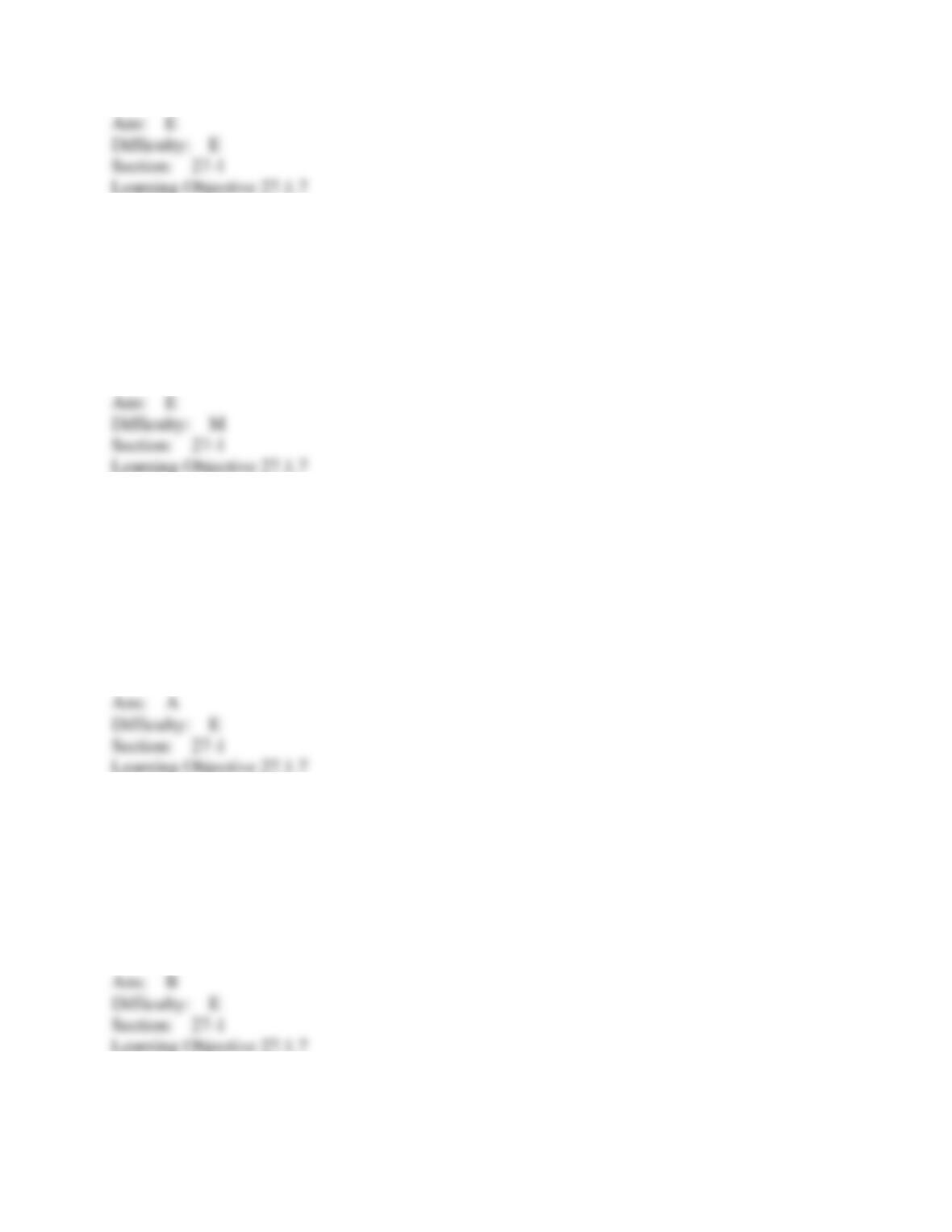
5. In the diagram R1 > R2 > R3. Rank the three resistors according to the current in them, least
to greatest.
A) 1, 2, 3
B) 3, 2, 1
C) 1, 3, 2
D) 3, 1, 2
E) All are the same
6. Two 110-V light bulbs, one labeled 25 W and the other 100 W, are connected in series to a
110 V source. Then:
A) the current in the 100-W bulb is greater than that in the 25-W bulb
B) the current in the 100-W bulb is less than that in the 25-W bulb
C) both bulbs will light with equal brightness
D) each bulb will have a potential difference of 55 V
E) none of the above
7. A series circuit consists of a battery with internal resistance r and an external resistor R. If
these two resistances are equal (r = R) then the energy dissipated per unit time by the internal
resistance r is:
A) the same as by R
B) half that by R
C) twice that by R
D) one third that by R
E) unknown unless the emf is given
8. Two wires made of the same material have the same length but different diameters. They are
connected in series to a battery. The quantity that is the same for the wires is:
A) the end-to-end potential difference
B) the current
C) the current density
D) the electric field
E) the electron drift velocity
9. Two wires are made of the same material and have the same length but different radii. They
are joined end-to-end and a potential difference is maintained across the combination. Of the
following the quantity that is the same for both wires is:
A) potential difference
B) current
C) current density
D) electric field
E) conduction electron drift speed
10. Four 20- resistors are connected in series and the combination is connected to a 20-V emf
device. The current in any one of the resistors is:
A) 0.25 A
B) 1.0 A
C) 4.0 A
D) 5.0 A
E) 100 A
11. Nine identical wires, each of diameter d and length L, are connected in series. The
combination has the same resistance as a single similar wire of length L but whose diameter is:
A) 9d
B) 3d
C) d/3
D) d/9
E) d/81
12. Resistances of 2.0 , 4.0 , and 6.0 and a 24-V battery are all in series. The current in
the 2.0 resistor is:
A) 12 A
B) 4.0 A
C) 2.4 A
D) 2.0 A
E) 0.50 A
13. Four 20- resistors are connected in series and the combination is connected to a 20-V emf
device. The potential difference across any one of the resistors is:
A) 1 V
B) 4 V
C) 5 V
D) 20 V
E) 80 V
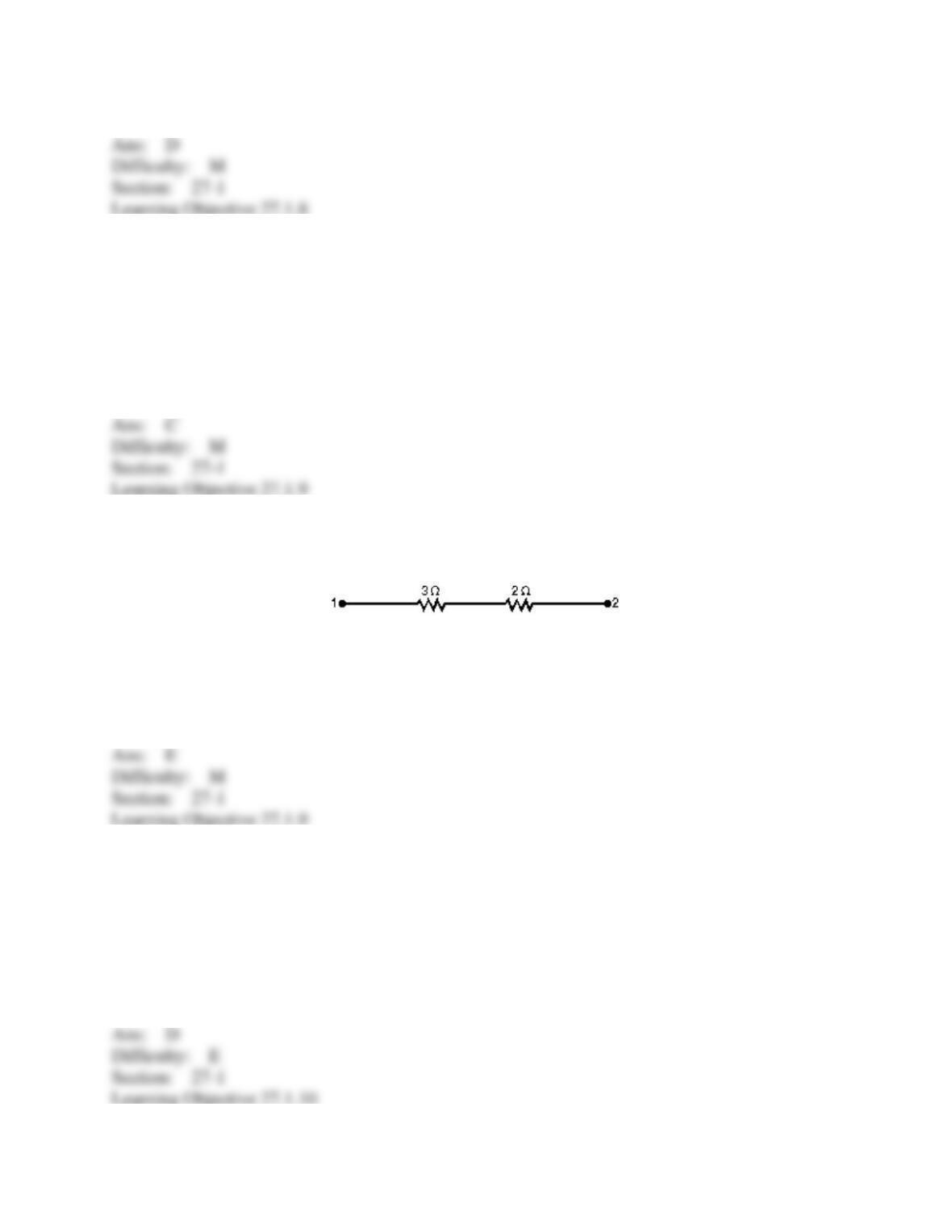
14. In the diagram, the current in the 3- resistor is 4 A. The potential difference between
points 1 and 2 is:
A) 0.75 V
B) 0.8 V
C) 1.25 V
D) 12 V
E) 20 V
15. A battery is connected across a series combination of two identical resistors. If the
potential difference across the terminals is V and the current in the battery is i, then:
A) the potential difference across each resistor is V and the current in each resistor is i
B) the potential difference across each resistor is V/2 and the current in each resistor is i/2
C) the potential difference across each resistor is V and the current in each resistor is i/2
D) the potential difference across each resistor is V/2 and the current in each resistor is i
E) none of the above are true
16. The resistance of resistor 1 is twice the resistance of resistor 2. The two are connected in
series and a potential difference is maintained across the combination. Then:
A) the current in 1 is twice that in 2
B) the current in 1 is half that in 2
C) the potential difference across 1 is twice that across 2
D) the potential difference across 1 is half that across 2
E) none of the above are true
17. Resistor 1 has twice the resistance of resistor 2. The two are connected in series and a
potential difference is maintained across the combination. The rate of thermal energy dissipation
in 1 is:
A) the same as that in 2
B) twice that in 2
C) half that in 2
D) four times that in 2
E) one fourth that in 2
18. Resistances of 2.0 , 4.0 , and 6.0 and a 24-V emf device are all in series. The
potential difference across the 2.0- resistor is:
A) 4 V
B) 8 V
C) 12 V
D) 24 V
E) 48 V
19. The emf of a battery is equal to its terminal potential difference:
A) under all conditions
B) only when the battery is being charged
C) only when a large current is in the battery
D) only when there is no current in the battery
E) under no conditions
20. The terminal potential difference of a battery is less than its emf:
A) under all conditions
B) only when the battery is being charged
C) only when the battery is being discharged
D) only when there is no current in the battery
E) under no conditions
21. A battery has an emf of 9 V and an internal resistance of 2 . If the potential difference
across its terminals is greater than 9 V:
A) it must be connected across a large external resistance
B) it must be connected across a small external resistance
C) the current must be out of the positive terminal
D) the current must be out of the negative terminal
E) the current must be zero
22. A battery of emf 24 V is connected to a 6- resistor. As a result, current of 3 A exists in
the resistor. The terminal potential difference of the battery is:
A) 0 V
B) 6 V
C) 12 V
D) 18 V
E) 24 V
23. Resistances of 2.0 , 4.0 , and 6.0 and a 24-V emf device are all in series. The circuit is
initially ungrounded. After grounding, the current in the circuit:
A) increases
B) decreases
C) does not change
D) depends on where in the circuit the ground wire is attached
E) depends on what the circuit is grounded to
24. A battery of emf 24 V is connected to a 6.0- resistor. As a result, current of 3.0 A exists in
the resistor. The rate at which energy is being dissipated in the battery is:
A) 3.0 W
B) 6.0 W
C) 18 W
D) 54 W
E) 72 W
25. The positive terminals of two batteries with emf’s of ℰ1 and ℰ2, respectively, are connected
together. Here ℰ1 > ℰ2. The circuit is completed by connecting the negative terminals. If each
battery has an internal resistance of r, the rate in watts at which electrical energy is converted to
chemical energy in the smaller battery is:
A) ℰ1
2/r
B) ℰ1
2/2r
C) (ℰ2 – ℰ1) ℰ1/r
D) (ℰ2 – ℰ1) ℰ1/2r
E) ℰ2
2/2r
26. “The sum of the currents into a junction equals the sum of the currents out of the junction”
is a consequence of:
A) Newton’s third law
B) Ohm’s law
C) Newton’s second law
D) conservation of energy
E) conservation of charge
27. In the context of the loop and junctions rules for electrical circuits a junction is:
A) where a wire is connected to a resistor
B) where a wire is connected to a battery
C) where only two wires are joined
D) where three or more wires are joined
E) where a wire is bent
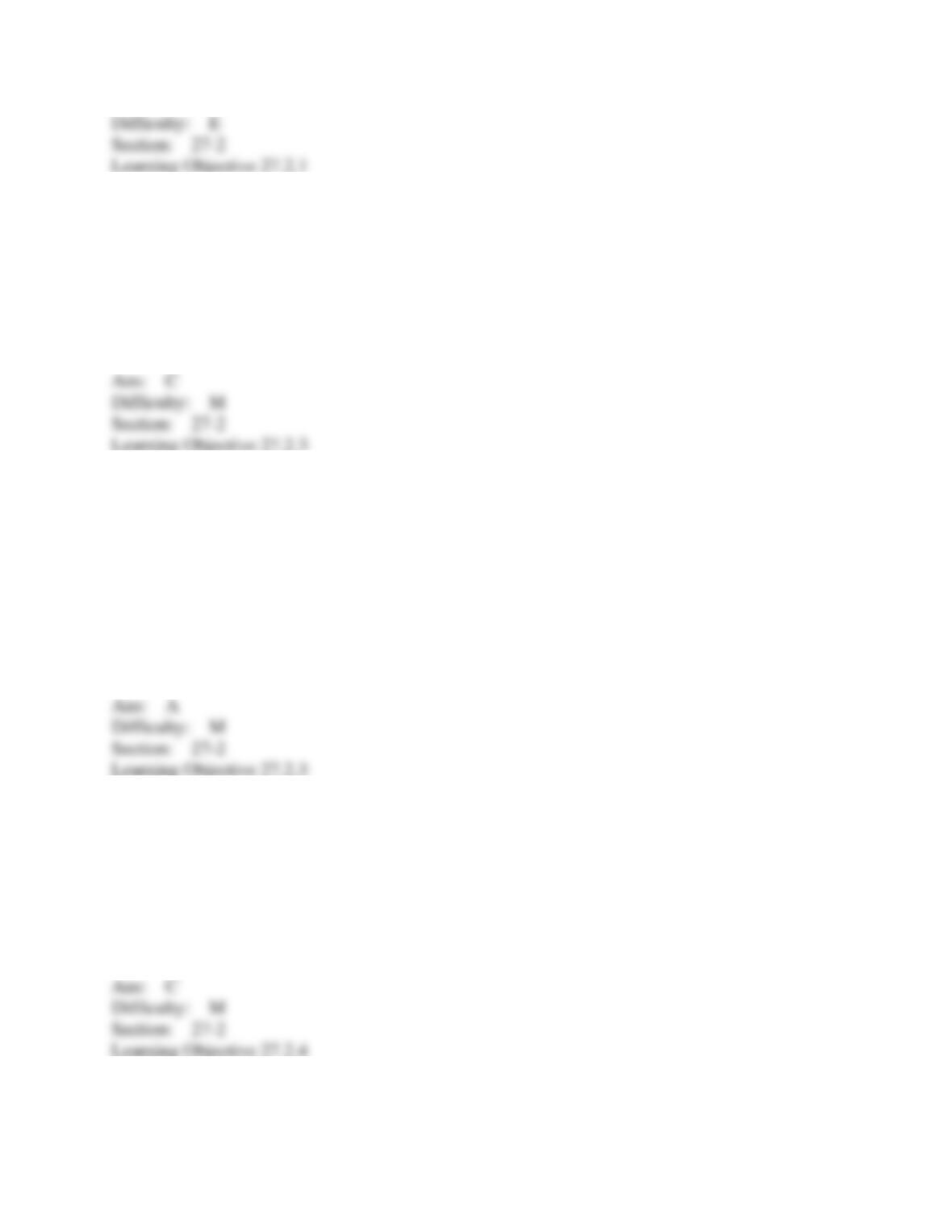
28. A portion of a circuit is shown, with the values of the currents given for some branches.
What is the direction and value of the current i?
A) , 6A
B) , 6A
C) , 4A
D) , 4A
E) , 2A
29. Four wires meet at a junction. The first carries 4 A into the junction, the second carries 5 A
out of the junction, and the third carries 2 A out of the junction. The fourth carries:
A) 7 A out of the junction
B) 7 A into the junction
C) 3 A out of the junction
D) 3 A into the junction
E) 1 A into the junction
30. A 120-V power line is protected by a 15-A fuse. What is the maximum number of 120 V,
500 W light bulbs that can be operated at full brightness from this line?
A) 1
B) 2
C) 3
D) 4
E) 5
31. A resistor with resistance R1 and a resistor with resistance R2 are connected in parallel to an
ideal battery with emf ℰ. The rate of thermal energy generation in the resistor with resistance
R1 is:
A) ℰ2/R1
B) ℰ2 R1/(R1 + R2)2
C) ℰ2 /(R1 + R2)
D) ℰ2/R2
E) ℰ2𝑅1/𝑅2
2
32. Four 20- resistors are connected in parallel and the combination is connected to a 20-V
emf device. The current in the device is:
A) 0.25 A
B) 1.0 A
C) 4.0 A
D) 5.0 A
E) 100 A
33. A total resistance of 3.0 is to be produced by combining an unknown resistor R with a 12
resistor. What is the value of R and how is it to be connected to the 12 resistor?
A) 2.4 , parallel
B) 2.4 , series
C) 4.0 , parallel
D) 4.0 , series
E) 9.0 , series
34. By using only two resistors, R1 and R2 a student is able to obtain resistances of 3 , 4 , 12
, and 16 . The values of R1 and R2 are:
A) 3 , 4
B) 2 , 12
C) 3 , 16
D) 4 , 12
E) 4 , 16
35. In an antique automobile, a 6-V battery supplies a total of 48 W to two identical headlights
in parallel. The resistance of each bulb is:
A) 0.75 Ω
B) 1.5 Ω
C) 3 Ω
D) 4 Ω
E) 8 Ω
36. A battery is connected across a parallel combination of two identical resistors. If the
potential difference across the terminals is V and the current in the battery is i, then:
A) the potential difference across each resistor is V and the current in each resistor is i
B) the potential difference across each resistor is V/2 and the current in each resistor is i/2
C) the potential difference across each resistor is V and the current in each resistor is i/2
D) the potential difference across each resistor is V/2 and the current in each resistor is i
E) none of the above are true
37. Four 20- resistors are connected in parallel and the combination is connected to a 20-V
emf device. The current in any one of the resistors is:
A) 0.25 A
B) 1.0 A
C) 4.0 A
D) 5.0 A
E) 100 A
38. Two wires made of the same material have the same length but different diameter. They are
connected in parallel to a battery. The quantity that is NOT the same for the wires is:
A) the end-to-end potential difference
B) the current
C) the current density
D) the electric field
E) the electron drift velocity
39. The resistance of resistor 1 is twice the resistance of resistor 2. The two are connected in
parallel and a potential difference is maintained across the combination. Then:
A) the current in 1 is twice that in 2
B) the current in 1 is half that in 2
C) the potential difference across 1 is twice that across 2
D) the potential difference across 1 is half that across 2
E) none of the above are true
40. Resistor 1 has twice the resistance of resistor 2. The two are connected in parallel and a
potential difference is maintained across the combination. The rate of thermal energy dissipation