Chapter: Chapter 24
Learning Objectives
LO 24.1.0 Solve problems related to electric potential.
LO 24.1.1 Identify that the electric force is conservative and thus has an associated potential
energy.
LO 24.1.2 Identify that at every point in a charged object’s electric field, the object sets up an
electric potential V, which is a scalar quantity that can be positive or negative depending on the
sign of object’s charge.
LO 24.1.3 For a charged particle placed at a point in an object’s electric field, apply the
relationship between the object’s electric potential V at that point, the particle’s charge q, and the
potential energy U of the particle-object system.
LO 24.1.4 Convert energies between units of joules and electron-volts.
LO 24.1.5 If a charged particle moves from an initial point to a final point in an electric field,
apply
the relationships between the change ΔV in the potential, the particle’s charge q, the change
ΔU in the potential energy, and the work W done by the electric force.
LO 24.1.6 If a charged particle moves between two given points in the electric field of a charged
object, identify that the amount of work done by the electric force is path independent.
LO 24.1.7 If a charged particle moves through a change ΔV in electric potential without an
applied
force acting on it, relate ΔV and the change ΔK in the particle’s kinetic energy.
LO 24.1.8 If a charged particle moves through a change ΔV in electric potential while an applied
force acts on it, relate ΔV, the change ΔK in the particle’s kinetic energy, and the work Wapp
done by the applied force.
LO 24.2.0 Solve problems related to equipotential surfaces and the electric field.
LO 24.2.1 Identify an equipotential surface and describe how it is related to the direction of the
associated electric field.
LO 24.2.2 Given an electric field as a function of position, calculate the change in potential ΔV
from an initial point to a final point by choosing a path between the points and integrating the
dot product of the field 𝐸
⃗
and a length element 𝑑𝑠 along the path.
LO 24.2.3 For a uniform electric field, relate the field magnitude E and the separation Δx and
potential difference ΔV between adjacent equipotential lines.
LO 24.2.4 Given a graph of electric field E versus position along an axis, calculate the change in
potential ΔV from an initial point to a final point by graphical integration.
LO 24.2.5 Explain the use of a zero-potential location.
LO 24.3.0 Solve problems related to potential due to a charged particle.
LO 24.3.1 For a given point in the electric field of a charged particle, apply the relationship
between the electric potential V, the charge of the particle q, and the distance r from the particle.
LO 24.3.2 Identify the correlation between the algebraic signs of the potential set up by a particle
and the charge of the particle.
LO 24.3.3 For points outside or on the surface of a spherically symmetric charge distribution,
calculate the electric potential as if all the charge is concentrated as a particle at the center of the
sphere.
LO 24.3.4 Calculate the net potential at any given point due to several charged particles,
identifying that algebraic addition is used, not vector addition.
LO 24.3.5 Draw equipotential lines for a charged particle.
LO 24.4.0 Solve problems related to potential due to an electric dipole.
LO 24.4.1 Calculate the potential V at any given point due to an electric dipole, in terms of the
magnitude p of the dipole moment or the product of the charge separation d and the magnitude q
of either charge.
LO 24.4.2 For an electric dipole, identify the locations of positive potential, negative potential,
and zero potential.
LO 24.4.3 Compare the decrease in potential with increasing distance for a single charged
particle and an electric dipole.
LO 24.5.0 Solve problems related to potential due to a continuous charge distribution.
LO 24.5.1 For charge that is distributed uniformly along a line or over a surface, find the net
potential at a given point by splitting the distribution up into charge elements and summing the
potential (by integration) due to each one.
LO 24.6.0 Solve problems related to calculating the field from the potential.
LO 24.6.1 Given an electric potential as a function of position along an axis, find the electric
field along that axis.
LO 24.6.2 Given a graph of electric potential versus position along an axis, determine the electric
field along the axis.
LO 24.6.3 For a uniform electric field, relate the field magnitude E and the separation Δx and
potential difference ΔV between adjacent equipotential lines.
LO 24.6.4 Relate the direction of the electric field and the directions in which the potential
decreases and increases.
LO 24.7.0 Solve problems related to electric potential energy of a system of charged particles.
LO 24.7.1 Identify that the total potential energy of a system of charged particles is equal to the
work an applied force must do to assemble the system, starting with the particles infinitely far
apart.
LO 24.7.2 Calculate the potential energy of a pair of charged particles.
LO 24.7.3 Identify that if a system has more than two charged particles, then the system’s total
potential energy is equal to the sum of the potential energies of every pair of the particles.
LO 24.7.4 Apply the principle of the conservation of mechanical energy to a system of charged
particles.
LO 24.7.5 Calculate the escape speed of a charged particle from a system of charged particles
(the minimum initial speed required to move infinitely far from the system).
LO 24.8.0 Solve problems related to potential of a charged isolated conductor.
LO 24.8.1 Identify that an excess charge placed on an isolated conductor (or connected isolated
conductors) will distribute itself on the surface of the conductor so that all points of the
conductor come to the same potential.
LO 24.8.2 For an isolated spherical conducting shell, sketch graphs of the potential and the
electric field magnitude versus distance from the center, both inside and outside the shell.
LO 24.8.3 For an isolated spherical conducting shell, identify that internally the electric field is
zero and the electric potential has the same value as the surface and that externally the electric
field and the electric potential have values as though all of the shell’s charge is concentrated as a
particle at its center.
LO 24.8.4 For an isolated cylindrical conducting shell, identify that internally the electric field is
zero and the electric potential has the same value as the surface and that externally the electric
field and the electric potential have values as though all of the cylinder’s charge is concentrated
as a line of charge on the central axis.
Multiple Choice
1. An electron volt is:
A) the force acting on an electron in a field of 1 N/C
B) the force required to move an electron 1 meter
C) the energy gained by an electron in moving through a potential difference of 1 volt
D) the energy needed to move an electron through 1 meter in any electric field
E) the work done when 1 coulomb of charge is moved through a potential difference of 1 volt
2. An electron has charge –e and mass me. A proton has charge e and mass 1840me. A “proton
volt” is equal to:
A) 1eV
B) 1840eV
C) (1/1840)eV
D) √1840 eV
E) (1/√1840) eV
3. The fact that we can define electric potential energy means that:
A) the electric force is nonconservative
B) the electric force is conservative
C) the work done on a charged particle depends on the path it takes
D) there is a point where the electric potential energy is exactly zero
E) it takes work for the electric force to move from some point a to some other point b and back
again

4. An electrically charged object creates an electric field. The electric potential due to this object:
A) is a vector that points either towards or away from the object, depending on the sign of the
charge
B) is a vector that makes circular paths around the object
C) is a non-negative scalar
D) is a scalar but will be positive or negative depending on the sign of the charge
E) points in the same direction as the field
5. A tiny sphere carrying a charge of 6.5 µC sits in an electric field, at a point where the electric
potential is 240 V. What is the sphere’s potential energy?
A) 2.7 x 10⁻⁸ J
B) 6.5 x 10⁻⁶ J
C) 1.6 x 10⁻³ J
D) 240 J
E) 3.7 x 10⁷ J
6. Protons in the LHC accelerator in Geneva, Switzerland are accelerated to an energy of 4.0
TeV. What is this in joules?
A) 6.4 x 10⁻¹⁹ J
B) 6.4 x 10⁻¹⁶ J
C) 6.4 x 10⁻¹³ J
D) 6.4 x 10⁻¹⁰ J
E) 6.4 x 10⁻⁷ J
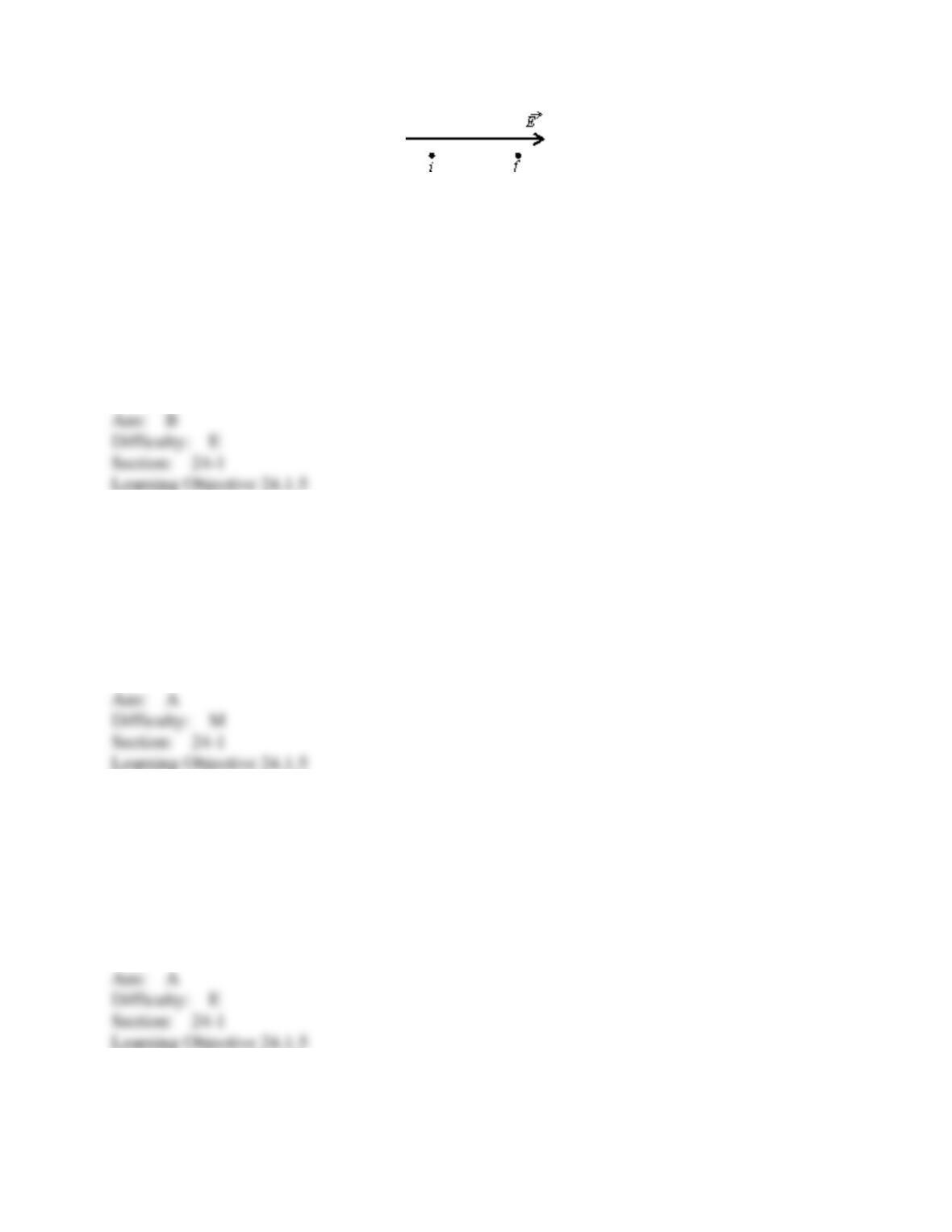
7. An electron moves from point i to point f, in the direction of a uniform electric field.
During this motion:
A) the work done by the field is positive and the potential energy of the electron-field system
increases
B) the work done by the field is negative and the potential energy of the electron-field system
increases
C) the work done by the field is positive and the potential energy of the electron-field system
decreases
D) the work done by the field is negative and the potential energy of the electron-field system
decreases
E) the work done by the field is positive and the potential energy of the electron-field system
does not change
8. If 500 J of work are required to carry a 40-C charge from one point to another, the potential
difference between these two points is:
A) 12.5 V
B) 20,000 V
C) 0.08 V
D) depends on the path
E) none of these
9. The potential difference between two points is 100 V. If a particle with a charge of 2 C is
transported from one of these points to the other, the magnitude of the work done is:
A) 200 J
B) 100 J
C) 50 J
D) 100 V
E) 2 J
10. During a lightning discharge, 30 C of charge move through a potential difference of 1.0
108 V in 2.0 10–2 s. The energy released by this lightning bolt is:
A) 1.5 1011 J
B) 3.0 109 J
C) 6.0 107 J
D) 3.3 106 J
E) 1500 J
11. The work required to carry a particle with a charge of 6.0-µC from a 5.0-V equipotential
surface to a 6.0-V equipotential surface and back again to the 5.0-V surface is:
A) 0 J
B) 1.2 10–5 J
C) 3.0 10–5 J
D) 6.0 10–5 J
E) 6.0 10–6 J
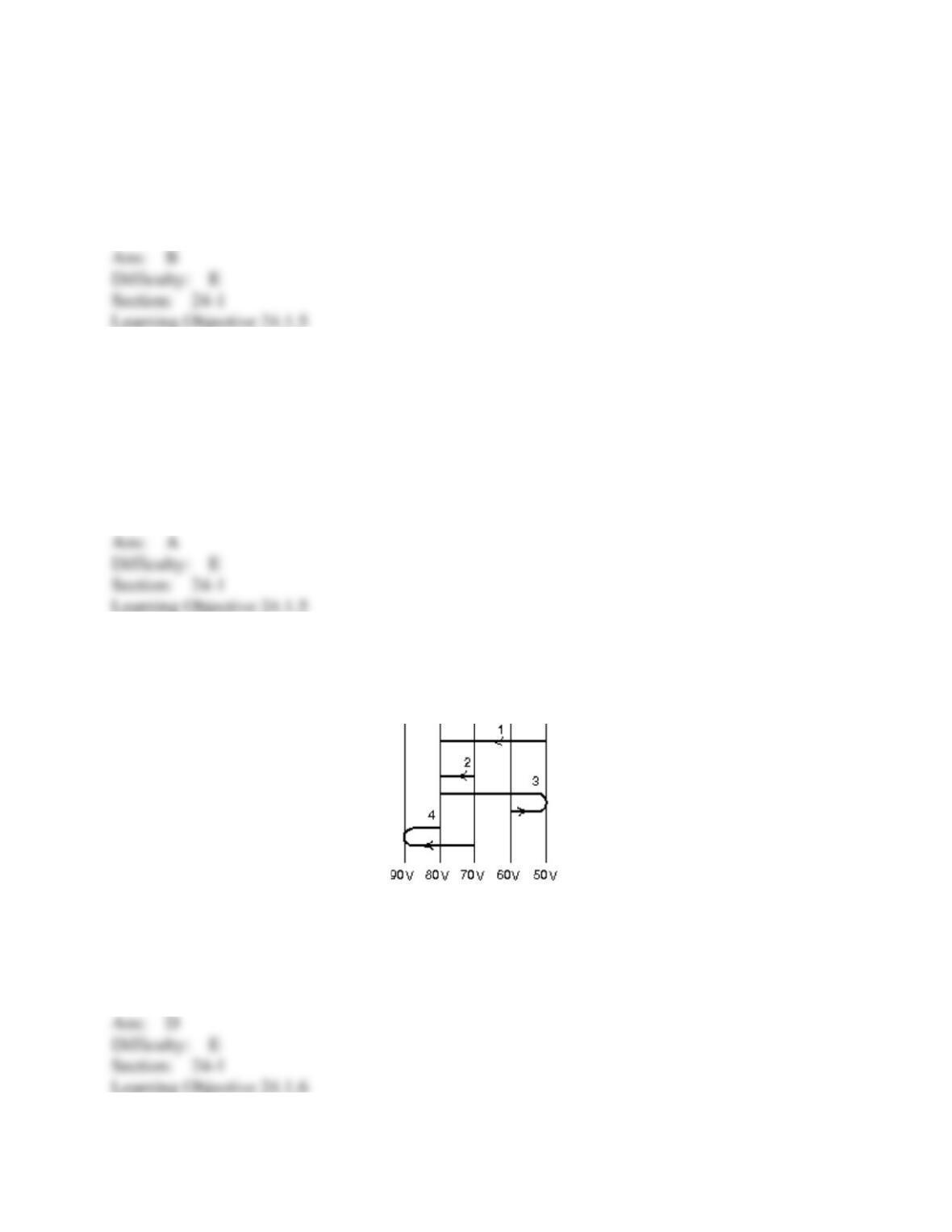
12. An electron goes from one equipotential surface to another along one of the four paths
shown below. Rank the paths according to the work done by the electric field, from least to
greatest.
A) 1, 2, 3, 4
B) 4, 3, 2, 1
C) 1, then 3, then 4 and 2 tie
D) 4 and 2 tie, then 3, then 1
E) 4, 3, 1, 2
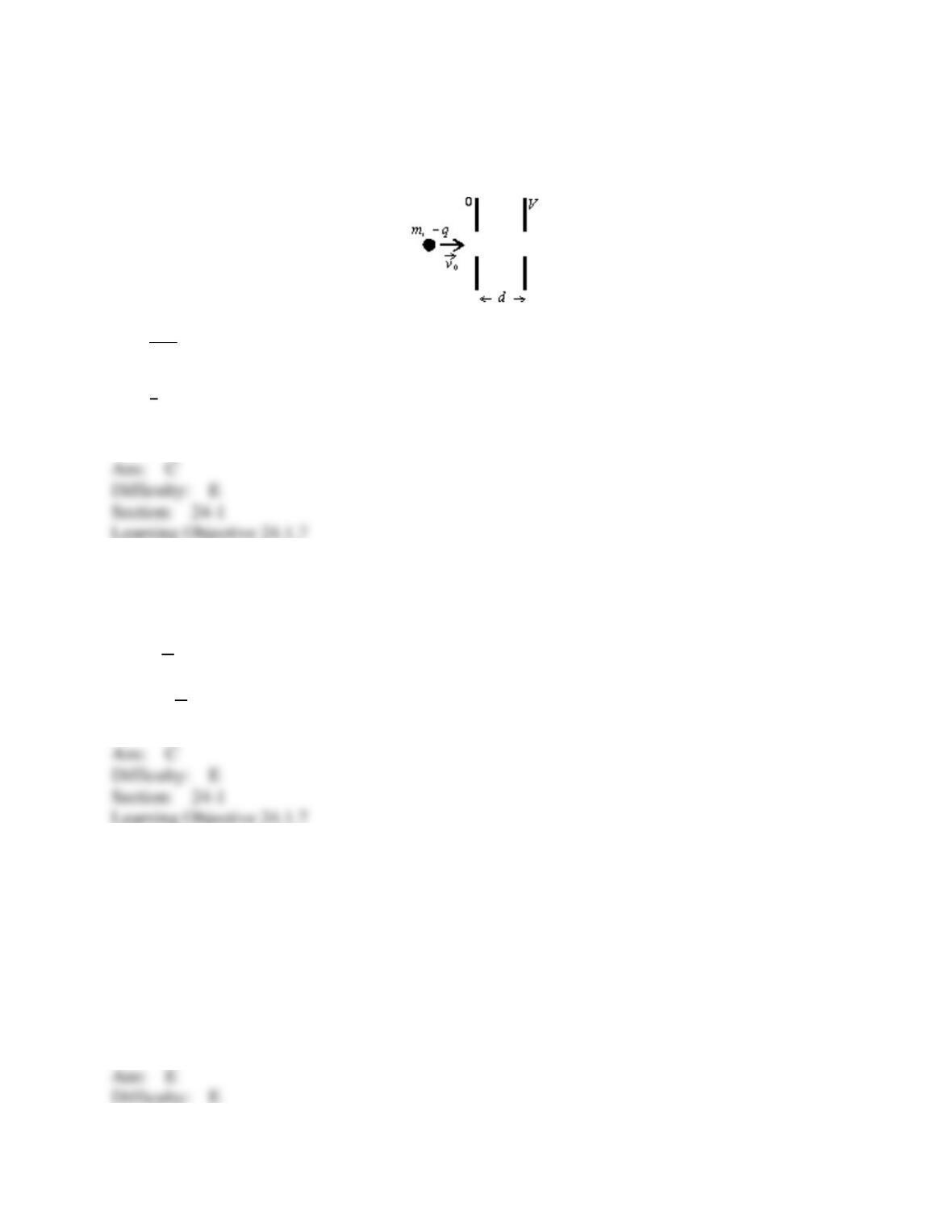
13. A particle with mass m and charge –q is projected with speed v0 into the region between
two parallel plates as shown. The potential difference between the two plates is V and their
separation is d. The change in kinetic energy of the particle as it traverses this region is:
A) –qV/d
B) 2𝑞𝑉
𝑚𝑣0
2
C) qV
D) 1
2𝑚𝑣0
2
E) none of these
14. An electron is accelerated from rest through a potential difference V. Its final speed is
proportional to:
A) V
B) V2
C) √𝑉
D) 1/V
E) 1/√𝑉
15. Two large parallel conducting plates are separated by a distance d, placed in a vacuum, and
connected to a source of potential difference V. An oxygen ion, with charge 2e, starts from rest
on the surface of one plate and accelerates to the other. If e denotes the magnitude of the electron
charge, the final kinetic energy of this ion is:
A) eV/2
B) eV/d
C) eVd
D) Vd/e
E) 2eV

16. The Earth’s electric field creates a potential that increases 100 V for every meter of altitude.
If an object of charge +4.5 mC and mass 68 g falls a distance of 1.0 m from rest under the
influence of the Earth’s electric and gravitational fields, what is its final kinetic energy?
A) 0.22 J
B) 0.45 J
C) 0.67 J
D) 1.1 J
E) 7.2 J
17. The electric field in a region around the origin is given by 𝐸
⃗
= 𝐶(𝑥𝑖̂ + 𝑦𝑗̂), where C is a
constant. The equipotential surfaces are:
A) concentric cylinders with axes along the z axis
B) concentric cylinders with axes along the x axis
C) concentric spheres centered at the origin
D) planes parallel to the xy plane
E) planes parallel to the yz plane
18. If the electric field is in the positive x direction and has a magnitude given by E = Cx2,
where C is a constant, then the electric potential is given by V =
A) 2Cx
B) –2Cx
C) Cx3/3
D) –Cx3/3
E) –3Cx3
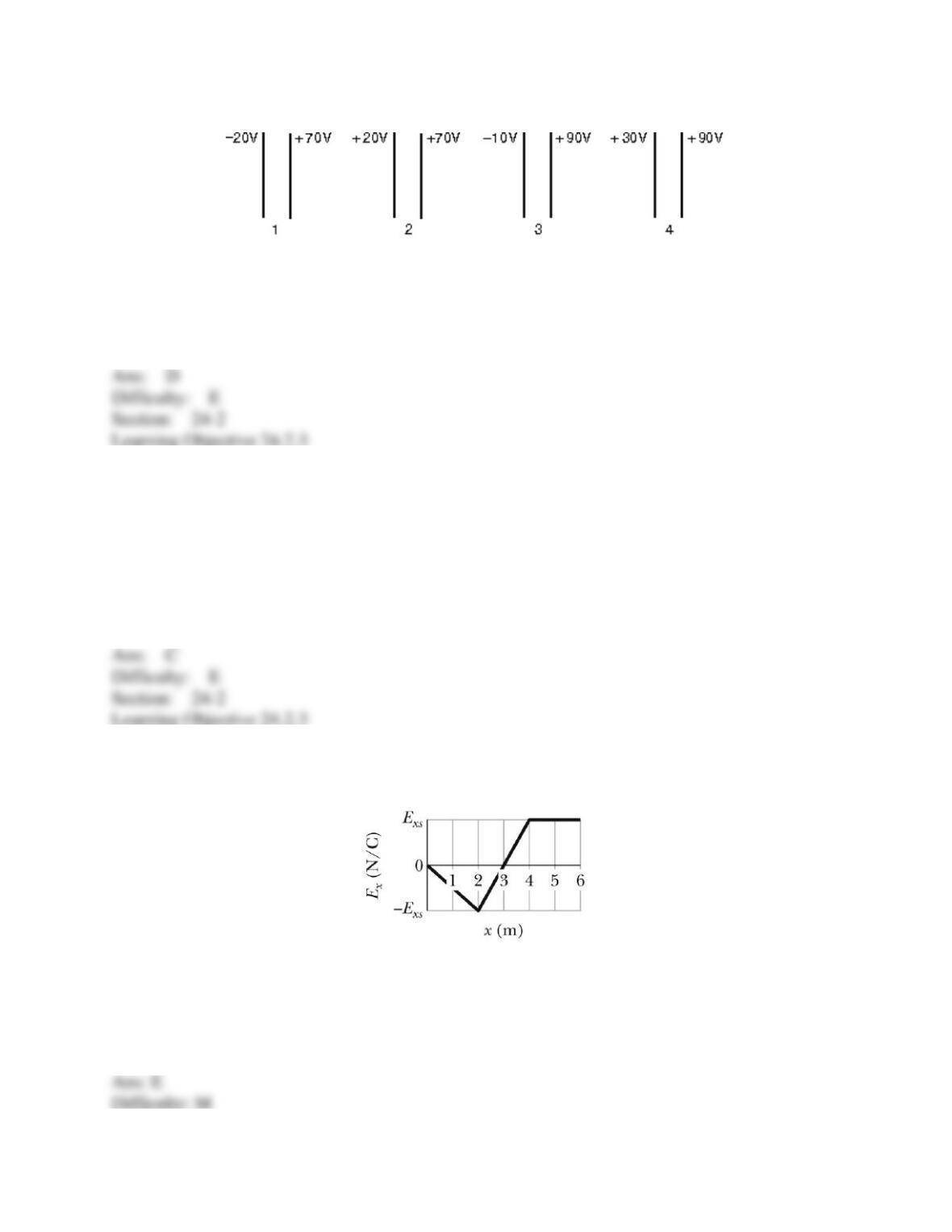
19. The diagram shows four pairs of large parallel conducting plates. The value of the
electric potential is given for each plate. Rank the pairs according to the magnitude of the
electric field between the plates, least to greatest.
A) 1, 2, 3, 4
B) 4, 3, 2, 1
C) 2, 3, 1, 4
D) 2, 4, 1, 3
E) 3, 2, 4, 1
20. The potential difference between the ends of a 2-meter stick that is parallel to a uniform
electric field is 400 V. The magnitude of the electric field is:
A) 0 V/m
B) 100 V/m
C) 200 V/m
D) 400 V/m
E) 800 V/m
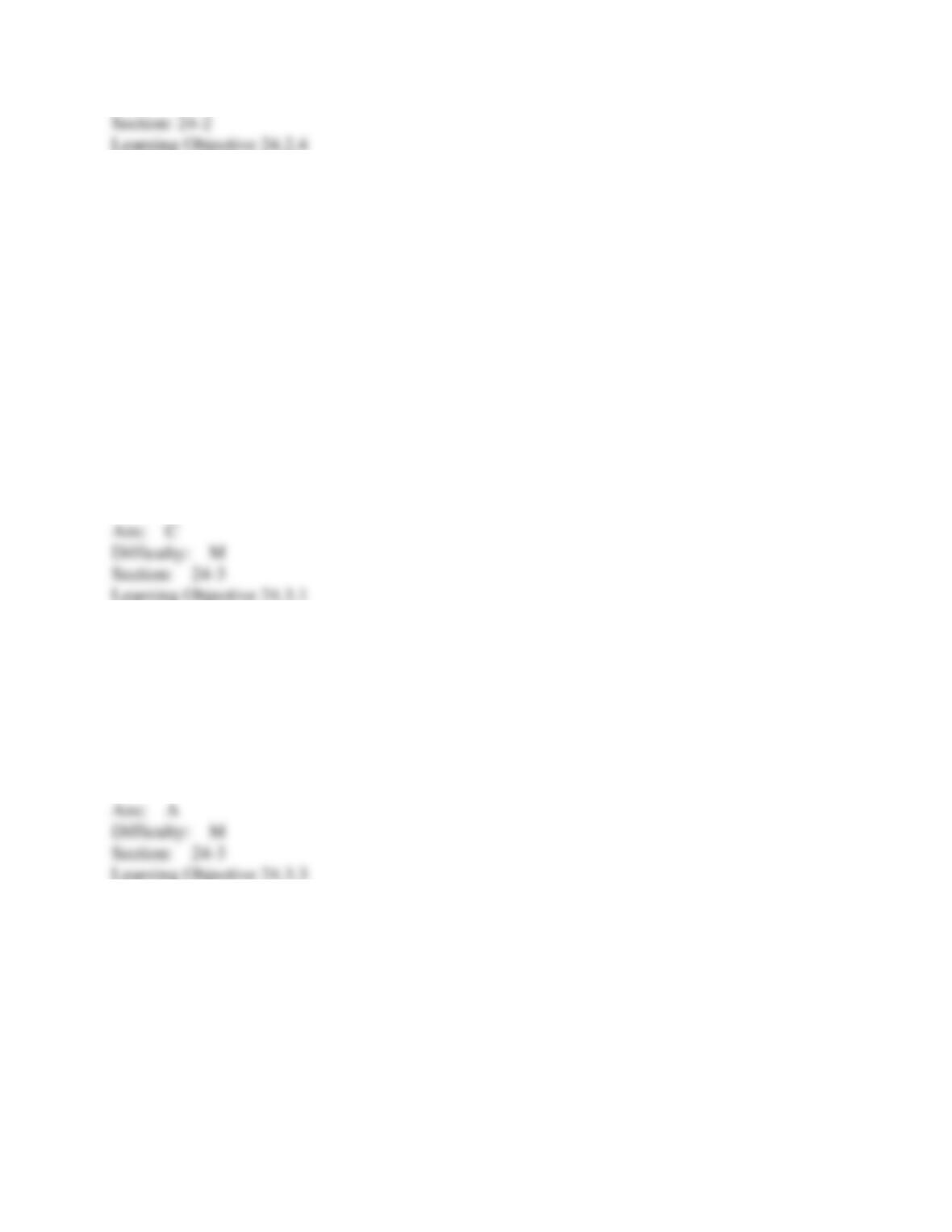
21. The graph shows the electric field as a function of position in a particular region of space. If
Exs = 100 N/C, what is the potential difference between x = 3 m and x = 6 m?
A) 250 V
B) 50 V
C) 0 V
D) –50 V
E) –250 V
22. In separate experiments, four different particles each start from far away with the same
speed and impinge directly on a gold nucleus. The masses and charges of the particles are
particle 1: mass m0, charge q0
particle 2: mass 2m0, charge 2q0
particle 3: mass 2m0, charge q0/2
particle 4: mass m0/2, charge 2q0
Rank the particles according to the distance of closest approach to the gold nucleus, from
smallest to largest.
A) 1, 2, 3, 4
B) 4, 3, 2, 1
C) 3, then 1 and 2 tie, then 4
D) 4, then 1 and 2 tie, then 3
E) 1 and 2 tie, then 3, then 4
23. Positive charge is distributed uniformly throughout a non-conducting sphere. The highest
electric potential occurs:
A) at the center
B) at the surface
C) halfway between the center and surface
D) just outside the surface
E) far from the sphere
24. A total charge of 7 10–8 C is uniformly distributed throughout a non-conducting sphere
with a radius of 5 cm. The electric potential at the surface, relative to the potential far away, is
about:
A) –1.3 104 V
B) 1.3 104 V
C) 630 V
D) 130 V
E) 0 V
25. Eight identical spherical raindrops are each at a potential V, relative to the potential far
away. They coalesce to make one spherical raindrop whose potential is:
A) V/8
B) V/2
C) 2V
D) 4V
E) 8V
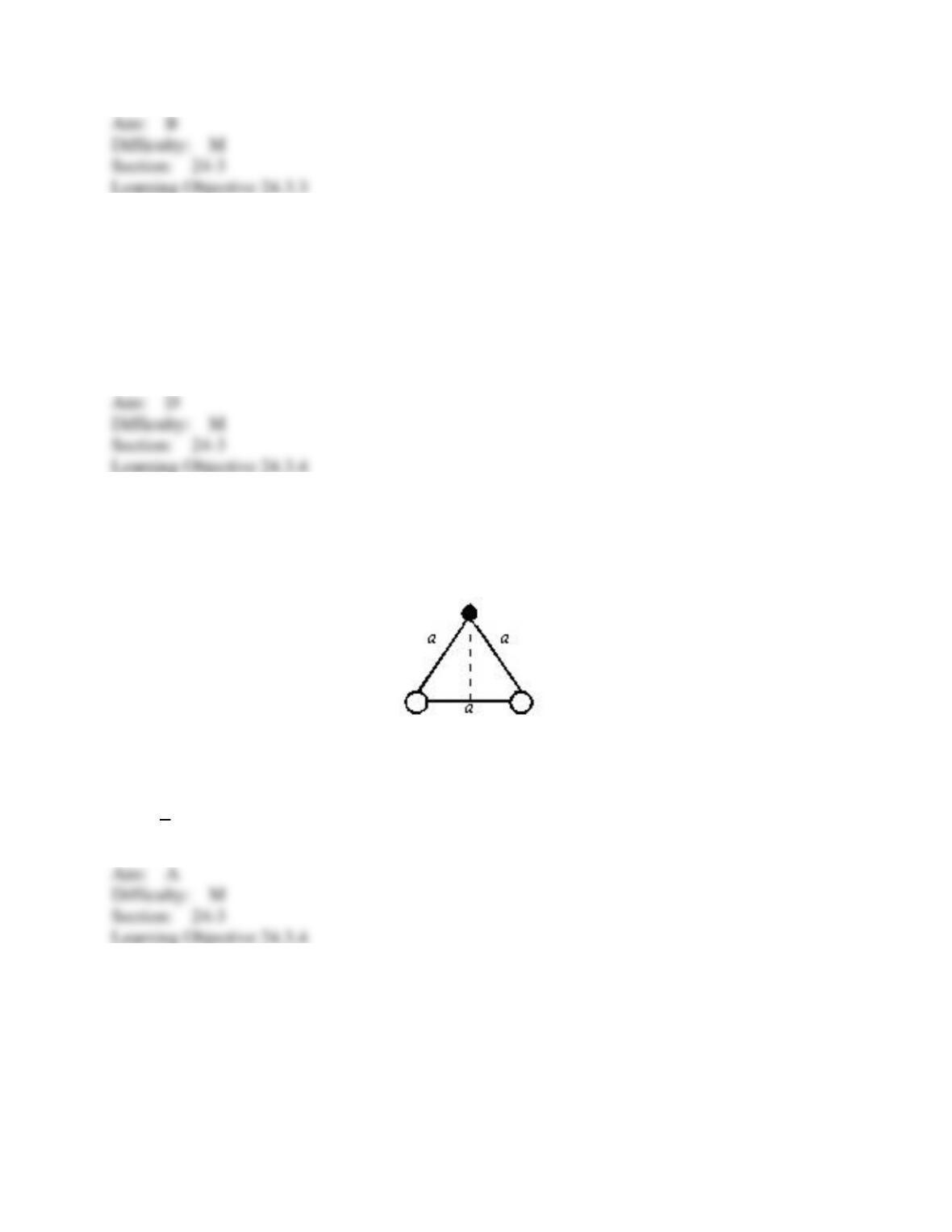
26. Two particles with charges Q and −Q are fixed at the vertices of an equilateral triangle with
sides of length a. If k = 1/40, the work required to move a particle with a charge q from the
other vertex to the center of the line joining the fixed charges is:
A) 0
B) kQq/a
C) kQq/a2
D) 2kQq/a
E) √2𝑘𝑄𝑞/𝑎
27. The equipotential surfaces associated with a charged point particle are:
A) radially outward from the particle
B) vertical planes
C) horizontal planes
D) concentric spheres centered at the particle
E) concentric cylinders with the particle on the axis