Chapter: Chapter 3
Learning Objectives
LO 3.1.0 Solve problems related to vectors and their components
LO 3.1.1 Add vectors by drawing them in head-to-tail arrangements, applying the commutative
and associative laws.
LO 3.1.2 Subtract a vector from a second one.
LO 3.1.3 Calculate the components of a vector on a given coordinate system, showing them in a
drawing.
LO 3.1.4 Given the components of a vector, draw the vector and determine its magnitude and
orientation.
LO 3.1.5 Convert angle measures between degrees and radians.
LO 3.2.0 Solve problems related to unit vectors and adding vectors by components
LO 3.2.1 Convert a vector between magnitude-angle and unit-vector notations.
LO 3.2.2 Add and subtract vectors in magnitude-angle notation and in unit-vector notation.
LO 3.2.3 Identify that, for a given vector, rotating the coordinate system about the origin can
change the vector’s components but not the vector itself.
LO 3.3.0 Solve problems related to multiplying vectors
LO 3.3.1 Multiply vectors by scalars.
LO 3.3.2 Identify that multiplying a vector by a scalar gives a vector, taking the dot (or scalar)
product of two vectors gives a scalar, and taking the cross (or vector) product gives a new vector
that is perpendicular to the original two.
LO 3.3.3 Find the dot product of two vectors in magnitude-angle notation and in unit-vector
notation.
LO 3.3.4 Find the angle between two vectors by taking their dot product in both magnitude-angle
notation and unit-vector notation.
LO 3.3.5 Given two vectors, use a dot product to find how much of one vector lies along the
other vector.
LO 3.3.6 Find the cross product of two vectors in magnitude-angle and unit-vector notations.
LO 3.3.7 Use the right-hand rule to find the direction of the vector that results from a cross
product.
LO 3.3.8 In nested products, where one product is buried inside another, follow the normal
algebra procedure by starting with the innermost product and working outward.
Multiple Choice
1. We say that the displacement of a particle is a vector quantity. Our best justification for this
assertion is:
A) displacement can be specified by a magnitude and a direction
B) operating with displacements according to the rules for manipulating vectors leads to results
in agreement with experiments
C) a displacement is obviously not a scalar
D) displacement can be specified by three numbers
E) displacement is associated with motion
2. A vector of magnitude 3 CANNOT be added to a vector of magnitude 4 so that the
magnitude of the resultant is:
A) 0
B) 1
C) 3
D) 5
E) 7
3. A vector of magnitude 20 is added to a vector of magnitude 25. The magnitude of this sum
can be:
A) 0
B) 3
C) 12
D) 47
E) 50
4. A vector 𝑆
⃗ of magnitude 6 and another vector 𝑇
⃗
⃗
have a resultant of magnitude 12. The
vector 𝑇
⃗
⃗
:
A) must have a magnitude of at least 6 but no more than 18
B) may have a magnitude of 20
C) cannot have a magnitude greater than 12
D) must be perpendicular to 𝑆
⃗
E) must be perpendicular to the resultant vector
5. If |𝐴
⃗+ 𝐵
⃗
⃗
|2= 𝐴2+ 𝐵2, then:
A) 𝐴
⃗ and 𝐵
⃗
⃗
must be parallel and in the same direction
B) 𝐴
⃗ and 𝐵
⃗
⃗
must be parallel and in opposite directions
C) it must be true that either 𝐴
⃗ or 𝐵
⃗
⃗
is zero
D) the angle between 𝐴
⃗ and 𝐵
⃗
⃗
must be 60
E) none of the above is true
6. If |𝐴
⃗+ 𝐵
⃗
⃗
| = 𝐴 + 𝐵 and neither 𝐴
⃗ nor 𝐵
⃗
⃗
vanish, then:
A) 𝐴
⃗ and 𝐵
⃗
⃗
are parallel and in the same direction
B) 𝐴
⃗ and 𝐵
⃗
⃗
are parallel and in opposite directions
C) the angle between 𝐴
⃗ and 𝐵
⃗
⃗
is 45
D) the angle between 𝐴
⃗ and 𝐵
⃗
⃗
is 60
E) 𝐴
⃗ is perpendicular to 𝐵
⃗
⃗
7. The vector −𝐴
⃗ is:
A) greater than 𝐴
⃗ in magnitude
B) less than 𝐴
⃗ in magnitude
C) in the same direction as 𝐴
⃗
D) in the direction opposite to 𝐴
⃗
E) perpendicular to 𝐴
⃗
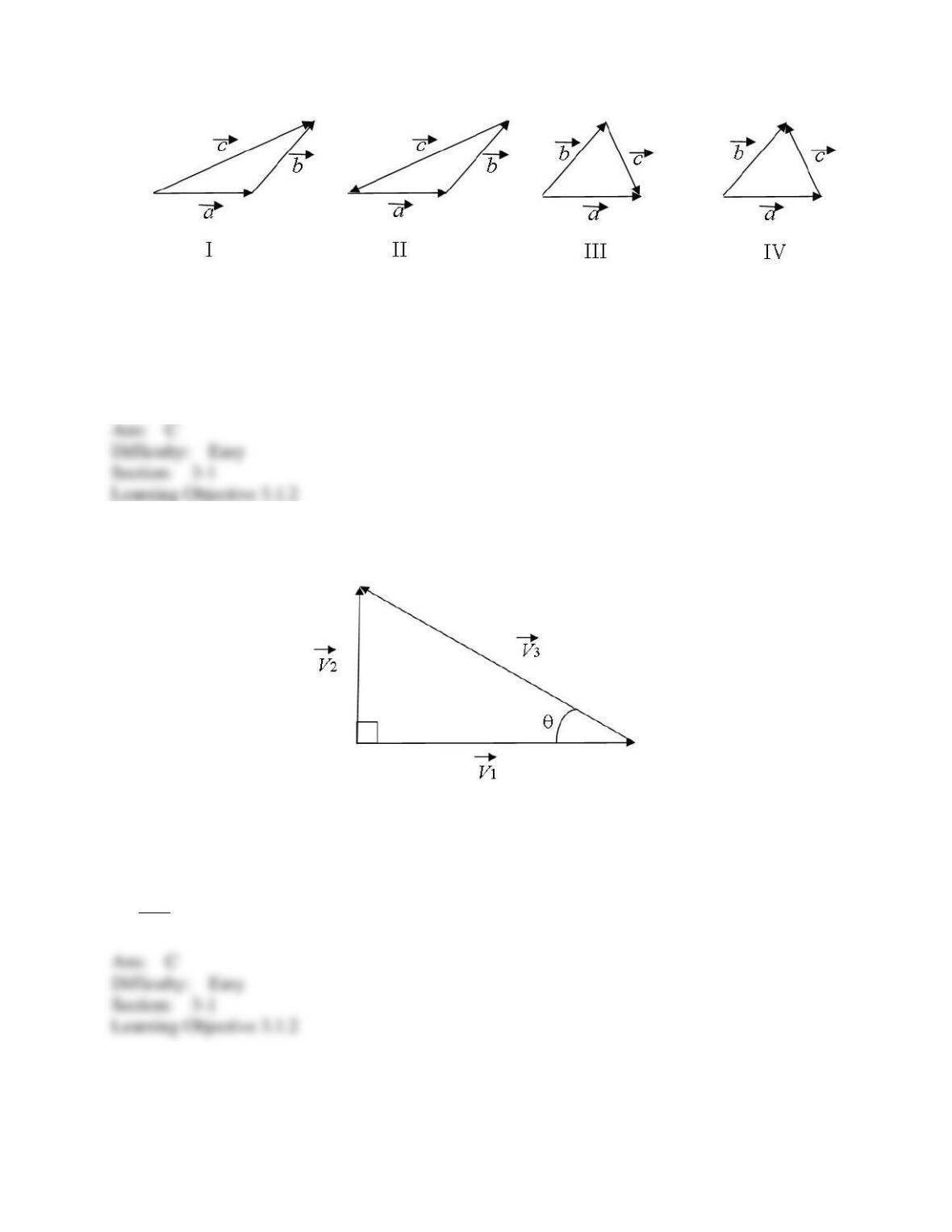
8. The vectors 𝑎⃗, 𝑏
⃗
⃗
, and 𝑐⃗ are related by 𝑐⃗ = 𝑎⃗ − 𝑏
⃗
⃗
. Which diagram below illustrates this
relationship?
A) I.
B) II.
C) III.
D) IV.
E) None of these
9. The vector 𝑉3
⃗
⃗
⃗
⃗
in the diagram is equal to:
A) 𝑉1
⃗
⃗
⃗
⃗
− 𝑉2
⃗
⃗
⃗
⃗
B) 𝑉1
⃗
⃗
⃗
⃗
+ 𝑉2
⃗
⃗
⃗
⃗
C) 𝑉2
⃗
⃗
⃗
⃗
− 𝑉1
⃗
⃗
⃗
⃗
D) 𝑉1
⃗
⃗
⃗
⃗
cos 𝜃
E) 𝑉
1
⃗
⃗
⃗
⃗
⃗
cos𝜃
10. If |𝐴
⃗− 𝐵
⃗
⃗
| = 𝐴 + 𝐵 and neither 𝐴
⃗ nor 𝐵
⃗
⃗
vanish, then:
A) 𝐴
⃗ and 𝐵
⃗
⃗
are parallel and in the same direction
B) 𝐴
⃗ and 𝐵
⃗
⃗
are parallel and in opposite directions
C) the angle between 𝐴
⃗ and 𝐵
⃗
⃗
is 45
D) the angle between 𝐴
⃗ and 𝐵
⃗
⃗
is 60
E) 𝐴
⃗ is perpendicular to 𝐵
⃗
⃗
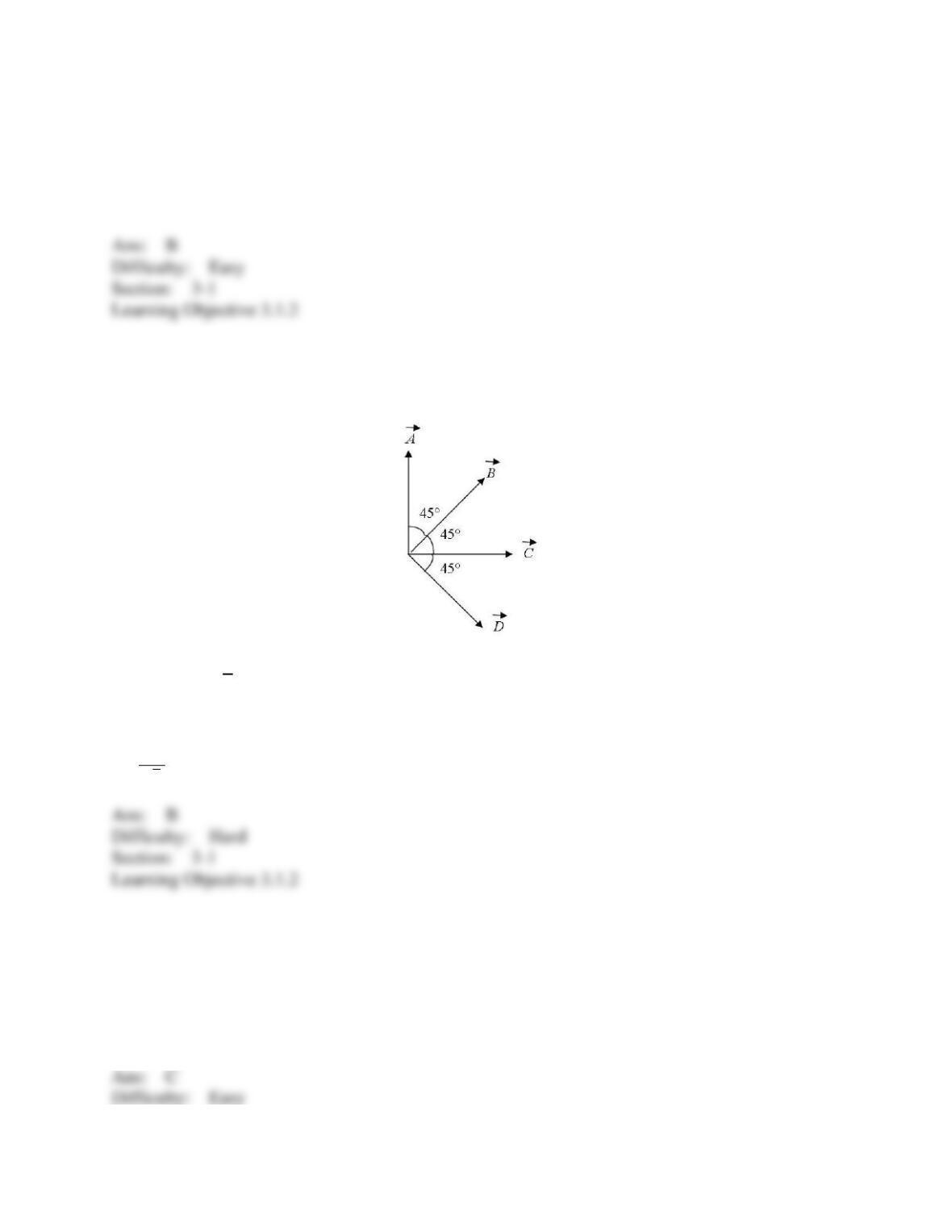
11. Four vectors (𝐴
⃗, 𝐵
⃗
⃗
, 𝐶
⃗, 𝐷
⃗
⃗
⃗
) all have the same magnitude. The angle between adjacent
vectors is 45 as shown. The correct vector equation is:
A) 𝐴
⃗− 𝐵
⃗
⃗
− 𝐶
⃗+ 𝐷
⃗
⃗
⃗
= 0
B) 𝐵
⃗
⃗
+ 𝐷
⃗
⃗
⃗
−√2𝐶
⃗= 0
C) 𝐴
⃗+ 𝐵
⃗
⃗
= 𝐶
⃗+ 𝐷
⃗
⃗
⃗
D) 𝐴
⃗+ 𝐵
⃗
⃗
+ 𝐶
⃗+ 𝐷
⃗
⃗
⃗
= 0
E) 𝐴
⃗+𝐶
⃗
√2= −𝐵
⃗
⃗
12. Vectors 𝐴
⃗ and 𝐵
⃗
⃗
lie in the xy plane. We can deduce that 𝐴
⃗= 𝐵
⃗
⃗
if:
A) Ax2 + Ay2 = Bx2 + By2
B) Ax + Ay = Bx + By
C) Ax = Bx and Ay = By
D) Ay /Ax = By /Bx
E) Ax = Ay and Bx = By
13. One radian is approximately
A) 10°
B) 33°
C) 57°
D) 90°
E) 180°
14. 30° is
A) π/10 radians
B) π/6 radians
C) 1 radian
D) π/2 radians
E) π radians
15. A vector has a magnitude of 12. When its tail is at the origin it lies between the positive x
axis and negative y axis and makes an angle of 30 with the x axis. Its y component is:
A) 6√3
B) −6√3
C) 6
D) –6
E) 12
16. If the x component of a vector 𝐴
⃗, in the xy plane, is half as large as the magnitude of the
vector, the tangent of the angle between the vector and the x axis is:
A) √3
B) 1/2
C) √3/2
D) 3/2
E) 3
17. A vector has a component of 10 m in the +x direction, a component of 10 m in the +y
direction, and a component of 5 m in the +z direction. The magnitude of this vector is:
A) 0 m
B) 15 m
C) 20 m
D) 25 m
E) 225 m
18. Let 𝑉
⃗
⃗
= 2.00𝑖̂ + 6.00𝑗̂ − 3.00𝑘
̂. The magnitude of 𝑉
⃗
⃗
is:
A) 5.00
B) 5.57
C) 7.00
D) 7.42
E) 8.54
19. A vector in the xy plane has a magnitude of 25 and an x component of 12. The angle it
makes with the positive x axis is:
A) 26
B) 29
C) 61
D) 64
E) 241
20. The angle between 𝐴
⃗ = (25 m)𝑖̂ + (45 m)𝑗̂ and the positive x axis is:
A) 29
B) 61
C) 151
D) 209
E) 241
21. The angle between 𝐴
⃗ = −(25 m)𝑖̂ + (45 m)𝑗̂ and the positive x axis is:
A) 29
B) 61
C) 119
D) 151
E) 209
22. Let 𝐴
⃗ = (2 m)𝑖̂ + (6 m)𝑗̂ – (3 m)𝑘
̂ and 𝐵
⃗
⃗
= (4 m)𝑖̂ + (2 m)𝑗̂ + (1 m)𝑘
̂. The vector sum
𝑆
⃗= 𝐴
⃗+ 𝐵
⃗
⃗
is:
A) (6 m)𝑖̂ + (8 m)𝑗̂ – (2 m)𝑘
̂
B) (−2 m)𝑖̂ + (4 m)𝑗̂ – (4 m)𝑘
̂
C) (2 m)𝑖̂ − (4 m)𝑗̂ + (4 m)𝑘
̂
D) (8 m)𝑖̂ + (12 m)𝑗̂ – (3 m)𝑘
̂
E) none of these
23. Let 𝐴
⃗ = (2 m)𝑖̂ + (6 m)𝑗̂ – (3 m)𝑘
̂ and 𝐵
⃗
⃗
= (4 m)𝑖̂ + (2 m)𝑗̂ + (1 m)𝑘
̂. The vector
difference 𝐷
⃗
⃗
⃗
= 𝐴
⃗− 𝐵
⃗
⃗
is:
A) (6 m)𝑖̂ + (8 m)𝑗̂ – (2 m)𝑘
̂
B) (−2 m)𝑖̂ + (4 m)𝑗̂ – (4 m)𝑘
̂
C) (2 m)𝑖̂ − (4 m)𝑗̂ + (4 m)𝑘
̂
D) (8 m)𝑖̂ + (12 m)𝑗̂ – (3 m)𝑘
̂
E) none of these
24. If 𝐴
⃗ = (2 m)𝑖̂ − (3 m)𝑗̂ and 𝐵
⃗
⃗
= (1 m)𝑖̂ − (2 m)𝑗̂, then 𝐴
⃗− 2𝐵
⃗
⃗
=
A) (1 m)𝑗̂
B) (−1 m)𝑗̂
C) (4 m)𝑖̂ − (7 m)𝑗̂
D) (4 m)𝑖̂ + (1 m)𝑗̂
E) (−4 m)𝑖̂ + (7 m)𝑗̂
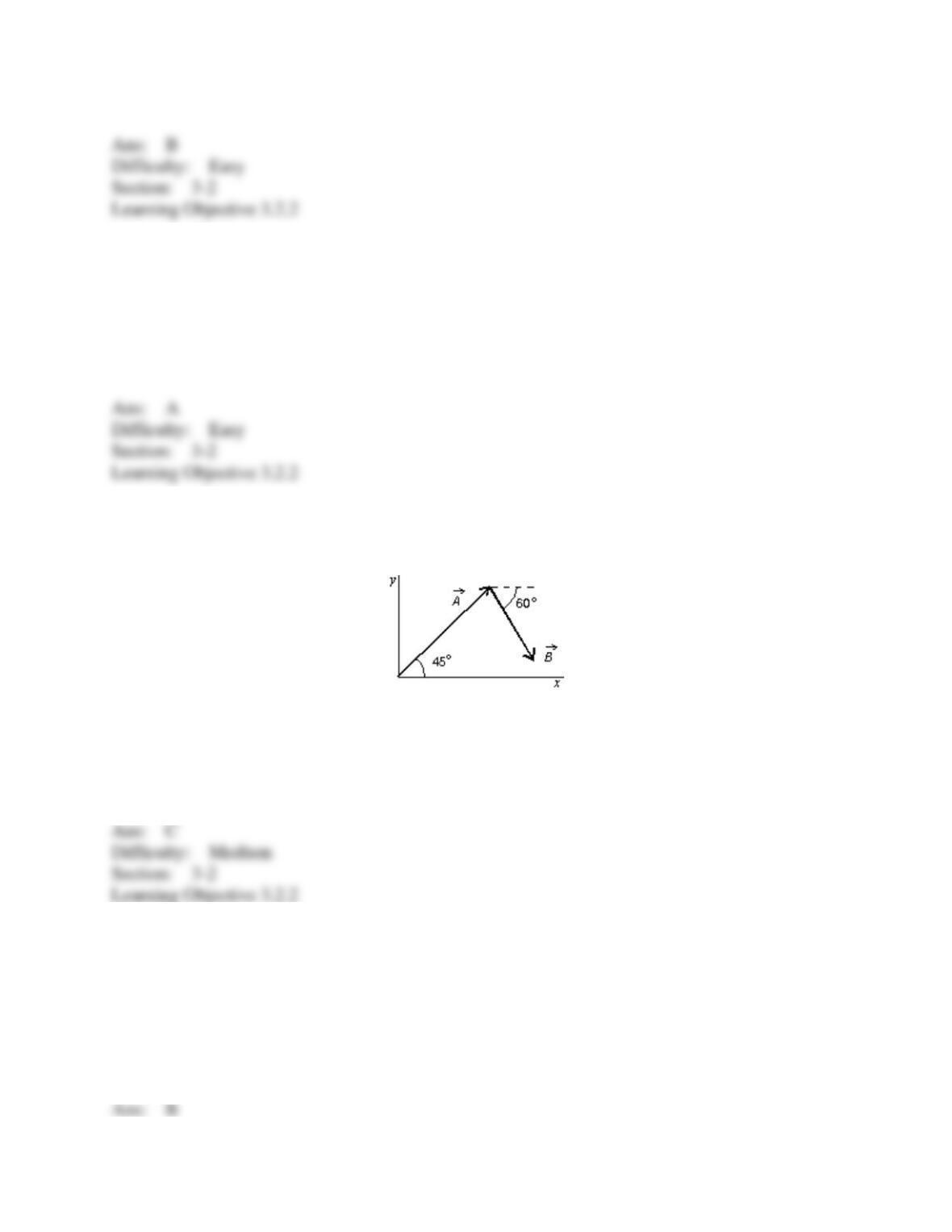
25. In the diagram, 𝐴
⃗ has magnitude 12 m and 𝐵
⃗
⃗
has magnitude 8 m. The x component of
𝐴
⃗+ 𝐵
⃗
⃗
is about:
A) 1.5 m
B) 4.5 m
C) 12 m
D) 15 m
E) 20 m
26. A certain vector in the xy plane has an x component of 4 m and a y component of 10 m. It is
then rotated in the xy plane so its x component is doubled. Its new y component is about:
A) 20 m
B) 7.2 m
C) 5.0 m
D) 4.5 m
E) 2.2 m
27. If 𝐴
⃗ = (6 m)𝑖̂ – (8 m)𝑗̂ then 4𝐴
⃗ has magnitude:
A) -8 m
B) 8 m
C) 10 m
D) 40 m
E) 56 m
28. Which of the following is correct?
A) Multiplying a vector by a scalar gives a scalar result.
B) Multiplying a vector by a vector always gives a vector result.
C) Multiplying a vector by a vector never gives a scalar result.
D) The only type of vector multiplication that gives a scalar result is the dot product.
E) The only type of vector multiplication that gives a vector result is the cross product.
29. Vectors 𝐴
⃗ and 𝐵
⃗
⃗
each have magnitude L. When drawn with their tails at the same point,
the angle between them is 30. The value of 𝐴
⃗∙ 𝐵
⃗
⃗
is:
A) 0
B) L2
C) √3𝐿2/2
D) 2L2
E) none of these
30. Let 𝐴
⃗ = (2 m)𝑖̂ + (6 m)𝑗̂ – (3 m)𝑘
̂ and 𝐵
⃗
⃗
= (4 m)𝑖̂ + (2 m)𝑗̂ + (1 m)𝑘
̂. Then 𝐴
⃗∙ 𝐵
⃗
⃗
equals:
A) (8 m)𝑖̂ + (12 m)𝑗̂ – (3 m)𝑘
̂
B) (12 m)𝑖̂ − (14 m)𝑗̂ – (20 m)𝑘
̂
C) 23
D) 17
E) none of these
31. Two vectors lie with their tails at the same point. When the angle between them is
increased by 20 their scalar product has the same magnitude but changes from positive to
negative. The original angle between them was:
A) 0°
B) 60
C) 70
D) 80
E) 90
32. Let 𝑆
⃗ = (1 m)𝑖̂ + (2 m)𝑗̂ + (2 m)𝑘
̂ and 𝑇
⃗
⃗
= (3 m)𝑖̂ + (4 m)𝑘
̂. The angle between these
two vectors is given by:
A) cos–1(14/15)
B) cos–1(11/225)
C) cos–1(104/225)
D) cos–1(11/15)
E) cannot be found since 𝑆 and 𝑇
⃗
⃗
do not lie in the same plane
33. Two vectors have magnitudes of 10 and 15. The angle between them when they are drawn
with their tails at the same point is 65. The component of the longer vector along the line of the
shorter is:
A) 0
B) 4.2
C) 6.3
D) 9.1
E) 14
34. If the magnitude of the sum of two vectors is less than the magnitude of either vector, then:
A) the scalar product of the vectors must be negative
B) the scalar product of the vectors must be positive
C) the vectors must be parallel and in opposite directions
D) the vectors must be parallel and in the same direction
E) none of the above
35. If the magnitude of the sum of two vectors is greater than the magnitude of either vector,
then:
A) the scalar product of the vectors must be negative
B) the scalar product of the vectors must be positive
C) the vectors must be parallel and in opposite directions
D) the vectors must be parallel and in the same direction
E) none of the above
36. Vectors 𝐴
⃗ and 𝐵
⃗
⃗
each have magnitude L. When drawn with their tails at the same point,
the angle between them is 30. The magnitude of 𝐴
⃗× 𝐵
⃗
⃗
is:
A) L2/2
B) L2
C) √3𝐿2/2
D) 2L2
E) none of these
37. Two vectors lie with their tails at the same point. When the angle between them is
increased by 20 the magnitude of their vector product doubles. The original angle between
them was about:
A) 0°
B) 18
C) 25
D) 45
E) 90
38. The two vectors (3 m)𝑖̂ − (7 m)𝑗̂ and (2 m)𝑖̂ + (3 m)𝑗̂ − (2 m)𝑘
̂ define a plane (it is the
plane of the triangle with both tails at one vertex and each head at one of the other vertices).
Which of the following vectors is perpendicular to the plane?
A) (14 m)𝑖̂ + (6 m)𝑗̂ + (23 m)𝑘
̂
B) (−14 m)𝑖̂ + (6 m)𝑗̂ + (23 m)𝑘
̂
C) (14 m)𝑖̂ − (6 m)𝑗̂ + (23 m)𝑘
̂
D) (14 m)𝑖̂ + (6 m)𝑗̂ − (23 m)𝑘
̂
E) (14 m)𝑖̂ + (6 m)𝑗̂
39. Let 𝑅
⃗
⃗
= 𝑆
⃗× 𝑇
⃗
⃗
and
90, where
is the angle between 𝑆
⃗ and 𝑇
⃗
⃗
when they are
drawn with their tails at the same point. Which of the following is NOT true?
A) |𝑅
⃗
⃗
| = |𝑆
⃗||𝑇
⃗
⃗
| sin 𝜃
B) −𝑅
⃗
⃗
= 𝑇
⃗
⃗
× 𝑆
⃗
C) 𝑅
⃗
⃗
∙ 𝑆
⃗= 0
D) 𝑅
⃗
⃗
∙ 𝑇
⃗
⃗
= 0
E) 𝑆
⃗∙ 𝑇
⃗
⃗
= 0
40. The value of 𝑖̂ ∙ (𝑗̂ × 𝑘
̂) is:
A) 0
B) +1
C) –1
D) 3
E) √3
41. The value of 𝑘
̂∙ (𝑘
̂× 𝑖̂) is:
A) 0
B) +1
C) –1
D) 3
E) √3
42. The value of (𝑗̂ × 𝑘
̂) ∙ (𝑘
̂× 𝑖̂) is:
A) 0
B) +1
C) –1
D) 3
E) √3
43. The result of (𝑗̂ × 𝑘
̂) × (𝑘
̂× 𝑖̂) is:
A) 0
B) +1
C) 𝑖̂
D) 𝑗̂
E) 𝑘
̂