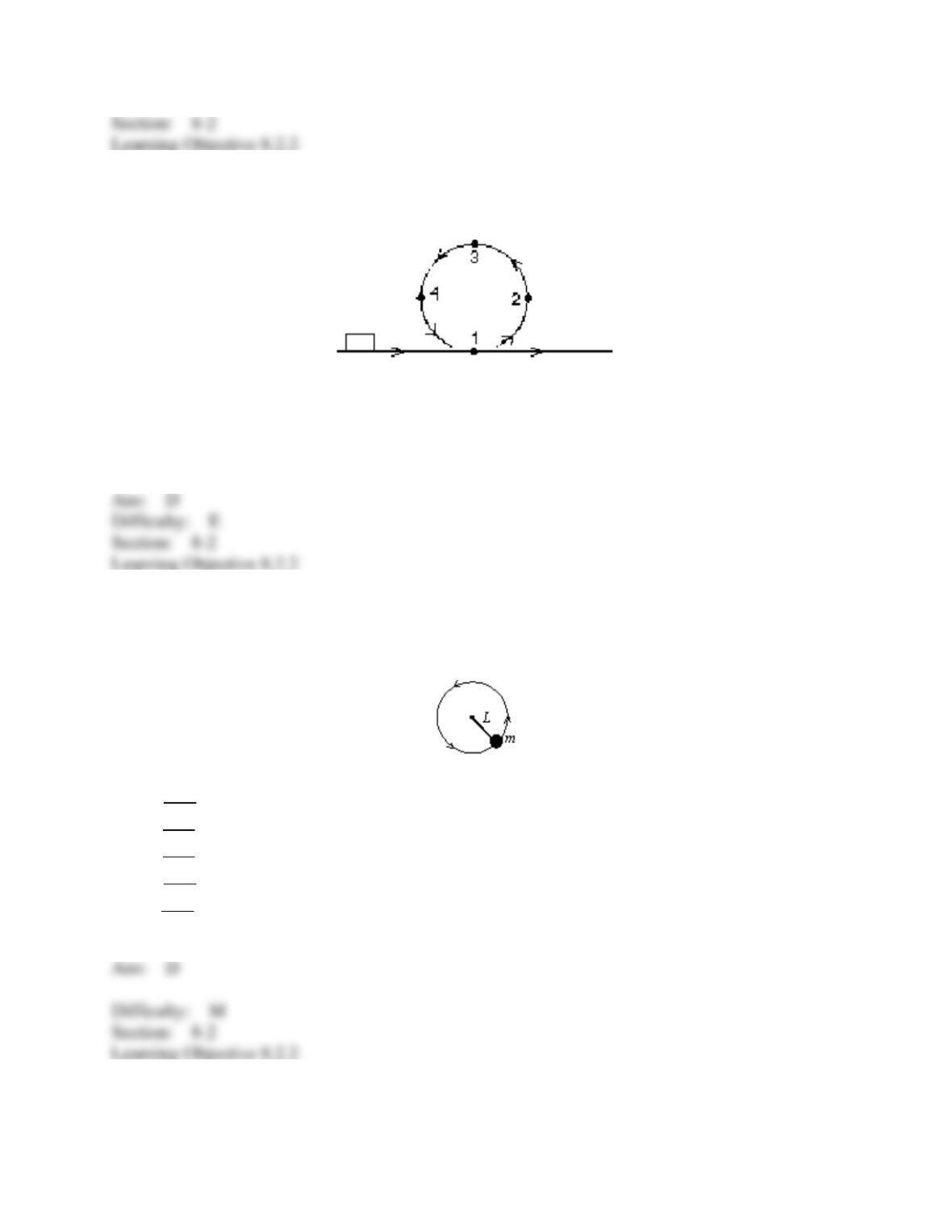
37. A rectangular block is moving along a frictionless path when it encounters the circular loop
as shown. The block passes points 1,2,3,4,1 before returning to the horizontal track. At point 3:
A) its mechanical energy is a minimum
B) the forces on it are balanced
C) it is not accelerating
D) its speed is a minimum
E) it experiences a net upward force
38. A ball of mass m, at one end of a string of length L, rotates in a vertical circle just fast
enough to prevent the string from going slack at the top of the circle. Assuming mechanical
energy is conserved, the speed of the ball at the bottom of the circle is:
A) √2𝑔𝐿
B) √3𝑔𝐿
C) √4𝑔𝐿
D) √5𝑔𝐿
E) √7𝑔𝐿
39. The graphs below show the magnitude of the force on a particle as the particle moves along
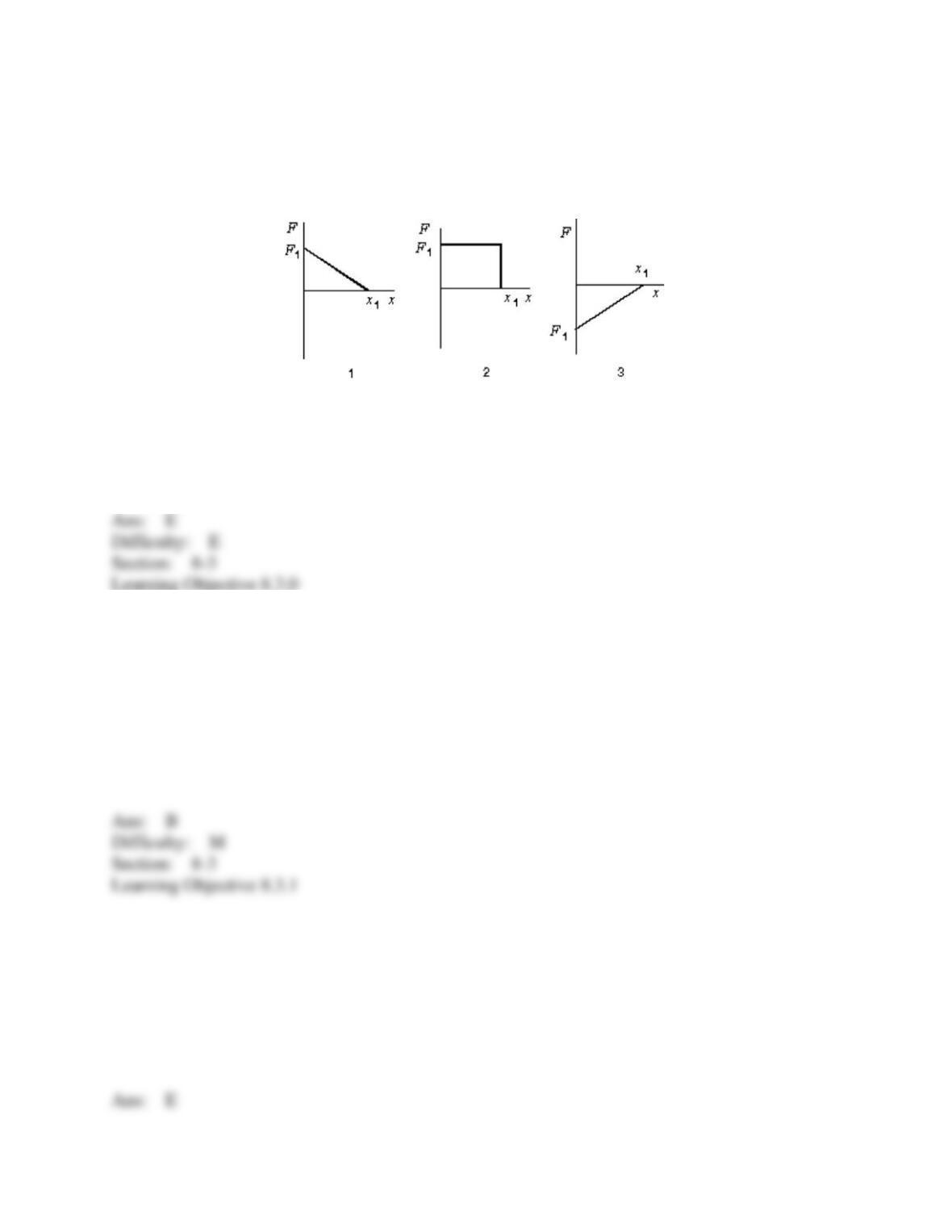
the positive x axis from the origin to x = x1. The force is parallel to the x axis and is conservative.
The maximum magnitude F1 has the same value for all graphs. Rank the situations according to
the change in the potential energy associated with the force, least (or most negative) to greatest
(or most positive).
A) 3, 1, 2
B) 1, 3, 2
C) 2, 3, 1
D) 3, 2, 1
E) 2, 1, 3
40. A particle moves along the x axis under the influence of a stationary object. The net force
on the particle, which is conservative, is given by F = (8N/m3)x3. If the potential energy is taken
to be zero for x = 0 then the potential energy is given by:
A) (2 J/m4)x4
B) (–2 J/m4)x4
C) (24 J/m2)x2
D) (–24 J/m2)x2
E) 5 J – (2 J/m4)x4
41. The potential energy of a body of mass m is given by U = –mgx + 1/2kx2. The
corresponding force is:
A) –mgx2/2 + kx3/6
B) mgx2/2 – kx3/6
C) –mg + kx/2
D) –mg + kx
E) mg – kx
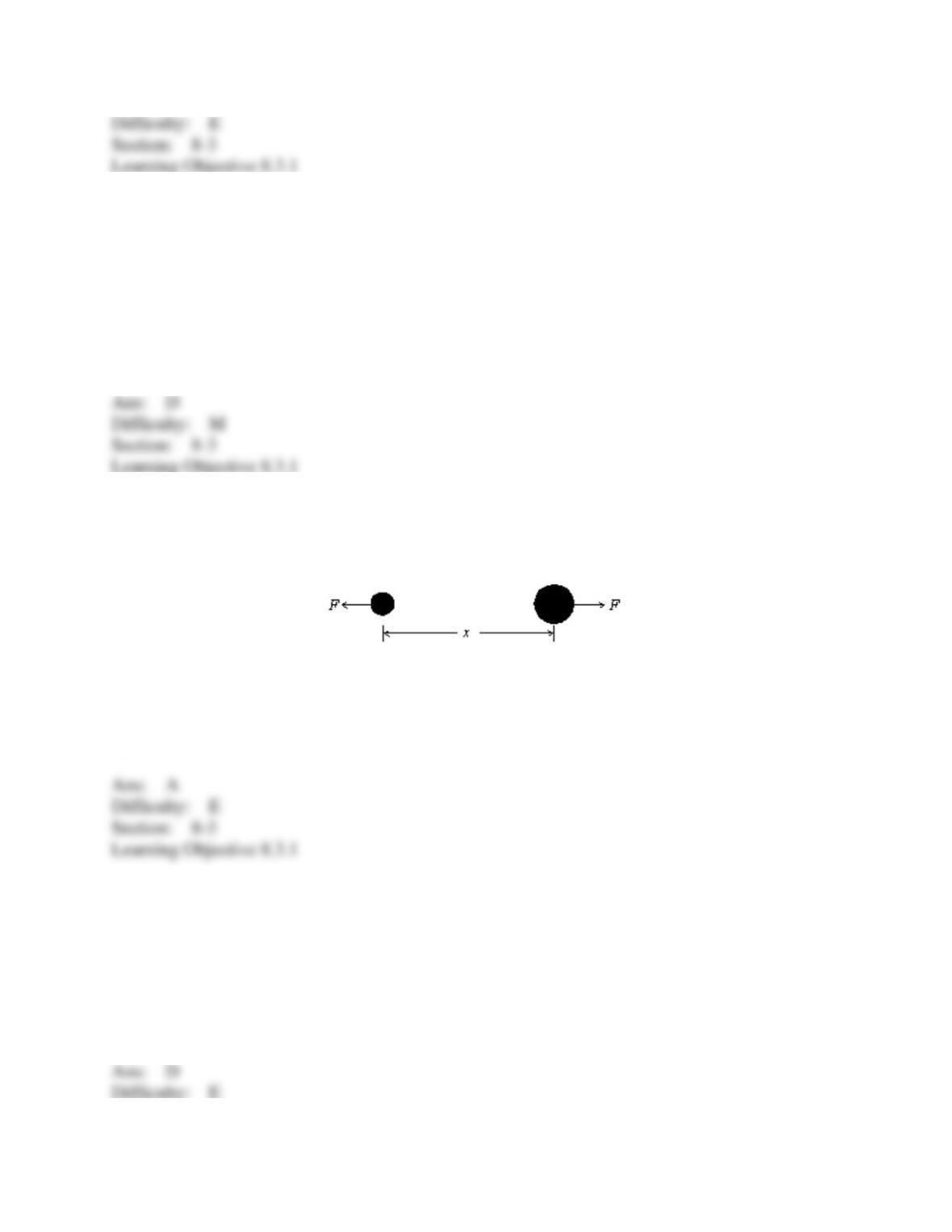
42. The potential energy of a 0.20-kg particle moving along the x axis is given by
U(x) = (8.0 J/m2)x2 − (2.0 J/m4)x4. When the particle is at x = 1.0 m the magnitude of its
acceleration is:
A) 0 m/s2
B) –8 m/s2
C) 8 m/s2
D) –40 m/s2
E) 40 m/s2
43. The potential energy for the interaction between the two atoms in a diatomic molecule is U
= A/x12 – B/x6, where A and B are constants and x is the interatomic distance. The magnitude of
the force that one atom exerts on the other is:
A) 12A/x13 – 6B/x7
B) –13A/x13 + 7B/x7
C) –11A/x11 + 5B/x5
D) 72A/x12 – 72B/x6
E) A/x13 – B/x7
44. Given a potential energy function U(x), the corresponding force 𝐹
⃗ is in the positive x
direction if:
A) U is positive
B) U is negative
C) U is an increasing function of x
D) U is a decreasing function of x
E) it is impossible to obtain the direction of 𝐹
⃗ from U
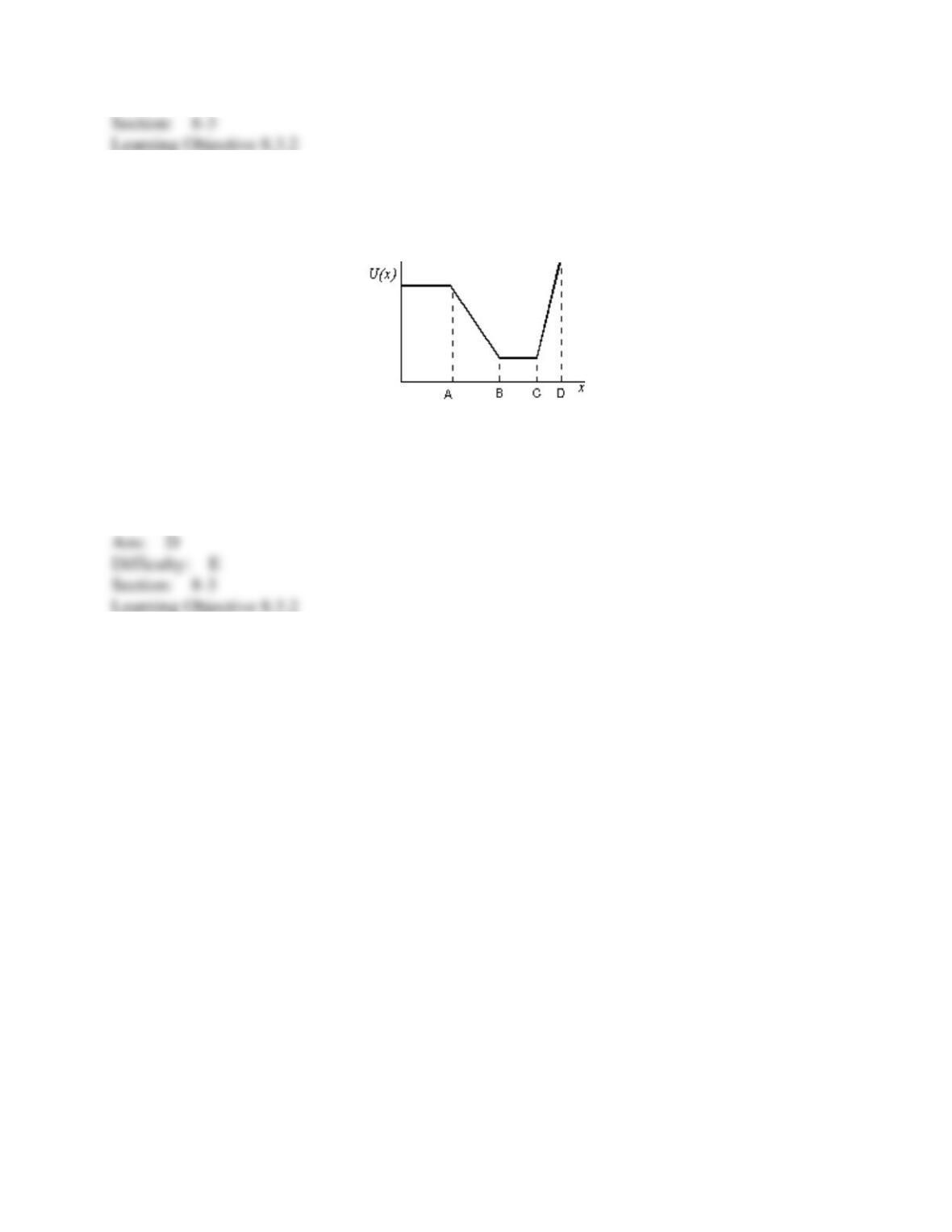
45. As a particle moves along the x axis it is acted by a conservative force. The potential
energy is shown below as a function of the coordinate x of the particle. Rank the labeled regions
according to the magnitude of the force, least to greatest.
A) AB, BC, CD
B) AB, CD, BC
C) BC, CD, AB
D) BC, AB, CD
E) CD, BC, AB
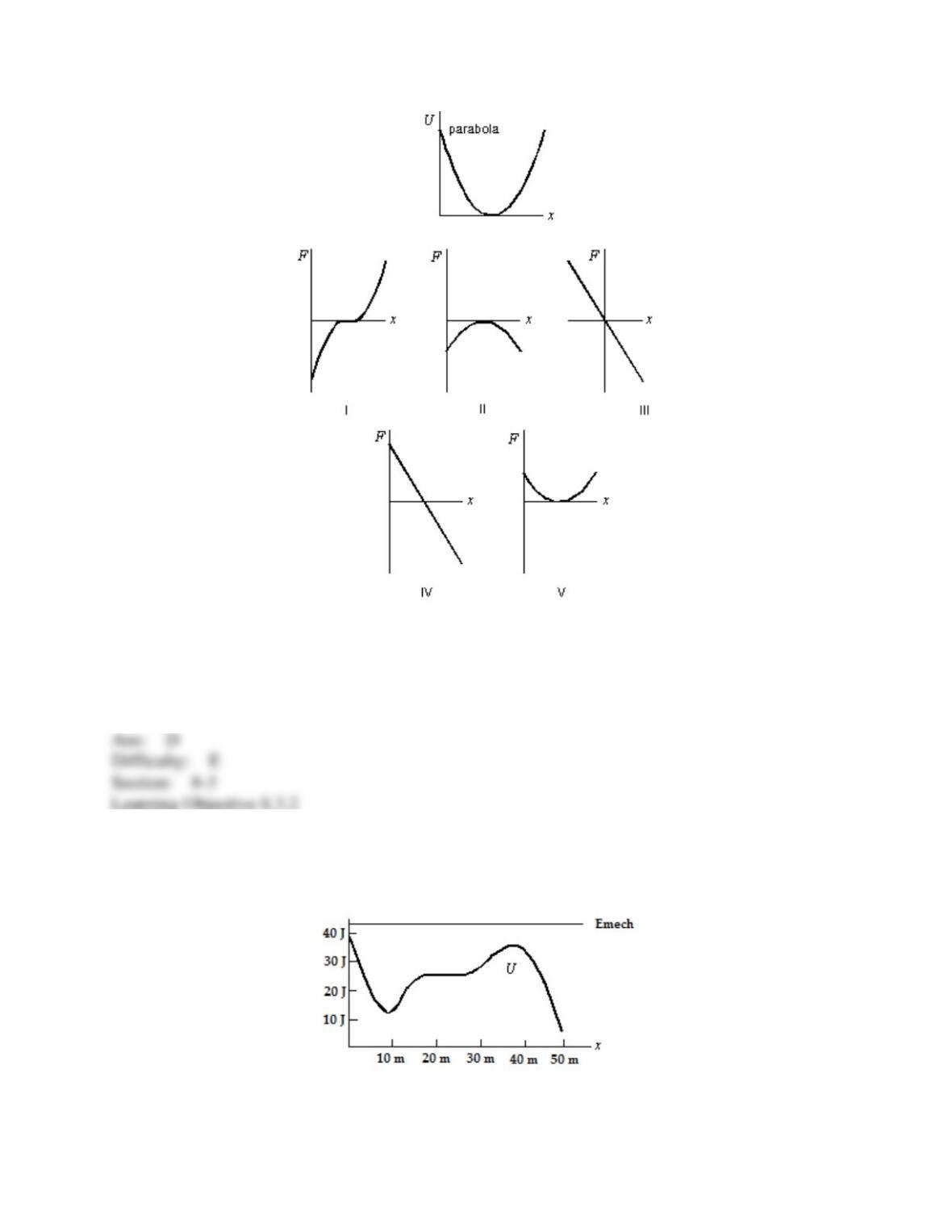
46. The first graph shows the potential energy U(x) for a particle moving on the x axis. Which
of the following five graphs correctly gives the force F exerted on the particle?
A) I
B) II
C) III
D) IV
E) V
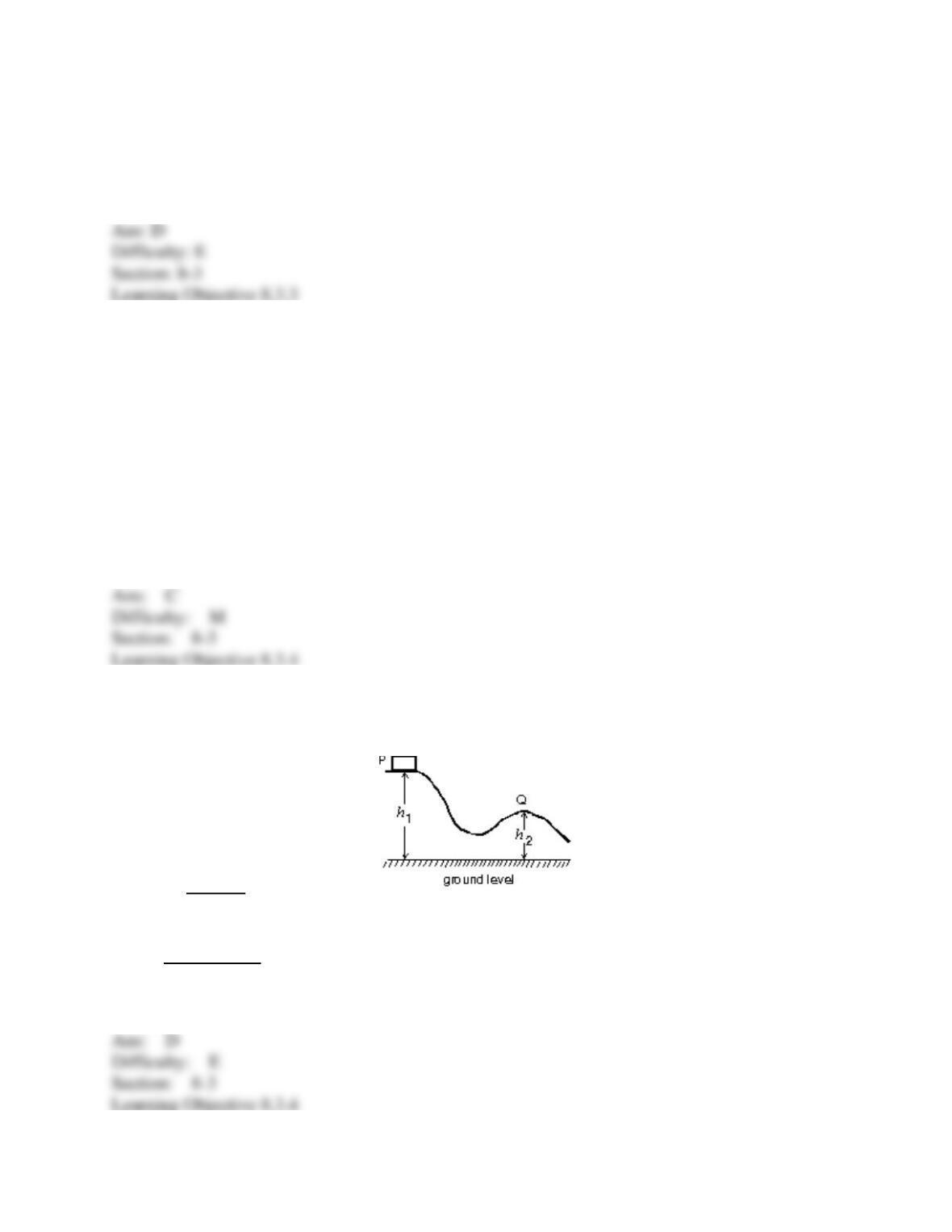
47. In this graph of potential energy vs. x, the horizontal line represents the total mechanical
energy of a particle. Approximately what is its kinetic energy at x = 15 m?
A) 5 J
B) 10 J
C) 15 J
D) 20 J
E) 25 J
48. The potential energy of a 0.20-kg particle moving along the x axis is given by
U(x) =(8.0 J/m2)x2 + (2.0 J/m4)x4.
When the particle is at x = 1.0 m it is traveling in the positive x direction with a speed of 5.0 m/s.
It next stops momentarily to turn around at x =
A) 0 m
B) –1.1 m
C) 1.1 m
D) –2.3 m
E) 2.3 m
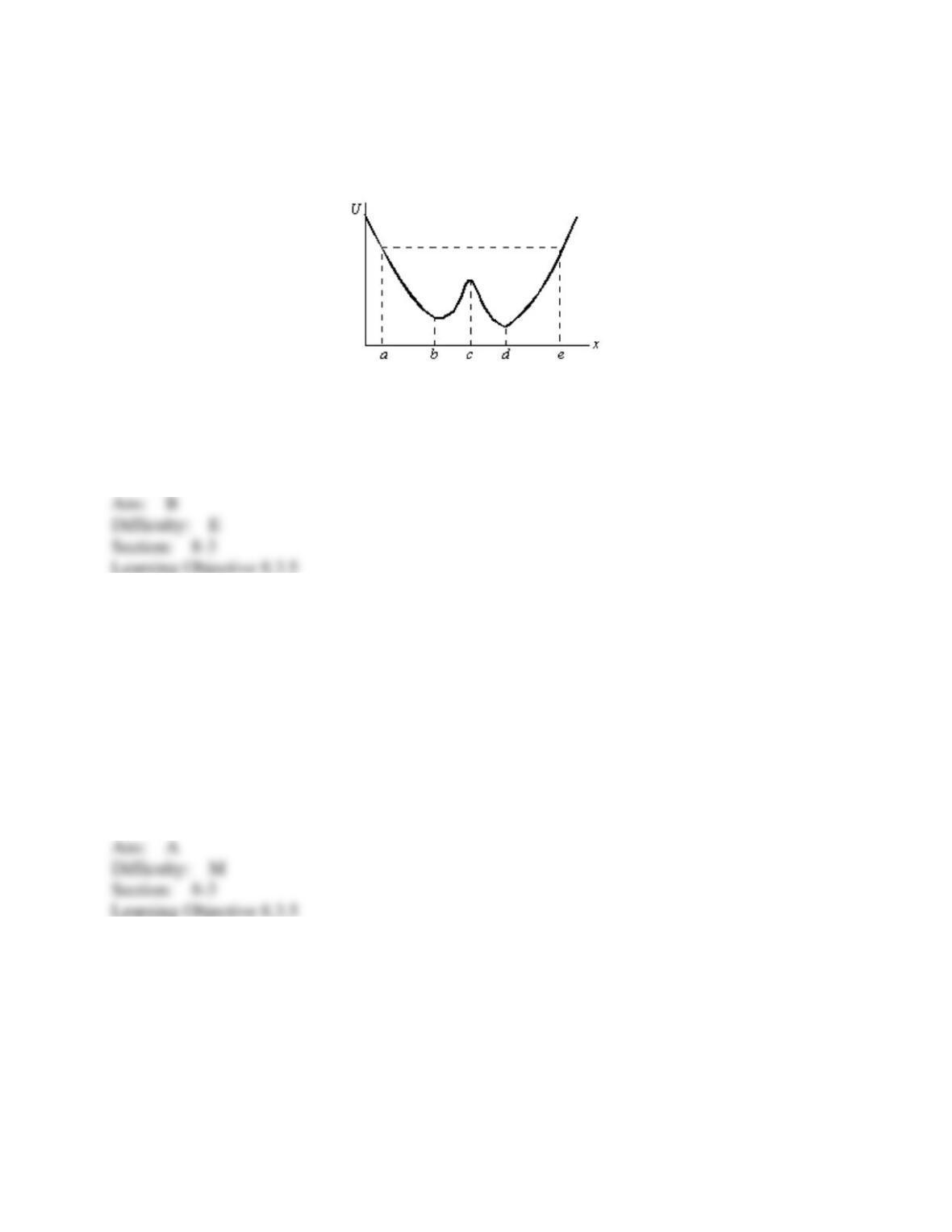
49. A block is released from rest at point P and slides along the frictionless track shown. At
point Q, its speed is:
A) 2𝑔√ℎ1− ℎ2
B) 2g(h1 – h2)
C) (h1 – h2)/2g
D) √2𝑔(ℎ1− ℎ2)
E) (h1 – h2)2/2g
50. A particle is released from rest at the point x = a and moves along the x axis subject to the
potential energy function U(x) shown. The particle:
A) moves to a point to the left of x = e, stops and remains at rest
B) moves to the point x = e, then moves to the left
C) moves to infinity at varying speed
D) moves to x = b where it remains at rest
E) moves to x = e and then to x = d, where it remains at rest
51. The potential energy of a particle moving along the x axis is given by
U(x) = (8.0 J/m2)x2 + (2.0 J/m4)x4.
If the total mechanical energy is 9.0 J, the limits of motion are:
A) –0.96 m; +0.96 m
B) –2.2 m; +2.2 m
C) –1.6 m; +1.6 m
D) –0.96 m; +2.2 m
E) –0.96 m; +1.6 m
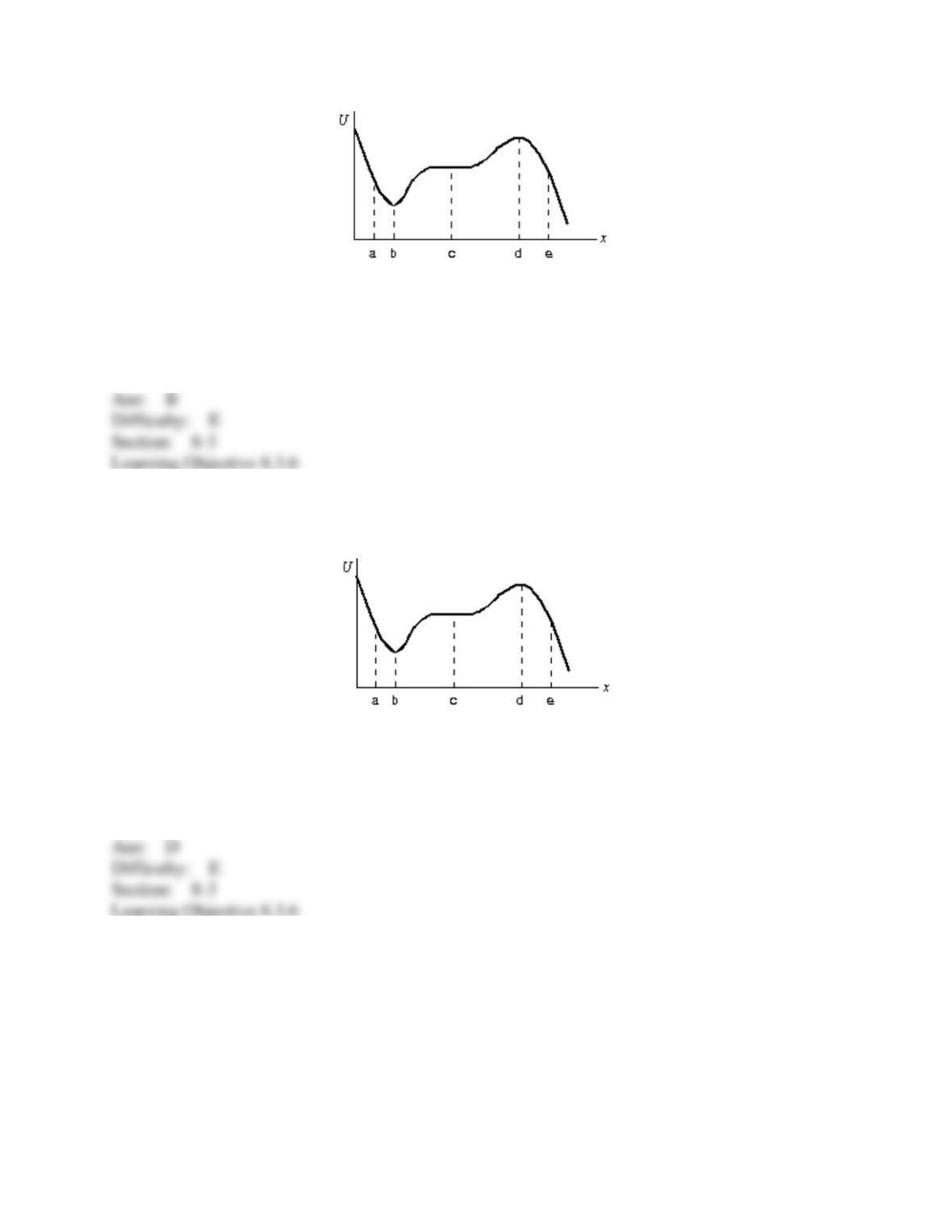
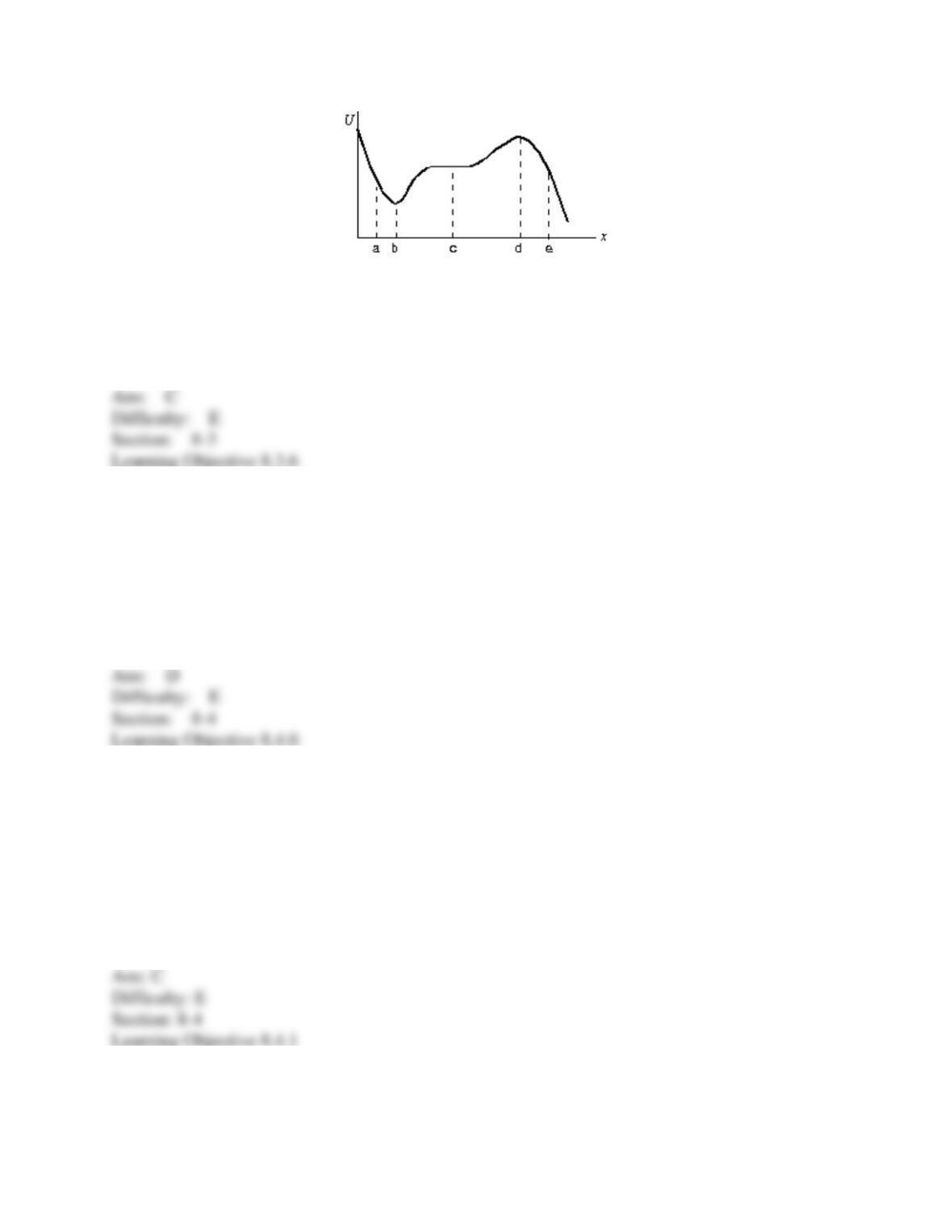
52. The diagram shows a plot of the potential energy as a function of x for a particle moving
along the x axis. The points of stable equilibrium are:
A) only a
B) only b
C) only c
D) only d
E) b and d
53. The diagram shows a plot of the potential energy as a function of x for a particle moving
along the x axis. The points of unstable equilibrium are:
A) only a
B) only b
C) only c
D) only d
E) b and d
54. The diagram shows a plot of the potential energy as a function of x for a particle moving
along the x axis. The points of neutral equilibrium are:
A) only a
B) only b
C) only c
D) only d
E) b and d
55. The thermal energy of a system consisting of a thrown ball, Earth, and the air is most
closely associated with:
A) the gravitational interaction of the Earth and the ball
B) the kinetic energy of the ball as a whole
C) motions of the individual particles within the ball
D) motions of individual particles within the ball and the air
E) the kinetic energy of Earth as a whole
56. A stationary mass m = 1.3 kg is hanging from a spring of spring constant k = 1200 N/m. You
raise the mass a distance of 10 cm above its equilibrium position. How much has the potential
energy of the mass-spring system changed?
A) 1.3 J
B) 6.0 J
C) 7.3 J
D) 12 J
E) 13 J
57. A 2.2-kg block starts from rest on a rough inclined plane that makes an angle of 25 with
the horizontal. The coefficient of kinetic friction is 0.25. As the block goes 2.0 m down the
plane, the mechanical energy of the Earth-block system changes by:
A) 0 J
B) –9.8 J
C) 9.8 J
D) –18 J
E) 18 J
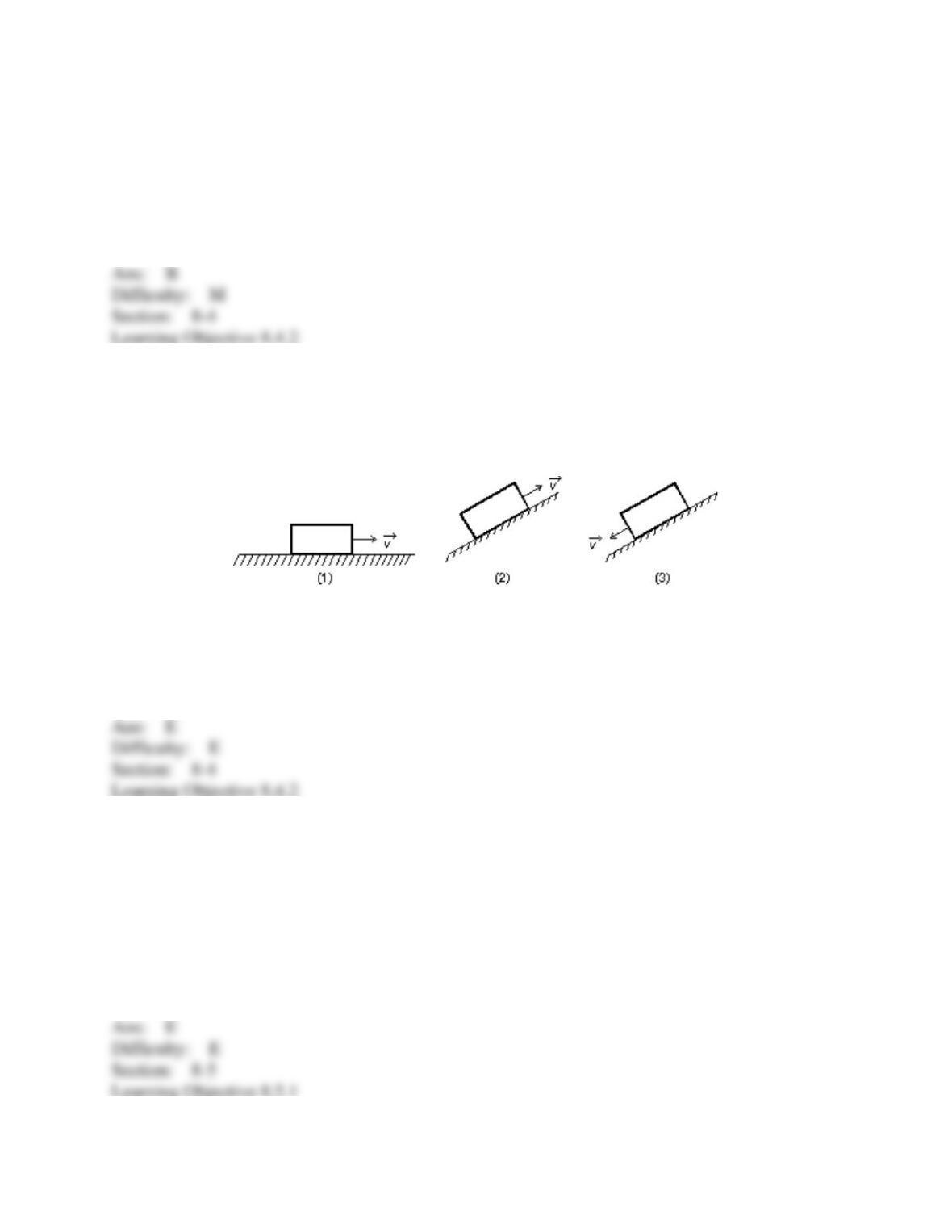
58. Three identical blocks move either on a horizontal surface, up a plane, or down a plane, as
shown below. They all start with the same speed and continue to move until brought to rest by
friction. Rank the three situations according to the mechanical energy dissipated by friction, least
to greatest.
A) The same for all cases
B) 1, 2, 3
C) 1, then 2 and 3 tie
D) 3, 1, 2
E) 2, 1, 3
59. Objects A and B interact with each other via both conservative and nonconservative forces.
Let KA and KB be the kinetic energies, U be the potential energy, and Eint be the internal energy.
If no external agent does work on the objects then:
A) KA + U is conserved
B) KA + U + Eint is conserved
C) KA + KB + Eint is conserved
D) KA + KB + U is conserved
E) KA + KB + U + Eint is conserved
60. A block slides across a rough horizontal table top. The work done by friction changes:
A) only the kinetic energy
B) only the potential energy
C) only the thermal energy
D) only the kinetic and potential energies
E) only the kinetic and thermal energies
61. A 25-g ball is released from rest 80 m above the surface of the Earth. During the fall the
total thermal energy of the ball and air increases by15 J. Just before it hits the surface its speed
is
A) 19 m/s
B) 35 m/s
C) 40 m/s
D) 45 m/s
E) 53 m/s
62. A 5-kg projectile is fired over level ground with a velocity of 200 m/s at an angle of 25
above the horizontal. Just before it hits the ground its speed is 150 m/s. Over the entire trip the
change in the thermal energy of the projectile and air is:
A) +6300 J
B) –6300 J
C) +44,000 J
D) –44,000 J
E) 0 J
63. A 0.75-kg block slides on a rough horizontal table top. Just before it hits a horizontal ideal
spring its speed is 3.5 m/s. It compresses the spring 5.7 cm before coming to rest. If the spring
constant is 1200 N/m, the thermal energy of the block and the table top must have:
A) not changed
B) decreased by 1.9 J
C) decreased by 2.6 J
D) increased by 1.9 J
E) increased by 2.6 J
64. A stationary mass m = 1.3 kg is hanging from a spring of spring constant k = 1200 N/m. You
raise the mass a distance of 10 cm above its equilibrium position in a time of 1.4 s. What was the
average power expended?
A) 0.93 W
B) 4.3 W
C) 5.2 W
D) 8.6 W
E) 10.2 W
65. The energy of a system increases at a rate of 3.5 t + 6.2 t2, in joules. What is the
instantaneous power at t = 3.1 s?
A) 3.5 W
B) 6.2 W
C) 16 W
D) 42 W
E) 70 W