Chapter: Chapter 40
Learning Objectives
LO 40.1.0 Solve problems related to properties of atoms.
LO 40.1.1 Discuss the pattern that is seen in a plot of ionization energies versus atomic number
Z.
LO 40.1.2 Identify that atoms emit and absorb light and have angular momentum and magnetism
LO 40.1.3 Explain the Einstein–de Haas experiment, including the principle of the conservation
of angular momentum.
LO 40.1.4 Identify the five quantum numbers of an electron in an atom and the allowed values of
each.
LO 40.1.5 Determine the number of electron states allowed in a given shell and subshell.
LO 40.1.6 Identify that an electron in an atom has an orbital angular momentum 𝐿
⃗
and an
orbital magnetic dipole moment 𝜇 𝑜𝑟𝑏.
LO 40.1.7 Calculate magnitudes for orbital angular momentum 𝐿
⃗
and orbital magnetic dipole
moment 𝜇 𝑜𝑟𝑏 in terms of the orbital quantum number ℓ.
LO 40.1.8 Apply the relationship between orbital angular momentum 𝐿
⃗
and orbital magnetic
dipole moment 𝜇 𝑜𝑟𝑏.
LO 40.1.9 Identity that 𝐿
⃗
and 𝜇 𝑜𝑟𝑏cannot be observed (measured) but a component on a
measurement axis (usually called the z axis) can.
LO 40.1.10 Calculate the z components Lz of an orbital angular momentum 𝐿
⃗
using the orbital
magnetic quantum number mℓ.
LO 40.1.11 Calculate the z components μorb,z of an orbital magnetic dipole moment 𝜇 𝑜𝑟𝑏using
the orbital magnetic quantum number mℓ and the Bohr magneton μB.
LO 40.1.12 For a given orbital state or spin state, calculate the semiclassical angle θ.
LO 40.1.13 Identify that a spin angular momentum 𝑠 (usually simply called spin) and a spin
magnetic dipole moment 𝜇 𝑠 are intrinsic properties of electrons (and also protons and neutrons).
LO 40.1.14 Calculate magnitudes for spin angular momentum 𝑠 and spin magnetic dipole
moment 𝜇 𝑠 in terms of the spin quantum number s.
LO 40.1.15 Apply the relationship between the spin angular momentum 𝑠 and the spin
magnetic dipole moment 𝜇 𝑠.
LO 40.1.16 Identity that 𝑠 and 𝜇 𝑠cannot be observed (measured) but a component on a
measurement axis can.
LO 40.1.17 Calculate the z components Sz of the spin angular momentum 𝑠 using the spin
magnetic quantum number ms.
LO 40.1.18 Calculate the z components μs,z of the spin magnetic dipole moment 𝜇 𝑠using the spin
magnetic quantum number ms and the Bohr magneton μB.
LO 40.1.19 Identify the effective magnetic dipole moment of an atom.
LO 40.2.0 Solve problems related to the Stern–Gerlach experiment.
LO 40.2.1 Sketch the Stern–Gerlach experiment and explain the type of atom required, the
anticipated result, the actual result, and the importance of the experiment.
LO 40.2.2 Apply the relationship between the magnetic field gradient and the force on an atom
in a Stern–Gerlach experiment.
LO 40.3.0 Solve problems related to magnetic resonance.
LO 40.3.1 For a proton in a magnetic field, sketch the field vector and the proton’s magnetic
moment vector for the lower energy state and the upper energy state and then include the labels
of spin up and spin down.
LO 40.3.2 For a proton in a magnetic field, calculate the energy difference between the two spin
states and find the photon frequency and wavelength required for a transition between the states.
LO 40.3.3 Explain the procedure of producing a nuclear magnetic resonance spectrum.
LO 40.4.0 Solve problems related to the exclusion principle and multiple electrons in a trap.
LO 40.4.1 Identify the Pauli exclusion principle.
LO 40.4.2 Explain the procedure for placing multiple electrons in traps of one, two, and three
dimensions, including the need to obey the exclusion principle and to allow for degenerate states,
and explain the terms empty, partially occupied, and fully occupied.
LO 40.4.3 For a system of multiple electrons in traps of one, two, and three dimensions,
produce energy-level diagrams.
LO 40.5.0 Solve problems related to building the periodic table.
LO 40.5.1 Identify that all states in a subshell have the same energy that is determined primarily
by quantum number n but to a lesser extent by quantum number ℓ.
LO 40.5.2 Identify the labeling system for the orbital angular momentum quantum number.
LO 40.5.3 Identify the procedure for filling up the shells and subshells in building up the
periodic table for as long as the electron-electron interaction can be neglected.
LO 40.5.4 Distinguish the noble gases from the other elements in terms of chemical interactions,
net angular momentum, and ionization energy.
LO 40.5.5 For a transition between two given atomic energy levels, for either emission or
absorption of light, apply the relationship between the energy difference and the frequency and
wavelength of the light.
LO 40.6.0 Solve problems related to X rays and the ordering of the elements.
LO 40.6.1 Identify where x rays are located in the electromagnetic spectrum.
LO 40.6.2 Explain how x rays are produced in a laboratory or medical setting.
LO 40.6.3 Distinguish between a continuous x-ray spectrum and a characteristic x-ray spectrum.
LO 40.6.4 In a continuous x-ray spectrum, identify the cause of the cutoff wavelength λmin.
LO 40.6.5 Identify that in an electron–atom collision, energy and momentum are conserved.
LO 40.6.6 Apply the relationship between a cutoff wavelength λmin and the kinetic energy K0 of
the incident electrons.
LO 40.6.7 Draw an energy-level diagram for holes and identify (with labels) the transitions that
produce x rays.
LO 40.6.8 For a given hole transition, calculate the wavelength of the emitted x ray.
LO 40.6.9 Explain the importance of Moseley’s work with regard to the periodic table.
LO 40.6.10 Sketch a Moseley plot.
LO 40.6.11 Describe the screening effect in a multielectron atom.
LO 40.6.12 Apply the relationship between the frequency of the emitted K-alpha x rays and the
atomic number Z of the atoms.
LO 40.7.0 Solve problems related to lasers.
LO 40.7.1 Distinguish the light of a laser from the light of a common light bulb.
LO 40.7.2 Sketch energy-level diagrams for the three basic ways that light can interact with
matter (atoms) and identify which is the basis of lasing.
LO 40.7.3 Identify metastable states.
LO 40.7.4 For two energy states, apply the relationship between the relative number of atoms in
the higher state due to thermal agitation, the energy difference, and the temperature.
LO 40.7.5 Identify population inversion, explain why it is required in a laser, and relate it to the
lifetimes of the states.
LO 40.7.6 Discuss how a helium–neon laser works, pointing out which gas lases and explaining
why the other gas is required.
LO 40.7.7 For stimulated emission, apply the relationships between energy change, frequency,
and wavelength.
LO 40.7.8 For stimulated emission, apply the relationships between energy, power, time,
intensity, area, photon energy, and rate of photon emission.
Multiple Choice
1. The Einstein–de Haas experiment showed that:
A) atoms emit and absorb light, but only of certain wavelengths.
B) atoms have momentum, and momentum is conserved.
C) atoms have electric fields, and electric fields can cause their energy levels to split.
D) atoms have magnetic dipole moments that are coupled to their angular momentum.
E) a gradient in a magnetic field will cause a beam of atoms to split.
2. The magnitude of the orbital angular momentum of an electron is what multiple of ℏ? (ℓ is a
positive integer.)
A) 1
B) 1/2
C) √ℓ(ℓ + 1)
D) 2ℓ+1
E) ℓ2
3. The magnetic quantum number mℓ is most closely associated with what property of the
electron in an atom?
A) Magnitude of the orbital angular momentum
B) Energy
C) z component of the spin angular momentum
D) z component of the orbital angular momentum
E) Radius of the orbit
4. The quantum number ms is most closely associated with what property of the electron in an
atom?
A) Magnitude of the orbital angular momentum
B) Energy
C) z component of the spin angular momentum
D) z component of the orbital angular momentum
E) Radius of the orbit
5. Possible values of the principal quantum number n for an electron in an atom are:
A) only 0 and 1
B) only 0,1,2,…,
C) only 0,1,…, ℓ−1
D) only 1/2 and –1/2
E) only 1,2,3,…,
6. The number of values of the orbital quantum number ℓ associated with the principal
quantum number n = 3 is:
A) 1
B) 2
C) 3
D) 4
E) 7
7. The number of possible values of the magnetic quantum number mℓ associated with a given
value of the orbital quantum number ℓ is:
A) 1
B) 2
C) ℓ
D) 2 ℓ
E) 2 ℓ +1
8. An atom is in a state with orbital quantum number ℓ=2. Possible values of the magnetic
quantum number mℓ are:
A) 1, 2
B) 0, 1, 2
C) 0, 1
D) –1, 0, 1
E) –2, –1, 0, 1, 2
9. An electron is in a quantum state for which the magnitude of the orbital angular momentum
is 6√2ℏ. How many allowed values of the z component of the angular momentum are there?
A) 7
B) 8
C) 16
D) 17
E) 20
10. An electron in an atom is in a state with principal quantum number n = 4. The possible
values of the orbital quantum number ℓ are:
A) 1, 2, 3
B) 1, 2, 3, 4
C) –3, –2, –1, 0, 1, 2, 3
D) 0, 1, 2, 3
E) 0, 1, 2
11. The possible values for the magnetic quantum number ms of an electron in an atom:
A) depend on n
B) depend on ℓ
C) depend on both n and ℓ
D) depend on whether or not there is an external magnetic field present
E) are 1/2
12. The number of states in a subshell with orbital quantum number ℓ=3 is:
A) 2
B) 3
C) 7
D) 9
E) 14
13. The number of states in a shell with principal quantum number n = 3 is:
A) 3
B) 8
C) 9
D) 18
E) 32
14. The electron states in an atom which constitute a single shell all have:
A) the same value of n
B) the same value of ℓ
C) the same value of n and the same value of ℓ
D) the same value of ℓ and the same value of mℓ
E) the same set of all four quantum numbers
15. The electron states in an atom which constitute a single subshell all have:
A) only the same value of n
B) only the same value of ℓ
C) only the same value of n and the same value of ℓ
D) only the same value of ℓ and the same value of mℓ
E) the same set of all four quantum numbers
16. The total number of electron states with n = 2 and ℓ=1 for an atom is:
A) 2
B) 4
C) 6
D) 8
E) 10
17. An electron is in a quantum state for which there are seven allowed values of the z
component of the angular momentum. The magnitude of the angular momentum is:
A) √3ℏ
B) √7ℏ
C) √9ℏ
D) √12ℏ
E) √14ℏ
18. The magnitude of the orbital magnetic dipole moment 𝜇 𝑜𝑟𝑏 of an atom is (
B is the Bohr
magneton, and ℓ is a positive integer):
A)
B
B)
B ℓ
C)
B√ℓ(ℓ + 1)
D)
B (2ℓ+1)
E)
B ℓ2
19. Space quantization means that:
A) space is quantized
B) Lz can have only certain discrete values
C) 𝐿
⃗
and 𝜇 are in the same direction
D) 𝐿
⃗
and 𝜇 are in opposite directions
E) an electron has a magnetic dipole moment
20. The quantity Lz is related to the quantum number mℓ by:
A) Lz = mℓ
B) Lz = mℓ ℏ
C) Lz = mℓ ℏ/2𝜋
D) Lz = √𝑚ℓ(𝑚ℓ+ 1)ℏ
E) Lz = √𝑚ℓ(𝑚ℓ+ 1)
21. In the relation µz=−mℓµB, the quantity
B is:
A) the Bohr magneton
B) the component of the dipole moment along the magnetic field
C) the permeability of the material
D) a friction coefficient
E) none of the above
22. An electron in an atom is in a state with ℓ=3 and mℓ =2. The angle between 𝐿
⃗
and the z
axis is:
A) 30
B) 35.3
C) 48.2
D) 54.7
E) 60
23. An electron in an atom is in a state with ℓ=5. The minimum angle between 𝐿
⃗
and the z
axis is:
A) 0
B) 18.0
C) 24.1
D) 33.6
E) 36.7
24. The magnitude of the spin magnetic dipole moment 𝜇 𝑠 of an atom is (
B is the Bohr
magneton, and s is a positive number):
A)
B
B)
B s
C)
B√𝑠(𝑠 + 1)
D) 2
B√𝑠(𝑠 + 1)
E) 2
B s
25. The quantity sz is related to the quantum number ms by:
A) sz = ms
B) sz = ms ℏ
C) sz = ms ℏ/2𝜋
D) sz = √𝑚𝑠(𝑚𝑠+ 1)ℏ
E) sz = √𝑚𝑠(𝑚𝑠+ 1)
26. The Stern-Gerlach experiment makes use of:
A) a strong uniform magnetic field
B) a strong non-uniform magnetic field
C) a strong uniform electric field
D) a strong non-uniform electric field
E) strong perpendicular electric and magnetic fields
27. A magnetic dipole 𝜇 is placed in a strong uniform magnetic field 𝐵
⃗
. The associated force
exerted on the dipole is:
A) along 𝜇
B) along −𝜇
C) along 𝐵
⃗
D) along 𝜇 × 𝐵
⃗
E) zero
28. The magnetic field 𝐵
⃗
is along the z axis in a Stern-Gerlach experiment. The force it exerts
on a magnetic dipole with dipole moment 𝜇 is proportional to:
A) 𝜇𝑧
2
B) B2
C) dB/dz
D) d2B/dz2
E) B dz
29. The force exerted on a magnetic dipole as it moves with velocity 𝑣 through a
Stern-Gerlach apparatus is:
A) proportional to v
B) proportional to 1/v
C) zero
D) proportional to v2
E) independent of v
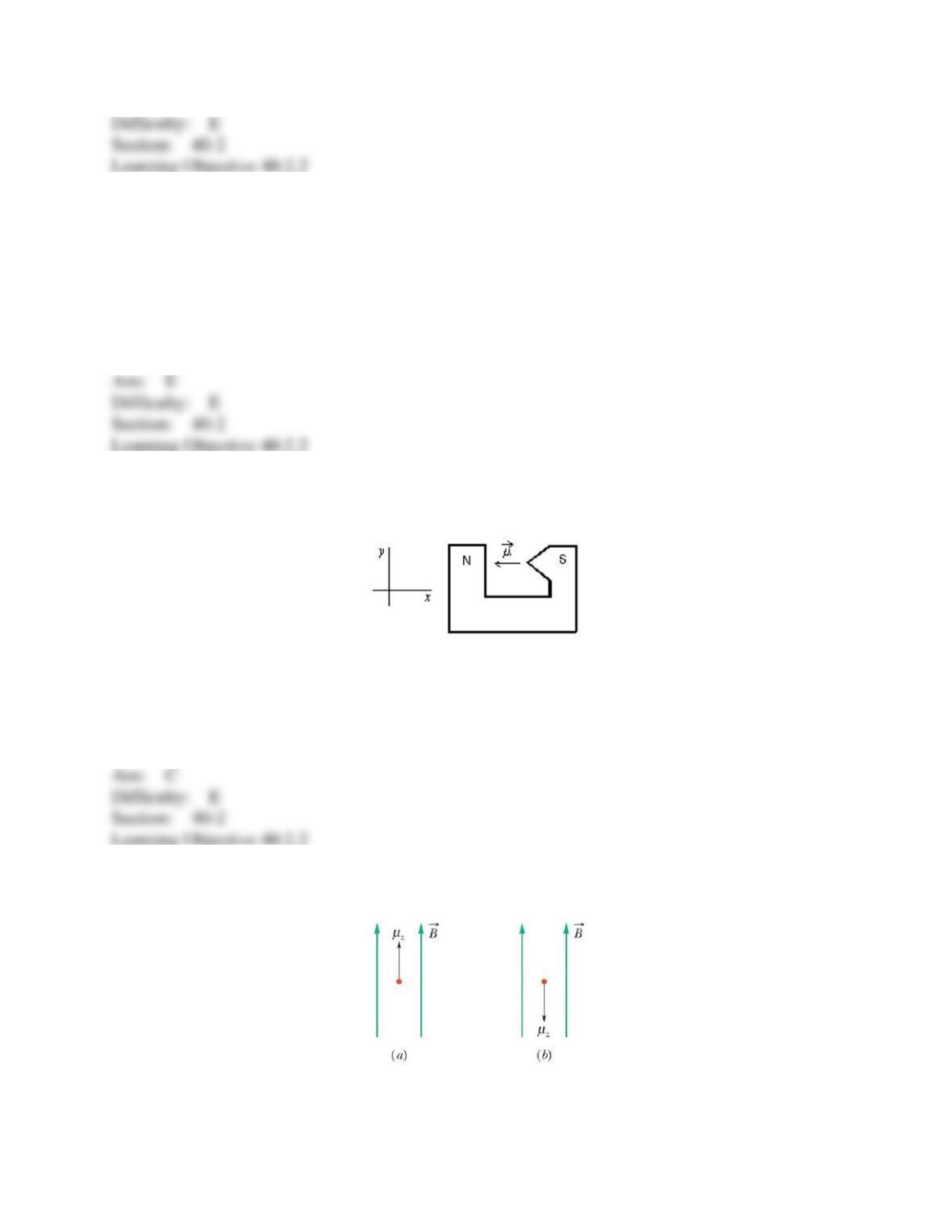
30. A magnetic dipole is placed between the poles of a magnet as shown. The direction of the
associated force exerted on the dipole is:
A) positive x
B) positive y
C) negative x
D) negative y
E) into or out of the page
31. The figure shows two different orientations of a proton in a magnetic field. Which orientation
is at higher energy?
A) a
B) b
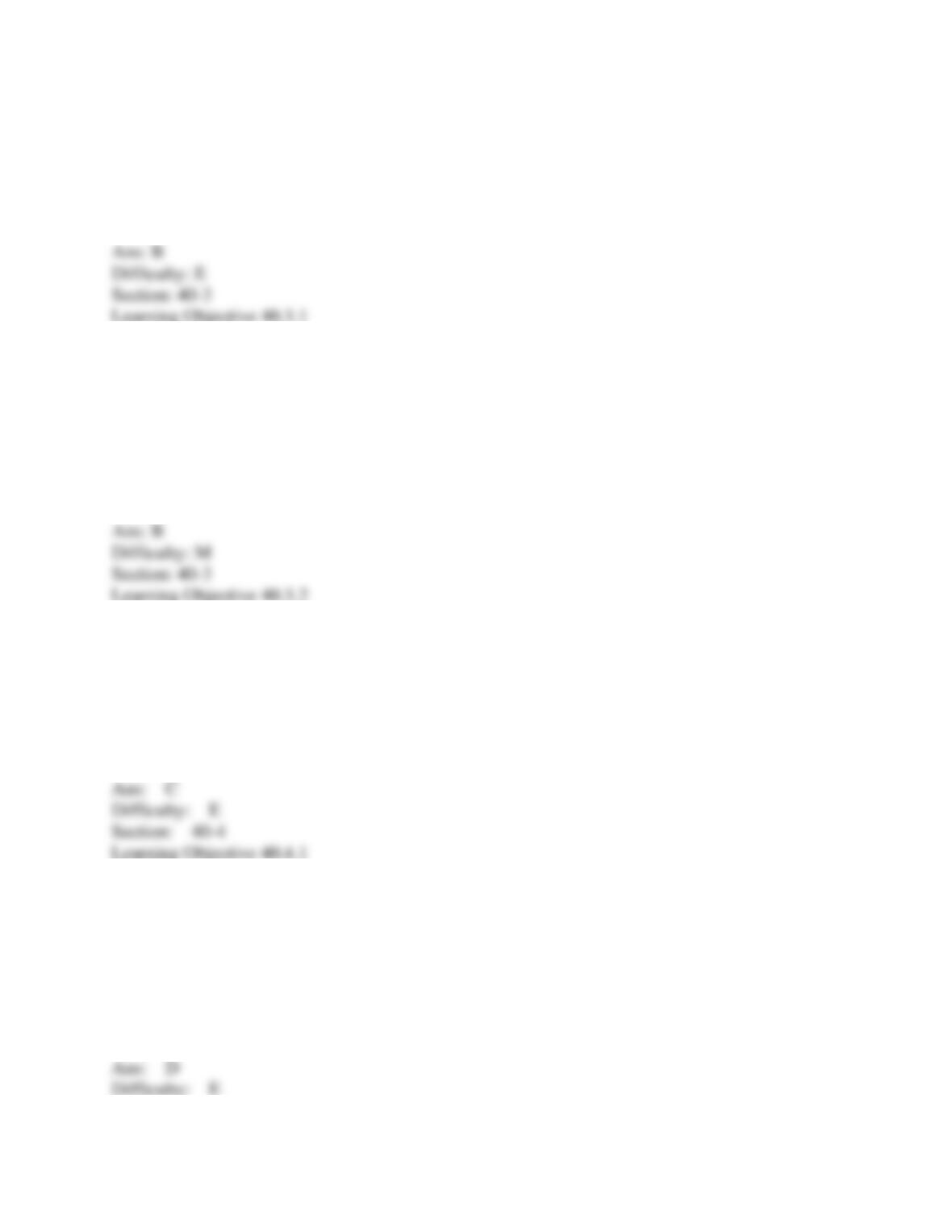
C) Both are at the same energy, and there is no other orientation at higher energy.
D) Both are at the same energy, but if the spin vector were perpendicular to the magnetic field
the energy would be higher.
E) Both are at the same energy, but if the spin vector were perpendicular to the magnetic field
the energy would be lower.
32. Hydrogen atoms are in a magnetic field of 2.0 T. What is their magnetic resonance
frequency?
A) 2.8 x 10¹⁰ Hz
B) 5.6 x 10¹⁰ Hz
C) 1.1 x 10¹¹ Hz
D) 1.8 x 10¹¹ Hz
E) 3.5 x 10¹¹ Hz
33. The Pauli exclusion principle is obeyed by:
A) all particles
B) all charged particles
C) all particles with spin quantum numbers of 1/2
D) all particles with spin quantum numbers of 1
E) all particles with mass
34. No state in an atom can be occupied by more than one electron. This is most closely related
to the:
A) wave nature of matter
B) finite value for the speed of light
C) Bohr magneton
D) Pauli exclusion principle
E) the Einstein-de Haas effect
35. Electrons are in a two-dimensional square potential energy well with sides of length L.
The potential energy is infinite at the sides and zero inside. The single-particle energies are
given by (ℎ2/8𝑚𝐿2)(𝑛𝑥
2+ 𝑛𝑦
2), , where nx and ny are integers. At most the number of electrons
that can have energy 8(h2/8mL2) is:
A) 1
B) 2
C) 3
D) 4
E) any number
36. Five electrons are in a two-dimensional square potential energy well with sides of length L.
The potential energy is infinite at the sides and zero inside. The single-particle energies are
given by (ℎ2/8𝑚𝐿2)(𝑛𝑥
2+ 𝑛𝑦
2) where nx and ny are integers. The energy of the ground state
of the system is
A) 0
B) 10 (h2/8mL2)
C) 19 (h2/8mL2)
D) 24 (h2/8mL2)
E) 48 (h2/8mL2)
37. Five electrons are in a two-dimensional square potential energy well with sides of length L.
The potential energy is infinite at the sides and zero inside. The single-particle energies are
given by (ℎ2/8𝑚𝐿2)(𝑛𝑥
2+ 𝑛𝑦
2) where nx and ny are integers. The energy of the first excited
state of the system is:
A) 13 (h2/8mL2)
B) 22 (h2/8mL2)
C) 24 (h2/8mL2)
D) 25 (h2/8mL2)
E) 27 (h2/8mL2)