Chapter: Chapter 29
Learning Objectives
LO 29.1.0 Solve problems related to magnetic fields due to currents.
LO 29.1.1 Sketch a current-length element in a wire and indicate the direction of the magnetic
field that it sets up at a given point near the wire.
LO 29.1.2 For a given point near a wire and a given current-element in the wire, determine the
magnitude and direction of the magnetic field due to that element.
LO 29.1.3 Identify the magnitude of the magnetic field set up by a current-length element at a
point in line with the direction of that element.
LO 29.1.4 For a point to one side of a long straight wire carrying current, apply the relationship
between the magnetic field magnitude, the current, and the distance to the point.
LO 29.1.5 For a point to one side of a long straight wire carrying current, use a right-hand rule to
determine the direction of the field vector.
LO 29.1.6 Identify that around a long, straight wire carrying current, the magnetic field lines
form circles.
LO 29.1.7 For a point to one side of the end of a semi-infinite wire carrying current, apply the
relationship between the magnetic field magnitude, the current, and the distance to the point.
LO 29.1.8 For the center of curvature of a circular arc of wire carrying current, apply the
relationship between the magnetic field magnitude, the current, the radius of curvature, and the
angle subtended by the arc (in radians).
LO 29.1.9 For a point to one side of a short straight wire carrying current, integrate the
Biot-Savart law to find the magnetic field set up at the point by the current.
LO 29.2.0 Solve problems related to force between two parallel currents.
LO 29.2.1 Given two parallel or antiparallel currents, find the magnetic field of the first current
at the location of the second current and then find the force acting on that second current.
LO 29.2.2 Identify that parallel currents attract each other, and antiparallel currents repel each
other.
LO 29.2.3 Describe how a rail gun works.
LO 29.3.0 Solve problems related to Ampere’s law.
LO 29.3.1 Apply Ampere’s law to a loop that encircles current.
LO 29.3.2 With Ampere’s law, use a right-hand rule for determining the algebraic sign of an
encircled current.
LO 29.3.3 For more than one current within an Amperian loop, determine the net current to be
used in Ampere’s law.
LO 29.3.4 Apply Ampere’s law to a long straight wire with current, to find the magnetic field
magnitude inside and outside the wire, identifying that only the current encircled by the
Amperian loop matters.
LO 29.4.0 Solve problems related to solenoids and toroids.
LO 29.4.1 Describe a solenoid and a toroid and sketch their magnetic field lines.
LO 29.4.2 Explain how Ampere’s law is used to find the magnetic field inside a solenoid.
LO 29.4.3 Apply the relationship between a solenoid’s internal magnetic field B, the current i,
and the number of turns per unit length n of the solenoid.
LO 29.4.4 Explain how Ampere’s law is used to find the magnetic field inside a toroid.
LO 29.4.5 Apply the relationship between a toroid’s internal magnetic field B, the current i, the
radius r, and the total number of turns N.
LO 29.5.0 Solve problems related to a current-carrying coil as a magnetic dipole.
LO 29.5.1 Sketch the magnetic field lines of a flat coil carrying current.
LO 29.5.2 For a current-carrying coil, apply the relationship between the dipole moment
magnitude μ and the coil’s current i, number of turns N, and area per turn A.
LO 29.5.3 For a point along the central axis, apply the relationship between the magnetic field
magnitude B, the magnetic moment μ, and the distance z from the center of the coil.
Multiple Choice
1. Suitable units for
0 are:
A) tesla
B) newton/ampere2
C) weber/meter
D) kilogramampere/meter
E) teslameter/ampere
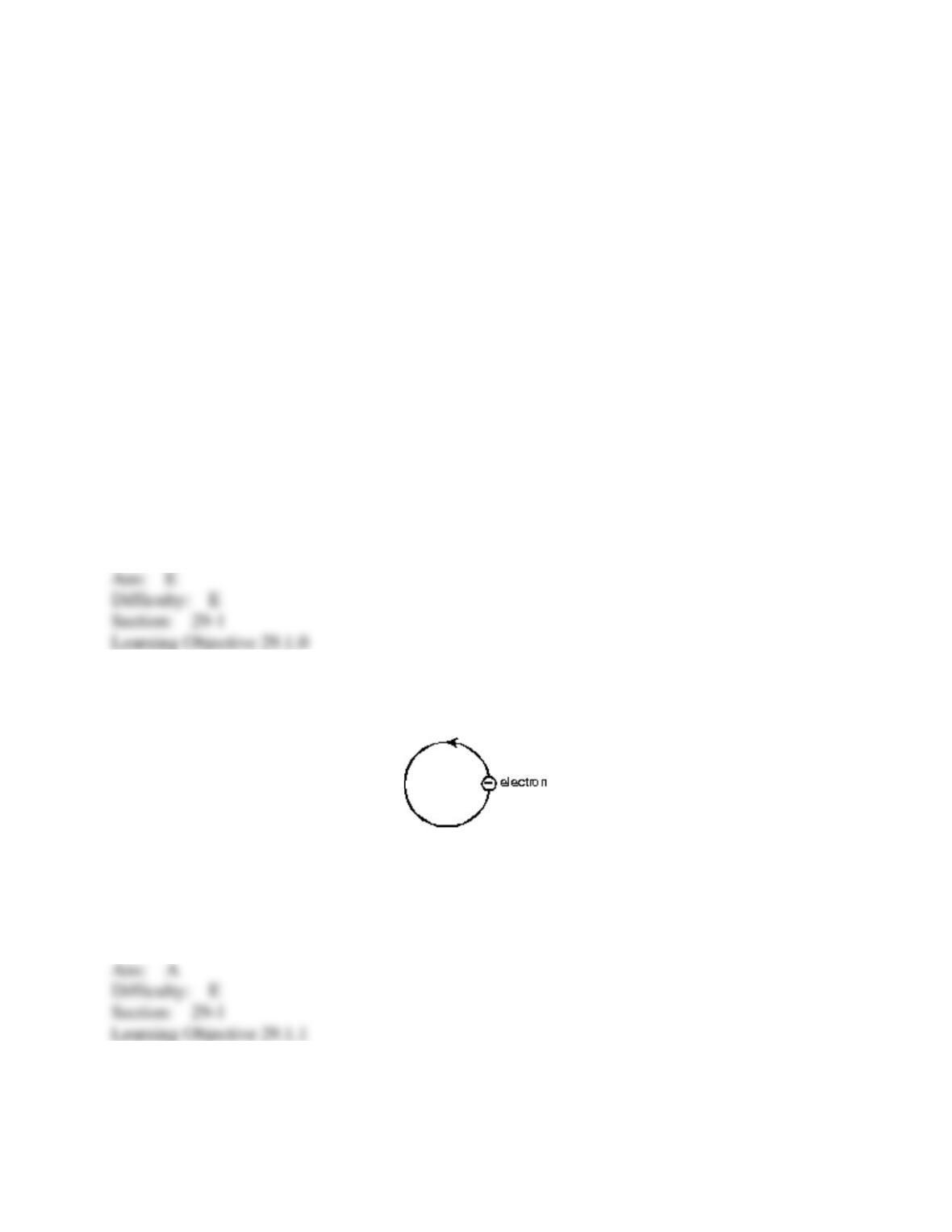
2. Electrons are going around a circle in a counterclockwise direction as shown. At the center
of the circle they produce a magnetic field that is:
A) into the page
B) out of the page
C) to the left
D) to the right
E) zero
3. In the figure, the current element 𝑖𝑑ℓ
⃗
, the point P, and the three vectors (1, 2, 3) are all in
the plane of the page. The direction of 𝑑𝐵
⃗
, due to this current element, at the point P is:
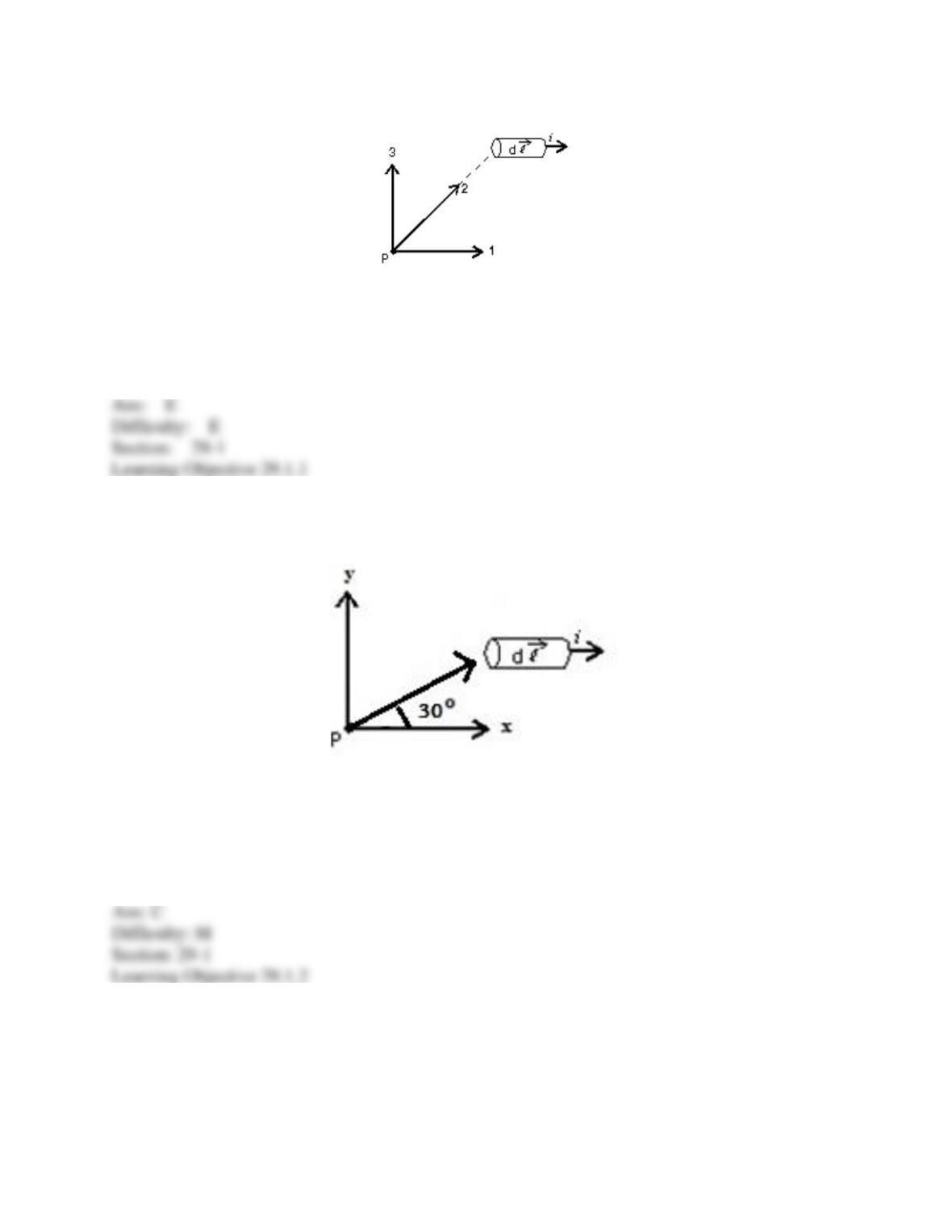
A) in the direction marked “1”
B) in the direction marked “2”
C) in the direction marked “3”
D) out of the page
E) into the page
4. In the figure, if the current element has a length of 1.0 mm, carries a current of 2.5 A, and is a
distance of 4.8 cm from the point P, what is the magnitude of the magnetic field at point P?
A) 0 T
B) 2.6 x 10⁻⁹ T
C) 5.4 x 10⁻⁸ T
D) 9.4 x 10⁻⁸ T
E) 1.1 x 10⁻⁷ T
5. The magnetic field outside a long straight current-carrying wire depends on the distance R
from the wire axis according to:
A) R
B) 1/R
C) 1/R2
D) 1/R3
E) 1/R3/2
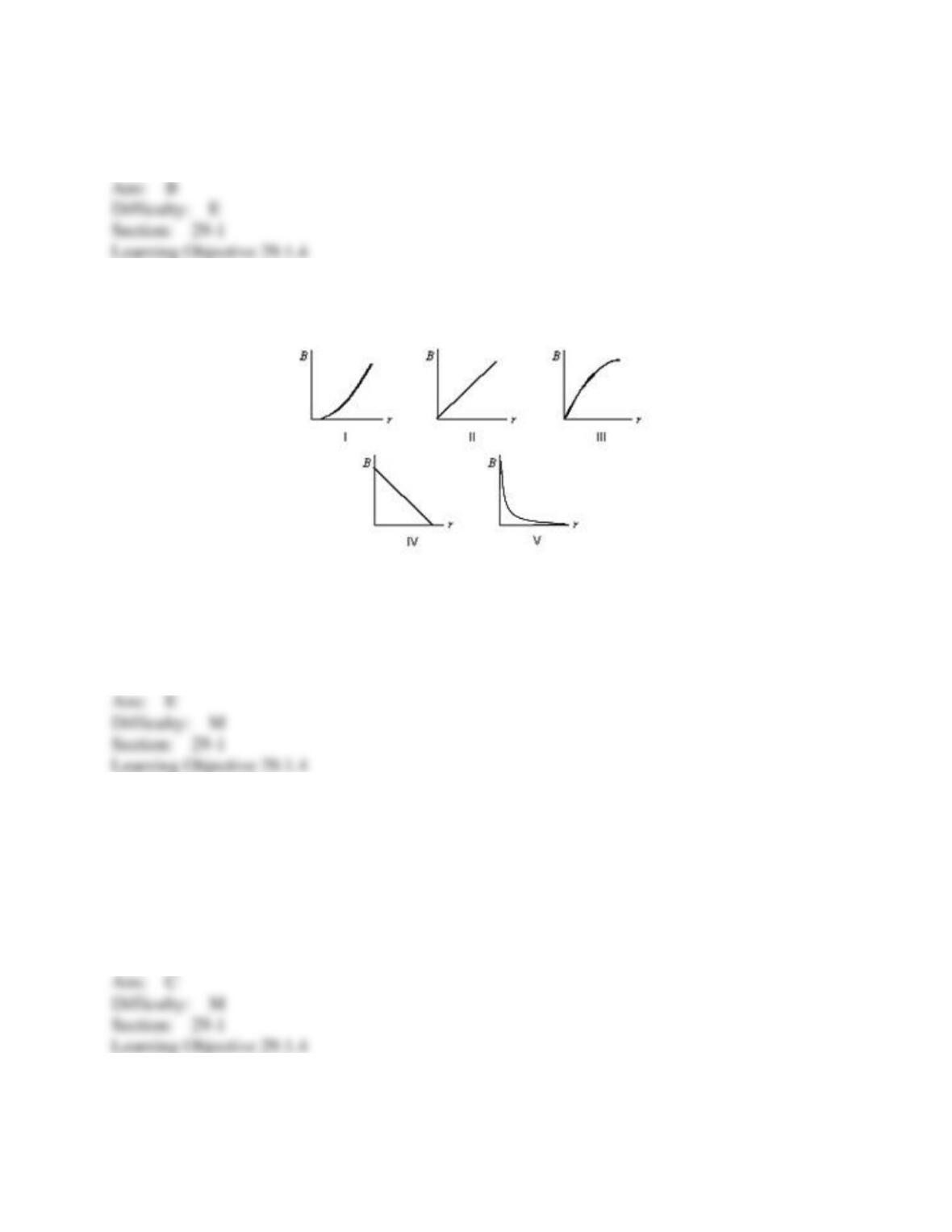
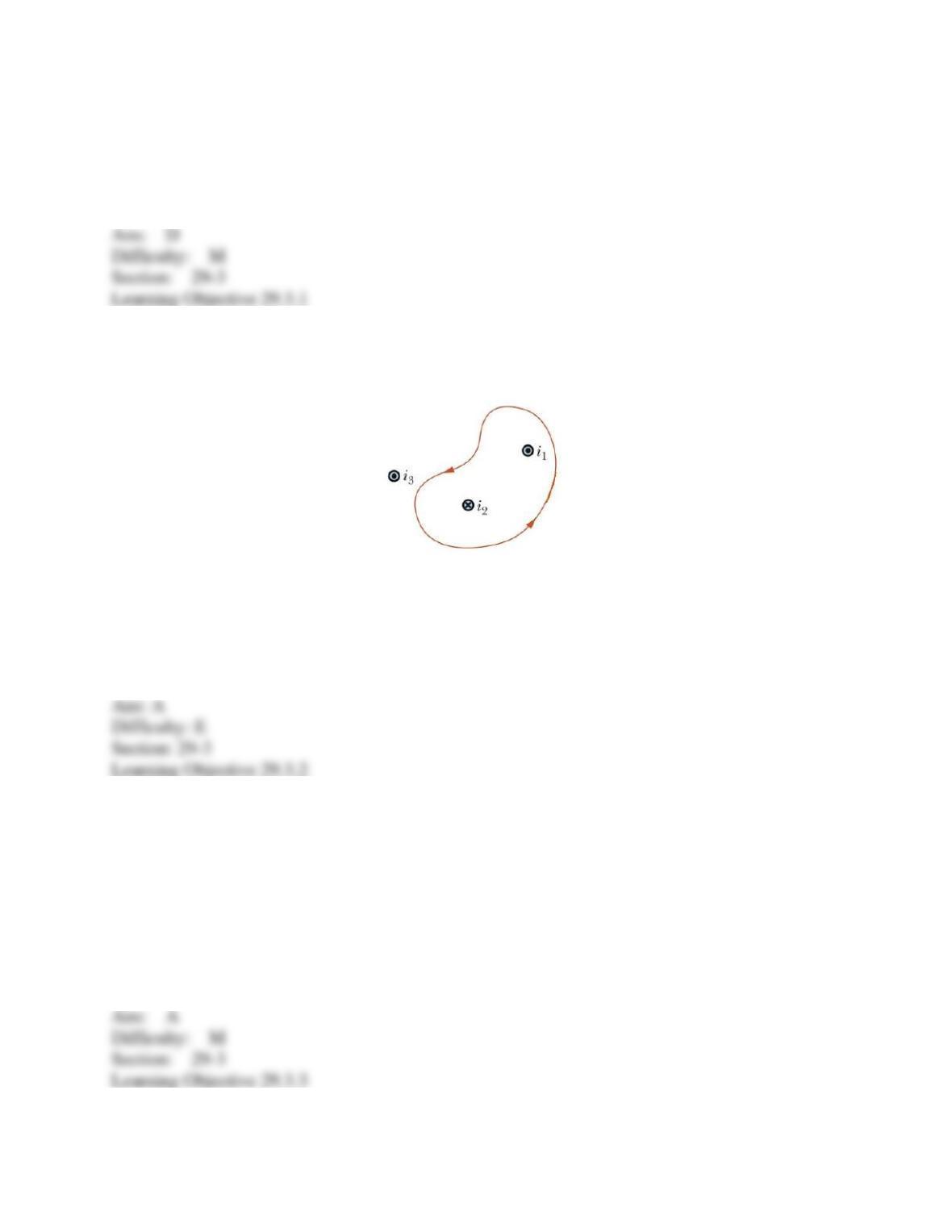
6. Which graph correctly gives the magnitude of the magnetic field outside an infinitely long,
very thin, straight current-carrying wire as a function of the distance r from the wire?
A) I
B) II
C) III
D) IV
E) V
7. The magnetic field a distance 2 cm from a long straight current-carrying wire is 2 10–5 T.
The current in the wire is:
A) 0.16 A
B) 1.0 A
C) 2.0 A
D) 4.0 A
E) 25 A
8. Two long straight wires are parallel and carry current in the same direction. The currents are
8.0 and 12 A and the wires are separated by 0.40 cm. The magnetic field at a point midway
between the wires is:
A) 0 T
B) 4.0 10–4 T
C) 8.0 10–4 T
D) 12 10–4 T
E) 20 10–4 T
9. Two long straight wires are parallel and carry current in opposite directions. The currents are
8.0 A and 12 A and the wires are separated by 0.40 cm. The magnetic field at a point midway
between the wires is:
A) 0 T
B) 4.0 10–4 T
C) 8.0 10–4 T
D) 12 10–4 T
E) 20 10–4 T
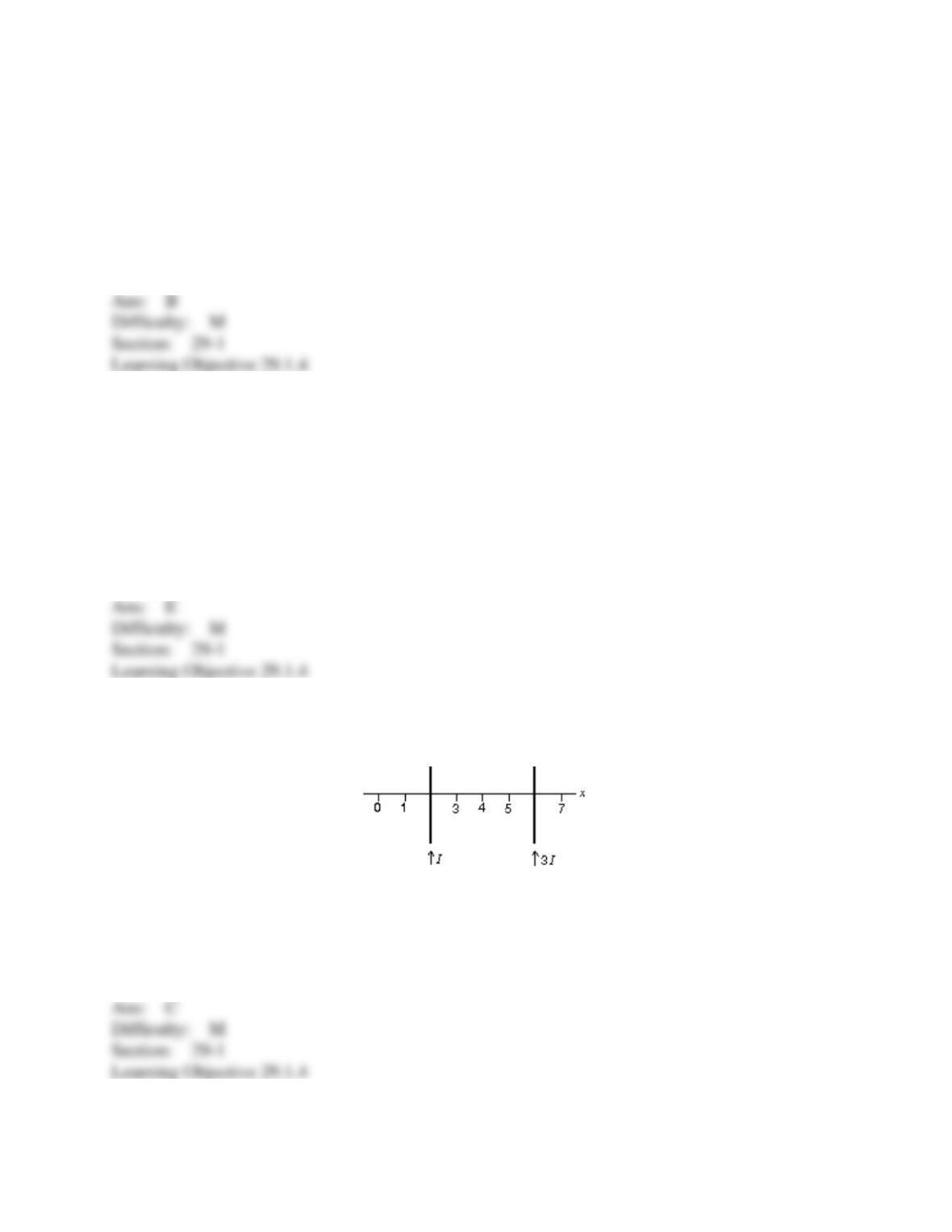
10. Two long straight current-carrying parallel wires cross the x axis and carry currents I and 3I
in the same direction, as shown. At what value of x is the net magnetic field zero?
A) 0
B) 1
C) 3
D) 5
E) 7
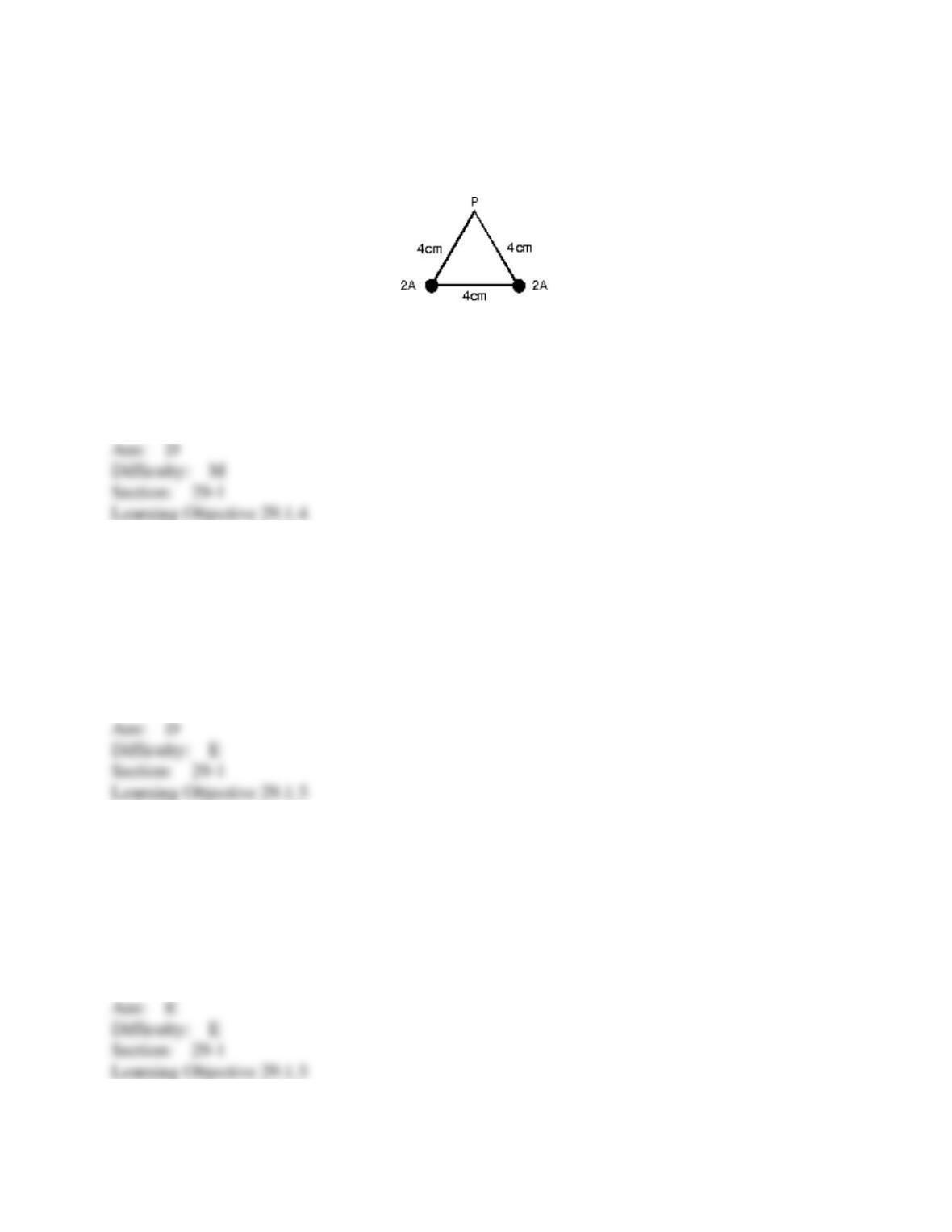
11. Two long straight wires pierce the plane of the paper at vertices of an equilateral triangle as
shown below. They each carry 2.0 A, out of the paper. The magnetic field at the third vertex (P)
has magnitude:
A) 5.0 10–6 T
B) 8.7 10–6 T
C) 1.0 10–5 T
D) 1.7 10–5 T
E) 2.0 10–5 T
12. Two long parallel straight wires carry equal currents in opposite directions. At a point
midway between the wires, the magnetic field they produce is:
A) zero
B) non-zero and along a line connecting the wires
C) non-zero and parallel to the wires
D) non-zero and perpendicular to the plane of the two wires
E) none of the above
13. In an overhead straight wire, the current is north. The magnetic field due to this current, at
our point of observation, is:
A) east
B) up
C) north
D) down
E) west
14. An ordinary magnetic compass is placed flat on the ground. A wire carrying a large current
i from east to west is placed directly above the compass. The end of the compass needle marked
“N” will point:
A) north
B) south
C) east
D) west
E) the compass will act as an electric motor, hence the needle will keep rotating
15. Lines of the magnetic field produced by a long straight wire carrying a current are:
A) in the direction of the current
B) opposite to the direction of the current
C) leave the wire radially
D) circles concentric with the wire
E) lines similar to those produced by a bar magnet
16. A semi-infinite wire runs along the positive y axis, beginning at the origin (x = y = 0) and
extending infinitely far in the +y direction. If the current in the wire is 12 A, what magnetic field
does it create on the x axis at the point x = 3.5 cm?
A) 0 T
B) 3.4 x 10⁻⁵ T
C) 6.9 x 10⁻⁵ T
D) 1.4 x 10⁻⁴ T
E) 4.3 x 10⁻⁴ T
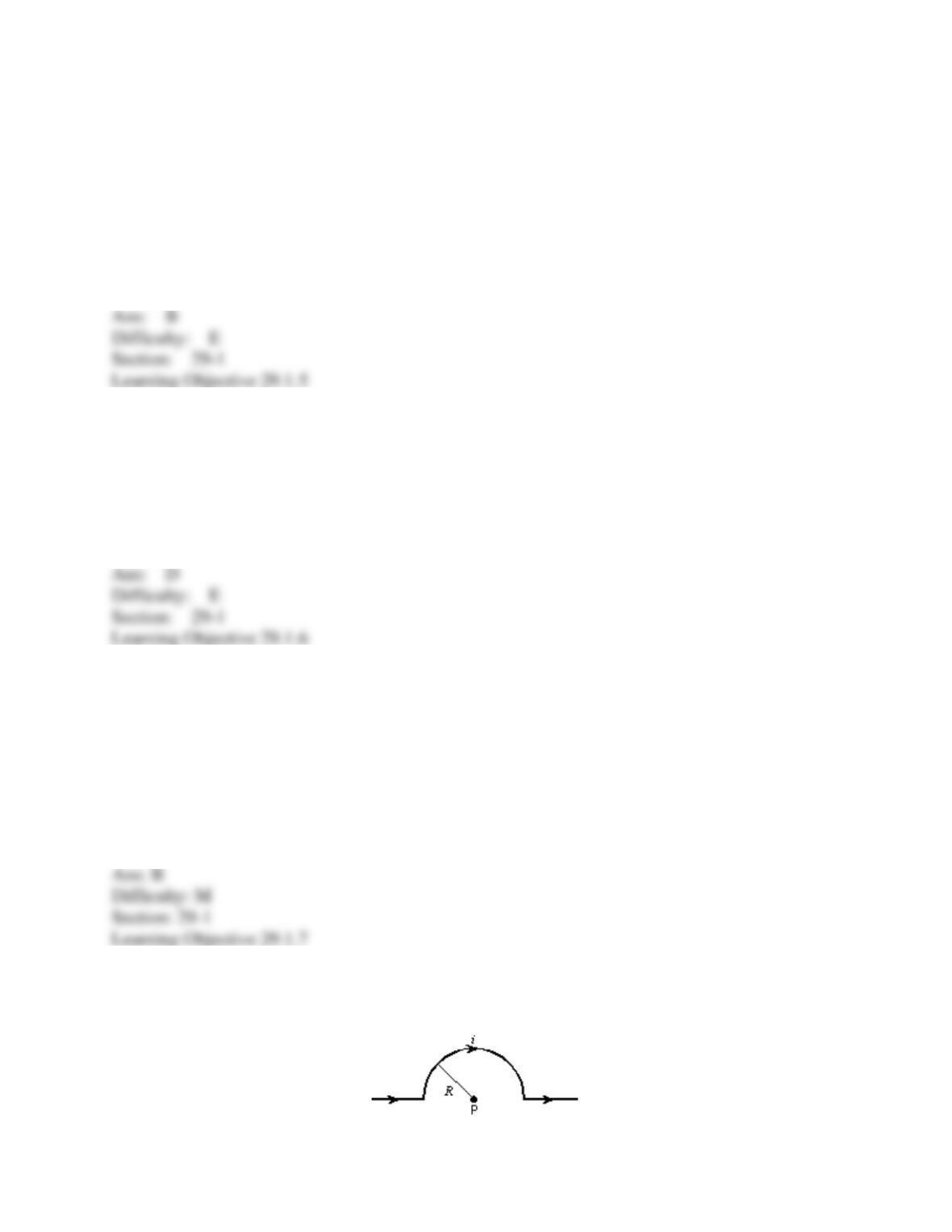
17. The magnitude of the magnetic field at point P, at the center of the semicircle shown, is
given by:
A) 2
0i/R2
B)
0i/2R
C)
0i/4R
D)
0i/2R
E)
0i/4R
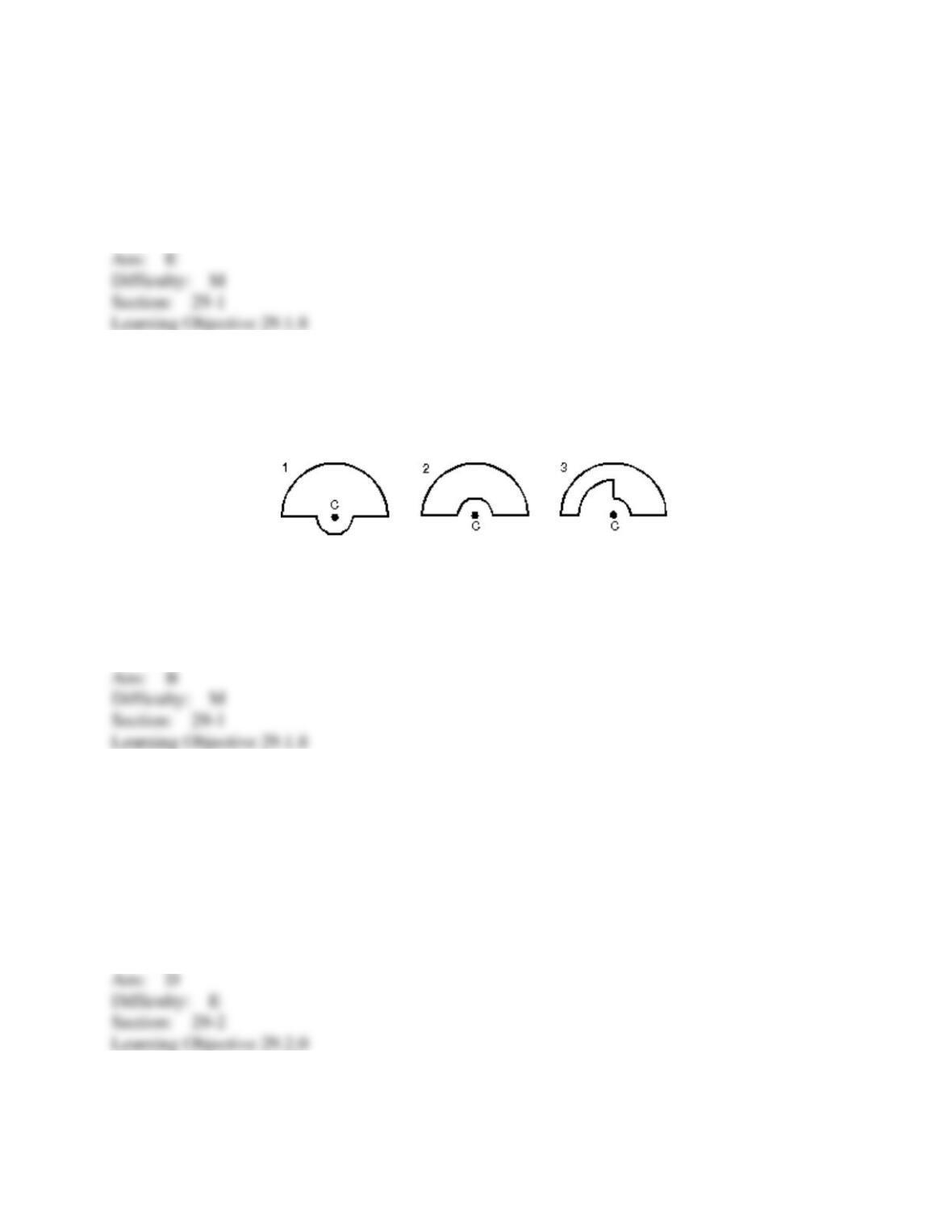
18. The diagrams show three circuits consisting of concentric circular arcs (either half or
quarter circles of radii r, 2r, and 3r) and radial lengths. The circuits carry the same current.
Rank them according to the magnitudes of the magnetic fields they produce at C, least to
greatest.
A) 1, 2, 3
B) 3, 2, 1
C) 1, 3, 2
D) 2, 3, 1
E) 2, 1, 3
19. A coulomb is:
A) one ampere per second
B) the quantity of charge which will exert a force of 1 N on a similar charge at a distance of 1
m
C) the amount of current in each of two long parallel wires separated by 1 m, which produces a
force of 2 10–7 N per meter
D) the amount of charge which flows past a point in one second when the current is 1 A
E) an abbreviation for a certain combination of kilogram, meter and second
20. The diagram shows three equally spaced wires that are perpendicular to the page. The
currents are all equal, two being out of the page and one being into the page. Rank the wires
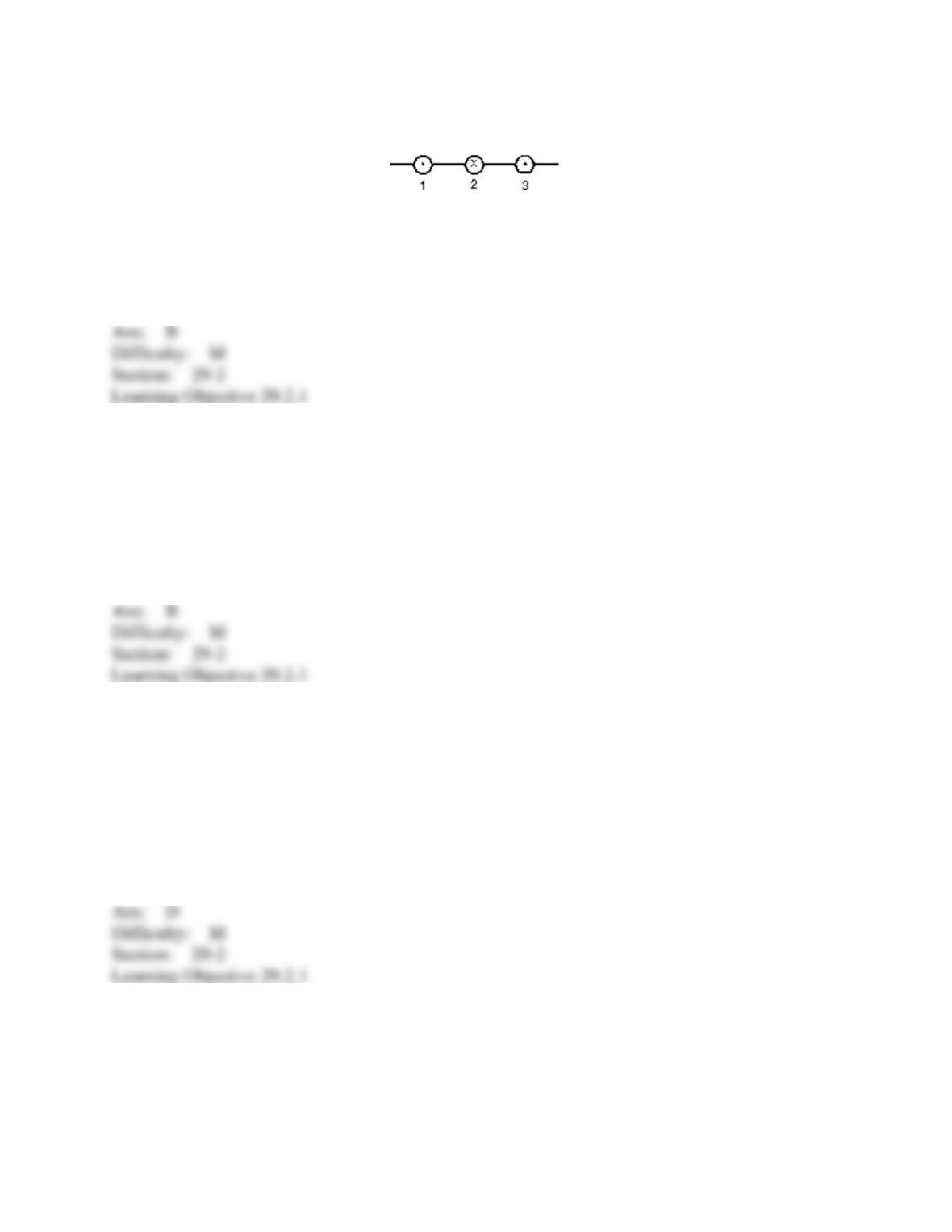
according to the magnitudes of the magnetic forces on them, from least to greatest.
A) 1, 2, 3
B) 2, then 1 and 3 tie
C) 2 and 3 tie, then 1
D) 1 and 3 tie, then 2
E) 3, 2, 1
21. Two parallel wires carrying equal currents of 10 A attract each other with a force of 1 mN.
If both currents are doubled, the force of attraction will be:
A) 0.25 mN
B) 0.5 mN
C) 1 mN
D) 2 mN
E) 4 mN
22. Two parallel long wires carry the same current and repel each other with a force F per unit
length. If both these currents are doubled and the wire separation tripled, the force per unit length
becomes:
A) 2F/9
B) 4F/9
C) 2F/3
D) 4F/3
E) 6F
23. Two parallel wires, 4 cm apart, carry currents of 2 A and 4 A respectively, in the same
direction. The force per unit length of one wire on the other is:
A) 1 10–3 N/m, repulsive
B) 1 10–3 N/m, attractive
C) 4 10–5 N/m, repulsive
D) 4 10–5 N/m, attractive
E) none of these
24. Two parallel wires, 4 cm apart, carry currents of 2 A and 4 A respectively, in opposite
directions. The force per unit length of one wire on the other is:
A) 1 10–3 N/m, repulsive
B) 1 10–3 N/m, attractive
C) 4 10–5 N/m, repulsive
D) 4 10–5 N/m, attractive
E) none of these
25. A constant current is sent through a helical coil made of flexible wire. The coil:
A) tends to get shorter
B) tends to get longer
C) tends to rotate about its axis
D) produces zero magnetic field at its center
E) none of the above
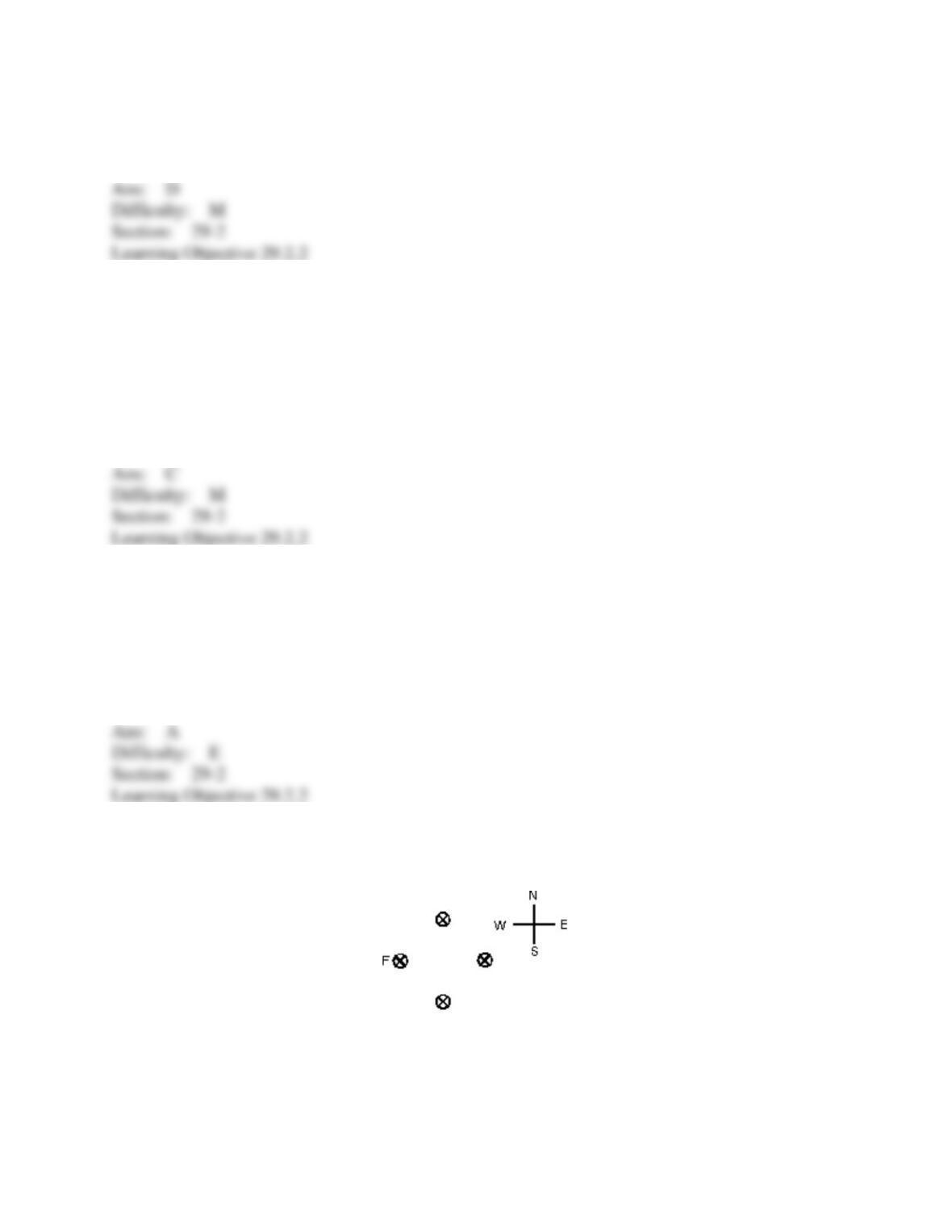
26. Four long straight wires carry equal currents into the page as shown. The magnetic force
exerted on wire F is:
A) north
B) east
C) south
D) west
E) zero
27. In Ampere’s law, ∮𝐵
⃗
∙ 𝑑𝑠 = 𝜇0𝑖, the integration must be over any:
A) surface
B) closed surface
C) path
D) closed path
E) closed path that surrounds all the current producing 𝐵
⃗
28. In Ampere’s law, ∮𝐵
⃗
∙ 𝑑𝑠 = 𝜇0𝑖 the symbol 𝑑𝑠 is:
A) an infinitesimal piece of the wire that carries current i
B) in the direction of 𝐵
⃗
C) perpendicular to 𝐵
⃗
D) a vector whose magnitude is the length of the wire that carries current i
E) none of the above
29. In Ampere’s law, ∮𝐵
⃗
∙ 𝑑𝑠 = 𝜇0𝑖 the direction of the integration around the path:
A) must be clockwise
B) must be counterclockwise
C) must be such as to follow the magnetic field lines
D) must be along the wire in the direction of the current
E) none of the above
30. A long straight wire carrying a 3.0 A current enters a room through a window 1.5 m high
and 1.0 m wide. The path integral ∮𝐵
⃗
∙ 𝑑𝑠 around the window frame has the value:
A) 0.20 Tm
B) 2.5 10–7 Tm
C) 3.0 10–7 Tm
D) 3.8 10–6 Tm
E) none of these
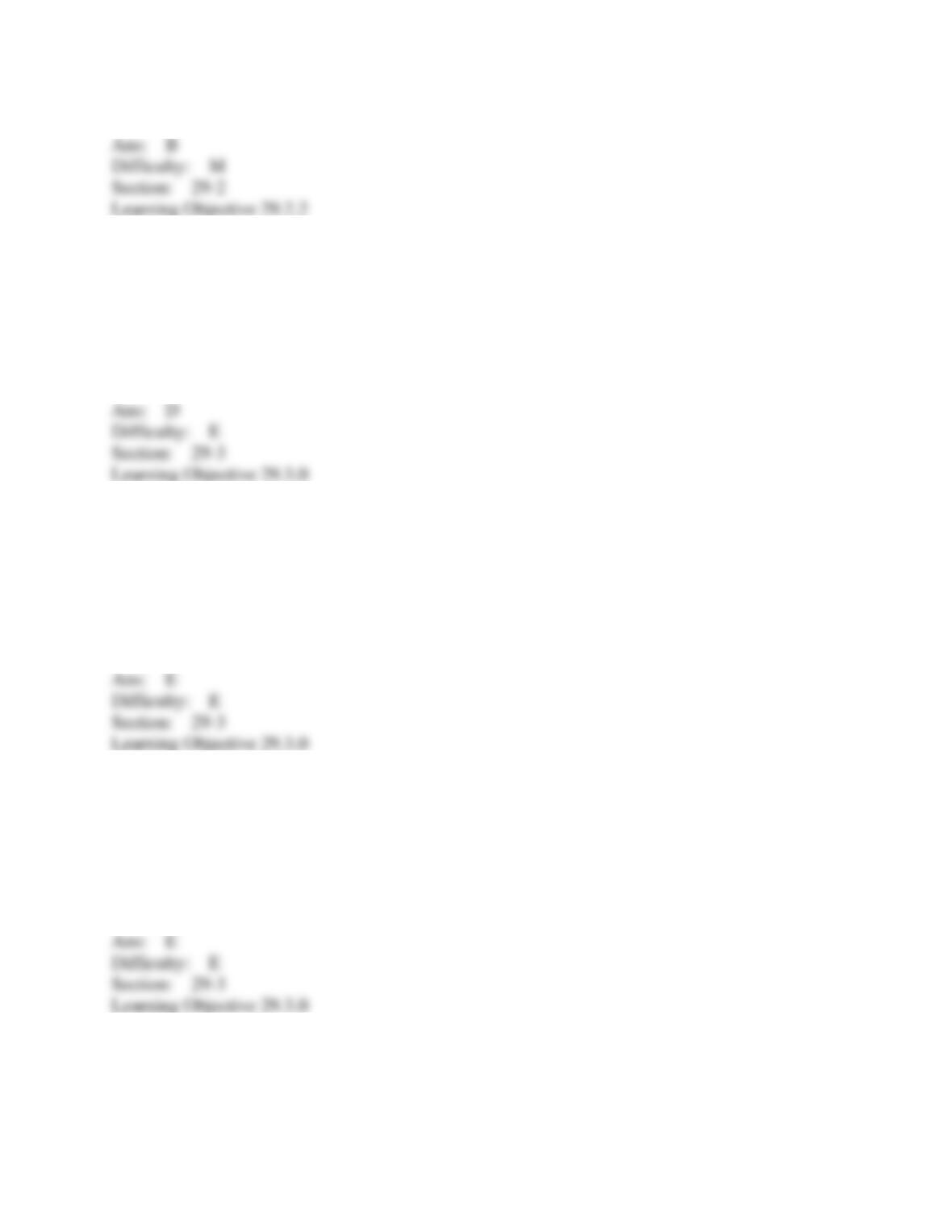
31. In the figure, there are three wires carrying currents in the indicated directions, and an
Amperian loop. The sign of the contribution of the current in each wire to the path integral ∮𝐵
⃗
∙
𝑑𝑠 in Ampere’s Law is:
A) i1 +, i2 –, i3 0
B) i1 –, i2 +, i3 0
C) i1 +, i2 +, i3 –
D) i1 –, i2 –, i3 +
E) i1 +, i2 –, i3 –
32. Two long straight wires enter a room through a window. One carries a current of 3.0 A into
the room while the other carries a current of 5.0 A out. The magnitude of the path integral ∮𝐵
⃗
∙
𝑑𝑠 around the window frame is:
A) 2.5 10–6 Tm
B) 3.8 10–6 Tm
C) 6.3 10–6 Tm
D) 1.0 10–5 Tm
E) none of these
33. If the magnetic field 𝐵
⃗
is uniform over the area bounded by a circle with a radius R, the
net current through the circle is:
A) 0
B) 2RB
0
C) R2B/
0
D) RB/2
0
E) 2RB/
0
34. The magnetic field at any point in the xy plane is given by 𝐵
⃗
= 𝐴𝑟 × 𝑘
̂, where 𝑟 is the
position vector of the point, A is a constant, and 𝑘
̂ is a unit vector in the +z direction. The net
current through a circle of radius R, in the xy plane and centered at the origin is given by:
A) AR2/
0
B) 2AR/
0
C) 4AR3/3
0
D) 2AR2/
0
E) AR2/2
0
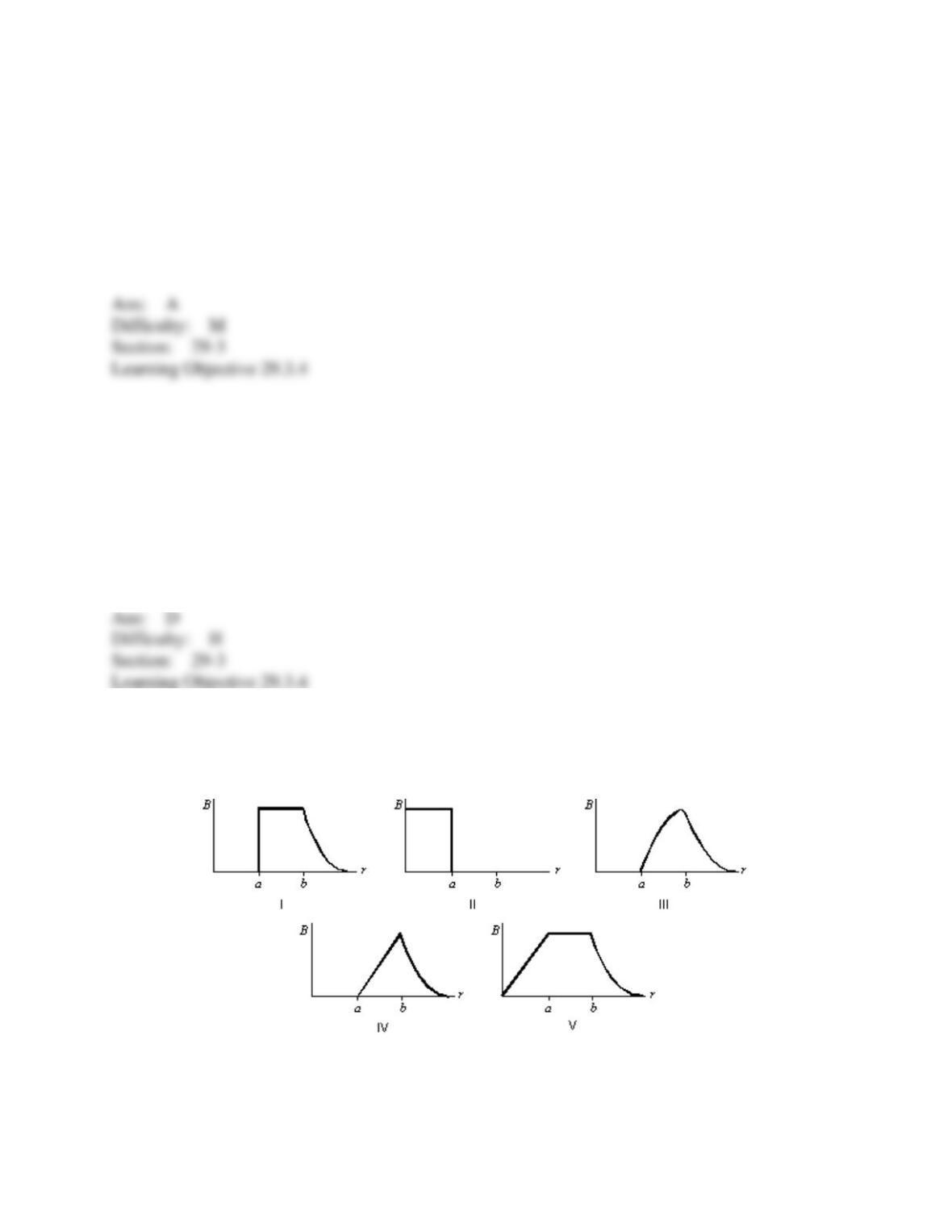
35. A hollow cylindrical conductor (inner radius = a, outer radius = b) carries a current i
uniformly spread over its cross section. Which graph below correctly gives B as a function of the
distance r from the center of the cylinder?
A) I
B) II
C) III
D) IV
E) V
36. A long straight cylindrical shell carries current i uniformly distributed over its cross
section. The magnitude of the magnetic field is greatest:
A) at the inner surface of the shell
B) at the outer surface of the shell
C) inside the shell near the middle
D) in hollow region near the inner surface
E) near the center of the hollow region
37. A long straight cylindrical shell has an inner radius Ri and an outer radius Ro. It carries a
current i, uniformly distributed over its cross section. A wire is parallel to the cylinder axis, in
the hollow region (r < Ri). The magnetic field is zero everywhere outside the shell (r > Ro). We
conclude that the wire:
A) is on the cylinder axis and carries current i in the same direction as the current in the shell
B) may be anywhere in the hollow region but must be carrying current i in the direction
opposite to that of the current in the shell
C) may be anywhere in the hollow region but must be carrying current i in the same direction
as the current in the shell
D) is on the cylinder axis and carries current i in the direction opposite to that of the current in
the shell
E) does not carry any current
38. A long straight cylindrical shell has an inner radius Ri and an outer radius Ro. It carries a
current i, uniformly distributed over its cross section. A wire is parallel to the cylinder axis, in
the hollow region (r < Ri). The magnetic field is zero everywhere in the hollow region. We
conclude that the wire:
A) is on the cylinder axis and carries current i in the same direction as the current in the shell
B) may be anywhere in the hollow region but must be carrying current i in the direction
opposite to that of the current in the shell
C) may be anywhere in the hollow region but must be carrying current i in the same direction
as the current in the shell
D) is on the cylinder axis and carries current i in the direction opposite to that of the current in
the shell
E) does not carry any current
39. The magnetic field 𝐵
⃗
inside a long ideal solenoid is independent of:
A) the current
B) the number of turns of wire
C) the spacing of the windings
D) the cross-sectional area
E) the direction of the current
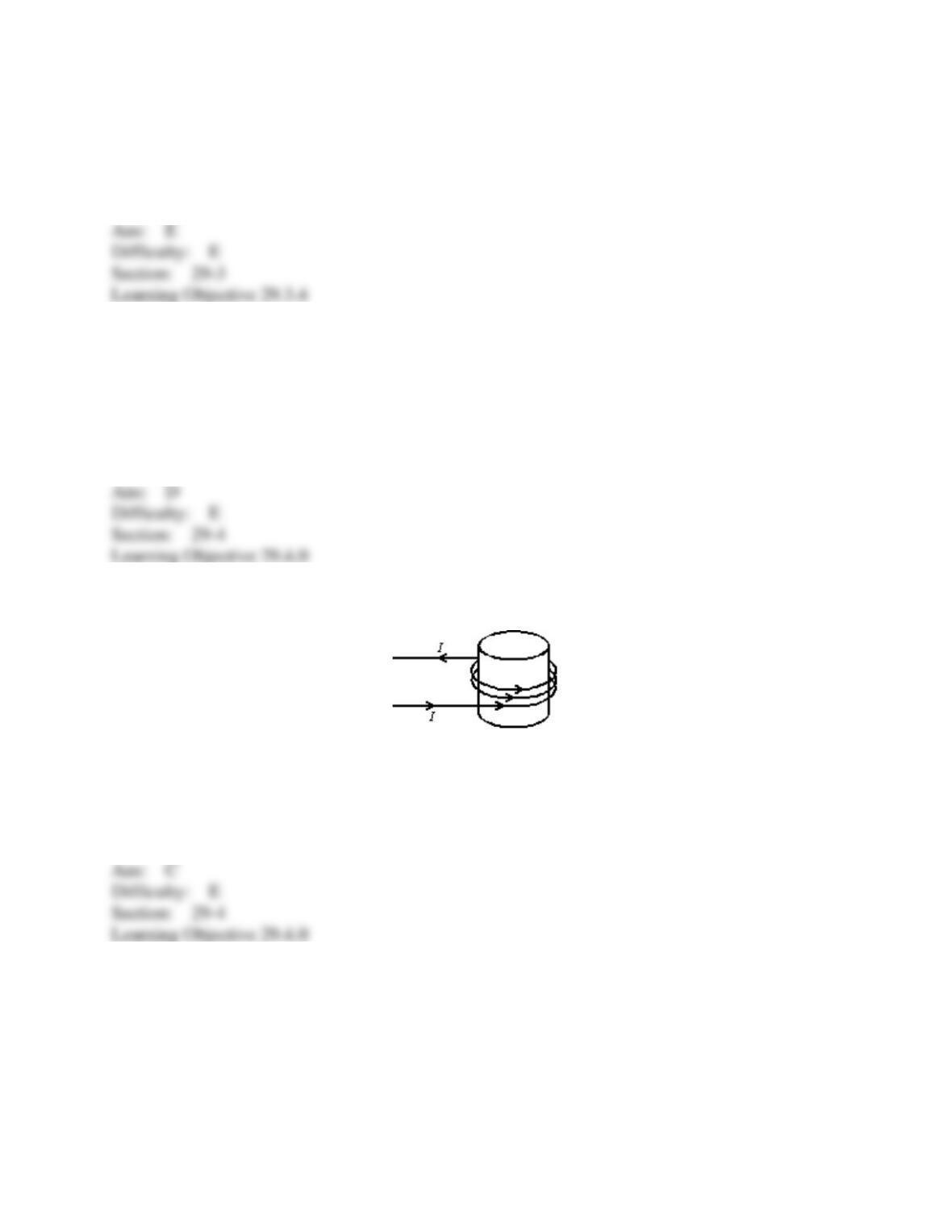
40. Magnetic field lines inside the solenoid shown are:
A) clockwise circles as one looks down the axis from the top of the page
B) counterclockwise circles as one looks down the axis from the top of the page
C) toward the top of the page
D) toward the bottom of the page
E) in no direction since B = 0
41. Two long ideal solenoids (with radii 20 mm and 30 mm respectively) have the same
number of turns of wire per unit length. The smaller solenoid is mounted inside the larger, along
a common axis. It is observed that there is zero magnetic field within the inner solenoid. The
current in the inner solenoid must be:
A) two-thirds the current in the outer solenoid
B) one-third the current in the outer solenoid
C) twice the current in the outer solenoid
D) half the current in the outer solenoid
E) the same as the current in the outer solenoid
42. Solenoid 2 has twice the radius and six times the number of turns per unit length as
solenoid 1. The ratio of the magnetic field in the interior of 2 to that in the interior of 1 is:
A) 1/3
B) 1
C) 2
D) 4
E) 6
43. A solenoid is 3.0 cm long and has a radius of 0.50 cm. It is wrapped with 500 turns of wire
carrying a current of 2.0 A. The magnetic field at the center of the solenoid is:
A) 9.9 10–8 T
B) 1.3 10–3 T
C) 4.2 10–2 T
D) 16 T
E) 20 T
44. A toroid with a square cross section carries current i. The magnetic field has its largest
magnitude:
A) at the center of the hole
B) just inside the toroid at its inner surface
C) just inside the toroid at its outer surface
D) at any point inside (the field is uniform)
E) at none of the above
45. A toroid has a square cross section with the length of an edge equal to the radius of the
inner surface. The ratio of the magnitude of the magnetic field at the inner surface to the
magnitude of the field at the outer surface is:
A) 1/4
B) 1/2
C) 1
D) 2
E) 4
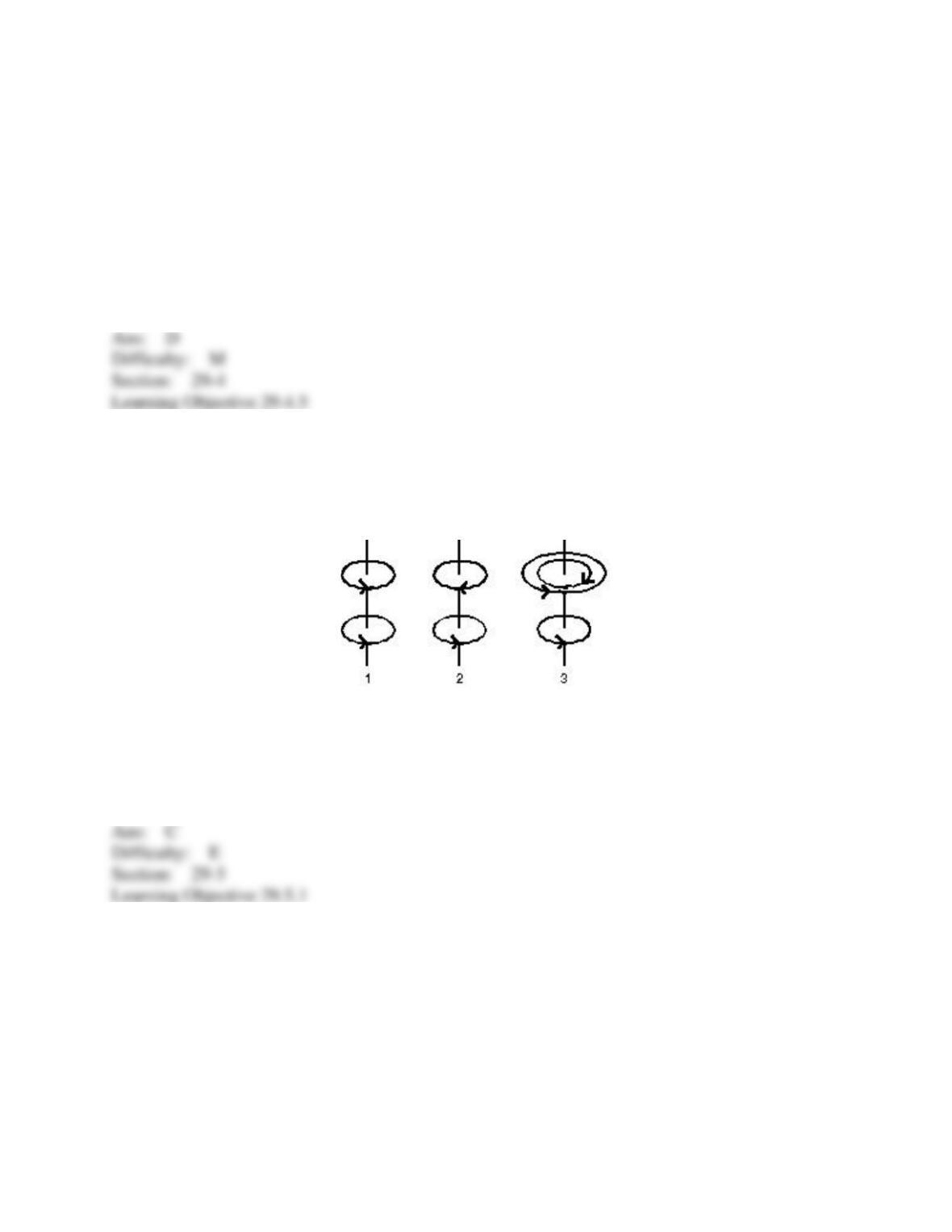
46. The diagram shows three arrangements of circular loops, centered on vertical axes and
carrying identical currents in the directions indicated. Rank the arrangements according to the
magnitudes of the magnetic fields at the midpoints between the loops on the central axes, from
least to greatest.
A) 1, 2, 3
B) 2, 1, 3
C) 2, 3, 1
D) 3, 2, 1
E) 3, 1, 2
47. A square loop of current-carrying wire with edge length a is in the xy plane, the origin
being at its center. Along which of the following lines can a charge move without experiencing a
magnetic force?
A) x = 0, y = a/2
B) x = a/2, y = a/2
C) x = a/2, y = 0
D) x = 0, y = 0
E) x = 0, z = 0
48. A 45-m long wire is coiled so that it makes a coil containing 100 circular loops, one on top of
the other. If the wire carries a current of 13 A, what is the magnetic dipole moment of the coil?
A) 21 A·m2
B) 6.7 A·m2
C) 3.3 A·m2
D) 2.6 A·m2
E) 1.2 A·m2
49. If R is the distance from a magnetic dipole, then the magnetic field it produces is
proportional to:
A) R2
B) R
C) 1/R
D) 1/R2
E) 1/R3