Chapter: Chapter 23
Learning Objectives
LO 23.1.0 Solve problems related to electric flux.
LO 23.1.1 Identify that Gauss’ law relates the electric field at points on a closed surface (real or
imaginary, said to be a Gaussian surface) to the net charge enclosed by that surface.
LO 23.1.2 Identify that the amount of electric field piercing a surface (not skimming along the
surface) is the electric flux Φ through the surface.
LO 23.1.3 Identify that an area vector for a flat surface is a vector that is perpendicular to the
surface and that has a magnitude equal to the area of the surface.
LO 23.1.4 Identify that any surface can be divided into area elements (patch elements) that are
each small enough and flat enough for an area vector 𝑑𝐴
⃗ to be assigned to it, with the vector
perpendicular to the element and having a magnitude equal to the area of the element.
LO 23.1.5 Calculate the flux Φ through a surface by integrating the dot product of the electric
field vector 𝐸
⃗
⃗
and the area vector 𝑑𝐴
⃗ (for patch elements) over the surface, in
magnitude-angle notation and unit-vector notation.
LO 23.1.6 For a closed surface, explain the algebraic signs associated with inward flux and
outward flux.
LO 23.1.7 Calculate the net flux Φ through a closed surface, algebraic sign included, by
integrating the dot product of the electric field vector 𝐸
⃗
⃗
and the area vector 𝑑𝐴
⃗ (for patch
elements) over the full surface.
LO 23.1.8 Determine if a closed surface can be broken up into parts (such as the sides of a cube)
to simplify the integration that yields the net flux through the surface.
LO 23.2.0 Solve problems related to Gauss’ law.
LO 23.2.1 Apply Gauss’ law to relate the net flux Φ through a closed surface (real or imaginary)
to the net charge qenc enclosed by the surface.
LO 23.2.2 Identify how the algebraic sign of the net enclosed charge corresponds to the direction
(inward or outward) of the net flux through a Gaussian surface.
LO 23.2.3 Identify that charge outside a Gaussian surface makes no contribution to the net flux
through the closed surface.
LO 23.2.4 Derive the expression for the magnitude of the electric field of a charged particle by
using Gauss’ law.
LO 23.2.5 Identify that for a charged particle or uniformly charged sphere, Gauss’ law is applied
with a Gaussian surface that is a concentric sphere in order to utilize the spherical symmetry, to
simplify the calculation.
LO 23.3.0 Solve problems related to a charged isolated conductor.
LO 23.3.1 Apply the relationship between surface charge density σ and the area over which the
charge is uniformly spread.
LO 23.3.2 Identify that if excess charge (positive or negative) is placed on an isolated conductor,
that charge moves to the surface and none is in the interior.
LO 23.3.3 Identify the value of the electric field inside an isolated conductor.
LO 23.3.4 For a conductor with a cavity that contains a charged object, determine the charge on
the cavity wall and on the external surface.
LO 23.3.5 Explain how Gauss’ law is used to find the electric field magnitude E near an isolated
conducting surface with a uniform surface charge density σ.
LO 23.3.6 For a uniformly charged conducting surface, apply the relationship between the
charge density σ and the electric field magnitude E at points near the conductor, and identify the
direction of the field vectors.
LO 23.4.0 Solve problems related to applying Gauss’ law: cylindrical symmetry.
LO 23.4.1 Explain how Gauss’ law is used to derive the electric field magnitude outside a line of
charge or a cylindrical surface (such as a plastic rod) with a uniform linear charge density λ.
LO 23.4.2 Apply the relationship between linear charge density λ on a cylindrical conducting
surface and the electric field magnitude E at radial distance r from the central axis.
LO 23.4.3 Explain how Gauss’ law can be used to find the electric field magnitude inside a
cylindrical nonconducting surface (such as a plastic rod) with a uniform volume charge density
ρ.
LO 23.5.0 Solve problems related to applying Gauss’ law: planar symmetry.
LO 23.5.1 For interior and exterior points, apply Gauss’ law to derive the electric field
magnitude E near a large, flat, nonconducting surface with a uniform surface charge density σ.
LO 23.5.2 For points near a large, flat nonconducting surface with a uniform charge density σ,
apply the relationship between the charge density and the electric field magnitude E and also
specify the direction of the field.
LO 23.5.3 For points near two large, flat conducting surfaces with a uniform charge density σ,
apply the relationship between the charge density and the electric field magnitude E and also
specify the direction of the field.
LO 23.6.0 Solve problems related to applying Gauss’ law: spherical symmetry.
LO 23.6.1 Identify that a shell of uniform charge attracts or repels a charged particle that is
outside the shell as if all the shell’s charge is concentrated at the center of the shell.
LO 23.6.2 Identify that if a charged particle is enclosed by a shell of uniform charge, there is no
electrostatic force on the particle from the shell.
LO 23.6.3 For a point outside a spherical shell with uniform charge, apply the relationship
between the electric field magnitude E, the charge q on the shell, and the distance r from the
shell’s center.
LO 23.6.4 Identify the magnitude of the electric field for points enclosed by a spherical shell
with uniform charge.
LO 23.6.5 For a uniform spherical charge distribution (a uniform ball of charge), determine the
magnitude and direction of the electric field at interior and exterior points.
Multiple Choice
1. Gauss’s law:
A) can always be used to calculate the electric field.
B) relates the electric field throughout space to the charges distributed through that space.
C) only applies to point charges.
D) relates the electric field at points on a closed surface to the net charge enclosed by that
surface.
E) relates the surface charge density to the electric field.
2. The electric flux Φ through a surface:
A) is the amount of electric field piercing the surface.
B) is the electric field multiplied by the area.
C) does not depend on the area involved.
D) is the line integral of the electric field around the edge of the surface.
E) is the amount of electric field skimming along the surface.
3. The area vector for a flat surface:
A) is parallel to the surface and has a magnitude equal to the length of a side of the surface.
B) is perpendicular to the surface and has a magnitude equal to the length of a side of the surface.
C) is parallel to the surface and has a magnitude equal to the area of the surface.
D) is perpendicular to the surface and has a magnitude equal to the area of the surface.
E) none of the above.
4. To calculate the flux through a curved surface,
A) the area vector has to be perpendicular to the surface somewhere
B) you must divide the surface into pieces that are tiny enough to be almost flat
C) the surface must be spherical
D) the surface cannot be curved very much; then you can treat it as though it were flat
E) actually the flux through a curved surface cannot be calculated.
5. When a piece of paper is held with one face perpendicular to a uniform electric field the flux
through it is 25 Nm2/C. When the paper is turned 25 with respect to the field the flux through it
is:
A) 0 Nm2/C
B) 11 Nm2/C
C) 12 Nm2/C
D) 23 Nm2/C
E) 25 Nm2/C
6. The flux of the electric field (24 N/C)𝑖̂ + (30 N/C) 𝑗̂ + (16 N/C) 𝑘
̂ through a 2.0 m2 portion
of the yz plane is:
A) 32 N m2/C
B) 34 N m2/C
C) 42 N m2/C
D) 48 N m2/C
E) 60 N m2/C
7. A cylindrical wastepaper basket with a 0.15-m radius opening is in a uniform electric field
of 300 N/C, perpendicular to the opening. The total flux through the sides and bottom is:
A) 0 Nm2/C
B) 4.2 Nm2/C
C) 21 Nm2/C
D) 280 Nm2/C
E) can’t tell without knowing the areas of the sides and bottom
8. Which statement is correct?
A) The flux through a closed surface is always positive.
B) The flux through a closed surface is always negative.
C) The sign of the flux through a closed surface depends on an arbitrary choice of sign for the
surface vector.
D) Inward flux through a closed surface is negative and outward flux is positive.
E) Inward flux through a closed surface is positive and outward flux is negative.
9. A closed cylinder with a 0.15-m radius ends is in a uniform electric field of 300 N/C,
perpendicular to the ends. The total flux through the cylinder is:
A) 0 Nm2/C
B) 4.2 Nm2/C
C) 21 Nm2/C
D) 280 Nm2/C
E) can’t tell without knowing the length of the cylinder
10. A point charge is placed at the center of a spherical Gaussian surface. The electric flux E
is changed if:
A) the sphere is replaced by a cube of the same volume
B) the sphere is replaced by a cube of one-tenth the volume
C) the point charge is moved off center (but still inside the original sphere)
D) the point charge is moved to just outside the sphere
E) a second point charge is placed just outside the sphere
11. A physics instructor in an anteroom charges an electrostatic generator to 25
C, then
carries it into the lecture hall. The net electric flux through the lecture hall walls is:
A) 0 Nm2/C
B) 25 10–6 Nm2/C
C) 2.2 105 Nm2/C
D) 2.8 106 Nm2/C
E) can’t tell unless the lecture hall dimensions are given
12. A point particle with charge q is placed inside a cube but not at its center. The electric
flux through any one side of the cube:
A) is zero
B) is q/0
C) is q/40
D) is q/60
E) cannot be computed using Gauss’ law
13. A particle with charge 5.0
C is placed at the corner of a cube. The total electric flux
through all sides of the cube is:
A) 0 Nm2/C
B) 7.1 104 Nm2/C
C) 9.4 104 Nm2/C
D) 1.4 105 Nm2/C
E) 5.6 105 Nm2/C
14. A point particle with charge q is at the center of a Gaussian surface in the form of a cube.
The electric flux through any one face of the cube is:
A) q/0
B) q/40
C) q/40
D) q/60
E) q/160
15. A 3.5-cm radius hemisphere contains a total charge of 6.6 10–7 C. The flux through the
rounded portion of the surface is 9.8 104 Nm2/C. The flux through the flat base is:
A) 0 Nm2/C
B) +2.3 104 Nm2/C
C) –2.3 104 Nm2/C
D) –9.8 104 Nm2/C
E) +9.8 104 Nm2/C
16. Charge Q is distributed uniformly throughout a spherical insulating shell. The net electric
flux through the outer surface of the shell is:
A) 0
B) Q/0
C) 2Q/0
D) Q/40
E) Q/20
17. The table below gives the electric flux through the ends and round surfaces of four
Gaussian surfaces in the form of cylinders. Rank the cylinders according to the charge inside,
from the most negative to the most positive.
left end
right end
rounded surface
cylinder 1:
+2 10–9 Nm2/C
+4 10–9 Nm2/C
–6 10–9 Nm2/C
cylinder 2:
+3 10–9 Nm2/C
–2 10–9 Nm2/C
+6 10–9 Nm2/C
cylinder 3:
–2 10–9 Nm2/C
–5 10–9 Nm2/C
+3 10–9 Nm2/C
cylinder 4:
+2 10–9 Nm2/C
–5 10–9 Nm2/C
–3 10–9 Nm2/C
A) 1, 2, 3, 4
B) 4, 3, 2, 1
C) 3, 4, 2, 1
D) 3, 1, 4, 2
E) 4, 3, 1, 2
18. Charge Q is distributed uniformly throughout a spherical insulating shell. The net electric
flux through the inner surface of the shell is:
A) 0
B) Q/0
C) 2Q/0
D) Q/40
E) Q/20
19. Consider Gauss law: ∮𝐸
⃗
⃗
∙ 𝑑𝐴
⃗=𝑞
𝜀0. Which of the following is true?
A) 𝐸
⃗
⃗
must be the electric field due to the enclosed charge
B) If q = 0 then 𝐸
⃗
⃗
= 0 everywhere on the Gaussian surface
C) If the three particles inside have charges of +q, +q and −2q, then the integral is zero
D) On the surface 𝐸
⃗
⃗
is everywhere parallel to 𝑑𝐴
⃗
E) If a charge is placed outside the surface, then it cannot affect 𝐸
⃗
⃗
at any point on the surface
20. Choose the INCORRECT statement:
A) Gauss’ law can be derived from Coulomb’s law
B) Gauss’ law states that the net number of lines crossing any closed surface in an outward
direction is proportional to the net charge enclosed within the surface
C) Coulomb’s law can be derived from Gauss’ law and symmetry
D) Gauss’ law applies to a closed surface of any shape
E) According to Gauss’ law, if a closed surface encloses no charge, then the electric field must
vanish everywhere on the surface
21. The outer surface of the cardboard center of a paper towel roll:
A) is a possible Gaussian surface
B) cannot be a Gaussian surface because it encloses no charge
C) cannot be a Gaussian surface since it is an insulator
D) cannot be a Gaussian surface since it is not closed
E) none of the above
22. Positive charge Q is placed on a conducting spherical shell with inner radius R1 and outer
radius R2. A particle with charge q is placed at the center of the cavity. The magnitude of the
electric field at a point in the cavity, a distance r from the center, is:
A) 𝑄
4𝜋𝜀0𝑅1
2
B) 𝑄
4𝜋𝜀0(𝑅1
2−𝑟2)
C) q/40r2
D) (q + Q)/40r2
E) (𝑞+𝑄)
4𝜋𝜀0(𝑅1
2−𝑟2)
23. A conducting sphere of radius 5.0 cm carries a net charge of 7.5 µC. What is the surface
charge density on the sphere?
A) 2.4 x 10⁻² C/m2
B) 1.4 x 10⁻² C/m2
C) 9.5 x 10⁻⁴ C/m2
D) 2.4 x 10⁻⁴ C/m2
E) 6.0 x 10⁻⁵ C/m2
24. A hollow conductor is positively charged. A small uncharged metal ball is lowered by a
silk thread through a small opening in the top of the conductor and allowed to touch its inner
surface. After the ball is removed, it will have:
A) a positive charge
B) a negative charge
C) no appreciable charge
D) a charge whose sign depends on what part of the inner surface it touched
E) a charge whose sign depends on where the small hole is located in the conductor
25. A particle with charge +Q is placed outside a large neutral conducting sheet. At any point
in the interior of the sheet the electric field produced by charges on the surface is directed:
A) toward the surface
B) away from the surface
C) toward Q
D) away from Q
E) none of the above
26. 10 C of charge are placed on a spherical conducting shell. A particle with a charge of –3 C
is placed at the center of the cavity. The net charge on the inner surface of the shell is:
A) –7 C
B) –3 C
C) 0 C
D) +3 C
E) +7 C
27. 10 C of charge are placed on a spherical conducting shell. A particle with a charge of –3C
is placed at the center of the cavity. The net charge on the outer surface of the shell is:
A) –7 C
B) –3 C
C) 0 C
D) +3 C
E) +7 C
28. Positive charge Q is placed on a conducting spherical shell with inner radius R1 and outer
radius R2. A point charge q is placed at the center of the cavity. The magnitude of the electric
field at a point in the interior of the conductor a distance r from the center is:
A) 0
B) 𝑄
4𝜋𝜀0𝑅1
2
C) 𝑄
4𝜋𝜀0𝑅2
2
D) q/40r2
E) Q/40r2
29. A spherical conducting shell has charge Q. A particle with charge q is placed at the center
of the cavity. The charge on the inner surface of the shell and the charge on the outer surface of
the shell, respectively, are:
A) 0, Q
B) q, Q – q
C) Q, 0
D) –q, Q + q
E) –q, 0
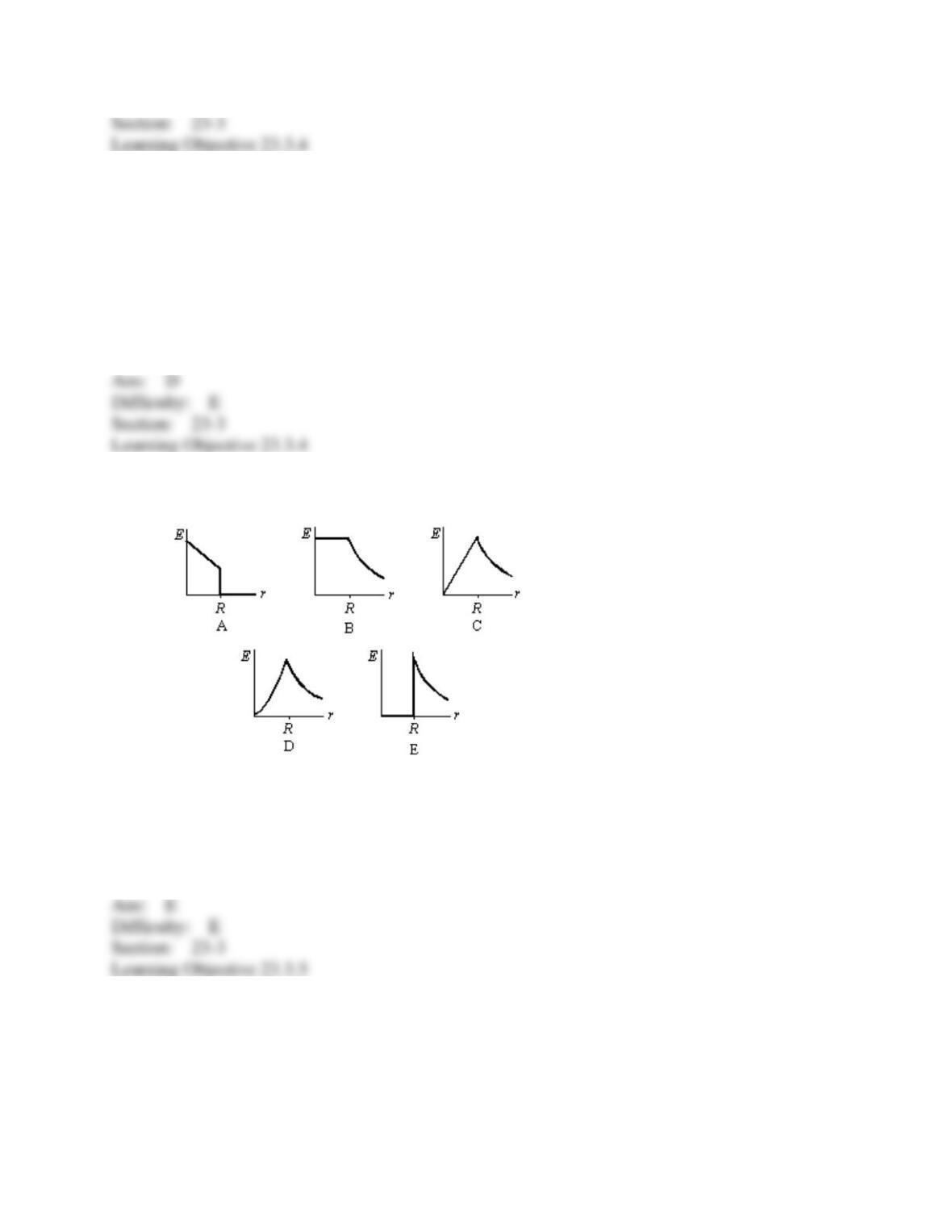
30. Which of the following graphs represents the magnitude of the electric field as a function
of the distance from the center of a solid charged conducting sphere of radius R?
A) A
B) B
C) C
D) D
E) E
31. A conducting sphere of radius 0.01 m has a charge of 1.0 10–9 C deposited on it. The
magnitude of the electric field just outside the surface of the sphere is:
A) 0 N/C
B) 450 N/C
C) 900 N/C
D) 4500 N/C
E) 90,000 N/C
32. A 300-N/C uniform electric field points perpendicularly toward the left face of a large
neutral conducting sheet. The area charge density on the left and right faces, respectively, are:
A) –2.7 10–9 C/m2; +2.7 10–9 C/m 2
B) +2.7 10–9 C/m2; –2.7 10–9 C/m 2
C) –5.3 10–9 C/m2; +5.3 10–9 C/m 2
D) +5.3 10–9 C/m2; –5.3 10–9 C/m 2
E) 0 C/m2; 0 C/m2
33. Charge is distributed uniformly along a long straight wire. The electric field 2 cm from the
wire is 20 N/C. The electric field 4 cm from the wire is:
A) 120 N/C
B) 80 N/C
C) 40 N/C
D) 10 N/C
E) 5 N/C
34. A long line of charge with λℓ charge per unit length runs along the cylindrical axis of a
cylindrical conducting shell which carries a charge per unit length of c. The charge per unit
length on the inner and outer surfaces of the shell, respectively are:
A) λℓ and c
B) −λℓ and c + λℓ
C) −λℓ and c – λℓ
D) λℓ + c and c – λℓ
E) λℓ – c and c + λℓ
35. Charge is distributed uniformly on the surface of a large flat plate. The electric field 2 cm
from the plate is 30 N/C. The electric field 4 cm from the plate is:
A) 120 N/C
B) 60 N/C
C) 30 N/C
D) 15 N/C
E) 7.5 N/C
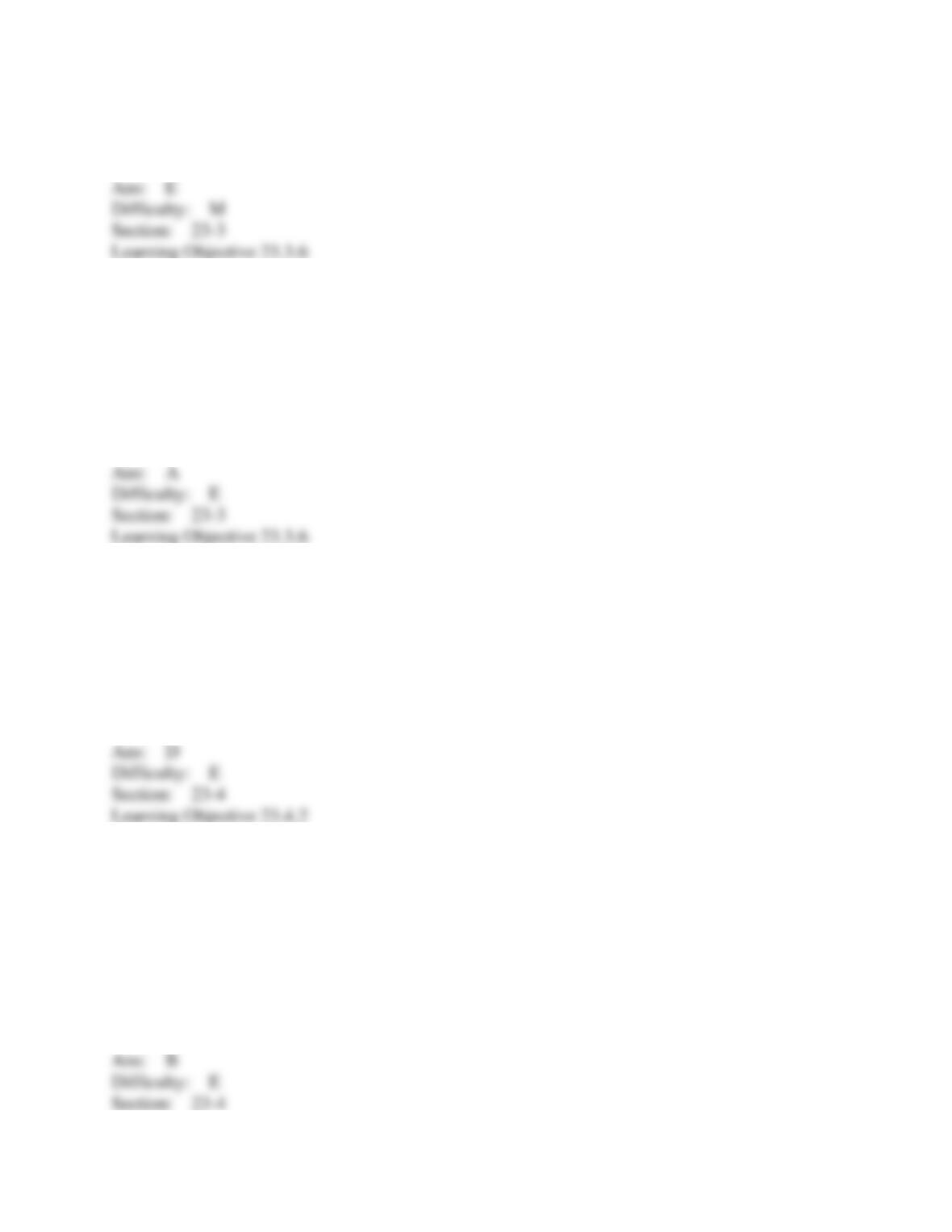
36. Two large insulating parallel plates carry charge of equal magnitude, one positive and the
other negative, that is distributed uniformly over their inner surfaces. Rank the points 1 through
5 according to the magnitude of the electric field at the points, least to greatest.
A) 1, 2, 3, 4, 5
B) 5, 4, 3, 2, 1
C) 1 and 4 and 5 tie, then 2 and 3 tie
D) 2 and 3 tie, then 1 and 4 tie, then 5
E) 2 and 3 tie, then 1 and 4 and 5 tie
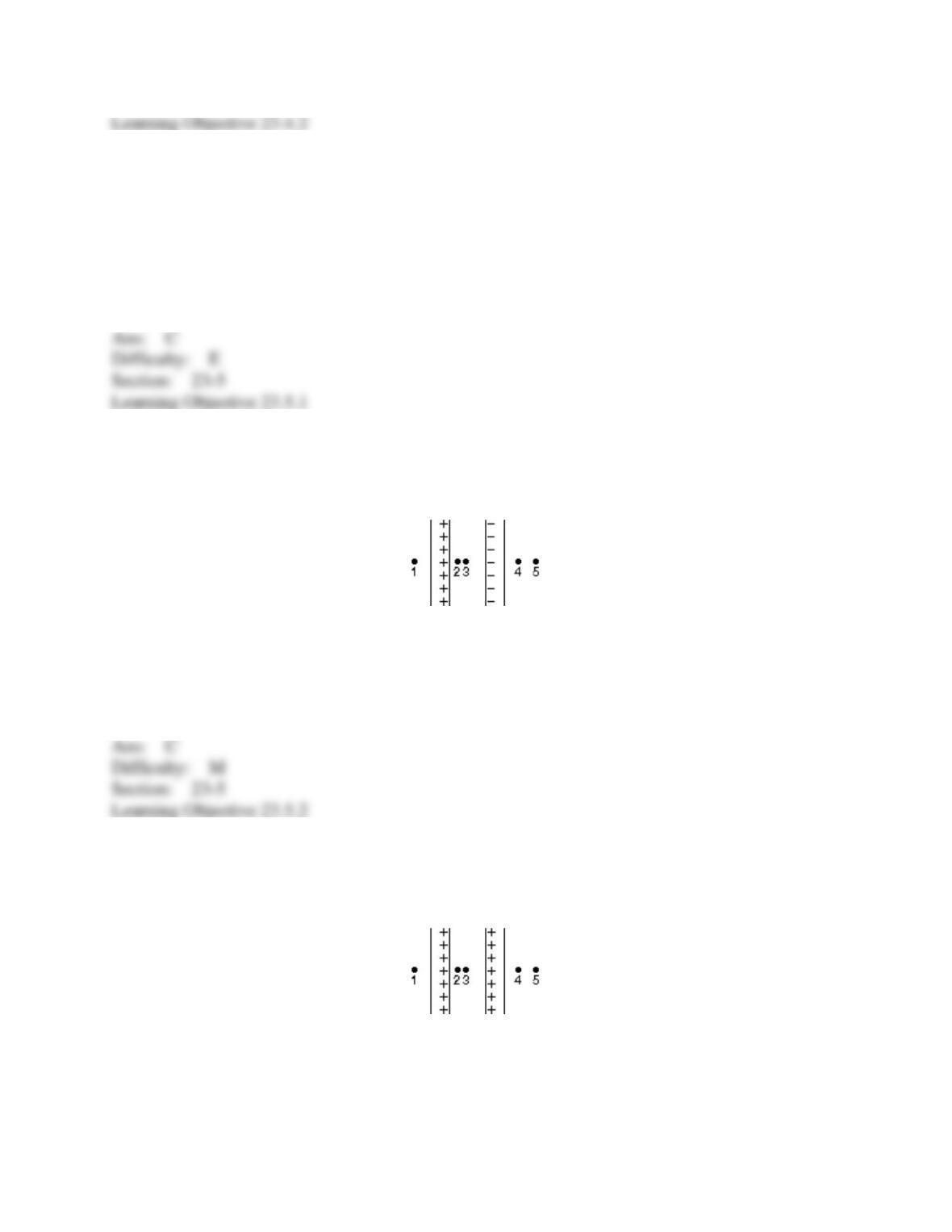
37. Two large insulating parallel plates carry positive charge of equal magnitude that is
distributed uniformly over their inner surfaces. Rank the points 1 through 5 according to the
magnitude of the electric field at the points, least to greatest.
A) 1, 2, 3, 4, 5
B) 5, 4, 3, 2, 1
C) 1 and 4 and 5 tie, then 2 and 3 tie
D) 2 and 3 tie, then 1 and 4 tie, then 5
E) 2 and 3 tie, then 1 and 4 and 5 tie
38. Two large conducting parallel plates carry charge of equal magnitude, one positive and the
other negative, that is distributed uniformly over their inner surfaces. Rank the points 1 through
5 according to the magnitude of the electric field at the points, least to greatest.
A) 1, 2, 3, 4, 5
B) 5, 4, 3, 2, 1
C) 1 and 4 and 5 tie, then 2 and 3 tie
D) 2 and 3 tie, then 1 and 4 tie, then 5
E) 2 and 3 tie, then 1 and 4 and 5 tie
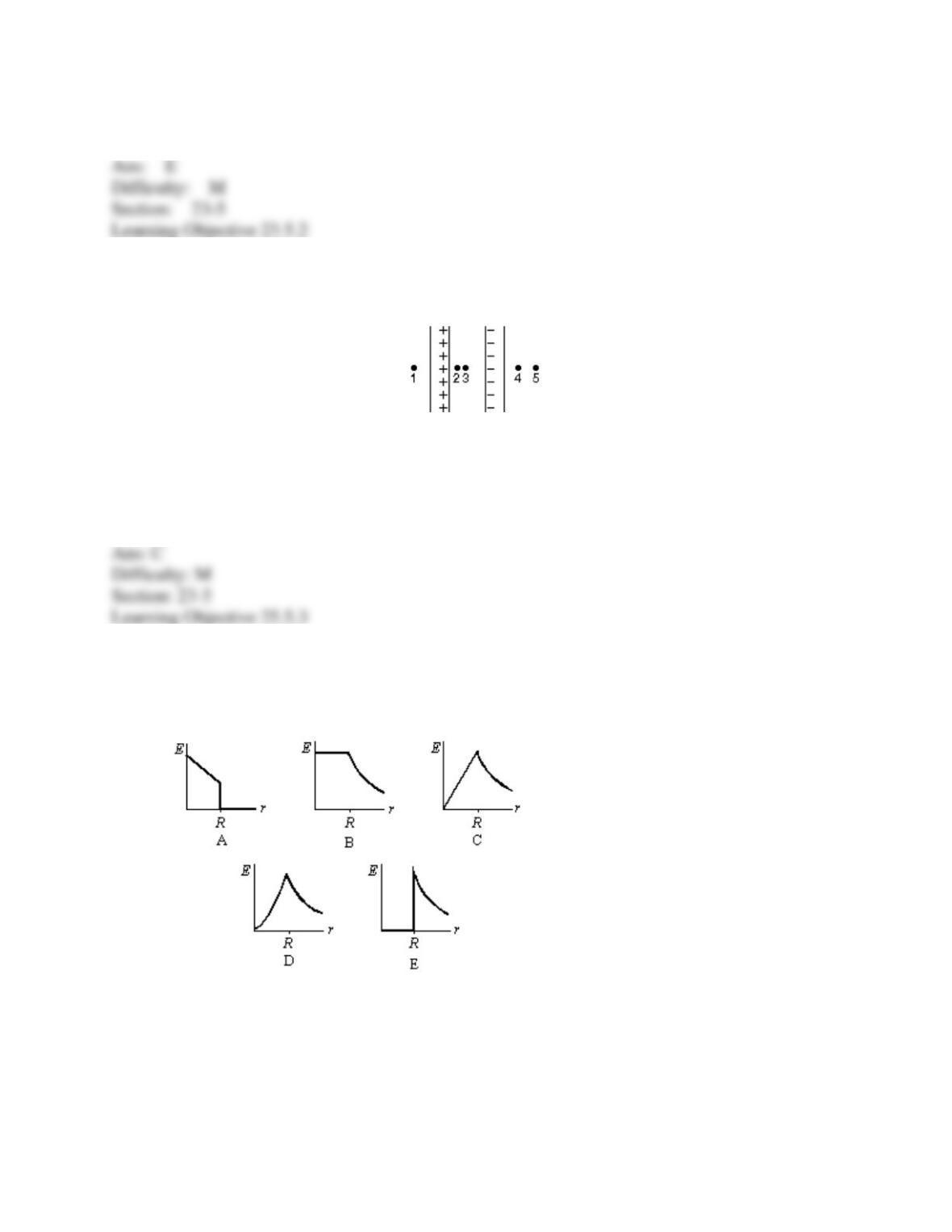
39. A solid insulating sphere of radius R contains a positive charge that is distributed with a
volume charge density that does not depend on angle but does increase linearly with distance
from the sphere center. Which of the graphs below correctly gives the magnitude E of the
electric field as a function of the distance r from the center of the sphere?
A) A
B) B
C) C
D) D
E) E

40. Positive charge Q is placed on a conducting spherical shell with inner radius R1 and outer
radius R2. A point charge q is placed at the center of the cavity. The force on the charge q is:
A) 𝑄𝑞
4𝜋𝜀0𝑅1
2
B) 𝑄𝑞
4𝜋𝜀0(𝑅2
2−𝑅1
2)
C) 𝑄𝑞
4𝜋𝜀0𝑅2
2
D) 𝑄𝑞
4𝜋𝜀0(𝑅2
2+𝑅1
2)
E) 0
41. Positive charge Q is placed on a conducting spherical shell with inner radius R1 and outer
radius R2. A point charge q is placed at the center of the cavity. The magnitude of the electric
field at a point outside the shell, a distance r from the center, is:
A) 𝑄
4𝜋𝜀0𝑅1
2
B) 𝑄
4𝜋𝜀0(𝑅1
2−𝑟2)
C) q/40r2
D) (q + Q)/40r2
E) (𝑞+𝑄)
4𝜋𝜀0(𝑅1
2−𝑟2)
42. Positive charge Q is placed on a conducting spherical shell with inner radius R1 and outer
radius R2. The electric field at a point r < R1 is:
A) 𝑄
4𝜋𝜀0𝑅1
2
B) 𝑄
4𝜋𝜀0(𝑅1
2−𝑟2)
C) Q/40r2
D) 0
E) 𝑄
4𝜋𝜀0(𝑅1
2+𝑟2)
43. Charge Q is distributed uniformly throughout an insulating sphere of radius R. The
magnitude of the electric field at a point R/2 from the center is:
A) Q/40R2
B) Q/0R2
C) 3Q/40R2
D) Q/80R2
E) none of these
44. Positive charge Q is distributed uniformly throughout an insulating sphere of radius R,
centered at the origin. A particle with a positive charge Q is placed at x = 2R on the x axis. The
magnitude of the electric field at x = R/2 on the x axis is:
A) Q/720R2
B) Q/80R2
C) 7Q/180R2
D) 11Q/180R2
E) none of these