Chapter: Chapter 39
Learning Objectives
LO 39.1.0 Solve problems related to energies of a trapped electron.
LO 39.1.1 Identify the confinement principle: Confinement of a wave (including a matter wave)
leads to the quantization of wavelengths and energy values.
LO 39.1.2 Sketch a one-dimensional infinite potential well, indicating the length (or width) and
the potential energy of the walls.
LO 39.1.3 For an electron, apply the relationship between the de Broglie wavelength λ and the
kinetic energy.
LO 39.1.4 For an electron in a one-dimensional infinite potential well, apply the relationship
between the de Broglie wavelength λ, the well’s length, and the quantum number n.
LO 39.1.5 For an electron in a one-dimensional infinite potential well, apply the relationship
between the allowed energies En, the well length L, and the quantum number n.
LO 39.1.6 Sketch an energy-level diagram for an electron in a one-dimensional infinite potential
well, indicating the ground state and several excited states.
LO 39.1.7 Identify that a trapped electron tends to be in its ground state, can be excited to a
higher energy state, and cannot exist between the allowed states.
LO 39.1.8 Calculate the energy change required for an electron to move between states: a
quantum jump up or down an energy-level diagram.
LO 39.1.9 If a quantum jump involves light, identify that an upward jump requires the absorption
of a photon (to increase the electron’s energy) and a downward jump requires the emission of a
photon (to reduce the electron’s energy).
LO 39.1.10 If a quantum jump involves light, apply the relationships between the energy change
and the frequency and wavelength associated with the photon.
LO 39.1.11 Identify the emission and absorption spectra of an electron in a one-dimensional
infinite potential well.
LO 39.2.0 Solve problems related to wave functions of a trapped electron.
LO 39.2.1 For an electron trapped in a one-dimensional, infinite potential well, write its wave
function in terms of coordinates inside the well and in terms of the quantum number n.
LO 39.2.2 Identify probability density.
LO 39.2.3 For an electron trapped in a one-dimensional, infinite potential well in a given state,
write the probability density as a function of position inside the well, identify that the probability
density is zero outside the well, and calculate the probability of detection between two given
coordinates inside the well.
LO 39.2.4 Identify the correspondence principle.
LO 39.2.5 Normalize a given wave function and identify what that has to do with the probability
of detection.
LO 39.2.6 Identify that the lowest allowed energy (the zero-point energy) of a trapped electron is
not zero.
LO 39.3.0 Solve problems related to an electron in a finite well.
LO 39.3.1 Sketch a one-dimensional finite potential well, indicating the length and height.
LO 39.3.2 For an electron trapped in a finite well with given energy levels, sketch the
energy-level diagram, indicate the nonquantized region, and compare the energies and de Broglie
wavelengths with those of an infinite well of the same length.
LO 39.3.3 For an electron trapped in a finite well, explain (in principle) how the wave functions
for the allowed states are determined
LO 39.3.4 For an electron trapped in a finite well with a given quantum number, sketch the
probability density as a function of position across the well and into the walls
LO 39.3.5 Identify that a trapped electron can exist in only the allowed states and relate that
energy of the state to the kinetic energy of the electron.
LO 39.3.6 Calculate the energy that an electron must absorb or emit to move between the
allowed states or between an allowed state and any value in the nonquantized region.
LO 39.3.7 If a quantum jump involves light, apply the relationship between the energy change
and the frequency and wavelength associated with the photon.
LO 39.3.8 From a given allowed state in a finite well, calculate the minimum energy required for
the electron to escape and the kinetic energy of the escaped electron if provided more than that
minimal energy.
LO 39.3.9 Identify the emission and absorption spectra of an electron in a one-dimensional
infinite potential well.
LO 38.4.0 Solve problems related to two- and three-dimensional electron traps.
LO 39.4.1 Discuss nanocrystallites as being electron traps and explain how their threshold
wavelength can determine their color.
LO 39.4.2 Identify quantum dots and quantum corrals.
LO 39.4.3 For a given state of an electron in an infinite potential well with two or three
dimensions, write equations for the wave function and probability density and then calculate the
probability of detection for a given range in the well.
LO 39.4.4 For a given state of an electron in an infinite potential well with two or three
dimensions, calculate the allowed energies and draw an energy-level diagram, complete with
labels for the quantum numbers, the ground state, and several excited states.
LO 39.4.5 Identify degenerate states
LO 39.4.6 Calculate the energy that an electron must absorb or emit to move between the
allowed states in a 2D or 3D trap.
LO 39.4.7 If a quantum jump involves light, apply the relationships between the energy change
and the frequency and wavelength associated with the photon.
LO 39.5.0 Solve problems related to the hydrogen atom.
LO 39.5.1 Identify Bohr’s model of the hydrogen atom and explain how he derived the quantized
radii and energies.
LO 39.5.2 For a given quantum number n in the Bohr model, calculate the electron’s orbital
radius, kinetic energy, potential energy, total energy, orbital period, orbital frequency,
momentum, and angular momentum.
LO 39.5.3 Distinguish the Bohr and Schrӧdinger descriptions of the hydrogen atom, including
the discrepancy between the allowed angular momentum values.
LO 39.5.4 For a hydrogen atom, apply the relationship between the quantized energies En and the
quantum number n.
LO 39.5.5 For a given jump in hydrogen, between quantized states or between a quantized state
and a nonquantized state, calculate the change in energy and, if light is involved, the associated

energy, frequency, wavelength, and momentum of the photon.
LO 39.5.6 Sketch an energy-level diagram for hydrogen, identifying the ground state, several of
the excited states, the nonquantized region, the Paschen series, the Balmer series, and the Lyman
series (including the series limits).
LO 39.5.7 For each transition series, identify the jumps giving the longest wavelength, the
shortest wavelength (for downward jumps), the series limit, and ionization.
LO 39.5.8 List the quantum numbers for an atom and indicate the allowed values.
LO 39.5.9 Given a normalized wave function for a state, find the radial probability density P(r)
and the probability of detecting the electron in a given range of radii.
LO 39.5.10 For ground-state hydrogen, sketch a graph of the radial probability density versus
radial distance and locate one Bohr radius a.
LO 39.5.11 For a given normalized wave function for hydrogen, verify that it satisfies the
Schrӧdinger equation.
LO 39.5.12 Distinguish shell from subshell.
LO 39.5.13 Explain a dot plot of the probability density for a given state.
Multiple Choice
1. An electron confined in a one-dimensional infinite potential well has an energy of 180 eV.
What is its wavelength?
A) 65 pm
B) 91 pm
C) 130 pm
D) 370 pm
E) 520 pm
2. The wavelength of a particle in a one-dimensional trap with zero potential energy in the
interior and infinite potential energy at the walls is proportional to (n = quantum number):
A) n
B) 1/n
C) 1/n2
D) √𝑛
E) n2
3. The energy of a particle in a one-dimensional trap with zero potential energy in the interior
and infinite potential energy at the walls is proportional to (n = quantum number):

A) n
B) 1/n
C) 1/n2
D) √𝑛
E) n2
4. The ground state energy of an electron in a one-dimensional trap with zero potential energy
in the interior and infinite potential energy at the walls is 2.0 eV. If the width of the well is
doubled, the ground state energy will be:
A) 0.5 eV
B) 1.0 eV
C) 2.0 eV
D) 4.0 eV
E) 8.0 eV
5. An electron is in a one-dimensional trap with zero potential energy in the interior and
infinite potential energy at the walls. The ratio E3/E1 of the energy for n = 3 to that for
n = 1 is:
A) 1/3
B) 1/9
C) 3/1
D) 9/1
E) 1/1
6. Identical particles are trapped in one-dimensional wells with infinite potential energy at the
walls. The widths L of the traps and the quantum numbers n of the particles are
1. L = 2L0, n = 2
2. L = 2L0, n = 4
3. L = 3L0, n = 3
4. L = 4L0, n = 2
Rank them according to the kinetic energies of the particles, least to greatest.

A) 1, 2, 3, 4
B) 4, 3, 2, 1
C) 1 and 3 tied, then 2, then 4
D) 4, then 1 and 3 tied, then 2
E) 2, then 1 and 3 tied, then 4
7. Four different particles are trapped in one-dimensional wells with infinite potential energy at
their walls. The masses of the particles and the width of the wells are
1. mass = 4m0, width = 2L0
2. mass = 2m0, width = 2L0
3. mass = 4m0, width = L0
4. mass = m0, width = 2L0
Rank them according to the kinetic energies of the particles when they are in their ground states,
lowest to highest.
A) 3 and 4 tied, then 2, then 1
B) 1, 2, then 3 and 4 tied
C) 1 and 2 tied, then 3, then 4
D) 4, 3, 2, 1
E) 3, 1, 2, 4
8. The ground state energy of an electron in a one-dimensional trap with zero potential energy
in the interior and infinite potential energy at the walls:
A) is zero
B) decreases with temperature
C) increases with temperature
D) is independent of temperature
E) oscillates with time
9. Two one-dimensional traps have infinite potential energy at their walls. Trap A has width L
and trap B has width 2L. For which value of the quantum number n does a particle in trap B
have the same energy as a particle in the ground state of trap A?

A) n = 1
B) n = 2
C) n = 3
D) n = 4
E) n = 5
10. An electron is trapped in a deep well with a width of 0.3 nm. If it is in the state with
quantum number n = 3 its kinetic energy is:
A) 6.0 10–28 J
B) 1.8 10–27 J
C) 6.7 10–19 J
D) 2.0 10–18 J
E) 6.0 10–18 J
11. A particle is trapped in a one-dimensional well with infinite potential energy at the walls.
Three possible pairs of energy levels are
1. n = 3 and n = 1
2. n = 3 and n = 2
3. n = 4 and n = 3
Order these pairs according to the difference in energy, least to greatest.
A) 1, 2, 3
B) 3, 2, 1
C) 2, 3, 1
D) 1, 3, 2
E) 3, 1, 2
12. An electron in an atom initially has an energy 5.5 eV above the ground state energy. It
drops to a state with energy 3.2 eV above the ground state energy and emits a photon in the
process. The wave associated with the photon has a wavelength of:
A) 5.4 10−7 m
B) 3.0 10−7 m
C) 1.7 10−7 m
D) 1.2 10−7 m
E) 1.0 10−7 m
13. An electron in an atom drops from an energy level at –1.1 10–18 J to an energy level at
–2.4 10–18 J. The wave associated with the emitted photon has a frequency of:
A) 2.0 1017 Hz
B) 2.0 1015 Hz
C) 2.0 1013 Hz
D) 2.0 1011 Hz
E) 2.0 109 Hz
14. An electron in an atom initially has an energy 7.5 eV above the ground state energy. It
drops to a state with an energy of 3.2 eV above the ground state energy and emits a photon in the
process. The momentum of the photon is:
A) 1.7 10–27 kg m/s
B) 2.3 10–27 kg m/s
C) 4.0 10–27 kg m/s
D) 5.7 10–27 kg m/s
E) 8.0 10–27 kg m/s
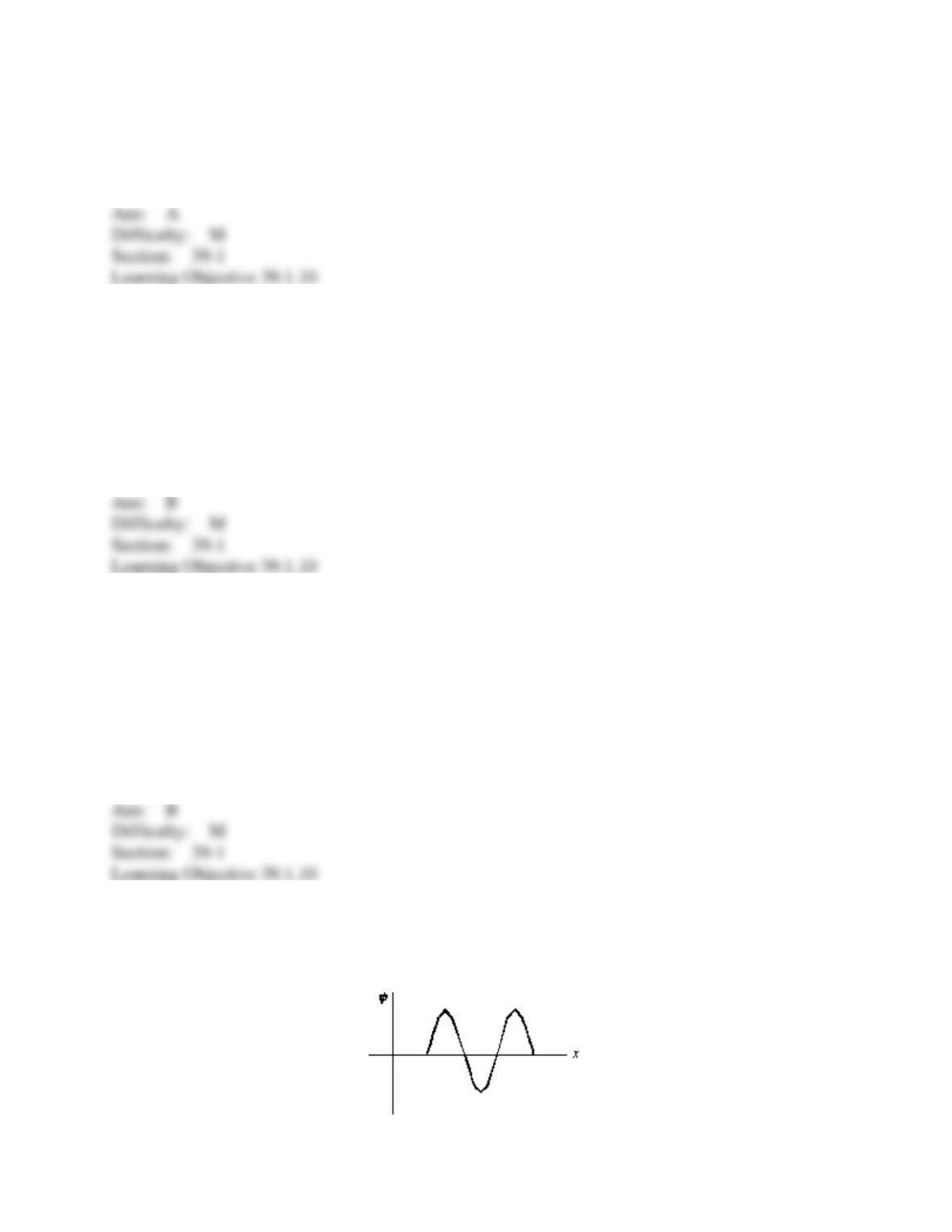
15. An electron is in a one-dimensional trap with zero potential energy in the interior and
infinite potential energy at the walls. A graph of its wave function
(x) versus x is shown. The
value of quantum number n is:
A) 0
B) 1
C) 2
D) 4
E) 8
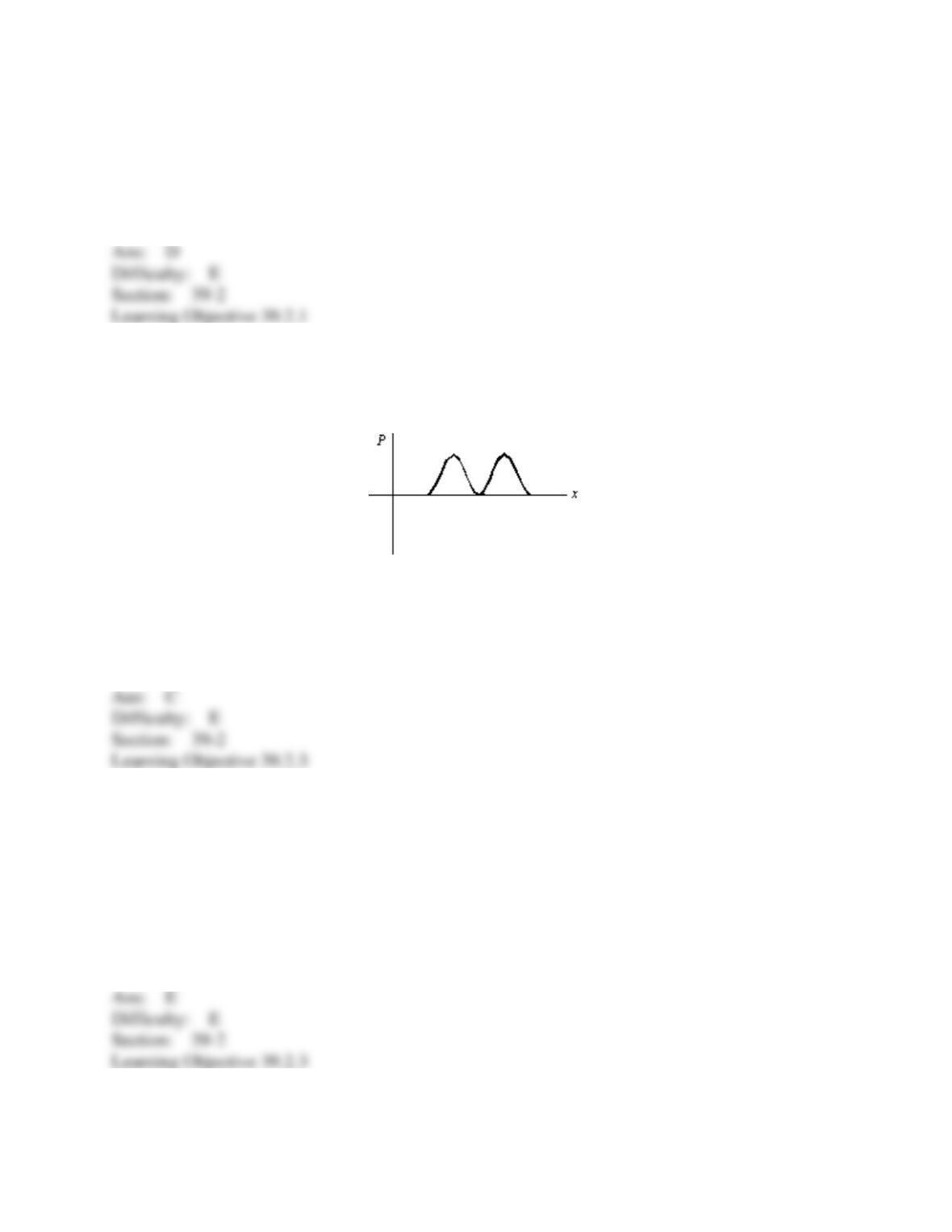
16. An electron is in a one-dimensional trap with zero potential energy in the interior and
infinite potential energy at the walls. A graph of its probability density P(x) versus x is shown.
The value of the quantum number n is:
A) 0
B) 1
C) 2
D) 3
E) 4
17. A particle is trapped in an infinite potential energy well. It is in the state with quantum
number n = 14. How many nodes does the probability density have (counting the nodes at the
ends of the well)?
A) 0
B) 7
C) 13
D) 14
E) 15
18. A particle is trapped in an infinite potential energy well. It is in the state with quantum

number n = 14. How many maxima does the probability density have?
A) 0
B) 7
C) 13
D) 14
E) 15
19. A particle is confined to a one-dimensional trap by infinite potential energy walls. Of the
following states, designed by the quantum number n, for which one is the probability density
greatest near the center of the well?
A) n = 2
B) n = 3
C) n = 4
D) n = 5
E) n = 6
20. If a wave function
for a particle moving along the x axis is “normalized” then:
A)
2dt = 1
B)
2dx = 1
C)
/x = 1
D)
/t = 1
E)
2 = 1
21. An electron is in a one-dimensional well with finite potential energy barriers at the walls.
The matter wave:
A) is zero at the barriers
B) is zero everywhere within each barrier
C) is zero in the well
D) extends into the barriers
E) is discontinuous at the barriers

22. A particle is confined by finite potential energy walls to a one-dimensional trap from
x = 0 to x = L. Its wave function in the region x > L has the form:
A)
(x) = A sin(kx)
B)
(x) = Aekx
C)
(x) = Ae–kx
D)
(x) = Aeikx
E)
(x) = 0
23. A particle in a certain finite potential energy well can have any of five quantized energy
values and no more. Which of the following would allow it to have any of six quantized energy
levels?
A) Increase the momentum of the particle
B) Decrease the momentum of the particle
C) Decrease the well width
D) Increase the well depth
E) Decrease the well depth
24. A particle is trapped in a finite potential energy well that is deep enough so that the electron
can be in the state with n = 4. For this state how many nodes does the probability density have?
A) 0
B) 1
C) 3
D) 4
E) 5
25. The figure shows the energy levels for an electron in a finite potential energy well. If the
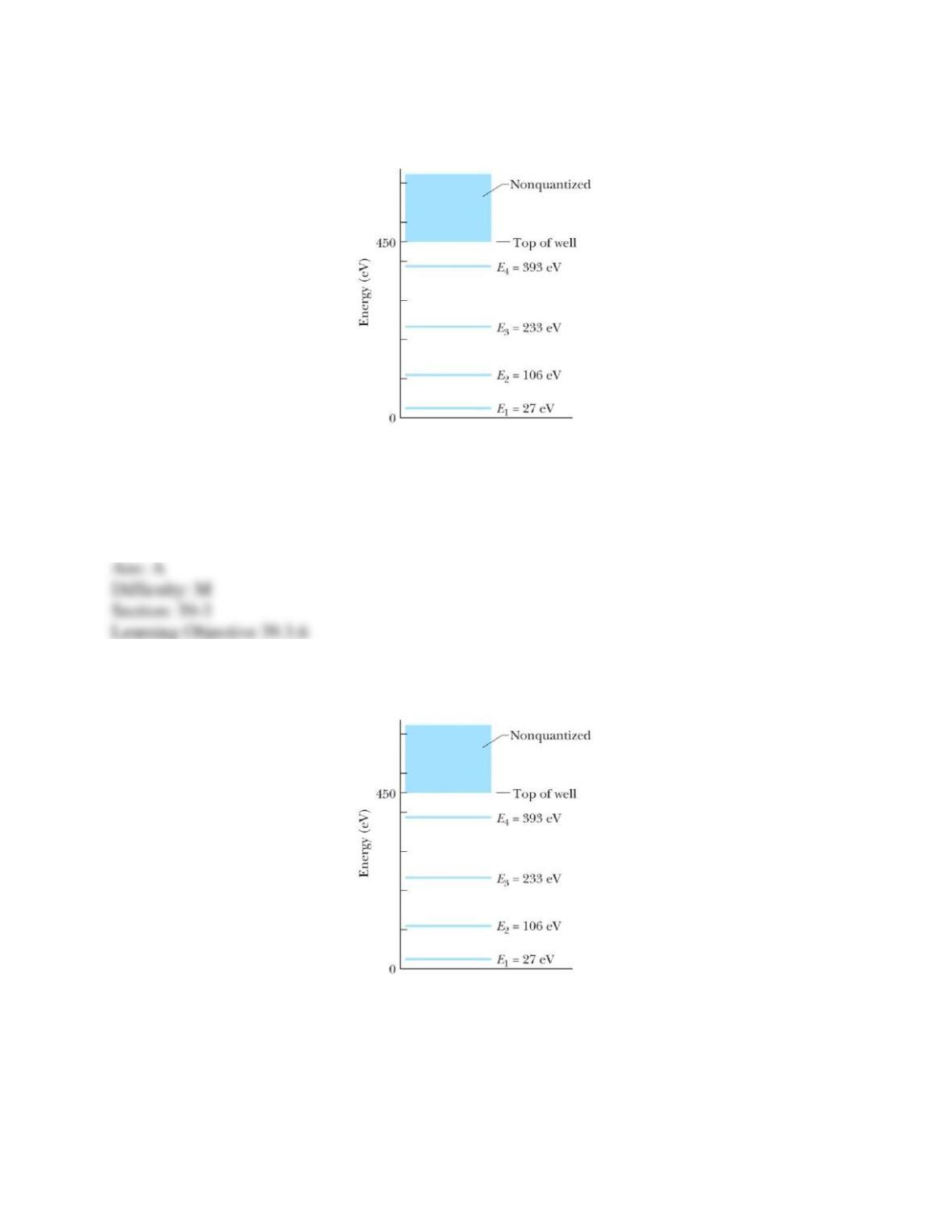
electron makes a transition from the n = 3 state to the ground state, what is the wavelength of the
emitted photon?
A) 6.0 nm
B) 5.7 nm
C) 5.3 nm
D) 3.0 nm
E) 2.3 nm
26. The figure shows the energy levels for an electron in a finite potential energy well. If an
electron in the n = 2 state absorbs a photon of wavelength 2.0 nm, what happens to the electron?
A) It makes a transition to the n = 3 state.
B) It makes a transition to the n = 4 state.
C) It escapes the well with a kinetic energy of 280 eV.
D) It escapes the well with a kinetic energy of 730 eV.
E) Nothing; this photon does not have an energy corresponding to an allowed transition so it is

not absorbed.
27. An electron is trapped in an infinitely deep rectangular well with sides of length Lx = L and
Ly = 2L. The energy of the state nx = 2, ny = 4 is:
A) 8ℎ2
𝑚𝐿2
B) ℎ2
𝑚𝐿2
C) ℎ2
2𝑚𝐿2
D) ℎ2
4𝑚𝐿2
E) ℎ2
8𝑚𝐿2
28. An electron is trapped in an infinitely deep rectangular well with sides of length Lx = L and
Ly = 2L. The energy that the electron needs to move from the ground state to the state nx = 2, ny =
4 is:
A) 2ℎ2
𝑚𝐿2
B) 3ℎ2
2𝑚𝐿2
C) ℎ2
𝑚𝐿2
D) 7ℎ2
8𝑚𝐿2
E) 3ℎ2
4𝑚𝐿2

29. The quantum number n is most closely associated with what property of the electron in a
hydrogen atom?
A) Energy
B) Orbital angular momentum
C) Spin angular momentum
D) Magnetic moment
E) z component of angular momentum
30. Take the potential energy of a hydrogen atom to be zero for infinite separation of the
electron and proton. Then the ground state energy of a hydrogen atom is –13.6 eV. The minus
sign indicates:
A) the kinetic energy is negative
B) the potential energy is positive
C) the electron might escape from the atom
D) the electron and proton are bound together
E) none of the above
31. The wave function for an electron in a state with zero angular momentum:
A) is zero everywhere
B) is spherically symmetric
C) depends on the angle from the z axis
D) depends on the angle from the x axis
E) is spherically symmetric for some shells and depends on the angle from the z axis for others
32. Consider the following:
I.
the probability density for an ℓ = 0 state
II.
the probability density for a state with ℓ ≠ 0
III.
the average of the probability densities for all states in an ℓ ≠ 0 subshell

Of these which are spherically symmetric?
A) only I
B) only II
C) only I and II
D) only I and III
E) I, II, and III
33. Take the potential energy of a hydrogen atom to be zero for infinite separation of the
electron and proton. Then, according to the quantum theory the energy En of a state with
principal quantum number n is proportional to:
A) n
B) n2
C) 1/n
D) 1/n2
E) none of the above
34. The binding energy of an electron in the ground state in a hydrogen atom is about:
A) 1.0 eV
B) 3.4 eV
C) 10.2 eV
D) 13.6 eV
E) 27.2 eV
35. Take the potential energy of a hydrogen atom to be zero for infinite separation of the
electron and proton. Then the ground state energy of a hydrogen atom is –13.6 eV. The energy of
the first excited state is:
A) 0 eV
B) –3.4 eV
C) –6.8 eV
D) –10.2 eV
E) –27 eV
36. Take the potential energy of a hydrogen atom to be zero for infinite separation of the
electron and proton. Then the ground state energy of a hydrogen atom is –13.6 eV. When the
electron is in the first excited state its excitation energy (the difference between the energy of the
state and that of the ground state) is:
A) 0
B) 3.4 eV
C) 6.8 eV
D) 10.2 eV
E) 13.6 eV
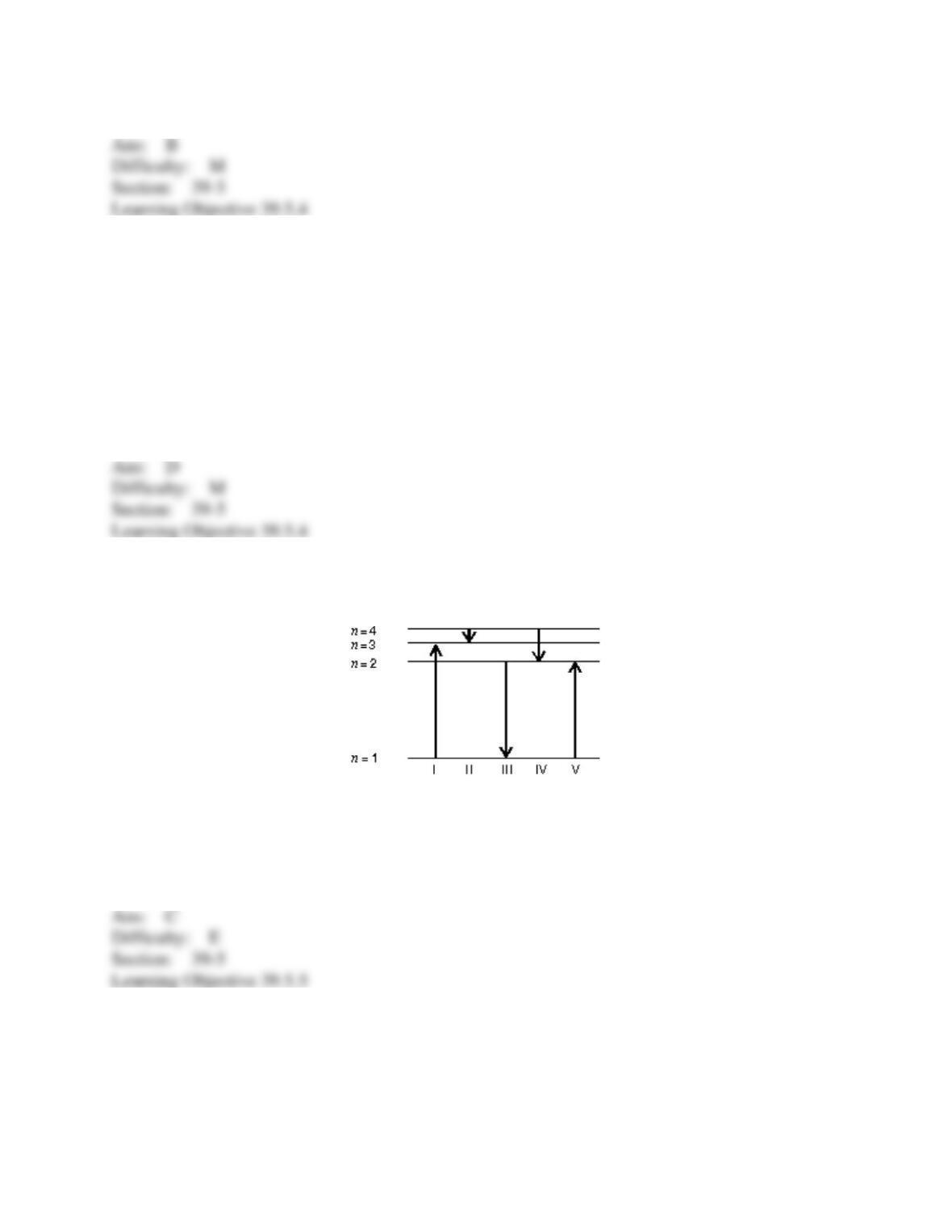
37. The diagram shows the energy levels for an electron in a certain atom. Of the transitions
shown, which represents the emission of a photon with the most energy?
A) I
B) II
C) III
D) IV
E) V
38. When a hydrogen atom makes the transition from the second excited state to the ground
state (at –13.6 eV) the energy of the photon emitted is:
A) 0 eV
B) 1.5 eV
C) 9.1 eV

D) 12.1 eV
E) 13.6 eV
39. The series limit for the Balmer series represents a transition m → n, where (m, n) is
A) (2,1)
B) (3,2)
C) (,0)
D) (,1)
E) (,2)
40. The Balmer series of hydrogen is important because it:
A) is the only one for which the Bohr theory can be used
B) is the only series which occurs for hydrogen
C) is in the visible region
D) involves the lowest possible quantum number n
E) involves the highest possible quantum number n
41. Which of the following sets of quantum numbers is possible for an electron in a hydrogen
atom?
A) n = 4, ℓ = 3, mℓ = −3
B) n = 4, ℓ = 4, mℓ = −2
C) n = 5, ℓ = −1, mℓ = 2
D) n = 3, ℓ = 1, mℓ = −2
E) n = 2, ℓ = 3, mℓ = −2
42. If the wave function
is spherically symmetric then the radial probability density is given

by:
A) 4r2
B)
2
C) 4r2
2
D) 4
2
E) 4r
2
43. If P(r) is the radial probability density for a hydrogen atom then the probability that the
separation of the electron and proton is between r and r + dr is:
A) P dr
B) P 2 dr
C) 4r2P dr
D) 4r2P dr
E) 4P dr
44. The radial probability density for the electron in the ground state of a hydrogen atom has a
peak at about:
A) 0.5 pm
B) 5 pm
C) 50 pm
D) 500 pm
E) 5000 pm
45. The following image is a dot plot of the ground state of the hydrogen atom. The dots
represent:

A) all the possible positions of the electron
B) every electron in the atom
C) the electron wave function
D) the volume probability density for the electron
E) the density of the electron cloud