Chapter: Chapter 20
Learning Objectives
LO 20.1.0 Solve problems related to entropy.
LO 20.1.1 Identify the second law of thermodynamics: If a process occurs in a closed system, the
entropy of the system increases for irreversible processes and remains constant for reversible
processes; it never decreases.
LO 20.1.2 Identify that entropy is a state function (the value for a particular state of the system
does not depend on how that state is reached).
LO 20.1.3 Calculate the change in entropy for a process by integrating the inverse of the
temperature (in kelvins) with respect to the heat Q transferred during the process.
LO 20.1.4 For a phase change with constant temperature process, apply the relationship between
the entropy change ΔS, the total transferred heat Q, and the temperature T (in kelvins).
LO 20.1.5 For a temperature change ΔT that is small relative to the temperature T, apply the
relationship between the entropy change ΔS, the transferred heat Q, and the average temperature
Tavg (in kelvins).
LO 20.1.6 For an ideal gas, apply the relationship between the entropy change ΔS and the initial
and final values of the pressure and volume.
LO 20.1.7 Identify that if a process is an irreversible one, the integration must be done for a
reversible process that takes the system between the same initial and final states as the
irreversible process.
LO 20.1.8 For stretched rubber, relate the elastic force to the rate at which the rubber’s entropy
changes with the change in the stretching distance.
LO 20.2.0 Solve problems related to entropy in the real world: engines.
LO 20.2.1 Identify that a heat engine is a device that extracts energy from its environment in the
form of heat and does useful work and that in an ideal heat engine, all processes are reversible,
with no wasteful energy transfers.
LO 20.2.2 Sketch a p-V diagram for the cycle of a Carnot engine, indicating the direction of
cycling, the nature of the processes involved, the work done during each process (including
algebraic sign), the net work done in the cycle, and the heat transferred during each process
(including algebraic sign).
LO 20.2.3 Sketch a Carnot cycle on a temperature-entropy diagram, indicating the heat transfers.
LO 20.2.4 Determine the net entropy change around a Carnot cycle.
LO 20.2.5 Calculate the efficiency ε of a Carnot engine in terms of the heat transfers and also in
terms of the temperatures of the reservoirs
LO 20.2.6 Identify that there are no perfect engines in which the energy transferred as heat Q
from a high temperature reservoir goes entirely into the work W done by the engine.
LO 20.2.7 Sketch a p-V diagram for the cycle of a Stirling engine, indicating the direction of
cycling, the nature of the processes involved, the work done during each process (including
algebraic sign), the net work done in the cycle, and the heat transfers during each process.
LO 20.3.0 Solve problems related to refrigerators and real engines.
LO 20.3.1 Identify that a refrigerator is a device that uses work to transfer energy from a
low-temperature reservoir to a high-temperature reservoir, and that an ideal refrigerator is one
that does this with reversible processes and no wasteful losses.
LO 20.3.2 Sketch a p-V diagram for the cycle of a Carnot refrigerator, indicating the direction of
cycling, the nature of the processes involved, the work done during each process (including

algebraic sign), the net work done in the cycle, and the heat transferred during each process
(including algebraic sign).
LO 20.3.3 Apply the relationship between the coefficient of performance K and the heat
exchanges with the reservoirs and the temperatures of the reservoirs.
LO 20.3.4 Identify that there is no ideal refrigerator in which all of the energy extracted from the
low-temperature reservoir is transferred to the high-temperature reservoir.
LO 20.3.5 Identify that the efficiency of a real engine is less than that the ideal Carnot engine.
LO 20.4.0 Solve problems related to a statistical view of entropy.
LO 20.4.1 Explain what is meant by the configurations of a system of molecules.
LO 20.4.2 Calculate the multiplicity of a given configuration.
LO 20.4.3 Identify that all microstates are equally probable but the configurations with more
microstates are more probable than the other configurations.
LO 20.4.4 Apply Boltzmann’s entropy equation to calculate the entropy associated with a
multiplicity.
Multiple Choice
1. In a reversible process the system:
A) is always close to equilibrium states
B) is close to equilibrium states only at the beginning and end
C) might never be close to any equilibrium state
D) is close to equilibrium states throughout, except at the beginning and end
E) is none of the above
2. A slow (quasi-static) process is NOT reversible if:
A) the temperature changes
B) energy is absorbed or emitted as heat
C) work is done on the system
D) friction is present
E) the pressure changes
3. Possible units of entropy are:
A) J
B) J/K
C) J–1
D) literatm
E) cal/mol
4. For all adiabatic processes:
A) the entropy does not change
B) the entropy increases
C) the entropy decreases
D) the entropy does not increase
E) the entropy does not decrease
5. For all reversible processes involving a system and its environment:
A) the entropy of the system does not change
B) the entropy of the system increases
C) the total entropy of the system and its environment does not change
D) the total entropy of the system and its environment increases
E) none of the above
6. For all irreversible processes involving a system and its environment:
A) the entropy of the system does not change
B) the entropy of the system increases
C) the total entropy of the system and its environment does not change
D) the total entropy of the system and its environment increases
E) none of the above
7. The change in entropy is zero for:
A) reversible adiabatic processes
B) reversible isothermal processes

C) reversible processes during which no work is done
D) reversible isobaric processes
E) all adiabatic processes
8. Which of the following processes leads to a change in entropy of zero for the system
undergoing the process?
A) Non-cyclic isobaric (constant pressure)
B) Non-cyclic isochoric (constant volume)
C) Non-cyclic isothermal (constant temperature)
D) Any closed cycle
E) None of these
9. An ideal gas expands into a vacuum in a rigid vessel. As a result there is:
A) a change in entropy
B) an increase of pressure
C) a change in temperature
D) a decrease of internal energy
E) a change in phase
10. Which of the following is NOT a state variable?
A) Work
B) Internal energy
C) Entropy
D) Temperature
E) Pressure
11. A hot object and a cold object are placed in thermal contact and the combination is isolated.
They transfer energy until they reach a common temperature. The change Sh in the entropy of
the hot object, the change Sc in the entropy of the cold object, and the change Stotal in the
entropy of the combination are:
A) Sh > 0, Sc > 0, Stotal > 0
B) Sh < 0, Sc > 0, Stotal > 0
C) Sh < 0, Sc > 0, Stotal < 0
D) Sh > 0, Sc < 0, Stotal > 0
E) Sh > 0, Sc < 0, Stotal < 0
12. Consider all possible isothermal contractions of an ideal gas. The entropy of the gas:
A) does not change for any of them
B) does not decrease for any of them
C) does not increase for any of them
D) increases for all of them
E) decreases for all of them
13. Rank from smallest to largest, the changes in entropy of a pan of water on a hot plate, as
the temperature of the water
1. goes from 20 to 30C
2. goes from 30 to 40C
3. goes from 40 to 45C
4. goes from 80 to 85C
A) 1, 2, 3, 4
B) 3, 4, 1, 2
C) 1 and 2 tie, then 3 and 4 tie
D) 3 and 4 tie, then 1 and 2 tie
E) 4, 3, 2, 1
14. An ideal gas is to taken reversibly from state i, at temperature T1, to other states labeled I,
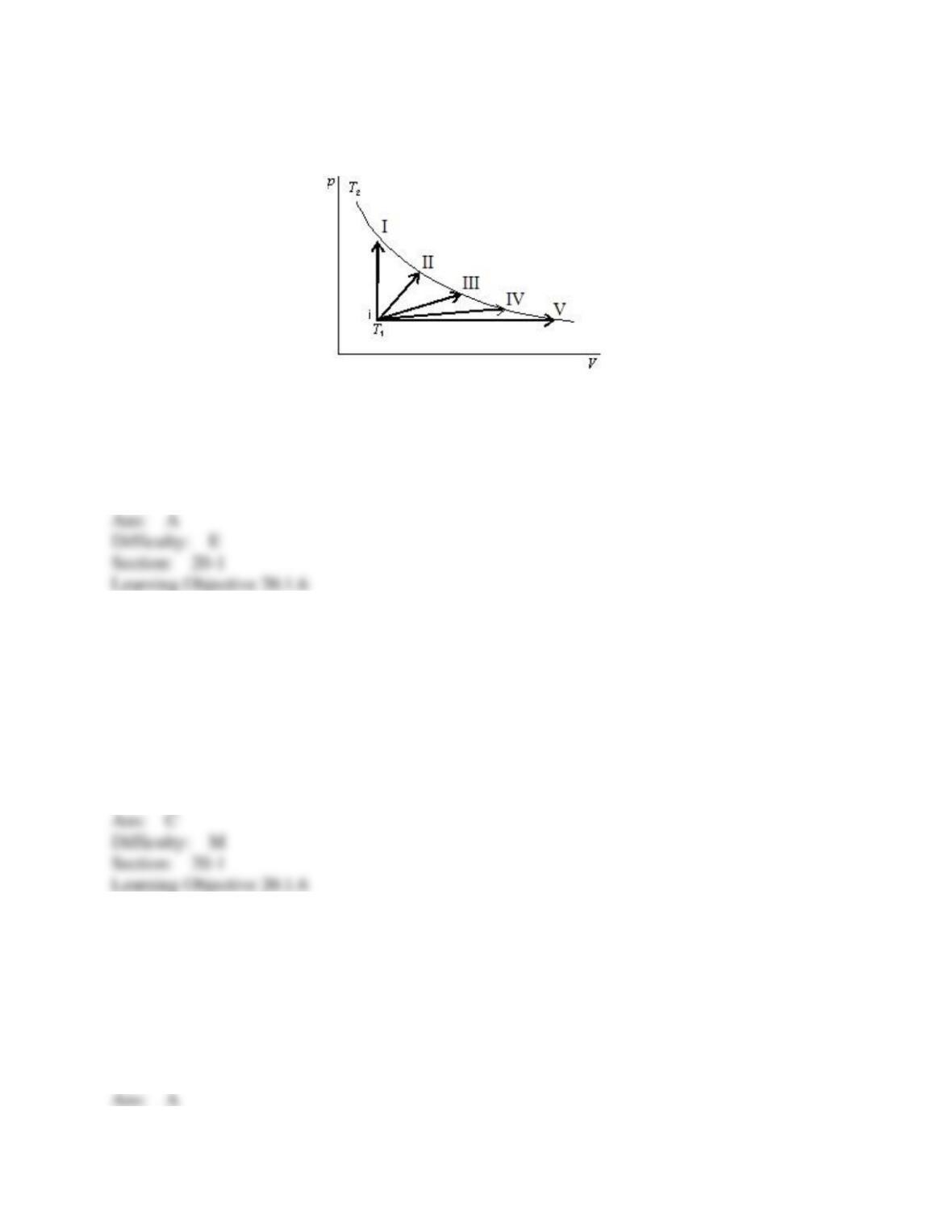
II, III, IV and V on the p-V diagram below. All are at the same temperature T2. Rank the five
processes according to the change in entropy of the gas, least to greatest.
A) I, II, III, IV, V
B) V, IV, III, II, I
C) I, then II, III, IV, and V tied
D) I, II, III, and IV, tied, then V
E) I and V tied, then II, III, IV
15. An ideal gas, consisting of n moles, undergoes a reversible isothermal process during
which the volume changes from Vi to Vf. The change in entropy of the thermal reservoir in
contact with the gas is given by:
A) nR(Vf – Vi)
B) nR ln(Vf – Vi)
C) nR ln(Vi/Vf)
D) nR ln(Vf/Vi)
E) none of the above (entropy can’t be calculated for the thermal reservoir)
16. One mole of an ideal gas expands reversibly and isothermally at temperature T until its
volume is doubled. The change of entropy of this gas for this process is:
A) R ln 2
B) (ln 2)/T
C) 0
D) RT ln 2
E) 2R

17. An ideal gas, consisting of n moles, undergoes an irreversible process in which the
temperature has the same value at the beginning and end. If the volume changes from Vi to Vf,
the change in entropy is given by:
A) n R(Vf – Vi)
B) n R ln(Vf – Vi)
C) n R ln(Vi/Vf)
D) n R ln(Vf/Vi)
E) none of the above (entropy can’t be calculated for an irreversible process)
18. The temperature of n moles of a gas is increased from Ti to Tf at constant pressure. If the
molar specific heat at constant pressure is Cp and is independent of temperature, then change in
the entropy of the gas is:
A) nCp ln(Tf/Ti)
B) nCp ln(Ti/Tf)
C) nCp ln(Tf – Ti)
D) nCp ln(1 – Ti/Tf)
E) nCp (Tf – Ti)
19. Consider the following processes: The temperatures of two identical gases are increased
from the same initial temperature to the same final temperature. Reversible processes are used.
For gas A the process is carried out at constant volume while for gas B it is carried out at
constant pressure. The change in entropy:
A) is the same for A and B
B) is greater for A
C) is greater for B
D) is greater for A only if the initial temperature is low
E) is greater for A only if the initial temperature is high
20. The difference in entropy S = SB – SA for two states A and B of a system can computed as
the integral dQ/T provided:
A) A and B are on the same adiabat
B) A and B have the same temperature
C) a reversible path is used for the integral
D) the change in internal energy is first computed
E) the energy absorbed as heat by the system is first computed
21. Let SI denote the change in entropy of a sample for an irreversible process from state A to
state B. Let SR denote the change in entropy of the same sample for a reversible process from
state A to state B. Then:
A) SI > SR
B) SI = SR
C) SI < SR
D) SI = 0
E) SR = 0
22. A force of 5 N stretches an elastic band at room temperature. The rate at which its entropy
changes as it stretches is about:
A) –2 x 10⁻² J/K·m
B) 2 x 10⁻² J/K·m
C) 1500 J/K·m
D) –1500 J/K·m
E) cannot be calculated without knowing the heat capacity
23. A heat engine:
A) converts heat input to an equivalent amount of work
B) converts work to an equivalent amount of heat
C) takes heat in, does work, and loses energy as heat
D) uses positive work done on the system to transfer heat from a low temperature reservoir to a
high temperature reservoir
E) uses positive work done on the system to transfer heat from a high temperature reservoir to
a low temperature reservoir
24. A heat engine that in each cycle does positive work and loses energy as heat, with no heat
energy input, would violate:
A) the zeroth law of thermodynamics
B) the first law of thermodynamics
C) the second law of thermodynamics
D) the third law of thermodynamics
E) Newton’s second law
25. An inventor suggests that a house might be heated by using a refrigerator to draw energy as
heat from the ground and reject energy as heat into the house. He claims that the energy supplied
to the house can exceed the work required to run the refrigerator. This:
A) is impossible by first law
B) is impossible by second law
C) would only work if the ground and the house were at the same temperature
D) is impossible since heat flows from the (hot) house to the (cold) ground
E) is possible
26. In a thermally insulated kitchen, an ordinary refrigerator is turned on and its door is left
open. The temperature of the room:
A) remains constant according to the first law of thermodynamics
B) increases according to the first law of thermodynamics
C) decreases according to the first law of thermodynamics
D) remains constant according to the second law of thermodynamics
E) increases according to the second law of thermodynamics
27. A Carnot cycle:
A) is bounded by two isotherms and two adiabats on a p–V graph
B) consists of two isothermal and two constant volume processes
C) is any four sided process on a p–V graph
D) only exists for an ideal gas
E) has an efficiency equal to the enclosed area on a p–V diagram
28. For one complete cycle of a reversible heat engine, which of the following quantities is
NOT zero?
A) the change in the entropy of the working gas
B) the change in the pressure of the working gas
C) the change in the internal energy of the working gas
D) the work done by the working gas
E) the change in the temperature of the working gas
29. A Carnot engine operates with a cold reservoir at a temperature of TL = 400 K and a hot
reservoir at a temperature of TH = 500 K. What is the net entropy change as it goes through a
complete cycle?
A) 0 J/K
B) 20 J/K
C) 80 J/K
D) 400 J/K
E) 500 J/K
30. The temperature TL of the cold reservoirs and the temperatures TH of the hot reservoirs for
four Carnot heat engines are
engine 1: TL = 400 K and TH = 500 K
engine 2: TL = 500 K and TH = 600 K

engine 3: TL = 400 K and TH = 600 K
engine 4: TL = 600 K and TH = 800 K
Rank these engines according to their efficiencies, least to greatest
A) 3, 4, 1, 2
B) 1 and 2 tie, then 3 and 4 tie
C) 2, 1, 3, 4
D) 1, 2, 4, 3
E) 2, 1, 4, 3
31. A Carnot heat engine runs between a cold reservoir at temperature TL and a hot reservoir at
temperature TH. You want to increase its efficiency. Of the following, which change results in
the greatest increase in efficiency? The value of T is the same for all changes.
A) Raise the temperature of the hot reservoir by T
B) Raise the temperature of the cold reservoir by T
C) Lower the temperature of the hot reservoir by T
D) Lower the temperature of the cold reservoir by T
E) Lower the temperature of the hot reservoir by (1/2)T and raise the temperature of the cold
reservoir by (1/2)T
32. A Carnot cycle heat engine operates between 400 K and 500 K. Its efficiency is:
A) 20%
B) 25%
C) 44%
D) 80%
E) 100%
33. A Carnot heat engine operates between a hot reservoir at absolute temperature TH and a
cold reservoir at absolute temperature TL. Its efficiency is:
A) TH/ TL
B) TL /TH
C) 1 – TH/ TL

D) 1 – TL /TH
E) 100%
34. A heat engine operates between a high temperature reservoir at TH and a low temperature
reservoir at TL. Its efficiency is given by 1 – TL/TH:
A) only if the working substance is an ideal gas
B) only if the engine is reversible
C) only if the engine is quasi-static
D) only if the engine operates on a Stirling cycle
E) no matter what characteristics the engine has
35. The maximum theoretical efficiency of a Carnot engine operating between reservoirs at the
steam point and at room temperature is about:
A) 10%
B) 20%
C) 50%
D) 80%
E) 99%
36. A Carnot engine operates between 200C and 20C. Its maximum possible efficiency is:
A) 90%
B) 100%
C) 38%
D) 72%
E) 24%
37. According to the second law of thermodynamics:
A) all heat engines have the same efficiency
B) all reversible heat engines have the same efficiency
C) the efficiency of any heat engine is independent of its working substance
D) the efficiency of a Carnot engine depends only on the temperatures of the two reservoirs
E) all Carnot engines theoretically have 100% efficiency
38. A heat engine absorbs energy of magnitude QH from a high temperature reservoir, does
work of magnitude W , and transfers energy of magnitude QL as heat to a low temperature
reservoir. Its efficiency is:
A) QH / W
B) QL / W
C) QH / QL
D) W / QH
E) W / QL
39. A certain heat engine draws 500 cal/s from a water bath at 27C and transfers 400 cal/s to a
reservoir at a lower temperature. The efficiency of this engine is:
A) 80%
B) 75%
C) 55%
D) 25%
E) 20%
40. A heat engine in each cycle absorbs energy from a reservoir as heat and does an equivalent
amount of work, with no other changes. This engine violates:
A) the zeroth law of thermodynamics
B) the first law of thermodynamics
C) the second law of thermodynamics
D) the third law of thermodynamics
E) none of the above

41. A cyclical process that transfers energy as heat from a high temperature reservoir to a low
temperature reservoir with no other change would violate:
A) the zeroth law of thermodynamics
B) the first law of thermodynamics
C) the second law of thermodynamics
D) the third law of thermodynamics
E) none of the above
42. According to the second law of thermodynamics:
A) heat energy cannot be completely converted to work
B) work cannot be completely converted to heat energy
C) for all cyclic processes we have dQ/T < 0
D) the reason all heat engine efficiencies are less than 100% is friction, which is unavoidable
E) all of the above are true
43. Consider the following processes:
I.
Energy flows as heat from a hot object to a colder object
II.
Work is done on a system and an equivalent amount of energy is
rejected as heat by the system
III.
Energy is absorbed as heat by a system and an equivalent amount
of work is done by the system
Which are never found to occur?
A) Only I
B) Only II
C) Only III
D) Only II and III
E) I, II and III
44. A heat engine in each cycle absorbs energy of magnitude QH as heat from a high
temperature reservoir, does work of magnitude W , and then absorbs energy of magnitude QL
as heat from a low temperature reservoir. If W = QH + QL this engine violates:
A) the zeroth law of thermodynamics
B) the first law of thermodynamics
C) the second law of thermodynamics
D) the third law of thermodynamics
E) none of the above
45. A heat engine operates between 200 K and 100 K. In each cycle it takes 100 J from the hot
reservoir, loses 25 J to the cold reservoir, and does 75 J of work. This heat engine violates:
A) both the first and second laws of thermodynamics
B) the first law but not the second law of thermodynamics
C) the second law but not the first law of thermodynamics
D) neither the first law nor the second law of thermodynamics
E) cannot answer without knowing the mechanical equivalent of heat
46. Is it possible to transfer energy from a low-temperature reservoir to a high-temperature
reservoir?
A) No, this violates the conservation of energy.
B) No, this violates the second law of thermodynamics.
C) Yes, this is what a heat engine does, and it can happen without the engine doing work.
D) Yes, this is what a refrigerator does, and it can happen without the refrigerator doing work.
E) Yes, this is what a refrigerator does, and the refrigerator must do work to make this happen.
47. A perfectly reversible heat pump with a coefficient of performance of 14 supplies energy to
a building as heat to maintain its temperature at 27C. If the pump motor does work at the rate
of 1 kW, at what rate does the pump supply energy to the building?
A) 15 kW
B) 3.9 kW
C) 1.4 kW
D) 0.26 kW
E) 0.067 kW
48. A refrigerator absorbs energy of magnitude QL as heat from a low temperature reservoir
and rejects energy of magnitude QH as heat to a high temperature reservoir. Work W is done
on the working substance. The coefficient of performance is given by:
A) QL /W
B) QH /W
C) (QL + QH )/W
D) W/QL
E) W/QH
49. A reversible refrigerator operates between a low temperature reservoir at TL and a high
temperature reservoir at TH. Its coefficient of performance is given by:
A) (TH – TL)/ TL
B) TL /(TH – TL)
C) (TH – TL)/TH
D) TH/(TH – TL)
E) TH(TH + TL)
50. A Carnot refrigerator runs between a cold reservoir at temperature TL and a hot reservoir at
temperature TH. You want to increase its coefficient of performance. Of the following, which
change results in the greatest increase in the coefficient? The value of T is the same for all
changes.
A) Raise the temperature of the hot reservoir by T
B) Raise the temperature of the cold reservoir by T
C) Lower the temperature of the hot reservoir by T
D) Lower the temperature of the cold reservoir by T
E) Lower the temperature of the hot reservoir by (1/2)T and raise the temperature of the cold
reservoir by (1/2)T
51. On a warm day a pool of water transfers energy to the air as heat and freezes. This is a
direct violation of:
A) the zeroth law of thermodynamics
B) the first law of thermodynamics
C) the second law of thermodynamics
D) the third law of thermodynamics
E) none of the above
52. An inventor claims to have a heat engine that has efficiency of 40% when it operates
between a high temperature reservoir of 150C and a low temperature reservoir of 30C. This
engine:
A) must violate the zeroth law of thermodynamics
B) must violate the first law of thermodynamics
C) must violate the second law of thermodynamics
D) must violate the third law of thermodynamics
E) does not necessarily violate any of the laws of thermodynamics
53. A Carnot heat engine and an irreversible heat engine both operate between the same high
temperature and low temperature reservoirs. They absorb the same heat from the high
temperature reservoir as heat. The irreversible engine:
A) does more work
B) rejects more energy to the low temperature reservoir as heat
C) has the greater efficiency
D) has the same efficiency as the reversible engine
E) cannot absorb the same energy from the high temperature reservoir as heat without violating
the second law of thermodynamics

54. For a system of molecules,
A) each configuration consists of a set of equivalent microstates.
B) each microstate consists of a set of equivalent configurations.
C) the number of configurations in a microstate is the multiplicity of the microstate.
D) the multiplicity of the configuration is the product of the number of molecules in each
microstate.
E) each configuration is equally probable.
55. Twenty-five identical molecules are in a box. Microstates are designated by identifying the
molecules in the left and right halves of the box. The multiplicity of the configuration with 15
molecules in the right half and 10 molecules in the left half is:
A) 1.03 1023
B) 3.27 106
C) 150
D) 25
E) 5
56. For a system of molecules,
A) each configuration is equally probable.
B) microstates with more configurations are more probable than other microstates.
C) configurations with more microstates are more probable than other configurations.
D) microstates with more configurations are less probable than other microstates.
E) configurations with more microstates are less probable than other configurations.
57. Twenty-five identical molecules are in a box. Microstates are designated by identifying the
molecules in the left and right halves of the box. The Boltzmann constant is 1.38 10–23 J/K.
The entropy associated with the configuration for which 15 molecules are in the left half and 10
molecules are in the right half is:
A) 2.07 10–22 J/K
B) 7.31 10–22 J/K
C) 4.44 10–23 J/K
D) 6.91 10–23 J/K
E) 2.22 10–23 J/K
58. The thermodynamic state of gas changes configuration from one with 3.8 1018
microstates to one with 7.9 1019 microstates. The Boltzmann constant is 1.38 10–23 J/K. The
change in entropy is:
A) S = 0
B) S = 1.05 10–23 J/K
C) S = –1.05 10–23 J/K
D) S = 4.19 10–23 J/K
E) S = –4.19 10–23 J/K
59. Let k be the Boltzmann constant. If the configuration of the molecules in a gas changes so
that the multiplicity is reduced to one-third its previous value, the entropy of the gas changes by:
A) S = 0
B) S = 3k ln 2
C) S = –3k ln 2
D) S = k ln(1/3)
E) S = –3 ln 3
60. Let k be the Boltzmann constant. If the configuration of molecules in a gas changes from
one with a multiplicity of M1 to one with a multiplicity of M2, then entropy changes by:
A) S = 0
B) S = k(M2 – M1)
C) S = kM2/M1
D) S = k ln(M2M1)
E) S = k ln(M2/M1)
61. Let k be the Boltzmann constant. If the thermodynamic state of gas at temperature T
changes isothermally and reversibly to a state with three times the number of microstates as
initially, the energy input to gas as heat is:
A) Q = 0
B) Q = 3kT
C) Q = –3kT
D) Q = kT ln 3
E) Q = –kT ln 3