Chapter: Chapter 10
Learning Objectives
LO 10.1.0 Solve problems related to rotational variables
LO 10.1.1 Identify that if all parts of a body rotate around a fixed axis locked together, the body
is a rigid body. (This chapter is about the motion of such bodies.)
LO 10.1.2 Identify that the angular position of a rotating rigid body is the angle that an internal
reference line makes with a fixed, external reference line.
LO 10.1.3 Apply the relationship between angular displacement and the initial and final angular
positions.
LO 10.1.4 Apply the relationship between average angular velocity, angular displacement, and
the time interval for that displacement.
LO 10.1.5 Apply the relationship between average angular acceleration, change in angular
velocity, and the time interval for that change.
LO 10.1.6 Identify that counterclockwise motion is in the positive direction and clockwise
motion is in the negative direction.
LO 10.1.7 Given angular position as a function of time, calculate the instantaneous angular
velocity at any particular time and the average angular velocity between any two particular
times.
LO 10.1.8 Given a graph of angular position versus time, determine the instantaneous angular
velocity at a particular time and the average angular velocity between any two particular times.
LO 10.1.9 Identify instantaneous angular speed as the magnitude of the instantaneous angular
velocity.
LO 10.1.10 Given angular velocity as a function of time, calculate the instantaneous angular
acceleration at any particular time and the average angular acceleration between any two
particular times.
LO 10.1.11 Given a graph of angular velocity versus time, determine the instantaneous angular
acceleration at any particular time and the average angular acceleration between any two
particular times.
LO 10.1.12 Calculate a body’s change in angular velocity by integrating its angular acceleration
function with respect to time.
LO 10.1.13 Calculate a body’s change in angular position by integrating its angular velocity
function with respect to time.
LO 10.2.0 Solve problems related to rotation with constant angular acceleration
LO 10.2.1 For constant angular acceleration, apply the relationships between angular position,
angular displacement, angular velocity, angular acceleration, and elapsed time (Table 10.1).
LO 10.3.0 Solve problems related to relating the linear and angular variables
LO 10.3.1 For a rigid body rotating about a fixed axis, relate the angular variables of the body
(angular position, angular velocity, and angular acceleration) and the linear variables of a particle
on the body (position, velocity, and acceleration) at any given radius.
LO 10.3.2 Distinguish between tangential acceleration and radial acceleration.
LO 10.4.0 Solve problems related to kinetic energy of rotation
LO 10.4.1 Calculate the rotational inertia of a single particle moving in a circle, as measured
relative to the center of that circle.
LO 10.4.2 Find the total rotational inertia of many particles moving around the same center.
LO 10.4.3 Calculate the rotational kinetic energy of a body in terms of its rotational inertia and
its angular speed.
LO 10.5.0 Solve problems related to calculating the rotational inertia
LO 10.5.1 Determine the rotational inertia of a body if it is given in Table 10-2.
LO 10.5.2 Calculate the rotational inertia of a body by integration over the mass elements of
the body.
LO 10.5.3 Apply the parallel-axis theorem for a rotation axis that is displaced from a parallel
axis through the center of mass of a body.
LO 10.6.0 Solve problems related to torque
LO 10.6.1 Identify that a torque on a body involves a force and a position vector, which
extends from a rotation axis to the point where the force is applied.
LO 10.6.2 Calculate the torque by using (a) the angle between the position vector and the force
vector, (b) the line of action and the moment arm of the force, and (c) the force component
perpendicular to the position vector.
LO 10.6.3 Identify that a rotation axis must always be specified to calculate a torque.
LO 10.6.4 Identify that a torque is assigned a positive or negative sign depending on the
direction it tends to make the body rotate about a specified rotation axis: “clocks are negative.”
LO 10.6.5 When more than one torque acts on a body about a rotation axis, calculate the net
torque.
LO 10.7.0 Solve problems related to Newton’s second law for rotation
LO 10.7.1 Apply Newton’s second law for rotation to relate the net torque on a body to the
body’s rotational inertia and rotational acceleration, all calculated relative to a specified rotation
axis.
LO 10.8.0 Solve problems related to work and rotational kinetic energy
LO 10.8.1 Calculate the work done by a torque acting on a rotating body by integrating the
torque with respect to the angle of rotation.
LO 10.8.2 Apply the work–kinetic energy theorem to relate the work done by a torque to the
resulting change in the rotational kinetic energy of the body.
LO 10.8.3 Calculate the work done by a constant torque by relating the work to the angle
through which the body rotates.
LO 10.8.4 Calculate the power of a torque by finding the rate at which work is done.
LO 10.8.5 Calculate the power of a torque at any given instant by relating it to the torque and
the angular velocity at that instant.
Multiple Choice
1. A radian is about:
A) 25
B) 37
C) 45
D) 57
E) 90
2. One revolution is the same as:
A) 1 rad
B) 57 rad
C) /2 rad
D) rad
E) 2 rad
3. One revolution per minute is about:
A) 0.0524 rad/s
B) 0.105 rad/s
C) 0.95 rad/s
D) 1.57 rad/s
E) 6.28 rad/s
4. If a wheel turns with constant angular speed then:
A) each point on its rim moves with constant velocity
B) each point on its rim moves with constant acceleration
C) the wheel turns through equal angles in equal times
D) the angle through which the wheel turns in each second increases as time goes on
E) the angle through which the wheel turns in each second decreases as time goes on
5. One-dimensional linear position is measured along a line, from a point designated x = 0.
One-dimensional angular position:
A) is measured along a line, from a point designated θ = 0.
B) is measured along the axis of rotation.
C) is the angle that an internal reference line makes with a fixed external reference line.
D) is measured relative to the positive y axis.
E) is meaningless, as rotations take place in two dimensions.
6. An object rotates from θ1 to θ2 through an angle that is less than 2π radians. Which of the
following represents its angular displacement?
A) θ1
B) θ2
C) θ1 – θ2
D) θ2 – θ1
E) θ1 + θ2
7. If a wheel is turning at 3.0 rad/s, the time it takes to complete one revolution is about:
A) 0.33 s
B) 0.67 s
C) 1.0 s
D) 1.3 s
E) 2.1 s
8. If a wheel turning at a constant rate completes 100 revolutions in 10 s its angular speed is:
A) 0.31 rad/s
B) 0.63 rad/s
C) 10 rad/s
D) 31 rad/s
E) 63 rad/s
9. The angular speed of the second hand of a watch is:
A) (/1800) rad/s
B) (/60) rad/s
C) (/30) rad/s
D) (2) rad/s
E) (60) rad/s
10. The angular speed of the minute hand of a watch is:
A) (60/) rad/s
B) (1800/) rad/s
C) () rad/s
D) (/1800) rad/s
E) (/60) rad/s
11. A child, riding on a large merry-go-round, travels a distance of 3000 m in a circle of
diameter 40 m. The total angle through which she revolves is:
A) 50 rad
B) 75 rad
C) 150 rad
D) 314 rad
E) none of these
12. Ten seconds after an electric fan is turned on, the fan rotates at 300 rev/min. Its average
angular acceleration is:
A) 3.14 rad/s2
B) 30 rad/s2
C) 30 rev/s2
D) 50 rev/min2
E) 1800 rev/s2
13. A flywheel rotating at 12 rev/s is brought to rest in 6 s. The magnitude of the average
angular acceleration of the wheel during this process is:
A) 1/ rad/s2
B) 2 rad/s2
C) 4 rad/s2
D) 4 rad/s2
E) 72 rad/s2
14. A phonograph turntable, initially rotating at 0.75 rev/s, slows down and stops in 30 s. The
magnitude of its average angular acceleration for this process is:
A) 1.5 rad/s2
B) 1.5 rad/s2
C) /40 rad/s2
D) /20 rad/s2
E) 0.75 rad/s2
15. If the angular velocity vector of a spinning body points out of the page then, when viewed
from above the page, the body is spinning:
A) clockwise about an axis that is perpendicular to the page
B) counterclockwise about an axis that is perpendicular to the page
C) about an axis that is parallel to the page
D) about an axis that is changing orientation
E) about an axis that is getting longer
16. The angular velocity vector of a spinning body points out of the page. If the angular
acceleration vector points into the page then:
A) the body is slowing down
B) the body is speeding up
C) the body is starting to turn in the opposite direction
D) the axis of rotation is changing orientation
E) none of the above
17. The angular velocity of a rotating wheel increases 2 rev/s every minute. The angular
acceleration of this wheel is:
A) 42 rad/s2
B) 2 rad/s2
C) 1/30 rad/s2
D) 2/30 rad/s2
E) 4 rad/s2
18. A wheel initially has an angular velocity of 18 rad/s. It has a constant angular acceleration
of 2.0 rad/s2 and is slowing at first. What time elapses before its angular velocity is18 rad/s in the
direction opposite to its initial angular velocity?
A) 3.0 s
B) 6.0 s
C) 9.0 s
D) 18 s
E) 36 s
19. A wheel initially has an angular velocity of 36 rad/s but after 6.0s its angular velocity is 24
rad/s. If its angular acceleration is constant the value is:
A) 2.0 rad/s2
B) –2.0 rad/s2
C) 3.0 rad/s2
D) –3.0 rad/s2
E) 6.0 rad/s2
20. A wheel initially has an angular velocity of –36 rad/s but after 6.0 s its angular velocity is
–24 rad/s. If its angular acceleration is constant the value is:
A) 2.0 rad/s2
B) –2.0 rad/s2
C) 3.0 rad/s2
D) –3.0 rad/s2
E) –6.0 rad/s2
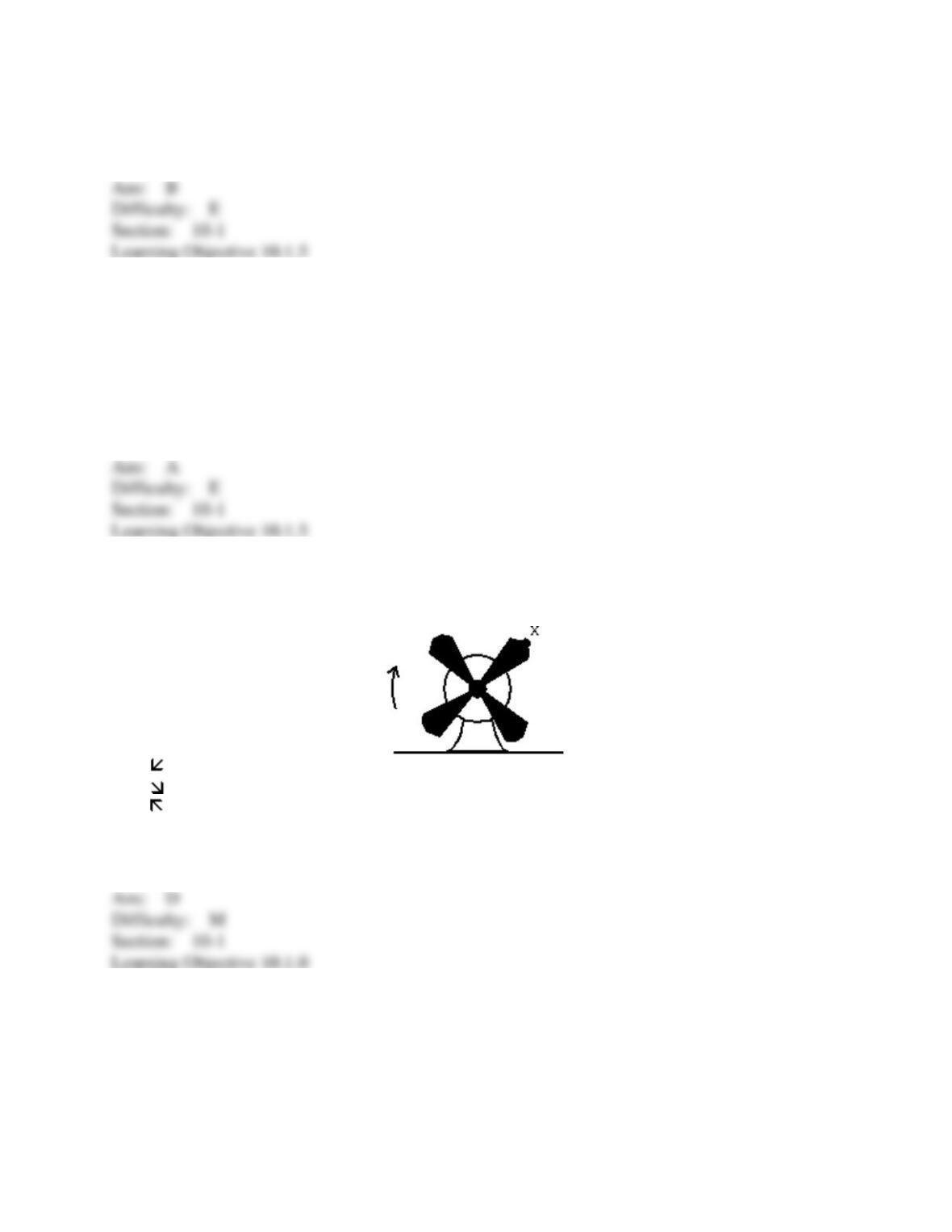
21. The fan shown has been turned on and is slowing as it rotates clockwise. The direction of
the acceleration of the point X on the fan tip could be:
A)
B)
C)
D)
E) →
22. An object rotates from θ1 to θ2 through an angle that is less than π radians. Which of the
following results in a positive angular displacement?
A) θ1 = 45°, θ2= −45°
B) θ1 = 45°, θ2= 15°
C) θ1 = 45°, θ2= −45°
D) θ1 = 135°, θ2= −135°
E) θ1 = −135°, θ2= 135°
23. The coordinate of an object is given as a function of time by θ = 7t – 3t2, where θ is in
radians and t is in seconds. Its average velocity over the interval from t = 0 to t = 2 s is:
A) 5 rad/s
B) –5 rad/s
C) 11 rad/s
D) –11 rad/s
E) 1 rad/s
24. The coordinate of an object is given as a function of time by θ = 7t – 3t2, where θ is in
radians and t is in seconds. Its angular velocity at t = 3 s is:
A) −11 rad/s
B) −3.7 rad/s
C) 1.0 rad/s
D) 3.7 rad/s
E) 11 rad/s
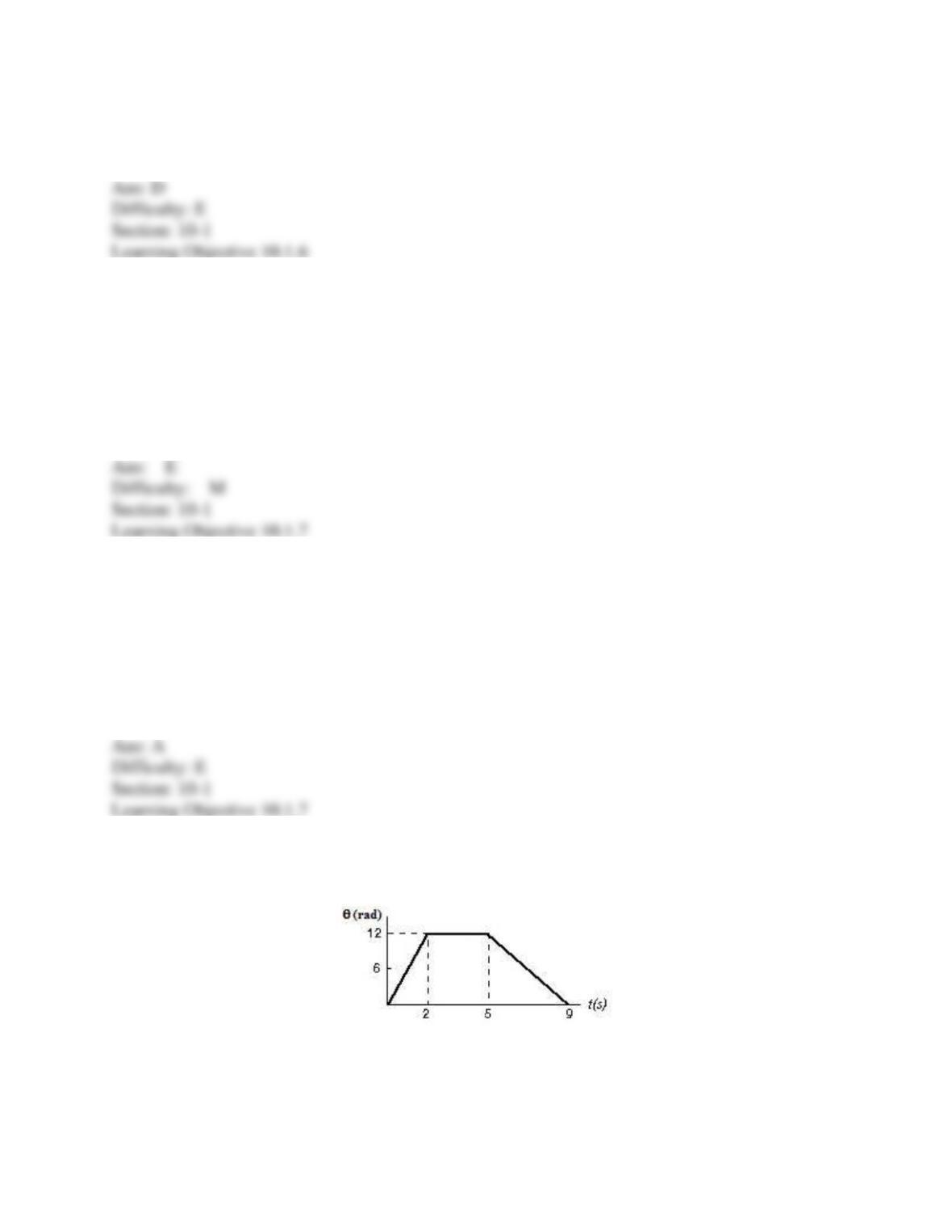
25. This graph shows the angular position of an object as a function of time. What is its average
angular velocity between t = 5 s and t = 9 s?
A) 3 rad/s
B) −3 rad/s
C) 12 rad/s
D) −12 rad/s
E) Need additional information.
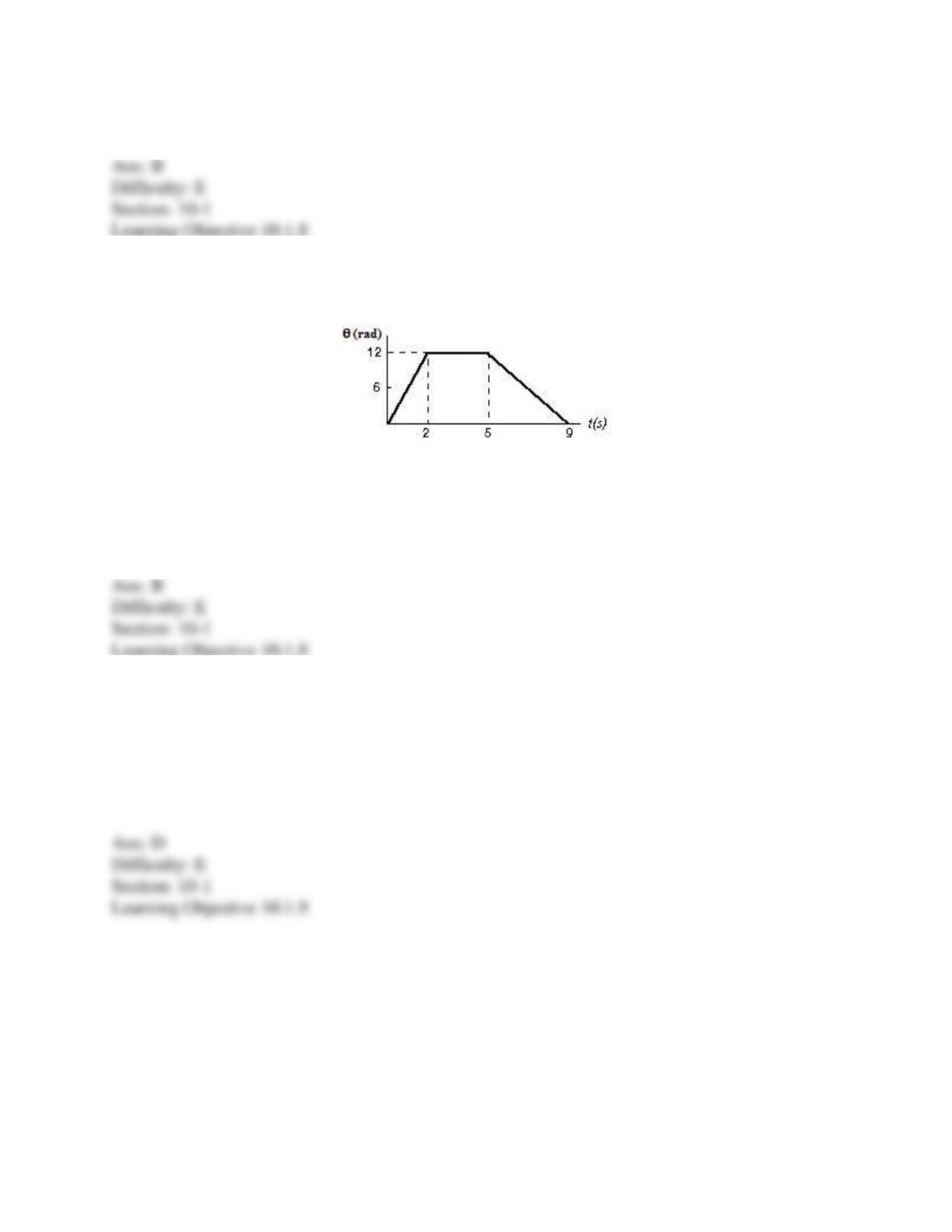
26. This graph shows the angular position of an object as a function of time. What is its
instantaneous angular velocity at t = 1.5 s?
A) −6 rad/s
B) 6 rad/s
C) 9 rad/s
D) 12 rad/s
E) Need additional information.
27. Instantaneous angular speed is:
A) total angular displacement divided by time
B) the integral of the displacement over time
C) the rate at which the angular acceleration is changing
D) the magnitude of the instantaneous angular velocity
E) a vector directed along the axis of rotation
28. The angular velocity of a rotating turntable is given in rad/s by ω(t) = 4.5 + 0.64t – 2.7t2.
What is its angular acceleration at t = 2.0 s?
A) −10 rad/s2
B) –5.0 rad/s2
C) −5.4 rad/s2
D) 2.4 rad/s2
E) 3.1 rad/s2
29. The angular velocity of a rotating turntable is given in rad/s by ω(t) = 4.5 + 0.64t – 2.7t2.
What is its average angular acceleration between t = 1.0 s and t = 3.0 s?
A) 0.64 rad/s2
B) −5.4 rad/s2
C) −7.7 rad/s2
D) −10 rad/s2
E) −27 rad/s2
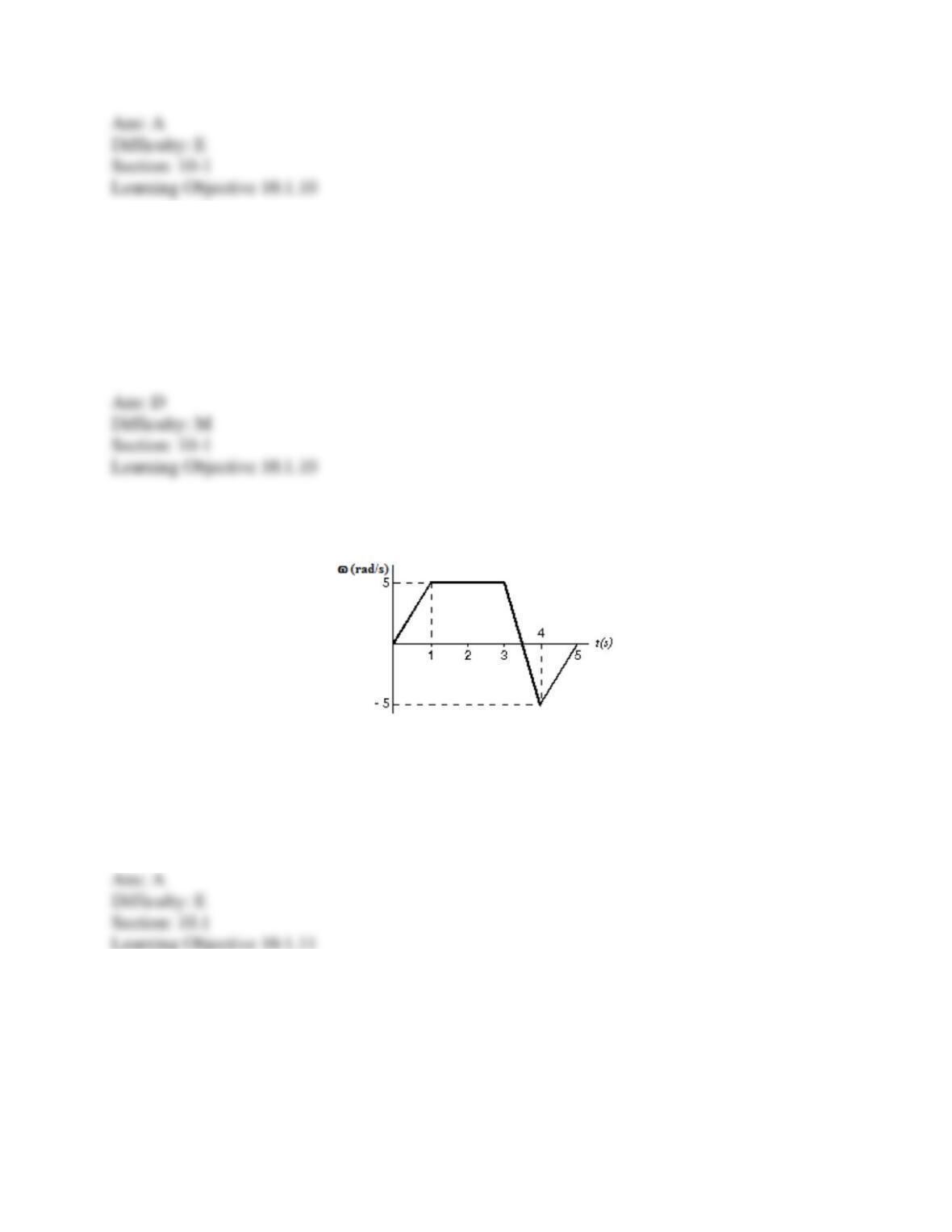
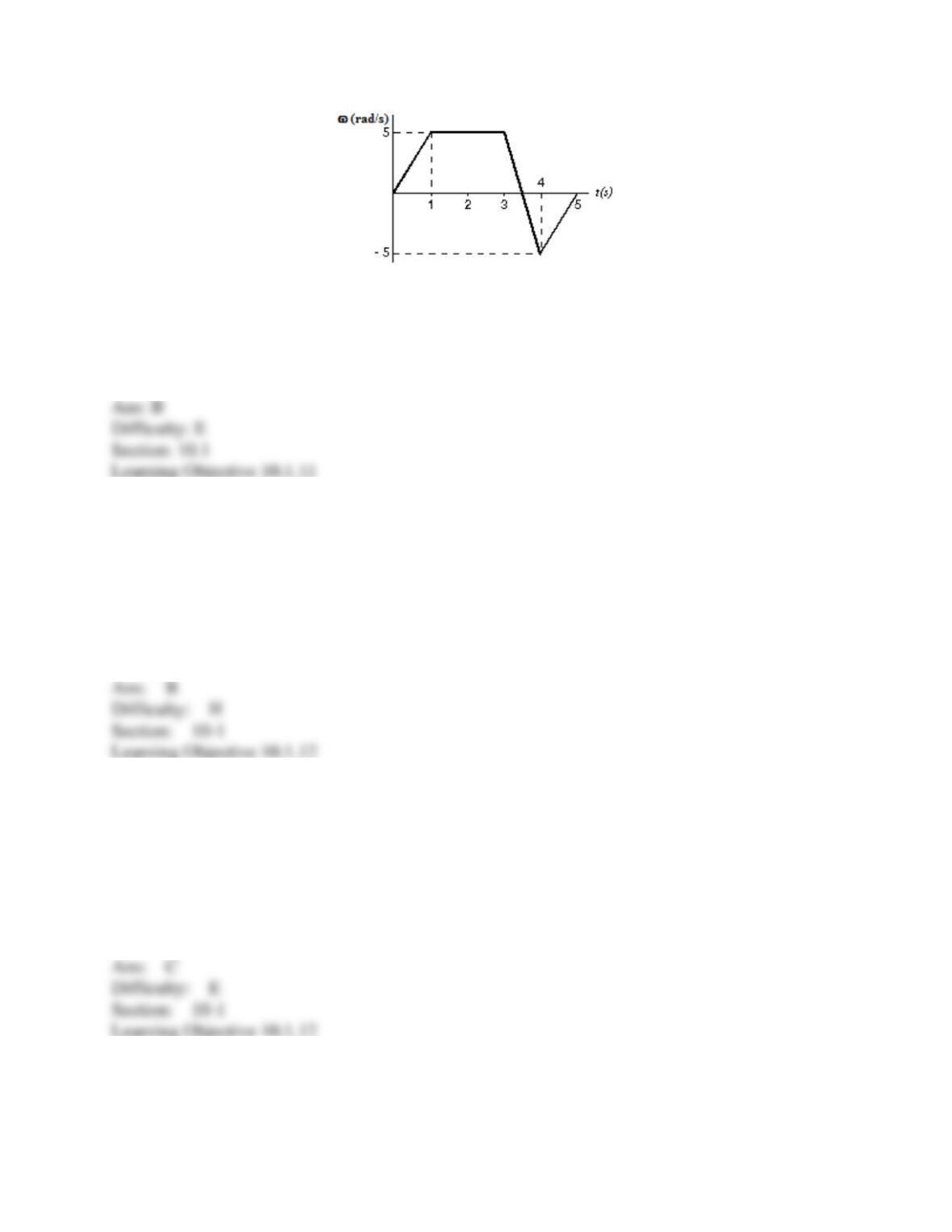
30. This graph shows the angular velocity of a turntable as a function of time. What is its angular
acceleration at t = 3.5 s?
A) −10 rad/s2
B) −5 rad/s2
C) 0 rad/s2
D) 5 rad/s2
E) 10 rad/s2
31. This graph shows the angular velocity of a turntable as a function of time. What is its average
angular acceleration between t = 2 s and t = 4 s?
A) −10 rad/s2
B) −5 rad/s2
C) 0 rad/s2
D) 5 rad/s2
E) 10 rad/s2
32. A wheel starts from rest and has an angular acceleration that is given by
(t) = (6.0
rad/s4)t2. After it has turned through 10 rev its angular velocity is:
A) 63 rad/s
B) 75 rad/s
C) 89 rad/s
D) 130 rad/s
E) 210 rad/s
33. A wheel is spinning at 27 rad/s but is slowing with an angular acceleration that has a
magnitude given by (3.0 rad/s4)t2. It stops in a time of:
A) 1.7 s
B) 2.6 s
C) 3.0 s
D) 4.4 s
E) 9.0 s
34. A wheel starts from rest and has an angular acceleration that is given by
(t) = 6 rad/s4)t2.
The angle through which it turns in time t is given by:
A) [(1/8)t4] rad/s4
B) [(1/4)t4] rad/s4
C) [(1/2)t4] rad/s4
D) (t4) rad/s4
E) 12 rad
35. A wheel starts from rest and has an angular acceleration that is given by
(t) = (6.0
rad/s4)t2. The time it takes to make 10 rev is:
A) 1.3 s
B) 2.1 s
C) 2.8 s
D) 3.3 s
E) 4.0 s
36. A flywheel is initially rotating at 20 rad/s and has a constant angular acceleration. After 9.0
s it has rotated through 450 rad. Its angular acceleration is:
A) 3.3 rad/s
B) 4.4 rad/s
C) 6.7 rad/s
D) 11 rad/s
E) 48 rad/s
37. A wheel rotates with a constant angular acceleration of rad/s2. During a certain time
interval its angular displacement is rad. At the end of the interval its angular velocity is 2
rad/s. Its angular velocity at the beginning of the interval is:
A) 0 rad/s
B) 1 rad/s
C) rad/s
D) 𝜋√2 rad/s
E) 2 rad/s
38. A wheel initially has an angular velocity of 18 rad/s but it is slowing at a rate of 2.0 rad/s2.
By the time it stops it will have turned through:
A) 81 rad
B) 160 rad
C) 245 rad
D) 330 rad
E) 410 rad
39. A wheel starts from rest and has an angular acceleration of 4.0 rad/s2. When it has made 10
rev its angular velocity is:
A) 8.9 rad/s
B) 16 rad/s
C) 22 rad/s
D) 32 rad/s
E) 250 rad/s
40. A wheel starts from rest and has an angular acceleration of 4.0 rad/s2. The time it takes to
make 10 revolutions is:
A) 0.50 s
B) 0.71 s
C) 2.2 s
D) 2.8 s
E) 5.6 s
41. A wheel of diameter 3.0 cm has a 4.0 m cord wrapped around its periphery. Starting from
rest, the wheel is given a constant angular acceleration of 2 rad/s2. The cord will unwind in:
A) 0.82 s
B) 2.0 s
C) 12 s
D) 16 s
E) 130 s
42. The figure shows a cylinder of radius 0.7 m rotating about its axis at 10 rad/s. The speed of
the point P is:
A) 7.0 m/s
B) 14 rad/s
C) 7 rad/s
D) 0.70 m/s
E) none of these
43. A particle moves in a circular path of radius 0.10 m with a constant angular speed of 5
rev/s. The acceleration of the particle is:
A) 0.10 m/s2
B) 0.50 m/s2
C) 500 m/s2
D) 2.5 m/s2
E) 102 m/s2
44. A car travels north at constant velocity. It goes over a piece of mud which sticks to the tire.
The initial acceleration of the mud, as it leaves the ground, is:
A) vertically upward
B) horizontally to the north
C) horizontally to the south
D) zero
E) upward and forward at 45 to the horizontal
45. Wrapping paper is being unwrapped from a 5.0-cm radius tube, free to rotate on its axis. If
it is pulled at the constant rate of 10 cm/s and does not slip on the tube, the angular velocity of
the tube is:
A) 2.0 rad/s
B) 5.0 rad/s
C) 10 rad/s
D) 25 rad/s
E) 50 rad/s
46. String is wrapped around the periphery of a 5.0-cm radius cylinder, free to rotate on its
axis. The string is pulled straight out at a constant rate of 10 cm/s and does not slip on the
cylinder. As each small segment of string leaves the cylinder, the segment’s acceleration changes
by:
A) 0 m/s2
B) 0.010 m/s2
C) 0.020 m/s2
D) 0.10 m/s2
E) 0.20 m/s2
47. A flywheel of diameter 1.2 m has a constant angular acceleration of 5.0 rad/s2. The
tangential acceleration of a point on its rim is:
A) 5.0 rad/s2
B) 3.0 m/s2
C) 5.0 m/s2
D) 6.0 m/s2
E) 12 m/s2
48. For a wheel spinning with constant angular acceleration on an axis through its center, the
ratio of the speed of a point on the rim to the speed of a point halfway between the center and the
rim is:
A) 1
B) 2
C) 1/2
D) 4
E) 1/4
49. For a wheel spinning on an axis through its center, the ratio of the tangential acceleration of
a point on the rim to the tangential acceleration of a point halfway between the center and the rim
is:
A) 1
B) 2
C) 1/2
D) 4
E) 1/4
50. For a wheel spinning on an axis through its center, the ratio of the radial acceleration of a
point on the rim to the radial acceleration of a point halfway between the center and the rim is:
A) 1
B) 2
C) 1/2
D) 4
E) 1/4
51. Two wheels are identical but wheel B is spinning with twice the angular speed of wheel A.
The ratio of the magnitude of the radial acceleration of a point on the rim of B to the magnitude
of the radial acceleration of a point on the rim of A is:
A) 1
B) 2
C) 1/2
D) 4
E) 1/4
52. The magnitude of the acceleration of a point on a spinning wheel is increased by a factor of
4 if:
A) the magnitudes of the angular velocity and the angular acceleration are each multiplied by a
factor of 4
B) the magnitude of the angular velocity is multiplied by a factor of 4 and the angular
acceleration is not changed
C) the magnitudes of the angular velocity and the angular acceleration are each multiplied by a
factor of 2
D) the magnitude of the angular velocity is multiplied by a factor of 2 and the angular
acceleration is not changed
E) the magnitude of the angular velocity is multiplied by a factor of 2 and the magnitude of the
angular acceleration is multiplied by a factor of 4
53. A wheel starts from rest and spins with a constant angular acceleration. As time goes on the
acceleration vector for a point on the rim:
A) decreases in magnitude and becomes more nearly tangent to the rim
B) decreases in magnitude and becomes more nearly radial
C) increases in magnitude and becomes more nearly tangent to the rim
D) increases in magnitude and becomes more nearly radial
E) increases in magnitude but retains the same angle with the tangent to the rim
54. Three identical balls are tied by light strings to the same rod and rotate around it, as shown
below. Rank the balls according to their rotational inertia, least to greatest.