Chapter: Chapter 8
Learning Objectives
LO 8.1.0 Solve problems related to potential energy
LO 8.1.1 Distinguish a conservative force from a nonconservative force.
LO 8.1.2 For a particle moving between two points, identify that the work done by a
conservative force does not depend on which path the particle takes.
LO 8.1.3 Calculate the gravitational potential energy of a particle (or, more properly, a
particle-Earth system).
LO 8.1.4 Calculate the elastic potential energy of a block–spring system.
LO 8.2.0 Solve problems related to conservation of mechanical energy
LO 8.2.1 Identify that the mechanical energy of a system is the sum of the kinetic energies and
potential energies of the objects within the system.
LO 8.2.2 For an isolated system in which only conservative forces act, apply the conservation of
mechanical energy to relate the initial potential and kinetic energies to the potential and kinetic
energies at a later instant.
LO 8.3.0 Solve problems related to reading a potential energy curve
LO 8.3.1 Given a particle’s potential energy as a function of its position x, determine the force
on the particle.
LO 8.3.2 Given a graph of potential energy versus x, determine the force on a particle.
LO 8.3.3 On a graph of potential energy versus x, superimpose a line for a particle’s mechanical
energy and determine the particle’s kinetic energy for any given value of x.
LO 8.3.4 If a particle moves along an x axis, use a potential-energy graph for that axis and the
conservation of mechanical energy to relate the energy values at one position to those at another
position.
LO 8.3.5 On a potential-energy graph, identify any turning points and any regions where the
particle is not allowed because of energy requirements.
LO 8.3.6 Explain neutral equilibrium, stable equilibrium, and unstable equilibrium.
LO 8.4.0 Solve problems related to work done on a system by an external force
LO 8.4.1 When work is done on a system by an external force with no friction involved,
determine the changes in kinetic energy and potential energy.
LO 8.4.2 When work is done on a system by an external force with friction involved, relate that
work to the changes in kinetic energy, potential energy, and thermal energy.
LO 8.5.0 Solve problems related to conservation of energy
LO 8.5.1 For an isolated system (no external force), apply the conservation of energy to relate
the initial total energy (energies of all kinds) to the total energy at a later instant.
LO 8.5.2 For a nonisolated system, relate the work done on the system by the external force to
the changes in the various types of energies within the system.
LO 8.5.3 Apply the relationship between average power, the associated energy transfer, and the
time interval in which that transfer is made.
LO 8.5.4 Given an energy transfer as a function of time, determine the instantaneous power.
Multiple Choice
1. A good example of kinetic energy is provided by:
A) a wound-up clock spring
B) the raised weights of a grandfather’s clock
C) a tornado
D) a gallon of gasoline
E) an automobile storage battery
2. No kinetic energy is possessed by:
A) a shooting star
B) a rotating propeller on a moving airplane
C) a pendulum at the bottom of its swing
D) an elevator standing at the fifth floor
E) a cyclone
3. The wound spring of a clock possesses:
A) kinetic but no potential energy
B) potential but no kinetic energy
C) both potential and kinetic energy in equal amounts
D) neither potential nor kinetic energy
E) both potential and kinetic energy, but more kinetic energy than potential energy
4. A body at rest in a system is capable of doing work if:
A) the potential energy of the system is positive
B) the potential energy of the system is is negative
C) it is free to move in such a way as to decrease its kinetic energy
D) it is free to move in such a way as to decrease the potential energy of the system
E) it is free to move in such a way as to increase the potential energy of the system
5. Which one of the following five quantities CANNOT be used as a unit of potential energy?
A) wattsecond
B) gramcm/s2
C) joule
D) kgm2/s2
E) ftlb
6. Suppose that the fundamental dimensions are taken to be: force (F), velocity (V) and time
(T). The dimensions of potential energy are then:
A) F/T
B) FVT
C) FV/T
D) F/T2
E) FV2/T2
7. A nonconservative force:
A) violates Newton’s second law
B) violates Newton’s third law
C) cannot do any work
D) must be perpendicular to the velocity of the particle on which it acts
E) none of the above
8. Two particles interact by conservative forces. In addition, an external force acts on each
particle. They complete round trips, ending at the points where they started. Which of the
following must have the same values at the beginning and end of this trip?
A) a total kinetic energy of the two-particle system
B) the potential energy of the two-particle system
C) the mechanical energy of the two-particle system
D) the total linear momentum of the two-particle system
E) none of the above
9. Two objects interact with each other and with no other objects. Initially object A has a speed
of 5 m/s and object B has a speed of 10 m/s. In the course of their motion they return to their
initial positions. Then A has a speed of 4 m/s and B has a speed of 7 m/s. We can conclude:
A) the potential energy changed from the beginning to the end of the trip
B) mechanical energy was increased by nonconservative forces
C) mechanical energy was decreased by nonconservative forces
D) mechanical energy was increased by conservative forces
E) mechanical energy was decreased by conservative forces
10. Only if a force on a particle is conservative:
A) does it do no work when the particle moves exactly once around any closed path
B) does the work it does equal the change in the kinetic energy of the particle
C) does it obey Newton’s second law
D) does it obey Newton’s third law
E) it is not a frictional force
11. A force on a particle is conservative if:
A) its work equals the change in the kinetic energy of the particle
B) it obeys Newton’s second law
C) it obeys Newton’s third law
D) its work depends on the end points of the motion, not this the path between
E) it is not a frictional force
12. A golf ball is struck by a golf club and falls on a green eight feet above the tee. The
potential energy of the Earth-ball system is greatest:
A) just before the ball is struck
B) just after the ball is struck
C) just after the ball lands on the green
D) when the ball comes to rest on the green
E) when the ball reaches the highest point in its flight
13. A 2-kg block is thrown upward from a point 20 m above the Earth’s surface. At what height
above Earth’s surface will the gravitational potential energy of the Earth-block system have
increased by 500 J?
A) 5 m
B) 25 m
C) 46 m
D) 70 m
E) 270 m
14. A force of 10 N holds an ideal spring with a 20-N/m spring constant in compression. The
potential energy stored in the spring is:
A) 0.5 J
B) 2.5 J
C) 5 J
D) 10 J
E) 200 J
15. A 0.50-kg block attached to an ideal spring with a spring constant of 80 N/m oscillates on a
horizontal frictionless surface. The total mechanical energy is 0.12 J. The greatest extension of
the spring from its equilibrium length is:
A) 1.5 10-3 m
B) 3.0 10-3 m
C) 0.039 m
D) 0.055 m
E) 18 m
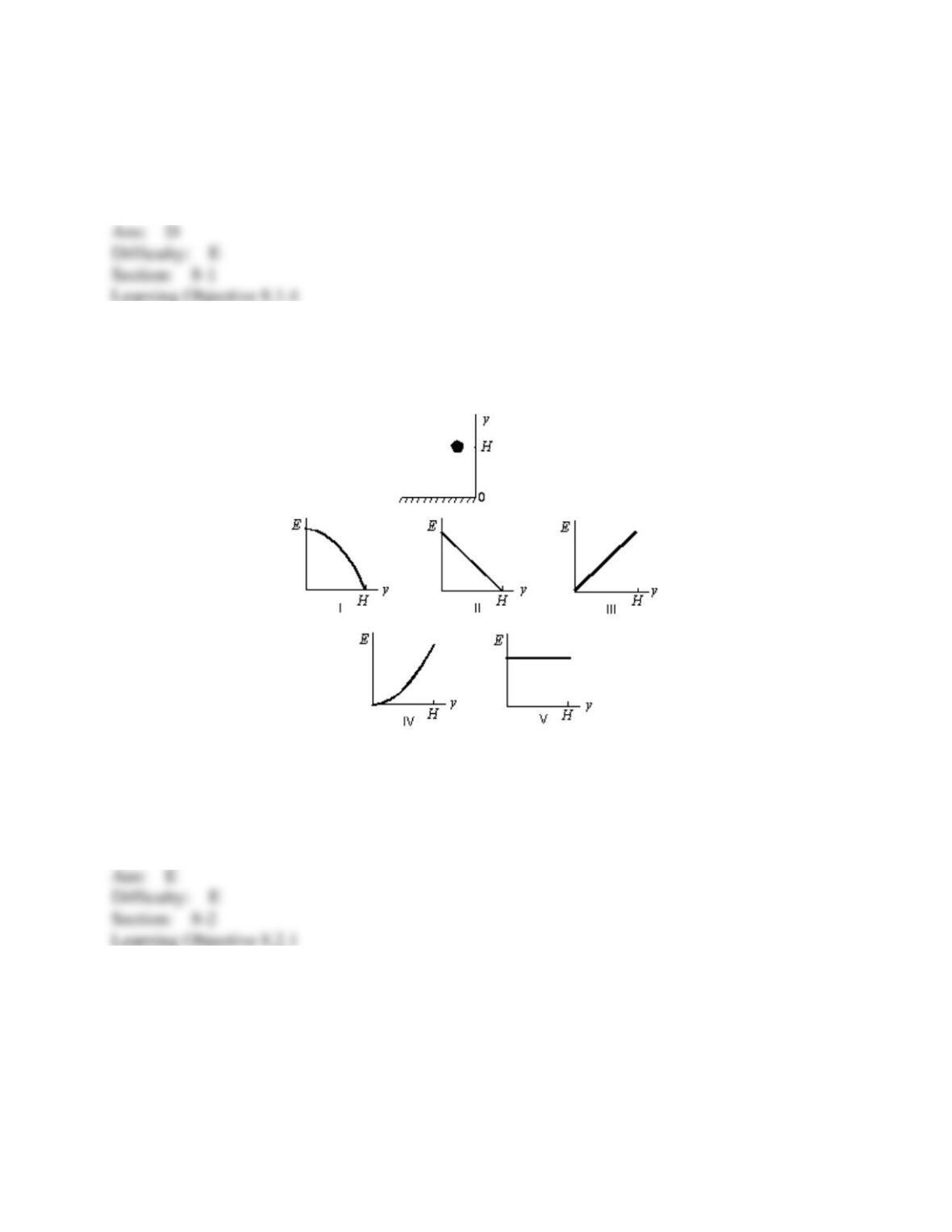
16. A ball is held at a height H above a floor. It is then released and falls to the floor. If air
resistance can be ignored, which of the five graphs below correctly gives the mechanical energy
E of the Earth-ball system as a function of the altitude y of the ball?
A) I
B) II
C) III
D) IV
E) V
17. The sum of the kinetic and potential energies of a system of objects is conserved:
A) only when no external force acts on the objects
B) only when the objects move along closed paths
C) only when the work done by the resultant external force is zero
D) always
E) none of the above
18. A 0.20-kg particle moves along the x axis under the influence of a conservative force. The
potential energy is given by
U(x) = (8.0 J/m2)x2 + (2.0 J/m4)x4,
where x is in coordinate of the particle. If the particle has a speed of 5.0 m/s when it is at x = 1.0
m, its speed when it is at the origin is:
A) 0 m/s
B) 2.5 m/s
C) 5.7 m/s
D) 7.9 m/s
E) 11 m/s
19. A 6.0-kg block is released from rest 80 m above the ground. When it has fallen 60 m its
kinetic energy is approximately:
A) 4700 J
B) 3500 J
C) 1200 J
D) 120 J
E) 60 J
20. An elevator is rising at constant speed. Consider the following statements:
I. the upward cable force is constant
II. the kinetic energy of the elevator is constant
III. the gravitational potential energy of the Earth-elevator system is constant
IV. the acceleration of the elevator is zero
V. the mechanical energy of the Earth-elevator system is constant
A) all five are true
B) only II and V are true
C) only IV and V are true
D) all but III are true
E) only I, II, and IV are true
21. A projectile of mass 0.50 kg is fired with an initial speed of 10 m/s at an angle of 60 above
the horizontal. The potential energy of the projectile-Earth system when the projectile is at its
highest point (relative to the potential energy when the projectile is at ground level) is:
A) 25 J
B) 18.75 J
C) 12.5 J
D) 6.25 J
E) none of these
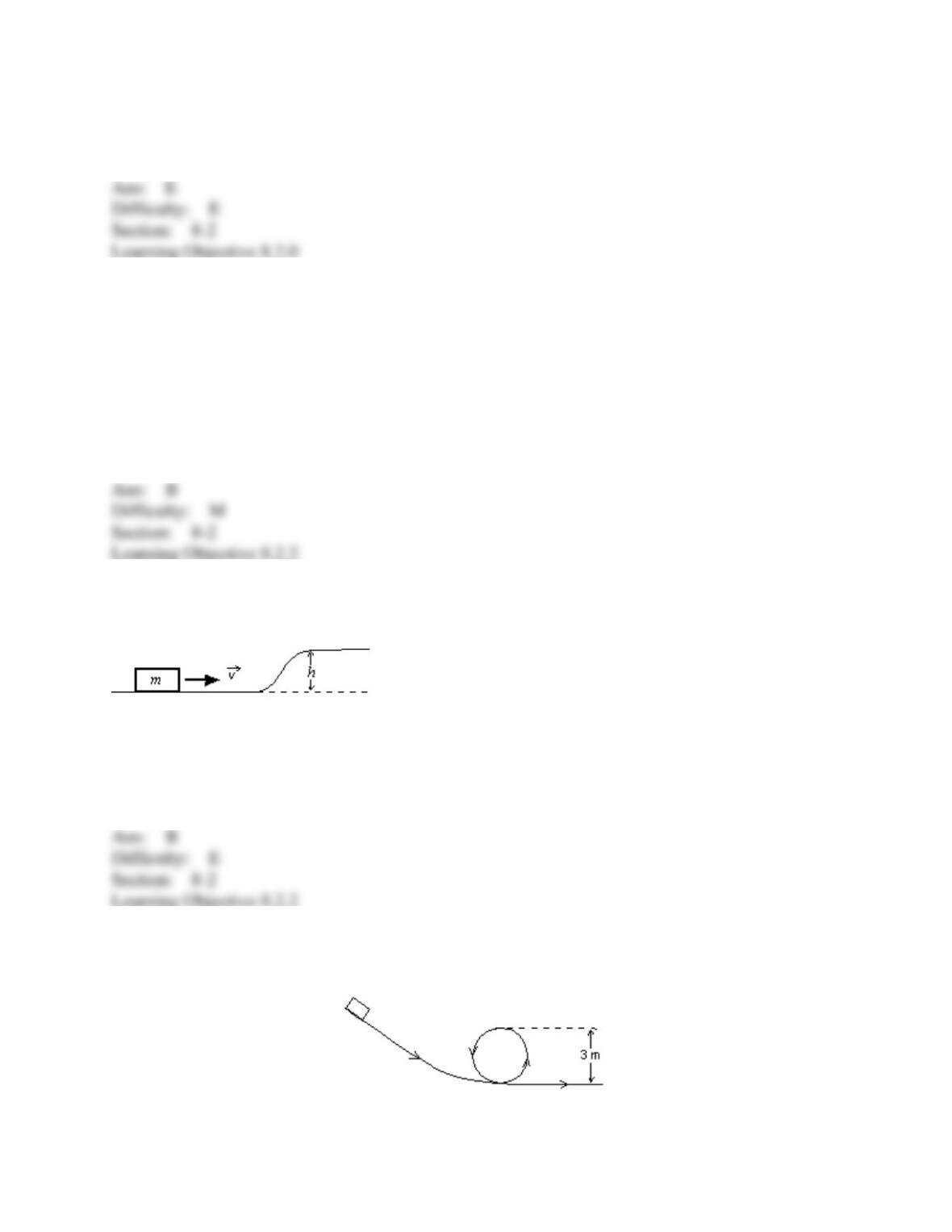
22. For a block of mass m to slide without friction up the rise of height h shown, it must have a
minimum initial kinetic energy of:
A) gh
B) mgh
C) gh/2
D) mgh/2
E) 2mgh
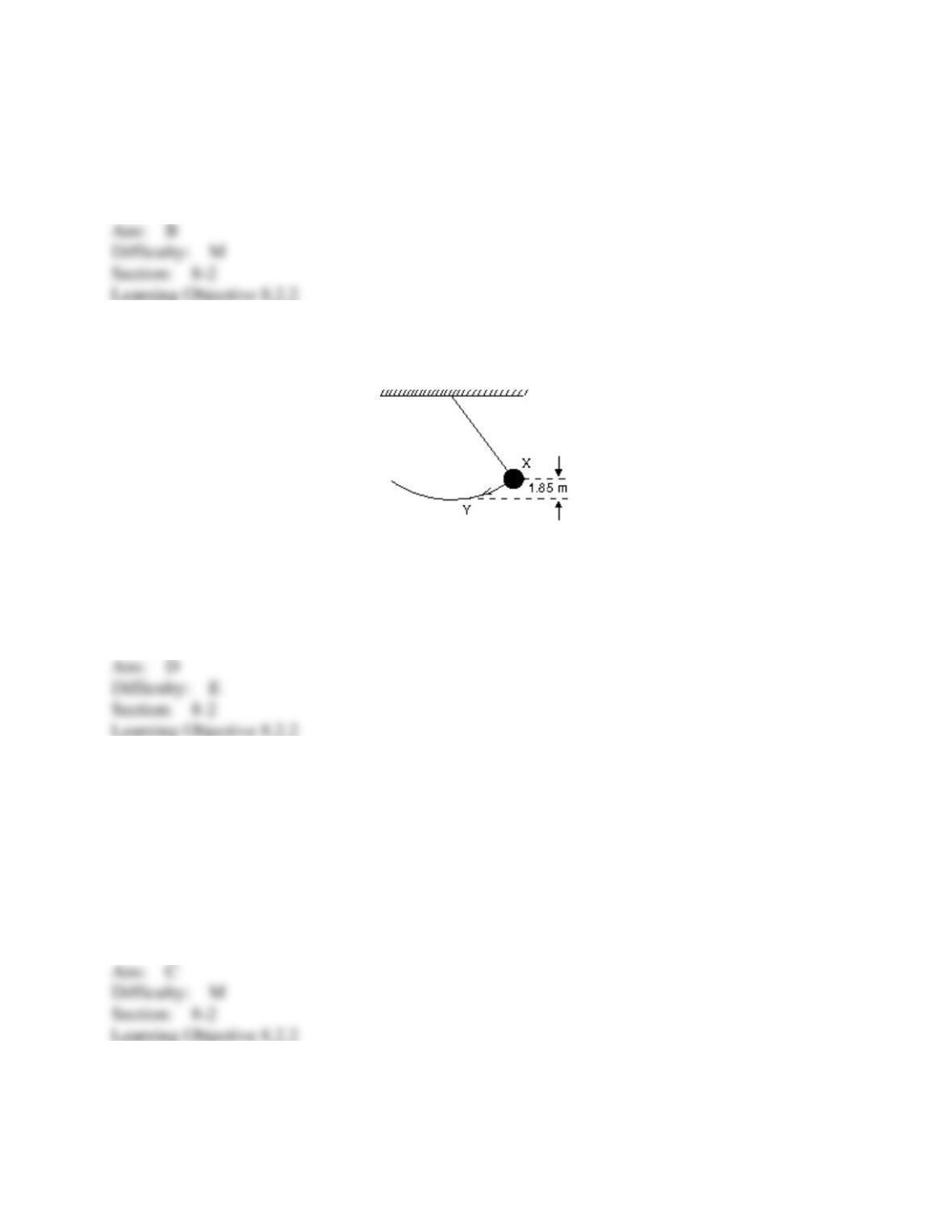
23. A small object slides along the frictionless loop-the-loop with a diameter of 3 m. What
minimum speed must it have at the top of the loop in order to remain in contact with the loop?
A) 1.9 m/s
B) 3.8 m/s
C) 5.4 m/s
D) 15 m/s
E) 29 m/s
24. A simple pendulum consists of a 2.0 kg mass attached to a string. It is released from rest at
X as shown. Its speed at the lowest point Y is:
A) 1.9 m/s
B) 3.7 m/s
C) 4.4 m/s
D) 6.0 m/s
E) 36 m/s
25. An ideal spring is used to fire a 15.0-g block horizontally. The spring has a spring constant
of 20 N/m and is initially compressed by 7.0 cm. The kinetic energy of the block as it leaves the
spring is:
A) 0 J
B) 2.5 10–2 J
C) 4.9 10–2 J
D) 9.8 10–2 J
E) 1.4 J
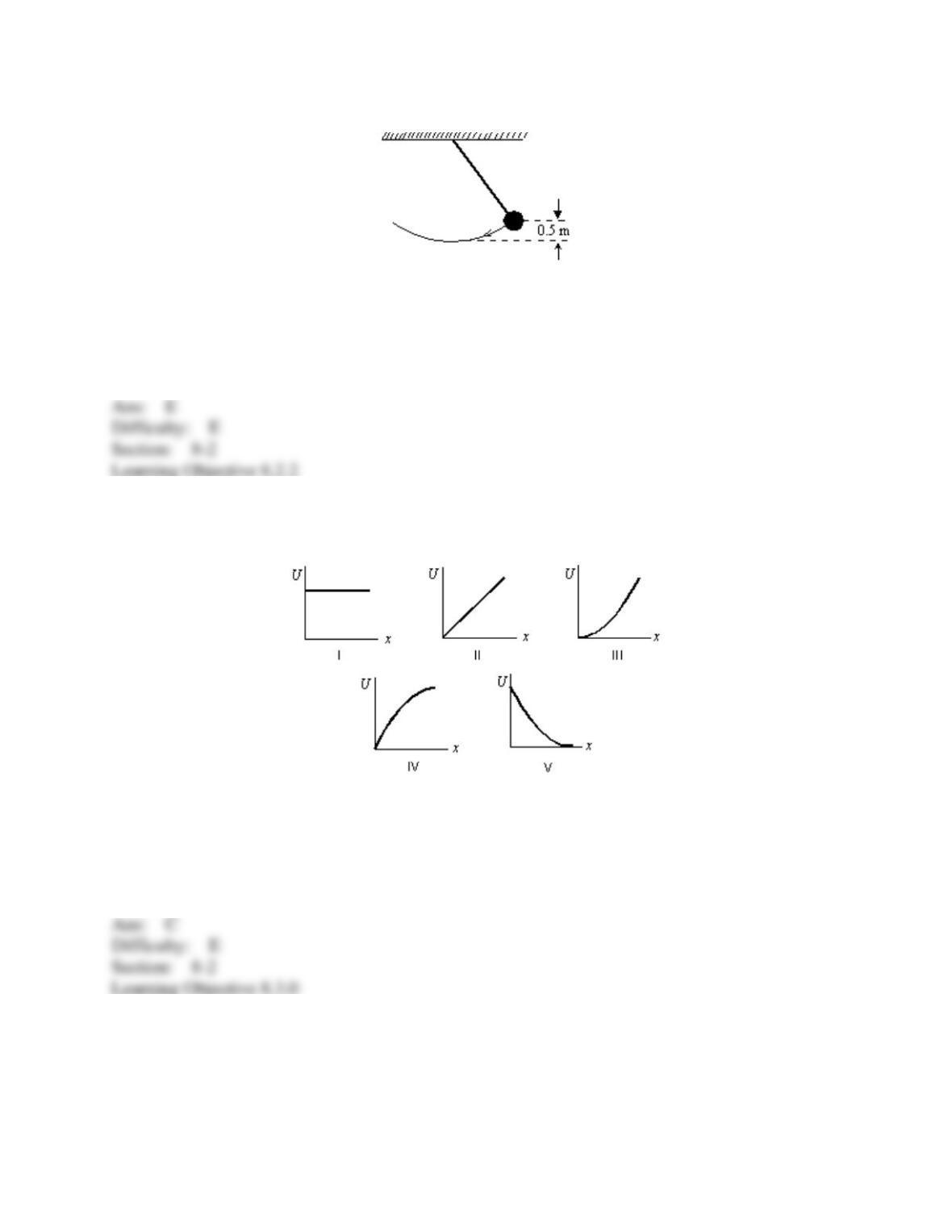
26. The long pendulum shown is drawn aside until the ball has risen 0.5 m. It is then given an
initial speed of 3.0 m/s. The speed of the ball at its lowest position is:
A) 0 m/s
B) 0.89 m/s
C) 3.1 m/s
D) 3.7 m/s
E) 4.3 m/s
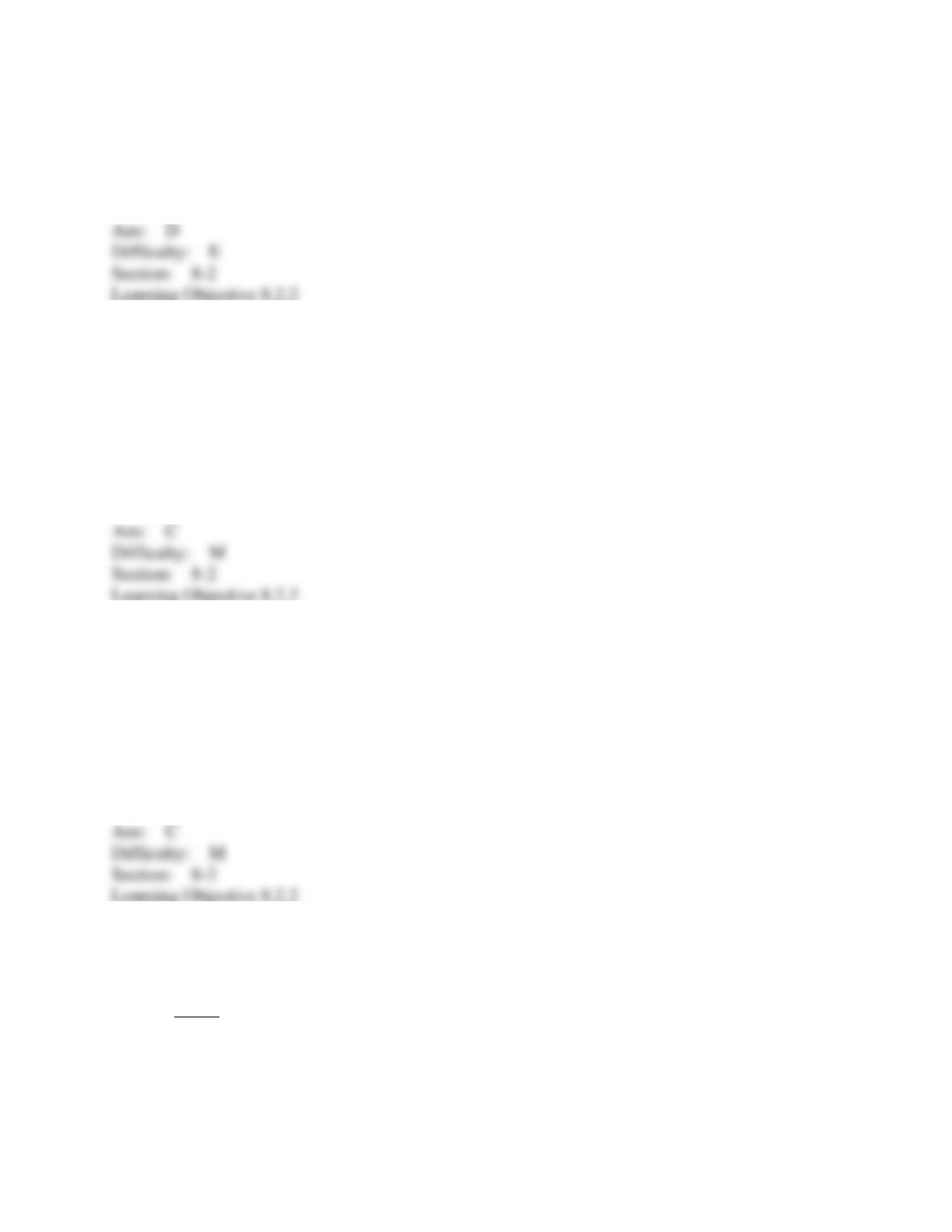
27. Which of the five graphs correctly shows the potential energy of a spring as a function of
its elongation x?
A) I
B) II
C) III
D) IV
E) V
28. A 0.50-kg block attached to an ideal spring with a spring constant of 80 N/m oscillates on a
horizontal frictionless surface. The total mechanical energy is 0.12 J. The greatest speed of the
block is:
A) 0.15 m/s
B) 0.24 m/s
C) 0.49 m/s
D) 0.69 m/s
E) 1.46 m/s
29. A 0.50-kg block attached to an ideal spring with a spring constant of 80 N/m oscillates on a
horizontal frictionless surface. When the spring is 4.0 cm longer than its equilibrium length, the
speed of the block is 0.50 m/s. The greatest speed of the block is:
A) 0.32 m/s
B) 0.55 m/s
C) 0.71 m/s
D) 0.87 m/s
E) 0.93 m/s
30. A 0.5-kg block slides along a horizontal frictionless surface at 2 m/s. It is brought to rest by
compressing a very long spring of spring constant 800 N/m. The maximum spring compression
is:
A) 0.6 cm
B) 3 cm
C) 5 cm
D) 7 cm
E) 8 cm
31. A block of mass m is initially moving to the right on a horizontal frictionless surface at a
speed v. It then compresses a spring of spring constant k. At the instant when the kinetic
energy of the block is equal to the potential energy of the spring, the spring is compressed a
distance of:
A) 𝑣√𝑚/2𝑘
B) (1/2)mv2
C) (1/4)mv2
D) mv2/4k
E) (1/4) √𝑚𝑣/𝑘
32. A 700-N man jumps out of a window into a fire net 10 m below. The net stretches 2 m
before bringing the man to rest and tossing him back into the air. The maximum potential energy
of the net, compared to its unstretched potential energy, is:
A) 300 J
B) 710 J
C) 850 J
D) 7000 J
E) 8400 J
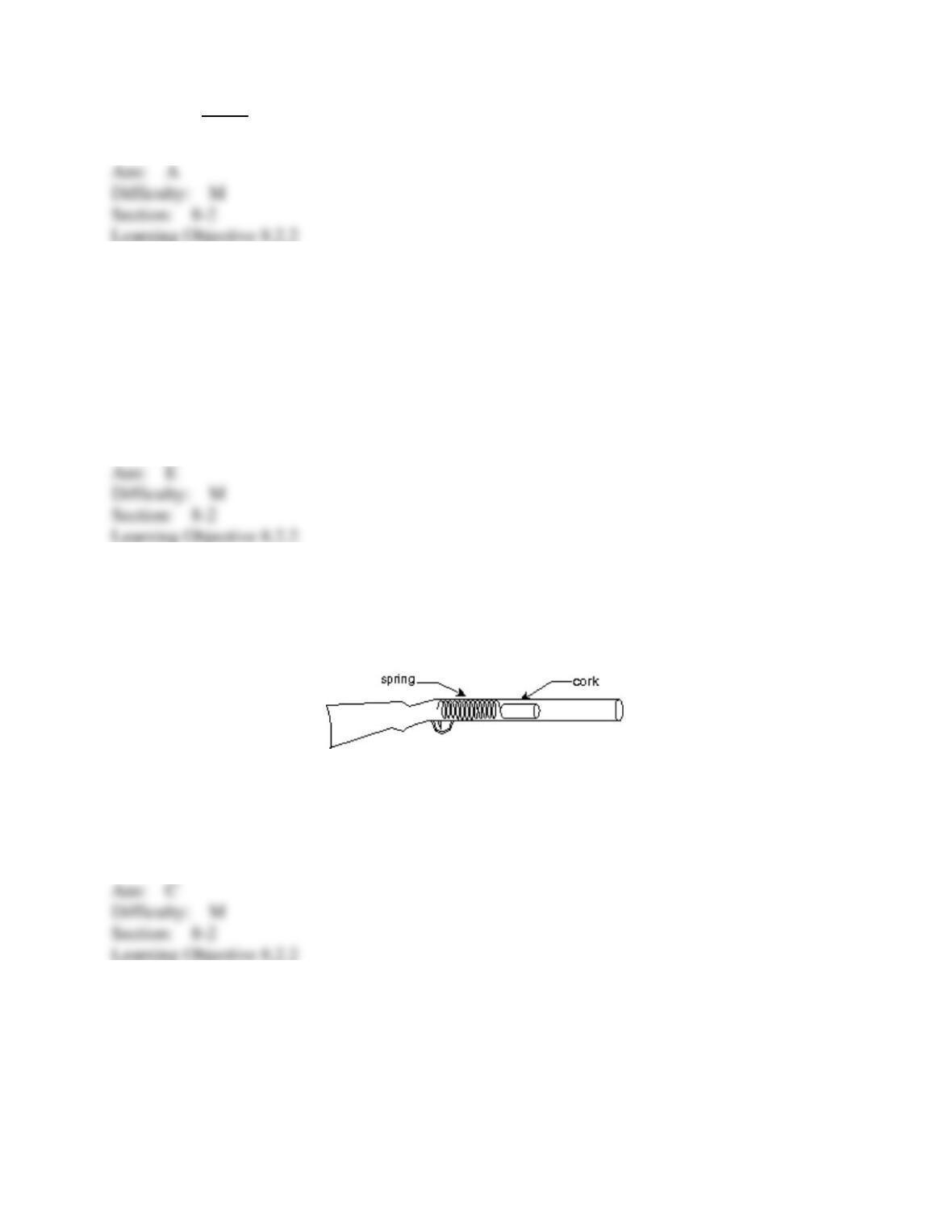
33. A toy cork gun contains a spring whose spring constant is 10.0 N/m. The spring is
compressed 5.00 cm and then used to propel a 6.00-g cork. The cork, however, sticks to the
spring for 1.00 cm beyond its unstretched length before separation occurs. The muzzle velocity
of this cork is:
A) 1.02 m/s
B) 1.41 m/s
C) 2.00 m/s
D) 2.04 m/s
E) 4.00 m/s
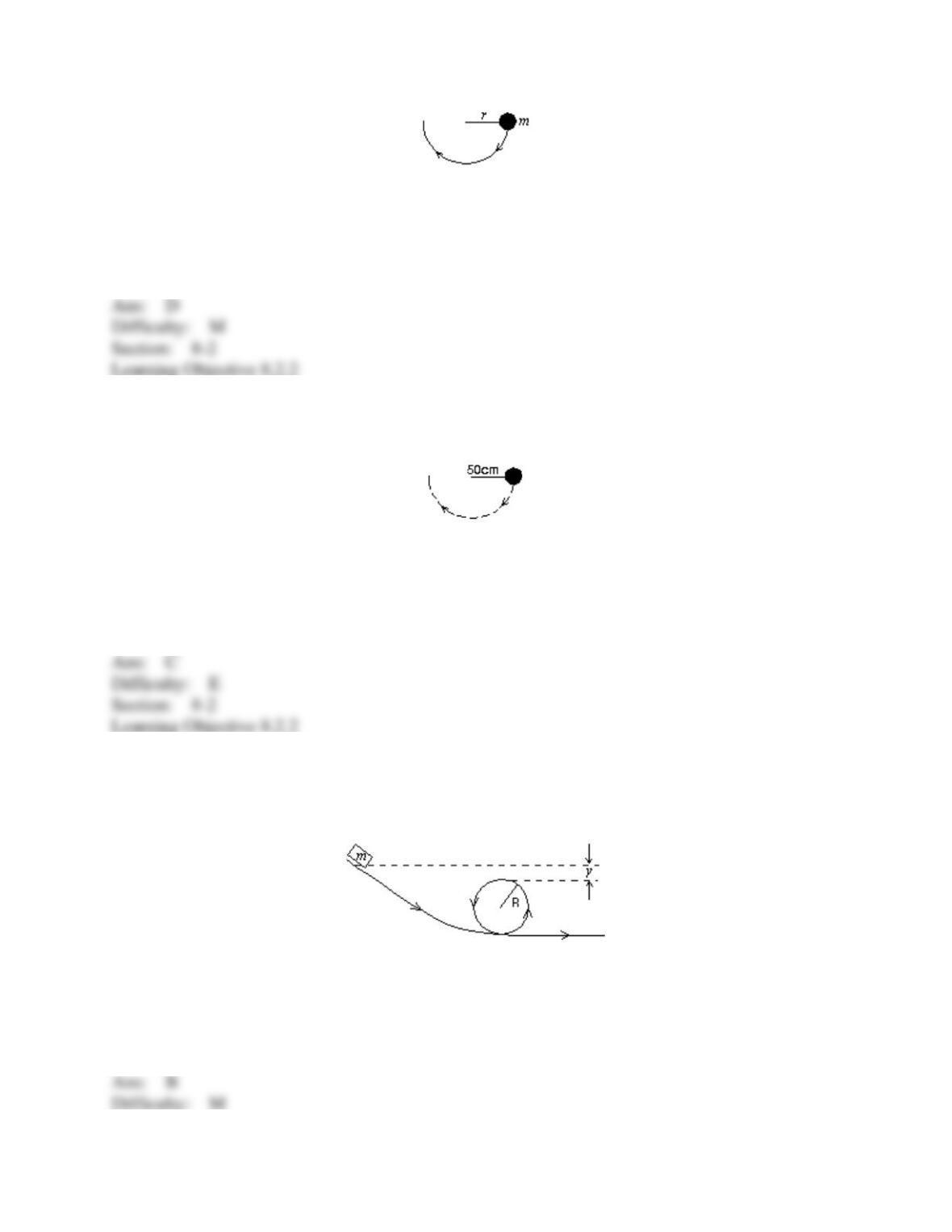
34. A small object of mass m, on the end of a light cord, is held horizontally at a distance r
from a fixed support as shown. The object is then released. What is the tension in the cord when
the object is at the lowest point of its swing?
A) mg/2
B) mg
C) 2 mg
D) 3 mg
E) mgr
35. The string in the figure is 50 cm long. When the ball is released from rest, it swings along
the dotted arc. How fast is it going at the lowest point in its swing?
A) 2.0 m/s
B) 2.2 m/s
C) 3.1 m/s
D) 4.4 m/s
E) 6.0 m/s
36. A small object of mass m starts at rest at the position shown and slides along the
frictionless loop-the-loop track of radius R. What is the smallest value of y such that the object
will slide without losing contact with the track?
A) R/4
B) R/2
C) R
D) 2R
E) 0