Chapter: Chapter 5
Learning Objectives:
LO 5.1.0 Solve problems related to Newton’s first and second laws
LO 5.1.1 Identify that a force is a vector quantity and thus has both magnitude and direction and
also components.
LO 5.1.2 Given two or more forces acting on the same particle, add the forces as vectors to get
the net force.
LO 5.1.3 Identify Newton’s first and second laws of motion.
LO 5.1.4 Identify inertial reference frames.
LO 5.1.5 Sketch a free-body diagram for an object, showing the object as a particle and drawing
the forces acting on it as vectors with their tails anchored on the particle.
LO 5.1.6 Apply the relationship (Newton’s second law) between the net force on an object, the
mass of the object, and the acceleration produced by the net force.
LO 5.1.7 Identify that only external forces on an object can cause the object to accelerate.
LO 5.2.0 Solve problems related to some particular forces
LO 5.2.1 Determine the magnitude and direction of the gravitational force acting on a body with
a given mass, at a location with a given free-fall acceleration.
LO 5.2.2 Identify that the weight of a body is the magnitude of the net force required to prevent
the body from falling freely, as measured from the reference frame of the ground.
LO 5.2.3 Identify that a scale gives an object’s weight when the measurement is done in an
inertial frame but not in an accelerating frame, where it gives an apparent weight.
LO 5.2.4 Determine the magnitude and direction of the normal force on an object when the
object is pressed or pulled onto a surface.
LO 5.2.5 Identify that the force parallel to the surface is a frictional force that appears when the
object slides or attempts to slide along the surface.
LO 5.2.6 Identify that a tension force is said to pull at both ends of a cord (or a cord-like object)
when the cord is taut.
LO 5.3.0 Solve problems related to applying Newton’s laws
LO 5.3.1 Identify Newton’s third law of motion and third-law force pairs.
LO 5.3.2 For an object that moves vertically or on a horizontal or inclined plane, apply Newton’s
second law to a free-body diagram of the object.
LO 5.3.3 For an arrangement where a system of several objects moves rigidly together, draw a
free-body diagram and apply Newton’s second law for the individual objects and also for the
system taken as a composite object.
Multiple Choice
1. An object moving at constant velocity in an inertial frame must:
A) have a net force on it
B) eventually stop due to gravity
C) not have any force of gravity acting on it
D) have zero net force acting on it
E) have no frictional force acting on it
2. In SI units a force is numerically equal to the ______, when the force is applied to it.
A) velocity of the standard kilogram
B) speed of the standard kilogram
C) velocity of any object
D) acceleration of the standard kilogram
E) acceleration of any object
3. Which of the following quantities is NOT a vector?
A) Mass
B) Displacement
C) Weight
D) Acceleration
E) Force
4. A newton is the force:
A) of gravity on a 1 kg body
B) of gravity on a 1 g body
C) that gives a l g body an acceleration of 1 cm/s2
D) that gives a 1 kg body an acceleration of 1 m/s2
E) that gives a 1 kg body an acceleration of 9.8 m/s2
5. The unit of force called the newton is:
A) the force needed to accelerate a mass of 1 kg at a rate of 9.8 m/s2
B) the force needed to accelerate a mass of 1 kg at a rate of 1 m/s2
C) defined by means of Newton’s third law
D) 1 kg of mass
E) 1 kg of force
6. A force of 1 N is:
A) 1 kg/s
B) 1kg m/s
C) 1kg m/s2
D) 1kg m2/s
E) 1kg m2/s2
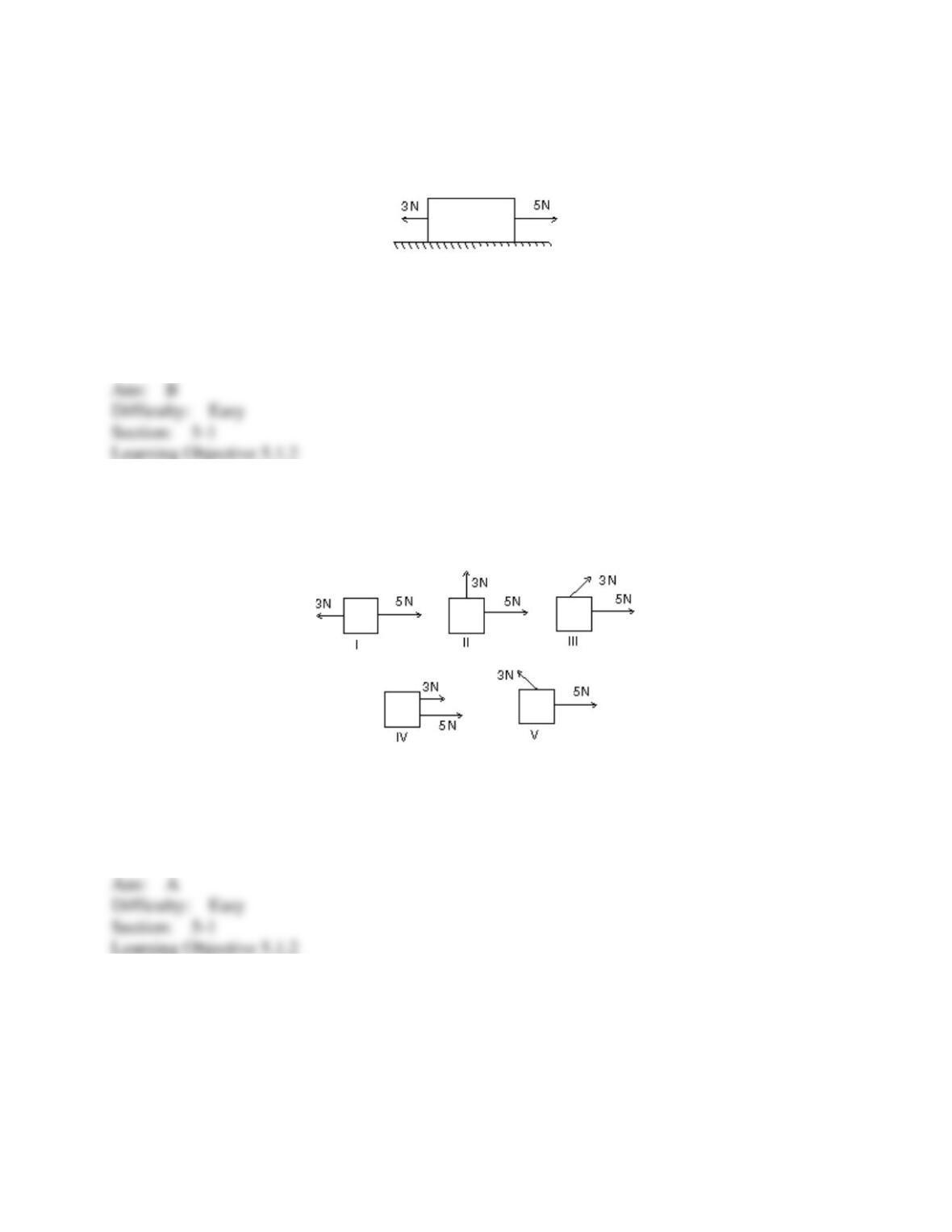
7. A circus performer of weight W is walking along a “high wire” as shown. The tension in the
wire is:
A) approximately W
B) approximately W/2
C) much less than W
D) much more than W
E) depends on whether he stands on one or two feet
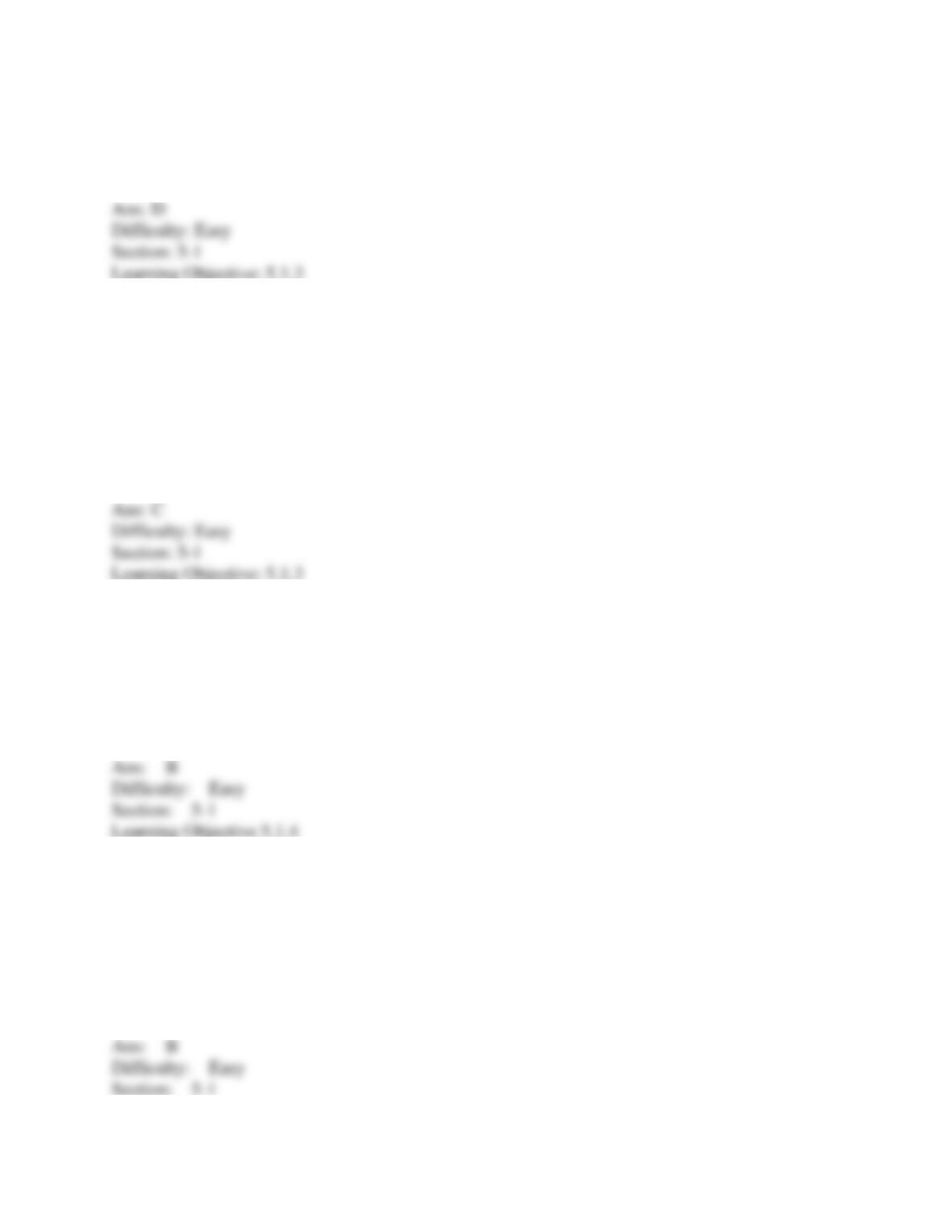
8. The block shown moves with constant velocity on a horizontal surface. Two of the forces on
it are shown. A frictional force exerted by the surface is the only other horizontal force on the
block. The frictional force is:
A) 0 N
B) 2 N, leftward
C) 2 N, rightward
D) slightly more than 2 N, leftward
E) slightly less than 2 N, leftward
9. Two forces, one with a magnitude of 3 N and the other with a magnitude of 5 N, are applied
to an object. For which orientation of the forces shown in the diagrams is the magnitude of the
acceleration of the object the least?
A) I
B) II
C) III
D) IV
E) V
10. Which of the following is a correct statement of Newton’s first law?
A) An object in motion will continue in motion at a constant speed unless acted on by a net
external force.
B) An object at rest will stay at rest unless acted on by a net internal force.
C) An object in motion will continue in motion at a constant velocity unless acted on by a net
internal force.
D) An object in motion will continue in motion at a constant velocity unless acted on by a net
external force.
E) Everything has inertia.
11. Which of the following is true, according to Newton’s second law?
A) The acceleration of an object is proportional to its mass and inversely proportional to the net
force on it.
B) The acceleration of an object is proportional to the product of its mass and the net force on it.
C) The acceleration of an object is proportional to the net force on it and inversely proportional
to its mass.
D) The acceleration of an object is equal to the net force on it.
E) The acceleration of an object depends on all the forces on it, both internal and external.
12. An example of an inertial reference frame is:
A) any reference frame that is not accelerating
B) a frame attached to a particle on which there are no forces
C) any reference frame that is at rest
D) a reference frame attached to the center of the universe
E) a reference frame attached to the Earth
13. The standard 1-kg mass is attached to a compressed spring and the spring is released. If the
mass initially has an acceleration of 5.6 m/s2, the force of the spring has a magnitude of:
A) 2.8 N
B) 5.6 N
C) 11.2 N
D) 0 N
E) an undetermined amount
Learning Objective 5.1.6
14. The term “mass” refers to the same physical concept as:
A) weight
B) inertia
C) force
D) acceleration
E) volume
15. The inertia of a body tends to cause the body to:
A) speed up
B) slow down
C) resist any change in its motion
D) fall toward the Earth
E) decelerate due to friction
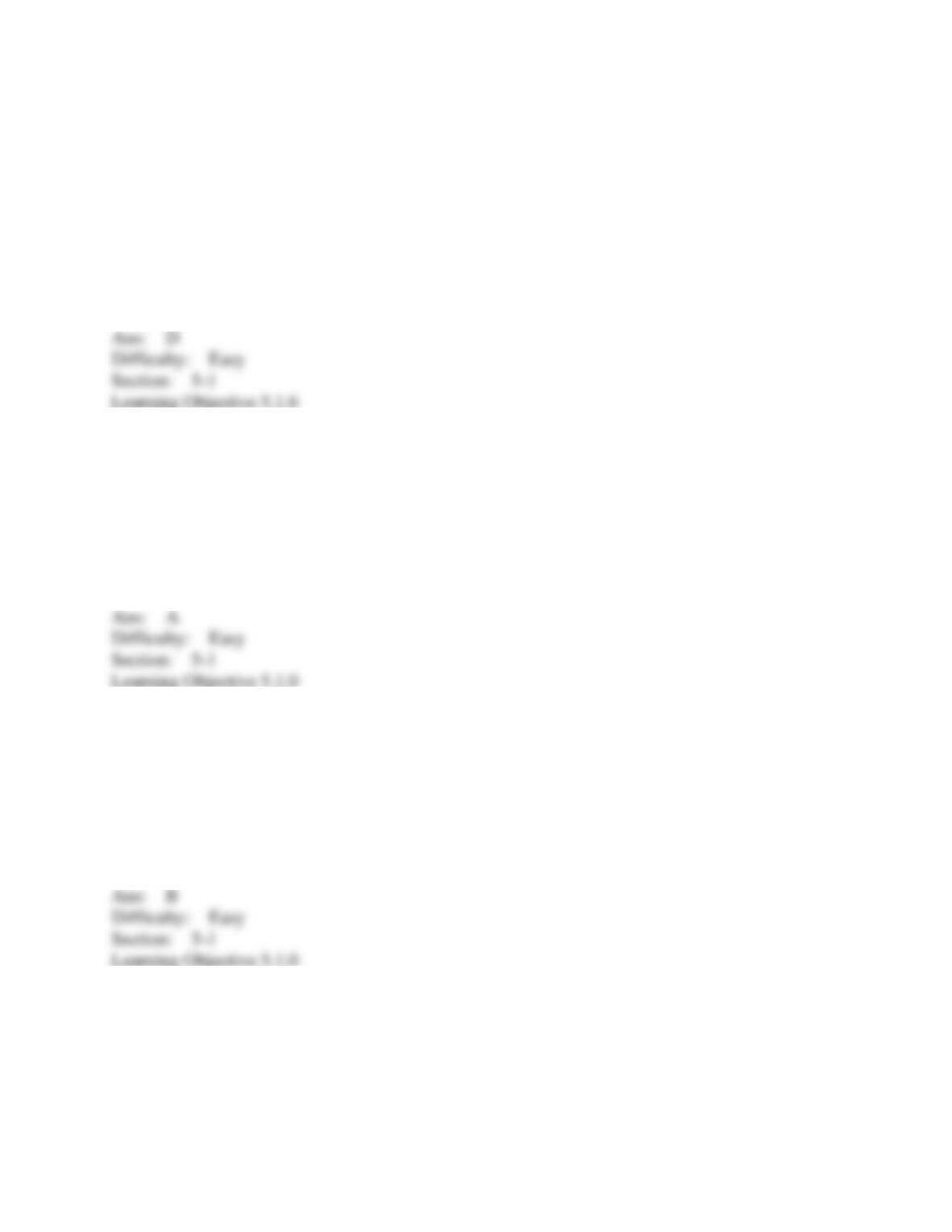
16. A heavy ball is suspended as shown. A quick jerk on the lower string will break that string
but a slow pull on the lower string will break the upper string. The first result occurs because:
A) the force is too small to move the ball
B) action and reaction is operating
C) the ball has inertia
D) air friction holds the ball back
E) the ball has too much energy
17. When a certain force is applied to the 1-kg standard mass its acceleration is 5.0 m/s2. When
the same force is applied to another object its acceleration is one-fifth as much. The mass of the
object is:
A) 0.2 kg
B) 0.5 kg
C) 1.0 kg
D) 5.0 kg
E) 10 kg
18. A motionless 400-N steel ball is suspended by a light rope from the ceiling. The tension in
the rope is:
A) 400 N
B) 800 N
C) 0 N
D) 200 N
E) 560 N
19. Mass differs from weight in that:
A) all objects have weight but some lack mass
B) weight is a force and mass is not
C) the mass of an object is always more than its weight
D) mass can only be expressed in the metric system
E) there is no difference
20. The mass of a body:
A) is slightly different at different places on the Earth
B) is a vector
C) is independent of the acceleration due to gravity
D) is the same for all bodies of the same volume
E) can be measured most accurately on a spring scale
21. The mass and weight of a body:
A) differ by a factor of 9.8
B) are identical
C) are the same physical quantities expressed in different units
D) are both a direct measure of the inertia of the body
E) have the same ratio as that of any other body placed at that location
22. Acceleration is always in the direction:
A) of the displacement
B) of the initial velocity
C) of the final velocity
D) of the net force
E) opposite to the frictional force
23. Equal forces 𝐹
⃗ act on isolated bodies A and B. The mass of B is three times that of A. The
magnitude of the acceleration of A is:
A) three times that of B
B) 1/3 that of B
C) the same as B
D) nine times that of B
E) 1/9 that of B
24. A car travels east at constant velocity. The net force on the car is:
A) east
B) west
C) up
D) down
E) zero
25. A constant force of 8.0 N is exerted for 4.0 s on a 16-kg object initially at rest. The change
in speed of this object will be:
A) 0.5 m/s
B) 2 m/s
C) 4 m/s
D) 8 m/s
E) 32 m/s
26. A 6-kg object is moving south. A net force of 12 N north on it result in the object having an
acceleration of:
A) 2 m/s2, north
B) 2 m/s2, south
C) 6 m/s2, north
D) 18 m/s2, north
E) 18 m/s2, south
27. A 9000-N automobile is pushed along a level road by four students who apply a total
forward force of 500 N. Neglecting friction, the acceleration of the automobile is:
A) 0.055m/s2
B) 0.54 m/s2
C) 1.8 m/s2
D) 9.8 m/s2
E) 18 m/s2
28. An object rests on a horizontal frictionless surface. A net horizontal force of magnitude F is
applied. This force produces an acceleration:
A) only if F is larger than the weight of the object
B) only while the object suddenly changes from rest to motion
C) always
D) only if the inertia of the object decreases
E) only if F is increasing
29. You are driving your car along the road and hit a patch that is so icy that there is effectively
no friction between your tires and the road. Which statement is most accurate?
A) If you hit the brakes, you will eventually stop.
B) If you twist the steering wheel, you can turn into the skid.
C) Nothing you do will have any effect; without any friction, you will continue to move in a
straight line at a constant speed, as there is no net external force on you.
D) If you hit the accelerator, you will get out of the icy patch faster.
E) Your car will start to spin.
30. An object placed on an equal-arm balance requires 12 kg to balance it. When placed on a
spring scale, the scale reads 12 kg. Everything (balance, scale, set of weights and object) is now
transported to the Moon where free-fall acceleration is one-sixth that on Earth. The new readings
of the balance and spring scale (respectively) are:
A) 12 kg, 12 kg
B) 2 kg, 2 kg
C) 12 kg, 2 kg
D) 2 kg, 12 kg
E) 12 kg, 72 kg
Learning Objective 5.2.1
31. A ball with a weight of 1.5 N is thrown at an angle of 30 above the horizontal with an
initial speed of 12 m/s. At its highest point, the net force on the ball is:
A) 9.8 N, 30 below horizontal
B) 0 N
C) 9.8 N, up
D) 9.8 N, down
E) 1.5 N, down
32. A heavy steel ball B is suspended by a cord from a block of wood W. The entire system is
dropped through the air. Neglecting air resistance, the tension in the cord is:
A) zero
B) the difference in the masses of B and W
C) the difference in the weights of B and W
D) the weight of B
E) none of these
33. A box is on a scale. In which of these situations will the scale reading NOT equal the weight
of the box?
A) The scale and box are in an airplane flying at constant speed.
B) The scale and box are in an elevator rising at constant speed.
C) The scale and box are in a hot air balloon in level flight.
D) The scale and box are on a steep slope, held in place by friction.
E) The scale and box are on Mars.
34. You stand on a spring scale on the floor of an elevator. Of the following, the scale shows
the highest reading when the elevator:
A) moves upward with increasing speed
B) moves upward with decreasing speed
C) remains stationary
D) moves downward with increasing speed
E) moves downward at constant speed
35. You stand on a spring scale on the floor of an elevator. Of the following, the scale shows
the highest reading when the elevator:
A) moves downward with increasing speed
B) moves downward with decreasing speed
C) remains stationary
D) moves upward with decreasing speed
E) moves upward at constant speed
36. A 90-kg man stands in an elevator that is moving up at a constant speed of 5.0 m/s. The
force exerted by him on the floor is about:
A) 0 N
B) 90 N
C) 880 N
D) 450 N
E) 49 N
37. A 90-kg man stands in an elevator that has a downward acceleration of 1.4 m/s2. The force
exerted by him on the floor is about:
A) 0 N
B) 90 N
C) 760 N
D) 880 N
E) 1010 N
38. When a 25-kg crate is pushed across a frictionless horizontal floor with a force of 200 N,
directed 20 below the horizontal, the magnitude of the normal force of the floor on the crate is:
A) 25 N
B) 68 N
C) 180 N
D) 250 N
E) 310 N
39. A man weighing 700 N is in an elevator that is accelerating upward at 4 m/s2. The force
exerted on him by the elevator floor is:
A) 71 N
B) 290 N
C) 410 N
D) 700 N
E) 990 N
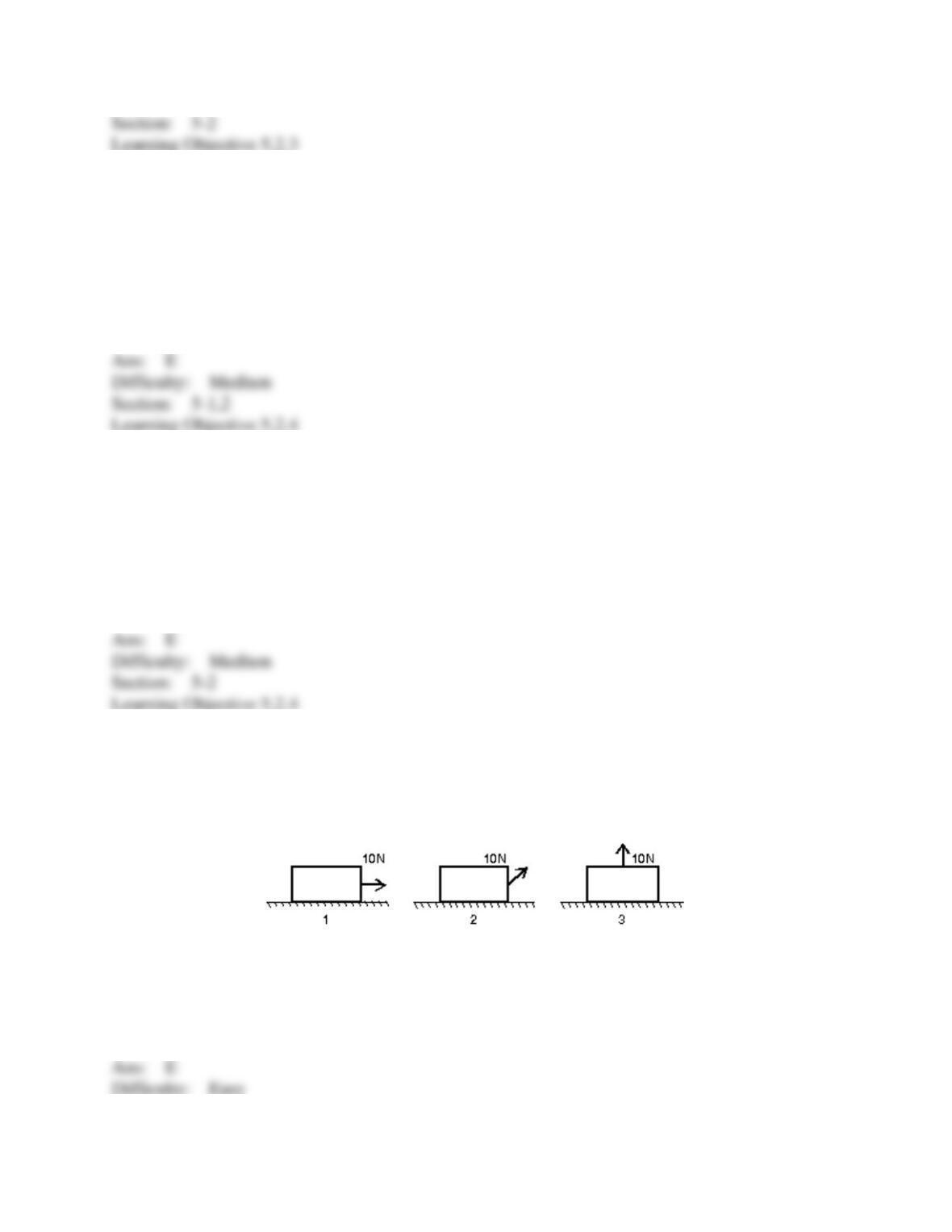
40. A crate rests on a horizontal surface and a woman pulls on it with a 10-N force. Rank the
situations shown below according to the magnitude of the normal force exerted by the surface on
the crate, least to greatest.
A) 1, 2, 3
B) 2, 1, 3
C) 2, 3, 1
D) 1, 3, 2
E) 3, 2, 1