C) displacement amplitude
D) pressure amplitude
E) harmonic content
35. Two notes are an octave apart. The ratio of their frequencies is:
A) 8
B) 10
C) √8
D) 2
E) √2
36. A standing wave in a pipe has nodes that are 1.2 m apart. What is the wavelength of the
wave?
A) 0.6 m
B) 1.2 m
C) 1.8 m
D) 2.4 m
E) cannot tell without knowing which harmonic it is
37. A tuning fork produces sound waves of wavelength in air. This sound is used to cause
resonance in an air column, closed at one end and open at the other. The length of this column
CANNOT be:
A) /4
B) 2/4
C) 3/4
D) 5/4
E) 7/4
38. A column of argon is open at one end and closed at the other. The shortest length of such a
column that will resonate with a 200 Hz tuning fork is 42.5 cm. The speed of sound in argon
must be:
A) 85.0 m/s
B) 170 m/s
C) 340 m/s
D) 470 m/s
E) 940 m/s
39. A 1024 Hz tuning fork is used to obtain a series of resonance levels in a gas column of
variable length, with one end closed and the other open. The length of the column changes by 20
cm from resonance to resonance. From this data, the speed of sound in this gas is:
A) 20 m/s
B) 51 m/s
C) 102 m/s
D) 205 m/s
E) 410 m/s
40. A vibrating tuning fork is held over a water column with one end closed and the other
open. As the water level is allowed to fall, a loud sound is heard for water levels separated by 17
cm. If the speed of sound in air is 340 m/s, the frequency of the tuning fork is:
A) 58 Hz
B) 500 Hz
C) 1000 Hz
D) 2000 Hz
E) 5800 Hz
41. An organ pipe with one end closed and the other open has length L. Its fundamental
frequency is proportional to:
A) L
B) 1/L
C) 1/L2
D) L2
E) √𝐿
42. Five organ pipes are described below. Which one has the highest fundamental frequency?
A) A 2.3-m pipe with one end open and the other closed
B) A 3.3-m pipe with one end open and the other closed
C) A 1.6-m pipe with both ends open
D) A 3.0-m pipe with both ends open
E) a pipe in which the displacement nodes are 5 m apart
43. If the speed of sound is 340 m/s, the two lowest frequencies of an 0.5 m organ pipe, closed
at one end, are approximately:
A) 170 and 340 Hz
B) 170 and 510 Hz
C) 340 and 680 Hz
D) 340 and 1020 Hz
E) 57 and 170 Hz
44. The lowest tone produced by a certain organ comes from a 3.0-m pipe with both ends open.
If the speed of sound is 340 m/s, the frequency of this tone is approximately:
A) 14 Hz
B) 28 Hz
C) 57 Hz
D) 110 Hz
E) 230 Hz
45. The speed of sound in air is 340 m/s. The shortest air column, closed at one end, which will
resonate to a 512 Hz tuning fork is approximately:
A) 4.2 cm
B) 8.3 cm
C) 17 cm
D) 33 cm
E) 66 cm
46. If the speed of sound is 340 m/s, the shortest pipe, closed at one end, which resonates at
218 Hz is:
A) 39 cm
B) 78 cm
C) 1.6 m
D) 3.1 m
E) 6.2 m
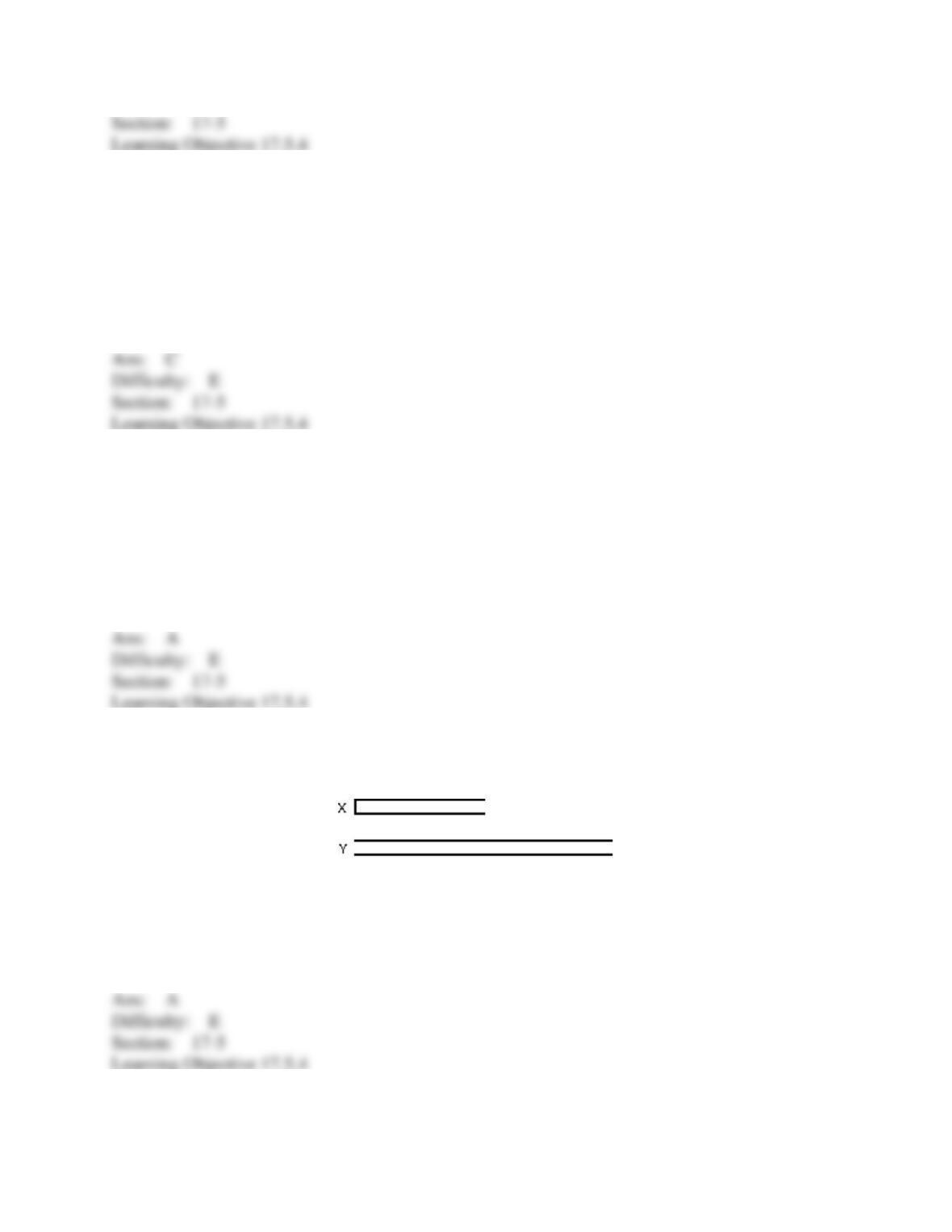
47. Organ pipe Y (open at both ends) is twice as long as organ pipe X (open at one end) as
shown. The ratio of their fundamental frequencies fX::fY is:
A) 1:1
B) 1:2
C) 2:1
D) 1:4
E) 4:1
48. A 200-cm organ pipe with one end open is in resonance with a sound wave of wavelength
270 cm. The pipe is operating in its:
A) fundamental frequency
B) first harmonic
C) second harmonic
D) third harmonic
E) fourth harmonic
49. An organ pipe with both ends open is 0.85 m long. Assuming that the speed of sound is 340
m/s, the frequency of the third harmonic of this pipe is:
A) 200 Hz
B) 300 Hz
C) 400 Hz
D) 600 Hz
E) none of these
50. The valves of a trumpet and the slide of a trombone are for the purpose of:
A) playing short (staccato) notes
B) tuning the instruments
C) changing the harmonic content
D) changing the length of the air column
E) producing gradations in loudness
51. Beats in sound occur when:
A) two waves of the same frequency interfere
B) two waves of slightly different frequency interfere
C) a reflected wave interferes with an incident wave
D) waves travel in two media having slightly different sound velocities
E) source and observer are in relative motion
52. To produce beats it is necessary to use two waves:
A) traveling in opposite directions
B) of slightly different frequencies
C) of equal wavelengths
D) of equal amplitudes
E) whose ratio of frequencies is an integer
53. In order for two sound waves to produce audible beats, it is essential that the two waves
have:
A) the same amplitude
B) the same frequency
C) the same number of overtones
D) slightly different amplitudes
E) slightly different frequencies
54. The largest number of beats per second will be heard from which pair of tuning forks?
A) 200 and 201 Hz
B) 256 and 260 Hz
C) 534 and 540 Hz
D) 763 and 774 Hz
E) 8420 and 8422 Hz
55. When listening to tuning forks of frequency 256 Hz and 260 Hz, one hears the following
number of beats per second:
A) 0
B) 2
C) 4
D) 8
E) 258
56. Two identical tuning forks vibrate at 256 Hz. One of them is then loaded with a drop of
wax, after which 6 beats per second are heard. The frequency of the loaded tuning fork is:
A) 250 Hz
B) 253 Hz
C) 256 Hz
D) 259 Hz
E) 262 Hz
57. Two identical strings, A and B, have nearly the same tension. When they both vibrate in
their fundamental resonant modes, there is a beat of 3 Hz. When string B is tightened slightly, to
increase the tension, the beat frequency becomes 6 Hz. This means:
A) that before tightening A had a higher frequency than B, but after tightening, B has a higher
frequency than A
B) that before tightening B had a higher frequency than A, but after tightening, A has a higher
frequency than B
C) that before and after tightening A has a higher frequency than B
D) that before and after tightening B has a higher frequency than A
E) none of the above
58. Two stationary tuning forks (350 and 352 Hz) are struck simultaneously. The resulting
sound is observed to:
A) beat with a frequency of 2 beats/s
B) beat with a frequency of 351 beats/s
C) be loud but not beat
D) be Doppler shifted by 2 Hz
E) have a frequency of 702 Hz
59. The rise in pitch of an approaching siren is an apparent increase in its:
A) speed
B) amplitude
C) frequency
D) wavelength
E) number of overtones
60. The Doppler shift formula for the frequency detected is
𝑓 = 𝑓′𝑣 ± 𝑣𝐷
𝑣 ∓ 𝑣𝑠
where f ‘ is the frequency emitted, v is the speed of sound, vD is the speed of the detector, and vs
is the speed of the source. Suppose the source is traveling at 5 m/s away from the detector, the
detector is traveling at 7 m/s toward the source, and there is a 3 m/s wind blowing from the
source toward the detector. The values that should be substituted into the Doppler shift equation
are:
A) vD = 7 m/s and vs = 5 m/s
B) vD = 10 m/s and vs = 8 m/s
C) vD = 4 m/s and vs = 2 m/s
D) vD = 10 m/s and vs = 2 m/s
E) vD = 4 m/s and vs = 8 m/s
61. A stationary source generates 5.0 Hz water waves whose speed is 2.0 m/s. A boat is
approaching the source at 1.0 m/s. The frequency of these waves, as observed by a person in the
boat, is:
A) 2.5 Hz
B) 5.0 Hz
C) 7.5 Hz
D) 15 Hz
E) 30 Hz
62. A stationary source S generates circular outgoing waves on a lake. The wave speed is 5.0
m/s and the crest-to-crest distance is 2.0 m. A person in a motor boat heads directly toward S at
3.0 m/s. To this person, the frequency of these waves is:
A) 1.0 Hz
B) 1.5 Hz
C) 2.0 Hz
D) 4.0 Hz
E) 8.0 Hz
63. A stationary source emits a sound wave of frequency f. If it were possible for a man to
travel toward the source at the speed of sound, he would observe the emitted sound to have a
frequency of:
A) 0
B) f/2
C) 2f/3
D) 2f
E) infinity
64. A source emits sound with a frequency of 1000 Hz. Both it and an observer are moving in
the same direction with the same speed, 100 m/s. If the speed of sound is 340 m/s, the observer
hears sound with a frequency of:
A) 290 Hz
B) 540 Hz
C) 1000 Hz
D) 1800 Hz
E) 3400 Hz
65. A source emits sound with a frequency of 1000 Hz. It and an observer are moving toward
each other, each with a speed of 100 m/s. If the speed of sound is 340 m/s, the observer hears
sound with a frequency of:
A) 290 Hz
B) 540 Hz
C) 1000 Hz
D) 1800 Hz
E) 3400 Hz
66. A source emits sound with a frequency of 1000 Hz. It is moving at 20 m/s toward a
stationary reflecting wall. If the speed of sound is 340 m/s an observer at rest directly behind the
source hears a beat frequency of:
A) 3.0 Hz
B) 55 Hz
C) 63 Hz
D) 114 Hz
E) 118 Hz
67. In each of the following two situations a source emits sound with a frequency of 1000 Hz.
In situation I the source is moving at 100 m/s toward an observer at rest. In situation II the
observer is moving at 100 m/s toward the source, which is stationary. The speed of sound is 340
m/s. The frequencies heard by the observers in the two situations are:
A) I: 1417 Hz; II: 1294 Hz
B) I: 1417 Hz; II: 1417 Hz
C) I: 1294 Hz; II: 1294 Hz
D) I: 773 Hz; II: 706 Hz
E) I: 773 Hz; II: 773 Hz
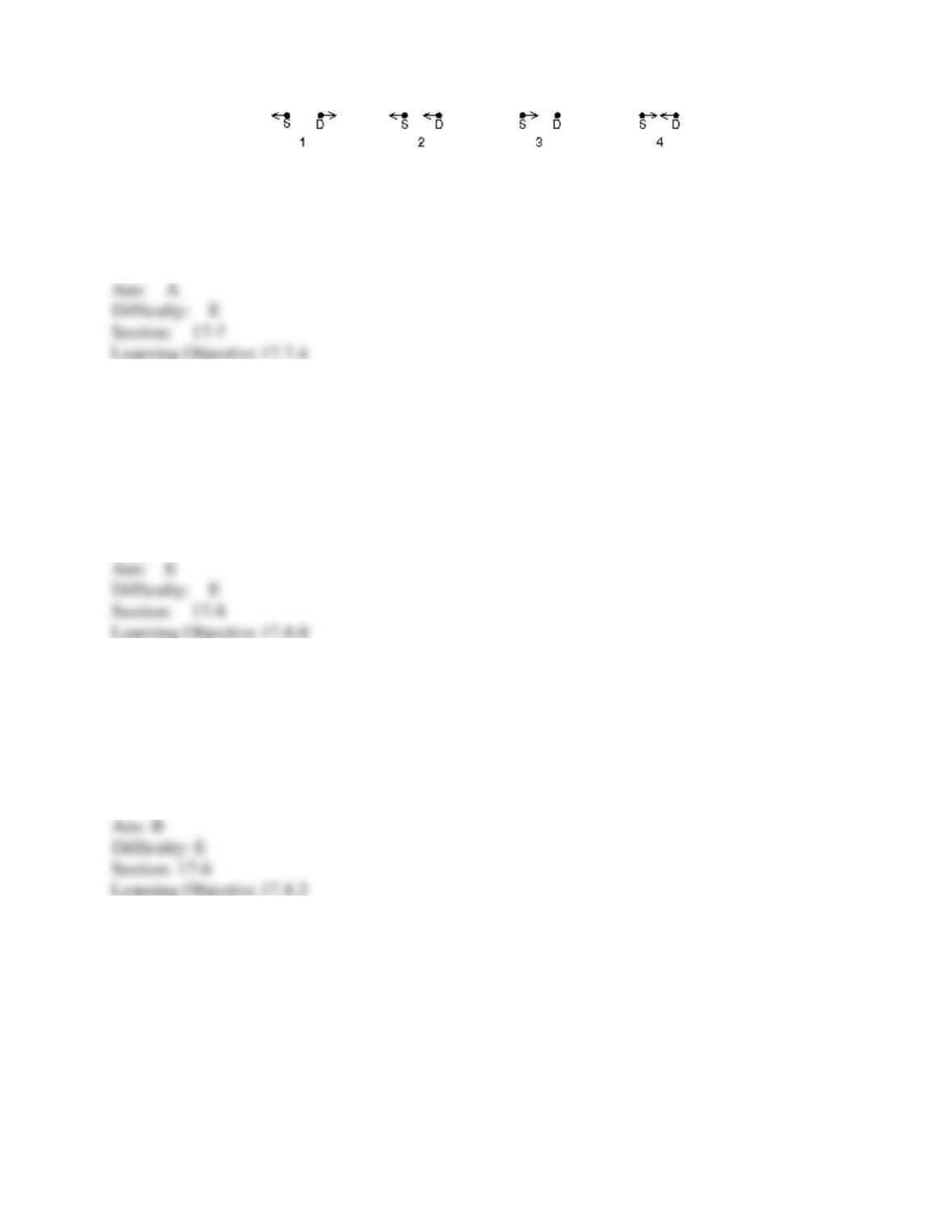
68. The diagram shows four situations in which a source of sound S and a detector D are either
moving or stationary. The arrows indicate the directions of motion. The speeds (when not zero)
are all the same. (Note that the detector in situation 3 is stationary). Rank the situations according
to the apparent frequency of the source, lowest to highest.
A) 1, 2, 3, 4
B) 4, 3, 2, 1
C) 1, 3, 4, 2
D) 2, 1, 4, 3
E) None of the above
69. A plane produces a sonic boom only when:
A) its speed changes from being slower than the speed of sound to being faster than the speed
of sound
B) it emits sound waves of high frequency
C) it flies at high altitudes
D) it flies on a curved path
E) it flies faster than the speed of sound
70. If the speed of sound is 340 m/s a plane flying at 400 m/s has a Mach number of:
A) 0.85
B) 1.2
C) 1.4
D) 1.7
E) 400
71. If the speed of sound is 340 m/s a plane flying at 400 m/s creates a conical shock wave with
an apex half angle of:
A) 0° (no shock wave)
B) 32
C) 40
D) 50
E) 58
72. The speed of sound is 340 m/s. A plane flies horizontally at an altitude of 10,000 m and a
speed of 400 m/s. When an observer on the ground hears the sonic boom the horizontal distance
from the point on its path directly above the observer to the plane is (assume the speed of sound
does not change with altitude):
A) 5800 m
B) 6100 m
C) 8400 m
D) 12,000 m
E) 16,000 m