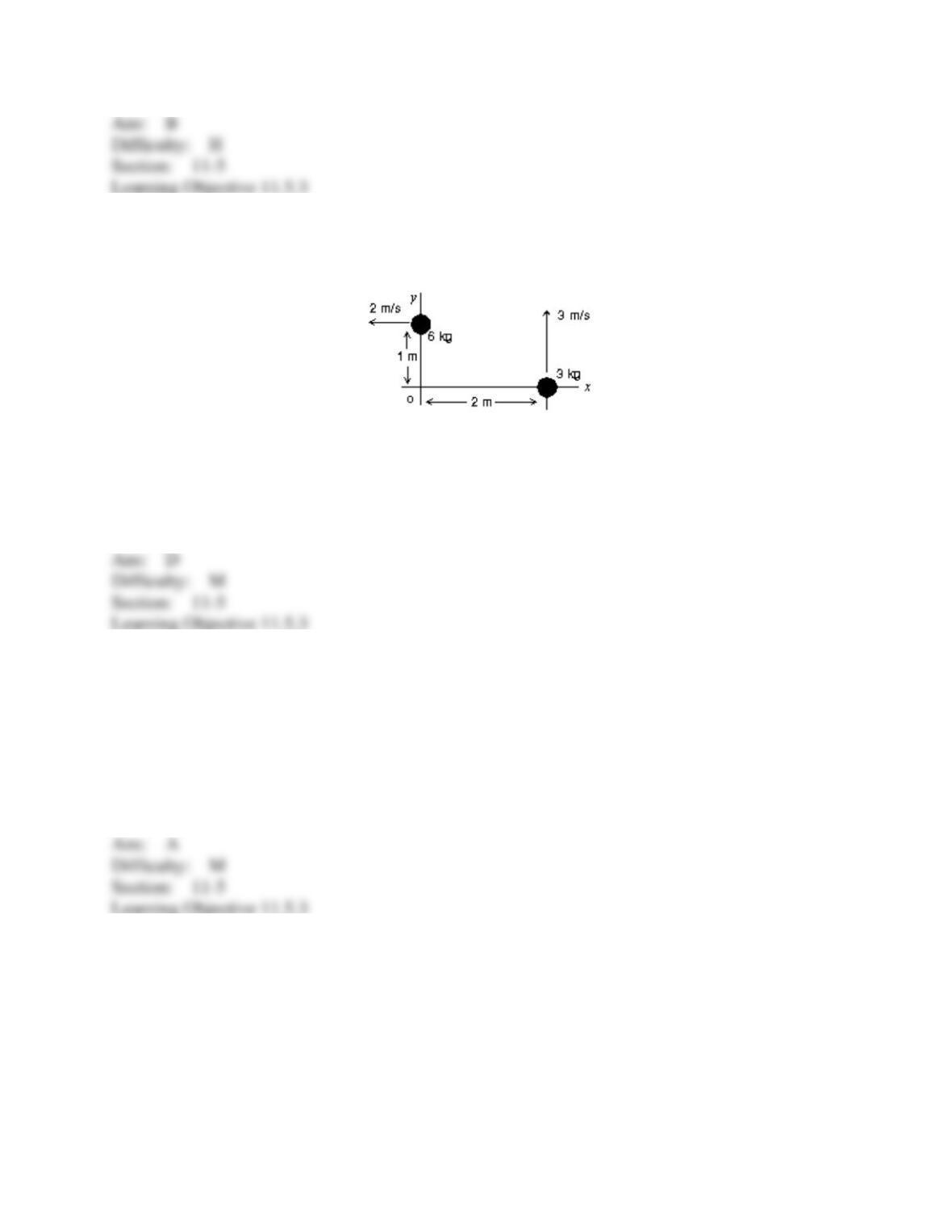
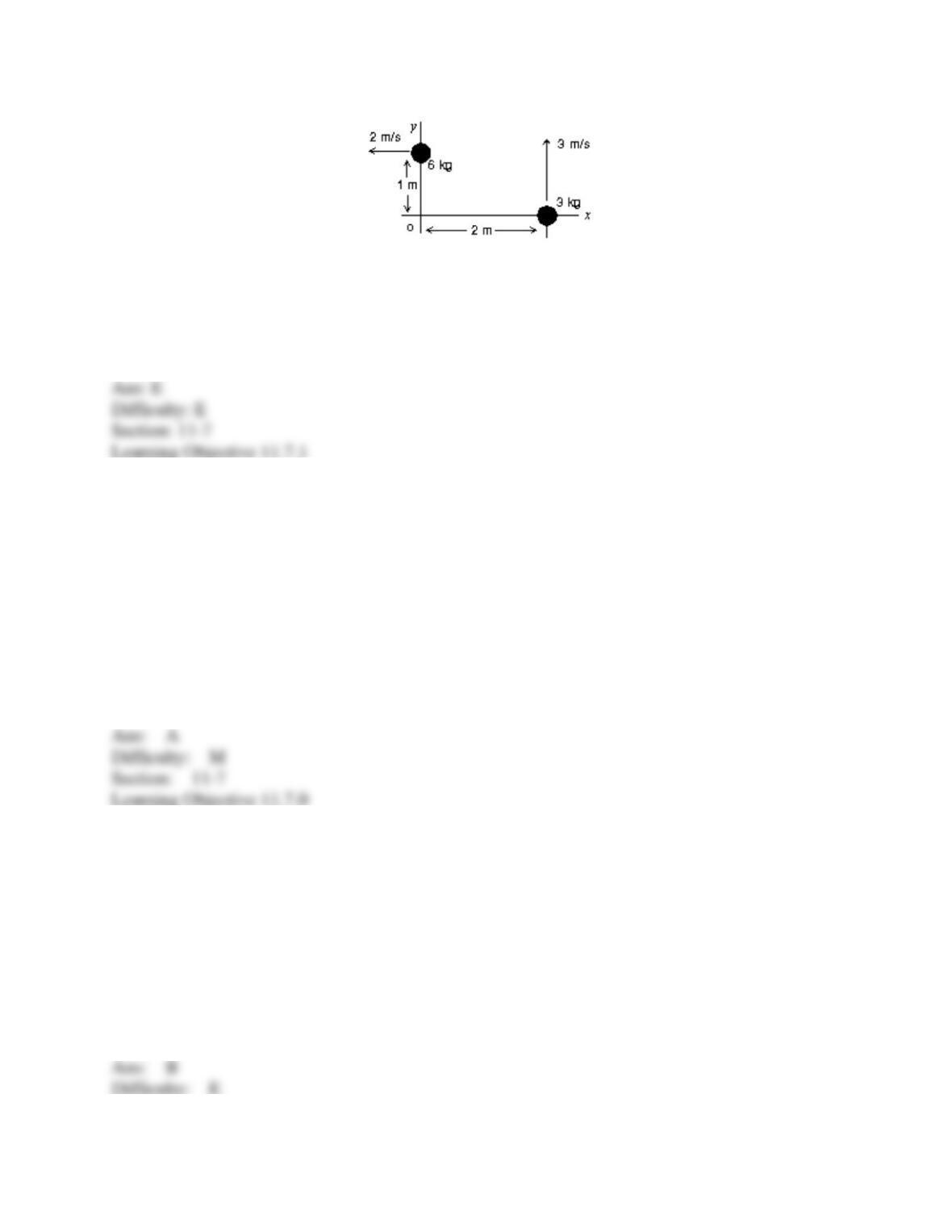
36. Two objects are moving in the x, y plane as shown. The magnitude of their total angular
momentum (about the origin O) is:
A) 0 kg∙m2/s
B) 6 kg∙m2/s
C) 12 kg∙m2/s
D) 30 kg∙m2/s
E) 78 kg∙m2/s
37. A 15-g paper clip is attached to the rim of a phonograph record with a diameter of 30 cm,
spinning at 3.5 rad/s. The magnitude of its angular momentum is:
A) 1.2 10–3 kg∙m2/s
B) 4.7 10–3 kg∙m2/s
C) 7.9 10–3 kg∙m2/s
D) 1.6 10–2 kg∙m2/s
E) 1.2 kg∙m2/s
38. As a 2.0-kg block travels around a 0.50-m radius circle it has an angular speed of 12 rad/s.
The circle is parallel to the xy plane and is centered on the z axis, 0.75 m from the origin. The
magnitude of its angular momentum around the origin is:
A) 6.0 kg∙m2/s
B) 9.0 kg∙m2/s
C) 11 kg∙m2/s
D) 14 kg∙m2/s
E) 20 kg∙m2/s
39. A 2.0-kg block travels around a 0.50-m radius circle with an angular speed of 12 rad/s. The
circle is parallel to the xy plane and is centered on the z axis, a distance of 0.75 m from the
origin. The z component of the angular momentum around the origin is:
A) 6.0 kg∙m2/s
B) 9.0 kg∙m2/s
C) 11 kg∙m2/s
D) 14 kg∙m2/s
E) 20 kg∙m2/s
40. A 2.0-kg block travels around a 0.50-m radius circle with an angular speed of 12 rad/s. The
circle is parallel to the xy plane and is centered on the z axis, 0.75 m from the origin. The
component in the xy plane of the angular momentum around the origin has magnitude:
A) 0 kg∙m2/s
B) 6.0 kg∙m2/s
C) 9.0 kg∙m2/s
D) 11 kg∙m2/s
E) 14 kg∙m2/s
41. A 2.0-kg block starts from rest on the positive x axis 3.0 m from the origin and thereafter
has an acceleration given by 𝑎 = 4.0𝑖̂ − 3.0𝑗̂ in m/s2. The torque, relative to the origin, acting
on it at the end of 2.0 s is:
A) 0 N∙m
B) (–18 N∙m) 𝑘
̂
C) (+24 N∙m) 𝑘
̂
D) (–144 N∙m) 𝑘
̂
E) (+144 N∙m) 𝑘
̂
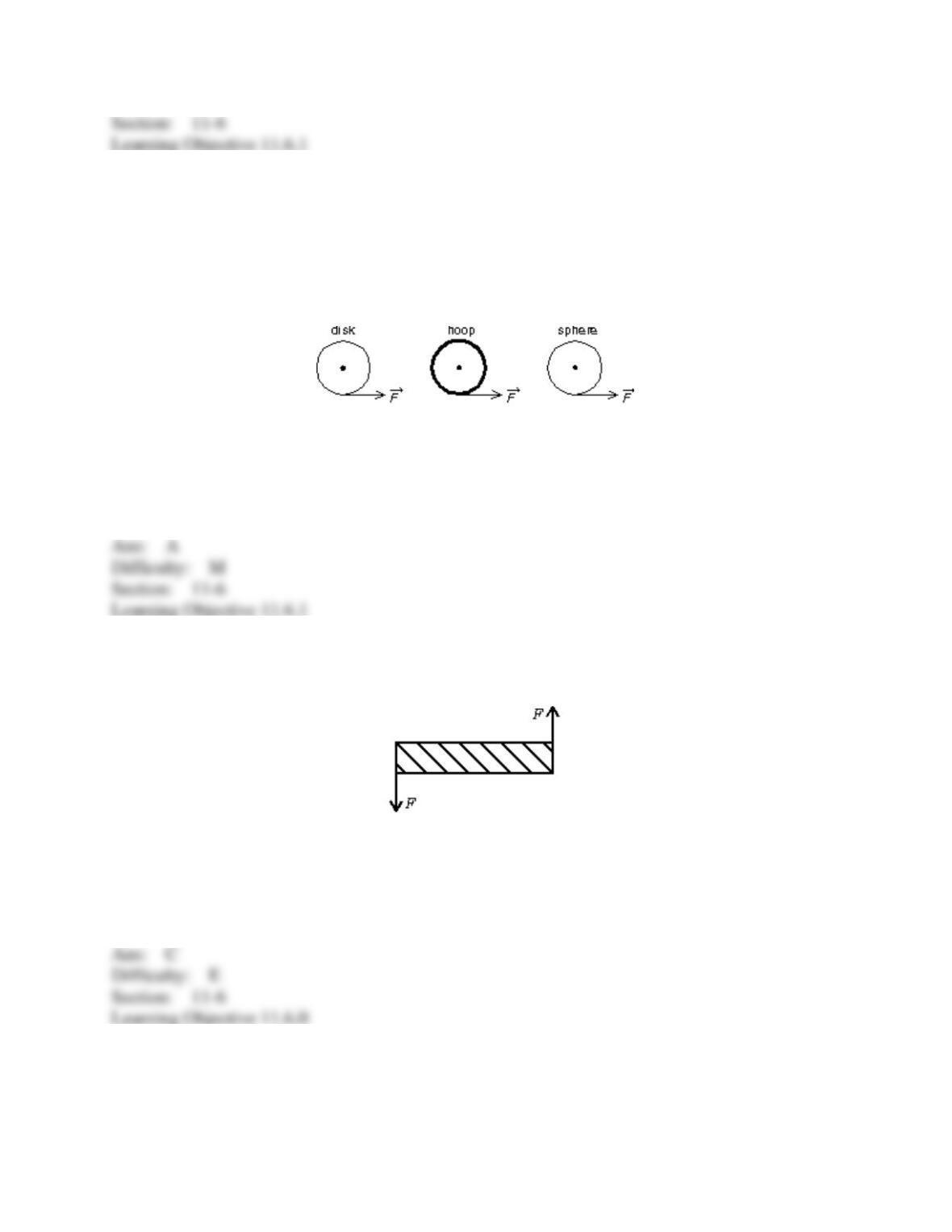
42. A uniform disk, a thin hoop, and a uniform sphere, all with the same mass and same outer
radius, are each free to rotate about a fixed axis through its center. Assume the hoop is connected
to the rotation axis by light spokes. With the objects starting from rest, identical forces are
simultaneously applied to the rims, as shown. Rank the objects according to their angular
momenta after a given time t, least to greatest.
A) all tie
B) disk, hoop, sphere
C) sphere, disk, hoop
D) hoop, sphere, disk
E) hoop, disk, sphere
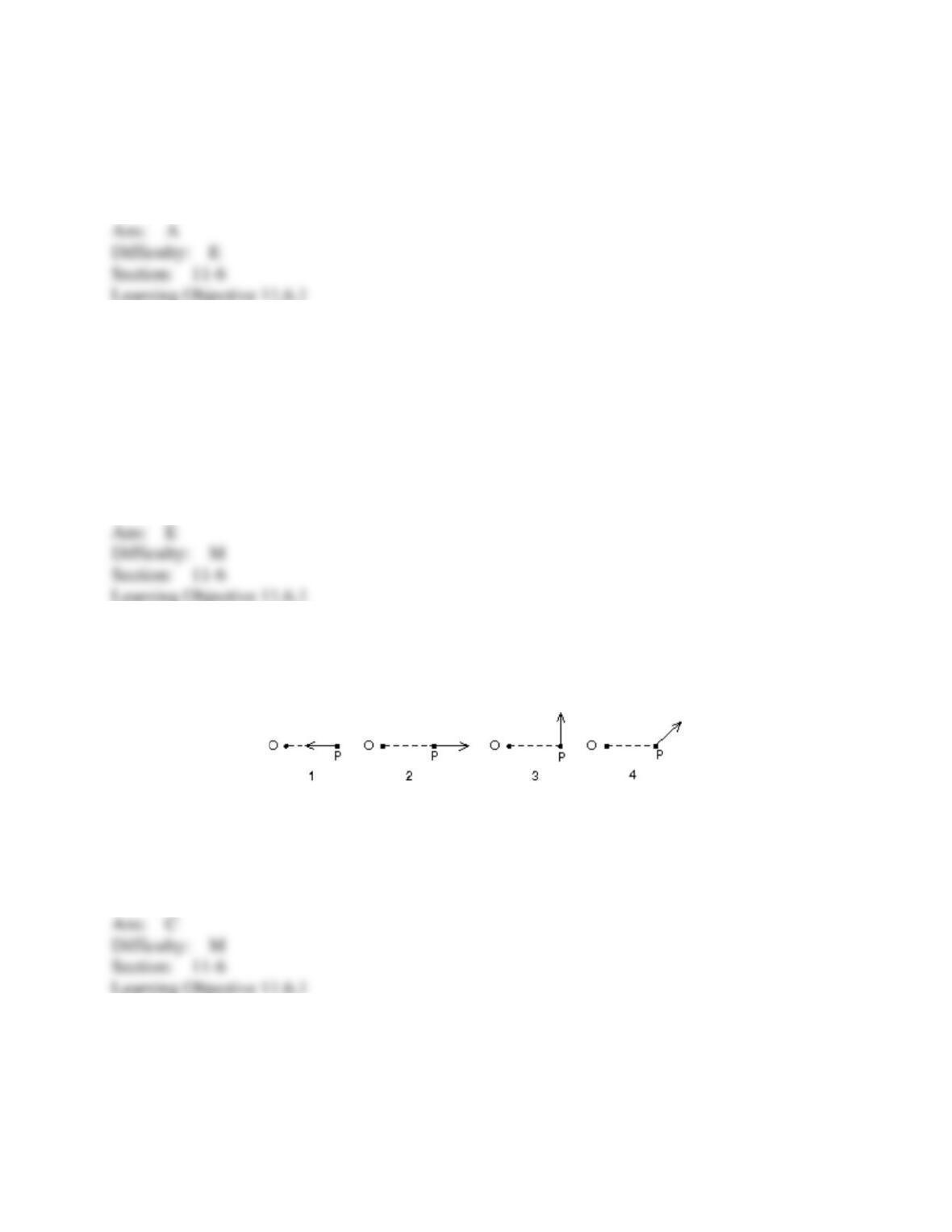
43. A rod rests on frictionless ice. Forces that are equal in magnitude and opposite in direction
are simultaneously applied to its ends as shown. The quantity that has a magnitude of zero is its:
A) angular momentum
B) angular acceleration
C) total linear momentum
D) kinetic energy
E) rotational inertia
44. A 2.0-kg stone is tied to a 0.50-m long string and swung around a circle at a constant
angular velocity of 12 rad/s. The net torque on the stone about the center of the circle is:
A) 0 N∙m
B) 6.0 N∙m
C) 12 N∙m
D) 72 N∙m
E) 140 N∙m
45. A 2.0-kg stone is tied to a 0.50 m long string and swung around a circle at a constant
angular velocity of 12 rad/s. The circle is parallel to the xy plane and is centered on the z axis,
0.75 m from the origin. The magnitude of the torque about the origin is:
A) 0 N∙m
B) 6.0 N∙m
C) 14 N∙m
D) 72 N∙m
E) 108 N∙m
46. A single force acts on a particle P. Rank each of the orientations of the force shown below
according to the magnitude of the time rate of change of the particle’s angular momentum about
the point O, least to greatest.
A) 1, 2, 3, 4
B) 1 and 2 tie, then 3, then 4
C) 1 and 2 tie, then 4, then 3
D) 1 and 2 tie, then 3 and 4 tie
E) All are the same
47. Two objects are moving in the x, y plane as shown. If a net torque of 44 N∙m acts on them for
5.0 seconds, what is the change in their angular momentum?
A) 0 kg∙m2/s
B) 6 kg∙m2/s
C) 30 kg∙m2/s
D) 150 kg∙m2/s
E) 220 kg∙m2/s
48. A pulley with radius R is free to rotate on a horizontal fixed axis through its center. A string
passes over the pulley. Mass m1 is attached to one end and mass m2 is attached to the other. The
portion of the string attached to m1 has tension T1 and the portion attached to m2 has tension T2.
The magnitude of the total external torque, about the pulley center, acting on the masses and
pulley, considered as a system, is given by:
A) m1 – m2gR
B) (m1 + m2)gR
C) m1 – m2gR + (T1 + T2)R
D) (m1 + m2)gR + (T1 – T2)R
E) m1 – m2gR + (T1 – T2)R
49. A uniform disk has radius R and mass M. When it is spinning with angular velocity
about
an axis through its center and perpendicular to its face its angular momentum is I
. When it is
spinning with the same angle velocity about a parallel axis a distance h away its angular
momentum is:
A) I
B) (I + Mh2)
C) (I – Mh2)
D) (I + MR2)
E) (I – MR2)
50. A pulley with radius R and rotational inertia I is free to rotate on a horizontal fixed axis
through its center. A string passes over the pulley. A block of mass m1 is attached to one end and
a block of mass m2, is attached to the other. At one time the block with mass m1 is moving
downward with speed v. If the string does not slip on the pulley, the magnitude of the total
angular momentum, about the pulley center, of the blocks and pulley, considered as a system, is
given by:
A) (m1 – m2)vR + Iv/R
B) (m1 + m2)vR + Iv/R
C) (m1 – m2)vR – Iv/R
D) (m1 + m2)vR – Iv/R
E) none of the above
51. An ice skater with rotational inertia I0 is spinning with angular speed
0. She pulls her arms
in, thereby increasing her angular speed to 4
0. Her rotational inertia is then:
A) I0
B) I0 /2
C) 2 I0
D) I0 /4
E) 4 I0
52. A man, with his arms at his sides, is spinning on a light frictionless turntable. When he
extends his arms:
A) his angular velocity increases
B) his angular velocity remains the same
C) his rotational inertia decreases
D) his rotational kinetic energy increases
E) his angular momentum remains the same
53. A man, holding a weight in each hand, stands at the center of a horizontal frictionless
rotating turntable. The effect of the weights is to double the rotational inertia of the system. As
he is rotating, the man opens his hands and drops the two weights. They fall outside the
turntable. Then:
A) his angular velocity doubles
B) his angular velocity remains about the same
C) his angular velocity is halved
D) the direction of his angular momentum vector changes
E) his rotational kinetic energy increases
54. A uniform sphere of radius R rotates about a diameter with angular momentum of
magnitude L. Under the action of internal forces the sphere collapses to a uniform sphere of
radius R/2. The magnitude of its new angular momentum is:
A) L/4
B) L/2
C) L
D) 2L
E) 4L
55. When a man on a frictionless rotating stool extends his arms horizontally, his rotational
kinetic energy:
A) must increase
B) must decrease
C) must remain the same
D) may increase or decrease depending on his initial angular velocity
E) may increase or decrease depending on his angular acceleration
56. When a woman on a frictionless rotating turntable extends her arms out horizontally, her
angular momentum:
A) must increase
B) must decrease
C) must remain the same
D) may increase or decrease depending on her initial angular velocity
E) tilts away from the vertical
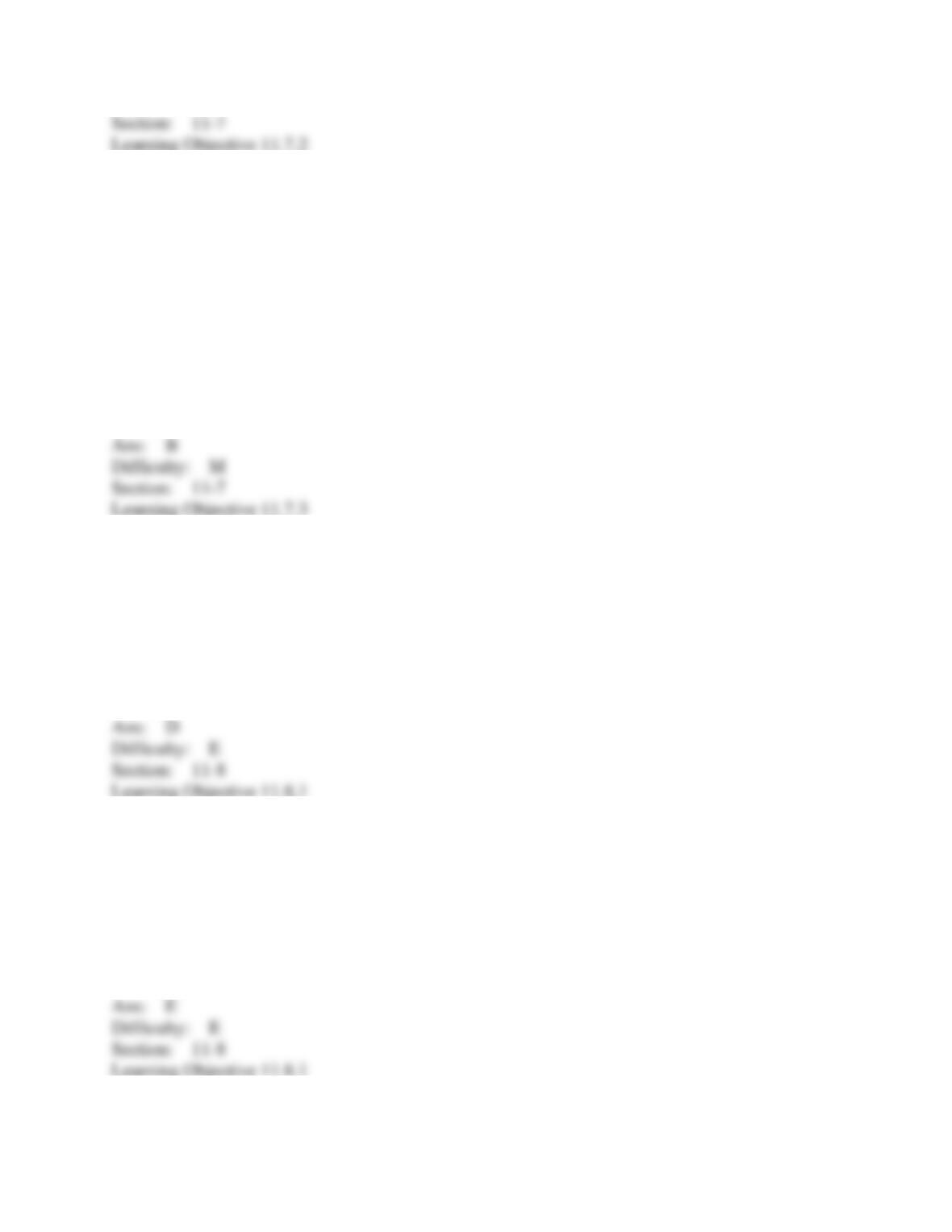
57. Two disks are mounted on low-friction bearings on a common shaft. The first disc has
rotational inertia I and is spinning with angular velocity
. The second disc has rotational inertia
2I and is spinning in the same direction as the first disc with angular velocity 2
as shown. The
two disks are slowly forced toward each other along the shaft until they couple and have a final
common angular velocity of:
A) 5
/3
B) 𝜔√3
C) 𝜔√7/3
D)
E) 3
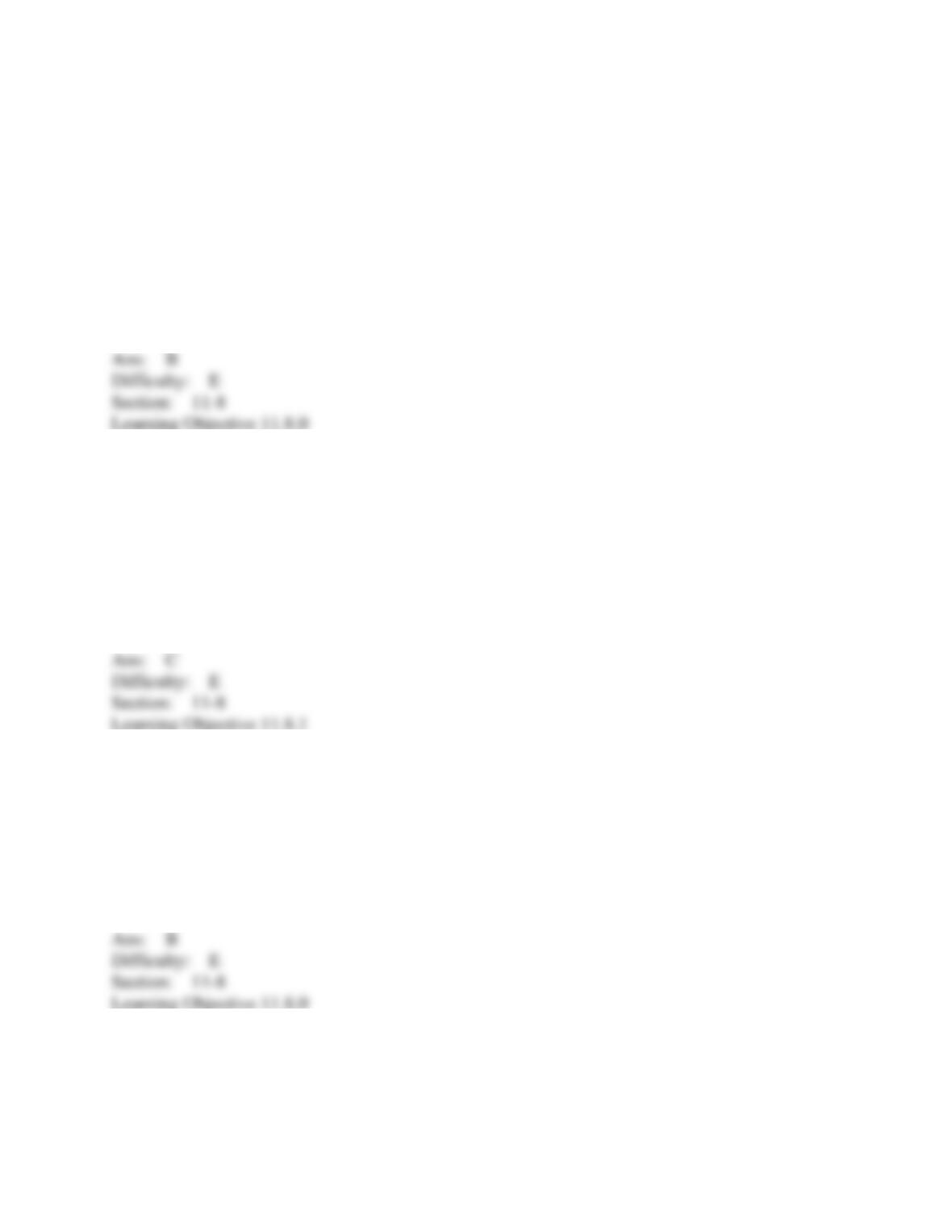
58. A wheel, with rotational inertia I, mounted on a vertical shaft with negligible rotational
inertia, is rotating with angular speed
0. A nonrotating wheel with rotational inertia 2I is
suddenly dropped onto the same shaft as shown. The resultant combination of the two wheels
and shaft will rotate at:
A)
0 /2
B) 2
0
C)
0 /3
D) 3
0
E)
0 /4
59. A phonograph record is dropped onto a freely spinning turntable. Then:
A) neither angular momentum nor mechanical energy is conserved because of the frictional
forces between record and turntable
B) the frictional force between record and turntable increases the total angular momentum
C) the frictional force between record and turntable decreases the total angular momentum
D) the total angular momentum remains constant
E) the sum of the angular momentum and rotational kinetic energy remains constant
60. A playground merry-go-round has a radius R and a rotational inertia I. When the
merry-go-round is at rest, a child with mass m runs with speed v along a line tangent to the rim
and jumps on. The angular velocity of the merry-go-round is then:
A) mv/I
B) v/R
C) mRv/I
D) 2mRv/I
E) mRv/(mR2 + I)
61. A playground merry-go-round has a radius of 3.0 m and a rotational inertia of 600 kg∙m2. It
is initially spinning at 0.80 rad/s when a 20-kg child crawls from the center to the rim. When the
child reaches the rim the angular velocity of the merry-go-round is:
A) 0.62 rad/s
B) 0.73 rad/s
C) 0.77 rad/s
D) 0.91 rad/s
E) 1.1 rad/s

62. Two pendulum bobs of unequal mass are suspended from the same fixed point by strings of
equal length. The lighter bob is drawn aside and then released so that it collides with the other
bob on reaching the vertical position. The collision is elastic. What quantities are conserved in
the collision?
A) Both kinetic energy and angular momentum of the system
B) Only kinetic energy
C) Only angular momentum
D) Angular speed of lighter bob
E) None of the above
63. A particle, held by a string whose other end is attached to a fixed point C, moves in a circle
on a horizontal frictionless surface. If the string is cut, the angular momentum of the particle
about the point C:
A) increases
B) decreases
C) does not change
D) changes direction but not magnitude
E) none of these
64. A block with mass M, on the end of a string, moves in a circle on a horizontal frictionless
table as shown. As the string is slowly pulled through a small hole in the table:
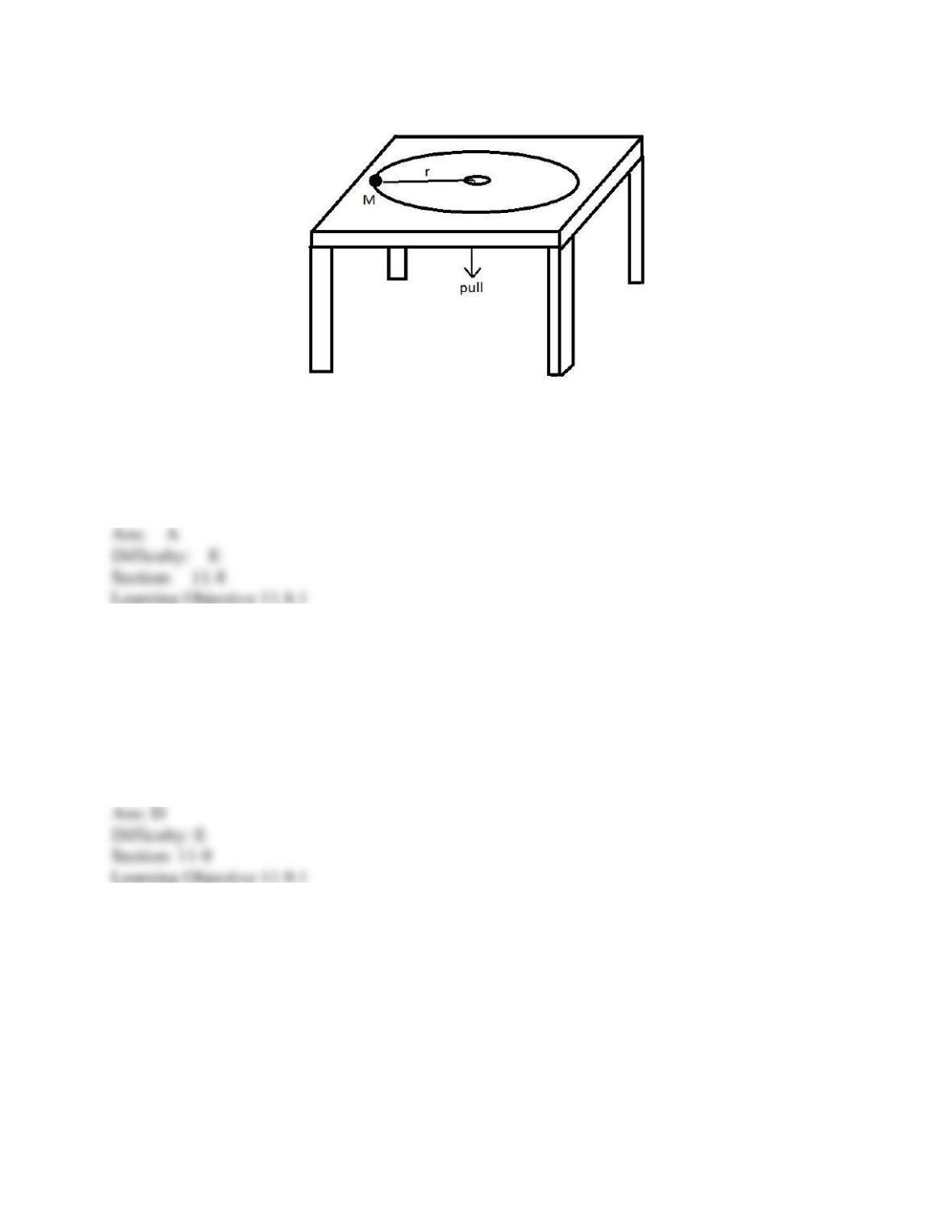
A) the angular momentum of M remains constant
B) the angular momentum of M decreases
C) the kinetic energy of M remains constant
D) the kinetic energy of M decreases
E) none of the above
65. What is precession?
A) Precession is the action of a solid rolling up a slope, prior to rolling back down again.
B) Precession is the increase in economic activity before a recession.
C) Precession is the rotation of a solid around a fixed axis.
D) Precession is the rotation of an angular momentum vector around a vertical axis.
E) Precession is the oscillatory motion of an angular momentum vector as it rotates around a
vertical axis.
66. A simple gyroscope consists of a wheel (M = 2.0 kg, R = 0.75 m, I = 1.1 kg∙m2) rotating on a
horizontal shaft. If the shaft is balanced on a pivot 0.50 m from the wheel, and the wheel rotates
at 500 rev/min, what is the precession frequency of the wheel?
A) 1.8 x 10⁻² rad/s
B) 2.7 x 10⁻² rad/s
C) 0.17 rad/s
D) 0.26 rad/s
E) 0.50 rad/s

67. A simple gyroscope consists of a wheel (R = 0.75 m, I = 0.9 MR2) rotating on a horizontal
shaft. If the shaft is balanced on a pivot 0.50 m from the wheel, and the wheel rotates at 500
rev/min, what is the precession frequency of the wheel?
A) 1.9 x 10⁻² rad/s
B) 2.9 x 10⁻² rad/s
C) 0.19 rad/s
D) 0.28 rad/s
E) cannot be calculated without knowing the mass of the wheel