
34. An artificial Earth satellite of mass m is moved from a circular orbit with radius R to a
circular orbit with radius 2R. If the mass of the Earth is ME, the work done by the gravitational
force is:
A) zero
B) GMEm/R
C) GMEm/2R
D) −GMEm/R
E) −GMEm/2R
35. An object is dropped from an altitude of one Earth radius above Earth’s surface. If M is the
mass of Earth and R is its radius, the speed of the object just before it hits Earth, neglecting air
resistance, is given by:
A) √𝐺𝑀/𝑅
B) √𝐺𝑀/2𝑅
C) √2𝐺𝑀/𝑅
D) √𝐺𝑀/𝑅2
E) √𝐺𝑀/2𝑅2
36. A projectile is fired straight upward from Earth’s surface with a speed that is half the escape
speed. If R is the radius of Earth, the highest altitude reached, measured from the surface, is:
A) R/4
B) R/3
C) R/2
D) R
E) 2R
37. To measure the mass of a planet with the same radius as Earth, an astronaut drops an object
from rest (relative to the planet) from an altitude of one radius above the surface. When the
object hits its speed is 4 times what it would be if the same experiment were carried out for
Earth. In units of ME (the mass of the Earth), the mass of the planet is:
A) 2 ME
B) 4 ME
C) 8 ME
D) 16 ME
E) 32 ME
38. In order to fire a projectile upward and have it escape the Earth’s gravity,
A) the kinetic energy of the projectile may have any positive value.
B) the potential energy of the projectile must be positive
C) the total energy (kinetic plus potential) of the projectile must be negative
D) the total energy (kinetic plus potential) of the projectile must not be negative
E) the total energy (kinetic plus potential) of the projectile must be exactly zero
39. The escape velocity at the surface of Earth is approximately 11 km/s. What is the mass, in
units of ME (the mass of the Earth), of a planet with twice the radius of Earth for which the
escape speed is twice that for Earth?
A) 2 ME
B) 4 ME
C) 8 ME
D) 1/2 ME
E) 1/4 ME
40. Neglecting air resistance, a 1.0-kg projectile has an escape velocity of about 11 km/s at the
surface of Earth. The corresponding escape velocity for a 2.0 kg projectile is:
A) 5.5 km/s
B) 7.8 km/s
C) 11 km/s
D) 16 km/s
E) 22 km/s
41. Neglecting air resistance, the escape speed from a certain planet for an empty space vehicle
is 1.12 104 m/s. What is the corresponding escape speed for the fully loaded vehicle which has
triple the mass of the empty one?
A) 3.73 103 m/s
B) 1.12 104 m/s
C) 3.36 104 m/s
D) 1.01 105 m/s
E) 1.40 1012 m/s
42. Consider the statement: “Earth moves in a stable orbit around the Sun and is therefore in
equilibrium”. The statement is:
A) false, because no moving body can be in equilibrium
B) true, because the Earth does not fall into or fly away from the sun
C) false, because the Earth is rotating on its axis and no rotating body can be in equilibrium
D) false, because the Earth has a considerable acceleration
E) true, because if it were not in equilibrium then buildings and structures would not be stable
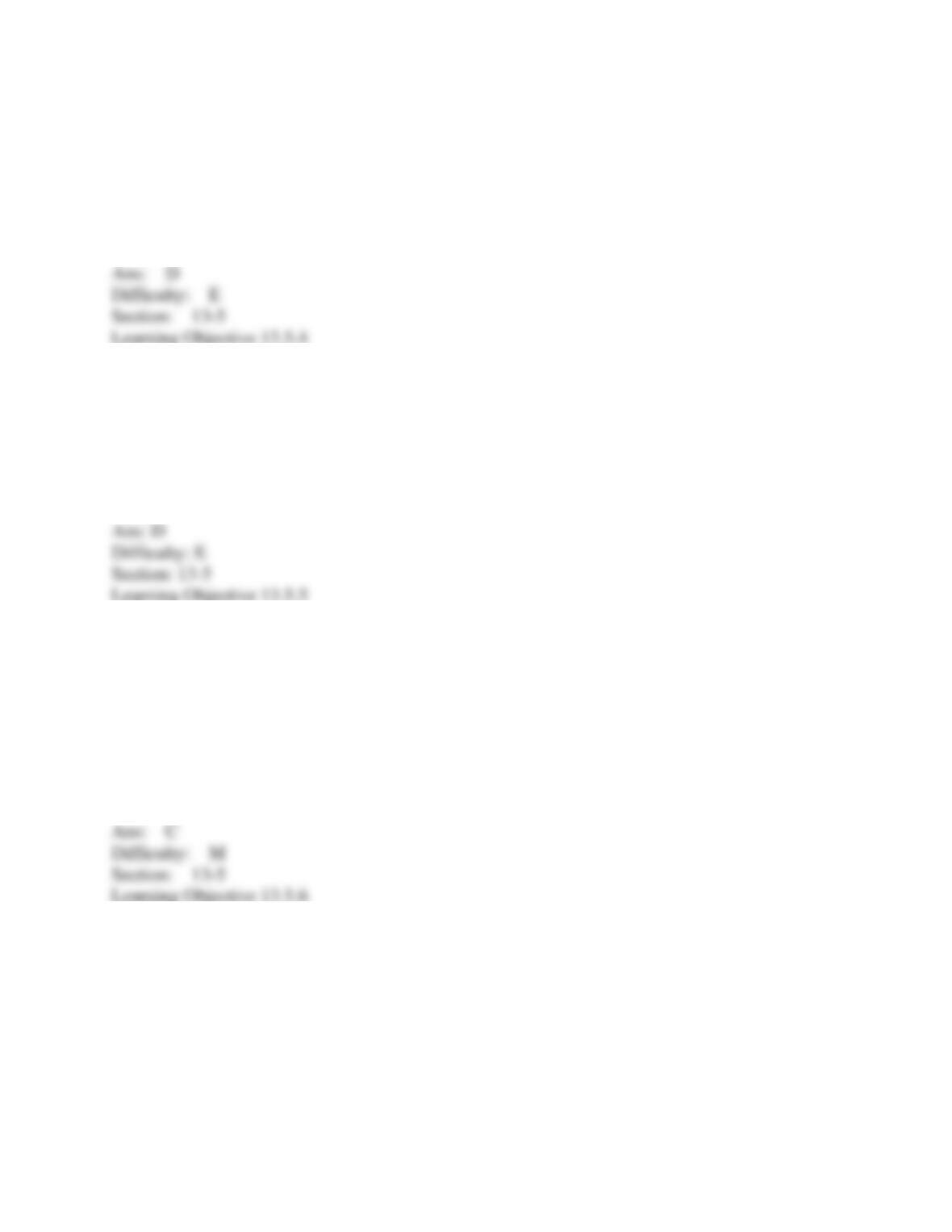
43. A planet travels in an elliptical orbit about a star X as shown. The magnitude of the
acceleration of the planet is:
A) greatest at point Q
B) greatest at point S
C) greatest at point U
D) greatest at point W
E) the same at all points
44. The speed of a comet in an elliptical orbit about the sun:
A) decreases while it is receding from the sun
B) is constant
C) is greatest when farthest from the sun
D) varies sinusoidally with time
E) equals L/(mr), where L is its angular momentum, m is its mass, and r is its distance from the
sun
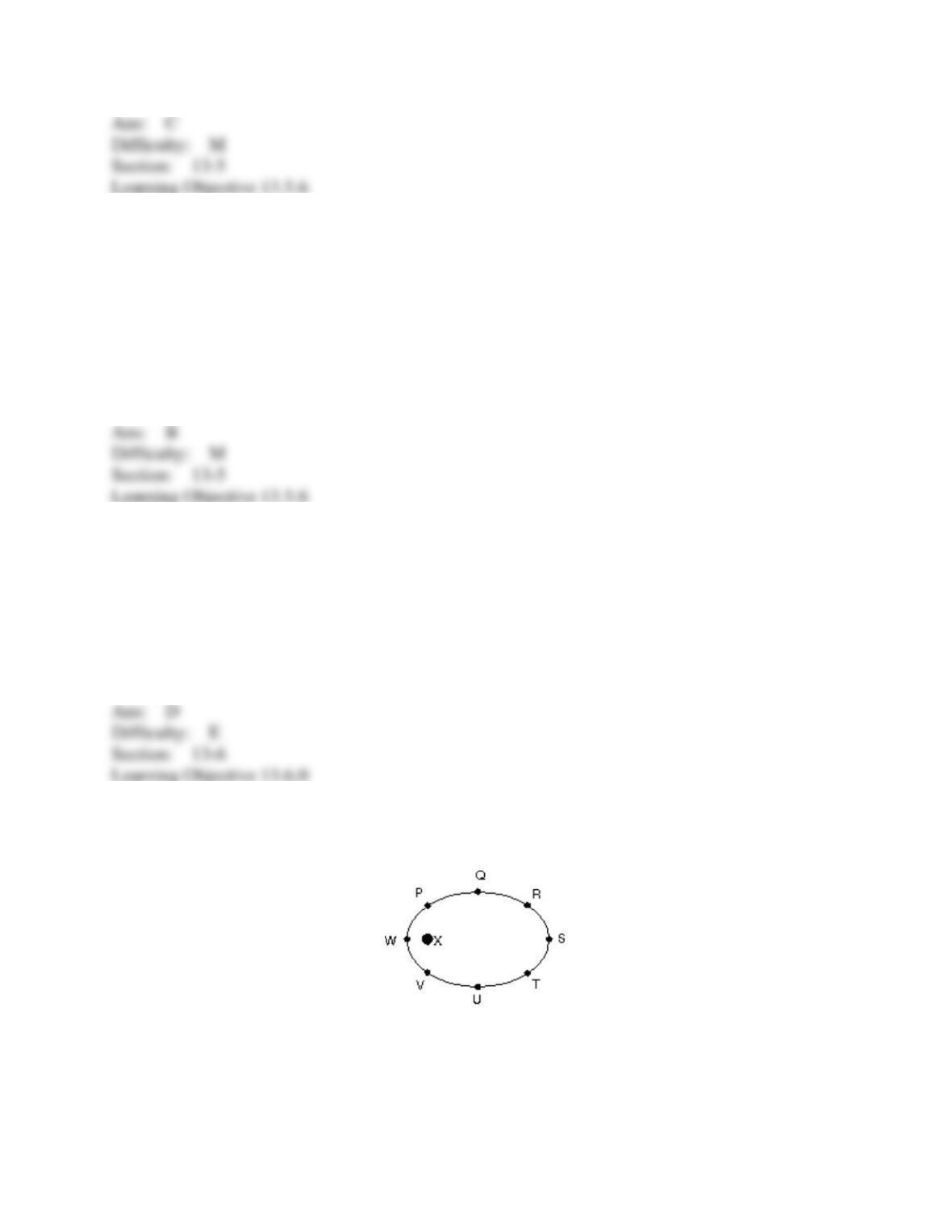
45. A planet travels in an elliptical orbit about a star as shown. At what pair of points is the
speed of the planet the same?
A) W and S
B) P and T
C) P and R
D) Q and U
E) Vand R
46. For a planet in orbit around a star the perihelion distance is rp and its speed at perihelion is
vp. The aphelion distance is ra and its speed at aphelion is va. Which of following is true?
A) va = vp
B) va/ra = vp/rp
C) va ra = vp rp
D) va/ra 2 = vp/rp 2
E) va ra 2 = vp rp 2
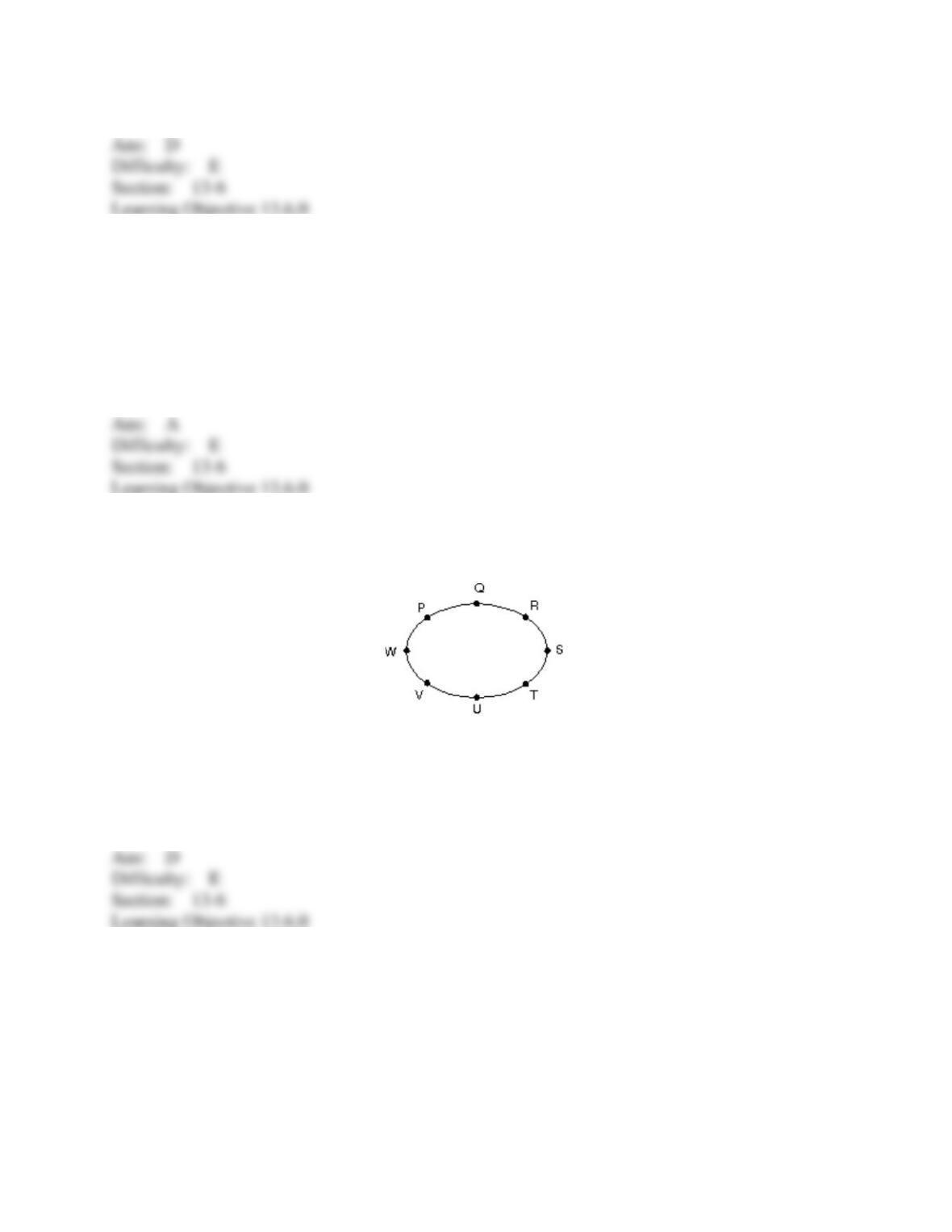
47. A small satellite is in elliptical orbit around Earth as shown. If L denotes the magnitude of
its angular momentum and K denotes kinetic energy:
A) L2 > L1 and K2 > K1
B) L2 > L1 and K2 = K1
C) L2 = L1 and K2 = K1
D) L2 < L1 and K2 = K1
E) L2 = L1 and K2 > K1
48. In planetary motion the line from the star to the planet sweeps out equal areas in equal
times. This is a direct consequence of:
A) the conservation of energy
B) the conservation of momentum
C) the conservation of angular momentum
D) the conservation of mass
E) none of the above
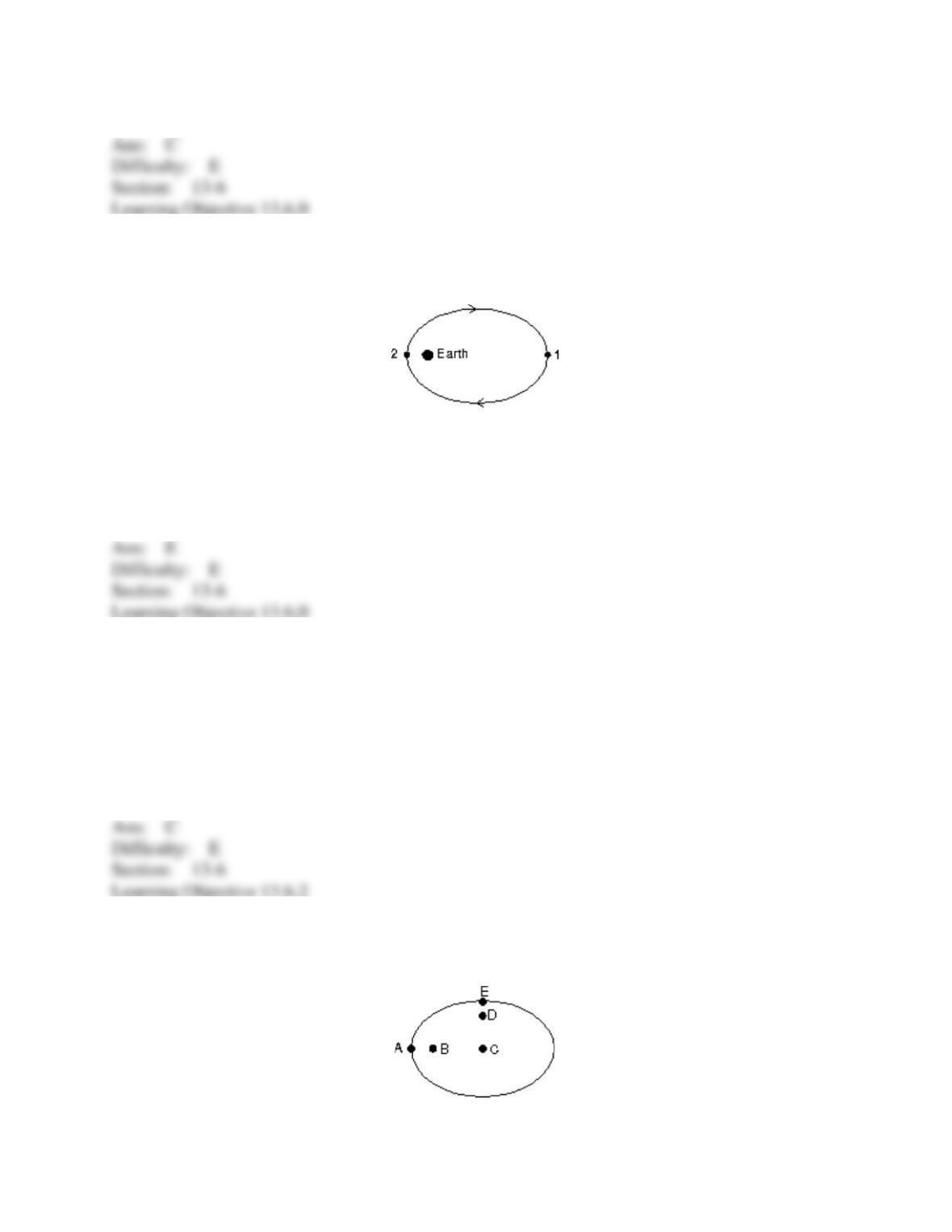
49. The elliptical orbit of a planet around the Sun is shown on the diagram. Which of the
following statements is true?
A) the eccentricity of the orbit is less than zero
B) the eccentricity of the orbit is greater than 1
C) the sun might be at point C
D) the sun might be at point D
E) the sun might be at point B
50. The orbit of a certain a satellite has a semimajor axis of 1.5 107 m and an eccentricity of
0.20. Its perigee (minimum distance) and apogee (maximum distance) are respectively:
A) 1.2 107 m, 1.8 107 m
B) 3.0 106 m, 1.2 107 m
C) 6.0 106 m, 9.0 106 m
D) 1.0 107 m, 1.2 107 m
E) 9.6 106 m, 1.8 107 m
51. Planet 1 and planet 2 are both in circular orbits around the same central star. The orbit of
planet 2 has a radius that is much larger than the radius of the orbit of planet 1. This means that:
A) the period of planet 1 is greater than the period of planet 2 and the speed of planet 1 is
greater than the speed of planet 2
B) the period of planet 1 is greater than the period of planet 2 and the speed of planet 1 is less
than the speed of planet 2
C) the period of planet 1 is less than the period of planet 2 and the speed of planet 1 is less than
the speed of planet 2
D) the period of planet 1 is less than the period of planet 2 and the speed of planet 1 is greater
than the speed of planet 2
E) the planets have the same speed and the same period
52. A planet is in circular orbit around the Sun. Its distance from the Sun is four times the
average distance of Earth from the Sun. The period of this planet is:
A) 4 Earth years
B) 8 Earth years
C) 16 Earth years
D) 64 Earth years
E) 2.5 Earth years
53. Two planets are orbiting a star in a distant galaxy. The first has a semimajor axis of 150
106 km, an eccentricity of 0.20, and a period of 1.0 Earth years. The second has a semimajor axis
of 250 106 km, an eccentricity of 0.30, and a period of:
A) 0.46 Earth yr
B) 0.57 Earth yr
C) 1.4 Earth yr
D) 1.7 Earth yr
E) 2.8 Earth yr
54. Given the perihelion distance, aphelion distance, and speed at perihelion of a planet, which
of the following CANNOT be calculated?
A) the mass of the star
B) the mass of the planet
C) the speed of the planet at aphelion
D) the period of orbit
E) the semimajor axis of the orbit
55. Assume that Earth is in circular orbit around the Sun with kinetic energy K and potential
energy U, taken to be zero for infinite separation. Then, the relationship between K and U:
A) is K = U
B) is K = –U
C) is K = U/2
D) is K = –U/2
E) depends on the radius of the orbit

56. An artificial Earth satellite is moved from a circular orbit with radius R to a circular orbit
with radius 2R. During this move:
A) the gravitational force does positive work, the kinetic energy of the satellite increases, and
the potential energy of the Earth-satellite system increases
B) the gravitational force does positive work, the kinetic energy of the satellite increases, and
the potential energy of the Earth-satellite system decreases
C) the gravitational force does positive work, the kinetic energy of the satellite decreases, and
the potential energy of the Earth-satellite system increases
D) the gravitational force does negative work, the kinetic energy of the satellite system
increases, and the potential energy of the Earth-satellite system decreases
E) the gravitational force does negative work, the kinetic energy of the satellite decreases, and
the potential energy of the Earth-satellite system increases
57. An artificial satellite of Earth nears the end of its life due to air resistance. While still in
orbit:
A) it moves faster as the orbit lowers
B) it moves slower as the orbit lowers
C) it slowly spirals away from Earth
D) it moves slower in the same orbit but with a decreasing period
E) it moves faster in the same orbit but with an increasing period
58. A spaceship is returning to Earth with its engine turned off. Consider only the gravitational
field of Earth. Let M be the mass of Earth, m be the mass of the spaceship, and R be the distance
from the center of Earth. In moving from position 1 to position 2 the kinetic energy of the
spaceship increases by:
A) 𝐺𝑀𝑚
𝑅2[1
𝑅2
2−1
𝑅1
2]
B) 𝐺𝑀𝑚[ 1
𝑅2
2+1
𝑅1
2]
C) 𝐺𝑀𝑚𝑅1−𝑅2
𝑅1
2
D) 𝐺𝑀𝑚𝑅1−𝑅2
𝑅1𝑅2
E) 𝐺𝑀𝑚𝑅1−𝑅2
𝑅1
2𝑅2
2
59. A planet in another solar system orbits a star with a mass of 4.0 1030 kg. At one point in
its orbit it is 250 106 km from the star and is moving at 35 km/s. Take the universal
gravitational constant to be 6.67 10–11 m2/s2 kg and calculate the semimajor axis of the
planet’s orbit. The result is:
A) 79 106 km
B) 140 106 km
C) 290 106 km
D) 320 106 km
E) 590 106 km
60. Einstein’s principle of equivalence states:
A) the gravitational constant is the same everywhere in the universe
B) it is impossible to tell the difference between gravitational force and the normal force
C) every mass exerts a gravitational force on every other mass
D) gravitational mass and inertial mass are the same
E) the laws of physics are the same in all inertial reference frames
61. In Einstein’s theory of gravitation, gravity is due to:
A) the acceleration of the universe
B) the presence of mass
C) the rotation of the universe
D) the curvature of spacetime
E) the speed of light