Chapter: Chapter 9
Learning Objectives
LO 9.1.0 Solve problems related to center of mass
LO 9.1.1 Given the positions of several particles along an axis or a plane, determine the location
of their center of mass.
LO 9.1.2 Locate the center of mass of an extended, symmetric object by using the symmetry.
LO 9.1.3 For a two-dimensional or three-dimensional extended object with a uniform
distribution of mass, determine the center of mass by (a) mentally dividing the object into simple
geometric figures, each of which can be replaced by a particle at its center and (b) finding the
center of mass of those particles.
LO 9.2.0 Solve problems related to Newton’s second law for a system of particles
LO 9.2.1 Apply Newton’s second law to a system of particles by relating the net force (of the
forces acting on the particles) to the acceleration of the system’s center of mass.
LO 9.2.2 Apply the constant-acceleration equations to the motion of the individual particles in a
system and to the motion of the system’s center of mass.
LO 9.2.3 Given the mass and velocity of the particles in a system, calculate the velocity of the
system’s center of mass.
LO 9.2.4 Given the mass and acceleration of the particles in a system, calculate the acceleration
of the system’s center of mass.
LO 9.2.5 Given the position of a system’s center of mass as a function of time, determine the
velocity of the center of mass.
LO 9.2.6 Given the velocity of a system’s center of mass as a function of time, determine the
acceleration of the center of mass.
LO 9.2.7 Calculate the change in the velocity of a com by integrating the com’s acceleration
function with respect to time.
LO 9.2.8 Calculate a com’s displacement by integrating the com’s velocity function with respect
to time.
LO 9.2.9 When the particles in a two-particle system move without the system’s com moving,
relate the displacements of the particles and the velocities of the particles.
LO 9.3.0 Solve problems related to linear momentum
LO 9.3.1 Identify that momentum is a vector quantity and thus has both magnitude and direction
and also components.
LO 9.3.2 Calculate the (linear) momentum of a particle as the product of the particle’s mass and
velocity.
LO 9.3.3 Calculate the change in momentum (magnitude and direction) when a particle changes
its speed and direction of travel.
LO 9.3.4 Apply the relationship between a particle’s momentum and the (net) force acting on the
particle.
LO 9.3.5 Calculate the momentum of a system of particles as the product of the system’s total
mass and its center-of-mass velocity.
LO 9.3.6 Apply the relationship between a system’s center-of-mass momentum and the net force
acting on the system.
LO 9.4.0 Solve problems related to collision and impulse
LO 9.4.1 Identify that impulse is a vector quantity and thus has both magnitude and direction and
also components.
LO 9.4.2 Apply the relationship between impulse and momentum change.
LO 9.4.3 Apply the relationship between impulse, average force, and the time interval taken by
the impulse.
LO 9.4.4 Apply the constant-acceleration equations to relate impulse to average force.
LO 9.4.5 Given force as a function of time, calculate the impulse (and thus also the momentum
change) by integrating the function.
LO 9.4.6 Given a graph of force versus time, calculate the impulse (and thus also the momentum
change) by graphical integration.
LO 9.4.7 In a continuous series of collisions by projectiles, calculate the average force on the
target by relating it to the rate at which mass collides and to the velocity change experienced by
each projectile.
LO 9.5.0 Solve problems related to conservation of linear momentum
LO 9.5.1 For an isolated system of particles, apply the conservation of linear momenta to relate
the initial momenta of the particles to their momenta at a later instant.
LO 9.5.2 Identify that the conservation of linear momentum can be done along an individual axis
by using components along that axis, provided that there is no net external force component
along that axis.
LO 9.6.0 Solve problems related to momentum and kinetic energy in collisions
LO 9.6.1 Distinguish between elastic collisions, inelastic collisions, and completely inelastic
collisions.
LO 9.6.2 Identify a one-dimensional collision as one where the objects move along a single axis,
both before and after the collision.
LO 9.6.3 Apply the conservation of momentum for an isolated one-dimensional collision to
relate the initial momenta of the objects to their momenta after the collision.
LO 9.6.4 Identify that in an isolated system, the momentum and velocity of the center of mass
are not changed even if the objects collide.
LO 9.7.0 Solve problems related to elastic collisions in one dimension
LO 9.7.1 For isolated elastic collisions in one dimension, apply the conservation laws for both
the total energy and the net momentum of the colliding bodies to relate the initial values to the
values after the collision.
LO 9.7.2 For a projectile hitting a stationary target, identify the resulting motion for the three
general cases: equal masses, target more massive than projectile, projectile more massive than
target.
LO 9.8.0 Solve problems related to collisions in two dimensions
LO 9.8.1 For an isolated system in which a two-dimensional collision occurs, apply the
conservation of momentum along each axis of a coordinate system to relate the momentum
components along an axis before the collision to the momentum components along the same axis
after the collision.
LO 9.8.2 For an isolated system in which a two-dimensional elastic collision occurs, (a) apply
the conservation of momentum along each axis of a coordinate system to relate the momentum
components along an axis before the collision to the momentum components along the same axis
after the collision and (b) apply the conservation of total kinetic energy to relate the kinetic
energies before and after the collision.
LO 9.9.0 Solve problems related to systems with varying mass: a rocket
LO 9.9.1 Apply the first rocket equation to relate the rate at which the rocket loses mass, the
speed of the exhaust products relative to the rocket, the mass of the rocket, and the acceleration
of the rocket.
LO 9.9.2 Apply the second rocket equation to relate the change in the rocket’s speed to the
relative speed of the exhaust products and the initial and final mass of the rocket.
LO 9.9.3 For a moving system undergoing a change in mass at a given rate, relate that rate to the
change in momentum.
Multiple Choice
1. Which one of the following statements is true?
A) the center of mass of an object must lie within the object
B) all the mass of an object is actually concentrated at its center of mass
C) the center of mass of an object cannot move if there is zero net force on the object
D) the center of mass of a cylinder must lie on its axis
E) none of the above
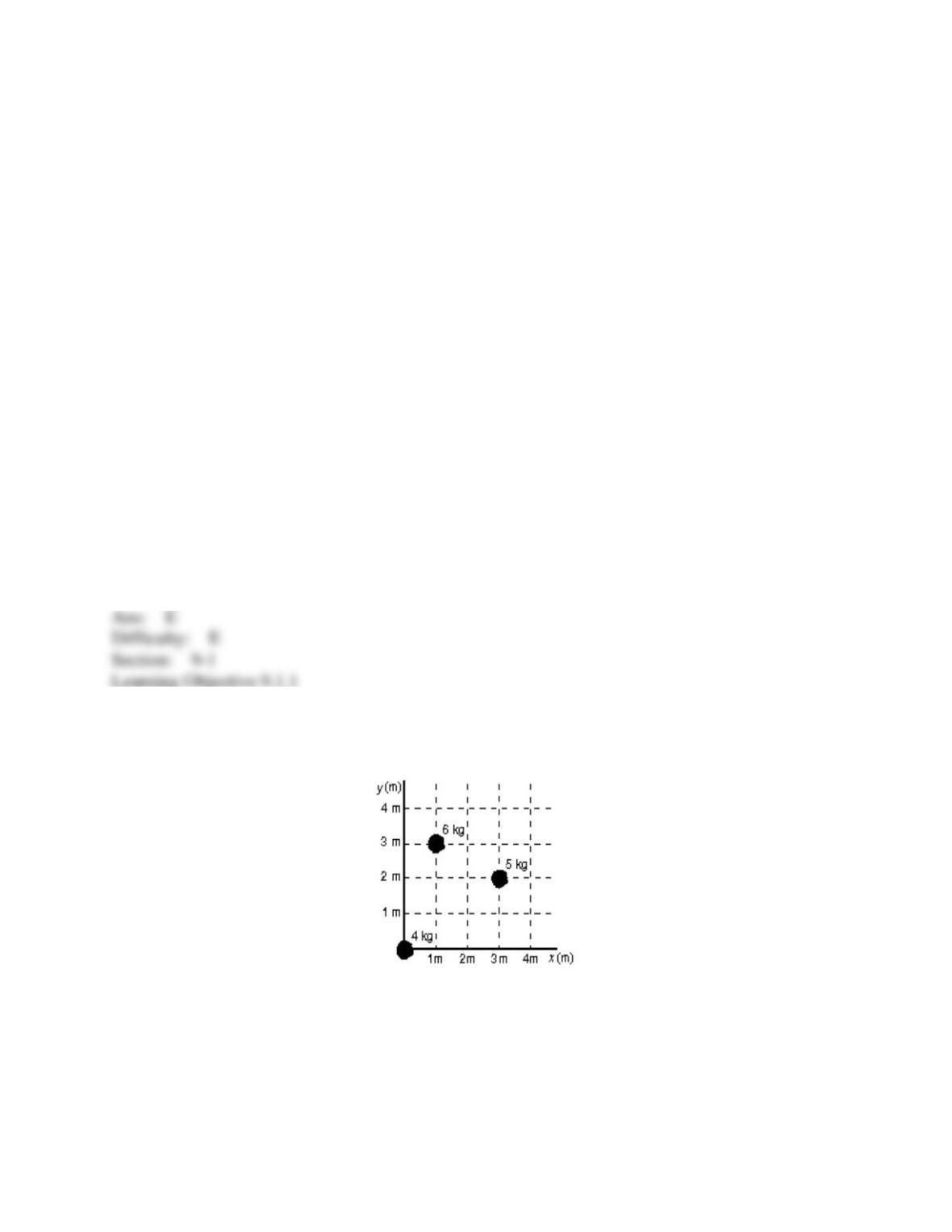
2. The x and y coordinates in meters of the center of mass of the three-particle system shown
below are:
A) 0 m, 0 m
B) 1.3 m, 1.7 m
C) 1.4 m, 1.9 m
D) 1.9 m, 2.5 m
E) 1.4 m, 2.5 m

3. The center of mass of a uniform disk of radius R is located:
A) on the rim
B) a distance R/2 from the center
C) a distance R/3 from the center
D) a distance 2R/3 from the center
E) at the center
4. The center of mass of the system consisting of Earth, the Sun, and the planet Mars is:
A) closer to the Earth than to either of the other bodies
B) closer to the Sun than to either of the other bodies
C) closer to Mars than to either of the other bodies
D) at the geometric center of the triangle formed by the three bodies
E) at the center of the line joining the Earth and Mars
5. The center of mass of Earth’s atmosphere is:
A) a little less than halfway between the Earth’s surface and the outer boundary of the
atmosphere
B) near the surface of the Earth
C) near the outer boundary of the atmosphere
D) near the center of the Earth
E) none of the above
6. At the same instant that a 0.50-kg ball is dropped from 25 m above Earth, a second ball, with
a mass of 0.25 kg, is thrown straight upward from Earth’s surface with an initial speed of 15 m/s.
They move along nearby lines and pass each other without colliding. At the end of 2.0 s the
height above Earth’s surface of the center of mass of the two-ball system is:

A) 2.9 m
B) 4.0 m
C) 7.1 m
D) 7.9 m
E) 10.4 m
7. A 640-N hunter gets a rope around a 3200-N polar bear. They are stationary, 20 m apart, on
frictionless level ice. When the hunter pulls the polar bear to him, the polar bear will move:
A) 1.0 m
B) 3.3 m
C) 10 m
D) 12 m
E) 17 m
8. Two boys with masses of 40 kg and 60 kg stand on a horizontal frictionless surface holding
the ends of a light 10-m long rod. The boys pull themselves together along the rod. When they
meet the 40-kg boy will have moved what distance?
A) 4 m
B) 5 m
C) 6 m
D) 10 m
E) need to know the forces they exert
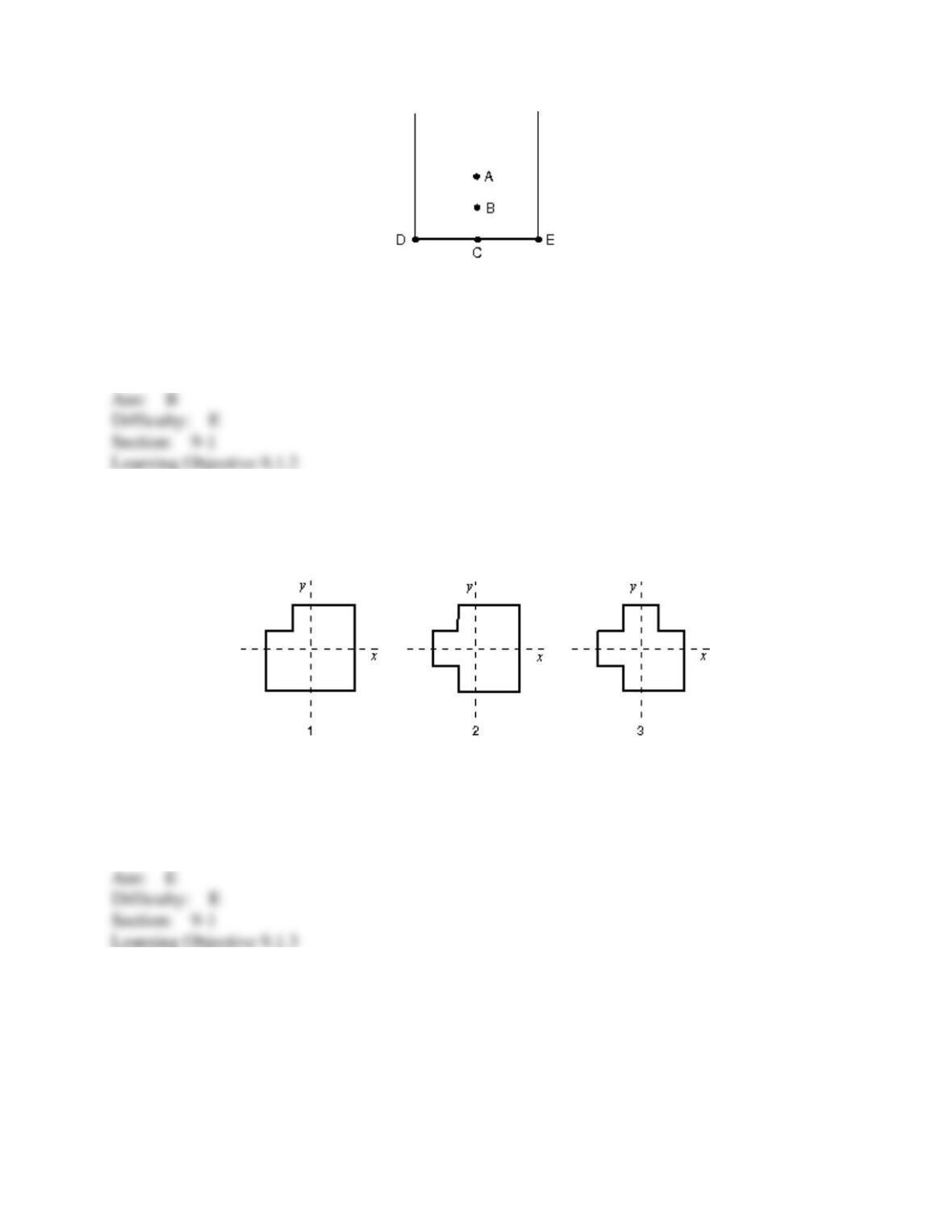
9. A thick uniform wire is bent into the shape of the letter “U” as shown. Which point indicates
the location of the center of mass of this wire?
A) A
B) B
C) C
D) D
E) E
10. A machinist starts with three identical square plates but cuts one corner from one of them,
two corners from the second, and three corners from the third. Rank the three plates according
to the x coordinates of their centers of mass, from smallest to largest.
A) 1, 2, 3
B) 1 and 2 tie, then 3
C) 1, then 2 and 3 tie
D) 3, 2, 1
E) 1, 3, 2
11. The center of mass of a system of particles has a constant velocity if:
A) the forces exerted by the particles on each other sum to zero
B) the external forces acting on particles of the system sum to zero
C) the velocity of the center of mass is initially zero
D) the particles are distributed symmetrically around the center of mass
E) the center of mass is at the geometric center of the system

12. The center of mass of a system of particles remains at the same place if:
A) it is initially at rest and the external forces sum to zero
B) it is initially at rest and the internal forces sum to zero
C) the sum of the external forces is less than the maximum force of static friction
D) no friction acts internally
E) none of the above
13. A man sits in the back of a canoe in still water. He then moves to the front of the canoe and
sits there. Afterwards the canoe:
A) is forward of its original position and moving forward
B) is forward of its original position and moving backward
C) is rearward of its original position and moving forward
D) is rearward of its original position and moving backward
E) is rearward of its original position and not moving
14. The center of mass of a system of particles obeys an equation similar to Newton’s second
law 𝐹
⃗= 𝑚𝑎⃗𝑐𝑜𝑚 where:
A) 𝐹
⃗ is the total internal force and m is the total mass of the system
B) 𝐹
⃗ is the total internal force and m is the mass acting on the system
C) 𝐹
⃗ is the total external force and m is the total mass of the system
D) 𝐹
⃗ is the force of gravity and m is the mass of Earth
E) 𝐹
⃗ is the force of gravity and m is the total mass of the system

15. A light rope passes over a light frictionless pulley attached to the ceiling. An object with a
large mass is tied to one end and an object with a smaller mass is tied to the other end. Starting
from rest, the heavier object moves downward, and the lighter object moves upward with an
acceleration of the same magnitude. Which of the following statements is true for the system
consisting of the two objects?
A) The center of mass remains at rest.
B) The net external force is zero.
C) The velocity of the center of mass is a constant.
D) The acceleration of the center of mass is g, downward.
E) None of the above statements are true.
16. Two 4.0-kg blocks are tied together with a compressed spring between them. They are
thrown from the ground with an initial velocity of 35 m/s, 45 above the horizontal. At the
highest point of the trajectory they become untied and spring apart. About how far below the
highest point is the center of mass of the two-block system 2.0 s later, before either fragment has
hit the ground?
A) 1.2 m
B) 20 m
C) 31 m
D) Can’t tell because the velocities of the fragments are not given.
E) Can’t tell because the coordinates of the highest point are not given.
17. Block A, with a mass of 4.0 kg, is moving with a speed of 2.0 m/s while block B, with a
mass of 8.0 kg, is moving in the opposite direction with a speed of 3.0 m/s. The center of mass of
the two-block system is moving with the velocity of:
A) 1.3 m/s in the same direction as A
B) 1.3 m/s in the same direction as B
C) 2.7 m/s in the same direction as A
D) 1.0 m/s in the same direction as B
E) 5.0 m/s in the same direction as A

18. At the same instant that a 0.50-kg ball is dropped from 25 m above Earth, a second ball,
with a mass of 0.25 kg, is thrown straight upward from Earth’s surface with an initial speed of 15
m/s. They move along nearby lines and pass without colliding. At the end of 2.0 s the velocity of
the center of mass of the two-ball system is:
A) 11 m/s, down
B) 11 m/s, up
C) 15 m/s, down
D) 15 m/s, up
E) 20 m/s, down
19. A 2.0-kg block is attached to one end of a spring with a spring constant of 100 N/m and a
4.0-kg block is attached to the other end. The blocks are placed on a horizontal frictionless
surface and set into motion. At one instant the 2.0-kg block is observed to be traveling to the
right with a speed of 0.50 m/s and the 4.0-kg block is observed to be traveling to the left with a
speed of 0.30 m/s. Since the only forces on the blocks are the force of gravity, the normal force
of the surface, and the force of the spring, we conclude that:
A) the spring is compressed at the time of the observation
B) the spring is not compressed at the time of observation
C) the motion was started with the masses at rest
D) the motion was started with at least one of masses moving
E) the motion was started by compressing the spring
20. At the same instant that a 0.50-kg ball is dropped from 25 m above Earth, a second ball,
with a mass of 0.25 kg, is thrown straight upward from Earth’s surface with an initial speed of 15
m/s. They move along nearby lines and pass without colliding. At the end of 2.0 s the
acceleration of the center of mass of the two-ball system is:
A) 0.25 g
B) 0.50 g
C) 0.67 g
D) 0.75 g
E) 1.0 g

Learning Objective 9.2.4
21. The position of the center of mass of a system of particles moves as x = 4.5 t + 2.4 t2 + 1.1 t3,
where x is in meters. If the system starts from rest at t = 0, what is its velocity at t = 3.0 s?
A) 8.0 m/s
B) 21 m/s
C) 49 m/s
D) 64 m/s
E) 65 m/s
22. The velocity of the center of mass of a system of particles changes as v = 4.5 t + 2.4 t2 + 1.1
t3, where v is in meters per second. If the system starts from rest at t = 0, what is its acceleration
at t = 3.0 s?
A) 7.1 m/s2
B) 14 m/s2
C) 20 m/s2
D) 49 m/s2
E) 65 m/s2
23. The acceleration of the center of mass of a system of particles changes as a = 4.5t + 2.4t2 +
1.1t3, where a is in m/s2. If the system starts from rest at t = 0, what is its velocity at t = 2.0 s?
A) 8.0 m/s
B) 14 m/s
C) 20 m/s
D) 27 m/s
E) 34 m/s
24. The velocity of the center of mass of a system of particles changes as v = 4.5 t + 2.4 t2 + 1.1
t3, where v is in meters per second. If the system starts from rest at t = 0, what is its position at t =
3.0 s?
A) 7.1 m
B) 21 m
C) 40 m
D) 49 m
E) 64 m
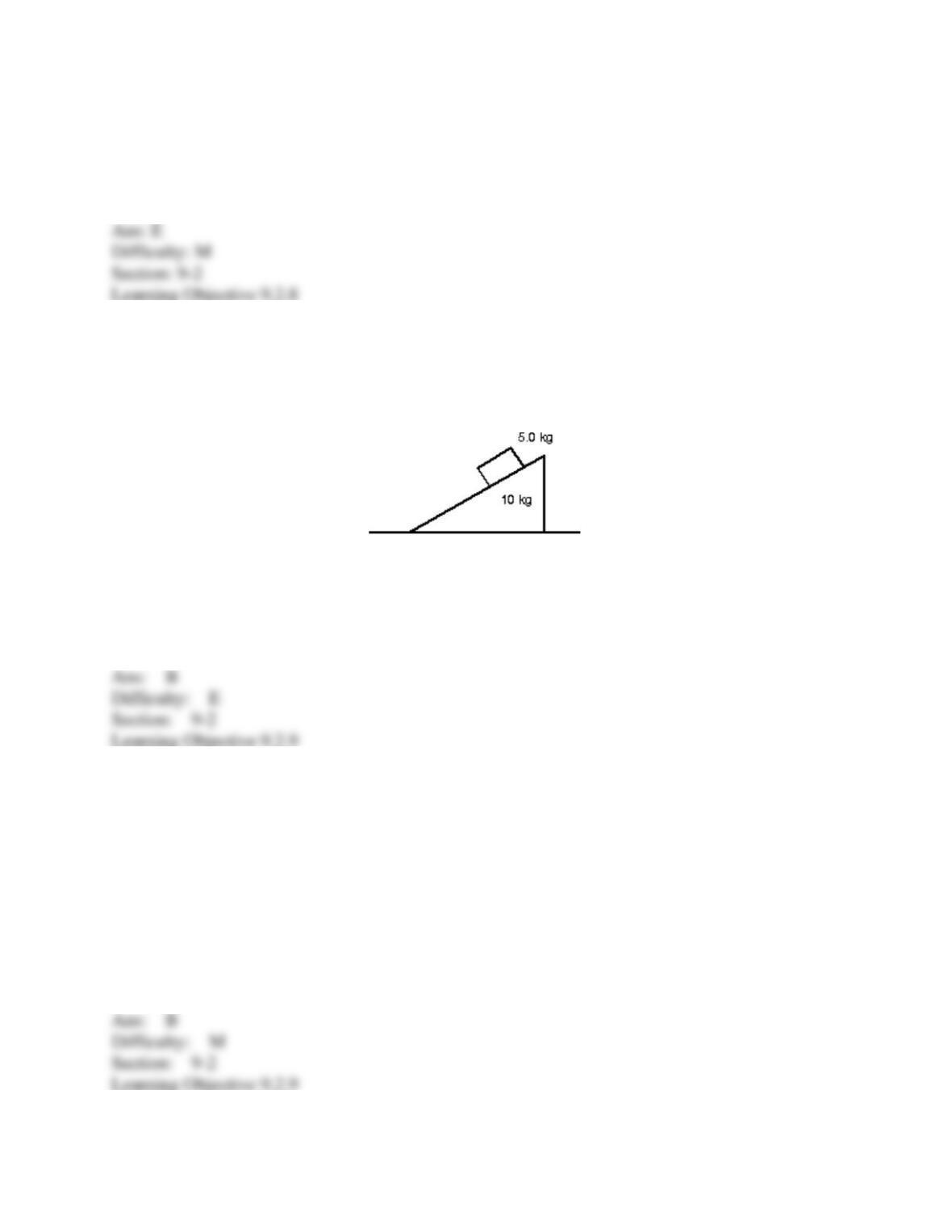
25. A large wedge with a mass of 10 kg rests on a horizontal frictionless surface, as shown. A
block with a mass of 5.0 kg starts from rest and slides down the inclined surface of the wedge,
which is rough. At one instant the vertical component of the block’s velocity is 3.0 m/s and the
horizontal component is 6.0 m/s. At that instant the velocity of the wedge is:
A) 3.0 m/s left
B) 3.0 m/s, right
C) 6.0 m/s, right
D) 6.0 m/s, left
E) 17 m/s, right
26. A 2.0-kg mass is attached to one end of a spring with a spring constant of 100 N/m and a
4.0-kg mass is attached to the other end. The masses are placed on a horizontal surface and the
spring is compressed 10 cm. The spring is then released with the masses at rest and the masses
oscillate. When the spring has its equilibrium length for the first time the 2.0-kg mass has a
speed of 0.36 m/s. The mechanical energy that has been lost to this instant is:
A) 0 J
B) 0.31 J
C) 0.61 J
D) 0.81 J
E) 1.2 J

27. Momentum may be expressed in:
A) kg/m
B) grams
C) Ns
D) kg/(ms)
E) N/s
28. The momentum of an object at a given instant is in the same direction as its:
A) displacement
B) velocity
C) acceleration
D) force
E) Momentum is a scalar and does not have a direction.
29. The momentum of an object at a given instant is independent of its:
A) inertia
B) mass
C) speed
D) velocity
E) acceleration
30. Two bodies, A and B, have equal kinetic energies. The mass of A is nine times that of B.
The ratio of the momentum of A to that of B is:
A) 1:9
B) 1:3
C) 1:1
D) 3:1
E) 9:1

31. Two objects, P and Q, have the same momentum. Q can have more kinetic energy than P if
it:
A) weighs more than P
B) is moving faster than P
C) weighs the same as P
D) is moving slower than P
E) is moving at the same speed as P
32. A 2.5-kg stone is released from rest and falls toward Earth. After 4.0 s, the magnitude of its
momentum is:
A) 98 kg∙m/s
B) 78 kg∙m/s
C) 39 kg∙m/s
D) 24 kg∙m/s
E) 0 kg∙m/s
33. A 1.0 kg-ball moving at 2.0 m/s perpendicular to a wall rebounds from the wall at 1.5 m/s.
The change in the momentum of the ball is:
A) zero
B) 0.5 N∙s away from wall
C) 0.5 N∙s toward wall
D) 3.5 N∙s away from wall
E) 3.5 N∙s toward wall
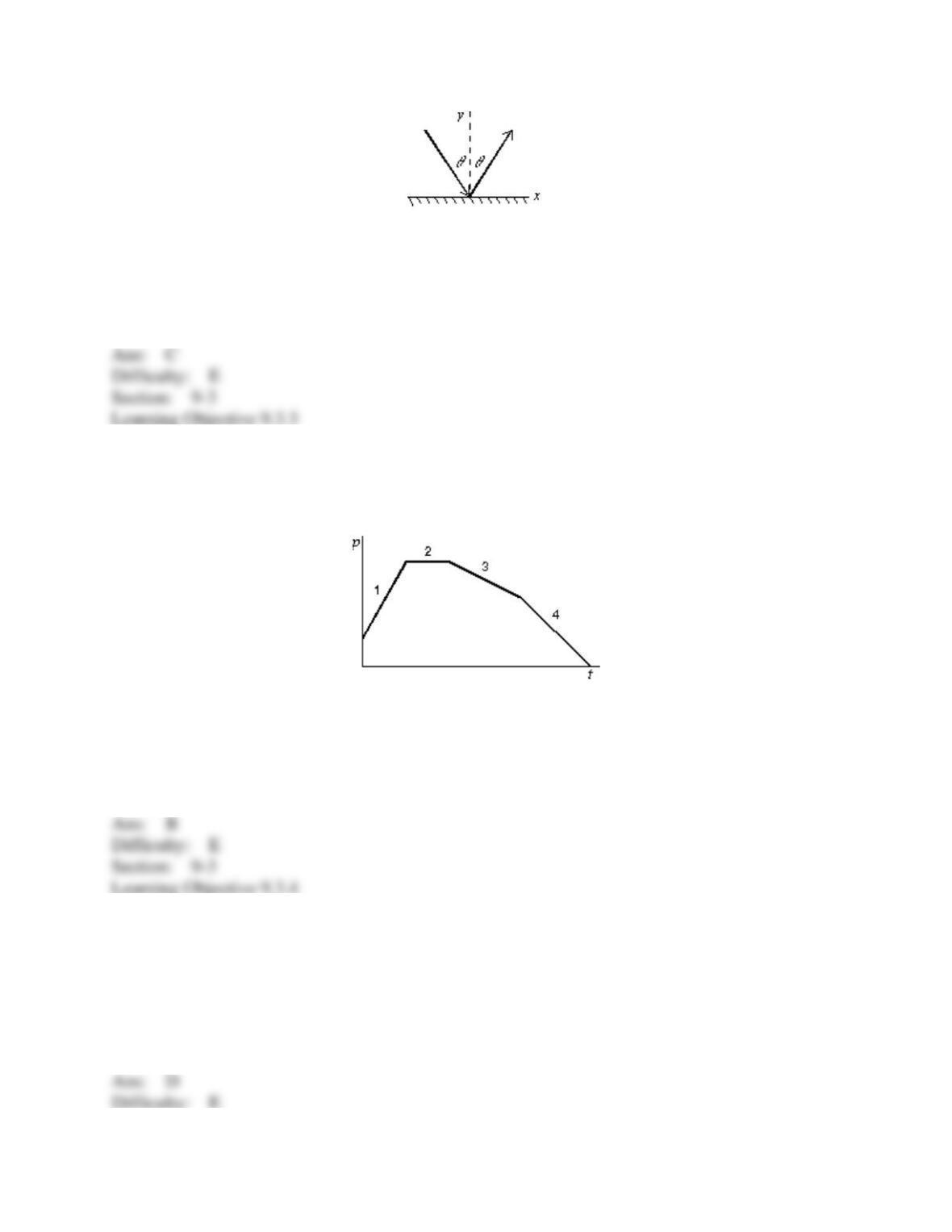
34. A ball hits a wall and rebounds with the same speed, as diagrammed below. The changes in
the components of the momentum of the ball are:
A) px > 0, py > 0
B) px < 0, py > 0
C) px = 0, py > 0
D) px = 0, py < 0
E) px > 0, py < 0
35. A particle moves along the x axis. Its momentum is graphed below as a function of time.
Rank the numbered regions according to the magnitude of the force acting on the particle, least
to greatest.
A) 1, 2, 3, 4
B) 2, 3, 4, 1
C) 1, 4, 3, 2
D) 4, 3, 2, 1
E) 2, 4, 3, 1
36. If the total momentum of a system is changing:
A) particles of the system must be exerting forces on each other
B) the system must be under the influence of gravity
C) the center of mass must have constant velocity
D) a net external force must be acting on the system
E) none of the above
37. When you step on the accelerator to increase the speed of your car, the force that
accelerates the car is:
A) the force of your foot on the accelerator
B) the force of friction of the road on the tires
C) the force of the engine on the drive shaft
D) the normal force of the road on the tires
E) none of the above
38. For a two-body collision, involving objects with different masses, a frame of reference
which has the same velocity relative to the laboratory as does the center of mass of the two
objects is:
A) a frame for which the momentum of the incident object is zero
B) a frame for which the momentum of the target object is zero
C) a frame for which the average momentum of the two objects is zero
D) a frame for which the total momentum of the two objects is zero
E) none of the above
39. Force:
A) equals the negative integral (with respect to distance) of the potential energy function
B) is the ability to do work
C) is the rate of change of doing work
D) equals the time rate of change of momentum
E) has dimensions of momentum multiplied by time
40. Block A, with a mass of 4.0 kg, is moving with a speed of 2.0 m/s while block B, with a
mass of 8.0 kg, is moving in the opposite direction with a speed of 3.0 m/s. The momentum of
the center of mass of the two-block system is:
A) 16 m/s in the same direction as A

B) 16 m/s in the same direction as B
C) 32 m/s in the same direction as A
D) 12 m/s in the same direction as B
E) 60 m/s in the same direction as A
41. The acceleration of the center of mass of a system of particles:
A) depends on all the forces on all the particles
B) depends on all the velocities of all the particles
C) depends only on the forces external to the system of particles
D) depends only on the forces internal to the system of particles
E) depends only on the force of gravity
42. The momentum of a system of particles is changing at the rate of 0.71 t + 1.2 t2, in kg∙m/s.
The net force at t = 2.0 s
A) cannot be determined without knowing the masses of the particles.
B) is 5.5 N
C) is 3.1 N
D) is 1.9 N
E) cannot be determined without knowing the momentum at t = 0
43. The direction of the impulse on a struck baseball
A) depends on how fast the ball was thrown
B) is in the direction of the ball’s change in velocity
C) is in the direction of the force of gravity
D) depends on how hard the ball is struck
E) Impulse is a scalar, and does not have a direction associated with it.
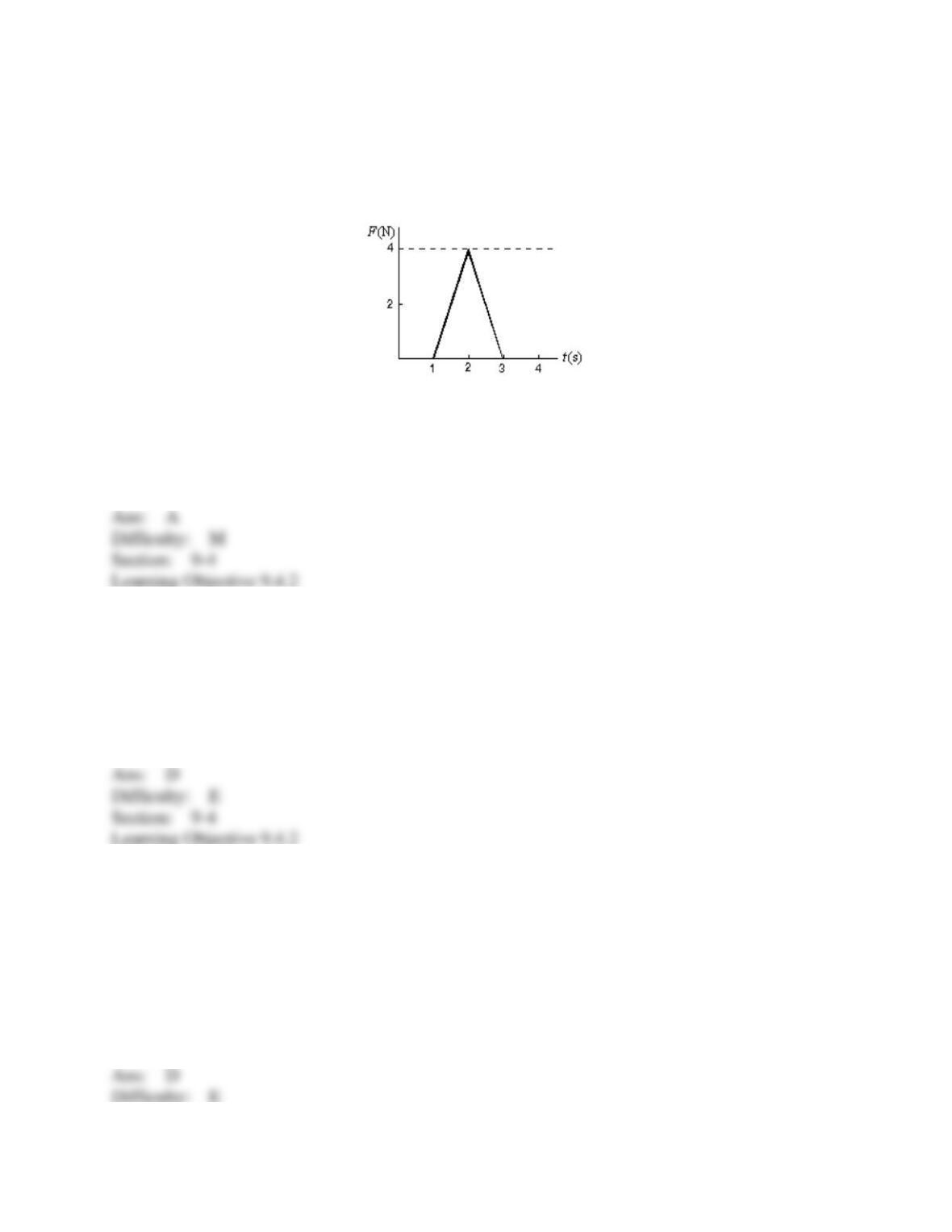
44. A 5-kg object can move along the x axis. It is subjected to a force 𝐹
⃗ in the positive x
direction; a graph of F as a function of time t is shown below. Over the time the force is applied
the change in the velocity of the object is:
A) 0.8 m/s
B) 1.3 m/s
C) 1.6 m/s
D) 2.3 m/s
E) 4.0 m/s
45. The physical quantity “impulse” has the same dimensions as that of:
A) force
B) power
C) energy
D) momentum
E) work
46. A 0.3 kg rubber ball is dropped from the window of a building. It strikes the sidewalk
below at 30 m/s and rebounds up at 20 m/s. The magnitude of the impulse due to the collision
with the sidewalk is:
A) 3.0 N∙s
B) 6.0 N∙s
C) 9.0 N∙s
D) 15 N∙s
E) 29 N∙s