C) 740 m, 2.4 s
D) 260 m, –0.60 s
E) 590 m, –1.4 s
35. Two flashes of light occur simultaneously at t = 0 in reference frame S, one at x = 0 and the
other at x = 600 m. They are observed in reference frame S’, which is moving at 0.95c in the
positive x direction. The origins of the two frames coincide at t = 0 and the clocks of S’ are
zeroed when the origins coincide. In S’ the coordinate where the leading edges of the two light
flashes meet and the time when they meet are:
A) 300 m, 1.0 s
B) 15 m, 0.050 s
C) 585 m, 1.95 s
D) 48 m, 0.16 s
E) 1900 m, 0.16 s
36. Spaceship A, traveling past us at 0.7c, sends a message capsule to spaceship B, which is in
front of A and is traveling in the same direction as A at 0.8c relative to us. The capsule travels
at 0.95c relative to us. A clock that measures the proper time between the sending and
receiving of the capsule travels:
A) in the same direction as the spaceships at 0.7c relative to us
B) in the opposite direction from the spaceships at 0.7c relative to us
C) in the same direction as the spaceships at 0.8c relative to us
D) in the same direction as the spaceships at 0.95c relative to us
E) in the opposite direction from the spaceships at 0.95c relative to us
37. Frame S’ moves in the positive x direction at 0.6c with respect to frame S. A particle moves
in the positive x direction at 0.4c as measured by an observer in S’. The speed of the particle as
measured by an observer in S is:
A) c/5
B) 5c/19
C) 8c/25
D) 25c/31
E) c
38. Star S1 is moving away from us at a speed of 0.8c. Star S2 is moving away from us in the
opposite direction at a speed of 0.5c. The speed of S1 as measured by an observer on S2 is:
A) 0.21c
B) 0.50c
C) 0.93c
D) 1.3c
E) 2.2c
39. Observer A measures the velocity of a rocket as 𝑣⃗ and a comet as 𝑢
⃗
⃗
. Here 𝑢
⃗
⃗
and 𝑣⃗ are
parallel and in the direction of the observer’s positive x axis. The speed of the comet as measured
by an observer on the rocket is:
A) (u – v)/(1 – uv/c2)
B) (u – v)/(1 – v2/c2)
C) (u – v)/(1 – v2/c2)1/2
D) (u – v)/(1 + uv/c2)
E) (u + v)/(1 – uv/c2)
40. Two electrons move in opposite directions at 0.70c as measured in the laboratory. The
speed of one electron as measured from the other is:
A) 0.35c
B) 0.70c
C) 0.94c
D) 1.00c
E) 1.40c
41. Light from some stars shows an apparent change in frequency because of:
A) interference
B) refraction by layers of air
C) diffraction
D) reflection
E) relative motion
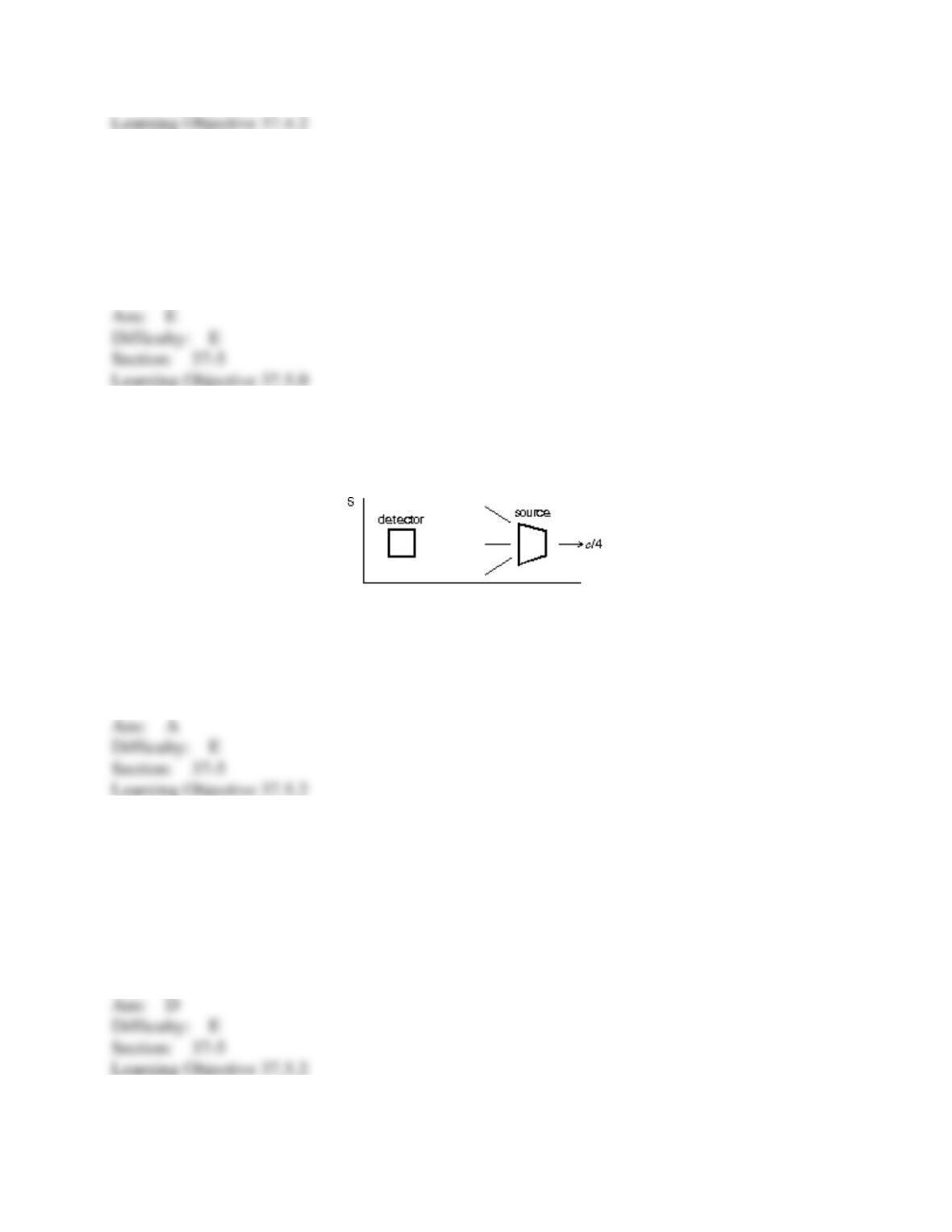
42. While emitting light of proper frequency f0, a source moves to the right with speed c/4
relative to reference frame S. A detector, to the left of the source, measures the frequency to be
f, which is greater than f0. This means:
A) the detector is moving to the right with a speed that is greater than c/4 relative to S
B) the detector is moving to the right with a speed that is less than c/4 relative to S
C) the detector is moving to the left with a speed that is greater than c/4 relative to S
D) the detector is moving to the left with a speed that is less than c/4 relative to S
E) the detector is not moving
43. Light from a stationary spaceship is observed, then the spaceship moves directly away from
the observer at high speed. As a result, the light seen by the observer has:
A) a higher frequency and a longer wavelength than before
B) a lower frequency and a shorter wavelength than before
C) a higher frequency and a shorter wavelength than before
D) a lower frequency and a longer wavelength than before
E) the same frequency and wavelength as before
44. A train traveling very fast (v = 0.6c) has an engineer (E) at the front, a guard (G) at the rear
and a passenger (S’) exactly half way between them. Both E and G are equipped with yellow
signaling lamps. The train passes a station, closely observed by the station master (S). Both E
and G use their lamps to send signals. According to both S and S’ these signals arrive
simultaneously at the instant S’ is passing S. According to S, the signal from E will look ______
and that from G will look _____:
A) red, blue
B) yellow, yellow
C) blue, red
D) blue, blue
E) red, red
45. A console lamp in the cabin of a spaceship appears green when the ship and observer are
both at rest. When the ship is moving at 0.90c away from Earth, passengers on board see:
A) a dark lamp (the frequency is too high to be seen)
B) a dark lamp (the frequency is too low to be seen)
C) a red lamp
D) a violet lamp
E) a green lamp
46. Visible light, with a frequency of 6.0 1014 Hz, is reflected from a spaceship moving
directly away at a speed of 0.90c. The frequency of the reflected waves observed at the source is:
A) 3.2 1013 Hz
B) 1.4 1014 Hz
C) 6.0 1014 Hz
D) 2.6 1015 Hz
E) 1.1 1016 Hz
47. How fast should you move away from a 6.0 1014 Hz light source to observe waves with a
frequency of 4.0 1014 Hz?
A) 0.20c
B) 0.39c
C) 0.45c
D) 0.51c
E) 0.76c
48. A spectral line of a certain star is observed to be “red shifted” from a wavelength of 500 nm
to a wavelength of 1500 nm. Interpreting this as a Doppler effect, the speed of recession of this
star is:
A) 0.33c
B) 0.50c
C) 0.71c
D) 0.80c
E) c
49. A source at rest emits light of wavelength 500 nm. When it is moving at 0.90c toward an
observer, the observer detects light of wavelength:
A) 26 nm
B) 115 nm
C) 500 nm
D) 2200 nm
E) 9500 nm
50. A source at rest emits light of wavelength 500 nm. When it is moving at 0.90c away from
an observer, the observer detects light of wavelength:
A) 26 nm
B) 115 nm
C) 500 nm
D) 2200 nm
E) 9500 nm
51. A distant star has a transverse speed (perpendicular to our line of sight) of 30,000 km/s with
respect to Earth. Its spectrum has an absorption line at a frequency of 5.00 x 10¹⁴ Hz. What is the
frequency of that line as observed on Earth?
A) 4.50 x 10¹⁴ Hz
B) 4.90 x 10¹⁴ Hz
C) 4.97 x 10¹⁴ Hz
D) 5.00 x 10¹⁴ Hz
E) 5.04 x 10¹⁴ Hz
52. If the mass of a particle is zero its speed must be:
A) c
B) infinite
C) 0
D) any speed less than c
E) any speed greater than c
53. According to the theory of relativity:
A) mass is a form of energy
B) moving particles lose mass
C) momentum is not conserved in high speed collisions
D) a rod moving rapidly sideways (perpendicular to its length) is shorter along its length
E) a rod moving rapidly sideways (perpendicular to its length) is longer along its length
54. If the kinetic energy of a free particle is much less than its rest energy then its kinetic
energy is proportional to:
A) the magnitude of its momentum
B) the square of the magnitude of its momentum
C) the square root of the magnitude of its momentum
D) the reciprocal of the magnitude of its momentum
E) none of the above
55. An electron (m = 9.11 10–31 kg) has a speed of 0.95c. The magnitude of its momentum is:
A) 2.6 10–22 kg m/s
B) 2.9 10–22 kg m/s
C) 6.0 10–22 kg m/s
D) 8.3 10–22 kg m/s
E) 8.8 10–22 kg m/s
56. According to relativity theory a particle of mass m with a momentum of 2mc has a speed
of:
A) 4c
B) 2c
C) c
D) 0.89c
E) c/2
57. A particle with zero mass and energy E carries momentum:
A) Ec
B) Ec2
C) √𝐸𝑐
D) E/c
E) E/c2
58. If the kinetic energy of a free particle is much greater than its rest energy then its kinetic
energy is proportional to:
A) the magnitude of its momentum
B) the square of the magnitude of its momentum
C) the square root of the magnitude of its momentum
D) the reciprocal of the magnitude of its momentum
E) none of the above
59. A particle with rest mass m moves with speed 0.6c. Its kinetic energy is:
A) 0.18mc2
B) 0.22mc2
C) 0.25mc2
D) mc2
E) 1.25mc2
60. An electron is moving at 0.6c. If we calculate its kinetic energy using (1/2)mv2, we get a
result which is:
A) just right
B) just half enough
C) twice the correct value
D) about 1% too low
E) about 28% too low
61. The velocity of an electron is changed from c/2 in the –x direction to c/2 in the +x direction.
As a result, its kinetic energy changes by:
A) 2mc2
B) √2mc2
C) mc2
D) 0.5mc2
E) 0
62. An electron (m = 9.11 10–31 kg) has a speed of 0.95c. Its kinetic energy is:
A) 8.2 10–14 J
B) 1.8 10–13 J
C) 2.0 10–13 J
D) 2.2 10–13 J
E) 2.6 10–13 J
63. The mass of a particle is m. In order for its total energy to be twice its rest energy, its
momentum must be:
A) mc/2
B) mc/√2
C) mc
D) √3mc
E) 2mc
64. If the kinetic energy of a particle is equal to its rest energy then its speed must be:
A) 0.25c
B) 0.50c
C) 0.87c
D) c
E) unknown unless its mass is given
65. The magnitude of the momentum of a particle can never exceed:
A) mc, where m is its mass
B) E/c, where E is its energy
C) K/c, where K is its kinetic energy
D) none of the above, but there is an upper limit
E) none of the above; there is no upper limit
66. An electron (m = 9.11 10–31 kg) has a momentum of 1.3 10–21 kg m/s. Its kinetic
energy is:
A) 6.3 10–14 J
B) 8.2 10–14 J
C) 1.5 10–13 J
D) 3.2 10–13 J
E) 4.0 10–13 J
67. A certain particle has a kinetic energy of 3.2 10–10 J and a momentum of 1.7 10–18 kg
m/s. Its mass is:
A) 9.1 10–31 kg
B) 2.7 10–27 kg
C) 4.5 10–27 kg
D) 6.3 10–27 kg
E) 8.6 10–27 kg
68. The work that must be done to increase the speed of an electron (m = 9.11 10–31 kg) from
0.90c to 0.95c is:
A) 8.2 10–13 J
B) 3.2 10–13 J
C) 2.6 10–13 J
D) 7.4 10–14 J
E) 3.8 10–15 J
69. Two isotopes of hydrogen fuse to form a helium nucleus and a neutron:
2H + 3H → 4He + n
The masses are:
2H:
2.013553 u
3H:
3.015501 u
4He:
4.001506 u
n:
1.008665 u
What is the Q value of this reaction?
A) 1.9 MeV
B) 2.5 MeV
C) 2.8 MeV
D) 17.6 MeV
E) 938 MeV