Learning Objective 40.4.2
38. Electrons are in a two-dimensional square potential energy well with sides of length L.
The potential energy is infinite at the sides and zero inside. The single-particle energies are
given by (ℎ2/8𝑚𝐿2)(𝑛𝑥
2+ 𝑛𝑦
2) where nx and ny are integers. The number of single-particle
states with energy 5(h2/8mL2) is:
A) 1
B) 2
C) 3
D) 4
E) 5
39. Six electrons are in a two-dimensional square potential energy well with sides of length L.
The potential energy is infinite at the sides and zero inside. The single-particle energies are
given by (ℎ2/8𝑚𝐿2)(𝑛𝑥
2+ 𝑛𝑦
2) where nx and ny are integers. If a seventh electron is added to
the system when it is in its ground state the least energy the additional electron can have is:
A) 2 (h2/8mL2)
B) 5 (h2/8mL2)
C) 8 (h2/8mL2)
D) 10 (h2/8mL2)
E) 13 (h2/8mL2)
40. When a lithium atom is made from a helium atom by adding a proton (and neutron) to the
nucleus and an electron outside, the electron goes into an n = 2, ℓ=0 state rather than an n = 1,
ℓ=0 state. This is an indication that electrons:
A) obey the Pauli exclusion principle
B) obey the minimum energy principle
C) undergo the Zeeman effect
D) are diffracted
E) and protons are interchangeable
41. The most energetic electron in any atom at the beginning of a period of the periodic table is
in:
A) an ℓ=0 state
B) an ℓ=1 state
C) an ℓ=2 state
D) an n = 0 state with unspecified angular momentum
E) an n = 1 state with unspecified angular momentum
42. The most energetic electron in any atom at the end of a period of the periodic table is in:
A) an ℓ=0 state
B) an ℓ=1 state
C) an ℓ=2 state
D) an n = 0 state with unspecified angular momentum
E) an n = 1 state with unspecified angular momentum
43. The group of atoms at the ends of periods of the periodic table is called:
A) alkali metal atoms
B) rare earth atoms
C) transition metal atoms
D) alkaline atoms
E) noble gas atoms
44. The group of atoms at the beginning of periods of the periodic table is called:
A) alkali metal atoms
B) rare earth atoms
C) transition metal atoms
D) alkaline atoms
E) noble gas atoms
45. The ionization energy of an atom in its ground state is:
A) the energy required to remove the least energetic electron
B) the energy required to remove the most energetic electron
C) the energy difference between the most energetic electron and the least energetic electron
D) the same as the energy of a K photon
E) the same as the excitation energy of the most energetic electron
46. Which of the following subshells cannot exist?
A) 3p
B) 2p
C) 4d
D) 3d
E) 2d
47. If electrons did not have intrinsic angular momentum (spin) but still obeyed the Pauli
exclusion principle the states occupied by electrons in the ground state of helium would be:
A) (n = 1, ℓ=0); (n = 1, ℓ=0)
B) (n = 1, ℓ=0); (n = 1, ℓ=1)
C) (n = 1, ℓ=0); (n = 2, ℓ=0)
D) (n = 2, ℓ=0); (n = 2, ℓ=1)
E) (n = 2, ℓ=1); (n = 2, ℓ=1)
48. Which of the following (n, ℓ, mℓ, ms) combinations is impossible for an electron in an
atom?
A) 3, 1, 1, –1/2
B) 6, 2, 0, 1/2
C) 3, 2, –2, –1/2
D) 3, 1, –2, 1/2
E) 1, 0, 0, –1/2
49. For any atom other that hydrogen and helium all electrons in the same shell have:
A) the same energy
B) the same magnitude of angular momentum
C) the same magnetic quantum number
D) the same spin quantum number
E) none of the above
50. The states being filled from the beginning to end of the lanthanide series of atoms are:
A) n = 3, ℓ=2 states
B) n = 4, ℓ=1 states
C) n = 4, ℓ=2 states
D) n = 4, ℓ=3 states
E) n = 5, ℓ=2 states
51. An electron in a K shell of an atom has the principal quantum number:
A) n = 0
B) n = 1
C) n = 2
D) n = 3
E) n =
52. An electron in an L shell of an atom has the principal quantum number:
A) n = 0
B) n = 1
C) n = 2
D) n = 3
E) n =
53. In connection with x-ray emission the symbol K refers to:
A) an alpha particle radiation
B) an effect of the dielectric constant on energy levels
C) x-ray radiation from potassium
D) x-ray radiation associated with an electron going from n = to n = 1
E) x-ray radiation associated with an electron going from n = 2 to n = 1
54. In connection with x-ray emission the symbol L
refers to:
A) a beta particle radiation
B) an atomic state of angular momentum h/2
C) the inductance associated with an orbiting electron
D) x-radiation associated with an electron going from n = 4 to n = 2
E) none of the above
55. Characteristic K x-radiation of an element is caused by:
A) stoppage of electrons by the nucleus
B) scattering of the incident radiation with a change of wavelength
C) ejection of an electron from an outer shell
D) transition of an electron to the innermost orbit
E) none of the above
56. The most energetic photon in a continuous x-ray spectrum has an energy approximately
equal to:
A) the energy of all the electrons in a target atom
B) the kinetic energy of an incident-beam electron
C) the rest energy, mc2, of an electron
D) the total energy of a K-electron in the target atom
E) the kinetic energy of a K-electron in the target atom
57. Two different electron beams are incident on two different targets and both produce x rays.
The cutoff wavelength for target 1 is shorter than the cutoff wavelength for target 2. We can
conclude that:
A) target 2 has a higher atomic number than target 1
B) target 2 has a lower atomic number than target 1
C) the electrons in beam 1 have greater kinetic energy than those in beam 2
D) the electrons in beam 1 have less kinetic energy than those in beam 2
E) target 1 is thicker than target 2
58. Radiation with the minimum wavelength as well as the K x-ray lines are detected for a
certain target. The energy of the incident electrons is then doubled, with the result that:
A) the minimum wavelength increases and the wavelengths of the K lines remain the same
B) the minimum wavelength decreases and the wavelengths of the K lines remain the same
C) the minimum wavelength and the wavelengths of the K lines all increase
D) the minimum wavelength and the wavelengths of the K lines all decrease
E) the minimum wavelength increases and the wavelengths of the K lines all decrease
59. The transition shown gives rise to an x-ray. The correct label for this is:
A) K
B) K
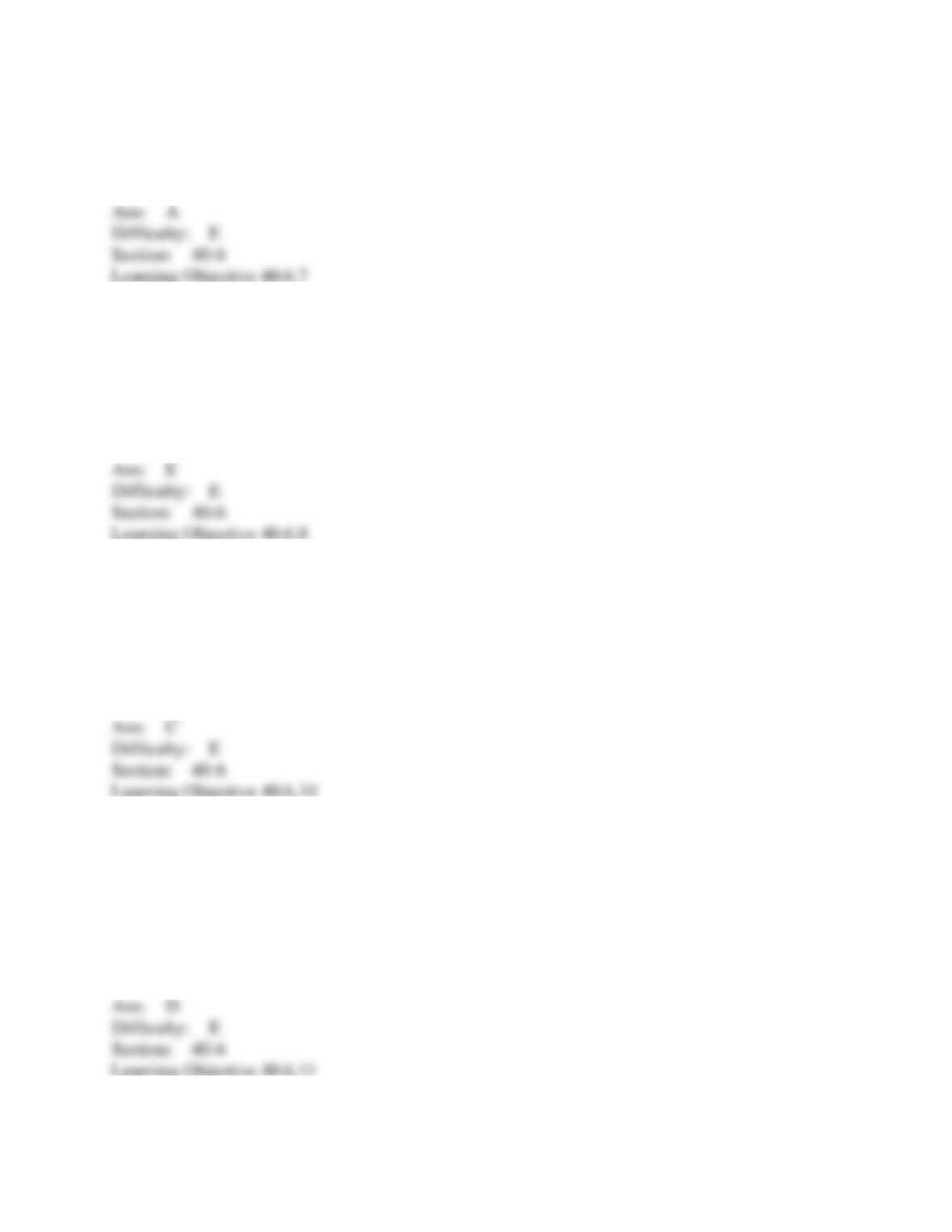
C) L
D) L
E) KL
60. A photon with the smallest wavelength in the continuous z-ray spectrum is emitted when:
A) an electron is knocked from a K shell
B) a valence electron is knocked from the atom
C) the incident electron becomes bound to the atom
D) the atom has the greatest recoil energy
E) the incident electron loses all its energy in a single decelerating event
61. In a Moseley graph:
A) the x-ray frequency is plotted as a function of atomic number
B) the square of the x-ray frequency is plotted as a function of atomic number
C) the square root of the x-ray frequency is plotted as a function of atomic number
D) the x-ray frequency is plotted as a function of the square root of atomic number
E) the square root of the x-ray frequency is plotted as a function of atomic mass
62. In calculating the x-ray energy levels the effective charge of the nucleus is taken to be
Z – b, where Z is the atomic number. The parameter b enters because:
A) an electron is removed from the inner shell
B) a proton is removed from the nucleus
C) the quantum mechanical force between two charges is less than the classical force
D) the nucleus is screened by electrons
E) the Pauli exclusion principle must be obeyed
63. The K x rays arising from a cobalt (Z = 27) target have a wavelength of about 179 pm.
The atomic number of a target that gives rise to K x rays with a wavelength one-third as great
(60pm) is:
A) Z = 9
B) Z = 26
C) Z = 28
D) Z = 46
E) Z = 81
64. The ratio of wavelength of K x-ray line for Nb (Z = 41) to that of Ga (Z = 31) is:
A) 9/16
B) 16/9
C) 3/4
D) 4/3
E) 1.15
65. In a laser:
A) excited atoms are stimulated to emit photons by radiation external to the laser
B) the transitions for laser emission are directly to the ground state
C) the states which give rise to laser emission are usually very unstable states that decay
rapidly
D) the state in which an atom is initially excited is never between two states that are involved
in the stimulated emission
E) a minimum of two energy levels are required.
66. A laser beam can be sharply focused because it is:
A) highly coherent
B) plane polarized
C) intense
D) circularly polarized
E) highly directional
67. The “e” in laser stands for:
A) electric
B) emf
C) energy
D) emission
E) entropy
68. Photons in a laser beam have the same energy, wavelength, polarization direction, and
phase because:
A) each is produced in an emission that is stimulated by another
B) all come from the same atom
C) the lasing material has only two quantum states
D) all photons are alike, no matter what their source
E) none of the above
69. A group of electromagnetic waves might
I.
be monochromatic
II.
be coherent
III.
have the same polarization direction
Which of these describe the waves from a laser?
A) I only
B) II only
C) III only
D) I and II only
E) I, II, and III
70. Suppose the energy required to ionize a neon atom is i, the energy to excite it is e, and its
energy due to thermal agitation at room temperature is t. In increasing order, these three energies
are:
A) i, e, t
B) t, i, e
C) e, t, i
D) i, t, e
E) t, e, i
71. A laser must be pumped to achieve:
A) a metastable state
B) fast response
C) stimulated emission
D) population inversion
E) the same wavelength for all photons
72. Which of the following is essential for laser action to occur between two energy levels of
an atom?
A) the lower level is metastable
B) the upper level is metastable
C) the lower level is the ground state
D) the are more atoms in the lower level than in the upper level
E) the lasing material is a gas
73. Which of the following is essential for the laser action to occur between two energy levels
of an atom?
A) the lower level is metastable
B) there are more atoms in the upper level than in the lower level
C) there are more atoms in the lower level than in the upper level
D) the lower level is the ground state
E) the lasing material is a gas
74. Population inversion is important for the generation of a laser beam because it assures that:
A) spontaneous emission does not occur more often than stimulated emission
B) photons do not split too rapidly
C) more photons are emitted than are absorbed
D) photons do not collide with each other
E) photons do not make upward transitions
75. A metastable state is important for the generation of a laser beam because it assures that:
A) spontaneous emission does not occur more often than stimulated emission
B) photons do not split too rapidly
C) more photons are emitted than are absorbed
D) photons do not collide with each other
E) photons do not make upward transitions
76. Photons in a laser beam are produced by:
A) transitions from a metastable state
B) transitions from a state that decays rapidly
C) splitting of other photons
D) pumping
E) reflection from mirrors
77. In a helium-neon laser, the laser light arises from a transition from a _________ state to a
_________ state:
A) He, He
B) Ne, Ne
C) He, Ne
D) Ne, He
E) N, He
78. The purpose of the mirrors at the ends of a helium-neon laser is:
A) to assure that no laser light leaks out
B) to increase the number of stimulated emissions
C) to absorb some of the photons
D) to keep the light used for pumping inside the laser
E) to double the effective length of the laser
79. Electrons in a certain laser make transitions from a metastable state to the ground state.
Initially there are 6 1020 atoms in the metastable state and 2 1020 atoms in the ground state.
The number of photons that can be produced in a single burst is about:
A) 2 1020
B) 3 1020
C) 4 1020
D) 6 1020
E) 8 1020