Chapter: Chapter 21
Learning Objectives
LO 21.1.0 Solve problems related to Coulomb’s law.
LO 21.1.1 Distinguish between being electrically neutral, negatively charged, and positively
charged, and identify excess charge.
LO 21.1.2 Distinguish between conductors, nonconductors (insulators), semiconductors, and
superconductors.
LO 21.1.3 Describe the electrical properties of the particles inside an atom.
LO 21.1.4 Identify conduction electrons and explain their role in making a conducting object
negatively or positively charged.
LO 21.1.5 Identify what is meant by “electrically isolated” and by “grounding.”
LO 21.1.6 Explain how a charged object can set up induced charge in a second object.
LO 21.1.7 Identify that charges with the same electrical sign repel each other and those with
opposite electrical signs attract each other.
LO 21.1.8 For either of the particles in a pair of charged particles, draw a free body diagram,
showing the electrostatic force (Coulomb force) on it, anchoring the tail of the force vector on
that particle.
LO 21.1.9 For either of the particles in a pair of charged particles, apply Coulomb’s law to relate
the magnitude of the electrostatic force, the charge magnitudes of the particles, and the
separation between the particles.
LO 21.1.10 Identify that Coulomb’s law applies only to (point-like) particles and objects that can
be treated as particles.
LO 21.1.11 If more than one force acts on a particle, find the net force by adding all the forces as
vectors, not scalars.
LO 21.1.12 Identify that a shell of uniform charge attracts or repels a charged particle that is
outside the shell as if all the shell’s charge were concentrated as a particle at the shell’s center.
LO 21.1.13 Identify that if a charged particle is located inside a shell of uniform charge, there is
no net electrostatic force on the particle from the shell.
LO 21.1.14 Identify that if excess charge is put on a spherical conductor, it spreads out uniformly
over the external surface area.
LO 21.1.15 Identify that if two identical spherical conductors touch or are connected by
conducting wire, any excess charge will be shared equally.
LO 21.1.16 Identify that a nonconducting object can have any given distribution of charge,
including charge at interior points.
LO 21.1.17 Identify current as the rate at which charge moves through a point.
LO 21.1.18 For current through a point, apply the relationship between the current, a time
interval, and the amount of charge that moves through the point in that time interval.
LO 21.2.0 Solve problems related to how charge is quantized.
LO 21.2.1 Identify the elementary charge.
LO 21.2.2 Identify that the charge of a particle or object must be a positive or negative integer
times the elementary charge.
LO 21.3.0 Solve problems related to how charge is conserved.
LO 21.3.1 Identify that in any physical process, the net electric charge cannot change (the net
charge is always conserved).
LO 21.3.2 Identify an annihilation process and a pair production.
LO 21.3.3 Identify mass number and atomic number.
Multiple Choice
1. A neutral metal ball is suspended by a string. A positively charged insulating rod is placed
near the ball, which is observed to be attracted to the rod. This is because:
A) the ball becomes positively charged by induction
B) the ball becomes negatively charged by induction
C) the number of electrons in the ball is more than the number in the rod
D) the string is not a perfect insulator
E) there is a rearrangement of the electrons in the ball
2. The units of 1/40 are:
A) N2/C2
B) Nm/C
C) N2m2/C2
D) Nm2/C2
E) m2/C2
3. The charge on a glass rod which has been rubbed with silk is called positive:
A) by arbitrary convention
B) so that the proton charge will be positive
C) to conform to the conventions adopted for G and m in Newton’s law of gravitation
D) because like charges repel
E) because glass is an insulator
4. A charged insulator can be discharged by passing it just above a flame. This is because the
flame:
A) warms it
B) dries it
C) contains carbon dioxide
D) contains ions
E) contains more rapidly moving atoms
5. An electrical insulator is a material:
A) containing no electrons
B) through which electrons do not flow easily
C) which has more electrons than protons on its surface
D) cannot be a pure chemical element
E) must be a crystal
6. A conductor is distinguished from an insulator with the same number of atoms by the
number of:
A) nearly free atoms
B) electrons
C) nearly free electrons
D) protons
E) molecules
7. When a hard rubber rod is given a negative charge by rubbing it with wool:
A) positive charges are transferred from rod to wool
B) negative charges are transferred from rod to wool
C) positive charges are transferred from wool to rod
D) negative charges are transferred from wool to rod
E) negative charges are created and stored on the rod
8. To make an uncharged object have a negative charge we must:
A) add some atoms
B) remove some atoms
C) add some electrons
D) remove some electrons
E) write down a negative sign
9. To make an uncharged object have a positive charge:
A) remove some neutrons
B) add some neutrons
C) add some electrons
D) remove some electrons
E) heat it to cause a change of phase
10. The diagram shows a pair of highly charged plastic cubes that attract each other.
Cube 3 is a conductor and is uncharged. Which of the following illustrates the forces between
cubes1 and 3 and between cubes 2 and 3?
A) I
B) II
C) III
D) IV
E) V
11. The leaves of a positively charged electroscope diverge more when an object is brought
near the knob of the electroscope. The object must be:
A) a conductor
B) an insulator
C) positively charged
D) negatively charged
E) uncharged
12. A negatively charged rubber rod is brought near the knob of a positively charged
electroscope. The result is that:
A) electroscope leaves will move farther apart
B) the rod will lose its charge
C) electroscope leaves will tend to collapse
D) electroscope will become discharged
E) nothing noticeable will happen
13. An electroscope is charged by induction using a glass rod that has been made positive by
rubbing it with silk. The electroscope leaves:
A) gain electrons
B) gain protons
C) lose electrons
D) lose protons
E) gain an equal number of protons and electrons
14. Consider the following procedural steps:
(1) ground the electroscope
(2) remove the ground from the electroscope
(3) touch a charged rod to the electroscope
(4) bring a charged rod near, but not touching, the electroscope
(5) remove the charged rod
To charge an electroscope by induction, use the sequence:
A) 1, 4, 5, 2
B) 4, 1, 2, 5
C) 3, 1, 2, 5
D) 4, 1, 5, 2
E) 3, 5
15. A positively charged insulating rod is brought close to an object that is suspended by a
string. If the object is attracted toward the rod we can conclude:
A) the object is positively charged
B) the object is negatively charged
C) the object is an insulator
D) the object is a conductor
E) none of the above
16. A positively charged insulating rod is brought close to an object that is suspended by a
string. If the object is repelled away from the rod we can conclude:
A) the object is positively charged
B) the object is negatively charged
C) the object is an insulator
D) the object is a conductor
E) none of the above
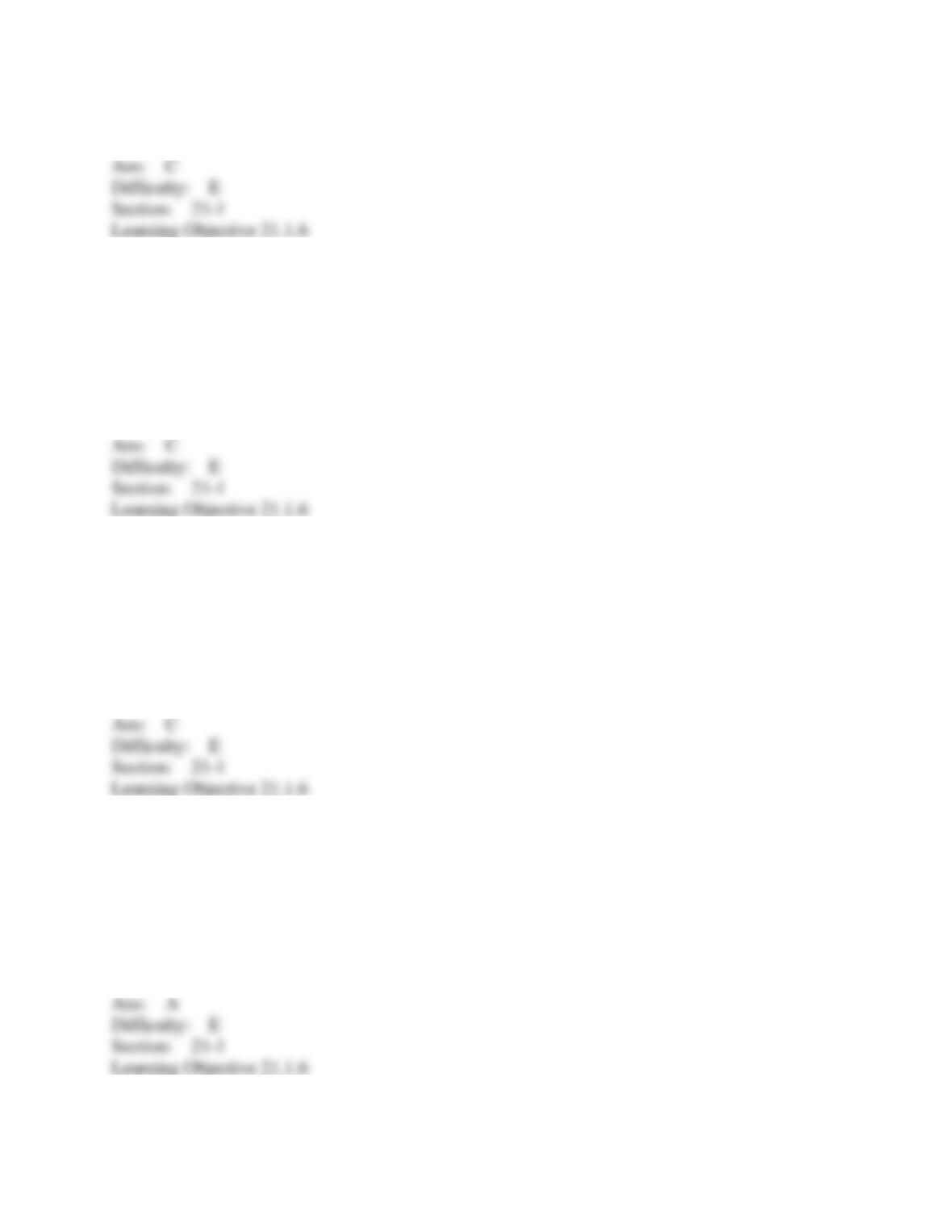
17. The diagram shows two pairs of highly charged plastic cubes. Cubes 1 and 2 attract each
and cubes 1 and 3 repel each other.
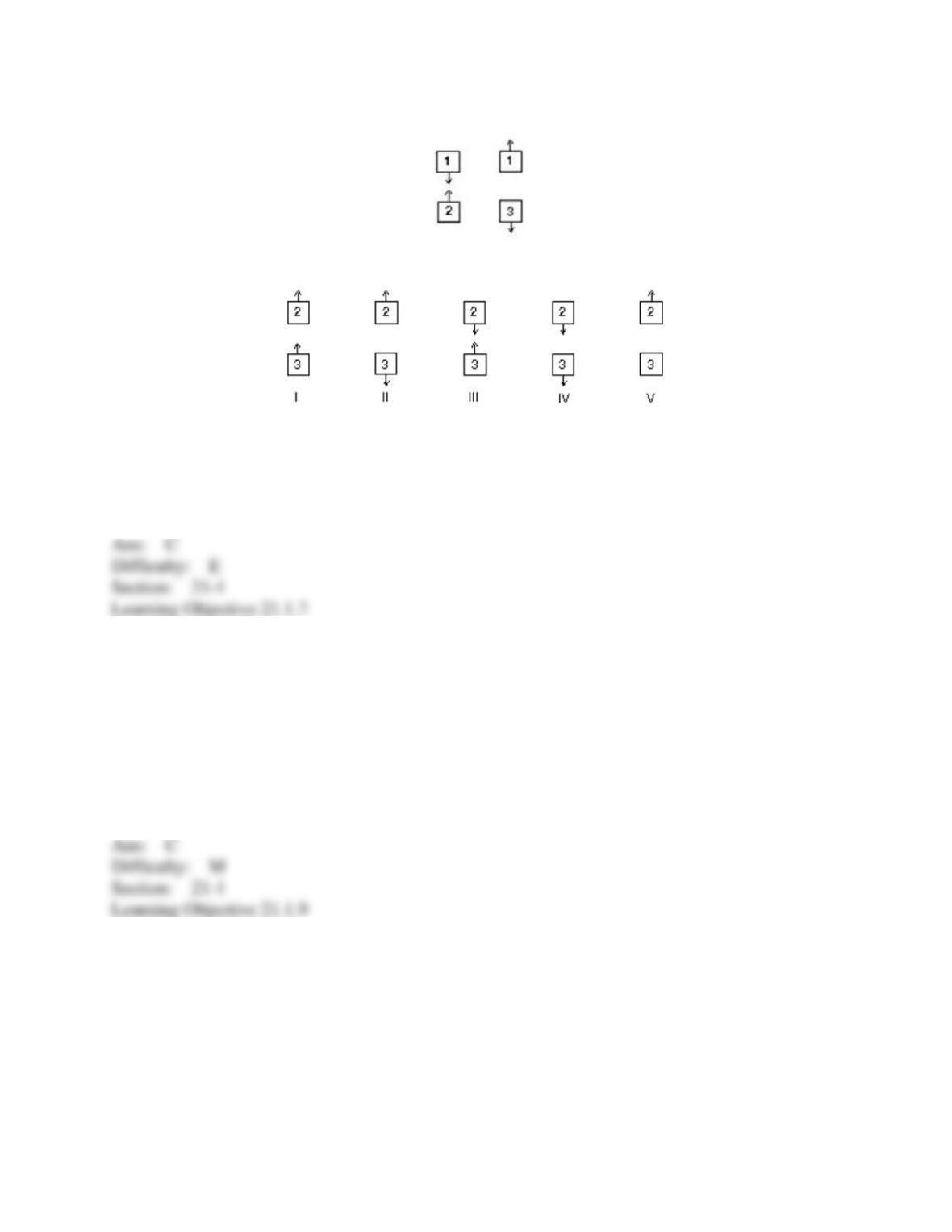
Which of the following illustrates the forces of cube 2 on 3 and cube 3 on 2?
A) I
B) II
C) III
D) IV
E) V
18. A small object has charge Q. Charge q is removed from it and placed on a second small
object. The two objects are placed 1 m apart. For the force that each object exerts on the other to
be a maximum, q should be:
A) 2Q
B) Q
C) Q/2
D) Q/4
E) 0
19. Two small charged objects repel each other with a force F when separated by a distance d.
If the charge on each object is reduced to one-fourth of its original value and the distance
between them is reduced to d/2 the force becomes:
A) F/16
B) F/8
C) F/4
D) F/2
E) F
20. Two particles, X and Y, are 4 m apart. X has a charge of 2Q and Y has a charge of Q. The
force of X on Y:
A) has twice the magnitude of the force of Y on X
B) has half the magnitude of the force of Y on X
C) has four times the magnitude of the force of Y on X
D) has one-fourth the magnitude of the force of Y on X
E) has the same magnitude as the force of Y on X
21. A 5.0-C charge is 10 m from a –2.0-C charge. The electrostatic force is on the positive
charge is:
A) 9.0 108 N toward the negative charge
B) 9.0 108 N away from the negative charge
C) 9.0 109 N toward the negative charge
D) 9.0 109 N away from the negative charge
E) none of these
22. Two identical charges, 2.0 m apart, exert forces of magnitude 4.0 N on each other. The
value of either charge is:
A) 1.8 10–9 C
B) 2.1 10–5 C
C) 4.2 10–5 C
D) 1.9 105 C
E) 3.8 105 C
23. A particle with charge Q is on the y axis a distance a from the origin and a particle with
charge q is on the x axis a distance d from the origin. The value of d for which the x component
of the force on the second particle is the greatest is:
A) 0
B) a
C) √2𝑎
D) a/2
E) 𝑎/√2
24. In the Rutherford model of the hydrogen atom, a proton (mass M, charge Q) is the nucleus
and an electron (mass m, charge q) moves around the proton in a circle of radius r. Let k denote
the Coulomb force constant (1/40) and G the universal gravitational constant. The ratio of the
electrostatic force to the gravitational force between electron and proton is:
A) kQq/GMmr2
B) GQq/kMm
C) kMm/GQq
D) GMm/kQq
E) kQq/GMm
25. A particle with a charge of 5 10–6 C and a mass of 20 g moves uniformly with a speed of
7 m/s in a circular orbit around a stationary particle with a charge of –5 10–6 C. The radius of
the orbit is:
A) 0 m
B) 0.23 m
C) 0.62 m
D) 1.6 m
E) 4.4 m
26. To what types of electrically charged objects does Coulomb’s law apply?
A) only pointlike particles
B) any symmetric objects
C) it applies to all such objects
D) only pointlike particles and objects that can be treated as particles
E) it applies to all such objects as long as they are not moving
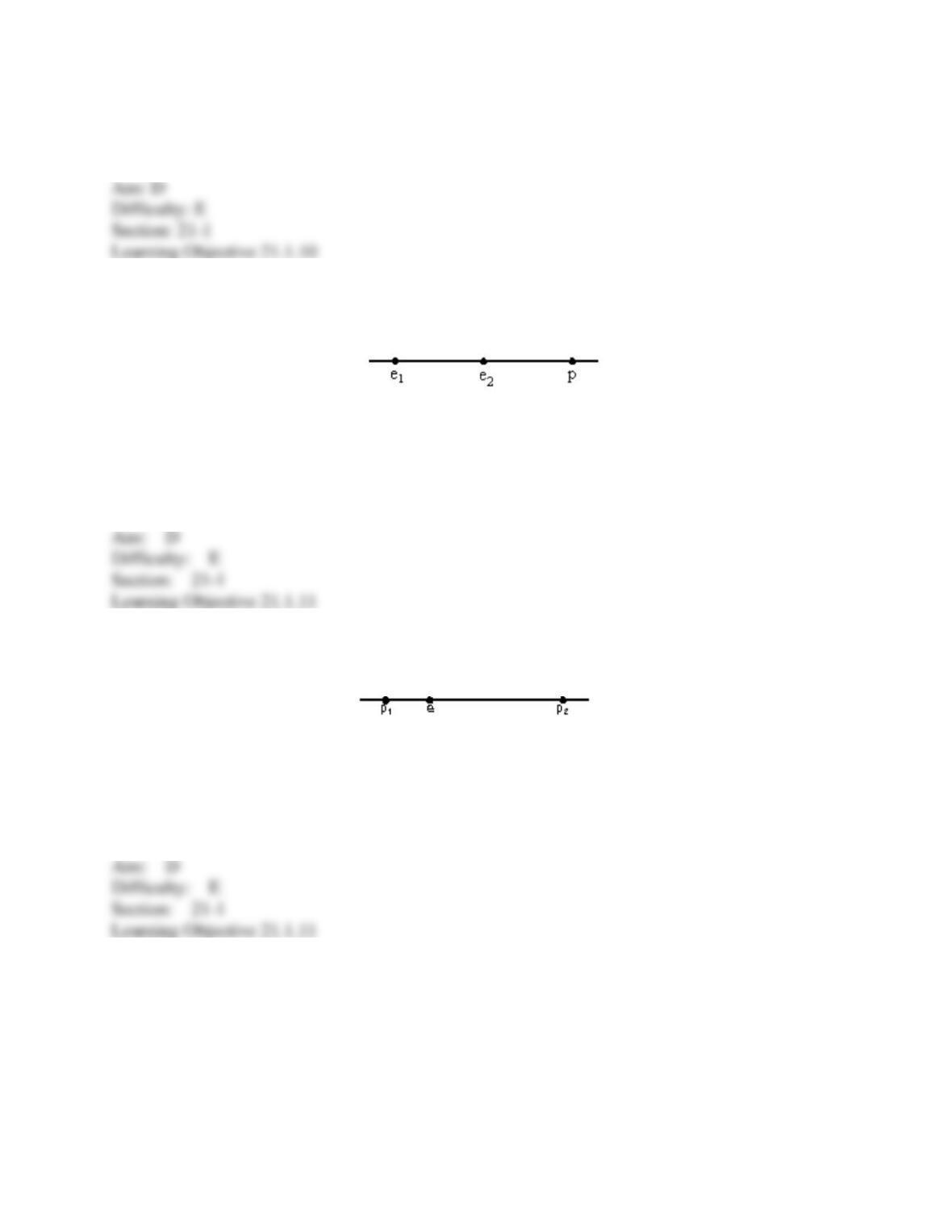
27. Two electrons (e1 and e2) and a proton (p) lie on a straight line, as shown. The directions of
the force of e2 on e1, the force of p on e1, and the total force on e1, respectively, are:
A) →, , →
B) , →, →
C) →, ,
D) , →,
E) , ,
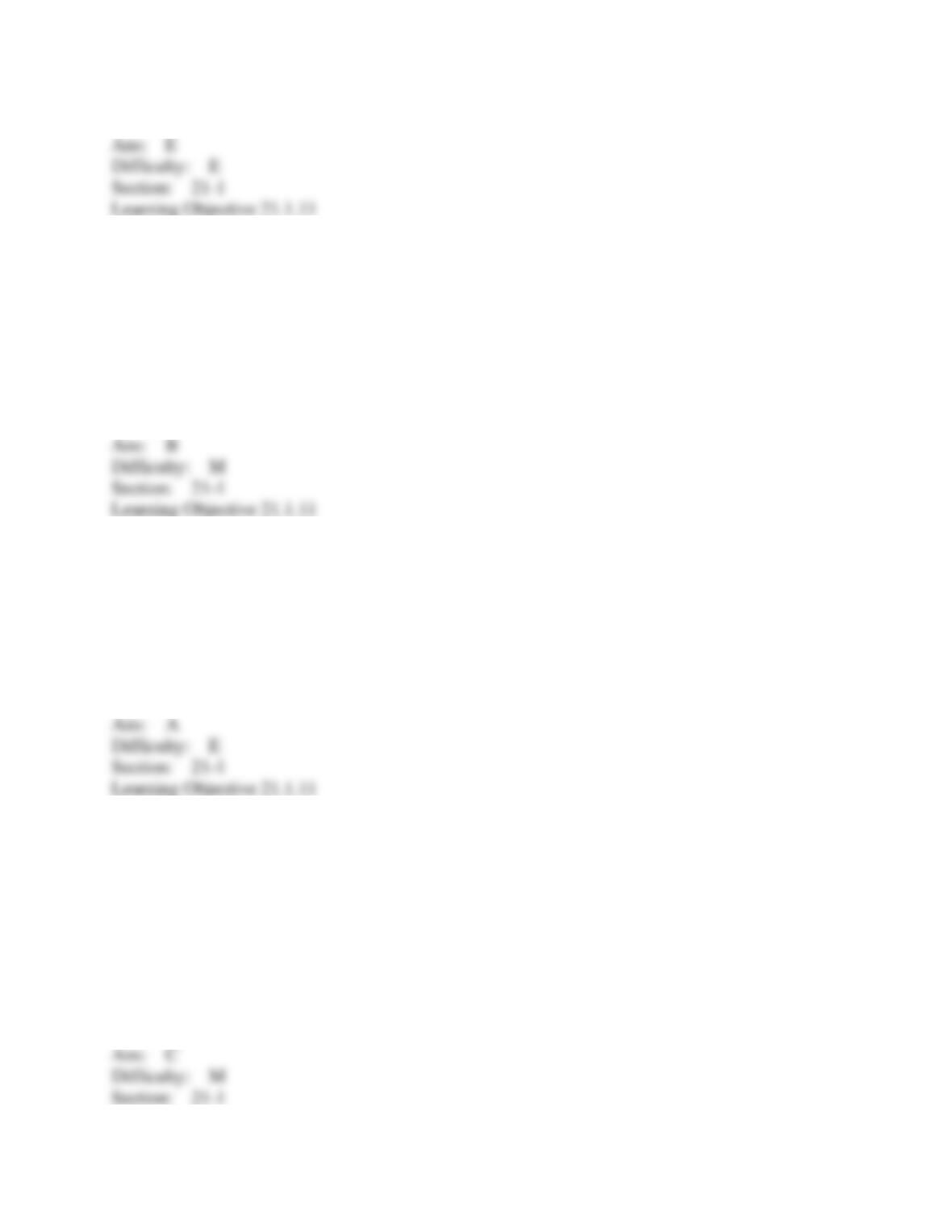
28. Two protons (p1 and p2) and an electron (e) lie on a straight line, as shown. The directions
of the force of p1 on e, the force of p2 on e, and the total force on e, respectively, are:
A) →, , →
B) , →, →
C) →, ,
D) , →,
E) , ,
29. Two particles have charges Q and –Q (equal magnitude and opposite sign). For a net force
of zero to be exerted on a third charge it must be placed:
A) midway between Q and –Q
B) on the perpendicular bisector of the line joining Q and –Q, but not on that line itself
C) on the line joining Q and –Q, to the side of Q opposite –Q
D) on the line joining Q and –Q, to the side of –Q opposite Q
E) at none of these places (there is no place)
30. Particle 1 with charge q1, and particle 2, with a charge q2, are on the x axis, with particle 1
at x = a with and particle 2 at x = –2a. For the net force on a third charged particle, at the origin
to be zero q1 and q2 must be related by q2=:
A) 2q1
B) 4q1
C) –2q1
D) –4q1
E) –q1/4
31. Two particles A and B have identical charge Q. For a net force of zero to be exerted on a
third charged particle it must be placed:
A) midway between A and B
B) on the perpendicular bisector of the line joining A and B but away from the line
C) on the line joining A and B, not between the particles
D) on the line joining A and B, closer to one of them than the other
E) at none of these places (there is no place)
32. A particle with charge 2
C is placed at the origin. An identical particle, with the same
charge, is placed 2 m from the origin on the x axis, and a third identical particle, with the same
charge, is placed 2 m from the origin on the y axis. The magnitude of the force on the particle at
the origin is:
A) 9.0 10–3 N
B) 6.4 10–3 N
C) 1.3 10–2 N
D) 1.8 10–2 N
E) 3.6 10–2 N
33. A charge Q is spread uniformly along the circumference of a circle of radius R. A point
particle with charge q is placed at the center of this circle. The total force exerted on the particle
q can be calculated by Coulomb’s law:
A) if you use R for the distance
B) if you use 2R for the distance
C) if you use 2R for the distance
D) and the result of the calculation is zero
E) none of the above
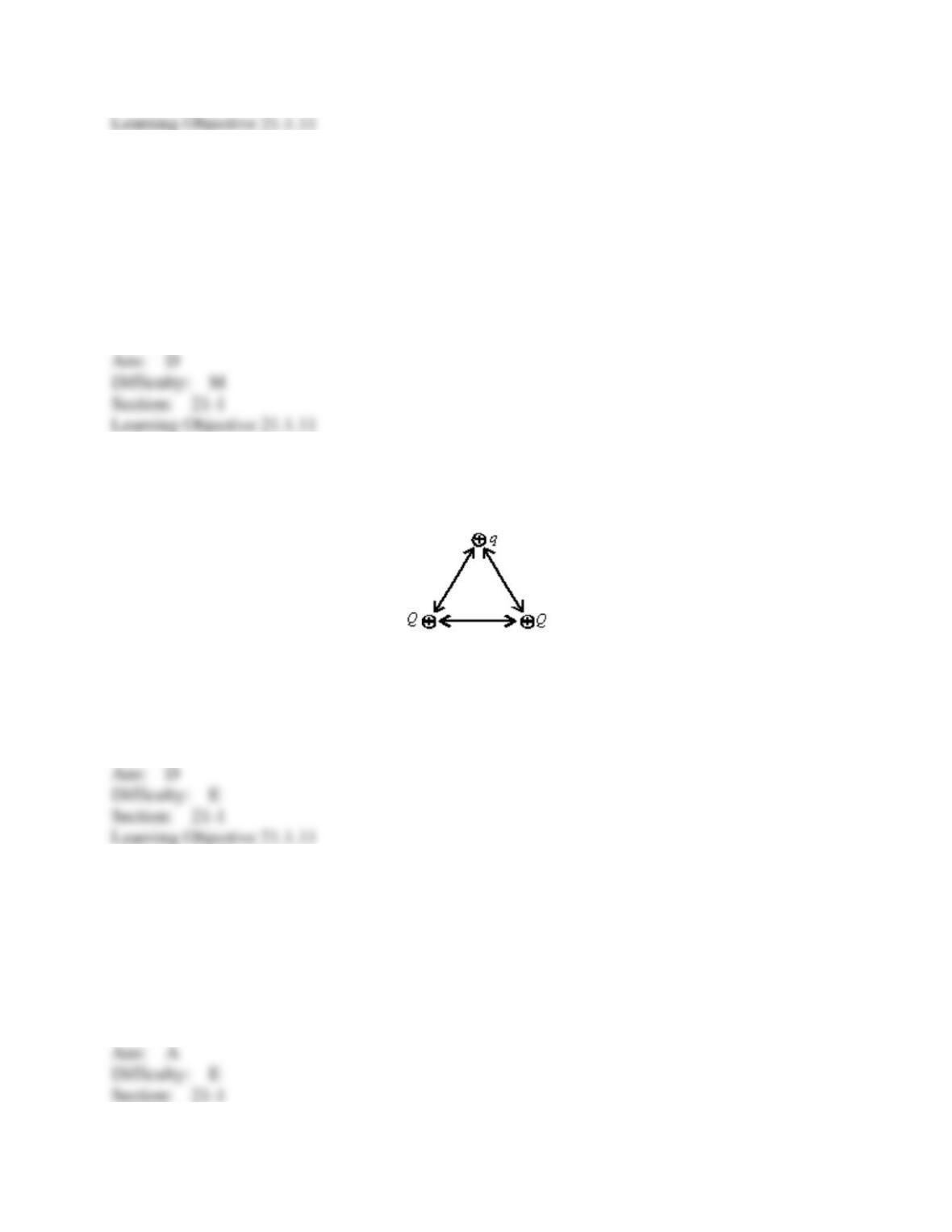
34. Two particles, each with charge Q, and a third particle, with a charge q, are placed at the
vertices of an equilateral triangle as shown. The total force on the particle with charge q is:
A) Parallel to the left side of the triangle
B) Parallel to the right side of the triangle
C) Parallel to the bottom side of the triangle
D) perpendicular to the bottom side of the triangle
E) perpendicular to the left side of the triangle
35. Charge is distributed uniformly on the surface of a spherical balloon (an insulator). A point
particle with charge q is inside. The electrical force on the particle q is greatest when:
A) it is just outside the surface of the balloon
B) it is at the center of the balloon
C) it is halfway between the balloon center and the inside surface
D) it is anywhere inside (the force is same everywhere and is not zero)
E) it is anywhere inside (the force is zero everywhere)
36. Charge is distributed uniformly on the surface of a spherical nonconducting shell. A point
particle with charge q is inside. The electrical force on the particle q is least when:
A) it is near the inside surface of the shell
B) it is at the center of the shell
C) it is halfway between the shell center and the inside surface
D) it is near, but not at, the center of the shell
E) all of the above (the force is zero everywhere inside)
37. If excess charge is put on a spherical conductor,
A) it remains where it was placed
B) it spreads a little from where it was placed but not over the whole sphere
C) it spreads uniformly over the surface of the sphere if the sphere is small
D) it spreads uniformly throughout the volume of the conductor
E) it spreads uniformly over the surface of the sphere
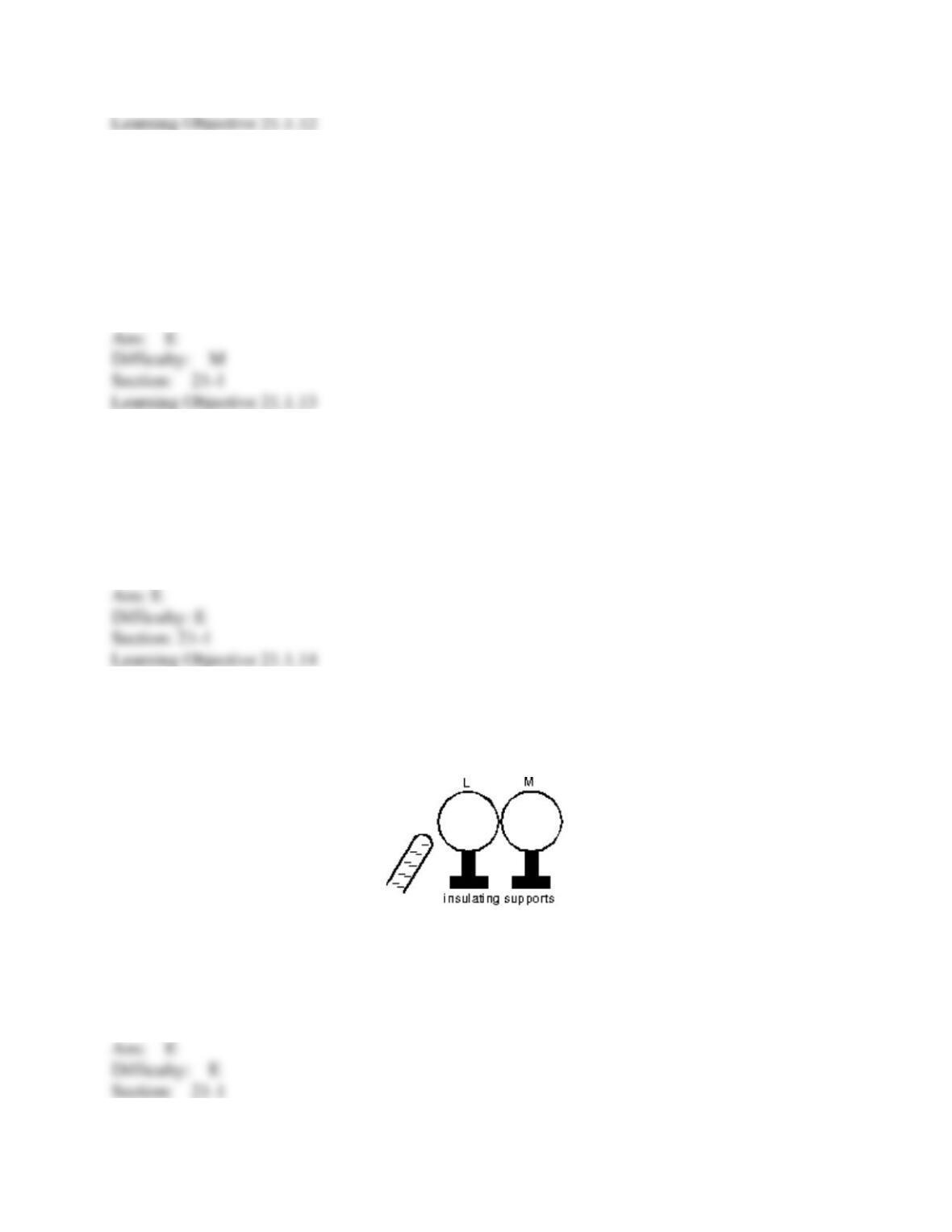
38. Two uncharged metal spheres, L and M, are in contact. A negatively charged rod is brought
close to L, but not touching it, as shown. The two spheres are slightly separated and the rod is
then withdrawn. As a result:
A) both spheres are neutral
B) both spheres are positive
C) both spheres are negative
D) L is negative and M is positive
E) L is positive and M is negative
39. A positively charged metal sphere A is brought into contact with an uncharged metal
sphere B. As a result:
A) both spheres are positively charged
B) A is positively charged and B is neutral
C) A is positively charged and B is negatively charged
D) A is neutral and B is positively charged
E) A is neutral and B is negatively charged
40. Two identical conducting spheres A and B carry equal charge and exert electrostatic forces
of magnitude F on each other. They are separated by a distance much larger than their diameters.
A third identical conducting sphere C is uncharged. Sphere C is first touched to A, then to B, and
finally removed. As a result, the electrostatic force between A and B becomes:
A) F/2
B) F/4
C) 3F/8
D) F/16
E) 0
41. If excess charge is put on a spherical nonconductor,
A) it remains where it was placed
B) it spreads a little from where it was placed but not over the whole sphere
C) it spreads uniformly over the surface of the sphere if the sphere is small
D) it spreads uniformly throughout the volume of the conductor
E) it spreads uniformly over the surface of the sphere
42. A coulomb is the same as:
A) an ampere/second
B) half an ampere second2
C) an ampere/meter2
D) an ampere second
E) a newton meter2
43. A kiloampere hour is a unit of:
A) current
B) charge per time
C) power
D) charge
E) energy
44. A wire contains a steady current of 2 A. The charge that passes a cross section in 2 s is:
A) 3.2 10–19 C
B) 6.4 10–19 C
C) 1 C
D) 2 C
E) 4 C
45. The magnitude of the charge on an electron is approximately:
A) 1023 C
B) 10–23 C
C) 1019 C
D) 10–19 C
E) 109 C
46. The magnitude of the total negative charge on the electrons in 1 mol of helium (atomic
number 2, atomic mass 4) is:
A) 4.8 104 C
B) 9.6 104 C
C) 1.9 105 C
D) 3.8 105 C
E) 7.7 105 C
47. The magnitude of the total negative charge on the electrons in 1 kg of helium (atomic
number 2, atomic mass 4) is:
A) 48 C
B) 2.4 107 C
C) 4.8 107 C
D) 9.6 107 C
E) 1.9 108 C
48. A wire contains a steady current of 2 A. The number of electrons that pass a cross section
in 2 s is:
A) 2
B) 4
C) 6.3 1018
D) 1.3 1019
E) 2.5 1019
49. Which of the following is NOT a possible value for the electric charge on an object?
A) 8 x 10–20 C
B) 8 x 10–19 C
C) 8 x 10–18 C
D) 8 x 10–17 C
E) 8 x 10–16 C
50. Is it ever possible for the following process to occur?
γ → e+ + e– + e+
A) Yes, it is.
B) No, this process does not conserve energy.
C) No, this process does not conserve momentum.
D) No, this process does not conserve mass.
E) No, this process does not conserve electric charge.
51. One type of medical imaging process is called positron emission tomography. Radioactive
material is injected into a patient; during the radioactive decay the material emits a positron,
which then interacts with an atomic electron, emitting gamma rays, which are detected by the
imager. This gamma ray emission process is called:
A) pair production
B) annihilation
C) absorption
D) alpha decay
E) fission
52. A nucleus of carbon 14 has 6 protons and 8 neutrons. The atomic number and mass number
of carbon 14 are, respectively,
A) 6 and 8
B) 6 and 14
C) 8 and 14
D) 14 and 20
E) 14 and 22