C) 0 J
D) 250 J
E) 500 J
40. A man pushes an 80-N crate a distance of 5.0 m upward along a frictionless slope that
makes an angle of 30 with the horizontal. His force is parallel to the slope. If the speed of the
crate decreases at a rate of 1.5 m/s2, then the work done by the man is:
A) –200 J
B) 61 J
C) 140 J
D) 200 J
E) 400 J
41. A man pushes an 80-N crate a distance of 5.0 m upward along a frictionless slope that
makes an angle of 30 with the horizontal. The force he exerts is parallel to the slope. If the
speed of the crate is constant, then the work done by the man is:
A) –200 J
B) 61 J
C) 140 J
D) 200 J
E) 260 J
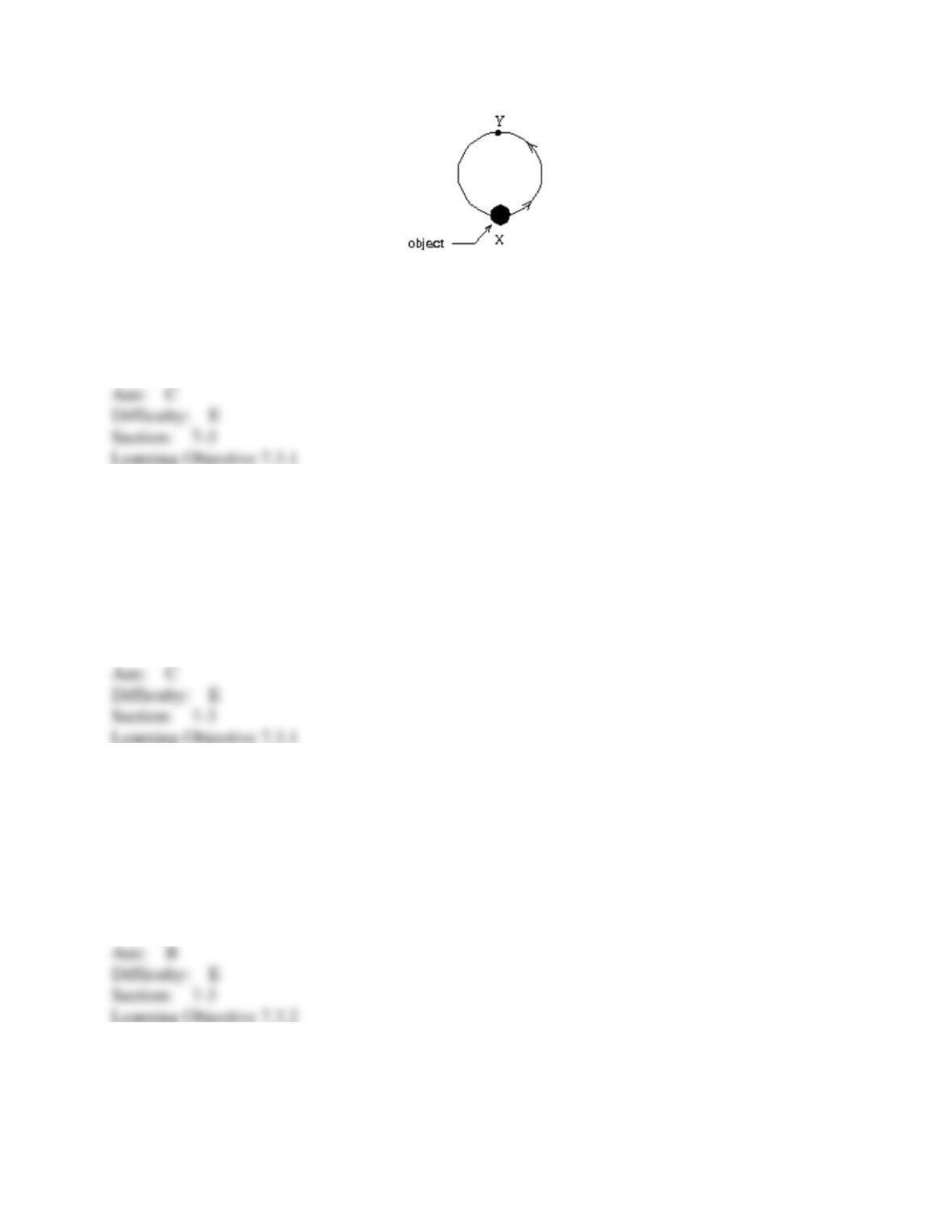
42. A man moves the 10-g object shown in a vertical plane at a constant speed from position X
to position Y along a circular track of radius 20 m. The process takes 0.75 min. The work done
by the man is about:
A) 1 J
B) 2 J
C) 4 J
D) 6 J
E) 12 J
43. A woman lifts a barbell 2.0 m in 5.0 s. If she lifts it the same distance in 10 s, the work
done by her is:
A) four times as great
B) two times as great
C) the same
D) half as great
E) one-fourth as great
44. A line drive to the shortstop is caught at the same height as it was originally hit. Over its
entire flight the work done by gravity and the work done by air resistance, respectively, are:
A) zero; positive
B) zero; negative
C) positive; negative
D) negative; positive
E) negative; negative
45. A baseball is hit high into the upper bleachers of left field. Over its entire flight the work
done by gravity and the work done by air resistance, respectively, are:
A) positive; positive
B) positive; negative
C) negative; positive
D) negative; negative
E) unknown since vital information is lacking
46. A block is attached to the end of an ideal spring and moved from coordinate xi to
coordinate xf. The relaxed position is at x = 0. The work done by spring is positive if:
A) xi = 2 cm and xf = 4 cm
B) xi = –2 cm and xf = 4 cm
C) xi = –2 cm and xf = –4 cm
D) xi = 2 cm and xf = –4 cm
E) xi = –4 cm and xf = –2 cm
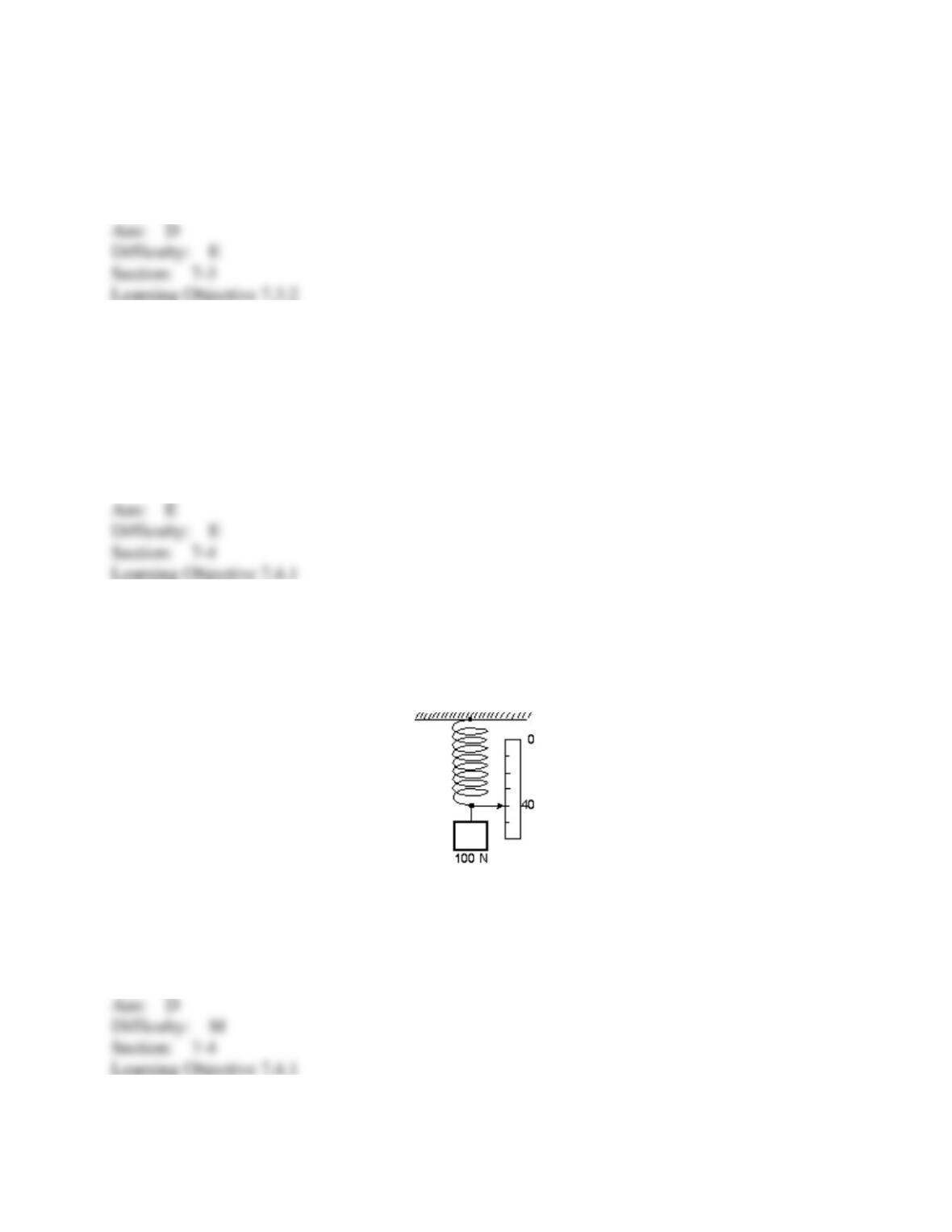
47. An ideal spring, with a pointer attached to its end, hangs next to a scale. With a 100-N
weight attached, the pointer indicates “40” on the scale as shown. Using a 200-N weight instead
results in “60” on the scale. Using an unknown weight X instead results in “30” on the scale. The
weight of X is:
A) 20 N
B) 30 N
C) 40 N
D) 50 N
E) 75 N
48. A spring of spring constant k is attached to a block of mass m. The spring moves the block
through a displacement x. How can you calculate how much work the spring does on the block?
A) Multiply the spring force, kx, by the distance x.
B) Multiply the spring force, ½ kx2, by the distance x.
C) Integrate the spring force, kx, over the distance x.
D) Integrate the spring force, ½ kx2, over the time it takes the block to move.
E) You cannot calculate this without knowing the acceleration of the block.
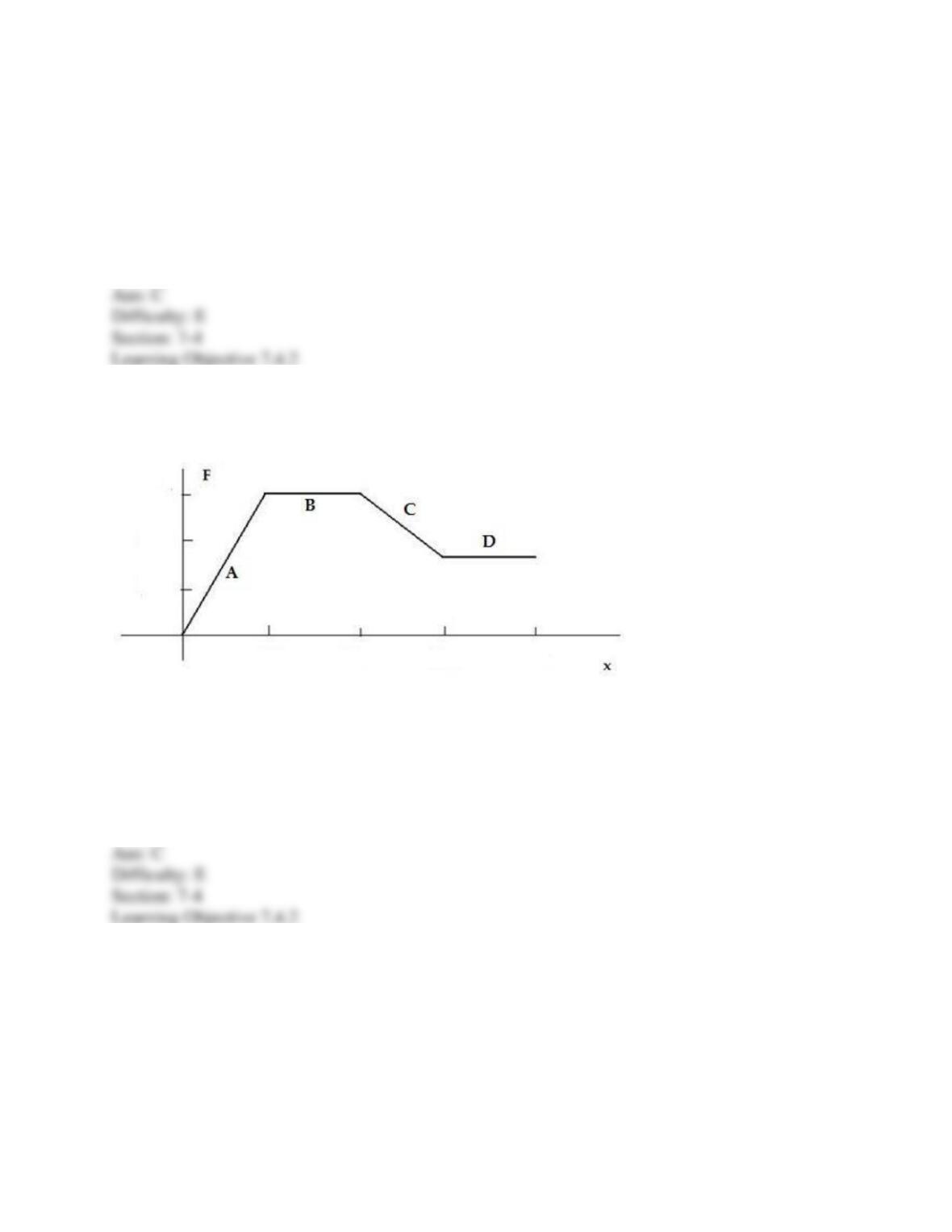
49. This plot shows an object being moved by a series of forces. Which segments of the motion
could have been caused by fixed springs?
A) None of the segments could represent work being done by springs.
B) Any of the segments could represent work being done by springs.
C) Segments A and C only.
D) Segments B and D only.
E) Segment A only.
50. An ideal spring is hung vertically from the ceiling. When a 2.0-kg mass hangs at rest from
it, the spring is extended 6.0 cm from its relaxed length. A downward external force is now
applied to the mass to extend the spring an additional 10 cm. While the spring is being extended
by the force, the work done by the spring is:
A) –3.6 J
B) –3.3 J
C) –1.0 J
D) 3.3 J
E) 3.6 J
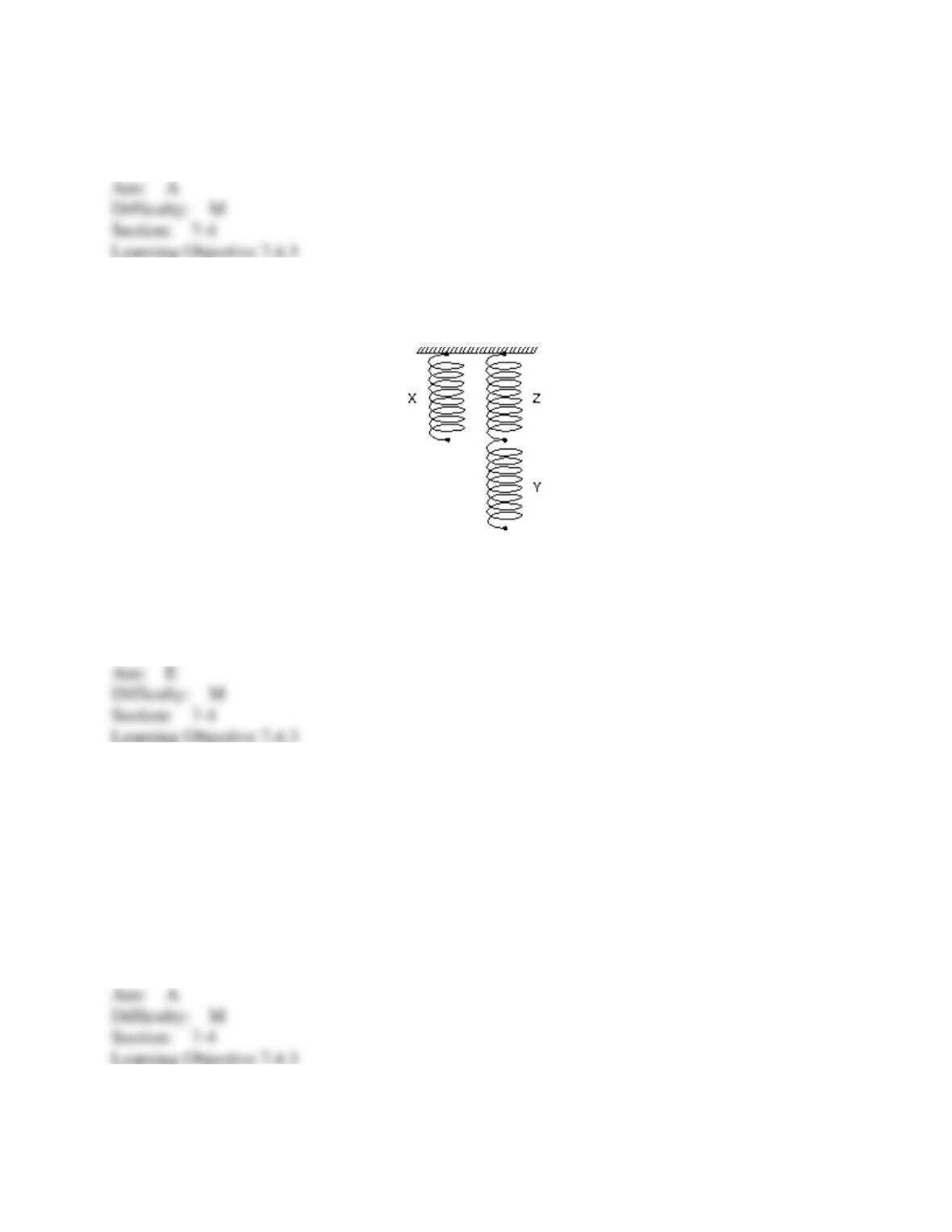
51. Three identical springs (X, Y, Z) are arranged as shown. When a 4.0-kg mass is hung on X,
the mass descends 3.0 cm. When a 6.0-kg mass is hung on Y, the mass descends:
A) 2.0 cm
B) 4.0 cm
C) 4.5 cm
D) 6.0 cm
E) 9.0 cm
52. An ideal spring is hung vertically from the ceiling. When a 2.0-kg mass hangs at rest from
it, the spring is extended 6.0 cm from its relaxed length. An upward external force is then applied
to the block to move it upward a distance of 16 cm. While the block is being raised by the
force, the work done by the spring is
A) –1.0 J
B) –0.52 J
C) –0.26 J
D) 0.52 J
E) 1.0 J
53. When a certain rubber band is stretched a distance x, it exerts a restoring force of
magnitude F = Ax, where A is a constant. The work done by a person in stretching this rubber
band from x = 0 to x = L is:
A) AL2
B) AL
C) A + 2L2
D) A/L
E) AL2/2
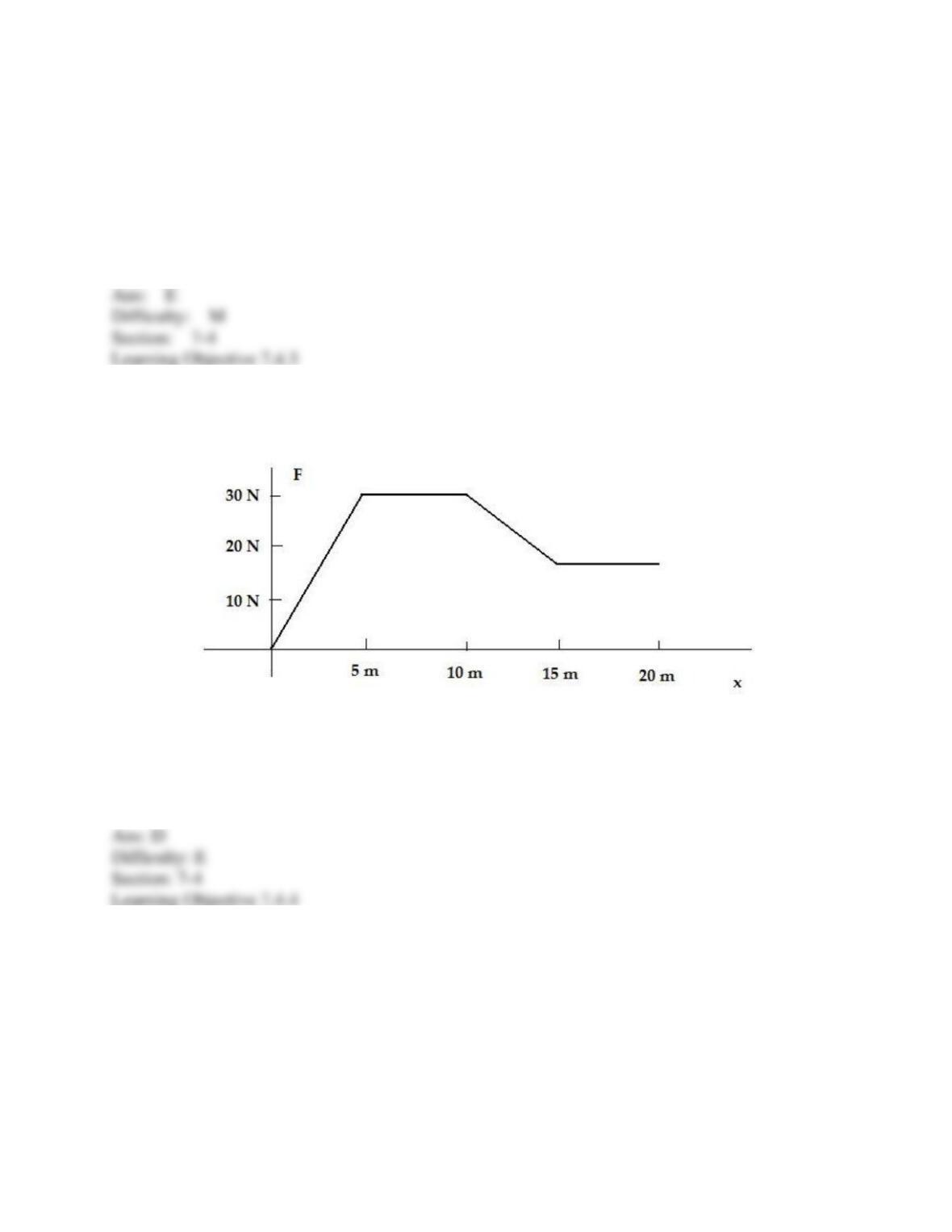
54. In the plot shown of force vs. distance, approximately how much work is done in moving an
object from x = 5 m to x = 15 m?
A) 10 J
B) 55 J
C) 125 J
D) 275 J
E) cannot be calculated without knowing the mass of the object
55. A 2-kg block is attached to a horizontal ideal spring with a spring constant of 200 N/m.
When the spring has its equilibrium length the block is given a speed of 5 m/s. What is the
maximum elongation of the spring?
A) 0 m
B) 0.5 m
C) 5 m
D) 10 m
E) 100 m
56. A 1.5 kg crate falls from a height of 2.0 m onto an industrial spring scale with a spring
constant of 1.5 105 N/m. At its greatest compression the reading on the scale is:
A) 15 N
B) 29 N
C) 1.5 103 N
D) 2.1 103 N
E) 3.0 103 N
57. When a certain rubber band is stretched a distance x, it exerts a restoring force F = ax +
bx2, where a and b are constants. The work done in stretching this rubber band from x = 0 to x =
L is:
A) aL2 + bLx3
B) aL + 2bL2
C) a + 2bL
D) bL
E) aL2/2 + bL3/3
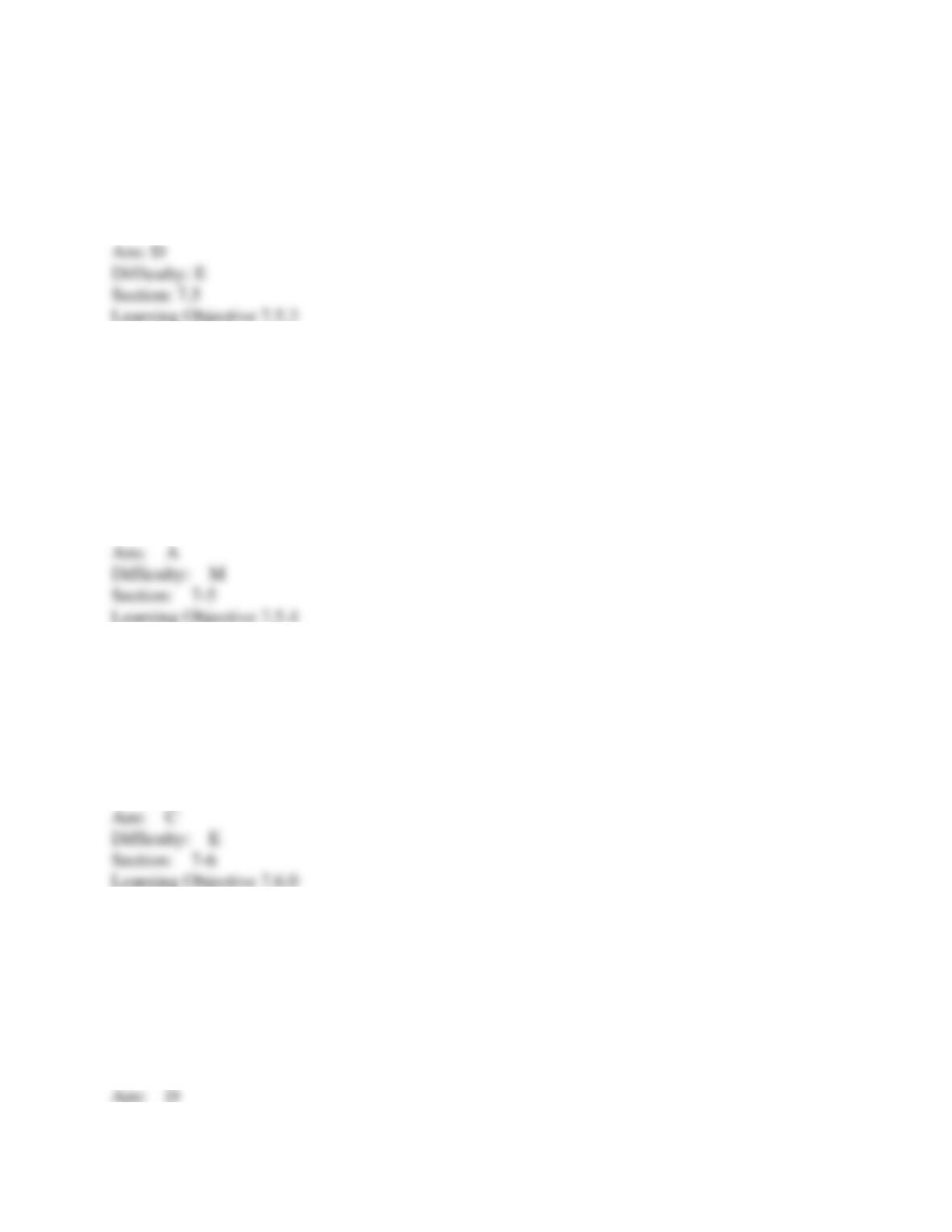
58. The plot shows the force on an object as it moves from x = 0 m to x = 20 m. How much work
is done on the object?
A) 40 J
B) 90 J
C) 200 J
D) 450 J
E) 750 J
59. A particle moving along the x axis is acted upon by a single force F = F0e–kx, where F0 and
k are constants. The particle is released from rest at x = 0. It will attain a maximum kinetic
energy of:
A) F0/k
B) F0/ek
C) kF0
D) 1/2(kF0)2
E) kekF0
60. One watt is:
A) 1 kg m/s3
B) 1 kg m2/s
C) 1 kg m2/s3
D) 1 kg m/s
E) 1 kg m2/s2
61. Power has the dimensions of:
A) ML2/T2
B) MT/L2
C) ML/T2
D) ML2/T3
E) none of these
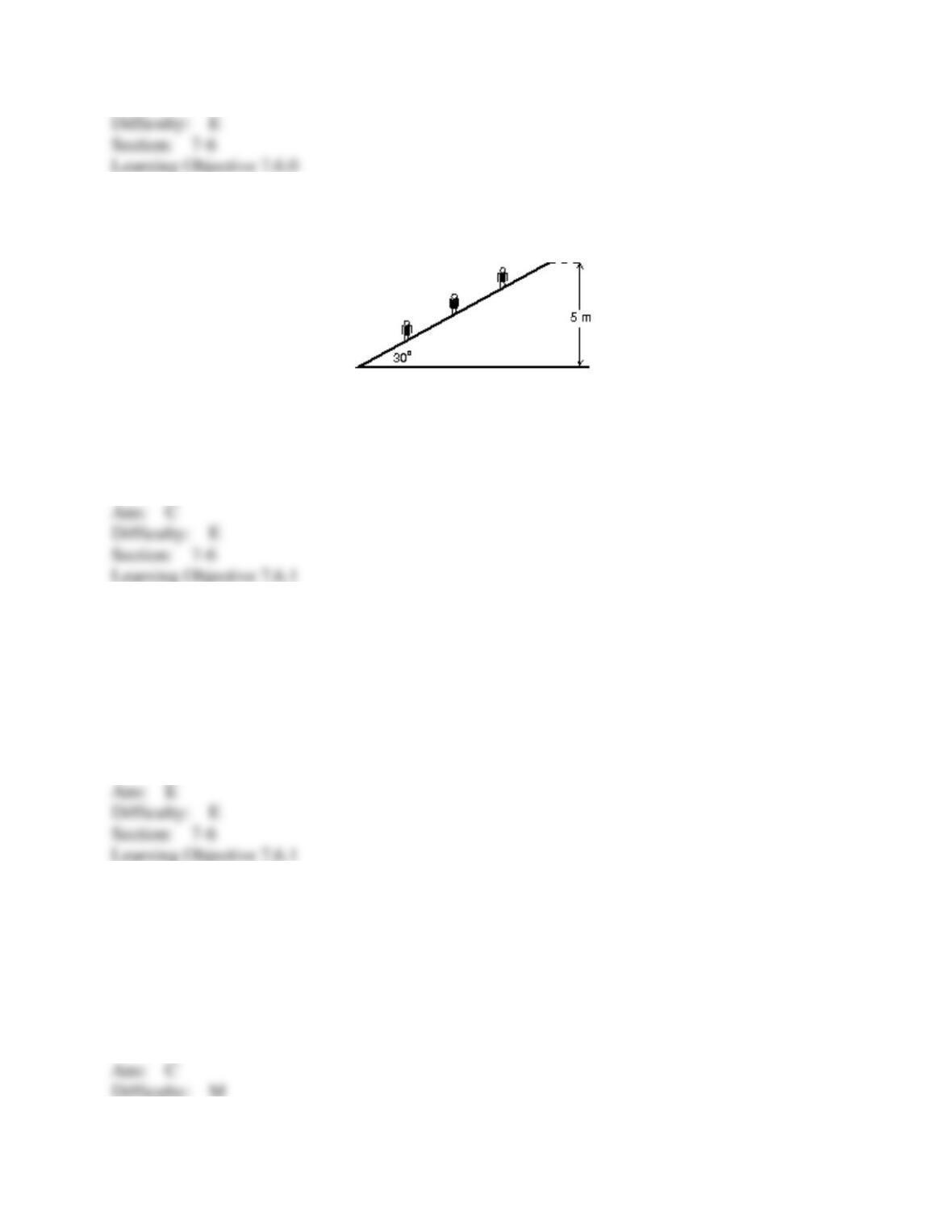
62. An escalator is used to move 20 people (60 kg each) per minute from the first floor of a
department store to the second floor, 5 m above. The power required is approximately:
A) 100 W
B) 200 W
C) 1000 W
D) 2000 W
E) 60,000 W
63. A person holds an 80-N weight 2 m above the floor for 30 seconds. The power required to
do this is:
A) 5.3 W
B) 40 W
C) 80 W
D) 160 W
E) none of these
64. A 50-N force acts on a 2-kg crate that starts from rest. When the force has been acting for 2
s the rate at which it is doing work is:
A) 100 W
B) 1000 W
C) 2500 W
D) 5000 W
E) 63000 W
65. A 50-N force is the only force on a 2-kg crate that starts from rest. At the instant the crate
has gone 2 m the rate at which the force is doing work is:
A) 2.5 W
B) 25 W
C) 75 W
D) 100 W
E) 500 W
66. Which of the following five units represents a quantity that is NOT the same type as the
other four?
A) joule
B) erg
C) watt
D) footpound
E) newtonmeter
67. Which of the following five quantities is NOT an expression for energy? Here m is a mass,
g is the acceleration due to gravity, h and d are distances, F is a force, v is a speed, a is an
acceleration, P is power, and t is time.
A) mgh
B) Fd
C) 1/2mv2
D) ma
E) Pt
68. A watt second is a unit of:
A) force
B) power
C) displacement
D) speed
E) energy
69. A watt per hour is a unit of:
A) energy
B) power
C) force
D) acceleration
E) none of these
70. A kilowatt hour is a unit of:
A) power
B) energy/time
C) energy
D) power/time
E) force/distance
71. A particle starts from rest and is acted on by a net force that does work at a rate that is
proportional to the time t. The speed of the particle is proportional to:
A) √𝑡
B) t
C) t2
D) 1/√𝑡
E) 1/t
72. A force 𝐹
⃗ = (4.1 N)𝑖̂ + (2.6 N 𝑗̂) – (4.7 N) 𝑘
̂ acts on a mass of 2.3 kg as it moves in the x
direction at a speed of 7.2 m/s. What is the rate at which the force is doing work?
A) 8.8 W
B) 16 W
C) 30 W
D) 49 W
E) 60 W
73. A mass of 47 kg is moving horizontally as a force of 190 N, directed at 25° below the
horizontal, is exerted on it. When its speed is 7.3 m/s, what is the rate at which the force is doing
work?
A) 0 W
B) 340 W
C) 590 W
D) 1300 W
E) 1400 W