accelerates upward. During the acceleration:
A) the cork is immersed more
B) the cork is immersed less
C) the cork is immersed the same amount
D) at first the cork is immersed less but as the elevator speeds up it is immersed more
E) at first the cork is immersed more but as the elevator speeds up it is immersed less
45. Two balls have the same shape and size but one is denser than the other. When they are
dropped in air, which has the greater acceleration? Do not ignore air resistance.
A) The heavier ball
B) The lighter ball
C) They have the same acceleration
D) The heavier ball if atmospheric pressure is high, they lighter ball if it is low
E) The lighter ball if atmospheric pressure is high, the heavier ball if it is low
46. A student standardizes the concentration of a salt-water solution by slowly adding salt until
an egg will just float. The procedure is based on the assumption that:
A) all eggs have the same volume
B) all eggs have the same weight
C) all eggs have the same density
D) all eggs have the same shape
E) the salt tends to neutralize the cholesterol in the egg
47. A wood board floats in fresh water with 60% of its volume under water. The density of the
wood is:
A) 0.4 g/cm3
B) 0.5 g/cm3
C) 0.6 g/cm3
D) less than 0.4 g/cm3
E) more than 0.6 g/cm3
48. A boat floating in fresh water displaces 16,000 N of water. How many newtons of salt
water would it displace if it floats in salt water of specific gravity 1.10?
A) 12,800 N
B) 14,400 N
C) 16,000 N
D) 17,600 N
E) 19,200 N
49. A loaded ship passes from a lake (fresh water) to the ocean (salt water). Salt water is denser
than fresh water and as a result the ship will:
A) ride higher in the water
B) settle lower in the water
C) ride at the same level in the water
D) experience an increase in buoyant force
E) experience a decrease in buoyant force
50. An object hangs from a spring balance. The balance indicates 30 N in air, 20 N when the
object is submerged in water. Which of the following is true?
A) The actual weight of the object is 20 N.
B) The actual weight of the object is 10 N.
C) The actual weight of the object is slightly more than 30 N, due to the buoyant force of the air.
D) The actual weight of the object is slightly less than 30 N, due to the buoyant force of the air.
E) The actual weight of the object is equal to the apparent weight of the object in both cases.
51. An object hangs from a spring balance. The balance indicates 30 N in air, 20 N when the
object is submerged in water. What does the balance indicate when the object is submerged in
liquid with a density that is half of water?
A) 20 N
B) 25 N
C) 30 N
D) 35 N
E) 40 N
52. A rock, which weighs 1400 N in air, has an apparent weight of 900 N when submerged in
fresh water (998 kg/m3). The volume of the rock is:
A) 0.14 m3
B) 0.50 m3
C) 0.90 m3
D) 5.1 10–2 m3
E) 9.2 10–2 m3
53. The dimensions of a wooden raft (density = 150 kg/m3) are 3.0 m 3.0 m 1.0 m. What
maximum load can it carry in sea water (density =1020 kg/m3)?
A) 1350 kg
B) 7800 kg
C) 9200 kg
D) 19,500 kg
E) 24,300 kg
54. A tin can has a volume of 1000 cm3 and a mass of 100 g. Approximately what mass of lead
shot can it carry without sinking in water?
A) 900 g
B) 100 g
C) 1000 g
D) 1100 g
E) 980 g
55. A solid has a volume of 8 cm3. When weighed on a spring scale calibrated in grams, the
scale indicates 20 g. What does the scale indicate if the object is weighed while immersed in a
liquid of density 2 g/cm3?
A) 4 g
B) 10 g
C) 12 g
D) 16 g
E) zero, since the object will float
56. A 210-g object apparently loses 30 g when suspended in a liquid of density 2.0 g/cm3. The
density of the object is:
A) 7.0 g/cm3
B) 3.5 g/cm3
C) 1.4 g/cm3
D) 14 g/cm3
E) none of these
57. A steel ax and an aluminum piston have the same apparent weight in water. When they are
weighed in air:
A) they weigh the same
B) the ax is heavier
C) the piston is heavier
D) both weigh less than they did in water
E) depends on their shapes
58. The apparent weight of a steel sphere immersed in various liquids is measured using a
spring scale. The greatest reading is obtained for that liquid:
A) having the smallest density
B) having the largest density
C) subject to the greatest atmospheric pressure
D) having the greatest volume
E) in which the sphere was submerged deepest
59. A 0.50 N metal sinker appears (as measured using a spring scale) to have a mass of 0.45 N
when submerged in water. The specific gravity of the metal is:
A) 6
B) 8
C) 9
D) 10
E) 12
60. The equation of continuity for fluid flow can be derived from the conservation of:
A) energy
B) mass
C) angular momentum
D) volume
E) pressure
61. A fluid is undergoing “incompressible” flow. This means that:
A) the pressure at a given point cannot change with time
B) the velocity at a given point cannot change with time
C) the velocity must be the same everywhere
D) the pressure must be the same everywhere
E) the density cannot change with time or location
62. A fluid is undergoing steady flow. Therefore:
A) the velocity of any given molecule of fluid does not change
B) the pressure does not vary from point to point
C) the velocity at any given point does not vary with time
D) the density does not vary from point to point
E) the flow is not uphill or downhill
63. Which of the following is true?
A) A streamline can only be defined for irrotational flow.
B) A streamline cannot be defined for turbulent flow.
C) Streamlines cannot cross in laminar flow, but can cross in turbulent flow.
D) A streamline is the path that a tiny element of fluid would take as the fluid flows.
E) The velocity vector of a fluid element is always perpendicular to the streamline.
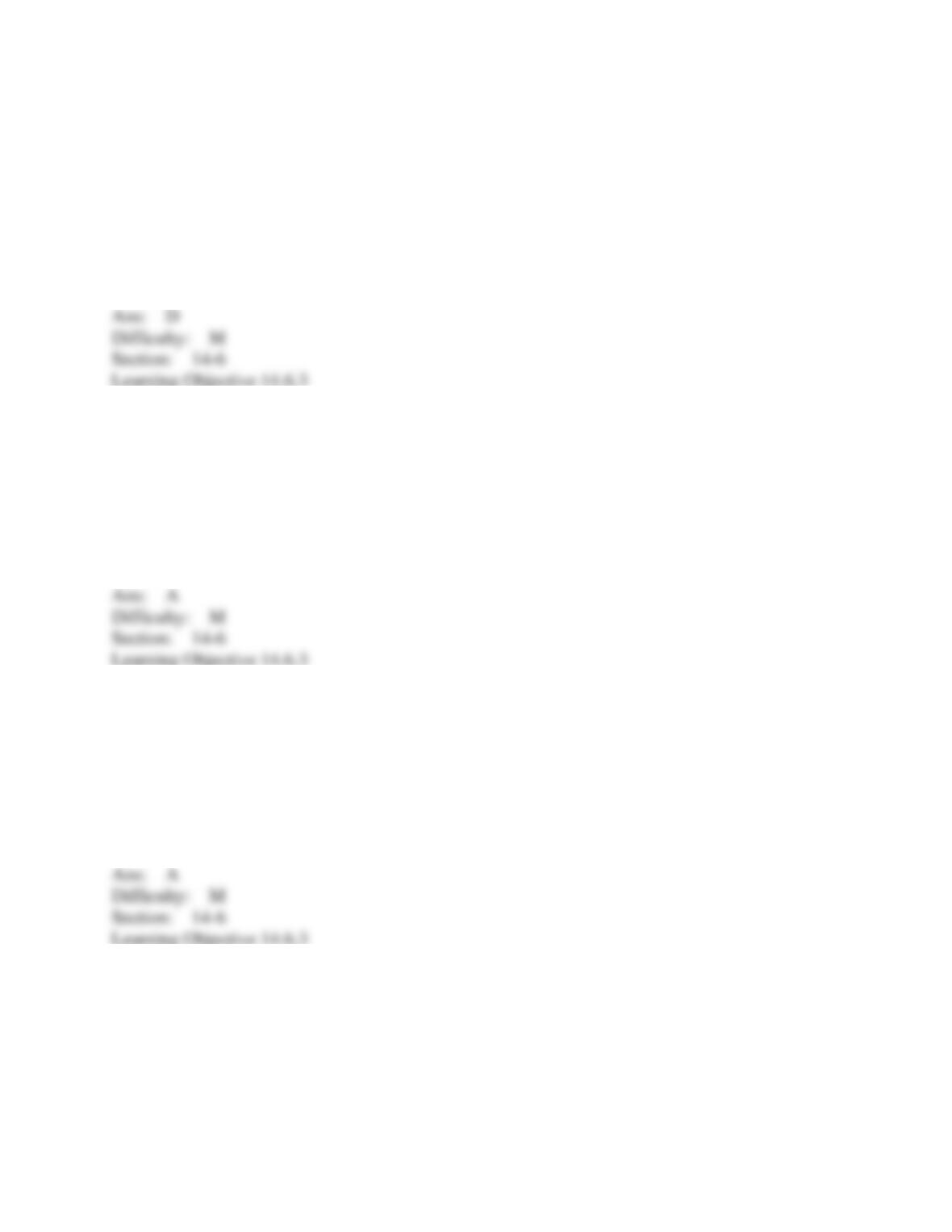
64. An incompressible liquid flows along the pipe as shown. The ratio of the speeds v2/v1 is:
A) A1/A2
B) A2/A1
C) √𝐴1/𝐴2
D) √𝐴2/𝐴1
E) v1/v2
65. Water flows through a cylindrical pipe of varying cross-section. The velocity is 3.0 m/s at a
point where the pipe diameter is 1.0 cm. At a point where the pipe diameter is 3.0 cm, the
velocity is:
A) 9 m/s
B) 3 m/s
C) 1 m/s
D) 0.33 m/s
E) 0.11 m/s
66. A constriction in a pipe reduces its diameter from 4.0 cm to 2.0 cm. Where the pipe is
narrow the water speed is 8.0 m/s. Where it is wide the water speed is:
A) 2.0 m/s
B) 4.0 m/s
C) 8.0 m/s
D) 16 m/s
E) 32 m/s
67. Water flows from a 6.0-cm diameter pipe into an 8.0-cm diameter pipe. The speed in the
6.0-cm pipe is 5.0 m/s. The speed in the 8-inch pipe is:
A) 2.8 m/s
B) 3.8 m/s
C) 6.7 m/s
D) 8.9 m/s
E) 9.9 m/s
68. A lawn sprinkler is made of a 1.0 cm diameter garden hose with one end closed and 25
holes, each with a diameter of 0.050 cm, cut near the closed end. If water flows at 2.0 m/s in the
hose, the speed of the water leaving a hole is:
A) 2.0 m/s
B) 32 m/s
C) 40 m/s
D) 600 m/s
E) 800 m/s
69. Water is streaming downward from a faucet opening with an area of 3.0 10–5 m2. It leaves
the faucet with a speed of 5.0 m/s. The cross sectional area of the stream 0.50 m below the faucet
is:
A) 1.5 10–5 m2
B) 2.0 10–5 m2
C) 2.5 10–5 m2
D) 3.0 10–5 m2
E) 3.5 10–5 m2
70. One end of a cylindrical pipe has a radius of 1.5 cm. Water (density = 1.0 103 kg/m3)
streams steadily out at 7.0 m/s. The volume flow rate is:
A) 4.9 10–3 m3/s
B) 2.5 m3/s
C) 4.9 m3/s
D) 7.0 m3/s
E) 48 m3/s
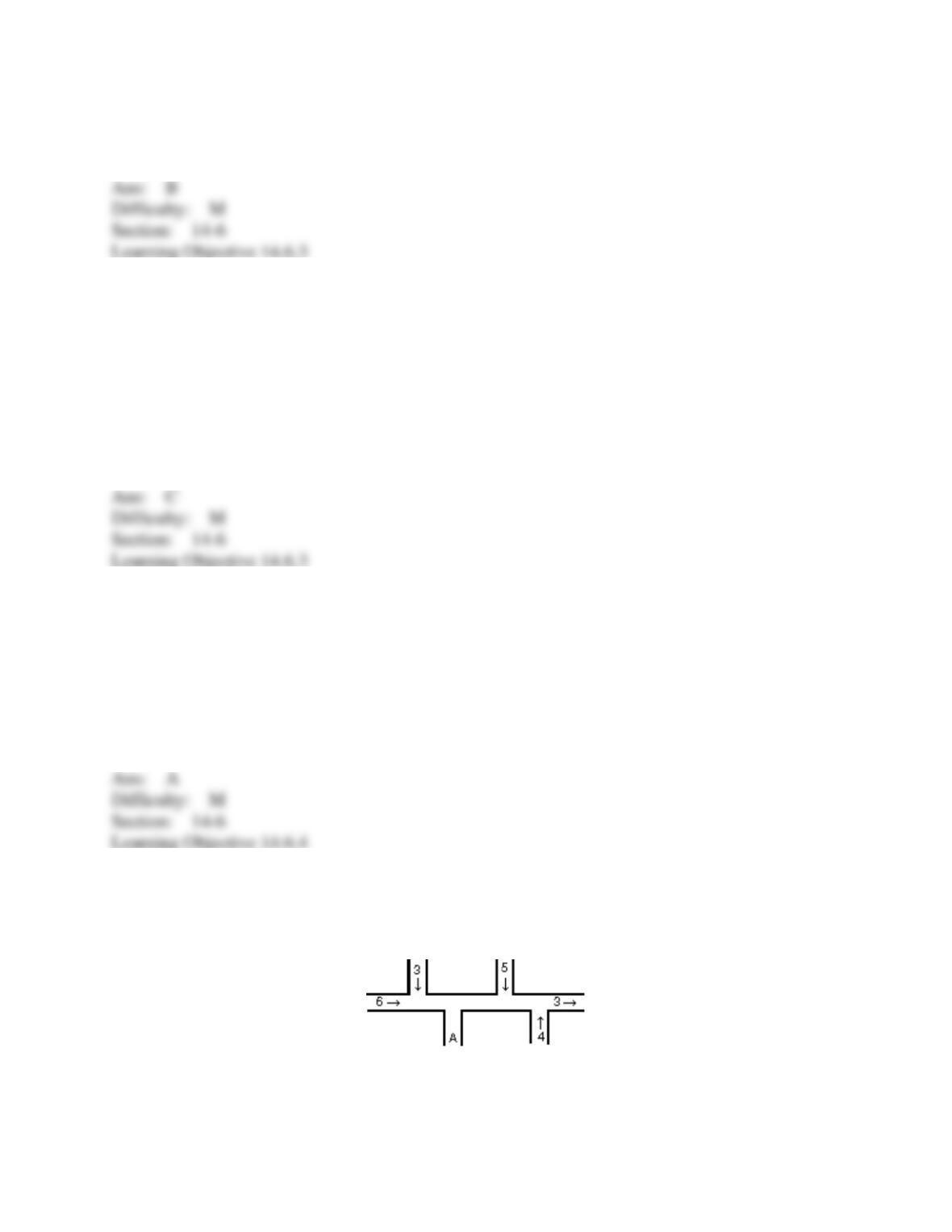
71. The diagram shows a pipe of uniform cross section in which water is flowing. The
directions of flow and the volume flow rates (in cm3/s) are shown for various portions of the
pipe. The direction of flow and the volume flow rate in the portion marked A are:
A) and 3 cm3/s
B) and 7 cm3/s
C) and 9 cm3/s
D) and 11 cm3/s
E) and 15 cm3/s
72. One end of a cylindrical pipe has a radius of 1.5 cm. Water (density = 1.0 103 kg/m3)
streams steadily out at 7.0 m/s. The rate at which mass is leaving the pipe is:
A) 2.5 kg/s
B) 4.9 kg/s
C) 7.0 kg/s
D) 48 kg/s
E) 7.0 103 kg/s
73. Which of the following assumptions is NOT made in the derivation of Bernoulli’s
equation?
A) assume streamline flow
B) neglect viscosity
C) neglect friction
D) neglect gravity
E) neglect turbulence
74. The quantity y appearing in Bernoulli’s equation MUST be measured:
A) upward from the center of the Earth
B) upward from the surface of the Earth
C) upward from the lowest point in the flow
D) downward from the highest point in the flow
E) upward from any convenient level
75. Consider a pipe containing a fluid, with the fluid being at rest. To apply Bernoulli’s
equation to this situation:
A) set v equal to zero because there is no motion
B) set g equal to zero because there is no acceleration
C) set v and g both equal to zero
D) set p equal to the atmospheric pressure
E) cannot be done, Bernoulli’s equation applies only to fluids in motion
76. A fluid of density 9.1 102 kg/m3 is flowing through a tube at a speed of 5.3 m/s. What is the
kinetic energy density of the fluid?
A) cannot be calculated without knowing the pressure
B) cannot be calculated without knowing the elevation
C) 4.8 103 J/m3
D) 1.3 104 J/m3
E) 2.5 106 J/m3
77. The units of pressure can also be written as:
A) N/m
B) J∙m2
C) W/m2
D) J/m3
E) N/m3
78. Water (density = 1.0 103 kg/m3) flows downhill through a pipe of diameter 1.5 cm. Its
speed at the top of the hill is 7.2 m/s. If the hill is 9.5 m high, what is the gravitational potential
energy density of the water at the top of the hill relative to the bottom?
A) cannot be calculated without knowing the pressure
B) 120 J/m3
C) 7.2 x 10³ J/m3
D) 9.5 x 10³ J/m3
E) 9.3 x 10⁴ J/m3
79. Water (density = 1.0 103 kg/m3) flows through a horizontal tapered pipe. At the wide end
its speed is 4.0 m/s. The difference in pressure between the two ends is 4.5 103 Pa. The
speed of the water at the narrow end is:
A) 2.6 m/s
B) 3.2 m/s
C) 4.0 m/s
D) 4.5 m/s
E) 5.0 m/s
80. A large water tank, open at the top, has a small hole in the bottom. When the water level is
30 m above the bottom of the tank, the speed of the water leaking from the hole:
A) is 2.5 m/s
B) is 24 m/s
C) is 44 m/s
D) cannot be calculated unless the area of the hole is given
E) cannot be calculated unless the areas of the hole and tank are given
81. A large tank filled with water has two holes in the bottom, one with twice the radius of the
other. In steady flow the speed of water leaving the larger hole is ________ the speed of the
water leaving the smaller.
A) twice
B) four times
C) half
D) one-fourth
E) the same as
82. A water line enters a house 2.0 m below ground. A smaller diameter pipe carries water to a
faucet 5.0 m above ground, on the second floor. Water flows at 2.0 m/s in the main line and at
7.0 m/s on the second floor. Take the density of water to be 1.0 103 kg/m3. The pressure in the
main line is 2.0 105 Pa; then the difference in pressure between the main line and the second
floor is:
A) 6.9 104 Pa with the main line at the higher pressure
B) 2.3 104 Pa with the main line at the higher pressure
C) 6.9 104 Pa with the main line at the lower pressure
D) 2.3 104 Pa with the main line at the lower pressure
E) 9.1 104 Pa with the main line at the higher pressure
83. A person blows across the top of one arm of a U-tube partially filled with water. The water
in that arm:
A) rises slightly
B) drops slightly
C) remains at the same height
D) rises if the blowing is soft but drops if it is hard
E) rises if the blowing is hard but drops if it is soft
84. Water flows through a constriction in a horizontal pipe. As it enters the constriction, the
water’s:
A) speed increases and pressure decreases
B) speed increases and pressure remains constant
C) speed increases and pressure increases
D) speed decreases and pressure increases
E) speed decreases and pressure decreases
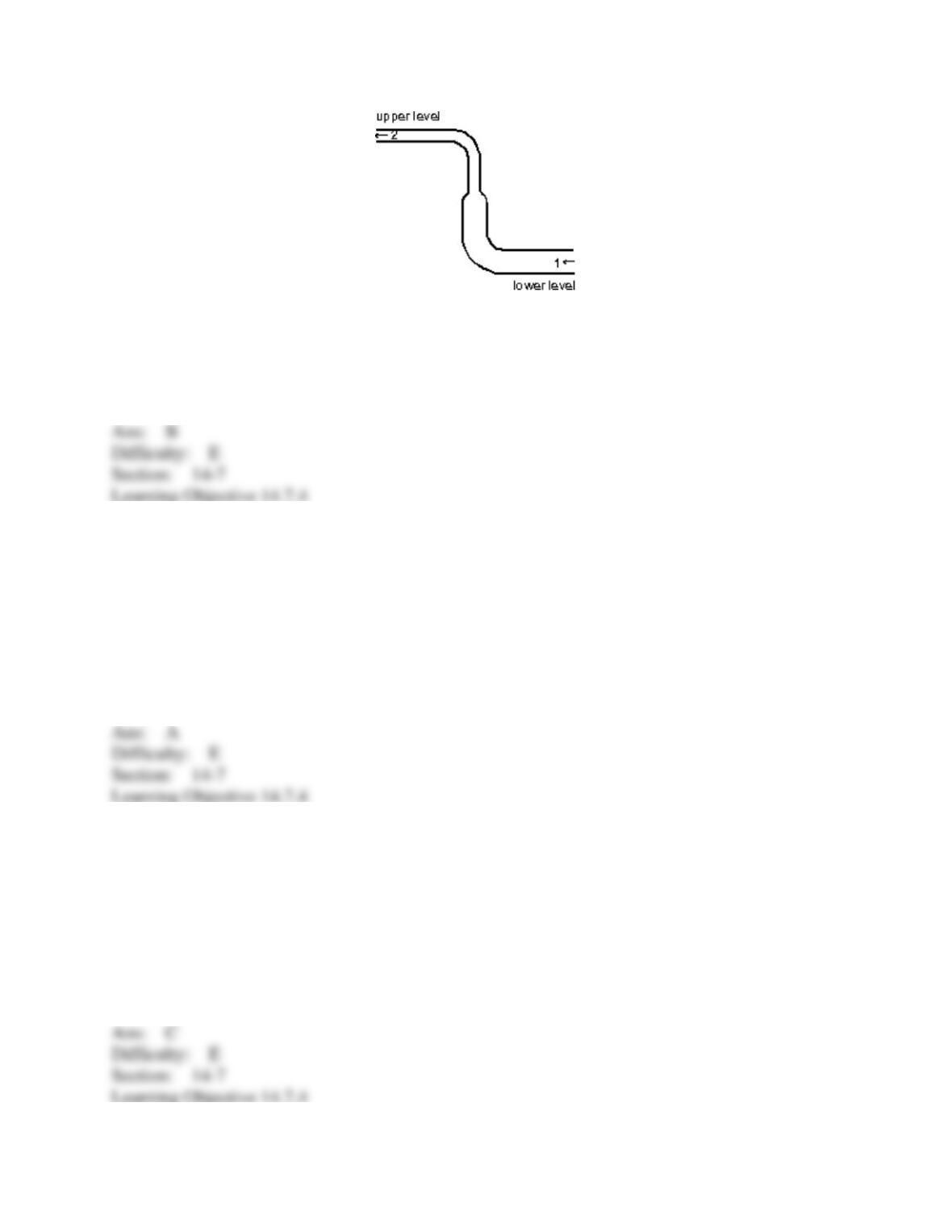
85. Water is pumped through the hose shown below, from a lower level to an upper level.
Compared to the water at point 1, the water at point 2:
A) has greater speed and greater pressure
B) has greater speed and less pressure
C) has less speed and less pressure
D) has less speed and greater pressure
E) has greater speed and the same pressure
86. A non-viscous incompressible liquid is flowing through a horizontal pipe of constant
cross-section. Bernoulli’s equation and the equation of continuity predict that the drop in pressure
along the pipe:
A) is zero
B) depends on the length of the pipe
C) depends on the fluid velocity
D) depends on the cross-sectional area of the pipe
E) depends on the height of the pipe
87. A non-viscous incompressible fluid is pumped steadily into the narrow end of a long
tapered pipe and emerges from the wide end. The pressure at the input is greater than at the
output. A possible explanation is:
A) the fluid speed increases from input to output
B) the fluid speed is the same at the two ends
C) the fluid is flowing uphill
D) the fluid is flowing downhill
E) the fluid is flowing horizontally
88. Water is pumped into one end of a long pipe at the rate of 40 L/min. It emerges at the other
end at 24 L/min. A possible reason for this decrease in flow is:
A) the water is being pumped uphill
B) the water is being pumped downhill
C) the diameter of the pipe is not the same at the two ends
D) friction in the pipe
E) a leak in the pipe
89. A non-viscous incompressible fluid is pumped steadily up a vertical pipe with uniform
cross section. The difference in pressure between points at the top and bottom:
A) is the same as it would be if the fluid were motionless
B) is greater at higher flow rates than at lower flow rates
C) is less at higher flow rates than at lower flow rates
D) does not depend on the density of the fluid
E) is zero
90. Bernoulli’s equation can be derived from the conservation of:
A) energy
B) mass
C) angular momentum
D) volume
E) pressure