Chapter: Chapter 6
Learning Objectives:
LO 6.1.0 Solve problems related to friction
LO 6.1.1 Distinguish between friction in a static situation and a kinetic situation.
LO 6.1.2 Determine direction and magnitude of a frictional force.
LO 6.1.3 For objects on horizontal, vertical, or inclined planes in situations involving friction,
draw free-body diagrams and apply Newton’s second law.
LO 6.2.0 Solve problems related to drag force and terminal speed
LO 6.2.1 Apply the relationship between the drag force on an object moving through air and the
speed of the object.
LO 6.2.2 Determine the terminal speed of an object falling through air.
LO 6.3.0 Solve problems related to uniform circular motion
LO 6.3.1 Sketch the path taken in uniform circular motion and explain the velocity, acceleration,
and force vectors (magnitudes and directions) during the motion.
LO 6.3.2 Identify that unless there is a radially inward net force (a centripetal force), an object
cannot move in circular motion.
LO 6.3.3 Apply the relationship between the radius of the circular path, the particle’s speed and
mass, and the net force acting on the particle.
Multiple Choice
1. The coefficient of kinetic friction:
A) is in the direction of the frictional force
B) is in the direction of the normal force
C) is the ratio of force to area
D) can have units of newtons
E) none of the above
2. When the brakes of an automobile are applied, the road exerts the greatest retarding force:
A) while the wheels are sliding
B) just before the wheels start to slide
C) when the automobile is going fastest
D) when the acceleration is least
E) at the instant when the speed begins to change
3. A brick slides on a horizontal surface. Which of the following will increase the frictional
force on it?
A) Putting a second brick on top
B) Decreasing the surface area of contact
C) Increasing the surface area of contact
D) Decreasing the mass of the brick
E) None of the above
4. A 40-N crate rests on a rough horizontal floor. A 12-N horizontal force is then applied to it.
If the coefficients of friction are
s = 0.5 and
k = 0.4, the magnitude of the frictional force on
the crate is:
A) 8 N
B) 12 N
C) 16 N
D) 20 N
E) 40 N
5. A 24-N horizontal force is applied to a 40-N block initially at rest on a rough horizontal
surface. If the coefficients of friction are
s = 0.5 and
k = 0.4, the magnitude of the frictional
force on the block is:
A) 12 N
B) 16 N
C) 20 N
D) 24 N
E) 40 N
6. A horizontal shove of at least 200-N is required to start moving an 800-N crate initially at
rest on a horizontal floor. The coefficient of static friction is:
A) 0.125
B) 0.25
C) 0.50
D) 4.00
E) none of these
7. A force 𝐹
⃗ (larger than the largest possible force of static friction) is applied to the left to an
object moving to the right on a horizontal surface. Then:
A) the object must be moving at constant speed
B) 𝐹
⃗ and the friction force act in opposite directions
C) the object must be slowing down
D) the object must be speeding up
E) the object will come to rest and remain at rest
8. A professor holds an eraser against a vertical chalkboard by pushing horizontally on it. She
pushes with a force that is much greater than is required to hold the eraser. The force of friction
exerted by the board on the eraser increases if she:
A) pushes with slightly greater force
B) pushes with slightly less force
C) stops pushing
D) pushes so her force is slightly downward but has the same magnitude
E) pushes so her force is slightly upward but has the same magnitude
9. A forward horizontal force of 12 N is used to pull a 240-N crate at constant velocity across a
horizontal floor. The coefficient of friction is:
A) 0.5
B) 0.05
C) 2
D) 0.2
E) 20
10. The speed of a 4.0-N hockey puck, sliding across a level ice surface, decreases at the rate
of 0.61 m/s2. The coefficient of kinetic friction between the puck and ice is:
A) 0.062
B) 0.25
C) 0.41
D) 0.62
E) 1.2
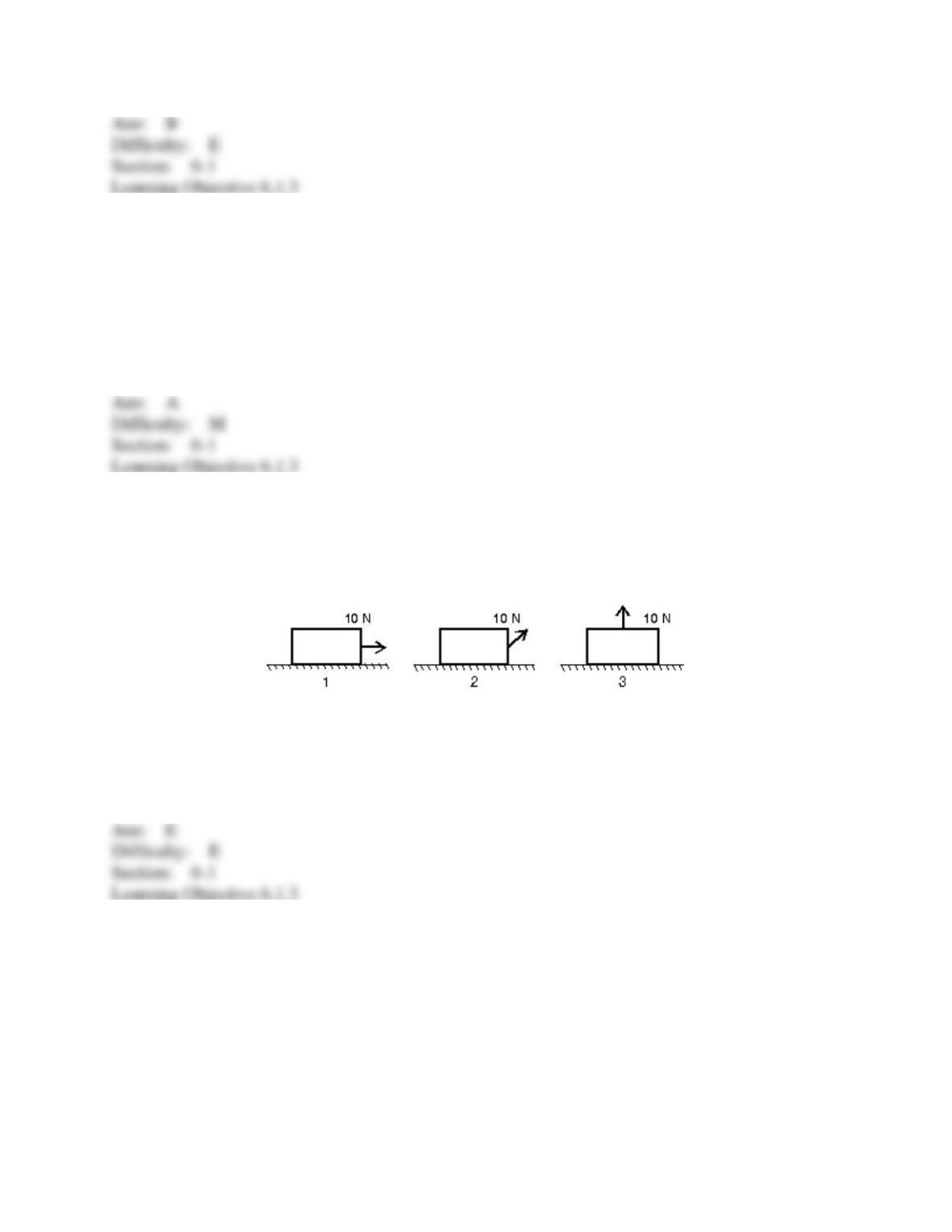
11. A crate rests on a horizontal surface and a woman pulls on it with a 10-N force. No
matter what the orientation of the force, the crate does not move. Rank the situations shown
below according to the magnitude of the frictional force of the surface on the crate, least to
greatest.
A) 1, 2, 3
B) 2, 1, 3
C) 2, 3, 1
D) 1, 3, 2
E) 3, 2, 1
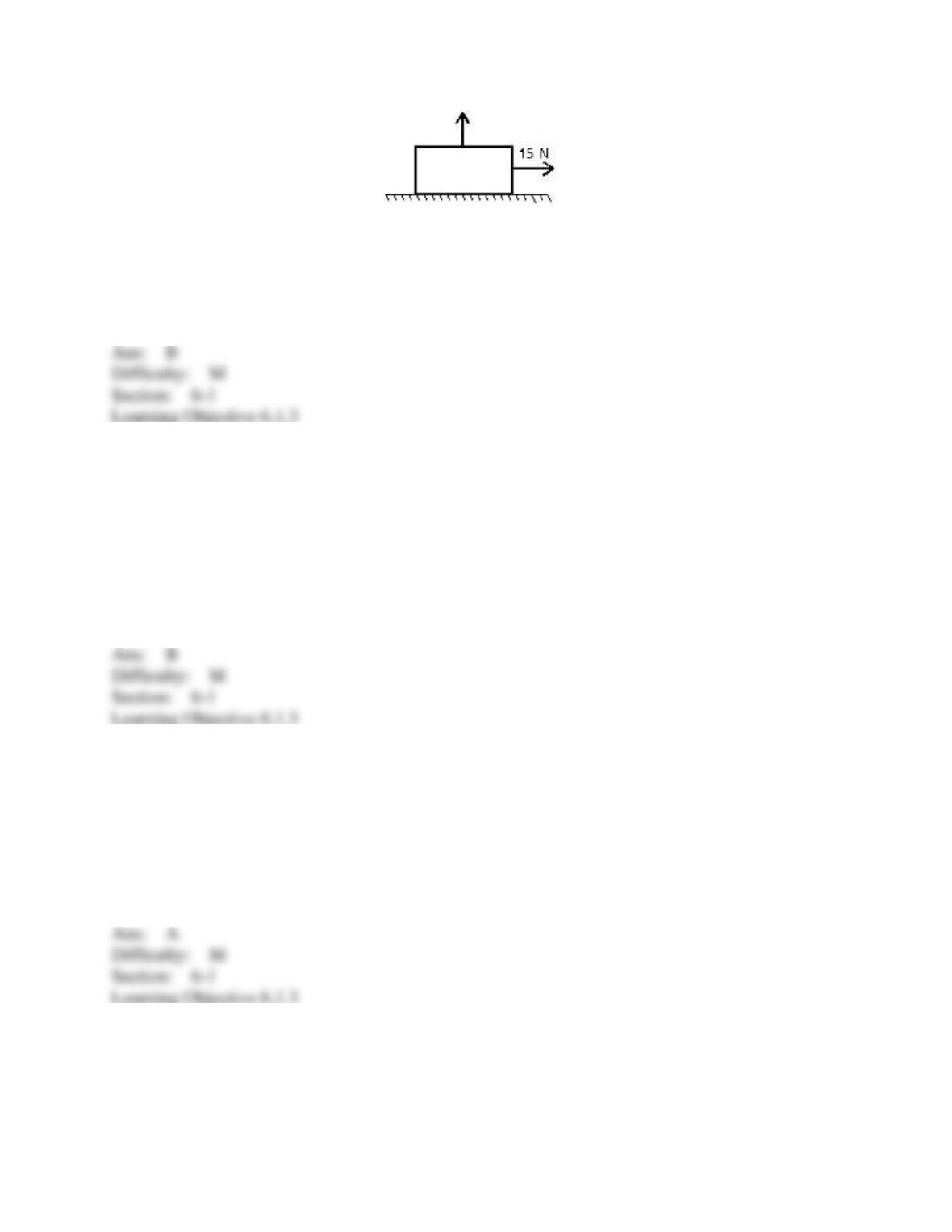
12. A box with a weight of 50 N rests on a horizontal surface. A person pulls horizontally on it
with a force of 15 N and it does not move. To start it moving, a second person pulls vertically
upward on the box. If the coefficient of static friction is 0.4, what is the smallest vertical force
for which the box moves?
A) 5 N
B) 12 N
C) 20 N
D) 25 N
E) 35 N
13. A bureau rests on a rough horizontal surface (
s = 0.50,
k = 0.40). A constant horizontal
force, just sufficient to start the bureau in motion, is then applied. The acceleration of the bureau
is:
A) 0 m/s2
B) 0.98 m/s2
C) 3.9 m/s2
D) 4.9 m/s2
E) 8.8 m/s2
14. A car is traveling at 15 m/s on a horizontal road. The brakes are applied and the car skids to
a stop in 4.0 s. The coefficient of kinetic friction between the tires and road is:
A) 0.38
B) 0.69
C) 0.76
D) 0.92
E) 3.75
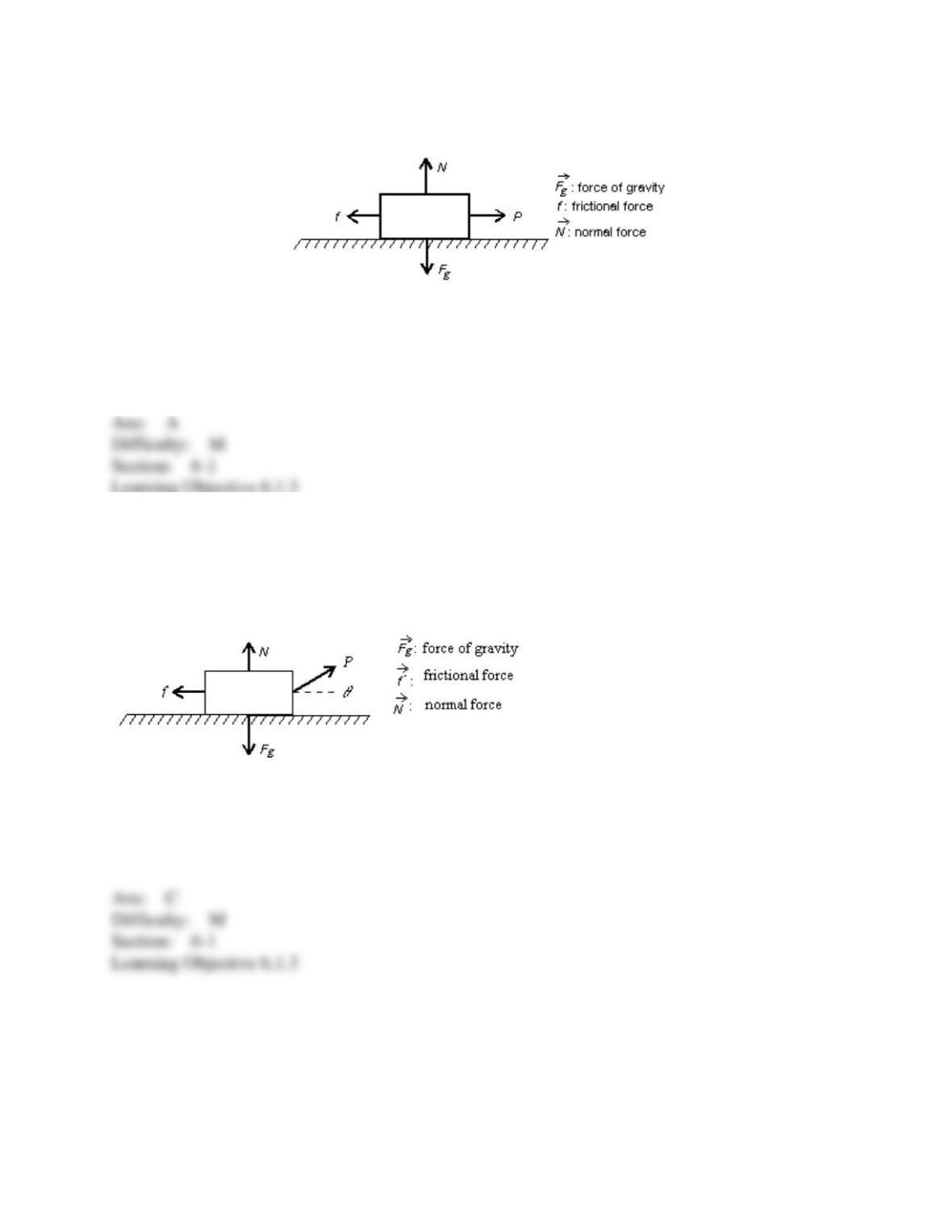
15. A boy pulls a wooden box along a rough horizontal floor at constant speed by means of a
force 𝑃
⃗
⃗
as shown. In the diagram f is the magnitude of the force of friction, N is the magnitude
of the normal force, and Fg is the magnitude of the force of gravity. Which of the following must
be true?
A) P = f and N = Fg
B) P = f and N > Fg
C) P > f and N < Fg
D) P > f and N = Fg
E) none of these
16. A boy pulls a wooden box along a rough horizontal floor at constant speed by means of a
force 𝑃
⃗
⃗
as shown. In the diagram f is the magnitude of the force of friction, N is the magnitude
of the normal force, and Fg is the magnitude of the force of gravity. Which of the following
must be true?
A) P = f and N = Fg
B) P = f and N > Fg
C) P > f and N < Fg
D) P > f and N = Fg
E) none of these
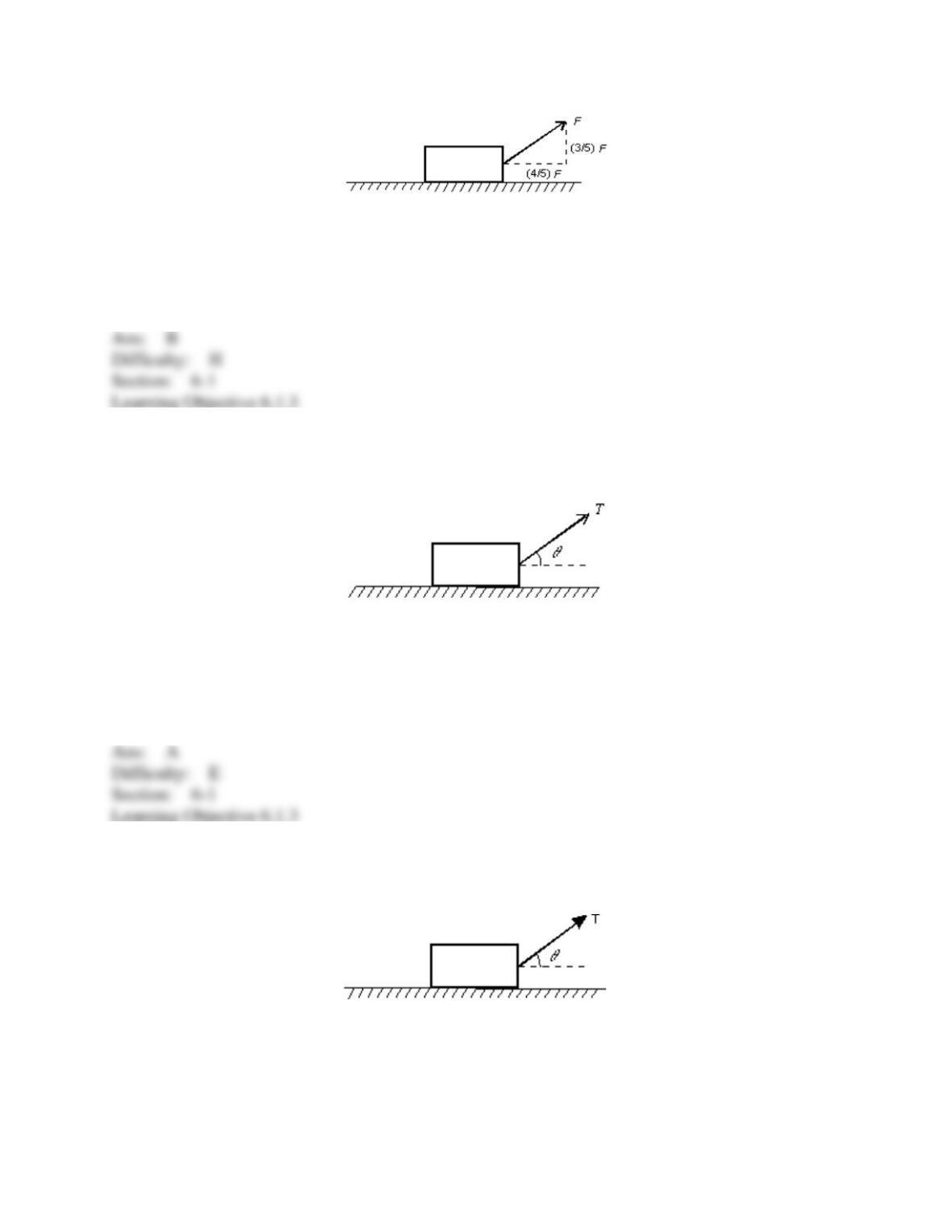
17. A 400-N block is dragged along a horizontal surface by an applied force 𝐹
⃗ as shown. The
coefficient of kinetic friction is uk = 0.4 and the block moves at constant velocity. The magnitude
of 𝐹
⃗ is:
A) 100 N
B) 150 N
C) 200 N
D) 290 N
E) 400 N
18. A block of mass m is pulled at constant velocity along a rough horizontal floor by an
applied force 𝑇
⃗
⃗
as shown. The magnitude of frictional force is:
A) T cos
B) T sin
C) 0
D) mg
E) mg cos
19. A block of mass m is pulled along a rough horizontal floor by an applied force 𝑇
⃗
⃗
as
shown. The vertical component of the force exerted on the block by the floor is:
A) mg
B) mg – T cos
C) mg + T cos
D) mg – T sin
E) mg + T sin
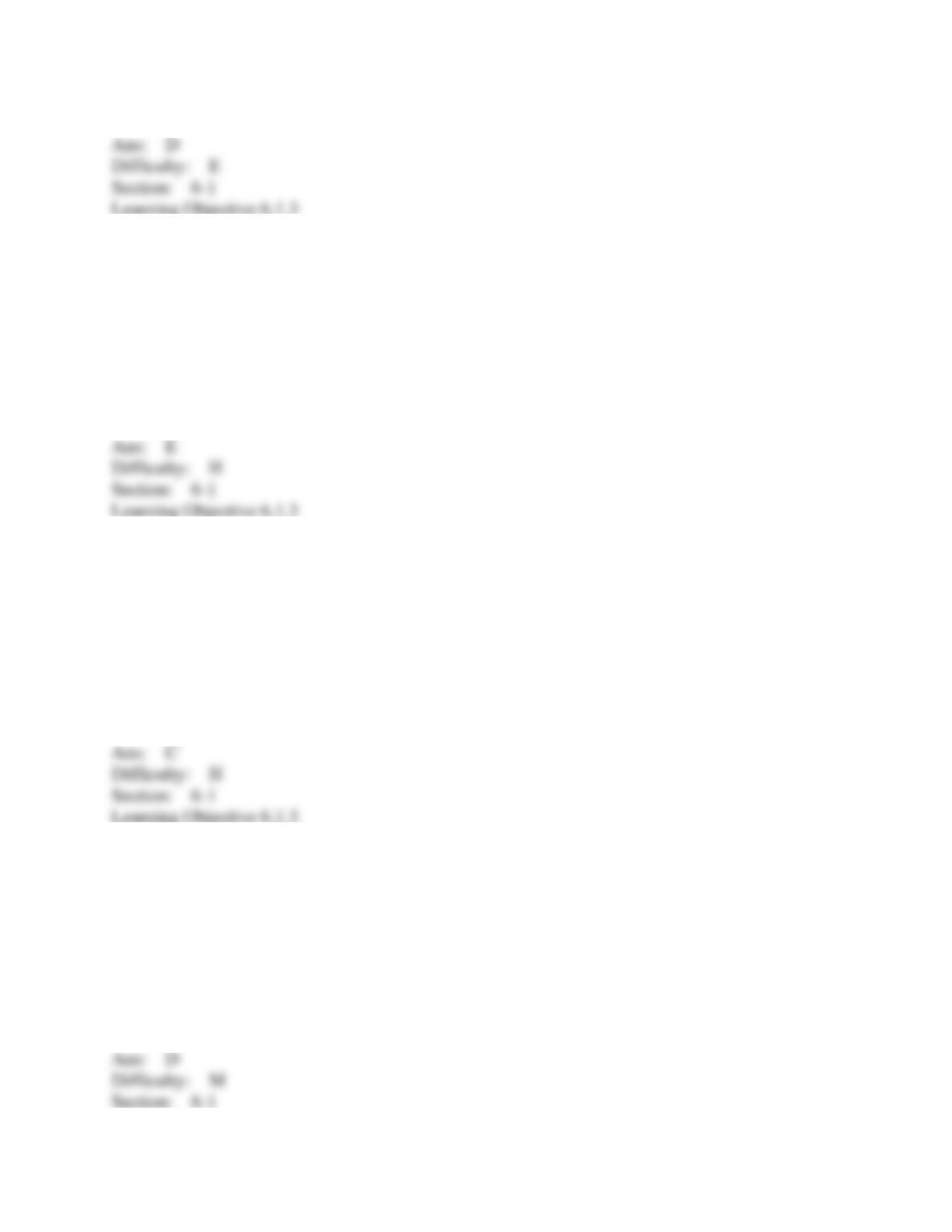
20. A 12-kg crate rests on a horizontal surface and a boy pulls on it with a force that is 30
below the horizontal. If the coefficient of static friction is 0.40, the minimum magnitude force he
needs to start the crate moving is:
A) 44 N
B) 47 N
C) 54 N
D) 56 N
E) 71 N
21. A crate resting on a rough horizontal floor is to be moved horizontally. The coefficient of
static friction is 0.40. To start the crate moving with the weakest possible applied force, in what
direction should the force be applied?
A) Horizontal
B) 24 below the horizontal
C) 22 above the horizontal
D) 24 above the horizontal
E) 66 below the horizontal
22. A 50-N force is applied to a crate on a horizontal rough floor, causing it to move
horizontally. If the coefficient of kinetic friction is 0.50, in what direction should the force be
applied to obtain the greatest acceleration?
A) Horizontal
B) 60 above the horizontal
C) 30 above the horizontal
D) 27 above the horizontal
E) 30 below the horizontal
23. A horizontal force of 12 N pushes a 0.50-kg book against a vertical wall. The book is
initially at rest. If the coefficients of friction are
s = 0.60 and
k = 0.50 which of the following
is true?
A) The frictional force is 4.9 N
B) The frictional force is 7.2 N
C) The normal force is 4.9 N
D) The block will start moving and accelerate
E) If started moving downward, the block will accelerate
24. A horizontal force of 5.0 N pushes a 0.50-kg block against a vertical wall. The block is
initially at rest. If
s = 0.60 and
k = 0.50, the frictional force after a period of time is:
A) 0 N
B) 2.5 N
C) 3.0 N
D) 4.0 N
E) 4.9 N
25. A horizontal force of 12 N pushes a 0.50-kg book against a vertical wall. The book is
initially at rest. If
s = 0.60 and
k = 0.50, the acceleration of the book is:
A) 0 m/s2
B) 9.4 m/s2
C) 9.8 m/s2
D) 14.4 m/s2
E) 19.2 m/s2
26. A horizontal force of 5.0 N pushes a 0.50-kg block against a vertical wall. The block is
initially at rest. If
s = 0.60 and
k = 0.50, the acceleration of the block is:
A) 0 m/s2
B) 3.8 m/s2
C) 4.8 m/s2
D) 8.0 m/s2
E) 9.8 m/s2
27. A box rests on a rough board 10 meters long. When one end of the board is slowly raised to
a height of 6 meters above the other end, the box begins to slide. The coefficient of static friction
is:
A) 0.8
B) 0.25
C) 0.4
D) 0.6
E) 0.75
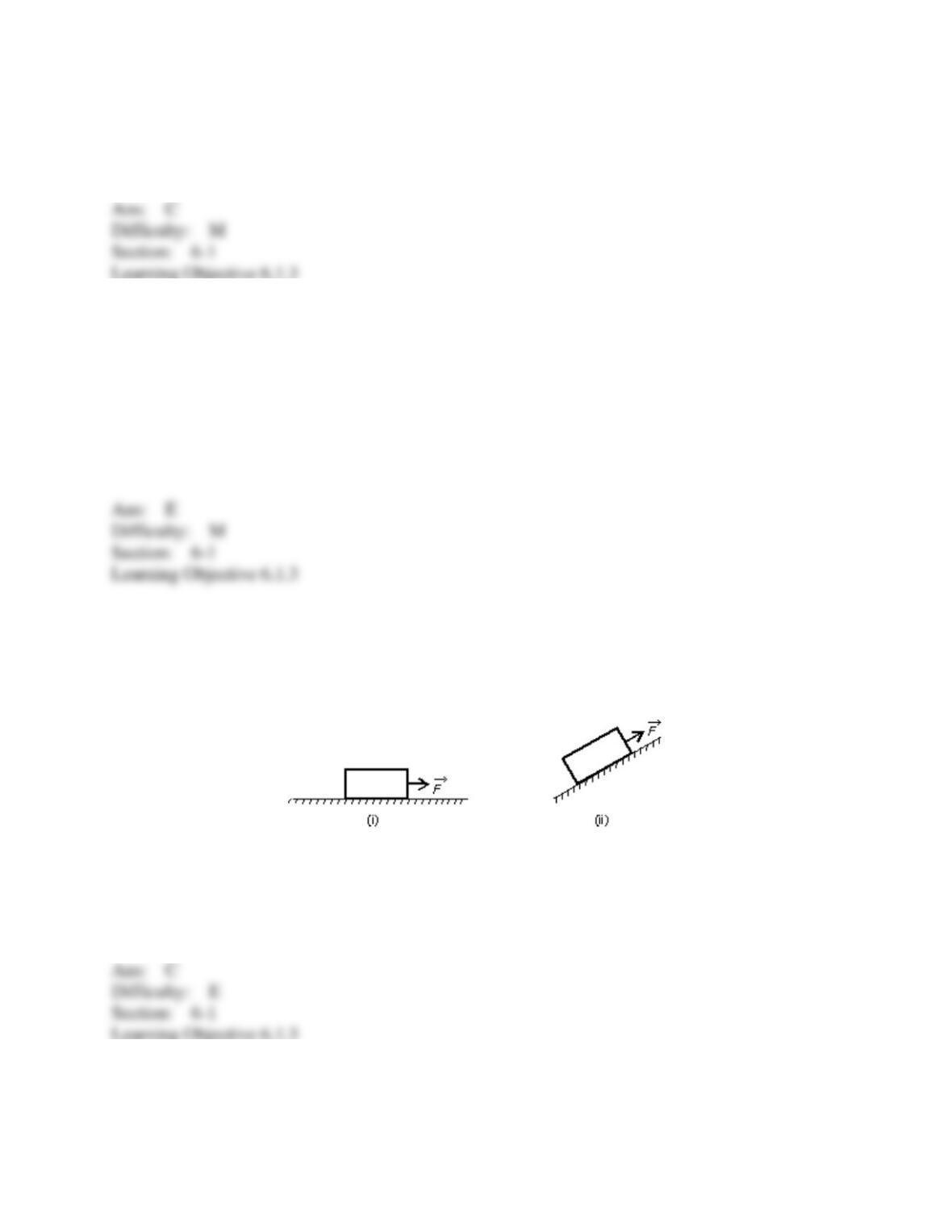
28. The same heavy wooden block is dragged by a force 𝐹
⃗ along a rough steel plate, as shown
below for two possible situations. The magnitude of the acceleration is the same for the two
situations; do not assume that the magnitude of 𝐹
⃗ is the same. The magnitude of the frictional
force in (ii), as compared with that in (i) is:
A) the same
B) greater
C) less
D) less for some angles and greater for others
E) can be less or greater, depending on the magnitude of the applied force.
29. A block is first placed on its long side and then on its short side on the same inclined plane.
The block slides down the plane on its short side but remains at rest on its long side. A possible
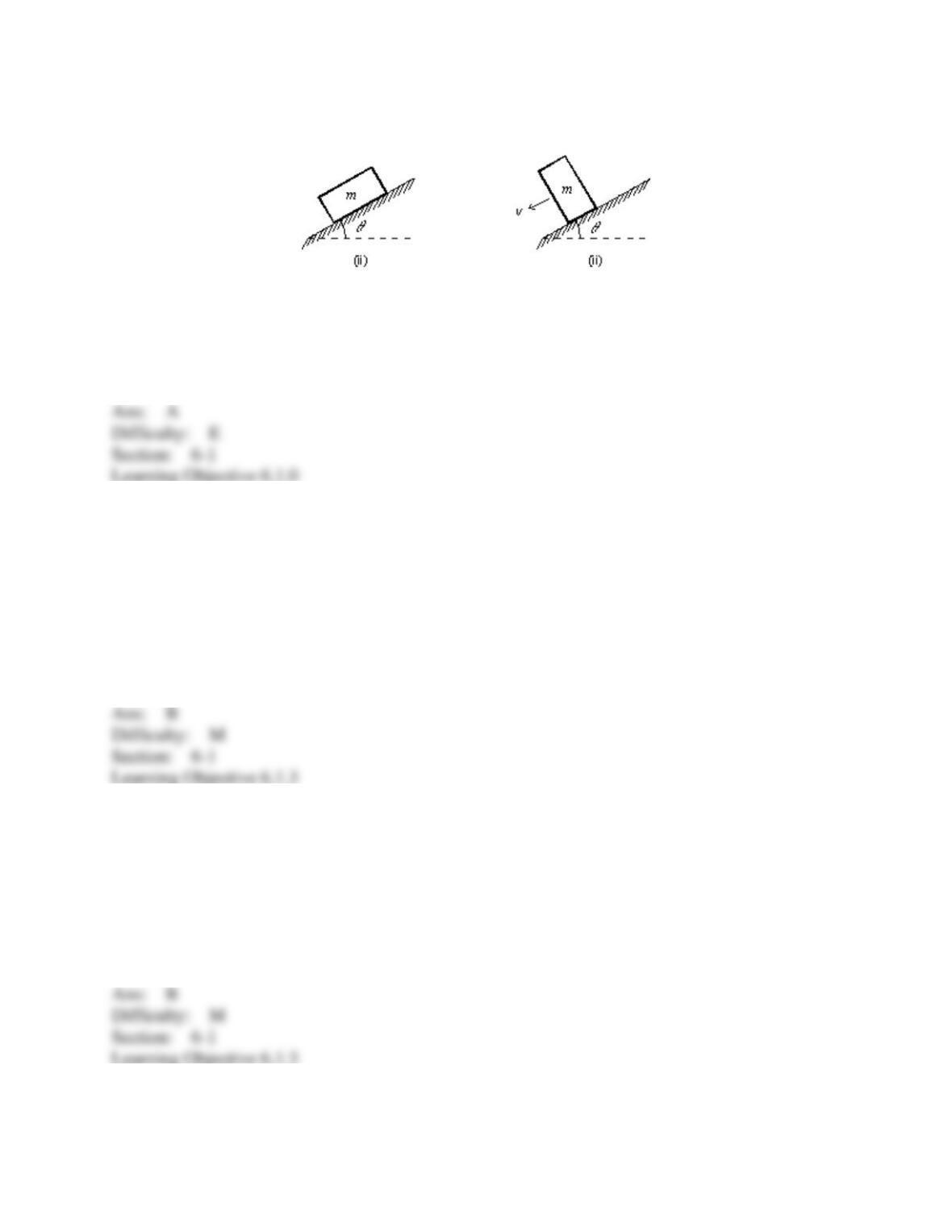
explanation is:
A) the short side is smoother
B) the frictional force is less because the contact area is less
C) the center of gravity is higher in the second case
D) the normal force is less in the second case
E) the force of gravity is more nearly down the plane in the second case
30. A block is placed on a rough wooden plane. It is found that when the plane is tilted 30 to
the horizontal, the block will slide down at constant speed. The coefficient of kinetic friction of
the block with the plane is:
A) 0.500
B) 0.577
C) 1.73
D) 0.866
E) 4.90
31. A crate is sliding down an incline that is 35 above the horizontal. If the coefficient of
kinetic friction is 0.40, the acceleration of the crate is:
A) 0 m/s2
B) 2.4 m/s2
C) 3.9 m/s2
D) 5.6 m/s2
E) 8.8 m/s2
32. A 5.0-kg crate is resting on a horizontal plank. The coefficient of static friction is 0.50 and
the coefficient of kinetic friction is 0.40. After one end of the plank is raised so the plank makes
an angle of 25 with the horizontal, the force of friction is:
A) 0 N
B) 20 N
C) 21 N
D) 22 N
E) 44 N
33. A 5.0-kg crate is resting on a horizontal plank. The coefficient of static friction is 0.50 and
the coefficient of kinetic friction is 0.40. After one end of the plank is raised so the plank makes
an angle of 30 with the horizontal, the force of friction is:
A) 0 N
B) 17 N
C) 20 N
D) 25 N
E) 49 N
34. A 5.0-kg crate is on an incline that makes an angle of 30 with the horizontal. If the
coefficient of static friction is 0.50, the minimum force that can be applied parallel to the plane to
hold the crate at rest is:
A) 0 N
B) 3.3 N
C) 21 N
D) 25 N
E) 46 N
35. A 5.0-kg crate is on an incline that makes an angle 30 with the horizontal. If the
coefficient of static friction is 0.5, the maximum force that can be applied parallel to the plane
without moving the crate is:
A) 0 N
B) 3.3 N
C) 21 N
D) 46 N
E) 55 N
36. Block A, with mass mA, is initially at rest on a horizontal floor. Block B, with mass mB, is
initially at rest on the horizontal top surface of A. The coefficient of static friction between the
two blocks is
s. Block A is pulled with a horizontal force. It begins to slide out from under B if
the force is greater than:
A) mAg
B) mBg
C)
smAg
D)
smBg
E)
s ( mA + mB)g
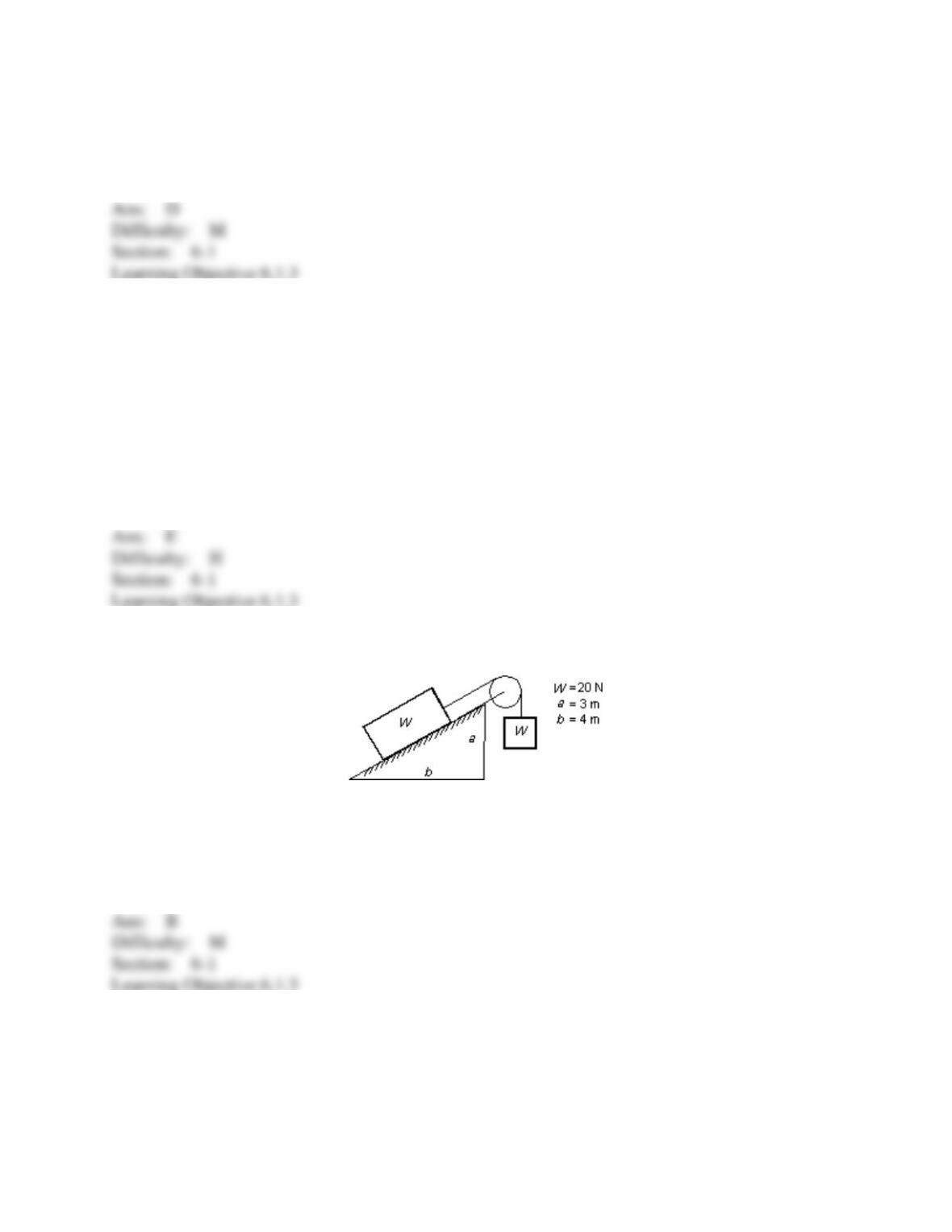
37. The system shown remains at rest. The force of friction on the block on the slope is:
A) 4 N
B) 8 N
C) 12 N
D) 16 N
E) 20 N
38. Block A, with a mass of 50 kg, rests on a horizontal table top. The coefficient of static
friction is 0.40. A horizontal string is attached to A and passes over a massless, frictionless
pulley as shown. The smallest mass mB of block B, attached to the dangling end, that will start A
moving when it is attached to the other end of the string is: