Chapter: Chapter 42
Learning Objectives
LO 42.1.0 Solve problems related to discovering the nucleus.
LO 42.1.1 Explain the general arrangement for Rutherford scattering and what was learned from
it.
LO 42.1.2 In a Rutherford scattering arrangement, apply the relationship between the projectile’s
initial kinetic energy and the distance of its closest approach to the target nucleus.
LO 42.2.0 Solve problems related to some nuclear properties.
LO 42.2.1 Identify nuclides, atomic number (or proton number), neutron number, mass number,
nucleon, isotope, disintegration, neutron excess, isobar, zone of stable nuclei, and island of
stability and explain the symbols used for nuclei (such as 197Au).
LO 42.2.2 Sketch a graph of proton number versus neutron number and identify the approximate
location of the stable nuclei, the proton-rich nuclei, and the neutron-rich nuclei.”
LO 42.2.3 For spherical nuclei, apply the relationship between radius and mass number and
calculate the nuclear density.
LO 42.2.4 Work with masses in atomic mass units, relate the mass number and the approximate
nuclear mass, and convert between mass units and energy.
LO 42.2.5 Calculate mass excess.
LO 42.2.6 For a given nucleus, calculate the binding energy ΔEbe and the binding energy per
nucleon ΔEben, and explain the meaning of each term.
LO 42.2.7 Sketch a graph of the binding energy per nucleon versus mass number, indicating the
nuclei that are the most tightly bound, those that can undergo fission with a release of energy,
and those that can undergo fusion with a release of energy.
LO 42.2.8 Identify the force that holds nucleons together.
LO 42.3.0 Solve problems related to radioactive decay.
LO 42.3.1 Explain what is meant by radioactive decay and identify that it is a random process.
LO 42.3.2 Identify disintegration constant (or decay constant) λ.
LO 42.3.3 Identify that, at any given instant, the rate dN/dt at which radioactive nuclei decay is
proportional to the number N of them still present then.
LO 42.3.4 Apply the relationship that gives the number N of radioactive nuclei as a function of
time.
LO 42.3.5 Apply the relationship that gives the decay rate R of radioactive nuclei as a function of
time.
LO 42.3.6 For any given time, apply the relationship between the decay rate R and the remaining
number N of radioactive nuclei.
LO 42.3.7 Identify activity.
LO 42.3.8 Distinguish Becquerel (Bq), curie (Ci), and counts per unit time.
LO 42.3.9 Distinguish half-life T1/2 and mean life τ.
LO 42.3.10 Apply the relationship between half-life T1/2, mean life τ, and disintegration constant
λ.
LO 42.3.11 Identify that in any nuclear process, including radioactive decay, the charge and the
number of nucleons are conserved.

LO 42.4.0 Solve problems related to alpha decay.
LO 42.4.1 Identify alpha particle and alpha decay.
LO 42.4.2 For a given alpha decay, calculate the mass change and the Q of the reaction.
LO 42.4.3 Determine the change in atomic number Z and mass number A of a nucleus
undergoing alpha decay.
LO 42.4.4 In terms of the potential barrier, explain how an alpha particle can escape from a
nucleus with less energy than the barrier height.
LO 42.5.0 Solve problems related to beta decay.
LO 42.5.1 Identify the two types of beta particles and the two types of beta decay.
LO 42.5.2 Identify neutrino.
LO 42.5.3 Explain why the beta particles in beta decays are emitted with a range of energies.
LO 42.5.4 For a given beta decay, calculate the mass change and the Q of the reaction.
LO 42.5.5 Determine the change in the atomic number Z of a nucleus undergoing a beta decay
and identify that the mass number A does not change.
LO 42.6.0 Solve problems related to radioactive dating.
LO 42.6.1 Apply the equations for radioactive decay to determine the age of rocks and
archaeological materials.
LO 42.6.2 Explain how radiocarbon dating can be used to date the age of biological samples.
LO 42.7.0 Solve problems related to measuring radiation dosage.
LO 42.7.1 Identify absorbed dose, dose equivalent, and the associated units.
LO 42.7.2 Calculate absorbed dose and dose equivalent.
LO 42.8.0 Solve problems related to nuclear models.
LO 42.8.1 Distinguish the collective model and the independent model, and explain the
combined model.
LO 42.8.2 Identify compound nucleus.
LO 42.8.3 Identify magic numbers.
Multiple Choice
1. The Rutherford scattering experiment showed that:
A) light has both particle-like and wavelike properties
B) atoms are electrically neutral
C) the positive and negative charges in the atom are uniformly distributed throughout its volume
D) the wavelength of scattered light depends on the scattering angle
E) the atom consists of a very tiny, massive, positively charged nucleus surrounded by almost
empty space
2. In the Rutherford scattering experiment, an alpha particle is aimed directly at a gold nucleus.
The distance of closest approach of the alpha particle to the nucleus occurs when:
A) the alpha particle hits the nucleus
B) the alpha particle hits the electron cloud
C) the kinetic energy of the alpha particle is completely transformed to potential energy due to
the nuclear force
D) the kinetic energy of the alpha particle is completely transformed to potential energy due to
the electric field of the nucleus
E) the kinetic energy of the alpha particle is completely transformed to potential energy due to
the electric field of the electrons
3. The smallest particle of any chemical element that can exist by itself and yet retain the
qualities that distinguish it as that element is:
A) an electron
B) a proton
C) a neutron
D) an atom
E) a molecule
4. A femtometer is:
A) larger than 10–9 m
B) 10–9 m
C) 10–12 m
D) 10–15 m
E) 10–18 m
5. The atomic number of an element is:
A) the whole number nearest to its mass
B) the number of protons in its nucleus
C) the nearest whole number of hydrogen atoms having the same mass as a single atom of the
given element
D) the number of neutrons in its nucleus
E) its order of discovery
6. Iron has atomic number 26. Naturally mined iron contains isotopes of mass numbers 54, 56,
57, and 58. Which of the following statements is FALSE?
A) every atom of iron has 26 protons
B) some iron atoms have 30 neutrons
C) some iron atoms have 54 neutrons
D) the isotopes may be separated in a mass spectrometer
E) there are four kinds of naturally occurring iron atoms with the same chemical properties
7. Let Z denote the atomic number and A denote the mass number of a nucleus. The number of
neutrons in this nucleus is:
A) Z
B) A – Z
C) A – 2Z
D) A
E) 2A – Z
8. The isotopes of an element:
A) cannot be separated at all
B) occur well separated in nature
C) have similar chemical behavior
D) cannot be separated by physical methods
E) have equal masses
9. Bromine, with atomic mass 79.942 u, is composed of nearly equal amounts of two isotopes,
one of which contains 79 nucleons per atom. The mass number of the other isotope is:
A) 78
B) 79
C) 80
D) 81
E) 82
10. Stable nuclei generally:
A) have a greater number of protons than neutrons
B) have low mass numbers
C) have high mass numbers
D) are beta emitters
E) none of the above
11. Let A be the mass number and Z be the atomic number of a nucleus. Which of the
following is approximately correct for light nuclei?
A) Z = 2A
B) Z = A
C) Z = A/2
D) Z =√𝐴
E) Z = A2
12. Which of the following nuclides is least stable?
A) 52Fe (Z = 26)
B) 115Nd (Z = 60)
C) 175Lu (Z = 71)
D) 208Pb (Z = 82)
E) 238U (Z = 92)
13. The mass density of an atomic nucleus:
A) is about 1015 kg/m3
B) is about 1012 kg/m3
C) increases with increasing nuclear mass
D) increases with decreasing nuclear radius
E) is roughly constant independent of atomic number
14. Volumes of atomic nuclei are proportional to:
A) the mass number
B) the atomic number
C) the total nuclear spin
D) the number of neutrons
E) none of these
15. A nucleus with a mass number of 64 has a mean radius of about:
A) 4.8 fm
B) 9.6 fm
C) 77 fm
D) 260 fm
E) 2.6 105 fm
16. 1 atomic mass unit is about:
A) 1.66 10–31 kg
B) 9.11 10–31 kg
C) 1.66 10–27 kg
D) 9.11 10–27 kg
E) 1.66 10–25 kg
17. The binding energy of a nucleus is the energy that must be supplied to:
A) remove a nucleon
B) remove an alpha particle
C) remove a beta particle
D) separate the nucleus into its constituent nucleons
E) separate the nucleus into a collection of alpha particles
18. If a nucleus has mass M, Z protons (mass mp) and N neutrons (mass mn) its binding energy
is equal to:
A) Mc2
B) (M – Zmp – Nmn)c2
C) (Zmp + Nmn – M)c2
D) (Zmp + Nmn)c2
E) (Zmp – M)c2
19. The greatest binding energy per nucleon occurs for nuclides with masses near that of:
A) helium
B) sodium
C) iron
D) mercury
E) uranium
20. A proton in a large nucleus:
A) has a net attractive force on all other protons in the nucleus
B) has a net repulsive force on all other protons in the nucleus
C) has a net repulsive force on all other neutrons in the nucleus
D) has a net attractive force on some protons in the nucleus and a net repulsive force on others
E) has a net attractive force on some neutrons in the nucleus and a net repulsive force on others
21. Two protons are separated by 10–16 m. The nuclear (N), electrostatic (E), and gravitational
(G) forces between these protons when written in order of increasing strength are:
A) N, E, G
B) N, G, E
C) G, E, N
D) G, N, E
E) E, G, N
22. Two protons are about 10–10 m apart. Their relative motion is chiefly determined by:
A) gravitational forces
B) electrical forces
C) nuclear forces
D) magnetic forces
E) torque due to electric dipole moments
23. The half-life of a given nuclear disintegration A → B:
A) depends on the initial number of A atoms
B) depends on the initial number of B atoms
C) is an exponentially increasing function of time
D) is an exponentially decreasing function of time
E) none of the above
24. Possible units for the disintegration constant are:
A) kg/s
B) s/kg
C) hour
D) day–1
E) cm–1
25. A large collection of nuclei are undergoing alpha decay. The rate of decay at any instant is
proportional to:
A) the number of undecayed nuclei present at that instant
B) the time since the decays started
C) the time remaining before all have decayed
D) the half-life of the decay
E) the average time between decays
26. Which expression correctly describes the radioactive decay of a substance whose half-life
is T?
A) N(t) = N0e–(t ln2)/T
B) N(t) = N0e–t/T
C) N(t) = N0e–tT
D) N(t) = N0e–tT ln2
E) N(t) = N0e–t/T ln2
27. Radioactive element A decays to the stable element B with a half-life T. Starting with a
sample of pure A and no B, which graph below most correctly shows the number of A atoms, NA,
as a function of time t?
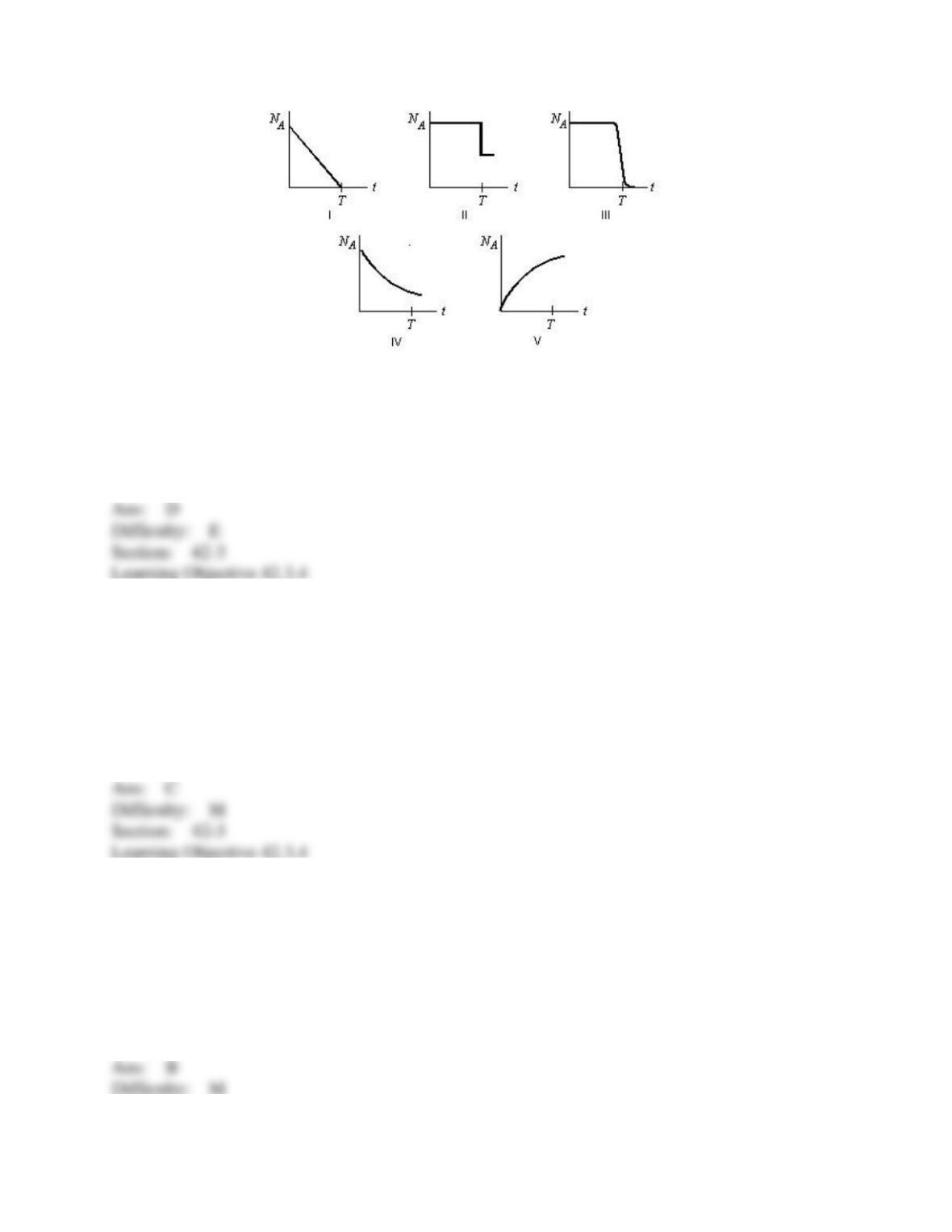
A) I
B) II
C) III
D) IV
E) V
28. The half-life of radium is about 1600 years. If a rock initially contains 1 g of radium, the
amount left after 8000 years will be about:
A) 200 mg
B) 63 mg
C) 31 mg
D) 16 mg
E) less than 1 mg
29. Starting with a sample of pure 66Cu, 7/8 of it decays into Zn in 15 minutes. The
corresponding half-life is:
A) 3.75 minutes
B) 5 minutes
C) 7 minutes
D) 10 minutes
E) 15 minutes
30. 210Bi (an isotope of bismuth) has a half-life of 5.0 days. The time for three-quarters of a
sample of 210Bi to decay is:
A) 2.5 days
B) 3.75 days
C) 10 days
D) 15 days
E) 20 days
31. Radioactive 90Sr has a half-life of 30 years. What percent of a sample of 90Sr will remain
after 60 years?
A) 0%
B) 14%
C) 25%
D) 50%
E) 75%
32. The half-life of a radioactive isotope is 6.5 h. If there are initially 48 1032 atoms of this
isotope, the number of atoms of this isotope remaining after 26 h is:
A) 12 1032
B) 6 1032
C) 3 1032
D) 6 104
E) 3 102
33. At the end of 14 min, 1/16 of a sample of radioactive polonium remains. The corresponding
half-life is:
A) (7/8) min
B) (8/7) min