Chapter: Chapter 36
Learning Objectives
LO 36.1.0 Solve problems related to single-slit diffraction.
LO 36.1.1 Describe the diffraction of light waves by a narrow opening and an edge, and also
describe the resulting interference pattern.
LO 36.1.2 Describe an experiment that demonstrates the Fresnel bright spot.
LO 36.1.3 With a sketch, describe the arrangement for a single-slit diffraction experiment.
LO 36.1.4 With a sketch, explain how splitting a slit width into equal zones leads to the
equations giving the angles to the minima in the diffraction pattern.
LO 36.1.5 Apply the relationships between width a of a thin, rectangular slit or object, the
wavelength λ, the angle θ to any of the minima in the diffraction pattern, the distance to a
viewing screen, and the distance between a minimum and the center of the pattern.
LO 36.1.6 Sketch the diffraction pattern for monochromatic light, identifying what lies at the
center and what the various bright and dark fringes are called (such as “first minimum”).
LO 36.1.7 Identify what happens to a diffraction pattern when the wavelength of the light or the
width of the diffracting aperture or object is varied.
LO 36.2.0 Solve problems related to intensity in single-slit diffraction.
LO 36.2.1 Divide a thin slit into multiple zones of equal width and write an expression for the
phase difference of the wavelets from adjacent zones in terms of the angle θ to a point on the
viewing screen.
LO 36.2.2 For single-slit diffraction, draw phasor diagrams for the central maximum and several
of the minima and maxima off to one side, indicating the phase difference between adjacent
phasors, explaining how the net electric field is calculated, and identifying the corresponding
part of the diffraction pattern.
LO 36.2.3 Describe a diffraction pattern in terms of the net electric field at points in the pattern.
LO 36.2.4 Evaluate α, the convenient connection between angle θ to a point in a diffraction
pattern and the intensity I at that point.
LO 36.2.5 For a given point in a diffraction pattern, at a given angle, calculate the intensity I in
terms of the intensity Im at the center of the pattern.
LO 36.3.0 Solve problems related to diffraction by a circular aperture.
LO 36.3.1 Describe and sketch the diffraction pattern from a small circular aperture or obstacle.
LO 36.3.2 For diffraction by a small circular aperture or obstacle, apply the relationships
between the angle θ to the first minimum, the wavelength λ of the light, the diameter d of the
aperture, the distance D to a viewing screen, and the distance y between the minimum and the
center of the diffraction pattern.
LO 36.3.3 By discussing the diffraction patterns of point objects, explain how diffraction limits
visual resolution of objects.
LO 36.3.4 Identify that Rayleigh’s criterion for resolvability gives the (approximate) angle at
which two point objects are just barely resolvable.
LO 36.3.5 Apply the relationships between the angle θR in Rayleigh’s criterion, the wavelength λ
of the light, the diameter d of the aperture (for example, the diameter of the pupil of an eye), the
angle θ subtended by two distant point objects, and the distance L to those objects.
LO 36.4.0 Solve problems related to diffraction by a double slit.
LO 36.4.1 In a sketch of a double-slit experiment, explain how the diffraction through each slit
modifies the two-slit interference pattern, and identify the diffraction envelope, the central peak,
and the side peaks of that envelope.
LO 36.4.2 For a given point in a double-slit diffraction pattern, calculate the intensity I in terms
of the intensity Im at the center of the pattern.
LO 36.4.3 In the intensity equation for a double-slit diffraction pattern, identify what part
corresponds to the interference between the two slits and what part corresponds to the diffraction
by each slit.
LO 36.4.4 For double-slit diffraction, apply the relationship between the ratio d/a and the
locations of the diffraction minima in the single-slit diffraction pattern, and then count the
number of two-slit maxima that are contained in the central peak and in the side peaks of the
diffraction envelope.
LO 36.5.0 Solve problems related to diffraction gratings.
LO 36.5.1 Describe a diffraction grating and sketch the interference pattern it produces in
monochromatic light.
LO 36.5.2 Distinguish the interference patterns of a diffraction grating and a double-slit
arrangement.
LO 36.5.3 Identify the terms line and order number.
LO 36.5.4 For a diffraction grating, relate order number m to the path length difference of rays
that give a bright fringe.
LO 36.5.5 For a diffraction grating, relate the slit separation d, the angle θ to a bright fringe in
the pattern, the order number m of that fringe, and the wavelength λ of the light.
LO 36.5.6 Identify the reason why there is a maximum order number for a given diffraction
grating.
LO 36.5.7 Explain the derivation of the equation for a line’s half-width in a diffraction-grating
pattern.
LO 36.5.8 Calculate the half-width of a line at a given angle in a diffraction-grating pattern.
LO 36.5.9 Explain the advantage of increasing the number of slits in a diffraction grating.
LO 36.5.10 Explain how a grating spectroscope works.
LO 36.6.0 Solve problems related to gratings: dispersion and resolving power.
LO 36.6.1 Identify dispersion as the spreading apart of the diffraction lines associated with
different wavelengths.
LO 36.6.2 Apply the relationships between dispersion D, wavelength difference Δλ, angular
separation Δθ, slit separation d, order number m, and the angle θ corresponding to the order
number.
LO 36.6.3 Identify the effect on the dispersion of a diffraction grating if the slit separation is
varied.
LO 36.6.4 Identify that for us to resolve lines, a diffraction grating must make them
distinguishable.
LO 36.6.5 Apply the relationship between resolving power R, wavelength difference Δλ, average
wavelength λavg, number of rulings N, and order number m.
LO 36.6.6 Identify the effect on the resolving power R if the number of slits N is increased.
LO 36.7.0 Solve problems related to x-ray diffraction.
LO 36.7.1 Identify approximately where x rays are located in the electromagnetic spectrum.
LO 36.7.2 Define a unit cell.
LO 36.7.3 Define reflecting planes (or crystal planes) and interplanar spacing.
LO 36.7.4 Sketch two rays that scatter from adjacent planes, showing the angle that is used in
calculations.
LO 36.7.5 For the intensity maxima in x-ray scattering by a crystal, apply the relationship
between the interplanar spacing d, the angle θ of scattering, the order number m, and the
wavelength λ of the x rays.
LO 36.7.6 Given a drawing of a unit cell, demonstrate how an interplanar spacing can be
determined.
Multiple Choice
1. Sound differs from light in that sound:
A) is not subject to diffraction
B) is a torsional wave rather than a longitudinal wave
C) does not require energy for its origin
D) is a longitudinal wave rather than a transverse wave
E) is always monochromatic
2. Radio waves are readily diffracted around buildings whereas light waves are negligibly
diffracted around buildings. This is because radio waves:
A) are plane polarized
B) have much longer wavelengths than light waves
C) have much shorter wavelengths than light waves
D) are nearly monochromatic (single frequency)
E) are amplitude modulated (AM)
3. Diffraction plays an important role in which of the following phenomena?
A) The sun appears as a disk rather than a point to the naked eye
B) Light is bent as it passes through a glass prism
C) A cheerleader yells through a megaphone
D) A farsighted person uses eyeglasses of positive focal length
E) A thin soap film exhibits colors when illuminated with white light
4. The rainbow seen after a rain shower is caused by:
A) diffraction
B) interference
C) refraction
D) polarization
E) absorption
5. When a highly coherent beam of light is directed against a very fine wire, the shadow
formed behind it is not just that of a single wire but rather looks like the shadow of several
parallel wires. The explanation of this involves:
A) refraction
B) diffraction
C) reflection
D) Doppler effect
E) an optical illusion
6. When the atmosphere is not quite clear, one may sometimes see colored circles concentric
with the Sun or the Moon. These are generally not more than a few diameters of the Sun or
Moon and invariably the innermost ring is blue. The explanation for these phenomena involves:
A) reflection
B) refraction
C) interference
D) diffraction
E) Doppler effect
7. The shimmering or wavy lines that can often be seen near the ground on a hot day are due
to:
A) Brownian movement
B) reflection
C) refraction
D) diffraction
E) dispersion
8. In order to obtain a single-slit diffraction pattern with a central maximum and several
secondary maxima, the slit width could be:
A)
B)
/10
C) 10
D) 104
E)
/104
9. A point source of monochromatic light is placed in front of a soccer ball and a screen is
placed behind the ball. The light intensity pattern on the screen is best described as:
A) a dark disk on a bright background
B) a dark disk with bright rings outside
C) a dark disk with a bright spot at its center
D) a dark disk with a bright spot at its center and bright rings outside
E) a bright disk with bright rings outside
10. At the first minimum adjacent to the central maximum of a single-slit diffraction pattern
the phase difference between the Huygens wavelet from the top of the slit and the wavelet from
the midpoint of the slit is:
A) /8 rad
B) /4 rad
C) /2 rad
D) rad
E) 3/2 rad
11. At the second minimum adjacent to the central maximum of a single-slit diffraction pattern
the Huygens wavelet from the top of the slit is 180 out of phase with the wavelet from:
A) a point one-fourth of the slit width from the top
B) the midpoint of the slit
C) a point one-fourth of the slit width from the bottom of the slit
D) the bottom of the slit
E) none of these
12. A plane wave with a wavelength of 500 nm is incident normally on a single slit with a
width of 5.0 10–6 m. Consider waves that reach a point on a far-away screen such that rays
from the slit make an angle of 1.0 with the normal. The difference in phase for waves from the
top and bottom of the slit is:
A) 0 rad
B) 0.55 rad
C) 1.1 rad
D) 1.6 rad
E) 2.2 rad
13. In the equation sin
= /a for single-slit diffraction,
is:
A) the angle to the first minimum
B) the angle to the second maximum
C) the phase angle between the extreme rays
D) N where N is an integer
E) (N + 1/2) where N is an integer
14. No fringes are seen in a single-slit diffraction pattern if:
A) the screen is far away
B) the wavelength is less than the slit width
C) the wavelength is greater than the slit width
D) the wavelength is less than the distance to the screen
E) the distance to the screen is greater than the slit width
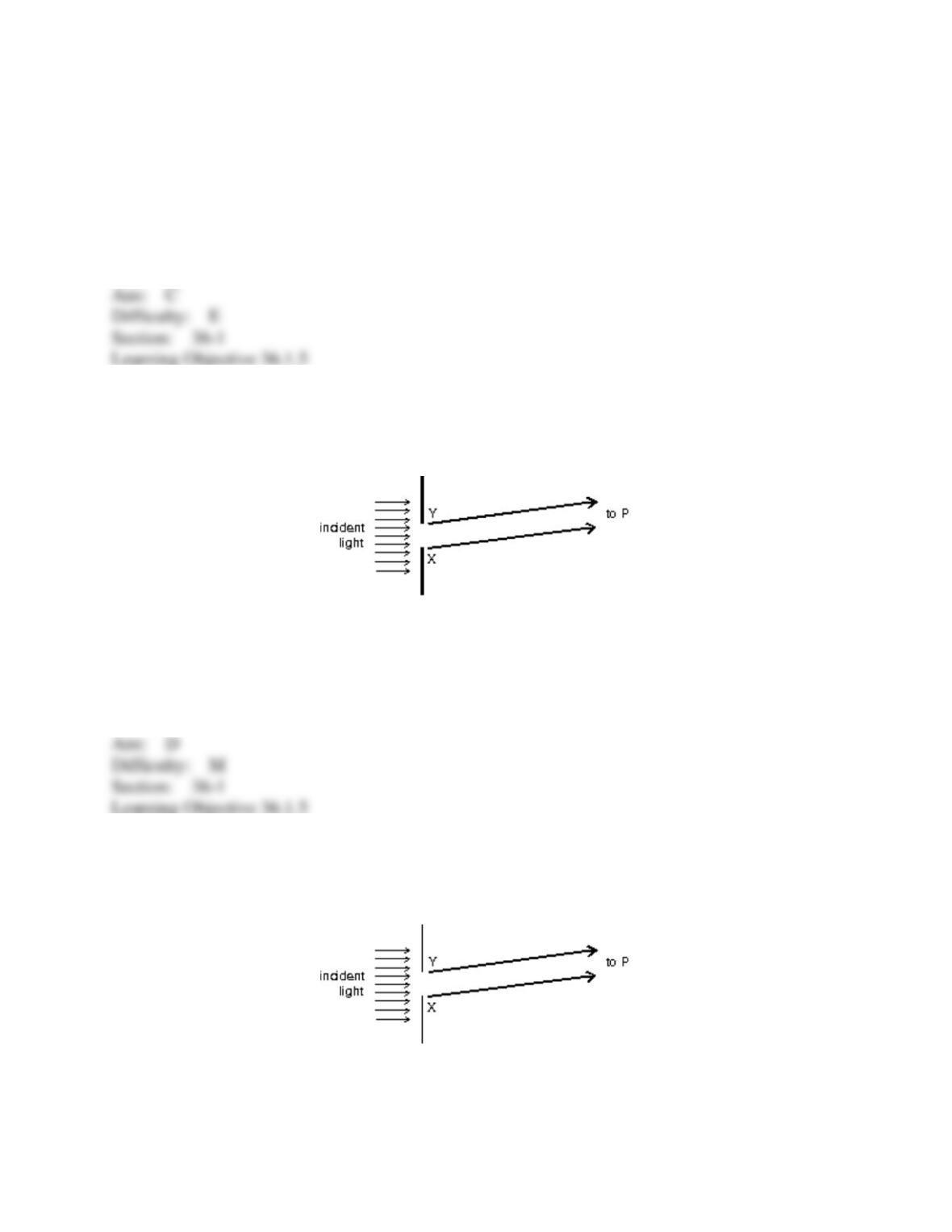
15. The diagram shows a single slit with the direction to a point P on a distant screen (not
shown). At P, the pattern has its second minimum (from its central maximum). If X and Y are
the edges of the slit, what is the path length difference (PX) – (PY)?
A)
/2
B)
C) 3
/2
D) 2
E) 5
/2
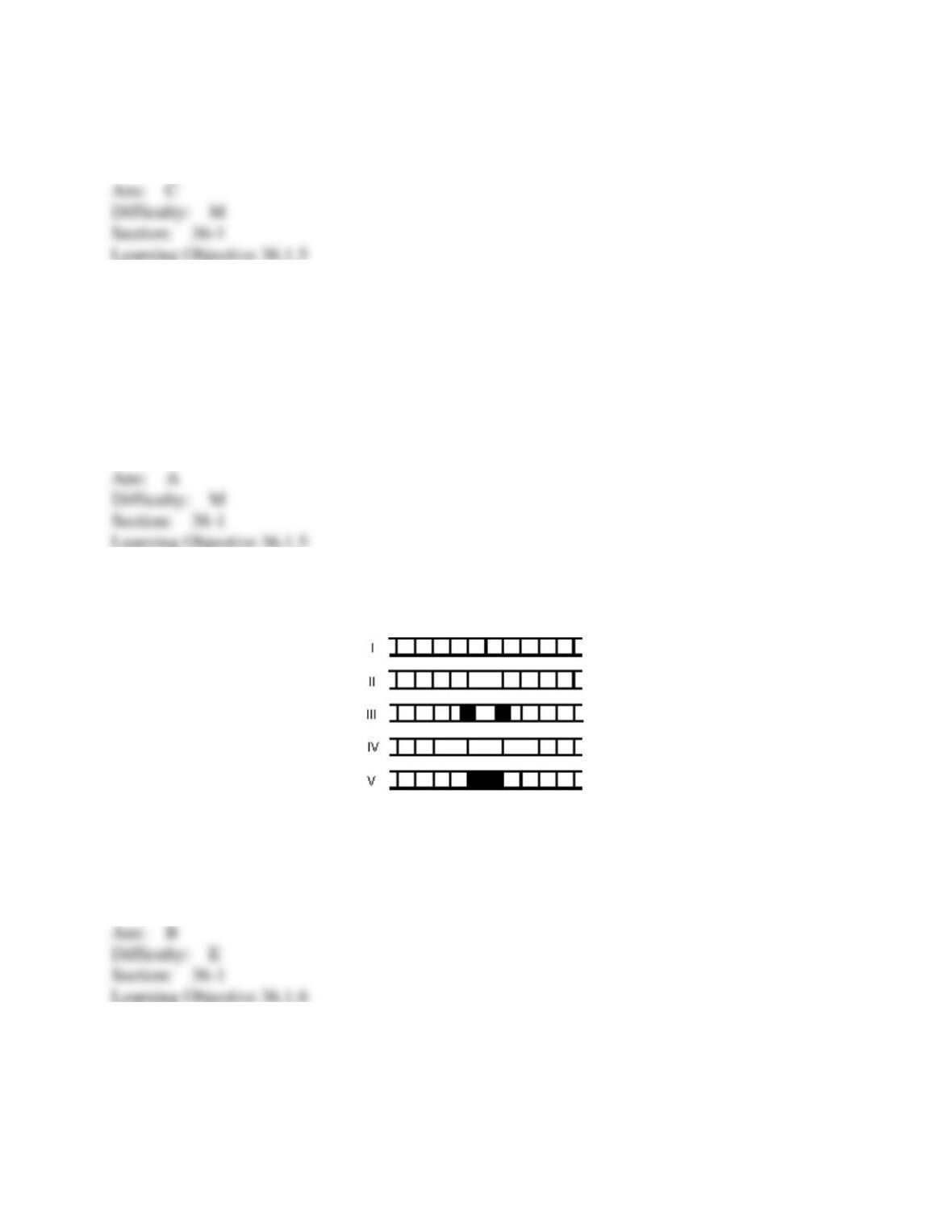
16. The diagram shows a single slit with the direction to a point P on a distant screen (not
shown). At P, the pattern has its maximum nearest the central maximum. If X and Y are the
edges of the slit, what is the path length difference (PX) – (PY)?
A)
/2
B)
C) 3
/2
D) 2
E) 5
/2
17. Consider a single-slit diffraction pattern caused by a slit of width a. There is a minimum at
sin
equal to:
A) exactly
/a
B) slightly more than
/a
C) slightly less than
/a
D) exactly
/2a
E) very nearly
/2a
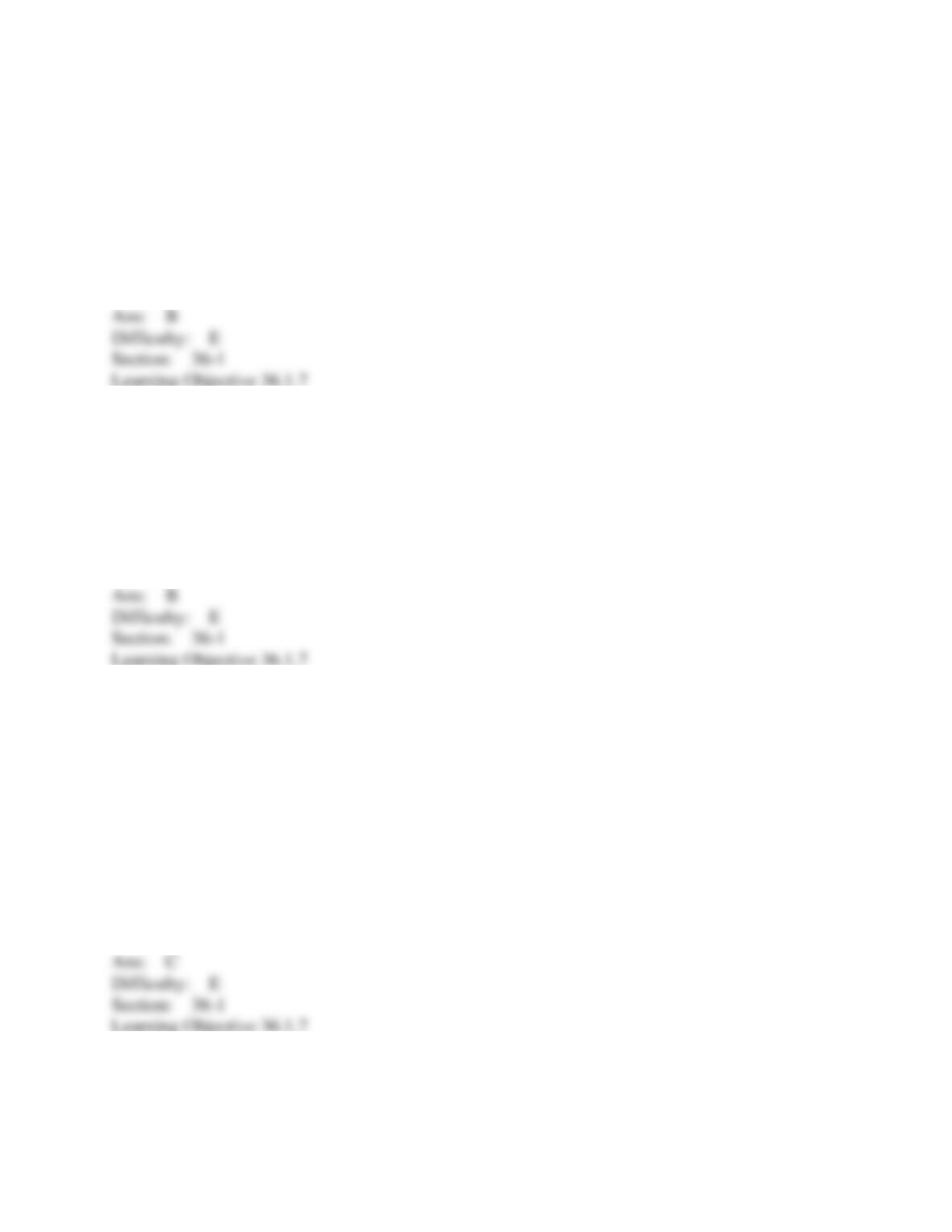
18. Monochromatic plane waves of light are incident normally on a single slit. Which one of
the five figures below most correctly shows the diffraction pattern observed on a distant screen?
A) I
B) II
C) III
D) IV
E) V
19. A student wishes to produce a single-slit diffraction pattern in a ripple tank experiment. He
considers the following parameters:
I.
frequency
II.
wavelength
III.
water depth
IV.
slit width
Which two of the above should be decreased to produce more bending?
A) I, III
B) I, IV
C) II, III
D) II, IV
E) III, IV
20. A parallel beam of monochromatic light is incident on a slit of width 2 cm. The light
passing through the slit falls on a screen 2 m away. As the slit width is decreased:
A) the width of the pattern on the screen continuously decreases
B) the width of the pattern on the screen at first decreases but then increases
C) the width of the pattern on the screen increases and then decreases
D) the width of the pattern on the screen remains the same
E) the width of the pattern on the screen continuously increases
21. A diffraction pattern is produced on a viewing screen by illuminating a long narrow slit
with light of wavelength
. If
is increased and no other changes are made:
A) the intensity at the center of the pattern decreases and the pattern expands away from the
bright center
B) the intensity at the center of the pattern increases and the pattern contracts toward the bright
center
C) the intensity at the center of the pattern does not change and the pattern expands away from
the bright center
D) the intensity at the center of the pattern does not change and the pattern contracts toward the
bright center
E) neither the intensity at the center of the pattern nor the pattern itself change
22. A diffraction pattern is produced on a viewing screen by illuminating a long narrow slit
with light of wavelength
. If the slit width is decreased and no other changes are made:
A) the intensity at the center of the pattern decreases and the pattern expands away from the
bright center
B) the intensity at the center increases and the pattern contracts toward the bright center
C) the intensity at the center of the pattern does not change and the pattern expands away from
the bright center
D) the intensity at the center of the pattern does not change and the pattern contracts toward the
bright center
E) neither the intensity at the center of the pattern nor the pattern itself change
23. In a single-slit diffraction pattern, the central maximum is about twice as wide as the other
maxima. This is because:
A) half the light is diffracted up and half is diffracted down
B) the central maximum has both electric and magnetic fields present
C) the small angle approximation applies only near the central maximum
D) the screen is flat instead of spherical
E) none of the above
24. The intensity at a secondary maximum of a single-slit diffraction pattern is less than the
intensity at the central maximum chiefly because:
A) some Huygens wavelets sum to zero at the secondary maximum but not at the central
maximum
B) the secondary maximum is further from the slits than the central maximum and intensity
decreases as the square of the distance
C) the Huygens construction is not valid for a secondary maximum
D) the amplitude of every Huygens wavelet is smaller when it travels to a secondary maximum
than when it travels to the central maximum
E) none of the above
25. Two wavelengths, 800 nm and 600 nm, are used separately in single-slit diffraction
experiments. The diagram shows the intensities on a far-away viewing screen as function of the
angle made by the rays with the straight-ahead direction. If both wavelengths are then used
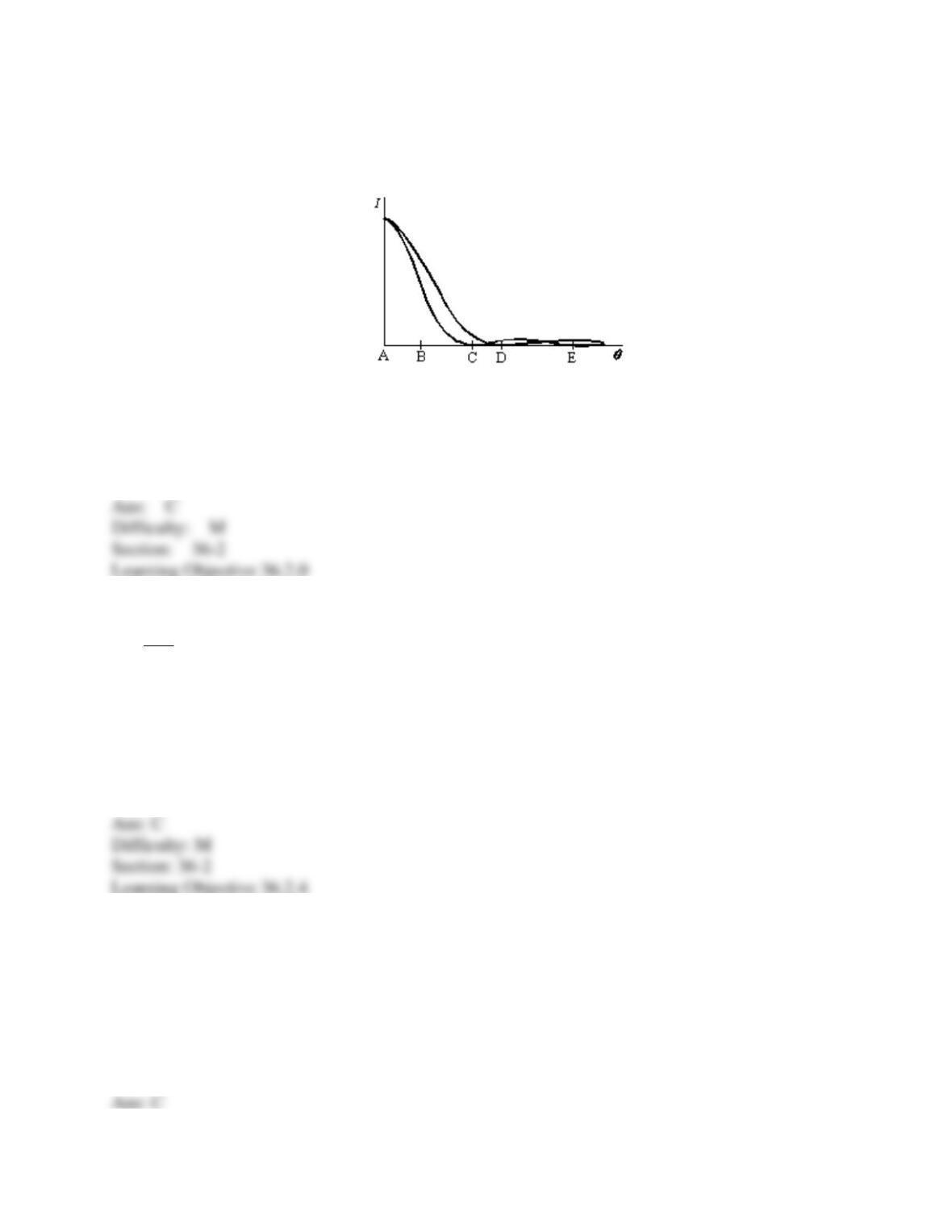
simultaneously, which point corresponds to the smallest angle at which the light on the screen is
purely 800-nm light?
A) A
B) B
C) C
D) D
E) E
26. The intensity of the single-slit diffraction pattern at any angle θ is given by 𝐼(𝜃)=
𝐼𝑚(sin𝛼
𝛼)2. For light of wavelength 480 nm falling on a slit of width 3.5 µm, what is the value of
α when θ = 18°?
A) 0.31 rad
B) 2.3 rad
C) 7.1 rad
D) 7.3 rad
E) 9.8 rad
27. Light of wavelength 480 nm falls on a slit of width 3.5 µm. What is the relative intensity
(that is, the value of I/Im) of the diffraction pattern at an angle of 18°?
A) 2.4 x 10⁻⁴
B) 1.7 x 10⁻³
C) 1.1 x 10⁻²
D) 1.0 x 10⁻¹
E) 1.0
28. A diffraction-limited laser of length ℓ and aperture diameter d generates light of
wavelength
. If the beam is directed at the surface of the Moon a distance D away, the radius of
the illuminated area on the moon is approximately:
A) dD/ ℓ
B) dD/
C) D
ℓ
D) D/d
E) ℓ
d
29. Two stars that are close together are photographed through a telescope. The black and
white film is equally sensitive to all colors. Which situation would result in the most clearly
separated images of the stars?
A) Small lens, red stars
B) Small lens, blue stars
C) Large lens, red stars
D) Large lens, blue stars
E) Large lens, one star red and the other blue
30. The resolving power of a telescope can be increased by:
A) increasing the objective focal length and decreasing the eyepiece focal length
B) increasing the lens diameters
C) decreasing the lens diameters
D) inserting a correction lens between objective and eyepiece
E) none of the above
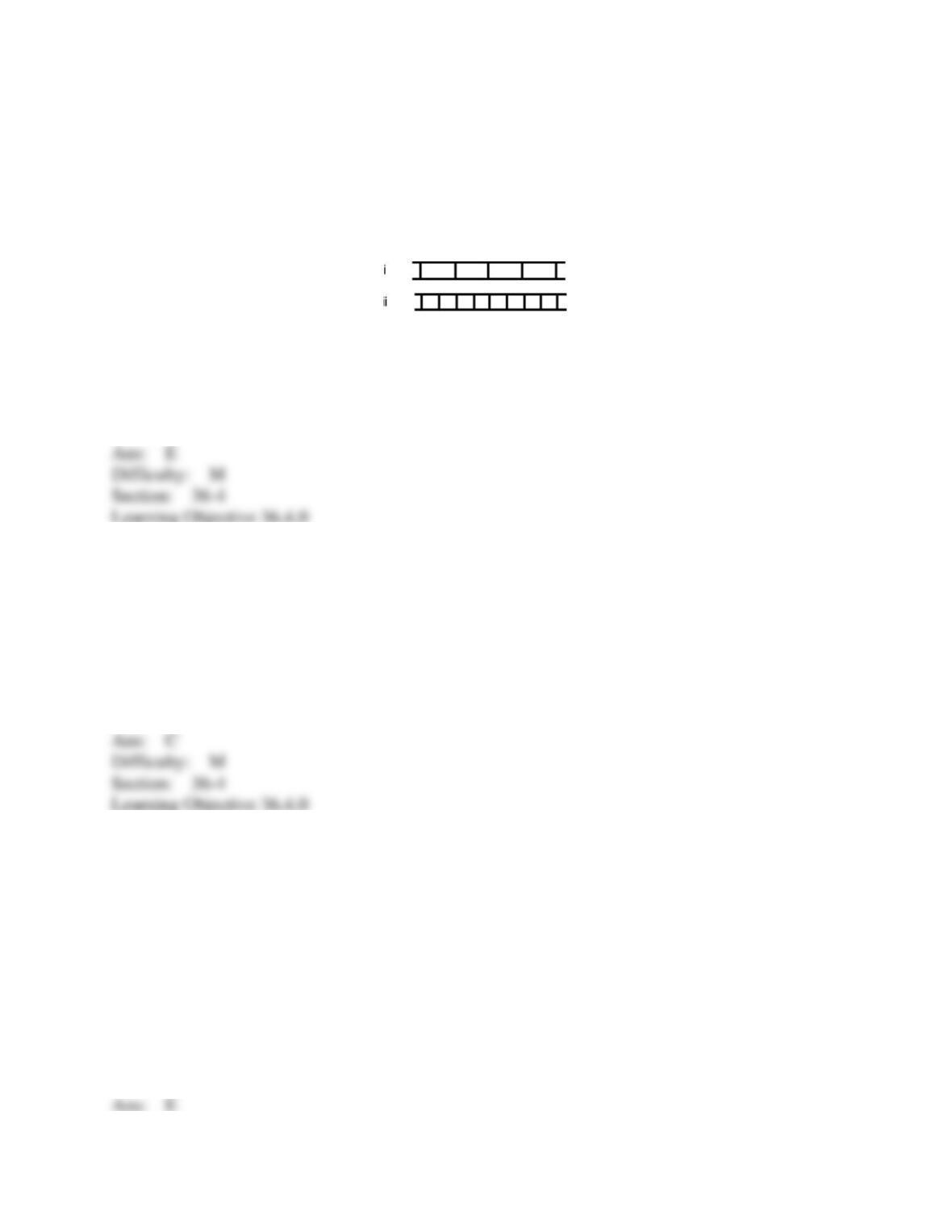
31. Figure (i) shows a double-slit pattern obtained using monochromatic light. Consider the
following five possible changes in conditions:
1. decrease the frequency
2. increase the frequency
3. increase the width of each slit
4. increase the separation between the slits
5. decrease the separation between the slits
Which of the above would change Figure (i) into Figure (ii)?
A) 3 only
B) 5 only
C) 1 and 3 only
D) 1 and 5 only
E) 2 and 4 only
32. Two slits of width a and separation d are illuminated by a beam of light of wavelength .
The separation of the interference fringes on a screen a distance D away is:
A) a/D
B) d/D
C) D/d
D) dD/
E) D/a
33. If we increase the wavelength of the light used to form a double-slit diffraction pattern:
A) the width of the central diffraction peak increases and the number of bright fringes within
the peak increases
B) the width of the central diffraction peak increases and the number of bright fringes within
the peak decreases
C) the width of the central diffraction peak decreases and the number of bright fringes within
the peak increases
D) the width of the central diffraction peak decreases and the number of bright fringes within
the peak decreases
E) the width of the central diffraction peak increases and the number of bright fringes within
the peak stays the same
34. Two slits in an opaque barrier each have a width of 0.020 mm and are separated by 0.050
mm. When coherent monochromatic light passes through the slits the number of interference
maxima within the central diffraction maximum:
A) is 1
B) is 2
C) is 4
D) is 5
E) cannot be determined unless the wavelength is given
35. When 450-nm light is incident normally on a certain double-slit system the number of
interference maxima within the central diffraction maximum is 5. When 900-nm light is incident
on the same slit system the number is:
A) 2
B) 3
C) 5
D) 9
E) 10
36. In a double-slit diffraction experiment the number of interference fringes within the central
diffraction maximum can be increased by:
A) increasing the wavelength
B) decreasing the wavelength
C) increasing the slit separation
D) decreasing the slit width
E) increasing the slit width
37. In the equation d sin
= m for the lines of a diffraction grating, d is: