Chapter: Chapter 26
Learning Objectives
LO 26.1.0 Solve problems related to electric current.
LO 26.1.1 Apply the definition of current as the rate at which charge moves through a point,
including solving for the amount of charge that passes the point in a given time interval.
LO 26.1.2 Identify that current is normally due to the motion of conduction electrons that are
driven by electric fields (such as those set up in a wire by a battery).
LO 26.1.3 Identify a junction in a circuit and apply the fact that (due to conservation of charge)
the total current into a junction must equal the total current out of the junction.
LO 26.1.4 Explain how current arrows are drawn in a schematic diagram of a circuit, and
identify that the arrows are not vectors.
LO 26.2.0 Solve problems related to current density.
LO 26.2.1 Identify a current density and a current density vector.
LO 26.2.2 For current through an area element on a cross section through a conductor (such as a
wire), identify the element’s area vector 𝑑𝐴
⃗.
LO 26.2.3 Find the current through a cross section of a conductor by integrating the dot product
of the current density vector 𝐽
⃗ and the element area vector 𝑑𝐴
⃗ over the full cross section.
LO 26.2.4 For the case where current is uniformly spread over a cross section in a conductor,
apply the relationship between the current i, the current density magnitude J, and the area A.
LO 26.2.5 Identify streamlines.
LO 26.2.6 Explain the motion of conduction electrons in terms of their drift speed.
LO 26.2.7 Distinguish the drift speeds of conduction electrons from their random-motion speeds,
including relative magnitudes.
LO 26.2.8 Identify carrier charge density n.
LO 26.2.9 Apply the relationship between current density J, charge carrier density n, and charge
carrier drift speed νd.
LO 26.3.0 Solve problems related to resistance and resistivity.
LO 26.3.1 Apply the relationship between potential difference V applied across an object, the
object’s resistance R, and the resulting current i between the application points.
LO 26.3.2 Identify a resistor.
LO 26.3.3 Apply the relationship between the electric field magnitude E set up at a point in a
given material, the material’s resistivity ρ, and the resulting current density magnitude J at that
point.
LO 26.3.4 For a uniform electric field set up in a wire, apply the relationship between the electric
field magnitude E, the potential difference V between the two ends, and the wire’s length L.
LO 26.3.5 Apply the relationship between resistivity ρ and conductivity σ.
LO 26.3.6 Apply the relationship between an object’s resistance R, the resistivity of its material
ρ, its length L, and its cross-sectional area A.
LO 26.3.7 Apply the equation that approximately gives a conductor’s resistivity ρ as a function
of
temperature T.
LO 26.3.8 Sketch a graph of resistivity ρ versus temperature T for a metal.
LO 26.4.0 Solve problems related to Ohm’s law.
LO 26.4.1 Distinguish between an object that obeys Ohm’s law and one that does not.
LO 26.4.2 Distinguish between a material that obeys Ohm’s law and one that does not.
LO 26.4.3 Describe the general motion of a conduction electron in a current.
LO 26.4.4 For the conduction electrons in a conductor, explain the relationship between the
mean free time τ, the effective speed, and the thermal (random) motion.
LO 26.4.5 Apply the relationship between resistivity ρ, number density n of conduction
electrons, and the mean free time τ of the electrons.
LO 26.5.0 Solve problems related to power, semiconductors, superconductors.
LO 26.5.1 Explain how conduction electrons in a circuit lose energy in a resistive device.
LO 26.5.2 Identify that power is the rate at which energy is transferred from one type to another.
LO 26.5.3 For a resistive device, apply the relationships between power P, current i, voltage V,
and resistance R.
LO 26.5.4 For a battery, apply the relationship between power P, current i, and potential
difference V.
LO 26.5.5 Apply the conservation of energy to a circuit with a battery and a resistive device to
relate the energy transfers in the circuit.
LO 26.5.6 Distinguish conductors, semiconductors, and superconductors.
Multiple Choice
1. A car battery is rated at 80 Ah. An ampere-hour is a unit of:
A) power
B) energy
C) current
D) charge
E) force
2. Current has units:
A) kilowatt·hour
B) coulomb/second
C) coulomb
D) volt
E) ohm
3. Current has units:
A) kilowatt·hour
B) ampere
C) coulomb
D) volt
E) ohm
4. Current is a measure of:
A) force that moves a charge past a point
B) resistance to the movement of a charge past a point
C) energy used to move a charge past a point
D) amount of charge that moves past a point per unit time
E) speed with which a charge moves past a point
5. A 60-watt light bulb carries a current of 0.5 ampere. The total charge passing through it in
one hour is:
A) 3600 C
B) 3000 C
C) 2400 C
D) 1800 C
E) 120 C
6. A 10-ohm resistor has a constant current. If 1200 C of charge flow through it in 4 minutes
what is the value of the current?
A) 3.0 A
B) 5.0 A
C) 20 A
D) 120 A
E) 300 A
7. Current in a conductor is normally due to:
A) the collective motion of all electrons in the conductor
B) the thermal motion of the conduction electrons
C) the drift motion of the conduction electrons due to electric fields
D) the drift motion of both electrons and positrons
E) the drift motion of both electrons and protons
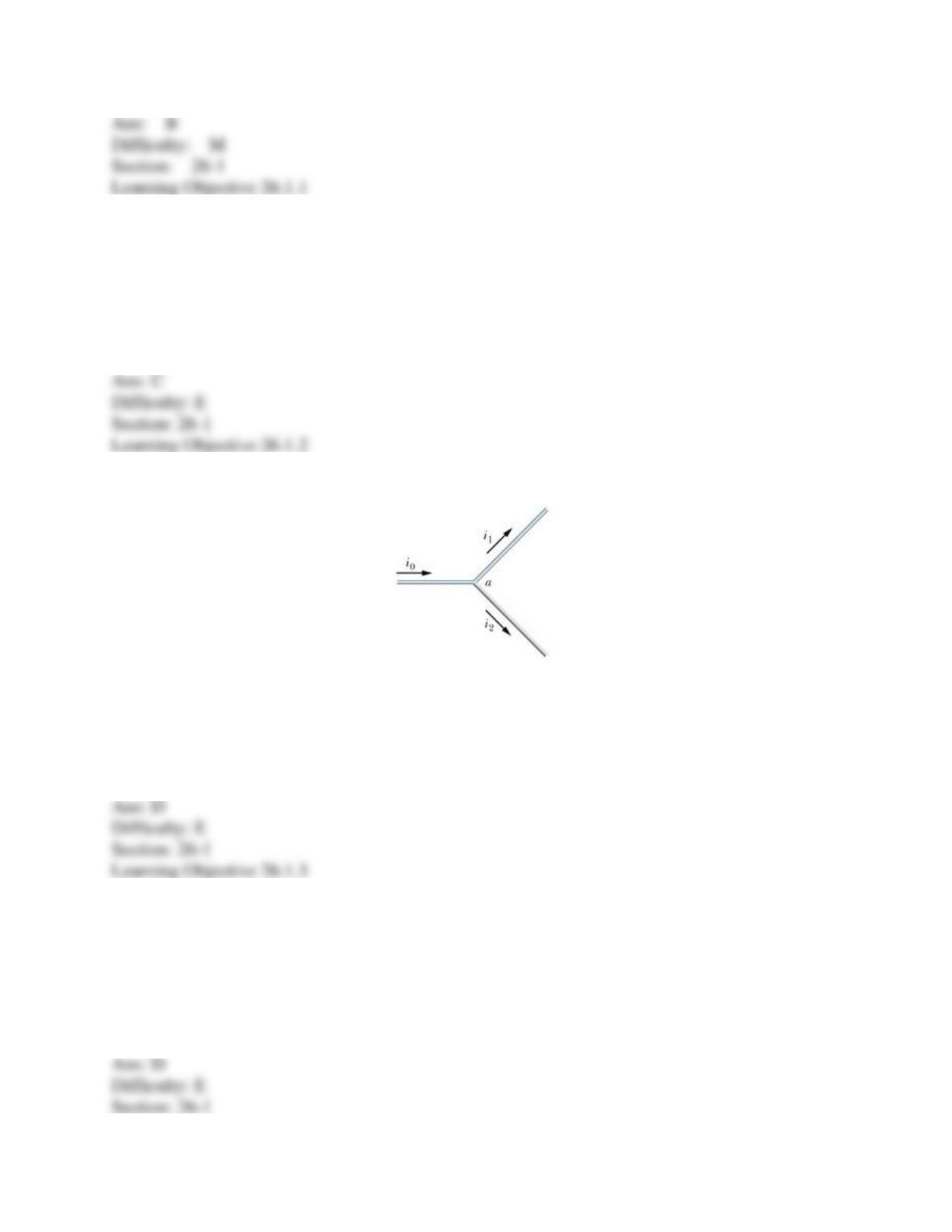
8. This figure shows a junction. What is true of the currents?
A) i1 = i0 + i2
B) i2= i0 + i1
C) i0 = i1 – i2
D) i1 = i0 – i2
E) i0 = i2– i1
9. In schematic diagrams, currents are indicated using arrows. What do the arrows indicate?
A) the direction of motion of the electrons
B) the direction of the current vector
C) the direction of motion of the charge carriers
D) the direction that positive charge carriers would move
E) nothing; they are just a convenient drawing tool
10. Conduction electrons move to the right in a certain wire. This indicates that:
A) the current density and electric field both point right
B) the current density and electric field both point left
C) the current density points right and the electric field points left
D) the current density points left and the electric field points right
E) the current density points left but the direction of the electric field is unknown
11. If 𝐽
over an area represents:
A) the electric flux through the area
B) the average current density at the position of the area
C) the resistance of the area
D) the resistivity of the area
E) the current through the area
12. Two wires made of different materials have the same uniform current density. They carry
the same current only if:
A) their lengths are the same
B) their cross-sectional areas are the same
C) both their lengths and cross-sectional areas are the same
D) the potential differences across them are the same
E) the electric fields in them are the same
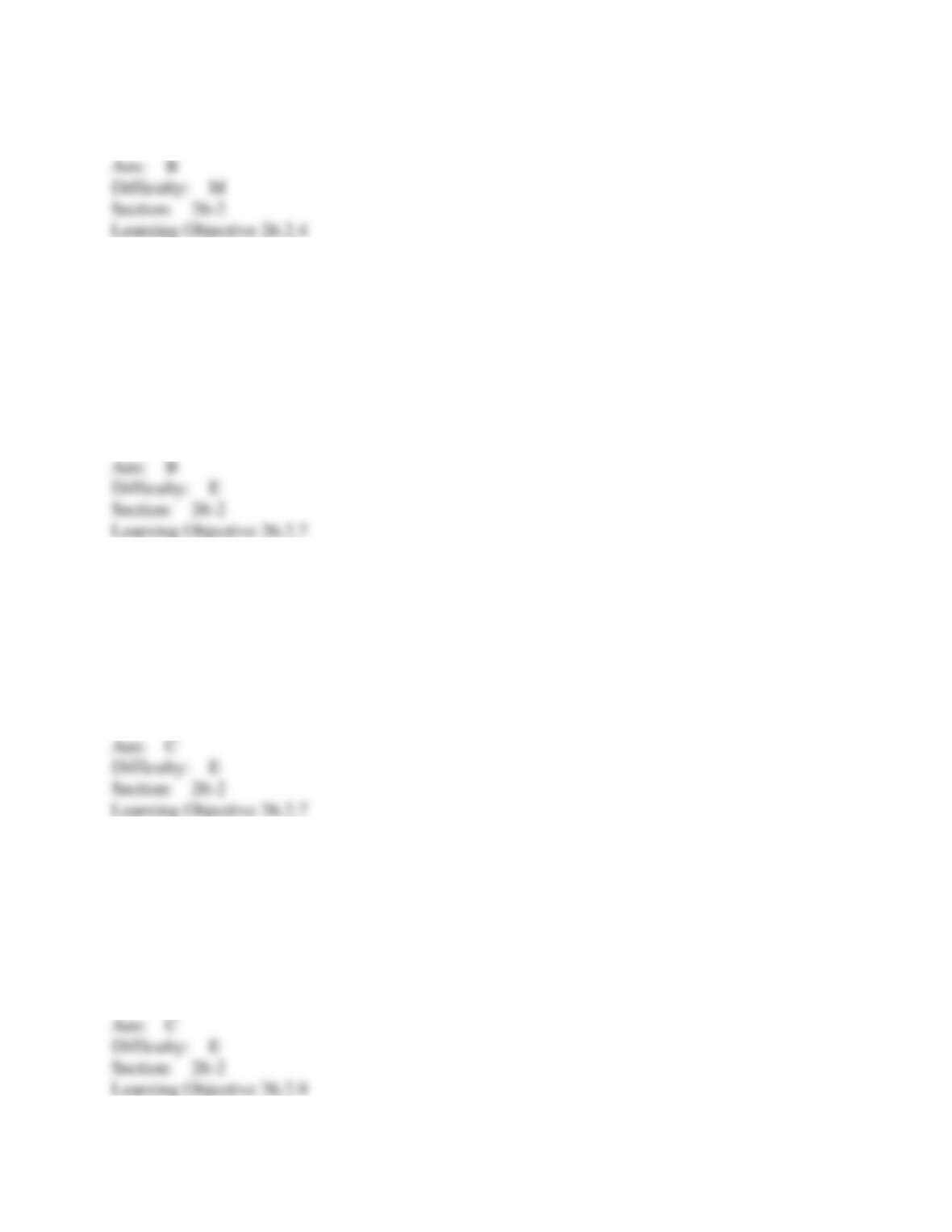
13. A wire with a length of 150 m and a radius of 0.15 mm carries a current with a uniform
current density of 2.8 107 A/m2. The current is:
A) 0.63 A
B) 2.0 A
C) 5.9 A
D) 300 A
E) 26000 A
14. In a conductor carrying a current we expect the electron drift speed to be:
A) much greater than the average electron speed
B) much less than the average electron speed
C) about the same as the average electron speed
D) less than the electron speed at low temperature and greater than the electron speed at high
temperature
E) less than the electron speed at high temperature and greater than the electron speed at low
temperature
15. The current is zero in a conductor when no potential difference is applied because:
A) the electrons are not moving
B) the electrons are not moving fast enough
C) for every electron with a given velocity there is another with a velocity of equal magnitude
and opposite direction
D) equal numbers of electrons and protons are moving together
E) otherwise Ohm’s law would not be valid
16. The current density is the same in two wires. Wire A has twice the free electron
concentration of wire B. The drift speed of electrons in A is:
A) twice that of electrons in B
B) four times that of electrons in B
C) half that of electrons in B
D) one-fourth that of electrons in B
E) the same as that of electrons in B
17. Copper contains 8.4 1028 free electrons per cubic meter. A copper wire of cross-sectional
area 7.4 10–7 m2 carries a current of 1 A. The electron drift speed is approximately:
A) 3 108 m/s
B) 103 m/s
C) 1 m/s
D) 10–4 m/s
E) 10–23 m/s
18. The units of resistivity are:
A) ohm
B) ohm·meter
C) ohm/meter
D) ohm/meter2
E) none of these
19. If the potential difference across a resistor is doubled:
A) only the current is doubled
B) only the current is halved
C) only the resistance is doubled
D) only the resistance is halved
E) both the current and resistance are doubled
20. A current of 0.5 ampere exists in a 60-ohm lamp. The applied potential difference is:
A) 15 V
B) 30 V
C) 60 V
D) 120 V
E) none of these
21. A wire has an electric field of 6.2 V/m and carries a current density of 2.4 x 10⁸ A/m2. What
is its resistivity?
A) 6.7 x 10⁻¹⁰ m
B) 1.5 x 10⁻⁸ m
C) 2.6 x 10⁻⁸ m
D) 3.9 x 10⁷ m
E) 1.5 x 10⁹ m
22. Conductivity is:
A) the same as resistivity, it is just more convenient to use for good conductors
B) expressed in –1
C) equal to 1/resistance
D) expressed in (m)–1
E) not a meaningful quantity for an insulator
23. Five cylindrical wires are made of the same material. Their lengths and radii are
wire 1: length ℓ, radius r
wire 2: length 3ℓ/2, radius r/2
wire 3: length ℓ/2, radius r/2
wire 4: length ℓ, radius r/2
wire 5: length 5ℓ, radius r/2
Rank the wires according to their resistances, least to greatest.
A) 1, 2, 3, 4, 5
B) 5, 4, 3, 2, 1
C) 1 and 2 tie, then 5, 3, 4
D) 1, 3, 4, 2, 5
E) 1, 2, 4, 3, 5
24. A cylindrical copper rod has resistance R. It is reformed to twice its original length with no
change of volume. Its new resistance is:
A) R/2
B) R
C) 2R
D) 4R
E) 8R
25. A certain wire has resistance R. Another wire, of the same material, has half the length and
half the diameter of the first wire. The resistance of the second wire is:
A) R/4
B) R/2
C) R
D) 2R
E) 4R
26. A wire is 1 m long and 1 10–6 m2 in cross-sectional area. When connected to a potential
difference of 2 V, a current of 4 A exists in the wire. The resistivity of this wire is:
A) 2 10–6 m
B) 8 10–6 m
C) 1 10–7 m
D) 4 10–7 m
E) 5 10–7 m
27. Two conductors are made of the same material and have the same length. Conductor A is a
solid wire of diameter 1 m. Conductor B is a hollow tube of inside diameter 1 m and outside
diameter 2 m. The ratio of their resistance, RA/RB, is:
A) 1
B) √2
C) 2
D) 3
E) 4
28. Of the following the copper conductor that has the least resistance is:
A) thin, long and hot
B) thick, short and cool
C) thick, long and hot
D) thin, short and cool
E) thin, short and hot
29. The resistance of a rod does NOT depend on:
A) its temperature
B) its material
C) its length
D) its conductivity
E) shape of its (fixed) cross-sectional area
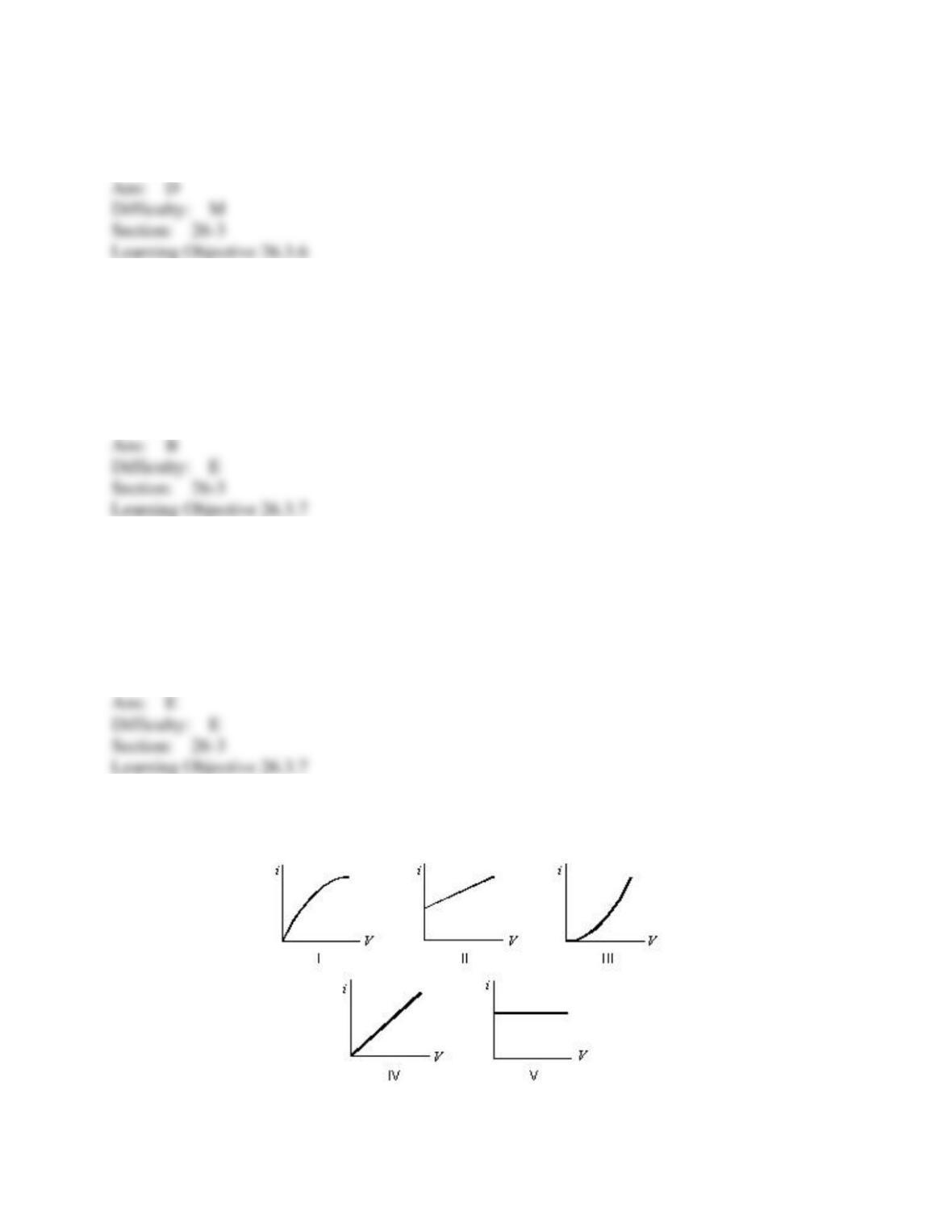
30. Which of the following graphs best represents the current-voltage relationship of an
incandescent light bulb?
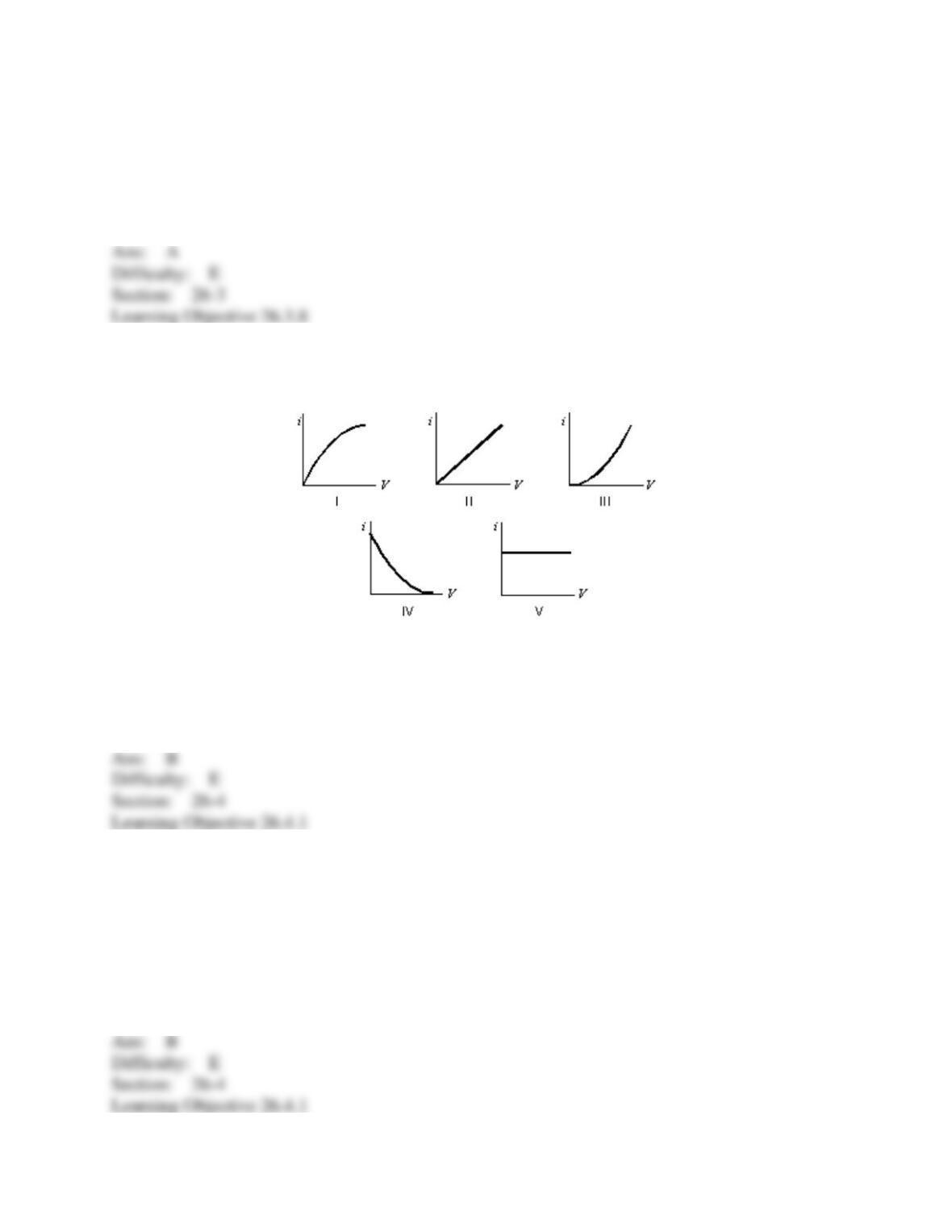
A) I
B) II
C) III
D) IV
E) V
31. Which of the following graphs best represents the current-voltage relationship for a device
that obeys Ohm’s law?
A) I
B) II
C) III
D) IV
E) V
32. A certain sample carries a current of 4 A when the potential difference is 2 V and a current
of 10 A when the potential difference is 4 V. This sample:
A) obeys Ohm’s law
B) has a resistance of 0.5 at 2 V
C) has a resistance of 2 at 2 V
D) has a resistance of 25 at 2 V
E) does not have a resistance
33. For an ohmic resistor, resistance is the proportionality constant for:
A) potential difference and electric field
B) current density and electric field
C) current and length
D) current and cross-sectional area
E) current and potential difference
34. For a cylindrical resistor made of ohmic material, the resistance does NOT depend on:
A) the current
B) the length
C) the cross-sectional area
D) the resistivity
E) the electron drift velocity
35. For an ohmic substance the resistivity is the proportionality constant for:
A) current and potential difference
B) current and electric field
C) current density and potential difference
D) current density and electric field
E) potential difference and electric field
36. For an ohmic substance, the electron drift velocity is proportional to:
A) the cross-sectional area of the sample
B) the length of the sample
C) the mass of an electron
D) the electric field in the sample
E) none of the above
37. For an ohmic substance, the resistivity depends on:
A) the electric field
B) the potential difference
C) the current density
D) the electron mean free time
E) the cross-sectional area of the sample
38. Two substances are identical except that the electron mean free time for substance A is
twice the electron mean free time for substance B. If the same electric field exists in both
substances the electron drift speed in A is:
A) the same as in B
B) twice that in B
C) half that in B
D) four times that in B
E) one fourth that in B
39. The rate at which electrical energy is used may be measured in:
A) watt/second
B) watt·second
C) watt
D) joule·second
E) kilowatt·hour
40. Energy may be measured in:
A) kilowatt
B) joule·second
C) watt
D) watt·second
E) volt/ohm
41. Suppose the electric company charges 10 cents per kWh. How much does it cost to use a
125 watt lamp 4 hours a day for 30 days?
A) $1.20
B) $1.50
C) $1.80
D) $7.20
E) none of these
42. The mechanical equivalent of heat is 1 cal = 4.18 J. A heating coil, connected to a 120-V
source, develops 60,000 calories in 10 minutes. The current in the coil is:
A) 0.83 A
B) 2.0 A
C) 3.5 A
D) 500 A
E) 2100 A
43. Which one of the following quantities is correctly matched to its unit?
A) power — kW·h
B) energy — kW
C) potential difference — J/C
D) current — A/s
E) resistance — V/C
44. You wish to triple the rate of energy dissipation in a heating device. To do this you could
triple:
A) the potential difference keeping the resistance the same
B) the current keeping the resistance the same
C) the resistance keeping the potential difference the same
D) the resistance keeping the current the same
E) both the potential difference and current
45. A student kept her 60-watt, 120-volt study lamp turned on from 2:00 PM until 2:00 AM.
How much charge went through it?
A) 720 C
B) 3,600 C
C) 7,200 C
D) 18,000 C
E) 21,600 C
46. An iron is marked “120 volt, 600 watt”. In normal use, the current in it is:
A) 0.2 A
B) 2 A
C) 4 A
D) 5 A
E) 7.2 A
47. A certain resistor dissipates 0.5 W when connected to a 3 V potential difference. When
connected to a 1 V potential difference, this resistor will dissipate:
A) 0.056 W
B) 0.167 W
C) 0.50 W
D) 1.5 W
E) none of these
48. An incandescent light bulb is marked “60 watt, 120 volt”. Its resistance is:
A) 0.5
B) 120
C) 180
D) 240
E) 300
49. The mechanical equivalent of heat is 1 cal = 4.18 J. The specific heat of water is 1 cal/g·K,
and its mass is 1 g/cm3. An electric immersion water heater, rated at 400 W, should heat a liter of
water from 10C to 30C in about:
A) 12 s
B) 50 s
C) 3.5 min
D) 15 min
E) 45 min
50. It is better to send 10,000 kW of electric power long distances at 10,000 V rather than at
220 V because:
A) there is less heating in the transmission wires
B) the resistance of the wires is less at high voltages
C) more current is transmitted at high voltages
D) the insulation is more effective at high voltages
E) the iR drop along the wires is greater at high voltage
51. A certain x-ray tube requires a current of 7 mA at a voltage of 80 kV. The rate of energy
dissipation is:
A) 5600 W
B) 560 W
C) 26 W
D) 11.4 W
E) 0.088 W
52. You buy a “75 W” light bulb. The label means that:
A) no matter how you use the bulb, the power will be 75 W
B) the bulb was filled with 75 W at the factory
C) the actual power dissipated will be much higher than 75 W since most of the power appears
as heat
D) the bulb is expected to “burn out” after you use up its 75 watts
E) none of the above
53. A current of 0.3 A passes through a lamp for 2 minutes using a 6 V power supply. The
energy dissipated by this lamp during the 2 minutes is:
A) 1.8 J
B) 12 J
C) 20 J
D) 36 J
E) 216 J
54. A 1.5-V battery is connected to a circuit and puts out a current of 0.45 A. How much power
is the battery putting out?
A) 0.30 W
B) 0.68 W
C) 3.3 W
D) 5.0 W
E) 7.4 W
55. Compared to a conductor, a semiconductor
A) has larger conductivity
B) has smaller resistivity
C) has a larger charge carrier density
D) has a negative temperature coefficient of resistivity
E) has zero resistivity