Chapter: Chapter 18
Learning Objectives
LO 18.1.0 Solve problems related to temperature.
LO 18.1.1 Identify the lowest temperature as 0 on the Kelvin scale (absolute zero).
LO 18.1.2 Explain the zeroth law of thermodynamics.
LO 18.1.3 Explain the conditions for the triple-point temperature.
LO 18.1.4 Explain the conditions for measuring a temperature with a constant-volume gas
thermometer.
LO 18.1.5 For a constant-volume gas thermometer, relate the pressure and temperature of the
gas in some given state to the pressure and temperature at the triple point.
LO 18.2.0 Solve problems related to the Celsius and Fahrenheit scales.
LO 18.2.1 Convert a temperature between any two (linear) temperature scales, including the
Celsius, Fahrenheit, and Kelvin scales.
LO 18.2.2 Identify that a change of one degree is the same on the Celsius and Kelvin scales.
LO 18.3.0 Solve problems related to thermal expansion.
LO 18.3.1 For one-dimensional thermal expansion, apply the relationship between the
temperature change ΔT, the length change ΔL, the initial length L, and the coefficient of linear
expansion α.
LO 18.3.2 For two-dimensional thermal expansion, use one-dimensional thermal expansion to
find the change in area.
LO 18.3.3 For three-dimensional thermal expansion, apply the relationship between the
temperature change ΔT, the volume change ΔV, the initial volume V, and the coefficient of
volume expansion β.
LO 18.4.0 Solve problems related to absorption of heat.
LO 18.4.1 Identify that thermal energy is associated with the random motions of the microscopic
bodies in an object.
LO 18.4.2 Identify that heat Q is the amount of transferred energy (either to or from an object’s
thermal energy) due to a temperature difference between the object and its environment.
LO 18.4.3 Convert energy units between various measurement systems.
LO 18.4.4 Convert between mechanical or electrical energy and thermal energy.
LO 18.4.5 For a temperature change ΔT of a substance, relate the change to the heat transfer Q
and the substance’s heat capacity C.
LO 18.4.6 For a temperature change ΔT of a substance, relate the change to the heat transfer Q
and the substance’s specific heat c and mass m.
LO 18.4.7 Identify the three phases of matter.
LO 18.4.8 For a phase change of a substance, relate the heat transfer Q, the heat of
transformation L, and the amount of mass m transformed.
LO 18.4.9 Identify that if a heat transfer Q takes a substance across a phase-change temperature,
the transfer must be calculated in steps: (a) a temperature change to reach the phase-change
temperature, (b) the phase change, and then (c) any temperature change that moves the substance
away from the phase-change temperature.
LO 18.5.0 Solve problems related to the first law of thermodynamics.
LO 18.5.1 If an enclosed gas expands or contracts, calculate the work W done by the gas by
integrating the gas pressure with respect to the volume of the enclosure.
LO 18.5.2 Identify the algebraic sign of work W associated with expansion and contraction of a
gas.
LO 18.5.3 Given a p–V graph of pressure versus volume for a gas, identify the starting point
(the initial state) and the final point (the final state) and calculate the work by using graphical
integration.
LO 18.5.4 On a p–V graph of pressure versus volume for a gas, identify the algebraic sign of
the work associated with a right-going process and a left-going process.
LO 18.5.5 Apply the first law of thermodynamics to relate the change in the internal energy ΔEint
of a gas, the energy Q transferred as heat to or from the gas, and the work W done on or by the
gas.
LO 18.5.6 Identify the algebraic sign of a heat transfer Q that is associated with a transfer to a
gas and a transfer from the gas.
LO 18.5.7 Identify that the internal energy ΔEint of a gas tends to increase if the heat transfer is
to the gas, and it tends to decrease if the gas does work on its environment.
LO 18.5.8 Identify that in an adiabatic process with a gas, there is no heat transfer Q with the
environment.
LO 18.5.9 Identify that in a constant-volume process with a gas, there is no work W done by
the gas.
LO 18.5.10 Identify that in a cyclical process with a gas, there is no net change in the internal
energy ΔEint.
LO 18.5.11 Identify that in a free expansion with a gas, the heat transfer Q, work done W, and
change in internal energy ΔEint are each zero.
LO 18.6.0 Solve problems related to heat transfer mechanisms.
LO 18.6.1 For thermal conduction through a layer, apply the relationship between the
energy-transfer rate Pcond and the layer’s area A, thermal conductivity k, thickness L, and
temperature difference ΔT (between its two sides).
LO 18.6.2 For a composite slab (two or more layers) that has reached the steady state in which
temperatures are no longer changing, identify that (by the conservation of energy) the rates of
thermal conduction Pcond through the layers must be equal.
LO 18.6.3 For thermal conduction through a layer, apply the relationship between thermal
resistance R, thickness L, and thermal conductivity k.
LO 18.6.4 Identify that thermal energy can be transferred by convection, in which a warmer fluid
(gas or liquid) tends to rise in a cooler fluid.
LO 18.6.5 In the emission of thermal radiation by an object, apply the relationship between the
energy-transfer rate Prad and the object’s surface area A, emissivity ε, and surface temperature T
(in kelvins).
LO 18.6.6 In the absorption of thermal radiation by an object, apply the relationship between
the energy-transfer rate Pabs and the object’s surface area A and emissivity ε, and the
environmental temperature T (in kelvins).
LO 18.6.7 Calculate the net energy-transfer rate Pnet of an object emitting radiation to its
environment and absorbing radiation from that environment.
Multiple Choice
1. The international standard thermometer is kept:
A) near Washington, D.C.
B) near Paris, France
C) near the north pole
D) near Rome, Italy
E) nowhere (there is none)
2. In constructing a thermometer it is NECESSARY to use a substance that:
A) expands with rising temperature
B) expands linearly with rising temperature
C) will not freeze
D) will not boil
E) undergoes some change when heated or cooled
3. What is the limiting low temperature of a physical object?
A) there is no limiting low temperature
B) 0 K
C) 0° C
D) 0° F
E) –100° C
4. If two objects are in thermal equilibrium with each other
A) they cannot be moving
B) they cannot be undergoing an elastic collision
C) they cannot have different pressures
D) they cannot be at different temperatures
E) they cannot be falling in the Earth’s gravitational field
5. When two gases separated by a diathermal wall are in thermal equilibrium with each other:
A) only their pressure must be the same
B) only their volumes must be the same
C) they must have the same number of particles
D) they must have the same pressure and the same volume
E) only their temperatures must be the same
6. A balloon is filled with cold air and placed in a warm room. It is NOT in thermal
equilibrium with the air of the room until
A) it rises to the ceiling
B) it sinks to the floor
C) it stops expanding
D) it starts to contract
E) none of the above
7. Suppose object C is in thermal equilibrium with object A and with object B. The zeroth law
of thermodynamics states:
A) that C will always be in thermal equilibrium with both A and B
B) that C must transfer energy to both A and B
C) that A is in thermal equilibrium with B
D) that A cannot be in thermal equilibrium with B
E) nothing about the relationship between A and B
8. The zeroth law of thermodynamics allows us to define
A) work
B) pressure
C) temperature
D) thermal equilibrium
E) internal energy
9. If the zeroth law of thermodynamics were not valid, which of the following could not be
considered a property of an object?
A) Pressure
B) Center of mass energy
C) Internal energy
D) Momentum
E) Temperature
10. The “triple point” of a substance is that point for which the temperature and pressure are
such that:
A) only solid and liquid are in equilibrium
B) only liquid and vapor are in equilibrium
C) only solid and vapor are in equilibrium
D) solid, liquid and vapor are all in equilibrium
E) the temperature, pressure and density are all numerically equal
11. Constant-volume gas thermometers using different gases all indicate nearly the same
temperature when in contact with the same object if:
A) the volumes are all extremely large
B) the volumes are all the same
C) the pressures are all extremely large
D) the pressures are the same
E) the particle concentrations are all extremely small
12. A constant-volume gas thermometer is used to measure the temperature of an object. When
the thermometer is in contact with water at its triple point (273 K) the pressure in the
thermometer is 8.50 104 Pa. When it is in contact with the object the pressure is 9.65 104 Pa.
The temperature of the object is:
A) 41.0 K
B) 114 K
C) 241 K
D) 310 K
E) 314 K
13. When a certain constant volume gas thermometer is in thermal contact with water at its
triple point (273.16 K) the pressure is 6.30 104 Pa. For this thermometer a kelvin corresponds
to a change in pressure of about:
A) 4.34 102 Pa
B) 2.31 102 Pa
C) 1.72 103 Pa
D) 2.31 103 Pa
E) 1.72 107 Pa
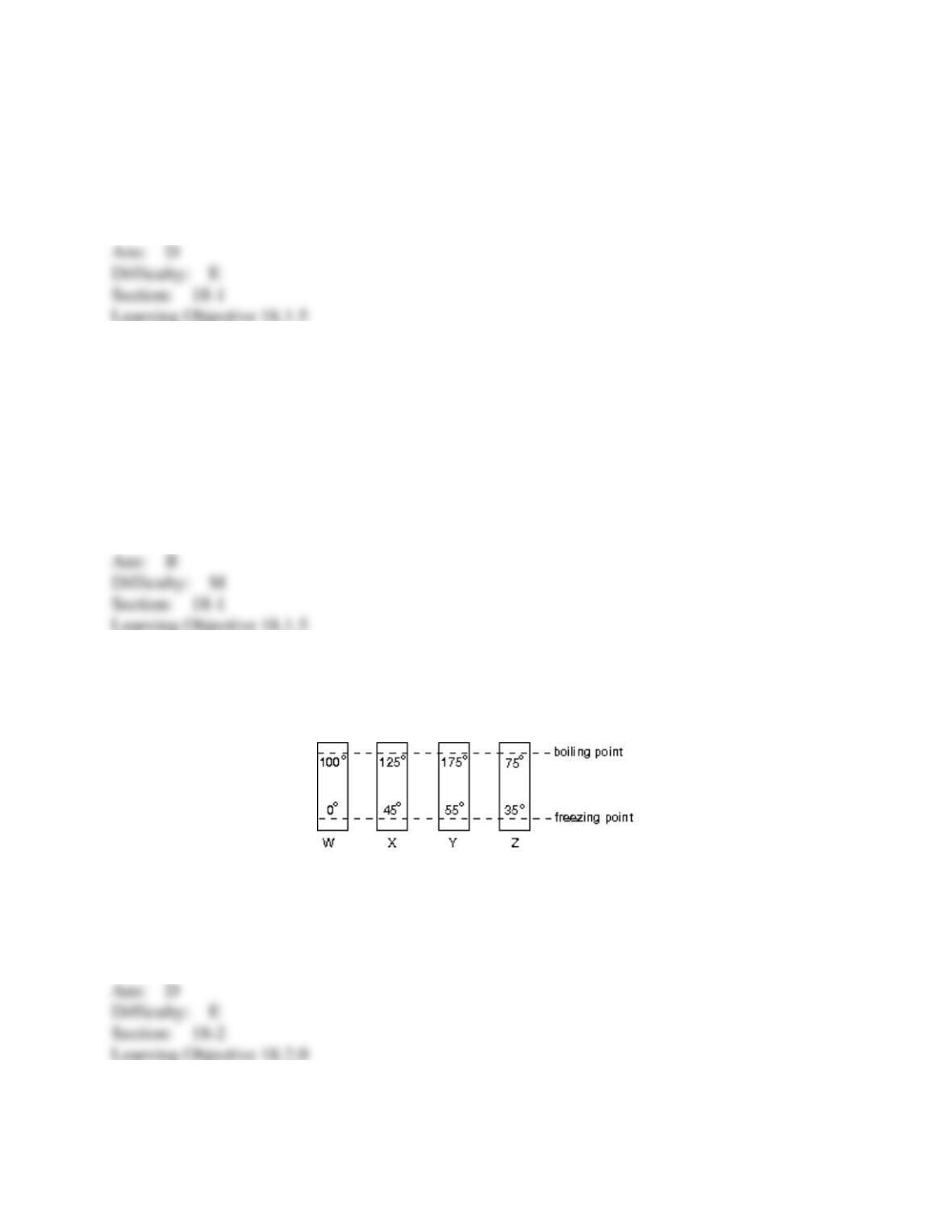
14. The diagram shows four thermometers, labeled W, X, Y, and Z. The freezing and boiling
points of water are indicated. Rank the thermometers according to the size of a degree on their
scales, smallest to largest.
A) W, X, Y, Z
B) Y, W, X, Z
C) Z, Y, W, X
D) Z, X, W, Y
E) W, Y, Z, X
15. There is a temperature at which the reading on the Kelvin scale is numerically:
A) equal to that on the Celsius scale
B) lower than that on the Celsius scale
C) equal to that on the Fahrenheit scale
D) less than zero
E) none of the above
16. Fahrenheit and Kelvin scales agree numerically at a reading of:
A) –40°
B) 0°
C) 273°
D) 301°
E) 574°
17. Which one of the following statements is true?
A) temperatures differing by 25 on the Fahrenheit scale must differ by 45 on the Celsius
scale
B) 40 K corresponds to –40C
C) temperatures which differ by 10 on the Celsius scale must differ by 18 on the Fahrenheit
scale
D) water at 90C is warmer than water at 202F
E) 0F corresponds to –32C
18. A Kelvin thermometer and a Fahrenheit thermometer both give the same reading for a
certain sample. The corresponding Celsius temperature is:
A) 574C
B) 232C
C) 301C
D) 614C
E) 276C
19. Room temperature is about 20 degrees on the:
A) Kelvin scale
B) Celsius scale
C) Fahrenheit scale
D) absolute scale
E) C major scale
20. A thermometer indicates 98.6C. It may be:
A) outdoors on a cold day
B) in a comfortable room
C) in a cup of hot tea
D) in a normal person’s mouth
E) in liquid air
21. The air temperature on a summer day might be about:
A) 0C
B) 10C
C) 25C
D) 80C
E) 125C
22. One degree is the same on the following temperature scales:
A) Fahrenheit and Celsius
B) Fahrenheit and Kelvin
C) Celsius and Kelvin
D) Fahrenheit and Absolute
E) none of the above
23. It is more difficult to measure the coefficient of volume expansion of a liquid than that of a
solid because:
A) no relation exists between linear and volume expansion coefficients
B) a liquid tends to evaporate
C) a liquid expands too much when heated
D) a liquid expands too little when heated
E) the containing vessel also expands
24. Possible units for the coefficient of volume expansion are:
A) mm/C
B) mm3/C
C) (C)3
D) 1/(C)3
E) 1/C
25. The two metallic strips that constitute some thermostats must differ in:
A) length
B) thickness
C) mass
D) rate at which they conduct heat
E) coefficient of linear expansion
26. Thin strips of iron and zinc are riveted together to form a bimetallic strip which bends
when heated. The iron is on the inside of the bend because:
A) it has a higher coefficient of linear expansion
B) it has a lower coefficient of linear expansion
C) it has a higher specific heat
D) it has a lower specific heat
E) it conducts heat better
27. A surveyor’s 30-m steel tape is correct at 68F. On a hot day the tape has expanded to 30.02
m. On that day, the tape indicates a distance of 15.52 m between two points. The true distance
between these points is:
A) 15.50 m
B) 15.51 m
C) 15.52 m
D) 15.53 m
E) 15.54 m
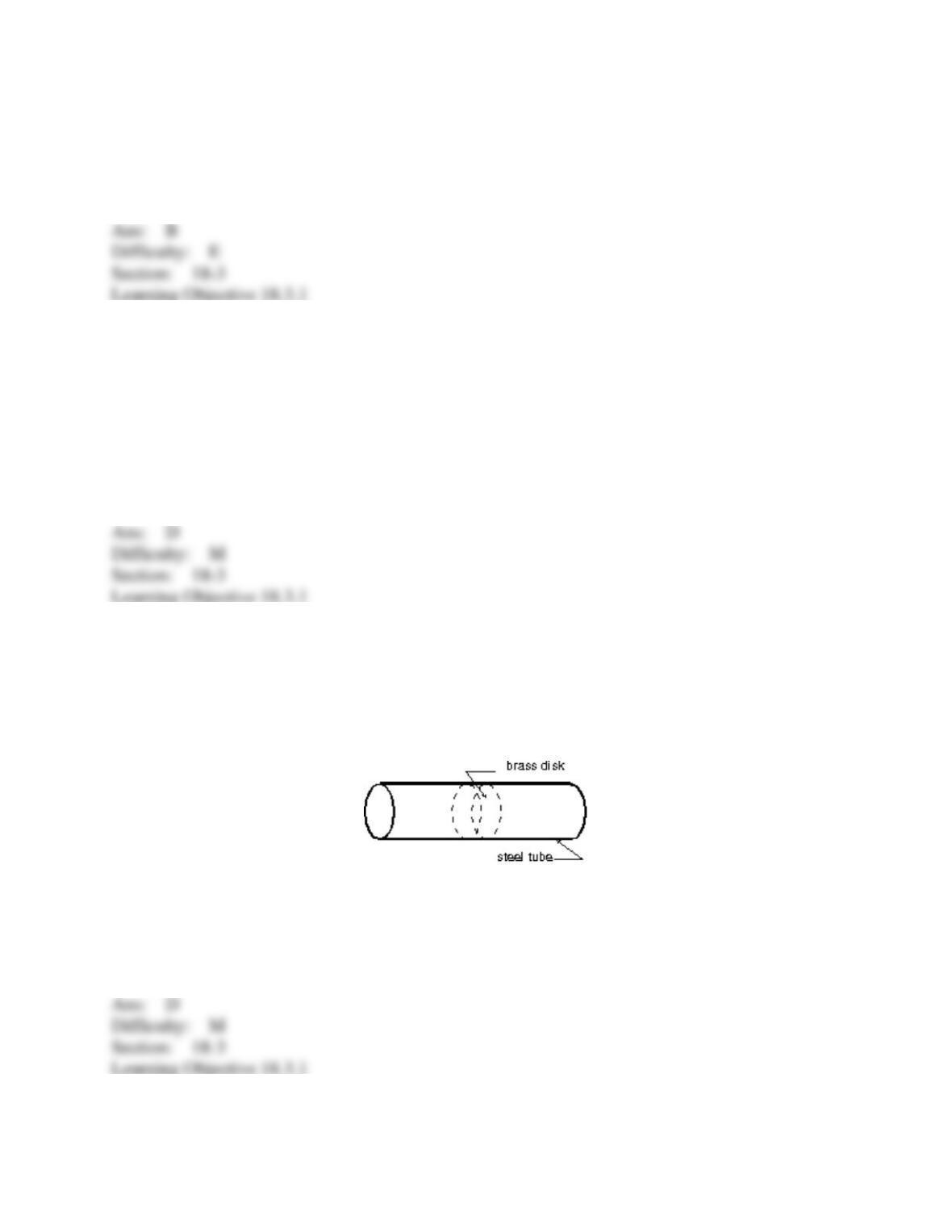
28. The Stanford linear accelerator contains hundreds of brass disks tightly fitted into a steel
tube (see figure). The coefficient of linear expansion of the brass is 2.00 10–5 per C. The
system was assembled by cooling the disks in dry ice (–57C) to enable them to just slide into
the close-fitting tube. If the diameter of a disk is 80.00 mm at 43C, what is its diameter in the
dry ice?
A) 78.400 mm
B) 79.998 mm
C) 80.160 mm
D) 79.840 mm
E) none of these
29. When the temperature of a copper penny is increased by 100 C, its diameter increases by
0.17%. The area of one of its faces increases by:
A) 0.17%
B) 0.34%
C) 0.51%
D) 0.13%
E) 0.27%
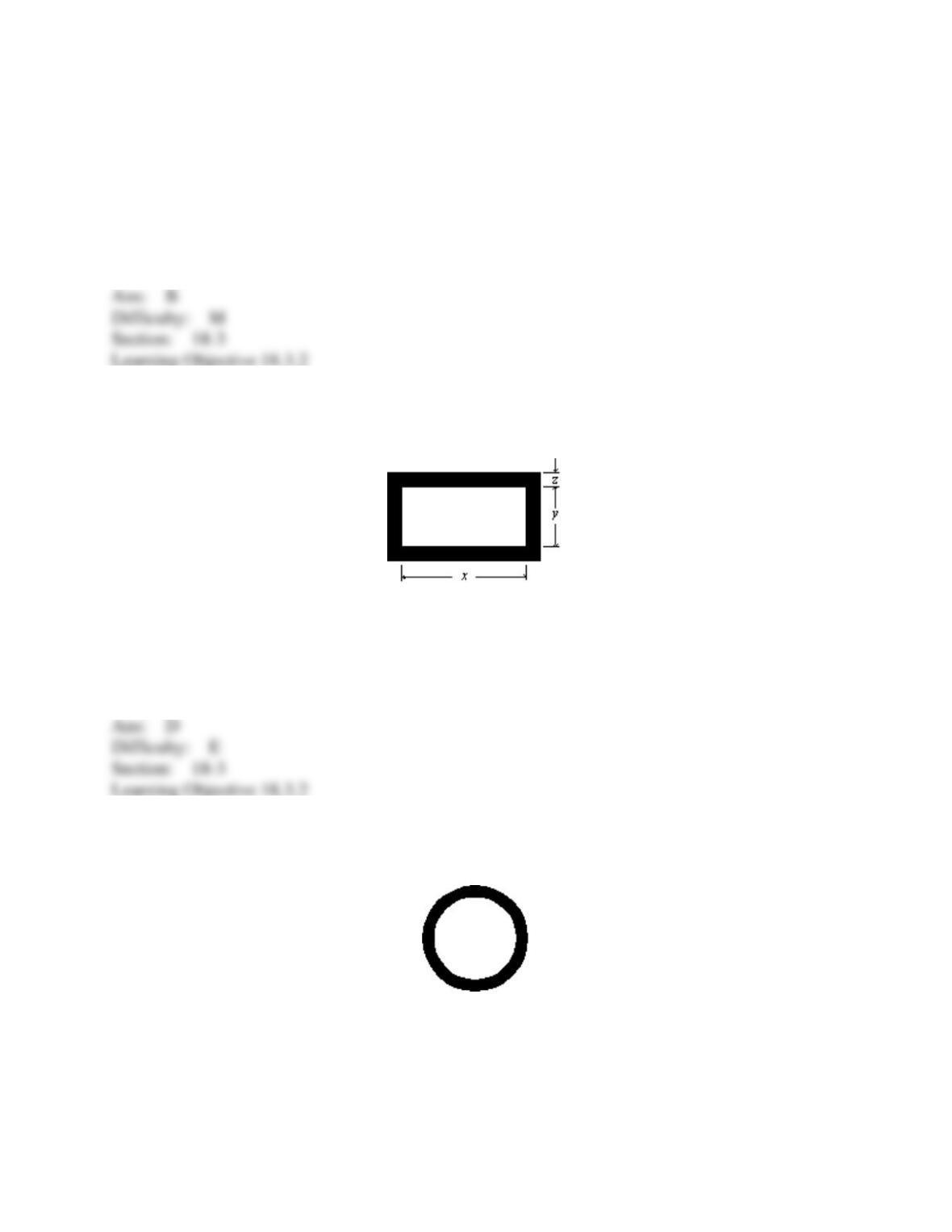
30. The figure shows a rectangular brass plate at 0C in which there is cut a rectangular hole of
dimensions indicated. If the temperature of the plate is raised to 150C:
A) x will increase and y will decrease
B) both x and y will decrease
C) x will decrease and y will increase
D) both x and y will increase
E) the changes in x and y depend on the dimension z
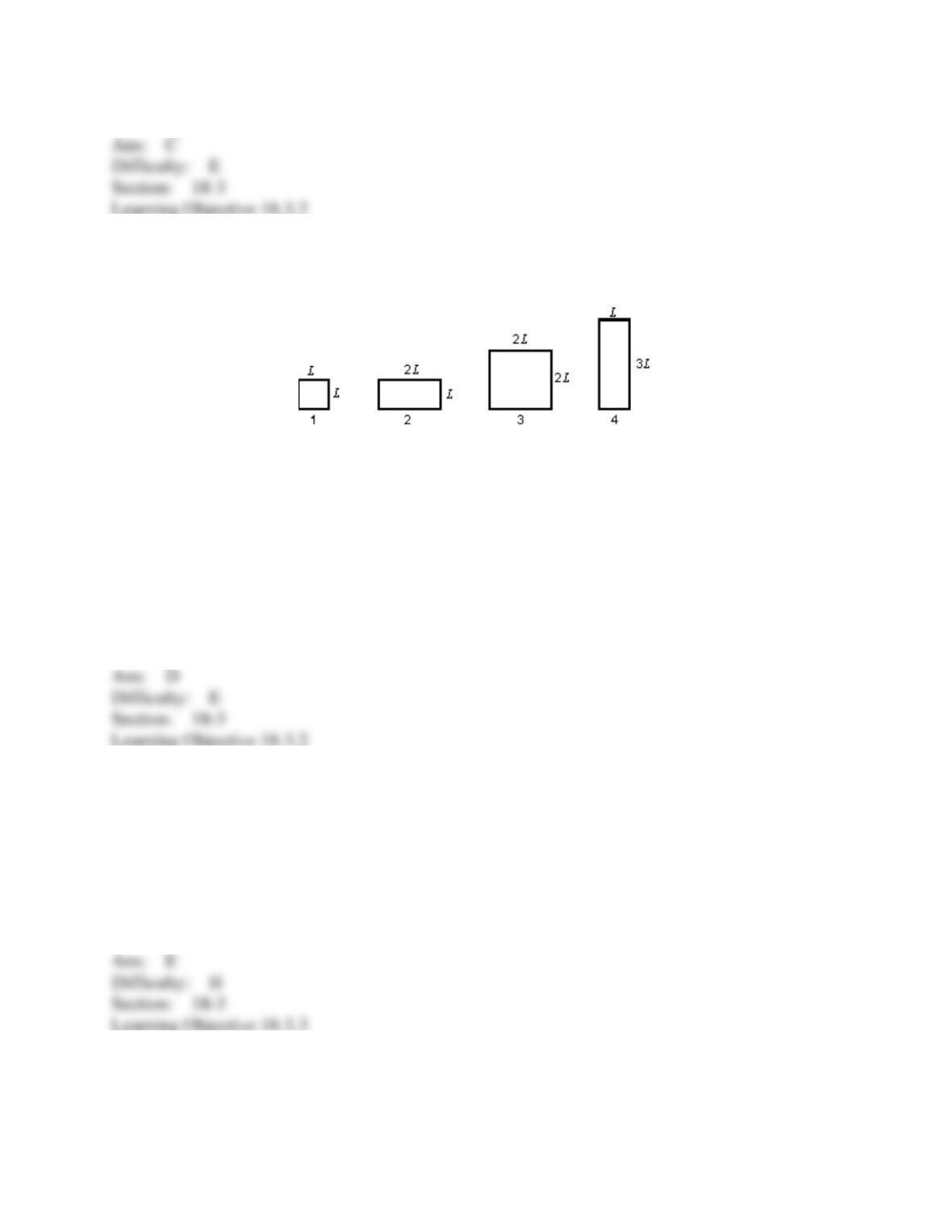
31. An annular ring of aluminum is cut from an aluminum sheet as shown. When this ring is
heated:
A) the aluminum expands outward and the hole remains the same in size
B) the hole decreases in diameter
C) the area of the hole expands the same percent as any area of the aluminum
D) the area of the hole expands a greater percent than any area of the aluminum
E) linear expansion forces the shape of the hole to be slightly elliptical
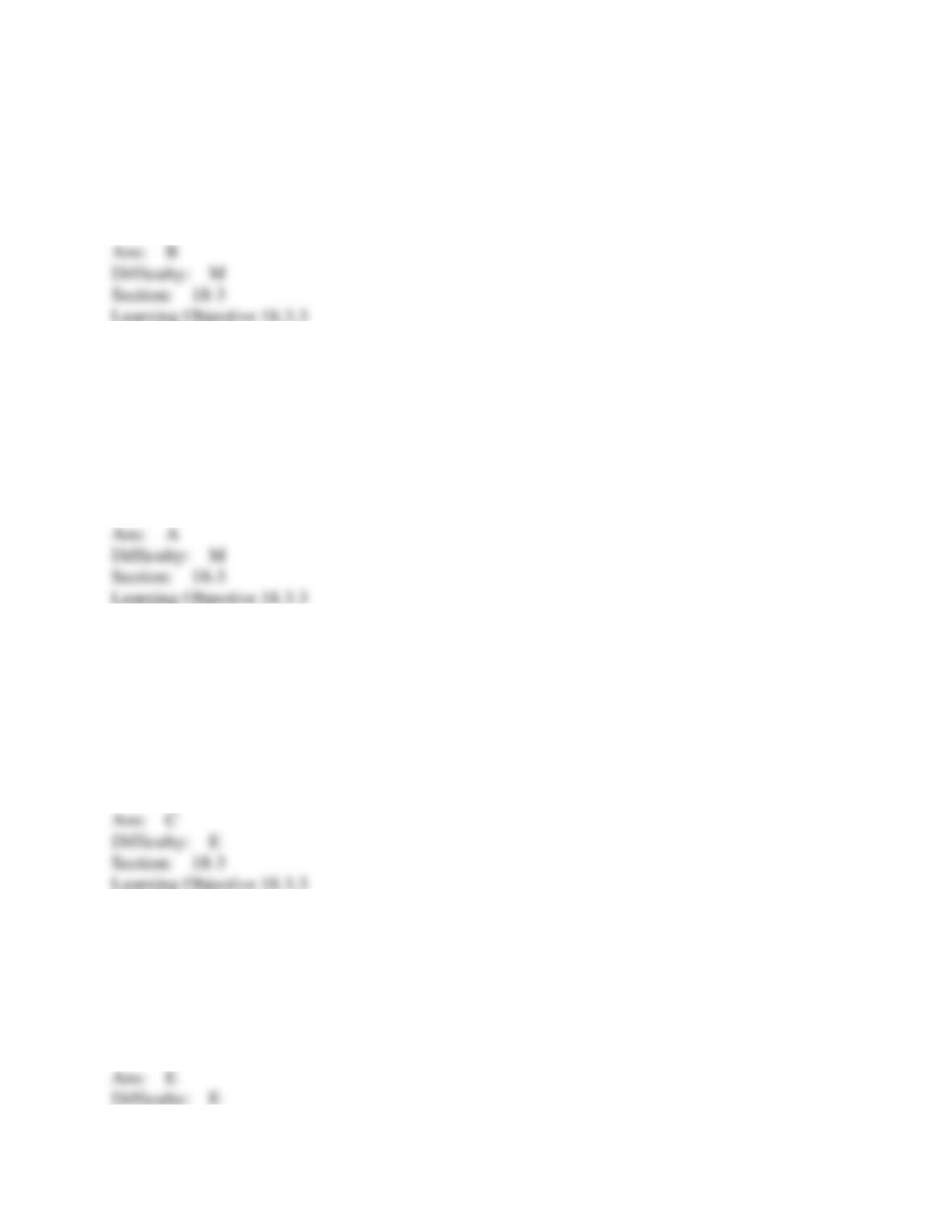
32. The diagram shows four rectangular plates and their dimensions. All are made of the
same material. The temperature now increases. Of these plates:
A) the vertical dimension of plate 1 increases the most and the area of plate 1 increases the
most
B) the vertical dimension of plate 2 increases the most and the area of plate 4 increases the
most
C) the vertical dimension of plate 3 increases the most and the area of plate 1 increases the
most
D) the vertical dimension of plate 4 increases the most and the area of plate 3 increases the
most
E) the vertical dimension of plate 4 increases the most and the area of plate 4 increases the
most
33. The mercury column in an ordinary medical thermometer doubles in length when its
temperature changes from 95F to 105F. Choose the correct statement:
A) the coefficient of volume expansion of mercury is 0.10 per F
B) the coefficient of volume expansion of mercury is 0.30 per F
C) the coefficient of volume expansion of mercury is (0.10/3) per F
D) the vacuum above the column helps to “pull up” the mercury this large amount
E) none of the above is true
34. The coefficient of linear expansion of iron is 10–5 per C. The volume of an iron cube, 5 cm
on edge, will increase by what amount if it is heated from 10C to 60C?
A) 0.00375 cm3
B) 0.1875 cm3
C) 0.0225 cm3
D) 0.0075 cm3
E) 0.0625 cm3
35. The coefficient of linear expansion of steel is 11 10–6 per C. A steel ball has a volume of
exactly 100 cm3 at 0C. When heated to 100C, its volume becomes:
A) 100.33 cm3
B) 100. 11 cm3
C) 100.0011 cm3
D) 100.0033 cm3
E) none of these
36. The coefficient of expansion of a certain type of steel is 0.000012 per C. The coefficient
of volume expansion is:
A) (0.000012)3 (C)–1
B) (4/3)(0.000012)3 (C)–1
C) 3 0.000012 (C)–1
D) 0.000012 (C)–1
E) depends on the shape of the volume to which it will be applied
37. Metal pipes, used to carry water, sometimes burst in the winter because:
A) metal contracts more than water
B) outside of the pipe contracts more than the inside
C) metal becomes brittle when cold
D) ice expands when it melts
E) water expands when it freezes
38. A gram of distilled water at 4C:
A) will increase slightly in weight when heated to 6C
B) will decrease slightly in weight when heated to 6C
C) will increase slightly in volume when heated to 6C
D) will decrease slightly in volume when heated to 6C
E) will not change in either volume or weight
39. A heat of transformation of a substance is:
A) the energy absorbed as heat during a phase transformation
B) the energy per unit mass absorbed as heat during a phase transformation
C) the same as the heat capacity
D) the same as the specific heat
E) the same as the molar specific heat
40. The thermal energy of an object is associated with:
A) its kinetic energy
B) its potential energy
C) its inertia
D) the random motions of its molecules
E) the collective motions of its molecules
41. Heat is:
A) energy transferred by virtue of a temperature difference
B) energy transferred by macroscopic work
C) energy content of an object
D) a temperature difference
E) a property objects have by virtue of their temperatures
42. Heat has the same units as:
A) temperature
B) work
C) energy/time
D) heat capacity
E) energy/volume
43. A calorie is about:
A) 0.24 J
B) 8.3 J
C) 250 J
D) 4.2 J
E) 4200 J
44. An insulated container, filled with water, contains a thermometer and a paddle wheel. The
paddle wheel can be rotated by an external source. This apparatus can be used to determine:
A) specific heat of water
B) relation between kinetic energy and absolute temperature
C) thermal conductivity of water
D) efficiency of changing work into heat
E) mechanical equivalent of heat
45. The heat capacity of an object is:
A) the amount of heat energy to raise its temperature by 1C
B) the amount of heat energy to change its state without changing its temperature
C) the amount of heat energy per kilogram to raise its temperature by 1C

D) the ratio of its specific heat to that of water
E) the change in its temperature caused by adding 1 J of heat
46. For constant volume processes the heat capacity of gas A is greater than the heat capacity
of gas B. We conclude that when they both absorb the same energy as heat at constant volume:
A) the temperature of A increases more than the temperature of B
B) the temperature of B increases more than the temperature of A
C) the internal energy of A increases more than the internal energy of B
D) the internal energy of B increases more than the internal energy of A
E) A does more positive work than B
47. The specific heat of a substance is:
A) the amount of heat energy to change the state of one gram of the substance
B) the amount of heat energy per unit mass emitted by oxidizing the substance
C) the amount of heat energy per unit mass to raise the substance from its freezing to its
boiling point
D) the amount of heat energy per unit mass to raise the temperature of the substance by 1C
E) the temperature of the object divided by its mass
48. Two different samples have the same mass and temperature. Equal quantities of energy are
absorbed as heat by each. Their final temperatures may be different because the samples have
different:
A) thermal conductivities
B) coefficients of expansion
C) densities
D) volumes
E) heat capacities