28. At one instant an electron is moving in the positive x direction along the x axis in a region
where there is a uniform magnetic field in the positive z direction. When viewed from a point on
the positive z axis, it subsequent motion is:
A) straight ahead
B) counterclockwise around a circle in the xy plane
C) clockwise around a circle in the xy plane
D) in the positive z direction
E) in the negative z direction
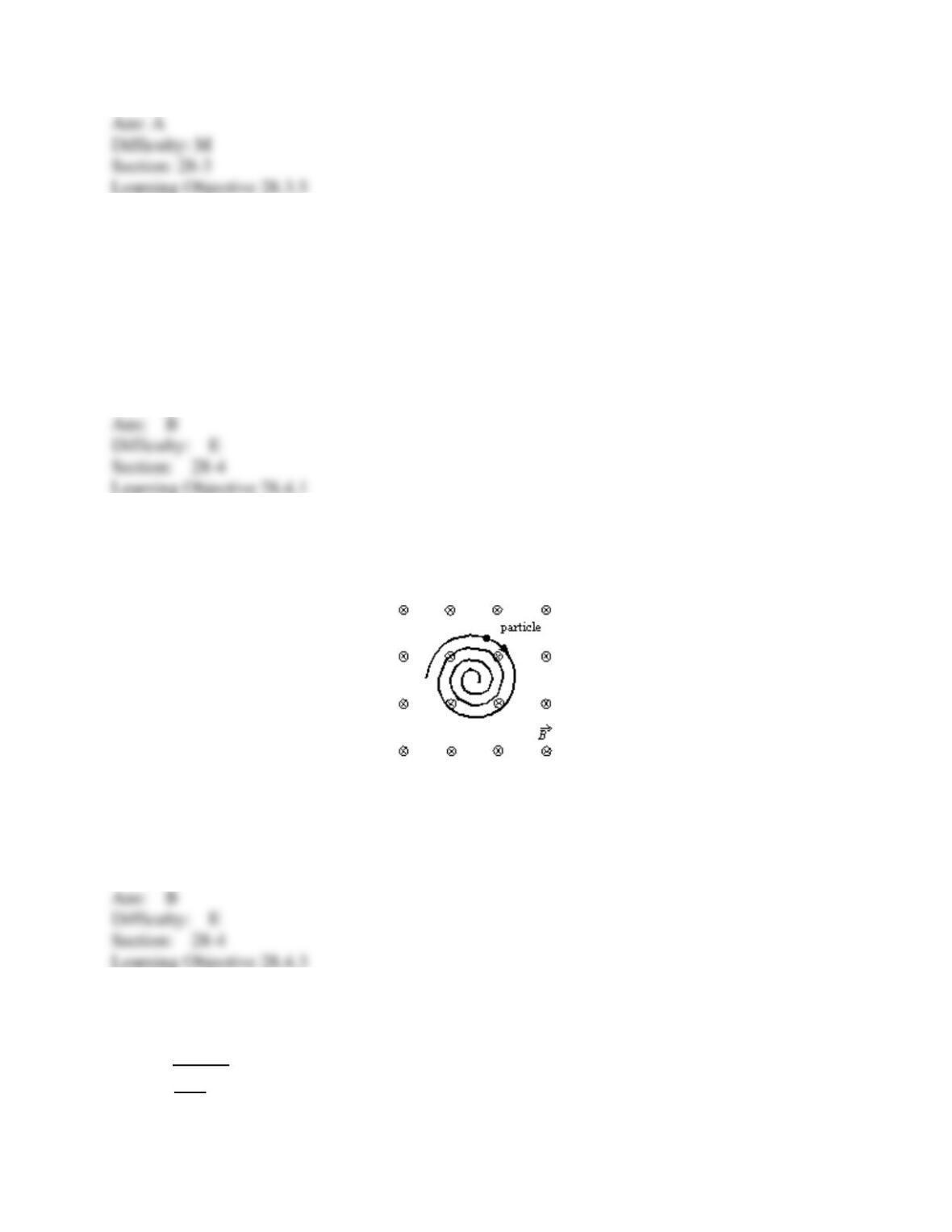
29. A uniform magnetic field is directed into the page. A charged particle, moving in the plane
of the page, follows a clockwise spiral of decreasing radius as shown. A reasonable explanation
is:
A) the charge is positive and slowing down
B) the charge is negative and slowing down
C) the charge is positive and speeding up
D) the charge is negative and speeding up
E) none of the above
30. Electrons (mass m, charge –e) are accelerated from rest through a potential difference V
and are then deflected by a magnetic field 𝐵
⃗
⃗
that is perpendicular to their velocity. The radius
of the resulting electron trajectory is:
A) (√2𝑒𝑉/𝑚)/𝐵
B) 𝐵√2𝑒𝑉/𝑚
C) (√2𝑚𝑉/𝑒)/𝐵
D) 𝐵√2𝑚𝑉/𝑒
E) none of these
31. In a certain mass spectrograph, an ion beam passes through a velocity filter consisting of
mutually perpendicular fields 𝐸
⃗
⃗
and 𝐵
⃗
⃗
. The beam then enters a region of another magnetic field
𝐵
⃗
⃗
′ perpendicular to the beam. The radius of curvature of the resulting ion beam is proportional
to:
A) EB‘/B
B) EB/B‘
C) BB‘/E
D) B/EB‘
E) E/BB‘
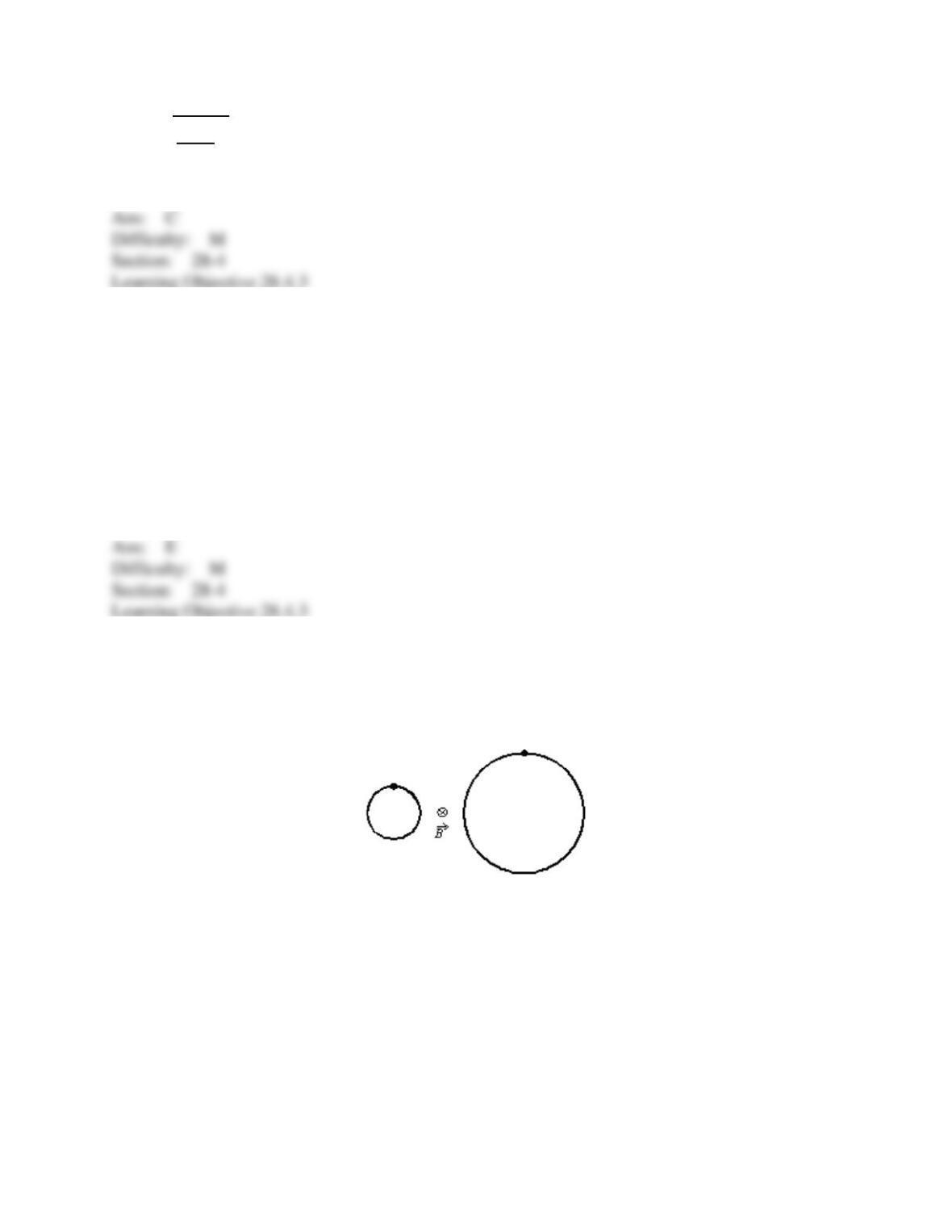
32. An electron and a proton both each travel with equal speeds around circular orbits in the
same uniform magnetic field, as shown in the diagram (not to scale). The field is into the page
on the diagram. Because the electron is less massive than the proton and because the electron is
negatively charged and the proton is positively charged:
A) the electron travels clockwise around the smaller circle and the proton travels
counterclockwise around the larger circle.
B) the electron travels counterclockwise around the smaller circle and the proton travels
clockwise around the larger circle
C) the electron travels clockwise around the larger circle and the proton travels
counterclockwise around the smaller circle
D) the electron travels counterclockwise around the larger circle and the proton travels
clockwise around the smaller circle
E) the electron travels counterclockwise around the smaller circle and the proton travels
counterclockwise around the larger circle
33. An electron is launched with velocity 𝑣⃗ in a uniform magnetic field 𝐵
⃗
⃗
. The angle
between 𝑣⃗ and 𝐵
⃗
⃗
is between 0 and 90o. As a result, the electron follows a helix, its velocity
vector 𝑣⃗ returning to its initial value in a time interval of:
A) 2πm/eB
B) 2πmv/eB
C) 2πmv sin
/eB
D) 2πmv cos
/eB
E) none of these
34. An electron is launched with velocity 𝑣⃗ in a uniform magnetic field 𝐵
⃗
⃗
. The angle
between 𝑣⃗ and 𝐵
⃗
⃗
is between 0 and 90o. As a result, the electron follows a helical path. The
pitch of the helix is:
A) the angle the helix makes with the magnetic field
B) the angle the helix makes with the electron’s velocity vector
C) the radius of the circular motion
D) the distance between adjacent turns of the helix
E) the time it takes the electron to move from one turn of the helix to the next
35. The resonance condition in a cyclotron states that:
A) the time it takes the protons to make one cycle equals the natural frequency of the proton
B) the protons oscillate on a vertical axis once per cycle
C) the proton spin changes direction once per cycle
D) the frequency of the proton orbits equals the frequency of the electrical oscillator
E) the frequency of the proton orbits is an integer multiple of 60 Hz
36. A cyclotron operates with a given magnetic field and at a given frequency. If R denotes the
radius of the final orbit, the final particle energy is proportional to:
A) 1/R
B) R
C) R2
D) R3
E) R4
37. Which is NOT one of the differences between a cyclotron and a synchrotron?
A) Orbits in a cyclotron are spirals, while in a synchrotron they are circles
B) Conventional cyclotrons fail above energies of about 50 MeV because the proton speeds get
too close to the speed of light, while synchrotrons are designed to accommodate all proton
energies
C) Large cyclotrons would require extremely large magnets, since they must cover all possible
orbital radii, while synchrotrons only need a thin ring
D) In general, synchrotrons are much smaller than cyclotrons
E) Both cyclotrons and synchrotrons require electrical oscillators to accelerate the protons
38. The diagram shows a straight wire carrying a flow of electrons into the page. The wire is
between the poles of a permanent magnet. The direction of the magnetic force exerted on the
wire is:
A)
B)
C)
D) →
E) into the page
39. The diagram shows a straight wire carrying current i in a uniform magnetic field. The
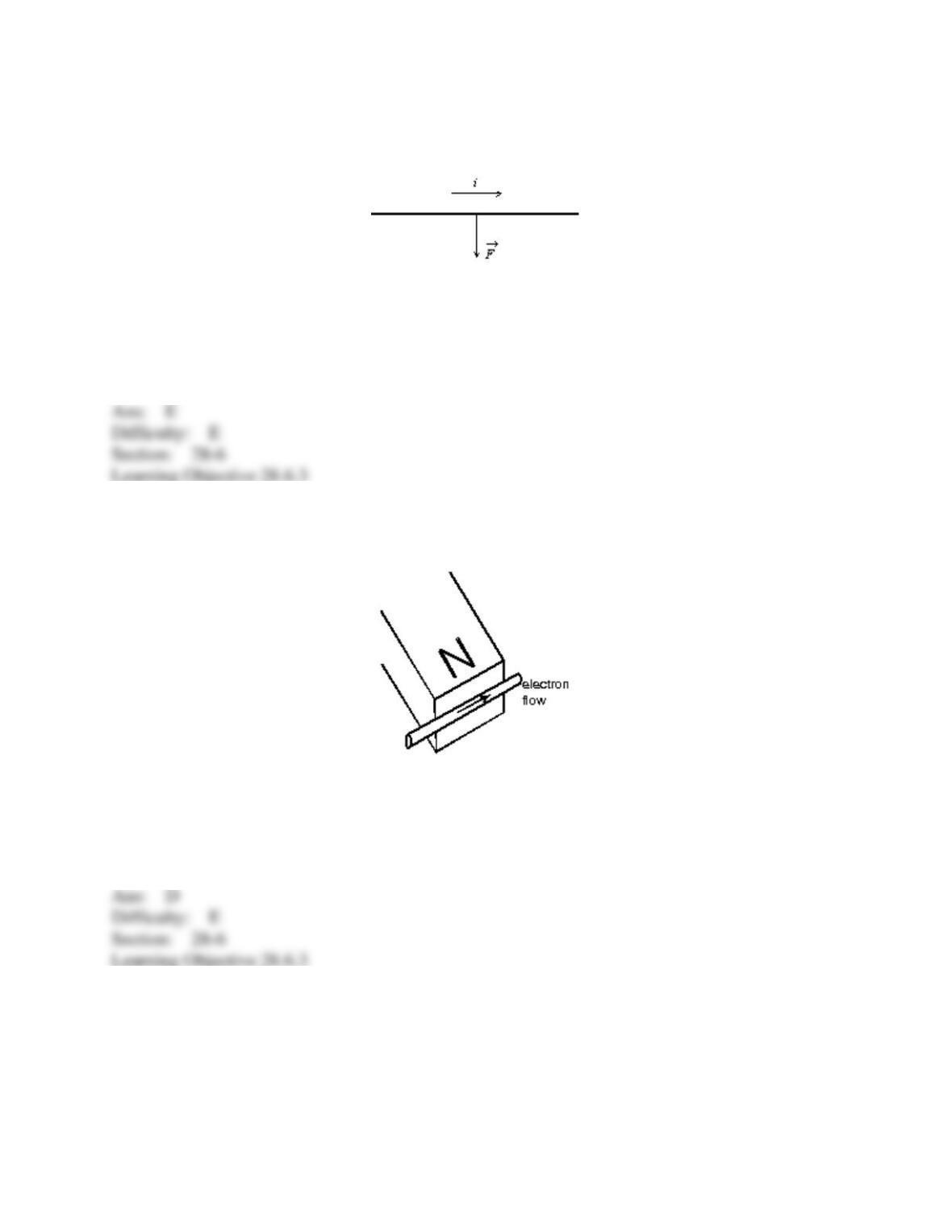
magnetic force on the wire is indicated by an arrow but the magnetic field is not shown. Of the
following possibilities, the direction of the magnetic field is:
A) to the right
B) opposite the direction of 𝐹
⃗
C) in the direction of 𝐹
⃗
D) into the page
E) out of the page
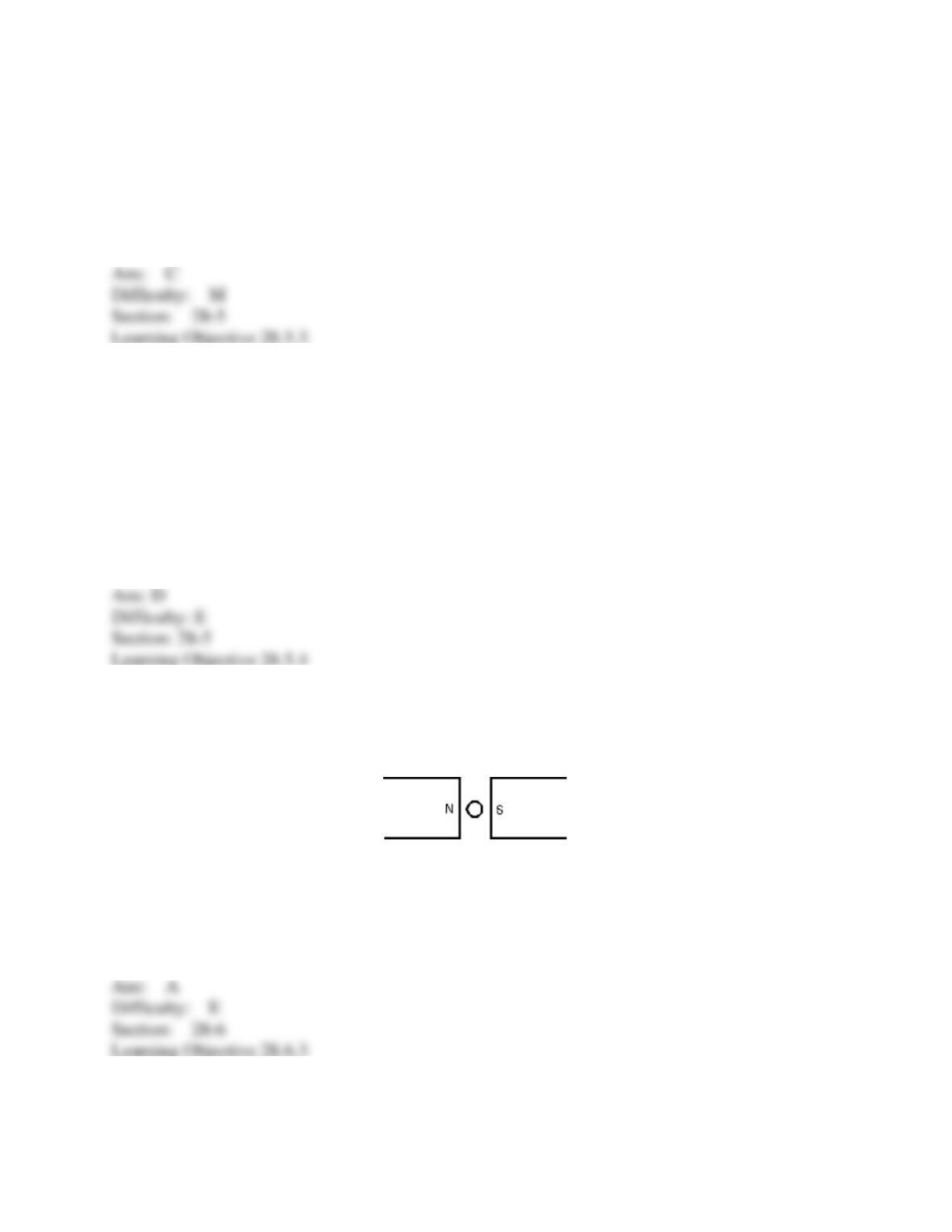
40. The figure shows the motion of electrons in a wire which is near the N pole of a magnet.
The wire will be pushed:
A) toward the magnet
B) away from the magnet
C) downward
D) upward
E) along its length
41. The figure shows a uniform magnetic field 𝐵
⃗
⃗
directed to the left and a wire carrying a
current into the page. The magnetic force acting on the wire is:
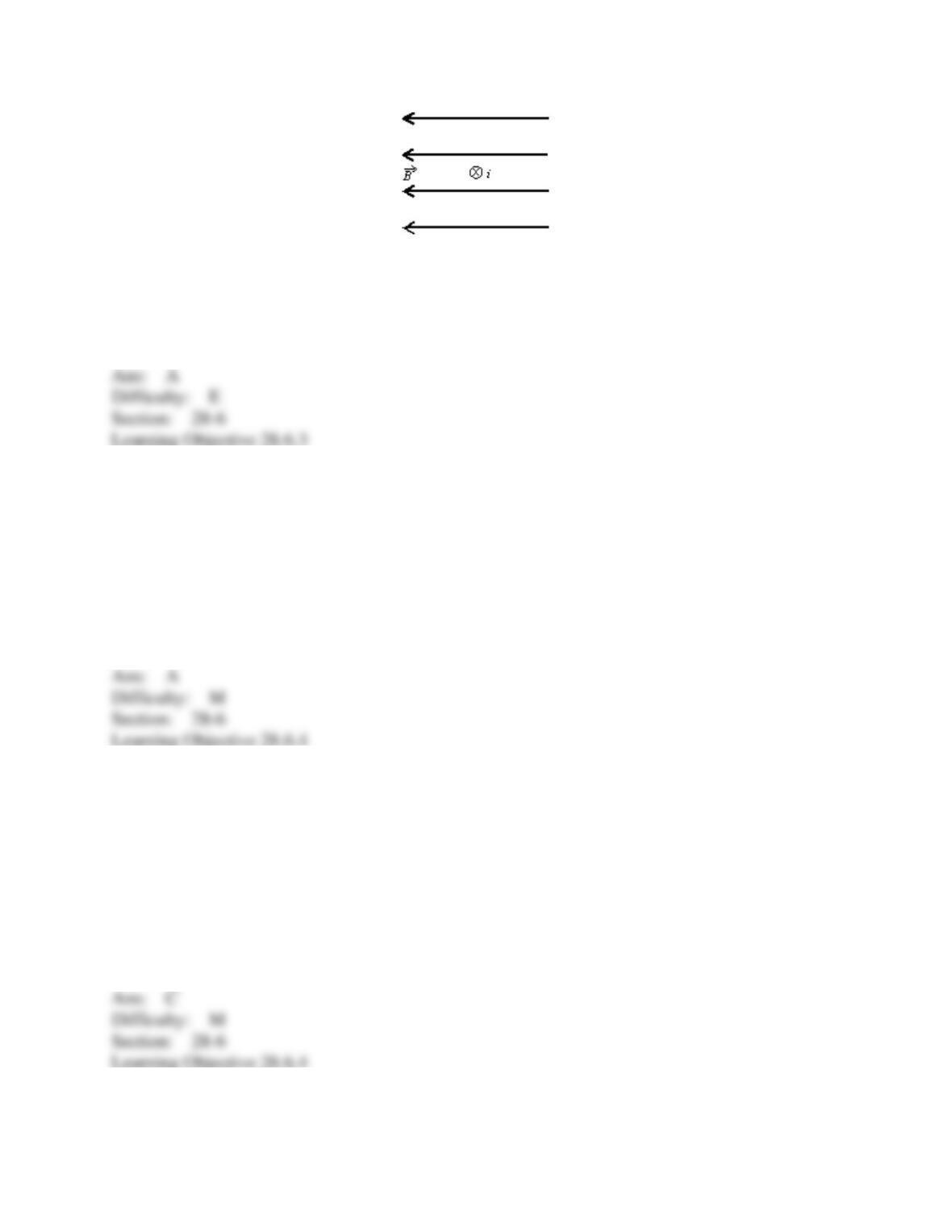
A) toward the top of the page
B) toward the bottom of the page
C) toward the left
D) toward the right
E) zero
42. A loop of wire carrying a current of 2.0 A is in the shape of a right triangle with two equal
sides, each 15 cm long. A 0.7 T uniform magnetic field is parallel to the hypotenuse. The total
magnetic force on the two equal sides has a magnitude of:
A) 0 N
B) 0.21 N
C) 0.30 N
D) 0.41 N
E) 0.51 N
43. A loop of wire carrying a current of 2.0 A is in the shape of a right triangle with two equal
sides, each 15 cm long. A 0.7 T uniform magnetic field is in the plane of the triangle and is
perpendicular to the hypotenuse. The resultant magnetic force on the two equal sides has a
magnitude of:
A) 0 N
B) 0.21 N
C) 0.30 N
D) 0.41 N
E) 0.51 N
44. A current is clockwise around the outside edge of this page and a uniform magnetic field is
directed parallel to the page, from left to right. If the magnetic force is the only force acting on
the page, the page will rotate so the right edge:
A) moves toward you
B) moves away from you
C) moves to your right
D) moves to your left
E) does not move
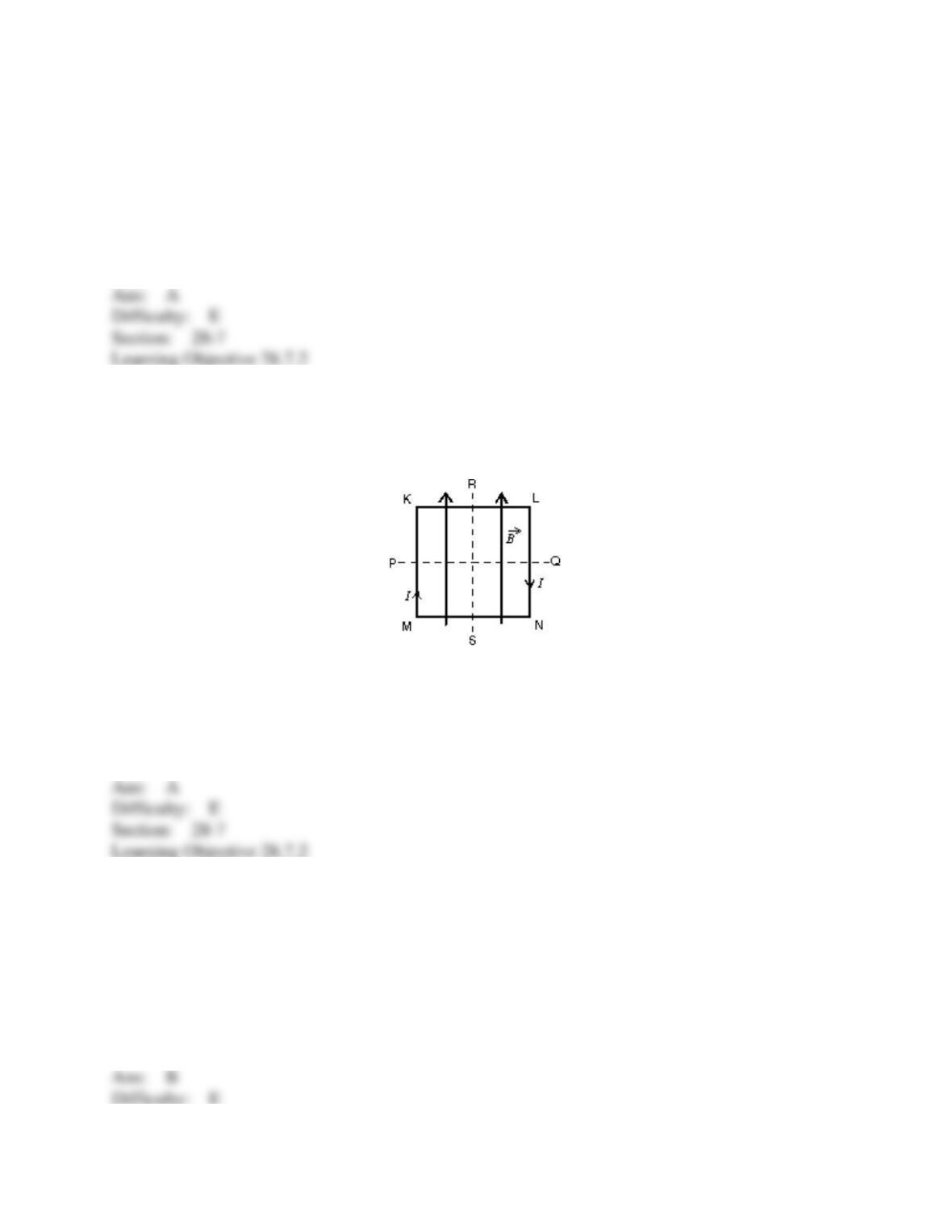
45. A square loop of wire lies in the plane of the page and carries a current I as shown. There is
a uniform magnetic field 𝐵
⃗
⃗
directed towards the top of the page, as indicated. The loop will
tend to rotate:
A) about PQ with KL coming out of the page
B) about PQ with KL going into the page
C) about RS with MK coming out of the page
D) about RS with MK going into the page
E) about an axis perpendicular to the page
46. The magnetic torque exerted on a flat current-carrying loop of wire by a uniform magnetic
field 𝐵
⃗
⃗
is:
A) maximum when the plane of the loop is perpendicular to 𝐵
⃗
⃗
B) maximum when the plane of the loop is parallel to 𝐵
⃗
⃗
C) dependent on the shape of the loop for a fixed loop area
D) independent of the orientation of the loop
E) such as to rotate the loop around the magnetic field lines
47. The units of magnetic dipole moment are:
A) ampere
B) ampere meter
C) ampere meter2
D) ampere/meter
E) ampere/meter2
48. You are facing a loop of wire which carries a clockwise current of 3.0 A and which
surrounds an area of 5.8 x 10⁻²m2. The magnetic dipole moment of the loop is:
A) 3.0 Am2, into the page
B) 3.0 Am2, out of the page
C) 0.17 Am2, into the page
D) 0.17 Am2, out of the page
E) 0.17 Am2, left to right
49. A circular loop of wire with a radius of 20 cm lies in the xy plane and carries a current of 2
A, counterclockwise when viewed from a point on the positive z axis. Its magnetic dipole
moment is:
A) 0.25 Am2, in the positive z direction
B) 0.25 Am2, in the negative z direction
C) 2.5 Am2, in the positive z direction
D) 2.5 Am2, in the negative z direction
E) 0.25 Am2, in the xy plane
50. The magnetic dipole moment of a current-carrying loop of wire is in the positive z
direction. If a uniform magnetic field is in the positive x direction the magnetic torque on the
loop is:
A) zero
B) in the positive y direction
C) in the negative y direction
D) in the positive z direction
E) in the negative z direction
51. A coil of 1000 turns of wire has a radius of 12 cm and carries a counterclockwise current of
15A. If it is lying flat on the ground, and the Earth’s magnetic field points due north, has a
magnitude of 5.8 x 10⁻⁵ T, and makes a downward angle of 25° with the vertical, what is the
torque on the loop?
A) 1.7 x 10⁻² N·m west
B) 3.6 x 10⁻² N·m west
C) 1.7 x 10⁻² N·m east
D) 3.6 x 10⁻² N·m east
E) 3.6 x 10⁻² N·m south
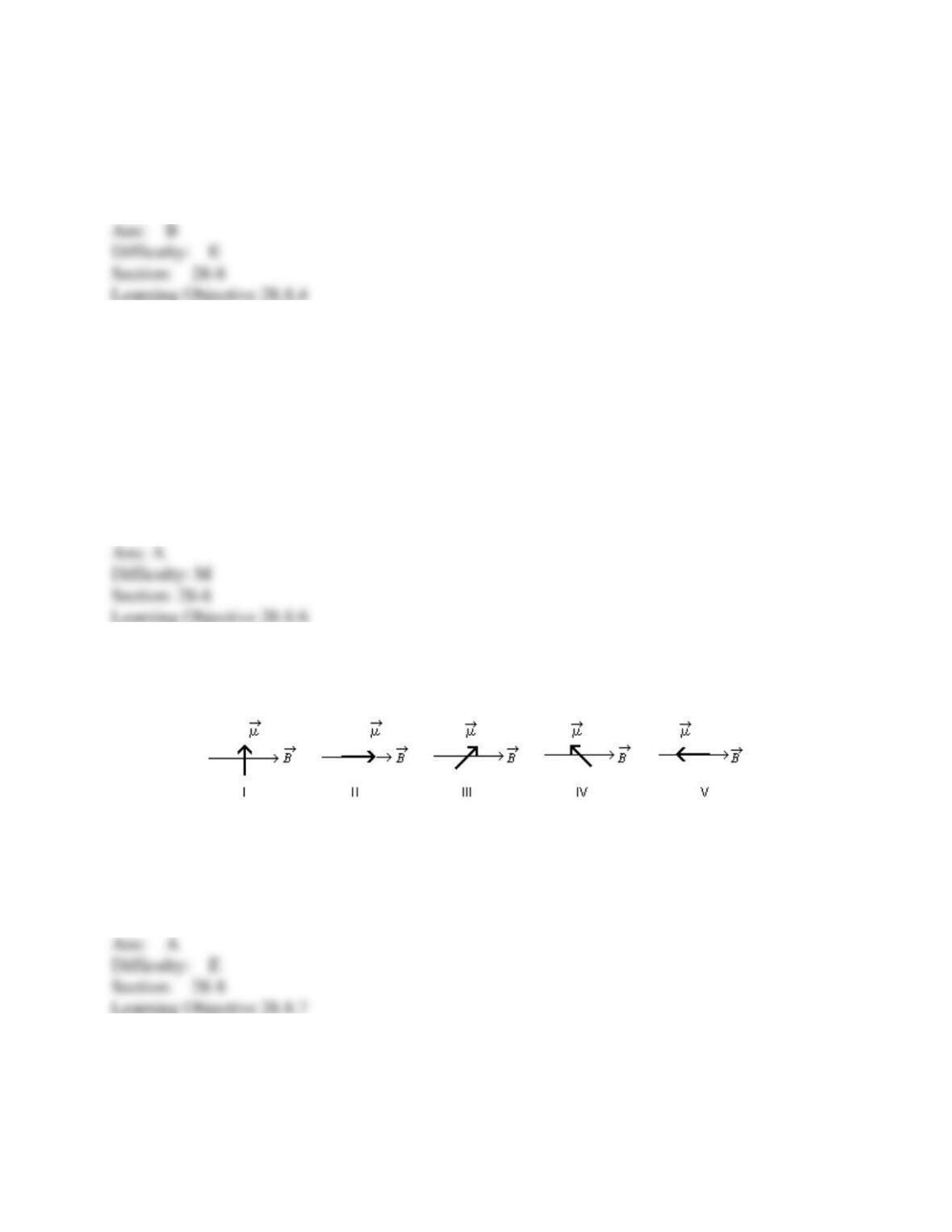
52. The diagrams show five possible orientations of a magnetic dipole 𝜇⃗ in a uniform
magnetic field 𝐵
⃗
⃗
. For which of these does the magnetic torque on the dipole have the greatest
magnitude?
A) I
B) II
C) III
D) IV
E) V
53. A loop of current-carrying wire has a magnetic dipole moment of 5.0 10–4 Am2. If the
dipole moment makes an angle of 57° with a magnetic field of 0.35 T, what is its potential
energy?
A) –9.5 x 10⁻⁵ J
B) –1.5 x 10⁻⁴ J
C) –1.8 x 10⁻⁴ J
D) +1.5 x 10⁻⁴ J
E) +9.5 x 10⁻⁵ J
54. For a loop of current-carrying wire in a uniform magnetic field the potential energy is a
minimum if the magnetic dipole moment of the loop is:
A) in the same direction as the field
B) in the direction opposite to that of the field
C) perpendicular to the field
D) at an angle of 45 to the field
E) none of the above
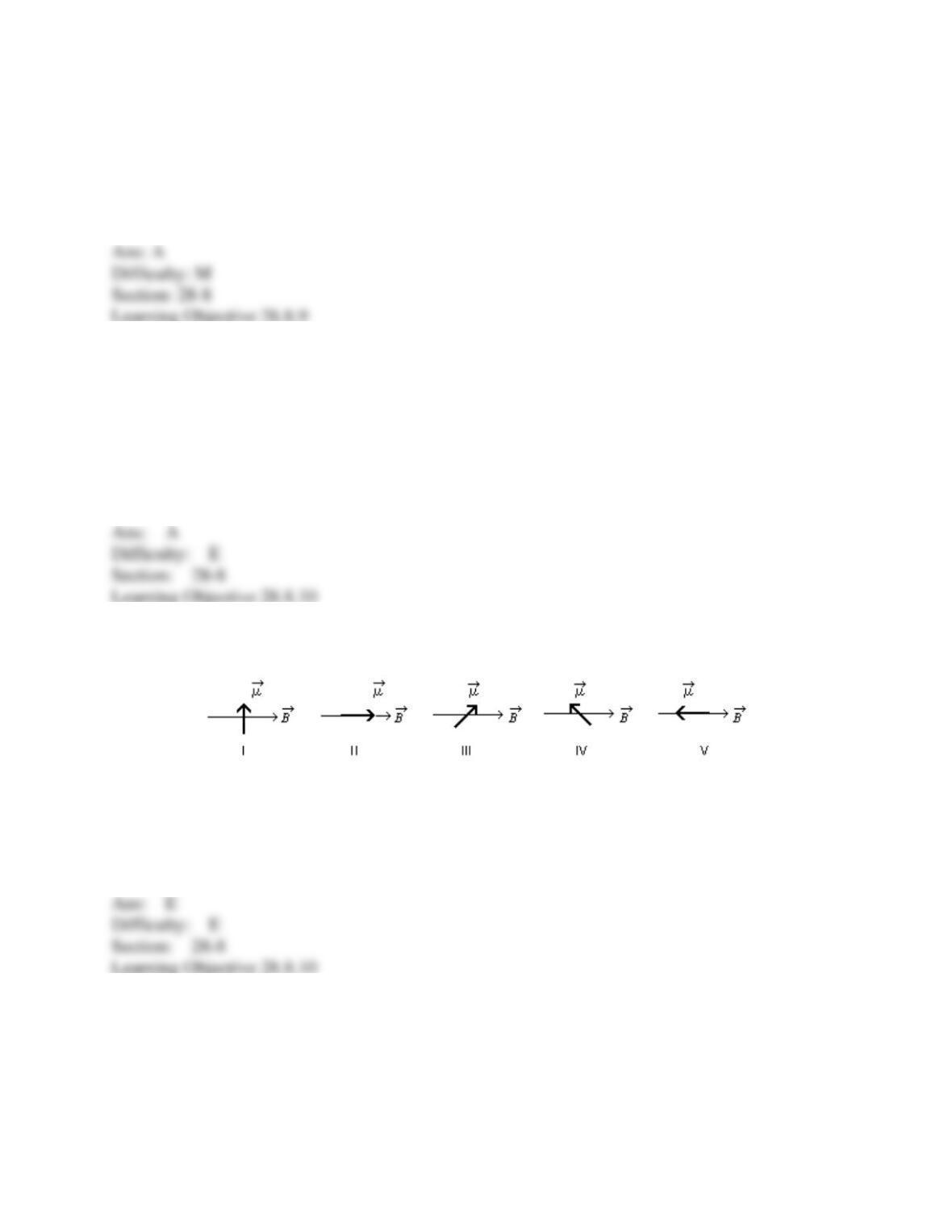
55. The diagrams show five possible orientations of a magnetic dipole 𝜇⃗ in a uniform
magnetic field 𝐵
⃗
⃗
. For which of these is the potential energy the greatest?
A) I
B) II
C) III
D) IV
E) V
56. A loop of current-carrying wire has a magnetic dipole moment of 5.0 10–4 Am2. The
moment initially is aligned with a 0.50-T magnetic field. To rotate the loop so its dipole moment
is perpendicular to the field and hold it in that orientation, you must do work of:
A) 0 J
B) 2.5 10–4 J

C) –2.5 10–4 J
D) 1.0 10–3 J
E) –1.0 10–3 J