A) the number of slits
B) the slit width
C) the slit separation
D) the order of the line
E) the index of refraction
38. A light spectrum is formed on a screen using a diffraction grating. The entire apparatus
(source, grating and screen) is now immersed in a liquid of index 1.33. As a result, the pattern on
the screen:
A) remains the same
B) spreads out
C) crowds together
D) becomes reversed, with the previously blue end becoming red
E) disappears because the index isn’t an integer
39. At a bright diffraction line phasors associated with waves from the slits of a multiple-slit
barrier:
A) are aligned
B) form a closed polygon
C) form a polygon with several sides missing
D) are parallel but adjacent phasors point in opposite directions
E) form the arc of a circle
40. For a certain multiple-slit barrier the slit separation is 4 times the slit width. For this
system:
A) the orders of the lines that appear are all multiples of 4
B) the orders of the lines that appear are all multiples of 2
C) the orders of the missing lines are all multiples of 4
D) the orders of the missing lines are all multiples of 2
E) none of the above are true
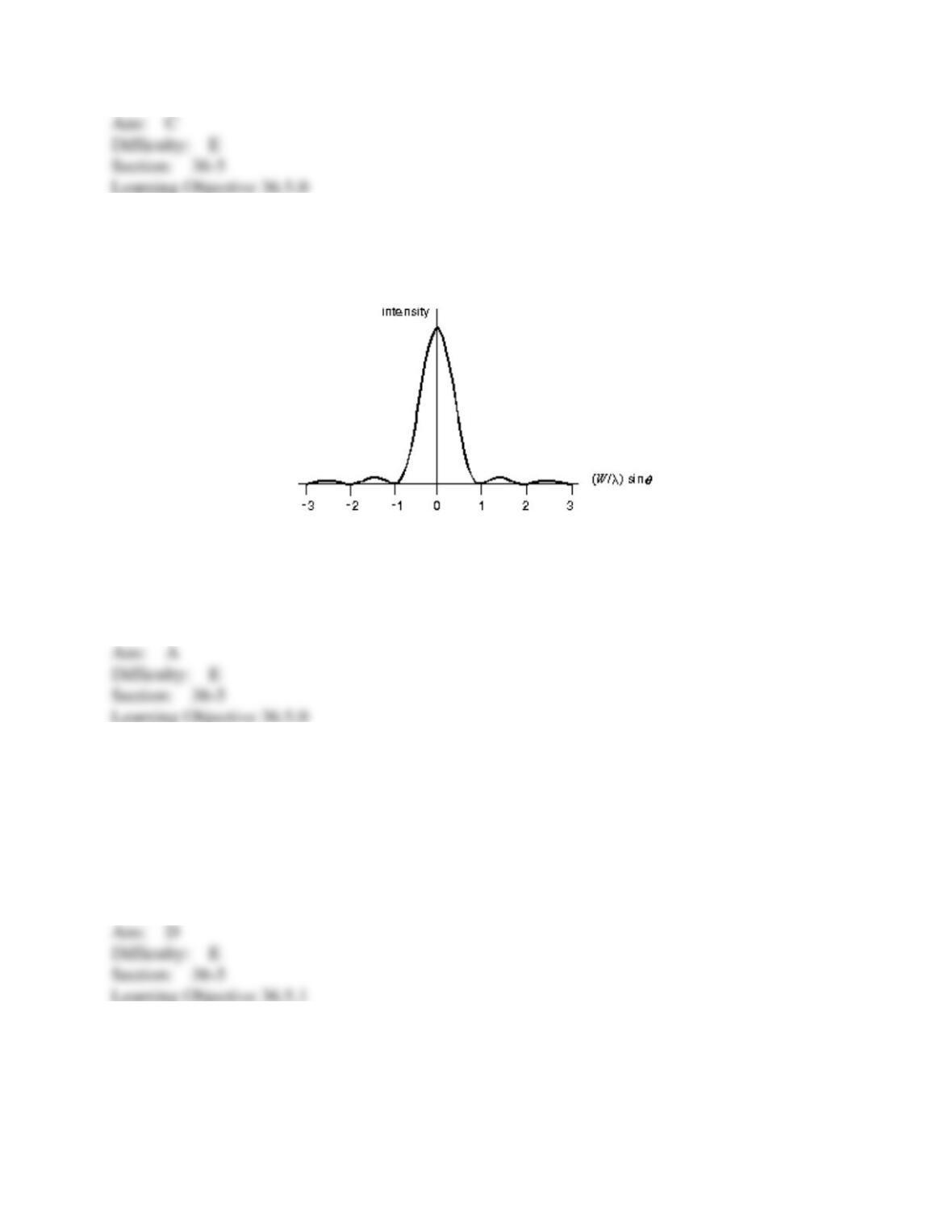
41. Light of wavelength
is normally incident on some plane optical device. The intensity
pattern shown is observed on a distant screen (
is the angle measured to the normal of the
device). The device could be:
A) a single slit of width W
B) a single slit of width 2W
C) two narrow slits with separation W
D) two narrow slits with separation 2W
E) a diffraction grating with slit separation W
42. A person with her eye relaxed looks through a diffraction grating at a distant
monochromatic point source of light. The slits of the grating are vertical. She sees:
A) one point of light
B) a hazy horizontal strip of light of the same color as the source
C) a hazy strip of light varying from violet to red
D) a sequence of horizontal points of light
E) a sequence of closely spaced vertical lines
43. In the equation d sin
= m for the lines of a diffraction grating, m is:
A) the number of slits
B) the slit width
C) the slit separation
D) the order of the line
E) the index of refraction
44. In the equation d sin
= m for the lines of a diffraction grating, d sin
is:
A) the number of slits
B) the slit width
C) the slit separation
D) the order of the line
E) the path length difference
45. An N-slit system has slit separation d and slit width a. Plane waves with intensity I and
wavelength
are incident normally on it. The angular separation of the lines depends only on:
A) a and N
B) a and
C) N and
D) d and
E) I and N
46. 600-nm light is incident on a diffraction grating with a ruling separation of 1.7 10–6 m.
The second order line occurs at a diffraction angle of:
A) 0°
B) 10
C) 21
D) 42
E) 45
47. Monochromatic light is normally incident on a diffraction grating that is 1 cm wide and has
10,000 slits. The first order line is deviated at a 30 angle. What is the wavelength of the incident
light?
A) 300 nm
B) 400 nm
C) 500 nm
D) 600 nm
E) 1000 nm
48. The spacing between adjacent slits on a diffraction grating is 3
. The deviation
of the
first order diffracted beam is given by:
A) sin(
/2) = 1/3
B) sin(
/3) = 2/3
C) sin(
) = 1/3
D) tan(
/2) = 1/3
E) tan(
) = 2/3
49. When light of a certain wavelength is incident normally on a certain diffraction grating the
line of order 1 is at a diffraction angle of 25. The diffraction angle for the second order line is:
A) 25
B) 42
C) 50
D) 58
E) 75
50. A diffraction grating of width W produces a deviation
in second order for light of
wavelength
. The total number N of slits in the grating is given by:
A) 2W
/sin
B) (W/
)sin
C)
W/2sin
D) (W/2
)sin
E) 2
/sin
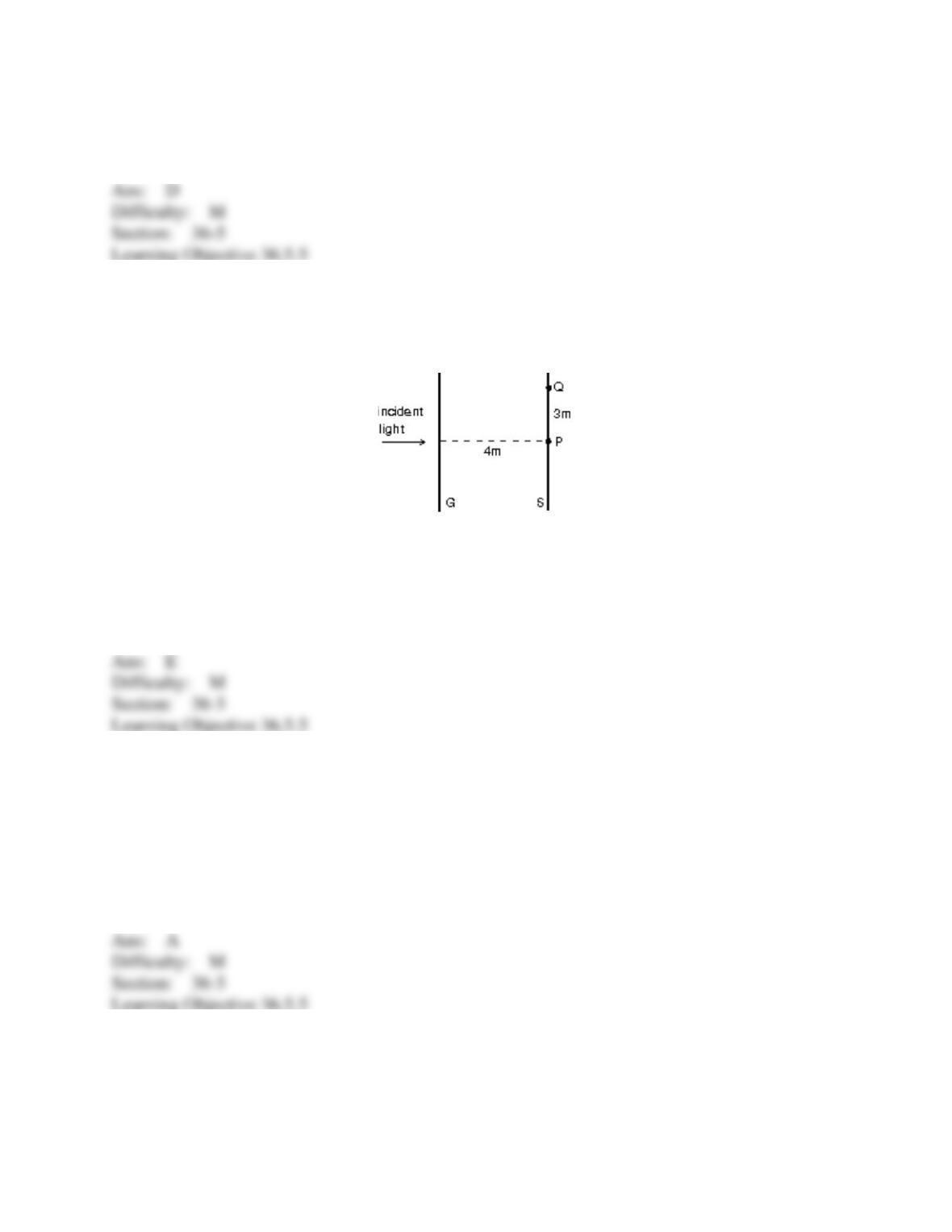
51. Light of wavelength
is normally incident on a diffraction grating G. On the screen S, the
central line is at P and the first order line is at Q, as shown. The distance between adjacent slits in
the grating is:
A) 3
/5
B) 3
/4
C) 4
/5
D) 5
/4
E) 5
/3
52. A mixture of 450-nm and 900-nm light is incident on a multiple-slit system. Which of the
following is true?
A) All lines of the 900-nm light coincide with lines of the 450-nm light
B) All lines of the 450-nm light coincide with lines of the 900-nm light
C) None of the lines of the 900-nm light coincide with lines of the 450-nm light
D) None of the lines of the 450-nm light coincide with lines of the 900-nm light
E) None of the above
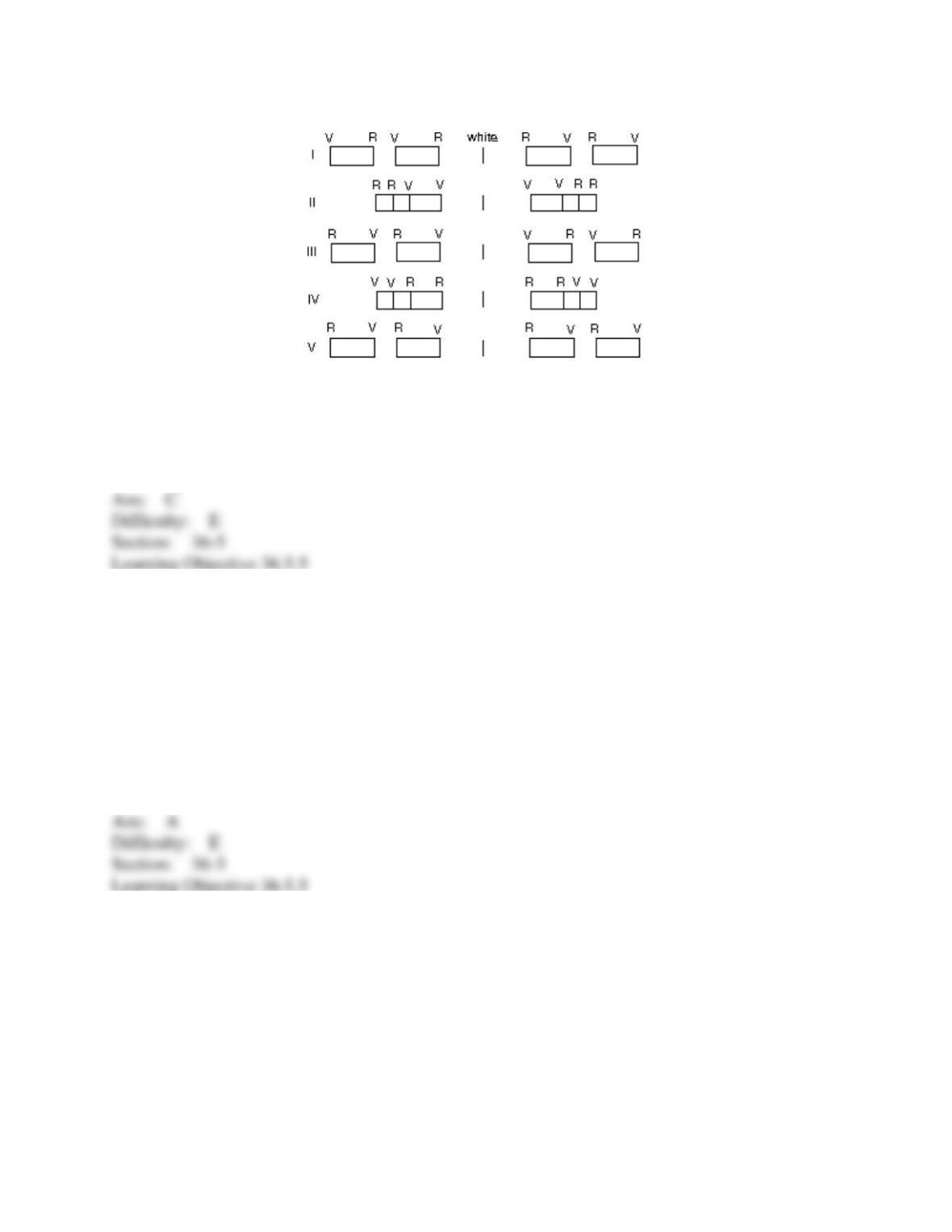
53. A beam of white light (from 400 nm for violet to 700 nm for red) is normally incident on a
diffraction grating. It produces two orders on a distant screen. Which diagram below (R = red, V
= violet) correctly shows the pattern on the screen?
A) I.
B) II.
C) III.
D) IV.
E) V.
54. If white light is incident on a diffraction grating:
A) the first order lines for all visible wavelengths occur at smaller diffraction angles than any
of the second order lines
B) some first order lines overlap the second order lines if the ruling separation is small but do
not if it is large
C) some first order lines overlap second order lines if the ruling separation is large but do not if
it is small
D) some first order lines overlap second order lines no matter what the ruling separation
E) first and second order lines have the same range of diffraction angles
55. Monochromatic light is normally incident on a diffraction grating. The mth order line is at
an angle of diffraction
and has width w. A wide single slit is now placed in front of the grating
and its width is then slowly reduced. As a result:
A) both
and w increase
B) both
and w decrease
C)
remains the same and w increases
D)
remains the same and w decreases
E)
decreases and w increases
56. If 550-nm light is incident normally on a diffraction grating and exactly 6 lines are
produced, the ruling separation must be:
A) between 2.75 10−6 m and 5.50 10−6 m
B) between 5.50 10−6 m and 1.10 10−5 m
C) between 3.30 10−6 m and 3.85 10−6 m
D) between 3.85 10−6 m and 4.40 10−6 m
E) between 2.20 10−6 m and 3.30 10−6 m
57. Light of wavelength 550 nm is incident on a diffraction grating that is 1 cm wide and has
1000 slits. What is the half-width of the m = 1 line?
A) 5.5 x 10⁻⁵ rad
B) 5.5 x 10⁻⁴ rad
C) 5.5 x 10⁻³ rad
D) 5.5 x 10⁻² rad
E) 5.5 x 10⁻¹ rad
58. As more slits with the same spacing are added to a multiple-slit system the lines:
A) spread further apart
B) move closer together
C) become wider
D) become narrower
E) do not change in position or width
59. The widths of the lines produced by monochromatic light falling on a diffraction grating
can be reduced by:
A) increasing the wavelength of the light
B) increasing the number of rulings without changing their spacing
C) decreasing the spacing between adjacent rulings without changing the number of rulings
D) decreasing both the wavelength and the spacing between rulings by the same factor
E) increasing the number of rulings and decreasing their spacing so the length of the grating
remains the same
60. The dispersion D of a grating can have units:
A) cm
B) 1/nm
C) nm/cm
D) radian
E) none of these
61. The resolving power R of a grating can have units:
A) cm
B) degree/nm
C) watt
D) nm/cm
E) watt/nm
62. The resolving power of a diffraction grating is defined by R =
/
. Here
and
+
are:
A) any two wavelengths
B) any two wavelengths that are nearly the same
C) two wavelengths for which lines of the same order are separated by radians
D) two wavelengths for which lines of the same order are separated by 2 radians
E) two wavelengths for which lines of the same order are separated by half the width of a
maximum
63. The dispersion of a diffraction grating indicates:
A) the resolution of the grating
B) the separation of lines of the same order
C) the number of rulings in the grating
D) the width of the lines
E) the spreading apart of diffraction lines associated with different wavelengths
64. A light beam incident on a diffraction grating consists of waves with two different
wavelengths. The separation of the two first order lines is great if:
A) the dispersion is great
B) the resolution is great
C) the dispersion is small
D) the resolution is small
E) none of the above (line separation does not depend on either dispersion or resolution)
65. Light of wavelength 550 nm is incident on a diffraction grating that is 1 cm wide and has
1000 slits. What is the dispersion of the m = 2 line?
A) 2.0 x 10⁵ rad/m
B) 2.0 x 10⁴ rad/m
C) 2.0 x 10³ rad/m
D) 2.0 x 10² rad/m
E) 2.0 x 101 rad/m
66. To obtain greater dispersion by a diffraction grating:
A) the slit width should be increased
B) the slit width should be decreased
C) the slit separation should be increased
D) the slit separation should be decreased
E) more slits with the same width and separation should be added to the system
67. Two nearly equal wavelengths of light are incident on an N slit grating. The two
wavelengths are not resolvable. When N is increased they become resolvable. This is because:
A) more light gets through the grating
B) the lines get more intense
C) the entire pattern spreads out
D) there are more orders present
E) the lines become more narrow
68. A diffraction grating just resolves the wavelengths 400.0 nm and 400.1 nm in first order.
The number of slits in the grating is:
A) 400
B) 1000
C) 2500
D) 4000
E) not enough information is given
69. What is the minimum number of slits required in a diffraction grating to just resolve light
with wavelengths of 471.0 nm and 471.6 nm?
A) 99
B) 197
C) 393
D) 786
E) 1179
70. Bragg’s law for x-ray diffraction is 2d sin
= m. The quantity d is:
A) the height of a unit cell
B) the smallest interatomic distance
C) the distance from detector to sample
D) the distance between planes of atoms
E) the usual calculus symbol for a differential
71. Which of the following is true for Bragg diffraction but not for diffraction from a grating?
A) Two different wavelengths may be used
B) For a given wavelength, a maximum may exist in several directions
C) Long waves are deviated more than short ones
D) There is only one grating spacing
E) Maxima occur only for particular angles of incidence
72. X rays are:
A) electromagnetic waves
B) negatively charged ions
C) rapidly moving electrons
D) rapidly moving protons
E) rapidly moving neutrons
73. Bragg’s law for x-ray diffraction is 2d sin
= m, where
is the angle between the incident
beam and:
A) a reflecting plane of atoms
B) the normal to a reflecting plane of atoms
C) the scattered beam
D) the normal to the scattered beam
E) the refracted beam
Learning Objective 36.7.3
74. The largest x-ray wavelength that can be diffracted by crystal planes with a separation of
0.316 nm is:
A) 0.158 nm
B) 0.316 nm
C) 0.474 nm
D) 0.632 nm
E) 1.26 nm
75. A beam of x-rays of wavelength 0.20 nm is diffracted by a set of planes in a crystal whose
separation is 3.1 10–8 cm. The smallest angle between the beam and the crystal planes for
which a reflection occurs is:
A) 0.70 rad
B) 0.33 rad
C) 0.066 rad
D) 0.033 rad
E) 0.0033 rad
76. An x-ray beam of wavelength 3 10–11 m is incident on a calcite crystal of lattice spacing
0.3 nm. The smallest angle between crystal planes and the x-ray beam which will result in
constructive interference is:
A) 2.9°
B) 5.7°
C) 12°
D) 23°
E) none of these
77. A beam of x rays of wavelength 0.10 nm is found to diffract in second order from the face
of a LiF crystal at a Bragg angle of 30. The distance between adjacent crystal planes is about:
A) 0.10 nm
B) 0.20 nm
C) 0.25 nm
D) 0.30 nm
E) 0.40 nm