Chapter: Chapter 15
Learning Objectives
LO 15.1.0 Solve problems related to simple harmonic motion.
LO 15.1.1 Distinguish simple harmonic motion from other types of periodic motion.
LO 15.1.2 For a simple harmonic oscillator, apply the relationship between position x and time t
to calculate either if given a value for the other.
LO 15.1.3 Relate period T, frequency f, and angular frequency ω.
LO 15.1.4 Identify (displacement) amplitude xm, phase constant (or phase angle) φ, and phase
ωt + φ.
LO 15.1.5 Sketch a graph of the oscillator’s position x versus time t, identifying amplitude xm
and period T.
LO 15.1.6 From a graph of position versus time, velocity versus time, or acceleration versus
time, determine the amplitude of the plot and the value of the phase constant φ.
LO 15.1.7 On a graph of position x versus time t, describe the effects of changing period T,
frequency f, amplitude xm, or phase constant φ.
LO 15.1.8 Identify the phase constant φ that corresponds to the starting time (t = 0) being set
when a particle in SHM is at an extreme point or passing through the center point.
LO 15.1.9 Given an oscillator’s position x(t) as a function of time, find its velocity v(t) as a
function of time, identify the velocity amplitude vm in the result, and calculate the velocity at any
given time.
LO 15.1.10 Sketch a graph of an oscillator’s velocity v versus time t, identifying the velocity
amplitude vm.
LO 15.1.11 Apply the relationship between velocity amplitude vm, angular frequency ω, and
(displacement) amplitude xm.
LO 15.1.12 Given an oscillator’s velocity v(t) as a function of time, calculate its acceleration
a(t) as a function of time, identify the acceleration amplitude am in the result, and calculate the
acceleration at any given time.
LO 15.1.13 Sketch a graph of an oscillator’s acceleration a versus time t, identifying the
acceleration amplitude am.
LO 15.1.14 Identify that for a simple harmonic oscillator the acceleration a at any instant is
always given by the product of a negative constant and the displacement x just then.
LO 15.1.15 For any given instant in an oscillation, apply the relationship between acceleration a,
angular frequency ω, and displacement x.
LO 15.1.16 Given data about the position x and velocity v at one instant, determine the phase ωt
+ φ and phase constant φ.
LO 15.1.17 For a spring-block oscillator, apply the relationships between spring constant k and
mass m and either period T or angular frequency ω.
LO 15.1.18 Apply Hooke’s law to relate the force F on a simple harmonic oscillator at any
instant to the displacement x of the oscillator at that instant.
LO 15.2.0 Solve problems related to energy in simple harmonic motion.
LO 15.2.1 For a spring-block oscillator, calculate the kinetic energy and elastic potential energy
at any given time.
LO 15.2.2 Apply the conservation of energy to relate the total energy of a spring-block oscillator
at one instant to the total energy at another instant.
LO 15.2.3 Sketch a graph of the kinetic energy, potential energy, and total energy of a
spring-block oscillator, first as a function of time and then as a function of the oscillator’s
position.
LO 15.2.4 For a spring-block oscillator, determine the block’s position when the total energy is
entirely kinetic energy and when it is entirely potential energy.
LO 15.3.0 Solve problems related to an angular simple harmonic oscillator.
LO 15.3.1 Describe the motion of an angular simple harmonic oscillator.
LO 15.3.2 For an angular simple harmonic oscillator, apply the relationship between the torque
τ and the angular displacement θ (from equilibrium).
LO 15.3.3 For an angular simple harmonic oscillator, apply the relationship between the period T
(or frequency f), the rotational inertia I, and the torsion constant κ.
LO 15.3.4 For an angular simple harmonic oscillator at any instant, apply the relationship
between the angular acceleration α, the angular frequency ω, and the angular displacement θ.
LO 15.4.0 Solve problems related to pendulums, circular motion.
LO 15.4.1 Describe the motion of an oscillating simple pendulum.
LO 15.4.2 Draw a free-body diagram of the pendulum bob with the pendulum at angle θ to the
vertical.
LO 15.4.3 For small-angle oscillations of a simple pendulum, relate the period T (or frequency f)
to the pendulum’s length L.
LO 15.4.4 Distinguish between a simple pendulum and a physical pendulum.
LO 15.4.5 For small-angle oscillations of a physical pendulum, relate the period T (or frequency
f) to the distance h between the pivot and the center of mass.
LO 15.4.6 For an oscillating system, determine the angular frequency ω from either an
equation relating torque τ and angular displacement θ or an equation relating angular acceleration
α and angular displacement θ.
LO 15.4.7 Distinguish between a pendulum’s angular frequency ω (having to do with the rate at
which cycles are completed) and its dθ/dt (the rate at which its angle with the vertical changes).
LO 15.4.8 Given data about the angular position θ and rate of change dθ/dt at one instant,
determine the phase constant and amplitude θm.
LO 15.4.9 Describe how the free-fall acceleration can be measured with a simple pendulum.
LO 15.4.10 For a given physical pendulum, determine the location of the center of oscillation.
LO 15.4.11 Describe how simple harmonic motion is related to uniform circular motion.
LO 15.5.0 Solve problems related to damped simple harmonic motion.
LO 15.5.1 Describe the motion of a damped simple harmonic oscillator and sketch a graph of the
oscillator’s position as a function of time.
LO 15.5.2 For any particular time, calculate the position of a damped simple harmonic
oscillator.
LO 15.5.3 Determine the amplitude at any given time.
LO 15.5.4 Calculate the angular frequency of a damped simple harmonic oscillator in terms of
the spring constant, the damping constant, and the mass.
LO 15.5.5 Apply the equation giving the (approximate) total energy of a damped simple
harmonic oscillator as a function of time.
LO 15.6.0 Solve problems related to forced oscillations and resonance.
LO 15.6.1 Distinguish between natural angular frequency ω and driving angular frequency ωd.
LO 15.6.2 For a forced oscillator, sketch a graph of the oscillation amplitude versus the ratio
ωd/ω of driving angular frequency to natural angular frequency, identify the approximate
location of resonance, and indicate the effect of increasing the damping constant.
LO 15.6.3 For a given natural angular frequency ω, identify the approximate driving angular
frequency ωd that gives resonance.
Multiple Choice
1. A particle oscillating in simple harmonic motion is:
A) never in equilibrium because it is in motion
B) never in equilibrium because there is a force
C) in equilibrium at the ends of its path because its velocity is zero there
D) in equilibrium at the center of its path because the acceleration is zero there
E) in equilibrium at the ends of its path because the acceleration is zero there
2. An object is undergoing simple harmonic motion. Throughout a complete cycle it:
A) has constant speed
B) has varying amplitude
C) has varying period
D) has varying acceleration
E) has varying mass
3. When a body executes simple harmonic motion, its acceleration at the ends of its path must
be:
A) zero
B) less than g
C) more than g
D) suddenly changing in sign
E) none of these
4. A weight suspended from an ideal spring oscillates up and down with a period T. If the
amplitude of the oscillation is doubled, the period will be:
A) T
B) 1.5 T
C) 2T
D) T/2
E) 4T
5. It is impossible for two particles, each executing simple harmonic motion, to remain in
phase with each other if they have different:
A) masses
B) periods
C) amplitudes
D) spring constants
E) kinetic energies
6. An oscillatory motion must be simple harmonic if:
A) the amplitude is small
B) the potential energy is equal to the kinetic energy
C) the motion is along the arc of a circle
D) the acceleration varies sinusoidally with time
E) the derivative, dU/dx, of the potential energy is negative
7. A particle is in simple harmonic motion with period T. At time t = 0 it is at the equilibrium
point. At the times listed below it is at various points in its cycle. Which of them is farthest away
from the equilibrium point?
A) 0.5T
B) 0.7T
C) T
D) 1.4T
E) 1.5T
Learning Objective 15.1.2
8. A particle moves back and forth along the x axis from x = –xm to x = +xm, in simple harmonic
motion with period T. At time t = 0 it is at x = +xm. When t = 0.75T:
A) it is at x = 0 and is traveling toward x = +xm
B) it is at x = 0 and is traveling toward x = –xm
C) it is at x = +xm and is at rest
D) it is between x = 0 and x = +xm and is traveling toward x = –xm
E) it is between x = 0 and x = –xm and is traveling toward x = –xm
9. A particle is in simple harmonic motion with period T. At time t=0 it is halfway between
the equilibrium point and an end point of its motion, travelling toward the end point. The next
time it is at the same place is:
A) t = T
B) t = T/2
C) t = T/3
D) t = T/4
E) none of the above
10. An object attached to one end of a spring makes 20 complete vibrations in 10s. Its period
is:
A) 2 Hz
B) 10 s
C) 0.5 Hz
D) 2 s
E) 0.50 s
11. An object attached to one end of a spring makes 20 vibrations in 10 seconds. Its frequency
is:
A) 2 Hz
B) 10 s
C) 0.05 Hz
D) 2 s
E) 0.50 s
12. An object attached to one end of a spring makes 20 vibrations in 10 seconds. Its angular
frequency is:
A) 0.79 rad/s
B) 1.57 rad/s
C) 2.0 rad/s
D) 6.3 rad/s
E) 12.6 rad/s
13. Frequency f and angular frequency
are related by
A) f =
B) f = 2
C) f =
/
D) f =
/2
E) f = 2
/
14. A block attached to a spring oscillates in simple harmonic motion along the x axis. The
limits of its motion are x = 10 cm and x = 50 cm and it goes from one of these extremes to the
other in 0.25 s. Its amplitude and frequency are:
A) 40 cm, 2 Hz
B) 20 cm, 4 Hz
C) 40 cm, 4 Hz
D) 25 cm, 4 Hz
E) 20 cm, 2 Hz
Learning Objective 15.1.4
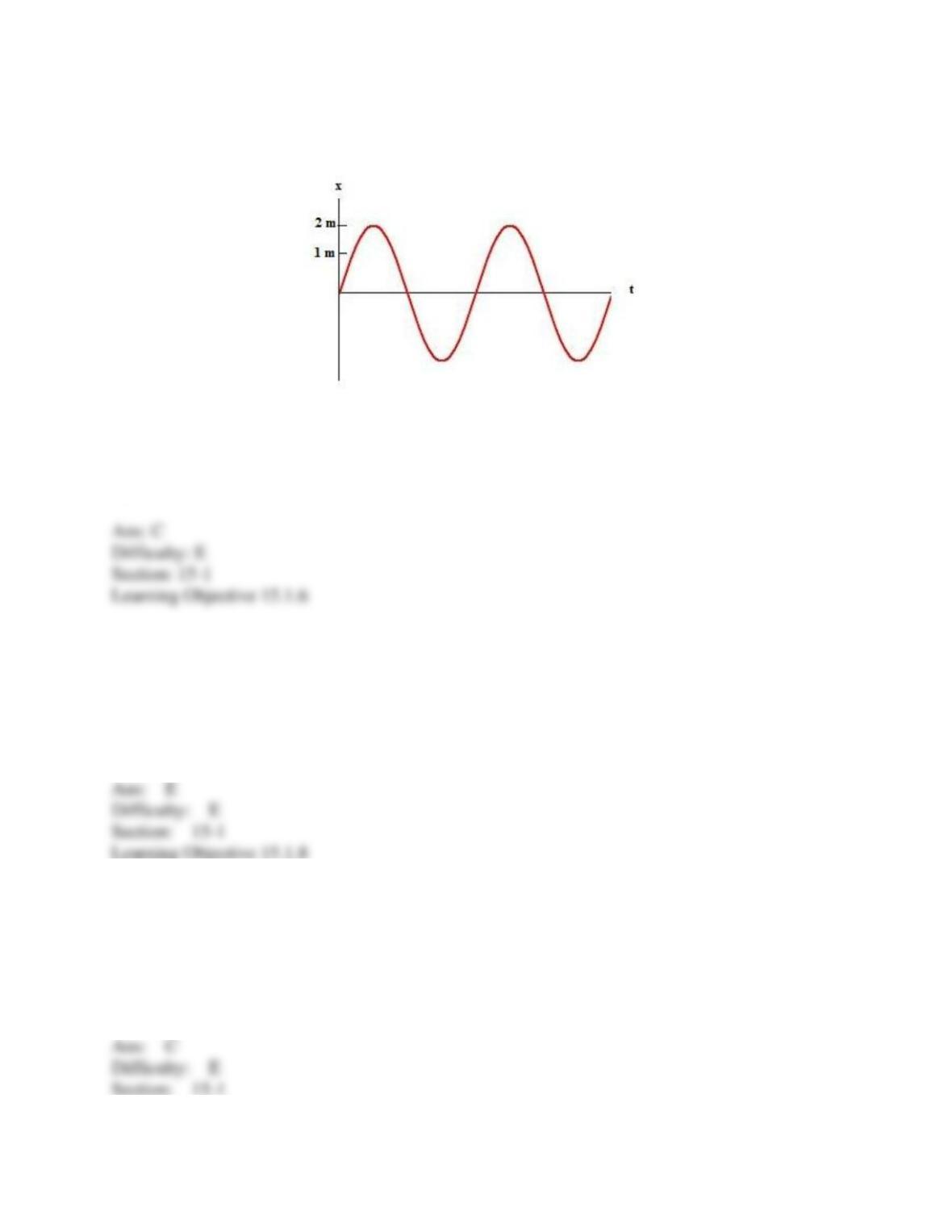
15. This plot shows a mass oscillating as x = xm cos (ωt + φ). What are xm and φ?
A) 1 m, 0°
B) 2 m, 0°
C) 2 m, 90°
D) 4 m, 0°
E) 4 m, 90°
16. The amplitude and phase constant of an oscillator are determined by:
A) the frequency
B) the angular frequency
C) the initial displacement alone
D) the initial velocity alone
E) both the initial displacement and velocity
17. In simple harmonic motion, the displacement is maximum when the:
A) acceleration is zero
B) velocity is maximum
C) velocity is zero
D) kinetic energy is maximum
E) momentum is maximum
18. Two identical undamped oscillators have the same amplitude of oscillation only if:
A) they are started with the same displacement x0
B) they are started with the same velocity v0
C) they are started with the same phase
D) they are started so the combination 𝜔2𝑥0
2+ 𝑣0
2 is the same
E) they are started so the combination 𝑥0
2+ 𝜔2𝑣0
2 is the same
19. The amplitude of any oscillator will be doubled by:
A) doubling only the initial displacement
B) doubling only the initial speed
C) doubling the initial displacement and halving the initial speed
D) doubling the initial speed and halving the initial displacement
E) doubling both the initial displacement and the initial speed
20. A particle moves in simple harmonic motion according to x = 2cos(50t), where x is in
meters and t is in seconds. Its maximum velocity is:
A) 100 sin(50t) m/s
B) 100 cos(50t) m/s
C) 100 m/s
D) 200 m/s
E) none of these
21. An object of mass m, oscillating on the end of a spring with spring constant k has amplitude
A. Its maximum speed is:
A) 𝐴√𝑘/𝑚
B) A2k/m
C) 𝐴√𝑚/𝑘
D) Am/k
E) A2m/k
22. A 0.20-kg object mass attached to a spring whose spring constant is 500 N/m executes
simple harmonic motion. If its maximum speed is 5.0 m/s, the amplitude of its oscillation is:
A) 0.0020 m
B) 0.10 m
C) 0.20 m
D) 25 m
E) 250 m
23. The acceleration of a body executing simple harmonic motion leads the velocity by what
phase?
A) 0 rad
B) /8 rad
C) /4 rad
D) /2 rad
E) rad
24. In simple harmonic motion, the magnitude of the acceleration is greatest when:
A) the displacement is zero
B) the displacement is maximum
C) the speed is maximum
D) the force is zero
E) the speed is between zero and its maximum
25. In simple harmonic motion:
A) the acceleration is greatest at the maximum displacement
B) the velocity is greatest at the maximum displacement
C) the period depends on the amplitude
D) the acceleration is constant
E) the acceleration is greatest at zero displacement
26. In simple harmonic motion, the magnitude of the acceleration is:
A) constant
B) proportional to the displacement
C) inversely proportional to the displacement
D) greatest when the velocity is greatest
E) never greater than g
27. A 1.2-kg mass is oscillating without friction on a spring whose spring constant is 3400 N/m.
When the mass’s displacement is 7.2 cm, what is its acceleration?
A) −3.8 m/s2
B) −200 m/s2
C) −240 m/s2
D) −2.0 x 10⁴ m/s2
E) cannot be calculated without more information
28. The displacement of an object oscillating on a spring is given by x(t) = xmcos(
t +
). If the
initial displacement is zero and the initial velocity is in the negative x direction, then the phase
constant
is:
A) 0 radians
B) /2 radians
C) radians
D) 3/2 radians
E) 2 radians
29. The displacement of an object oscillating on a spring is given by x(t) = xmcos(
t +
). If the
object is initially displaced in the negative x direction and given a negative initial velocity, then
the phase constant
is between:
A) 0 and /2 radians
B) /2 and radians
C) and 3/2 radians
D) 3/2 and 2 radians
E) none of the above (
is exactly 0, /2, , or 3/2 radians)
30. A certain spring elongates 9 mm when it is suspended vertically and a block of mass M is
hung on it. The angular frequency of this mass-spring system:
A) is 0.088 rad/s
B) is 33 rad/s
C) is 200 rad/s
D) is 1140 rad/s
E) cannot be computed unless the value of M is given
31. A 3-kg block, attached to a spring, executes simple harmonic motion according to
x = 2cos(50t) where x is in meters and t is in seconds. The spring constant of the spring is:
A) 1 N/m
B) 100 N/m
C) 150 N/m
D) 7500 N/m
E) none of these
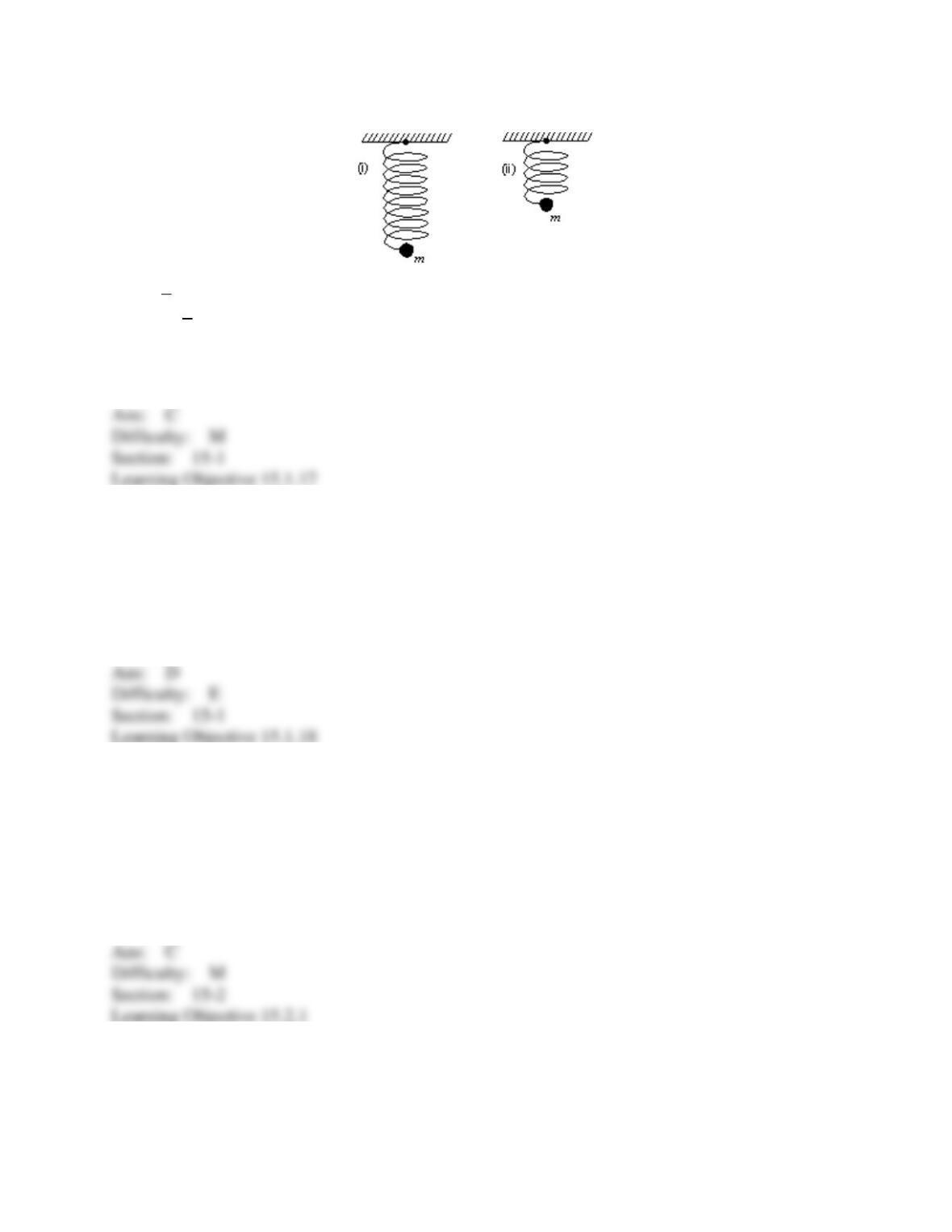
32. A simple harmonic oscillator consists of a mass m and an ideal spring with spring constant
k. The particle oscillates as shown in (i) with period T. If the spring is cut in half and used
with the same particle, as shown in (ii), the period will be:
A) 2T
B) √2𝑇
C) 𝑇/√2
D) T
E) T/2
33. In simple harmonic motion, the restoring force must be proportional to the:
A) amplitude
B) frequency
C) velocity
D) displacement
E) displacement squared
34. Let U be the potential energy (with the zero at zero displacement) and K be the kinetic
energy of a simple harmonic oscillator. Uavg and Kavg are the average values over a cycle. Then:
A) Kavg > Uavg
B) Kavg < Uavg
C) Kavg = Uavg
D) K = 0 when U = 0
E) K + U = 0
35. A particle is in simple harmonic motion along the x axis. The amplitude of the motion is xm.
At one point in its motion its kinetic energy is K = 5 J and its potential energy (measured with U
= 0 at x = 0) is U = 3 J. When it is at x = xm, the kinetic and potential energies are:
A) K = 5 J and U = 3 J
B) K = 5 J and U = –3 J
C) K = 8 J and U = 0 J
D) K = 0 J and U = 8 J
E) K = 0 J and U = –8 J
36. A particle is in simple harmonic motion along the x axis. The amplitude of the motion is xm.
When it is at x = x1, its kinetic energy is K = 5 J and its potential energy (measured with U = 0 at
x = 0) is U = 3 J. When it is at x = –1/2 xm, the kinetic and potential energies are:
A) K = 6 J and U = 2 J
B) K = 6 J and U = –2 J
C) K = 8 J and U = 0 J
D) K = 0 J and U = 8 J
E) K = 0 J and U = –8 J
37. A 0.25-kg block oscillates on the end of the spring with a spring constant of 200 N/m. If
the system has an energy of 6.0 J, then the amplitude of the oscillation is:
A) 0.06 m
B) 0.17 m
C) 0.24 m
D) 4.9 m
E) 6.9 m
38. A 0.25-kg block oscillates on the end of the spring with a spring constant of 200 N/m. If
the system has an energy of 6.0 J, then the maximum speed of the block is:
A) 0.06 m/s
B) 0.17 m/s
C) 0.24 m/s
D) 4.9 m/s
E) 6.9 m/s