Chapter: Chapter 32
Learning Objectives
LO 32.1.0 Solve problems related to Gauss’ law for magnetic fields.
LO 32.1.1 Identify that the simplest magnetic structure is a magnetic dipole.
LO 32.1.2 Calculate the magnetic flux Φ through a surface by integrating the dot product of the
magnetic field vector 𝐵
⃗
and the area vector 𝑑𝐴
(for patch elements) over the surface.
LO 32.1.3 Identify that the net magnetic flux through a Gaussian surface (which is a closed
surface) is zero.
LO 32.2.0 Solve problems related to induced magnetic fields.
LO 32.2.1 Identify that a changing electric flux induces a magnetic field.
LO 32.2.2 Apply Maxwell’s law of induction to relate the magnetic field induced around a
closed loop to the rate of change of electric flux encircled by the loop.
LO 32.2.3 Draw the field lines for an induced magnetic field inside a capacitor with parallel
circular plates that are being charged, indicating the orientations of the vectors for the electric
field and the magnetic field.
LO 32.2.4 For the general situation in which magnetic fields can be induced, apply the
Ampere–Maxwell (combined) law.
LO 32.3.0 Solve problems related to displacement current.
LO 32.3.1 Identify that in the Ampere–Maxwell law, the contribution to the induced magnetic
field by the changing electric flux can be attributed to a fictitious current (“displacement
current”) to simplify the expression.
LO 32.3.2 Identify that in a capacitor that is being charged or discharged, a displacement current
is said to be spread uniformly over the plate area, from one plate to the other.
LO 32.3.3 Apply the relationship between the rate of change of an electric flux and the
associated displacement current.
LO 32.3.4 For a charging or discharging capacitor, relate the amount of displacement current to
the amount of actual current and identify that the displacement current exists only when the
electric field within the capacitor is changing.
LO 32.3.5 Mimic the equations for the magnetic field inside and outside a wire with real current
to write (and apply) the equations for the magnetic field inside and outside a region of
displacement current.
LO 32.3.6 Apply the Ampere–Maxwell law to calculate the magnetic field of a real current and a
displacement current.
LO 32.3.7 For a charging or discharging capacitor with parallel circular plates, draw the
magnetic field lines due to the displacement current.
LO 32.3.8 List Maxwell’s equations and the purpose of each.
LO 32.4.0 Solve problems related to magnets.
LO 32.4.1 Identify lodestones.
LO 32.4.2 In Earth’s magnetic field, identify that the field is approximately that of a dipole and
also identify in which hemisphere the north geomagnetic pole is located.
LO 32.4.3 Identify field declination and field inclination.
LO 32.5.0 Solve problems related to magnetism and electrons.
LO 32.5.1 Identify that a spin angular momentum 𝑆
(usually simply called spin) and a spin
magnetic dipole moment 𝜇 𝑠 are intrinsic properties of electrons (and also protons and neutrons).
LO 32.5.2 Apply the relationship between the spin vector 𝑆
and the magnetic dipole moment
vector 𝜇 𝑠.
LO 32.5.3 Identify that 𝑆
and 𝜇 𝑠 cannot be observed (measured), only their components on an
axis of measurement (usually called the z axis) can be observed.
LO 32.5.4 Identify that the observed components Sz and μS,Z are quantized and explain what that
means.
LO 32.5.5 Apply the relationship between the component Sz and the spin magnetic quantum
number ms, specifying the allowed values of ms.
LO 32.5.6 Distinguish spin up from spin down.
LO 32.5.7 Determine the z components μS,Z of the magnetic dipole moment, both as a value and
in terms of the Bohr magneton μB.
LO 32.5.8 If an electron is in an external magnetic field, determine the orientation energy U of
its spin magnetic dipole moment 𝜇 𝑠.
LO 32.5.9 Identify that an electron in an atom has an orbital angular momentum 𝐿
⃗
𝑜𝑟𝑏 and an
orbital magnetic dipole moment 𝜇 𝑜𝑟𝑏.
LO 32.5.10 Apply the relationship between the orbital angular momentum 𝐿
⃗
𝑜𝑟𝑏 and the orbital
magnetic dipole moment 𝜇 𝑜𝑟𝑏.
LO 32.5.11 Identity that 𝐿
⃗
𝑜𝑟𝑏and 𝜇 𝑜𝑟𝑏 cannot be observed but their components 𝐿
⃗
𝑜𝑟𝑏,𝑧 and
𝜇 𝑜𝑟𝑏,𝑧 on a z (measurement) axis can.
LO 32.5.12 Apply the relationship between the component 𝐿
⃗
𝑜𝑟𝑏,𝑧 of the orbital angular
momentum and the orbital magnetic quantum number mℓ, specifying the allowed values mℓ.
LO 32.5.13 Determine the z components 𝜇 𝑜𝑟𝑏,𝑧 of the magnetic dipole moment, both as a value
and in terms of the Bohr magneton μB.
LO 32.5.14 If an atom is in an external magnetic field, determine the orientation energy U of the
orbital magnetic dipole moment μorb.
LO 32.5.15 Calculate the magnitude of the magnetic moment of a charged particle moving in a
circle or a ring of uniform charge rotating like a merry-go-round.
LO 32.5.16 Explain the classical loop model for an orbiting electron and the forces on such a
loop in a nonuniform magnetic field.
LO 32.5.17 Distinguish diamagnetism, paramagnetism, and ferromagnetism.
LO 32.6.0 Solve problems related to diamagnetism.
LO 32.6.1 For a diamagnetic sample placed in an external magnetic field, identify that the field
produces a magnetic dipole moment in the sample, and identify the relative orientations of that
moment and the field.
LO 32.6.2 For a diamagnetic sample in a nonuniform magnetic field, describe the force on the
sample and the resulting motion.
LO 32.7.0 Solve problems related to paramagnetism.
LO 32.7.1 For a paramagnetic sample placed in an external magnetic field, identify the relative
orientations of the field and the sample’s magnetic dipole moment.

LO 32.7.2 For a paramagnetic sample in a nonuniform magnetic field, describe the force on the
sample and the resulting motion.
LO 32.7.3 Apply the relationship between a sample’s magnetization M, its measured magnetic
moment, and its volume.
LO 32.7.4 Apply Curie’s law to relate a sample’s magnetization M to its temperature T, its Curie
constant C, and the magnitude B of the external field.
LO 32.7.5 Given a magnetization curve for a paramagnetic sample, relate the extent of the
magnetization for a given magnetic field and temperature.
LO 32.7.6 For a paramagnetic sample at a given temperature and in a given magnetic field,
compare the energy associated with the dipole orientations and the thermal motion.
LO 32.8.0 Solve problems related to ferromagnetism.
LO 32.8.1 Identify that ferromagnetism is due to a quantum mechanical interaction called
exchange coupling.
LO 32.8.2 Explain why ferromagnetism disappears when the temperature exceeds the material’s
Curie temperature.
LO 32.8.3 Apply the relationship between the magnetization of a ferromagnetic sample and the
magnetic moment of its atoms.
LO 32.8.4 For a ferromagnetic sample at a given temperature and in a given magnetic field,
compare the energy associated with the dipole orientations and the thermal motion.
LO 32.8.5 Describe and sketch a Rowland ring.
LO 32.8.6 Identify magnetic domains.
LO 32.8.7 For a ferromagnetic sample placed in an external magnetic field, identify the relative
orientations of the field and the magnetic dipole moment.
LO 32.8.8 Identify the motion of a ferromagnetic sample in a nonuniform field.
LO 32.8.9 For a ferromagnetic object placed in a uniform magnetic field, calculate the torque
and orientation energy.
LO 32.8.10 Explain hysteresis and a hysteresis loop.
LO 32.8.11 Identify the origin of lodestones.
Multiple Choice
1. Gauss’ law for magnetism:
A) can be used to find 𝐵
⃗
due to given currents provided there is enough symmetry
B) is false because there are no magnetic poles
C) can be used with open surfaces because there are no magnetic poles
D) contradicts Faraday’s law because one says B = 0 and the other says ℰ = –dB/dt
E) none of the above
2. The statement that magnetic field lines form closed loops is a direct consequence of:
A) Faraday’s law
B) Ampere’s law
C) Gauss’ law for electricity
D) Gauss’ law for magnetism
E) the Lorentz force
3. A magnetic field parallel to the x axis with a magnitude that decreases with increasing x but
does not change with y and z is impossible according to:
A) Faraday’s law
B) Ampere’s law
C) Gauss’ law for electricity
D) Gauss’ law for magnetism
E) Newton’s second law
4. According to Gauss’ law for magnetism, magnetic field lines:
A) form closed loops
B) start at south poles and end at north poles
C) start at north poles and end at south poles
D) start at both north and south poles and end at infinity
E) do not exist
5. Gauss’ law for magnetism, ∮𝐵
⃗
∙𝑑𝐴
= 0, tells us:
A) the net charge in any given volume
B) that the line integral of a magnetic field around any closed loop must vanish
C) the magnetic field of a current element
D) that magnetic monopoles do not exist
E) charges must be moving to produce magnetic fields
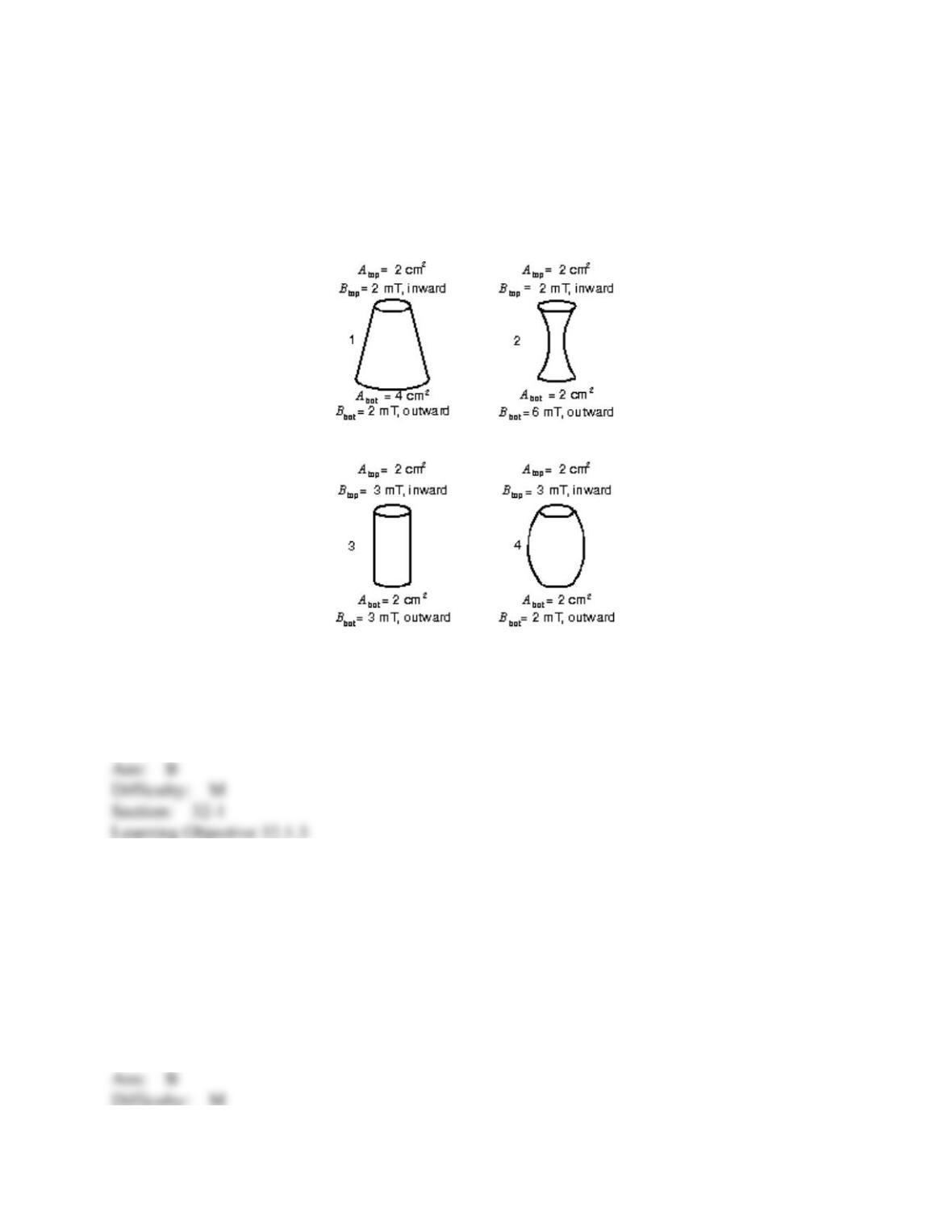
6. Four closed surfaces are shown, each with circular top and bottom faces and curved sides.
The areas Atop and Abot of the top and bottom faces and the magnitudes Btop and Bbot of the
uniform magnetic fields through the top and bottom faces are given. The fields are
perpendicular to the faces and are either inward or outward. Rank the surfaces according to the
magnitude of the magnetic flux through the curved sides, least to greatest.
A) 1, 2, 3, 4
B) 3, 4, 1, 2
C) 1, 2, 4, 3
D) 4, 3, 2, 1
E) 2, 1, 4, 3
7. A 1-A current is used to charge a parallel plate capacitor. A large square piece of paper is
placed between the plates and parallel to them so it sticks out on all sides. The value of the
integral ∮𝐵
⃗
∙𝑑𝑠 around the perimeter of the paper is:
A) 2 Tm
B) 4 10–7 Tm
C) 8.85 10–12 Tm
D) 10–7 Tm
E) not determined from the given quantities
8. A magnetic field exists between the plates of a capacitor:
A) always
B) never
C) when the capacitor is fully charged
D) while the capacitor is being charged
E) only when the capacitor is starting to be charged
9. A cylindrical region contains a uniform electric field that is along the cylinder axis and is
changing with time. If r is the distance from the cylinder axis the magnitude of the magnetic field
within the region is:
A) uniform
B) proportional to 1/r
C) proportional to r2
D) proportional to 1/r2
E) proportional to r
10. A cylindrical region contains a uniform electric field that is parallel to the axis and is
changing with time. If r is the distance from the cylinder axis the magnitude of the magnetic field
outside the region is:
A) zero
B) proportional to 1/r
C) proportional to r2
D) proportional to 1/r2
E) proportional to r
11. A 0.70-m radius cylindrical region contains a uniform electric field that is parallel to the
axis and is increasing at the rate 5.0 1012 V/ms. The magnetic field at a point 0.25 m from the
axis has a magnitude of:
A) 0 T
B) 7.0 10–6 T
C) 2.8 10–5 T
D) 5.4 10–5 T
E) 7.0 10–5 T
12. A 0.70-m radius cylindrical region contains a uniform electric field that is parallel to the
axis and is increasing at the rate 5.0 1012 V/ms. The magnetic field at a point 1.2 m from the
axis has a magnitude of:
A) 0 T
B) 7.0 10–6 T
C) 1.1 10–5 T
D) 2.3 10–5 T
E) 2.8 10–5 T
13. A sinusoidal emf is connected to a parallel plate capacitor. The magnetic field between the
plates is:
A) zero
B) constant
C) sinusoidal and its amplitude does not depend on the frequency of the source
D) sinusoidal and its amplitude is proportional to the frequency of the source
E) sinusoidal and its amplitude is inversely proportional to the frequency of the source
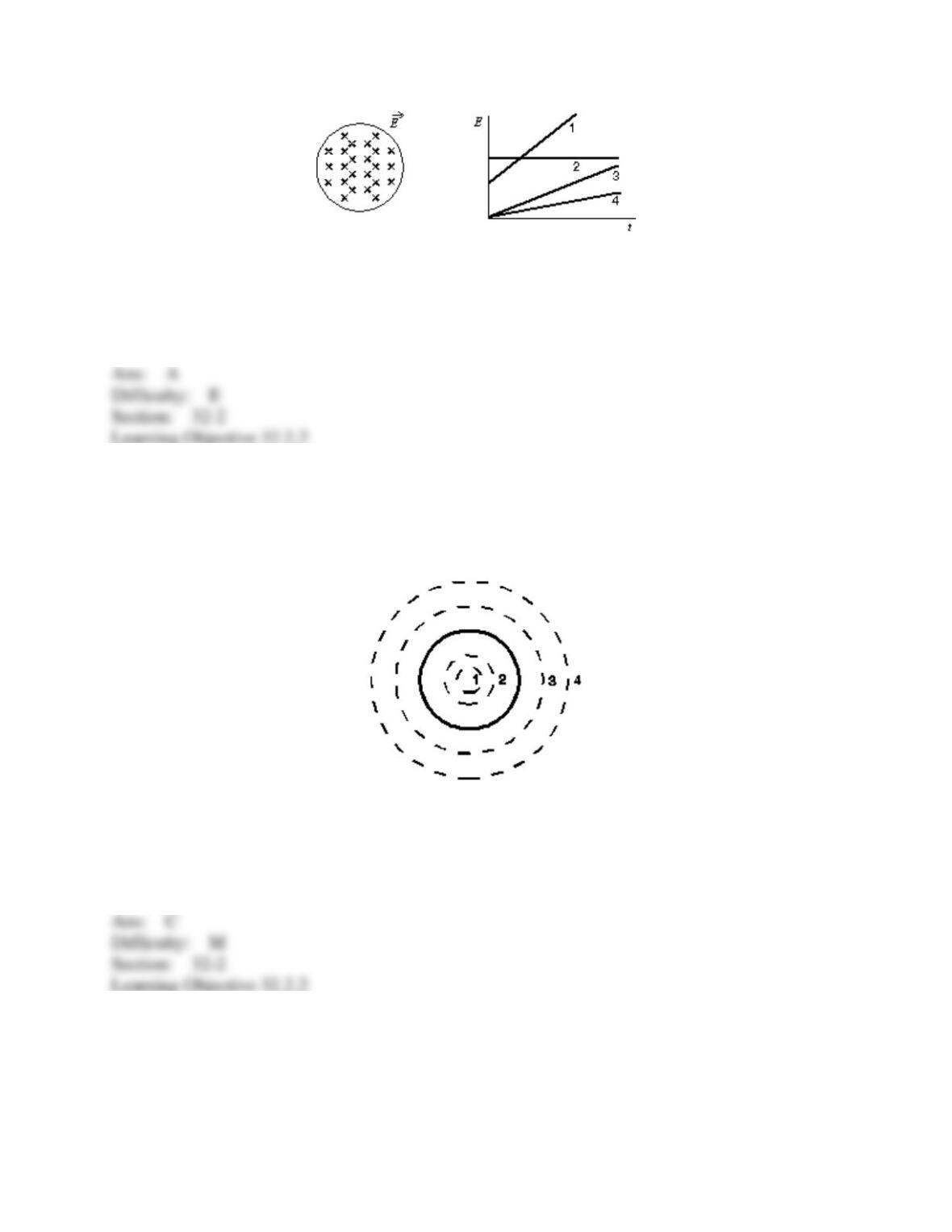
14. An electric field exists in the cylindrical region shown and is parallel to the cylinder axis.
The magnitude of the field might vary with time according to any of the four graphs shown.
Rank the four variations according to the magnitudes of the magnetic field induced at the edge of
the region, least to greatest.
A) 2, 4, 3, 1
B) 1, 3, 4, 2
C) 4, 3, 2, 1
D) 4, 3, 1, 2
E) 2, 1, 3, 4
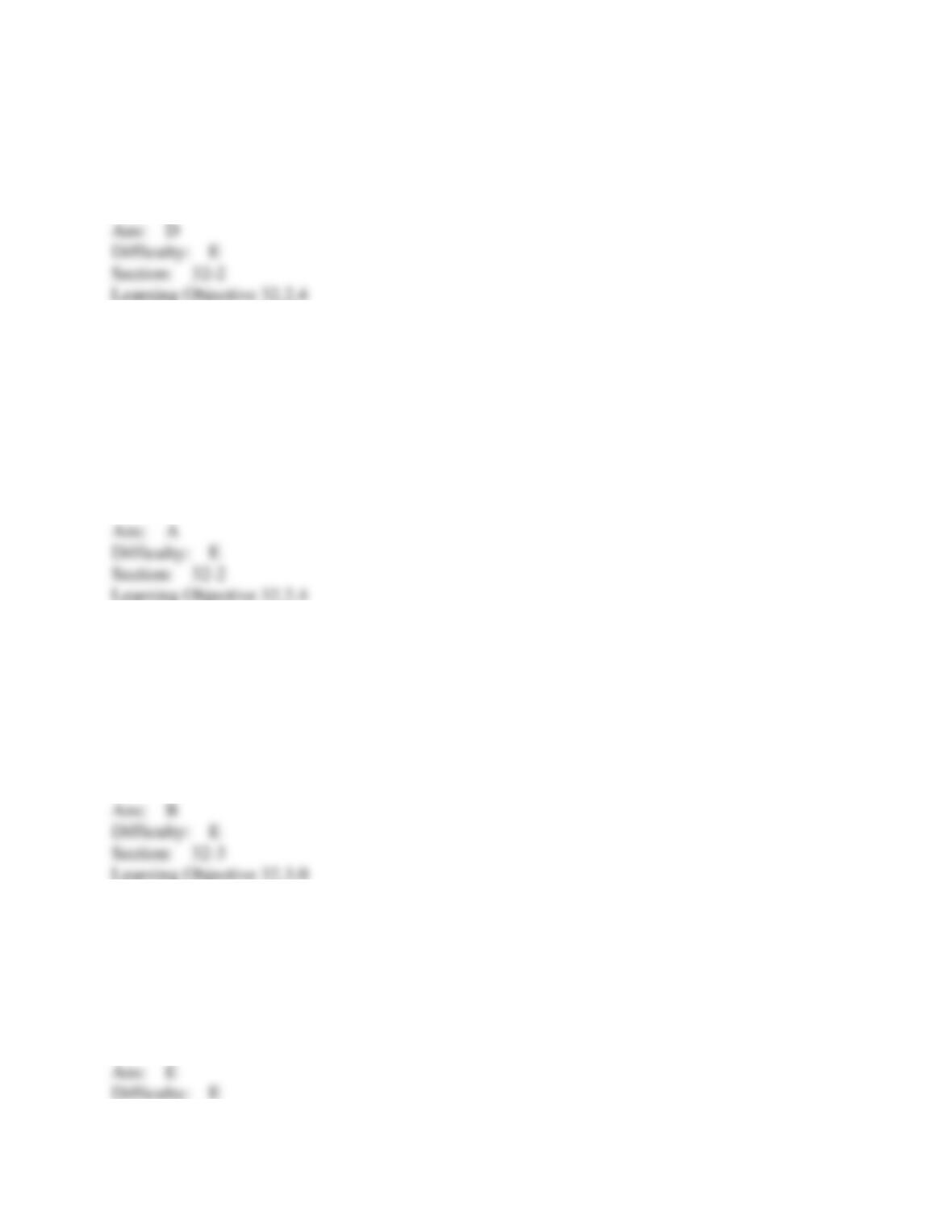
15. The diagram shows one plate of a parallel-plate capacitor from within the capacitor. The
plate is circular and has radius R. The dashed circles are four integration paths have radii of r1
= R/4, r2 = R/2, r3 =3 R/2, and r4 = 2R. Rank the paths according to the magnitude of ∮𝐵
⃗
∙𝑑𝑠
around the paths during the discharging of the capacitor, least to greatest.
A) 1, 2 and 3 tie, then 4
B) 1, 2, 3, 4
C) 1, then 2 and 4 tie, then 3
D) 4, 3, 1, 2
E) 3, then 2 and 4 tie, then 1
16. Suppose you are looking into one end of a long cylindrical tube in which there is a uniform
electric field, pointing away from you. If the magnitude of the field is decreasing with time the
direction of the induced magnetic field is:
A) toward you
B) away from you
C) clockwise
D) counterclockwise
E) to your right
17. Suppose you are looking into one end of a long cylindrical tube in which there is a uniform
electric field, pointing away from you. If the magnitude of the field is decreasing with time the
field lines of the induced magnetic field are:
A) circles
B) ellipses
C) straight lines parallel to the electric field
D) straight lines perpendicular to the electric field
E) none of the above
18. An electron is on the z axis moving toward the xy plane but it has not reached that plane
yet. At that instant:
A) there is only a true current through the xy plane
B) there is only a displacement current through the xy plane
C) there are both true and displacement currents through the xy plane
D) there is neither a true nor a displacement current through the xy plane
E) none of the above are true
19. One of the Maxwell equations begins with ∮𝐵
⃗
∙𝑑𝑠 = …. The symbol 𝑑𝑠 means:
A) an infinitesimal displacement of a charge
B) an infinitesimal displacement of a magnetic pole
C) an infinitesimal inductance
D) an infinitesimal surface area
E) none of the above
20. One of the Maxwell equations begins with ∮𝐸
⃗
∙𝑑𝑠 = …. The o symbol in the integral sign
means:
A) the same as the subscript in
0
B) integrate clockwise around the path
C) integrate counterclockwise around the path
D) integrate around a closed path
E) integrate over a closed surface
21. One of the Maxwell equations begins with ∮𝐵
⃗
∙𝑑𝐴
= …. The o symbol in the integral sign
means:
A) the same as the subscript in
0
B) integrate clockwise around the path
C) integrate counterclockwise around the path
D) integrate around a closed path
E) integrate over a closed surface
22. Two of Maxwell’s equations contain a path integral on the left side and an area integral on
the right. For them:
A) the path must pierce the area
B) the path must be well-separated from the area
C) the path must be along a field line and the area must be perpendicular to the field line
D) the path must be the boundary of the area
E) the path must lie in the area, away from its boundary
23. Two of Maxwell’s equations contain an integral over a closed surface. For them the
infinitesimal vector area 𝑑𝐴
is always:
A) tangent to the surface
B) perpendicular to the surface and pointing outward
C) perpendicular to the surface and pointing inward
D) tangent to a field line
E) perpendicular to a field line
24. Two of Maxwell’s equations contain a path integral on the left side and an area integral on
the right. The directions of the infinitesimal path element 𝑑𝑠 and infinitesimal area element 𝑑𝐴
are:
A) always in the same direction
B) always in opposite directions
C) always perpendicular to each other
D) never perpendicular to each other
E) none of the above
25. Two of Maxwell’s equations contain a path integral on the left side and an area integral on
the right. Suppose the area is the surface of a piece of paper at which you are looking and 𝑑𝐴
is
chosen to point toward you. Then, the path integral is:
A) clockwise around the circumference of the paper
B) counterclockwise around the circumference of the paper
C) from left to right
D) from right to left
E) from top to bottom
26. A 1.2-m radius cylindrical region contains a uniform electric field along the cylinder axis.
It is increasing uniformly with time. To obtain a total displacement current of 2.0 10−9 A
through a cross section of the region, the magnitude of the electric field should change at a rate
of:
A) 5.0 V/m·s
B) 12 V/m·s
C) 37 V/m·s
D) 50 V/m·s
E) 4.0 107 V/m·s
27. A 1-
F capacitor is connected to an emf that is increasing uniformly with time at a rate of
100 V/s. The displacement current between the plates is:
A) 0 A
B) 1 10–8 A
C) 1 10–6 A
D) 1 10–4 A
E) 100 A
28. Displacement current is:
A) dE/dt
B) 0dE/dt
C)
0dE/dt
D)
00dE/dt
E) –dB/dt
29. Displacement current exists wherever there is:
A) moving charge
B) a magnetic field
C) a changing magnetic field
D) an electric field
E) a changing electric field
30. A current of 1 A is used to charge a parallel plate capacitor with square plates. If the area of
each plate is 0.6 m2 the displacement current through a 0.3 m2 area wholly between the capacitor
plates and parallel to them is:
A) 2 A
B) 1 A
C) 0.7 A
D) 0.5 A
E) 0.25 A
31. Displacement current exists in the region between the plates of a parallel plate capacitor if:
A) the capacitor leaks charge across the plates
B) the capacitor is being discharged
C) the capacitor is fully charged
D) the capacitor is fully discharged
E) none of the above are true
32. A circular parallel-plate capacitor whose plates have a radius of 25 cm is being charged with
a current of 1.3 A. What is the magnetic field 11 cm from the center of the plates?
A) 4.6 x 10⁻⁷ T
B) 1.0 x 10⁻⁶ T
C) 2.4 x 10⁻⁶ T
D) 3.1 x 10⁻⁶ T
E) 6.2 x 10⁻⁶ T
33. Consider the four Maxwell equations:
I.
∮𝐸
⃗
∙𝑑𝐴
= 𝑞/𝜀0
II.
∮𝐵
⃗
∙𝑑𝐴
= 0
III.
∮𝐸
⃗
∙𝑑𝑠 = −𝑑Φ𝐵
𝑑𝑡
IV.
∮𝐵
⃗
∙𝑑𝑠 = 𝜇0𝑖+𝜇0𝜀0𝑑Φ𝐸
𝑑𝑡
Which of these must be modified if magnetic poles are discovered?
A) only I
B) only II
C) only II and III
D) only III and IV
E) only II, III, IV
34. One of the crucial facts upon which the Maxwell equations are based is:
A) the numerical value of the electron charge
B) charge is quantized
C) the numerical value of the charge/mass ratio of the electron
D) there are three types of magnetic materials
E) none of the above
35. Which of the following equations can be used, along with a symmetry argument, to
calculate the electric field of a point charge?
A) ∮𝐸
⃗
∙𝑑𝐴
= 𝑞/𝜀0
B) ∮𝐵
⃗
∙𝑑𝐴
= 0
C) ∮𝐸
⃗
∙𝑑𝑠 = −𝑑Φ𝐵
𝑑𝑡
D) ∮𝐵
⃗
∙𝑑𝑠 = 𝜇0𝑖+𝜇0𝜀0𝑑Φ𝐸
𝑑𝑡
E) none of these
36. Which of the following equations can be used, along with a symmetry argument, to
calculate the magnetic field of a long straight wire carrying current?
A) ∮𝐸
⃗
∙𝑑𝐴
= 𝑞/𝜀0
B) ∮𝐵
⃗
∙𝑑𝐴
= 0
C) ∮𝐸
⃗
∙𝑑𝑠 = −𝑑Φ𝐵
𝑑𝑡
D) ∮𝐵
⃗
∙𝑑𝑠 = 𝜇0𝑖+𝜇0𝜀0𝑑Φ𝐸
𝑑𝑡
E) none of these
37. Which of the following equations can be used to show that magnetic field lines form closed
loops?
A) ∮𝐸
⃗
∙𝑑𝐴
= 𝑞/𝜀0
B) ∮𝐵
⃗
∙𝑑𝐴
= 0
C) ∮𝐸
⃗
∙𝑑𝑠 = −𝑑Φ𝐵
𝑑𝑡
D) ∮𝐵
⃗
∙𝑑𝑠 = 𝜇0𝑖+𝜇0𝜀0𝑑Φ𝐸
𝑑𝑡
E) none of these
38. Which of the following equations, along with a symmetry argument, can be used to
calculate the magnetic field produced by a uniform time-varying electric field?
A) ∮𝐸
⃗
∙𝑑𝐴
= 𝑞/𝜀0
B) ∮𝐵
⃗
∙𝑑𝐴
= 0
C) ∮𝐸
⃗
∙𝑑𝑠 = −𝑑Φ𝐵
𝑑𝑡
D) ∮𝐵
⃗
∙𝑑𝑠 = 𝜇0𝑖+𝜇0𝜀0𝑑Φ𝐸
𝑑𝑡
E) none of these
39. Which of the following equations, along with a symmetry argument, can be used to
calculate the electric field produced by a uniform time-varying magnetic field?
A) ∮𝐸
⃗
∙𝑑𝐴
= 𝑞/𝜀0
B) ∮𝐵
⃗
∙𝑑𝐴
= 0
C) ∮𝐸
⃗
∙𝑑𝑠 = −𝑑Φ𝐵
𝑑𝑡
D) ∮𝐵
⃗
∙𝑑𝑠 = 𝜇0𝑖+𝜇0𝜀0𝑑Φ𝐸
𝑑𝑡
E) none of these