Chapter: Chapter 28
Learning Objectives
LO 28.1.0 Solve problems related to magnetic fields and the definition of B.
LO 28.1.1 Distinguish an electromagnet from a permanent magnet.
LO 28.1.2 Identify that a magnetic field is a vector quantity and thus has both magnitude and
direction.
LO 28.1.3 Explain how a magnetic field can be defined in terms of what happens to a charged
particle moving through the field.
LO 28.1.4 For a charged particle moving through a uniform magnetic field, apply the
relationship between force magnitude FB, charge q, speed v, field magnitude B, and the angle φ
between the directions of the velocity vector 𝑣⃗ and the magnetic field vector 𝐵
⃗
⃗
.
LO 28.1.5 For a charged particle sent through a uniform magnetic field, find the direction of the
magnetic force 𝐹
⃗B by (1) applying the right-hand rule to find the direction of the cross product
𝑣⃗ × 𝐵
⃗
⃗
and (2) determining what effect the charge q has on the direction.
LO 28.1.6 Find the magnetic force 𝐹
⃗B acting on a moving charged particle by evaluating the
cross product q(𝑣⃗ × 𝐵
⃗
⃗
) in unit-vector notation and magnitude-angle notation.
LO 28.1.7 Identify that the magnetic force vector 𝐹
⃗B must always be perpendicular to both the
velocity vector 𝑣⃗ and the magnetic field vector 𝐵
⃗
⃗
.
LO 28.1.8 Identify the effect of the magnetic force on the particle’s speed and kinetic energy.
LO 28.1.9 Identify a magnet as being a magnetic dipole.
LO 28.1.10 Identify that opposite poles attract each other and like magnetic poles repel each
other.
LO 28.1.11 Explain magnetic field lines, including where they originate and terminate and what
their spacing represents.
LO 28.2.0 Solve problems related to crossed fields: discovery of the electron.
LO 28.2.1 Describe the experiment of J. J. Thomson.
LO 28.2.2 For a charged particle moving through a magnetic field and an electric field,
determine the net force on the particle in both magnitude-angle notation and unit-vector notation.
LO 28.2.3 In situations where the magnetic force and electric force on a particle are in opposite
directions, determine the speeds at which the forces cancel, the magnetic force dominates, and
the electric force dominates.
LO 28.3.0 Solve problems related to crossed fields: the Hall effect.
LO 28.3.1 Describe the Hall effect for a metal strip carrying current, explaining how the electric
field is set up and what limits its magnitude.
LO 28.3.2 For a conducting strip in a Hall-effect situation, draw the vectors for the magnetic
field and electric field. For the conduction electrons, draw the vectors for the velocity, magnetic
force, and electric force.
LO 28.3.3 Apply the relationship between the Hall potential difference V, the electric field
magnitude E, and the width of the strip d.
LO 28.3.4 Apply the relationship between charge-carrier number density n, magnetic field
magnitude B, current i, and Hall-effect potential difference V.
LO 28.3.5 Apply the Hall-effect results to a conducting object moving through a uniform
magnetic field, identifying the width across which a Hall-effect potential difference V is set up
and calculating V.
LO 28.4.0 Solve problems related to a circulating charged particle.
LO 28.4.1 For a charged particle moving through a uniform magnetic field, identify under what
conditions it will travel in a straight line, in a circular path, and in a helical path.
LO 28.4.2 For a charged particle in uniform circular motion due to a magnetic force, start with
Newton’s second law and derive an expression for the orbital radius r in terms of the field
magnitude B and the particle’s mass m, charge magnitude q, and speed v.
LO 28.4.3 For a charged particle moving along a circular path in a magnetic field, calculate
and relate speed, centripetal force, centripetal acceleration, radius, period, frequency, and angular
frequency, and identify which of the quantities do not depend on speed.
LO 28.4.4 For a positive particle and a negative particle moving along a circular path in a
magnetic indicate the magnetic field, the pitch, the radius of curvature, the velocity component
parallel to the field, and the velocity component perpendicular to the field.
LO 28.4.5 For a charged particle moving in a helical path in a magnetic field, sketch the path
and indicate the magnetic field, the pitch, the radius of curvature, velocity component parallel to
the field, and the velocity component perpendicular to the field.
LO 28.4.6 For helical motion in a magnetic field, apply the relationship between the radius of
curvature and one of the velocity components.
LO 28.4.7 For helical motion in a magnetic field, identify pitch p and relate it to one of the
velocity components.
LO 28.5.0 Solve problems related to cyclotrons and synchrotrons.
LO 28.5.1 Describe how a cyclotron works, and in a sketch indicate a particle’s path and the
regions where the kinetic energy is increased.
LO 28.5.2 Identify the resonance condition.
LO 28.5.3 Apply the relationship between the particle’s mass and charge, the magnetic field, and
the frequency of circling.
LO 28.5.4 Distinguish between a cyclotron and a synchrotron.
LO 28.6.0 Solve problems related to magnetic force on a current-carrying wire.
LO 28.6.1 For the situation where a current is perpendicular to a magnetic field, sketch the
current, the direction of the magnetic field, and the direction of the magnetic force on the current
(or wire carrying the current).
LO 28.6.2 For a current in a magnetic field, apply the relationship between the magnetic force
magnitude FB, the current i, the length of the wire L, and the angle φ between the length vector 𝐿
⃗
⃗
and the field vector 𝐵
⃗
⃗
.
LO 28.6.3 Apply the right-hand rule for cross products to find the direction of the magnetic force
on a current in a magnetic field.
LO 28.6.4 For a current in a magnetic field, calculate the magnetic force 𝐹
⃗B with a cross product
of the length vector 𝐿
⃗
⃗
and the field vector 𝐵
⃗
⃗
, in magnitude-angle and unit-vector notations.
LO 28.6.5 Describe the procedure for calculating the force on a current-carrying wire in a
magnetic field if the wire is not straight or if the field is not uniform.
LO 28.7.0 Solve problems related to torque on a current loop.
LO 28.7.1 Sketch a rectangular loop of current in a magnetic field, indicating the magnetic forces
on the four sides, the direction of the current, the normal vector 𝑛
⃗
⃗
, and the direction in which a
torque from the forces tends to rotate the loop.
LO 28.7.2 For a current-carrying coil in a magnetic field, apply the relationship between the
torque magnitude τ, the number of turns N, the area of each turn A, the current i, the magnetic
field magnitude B, and the angle θ between the normal vector 𝑛
⃗
⃗
and the magnetic field vector
𝐵
⃗
⃗
.
LO 28.8.0 Solve problems related to the magnetic dipole moment.
LO 28.8.1 Identify that a current-carrying coil is a magnetic dipole with a magnetic dipole
moment 𝜇⃗ that has the direction of the normal vector 𝑛
⃗
⃗
, as given by a right-hand rule.
LO 28.8.2 For a current-carrying coil, apply the relationship between the magnitude μ of the
magnetic dipole moment, the number of turns N, the area A of each turn, and the current i.
LO 28.8.3 On a sketch of a current-carrying coil, draw the direction of the current, and then use a
right-hand rule to determine the direction of the magnetic dipole moment vector 𝜇⃗.
LO 28.8.4 For a magnetic dipole in an external magnetic field, apply the relationship between the
torque magnitude τ, the dipole moment magnitude μ, the magnetic field magnitude B, and the
angle θ between the dipole moment vector 𝜇⃗ and the magnetic field vector 𝐵
⃗
⃗
.
LO 28.8.5 Identify the convention of assigning a plus or minus sign to a torque according to the
direction of rotation.
LO 28.8.6 Calculate the torque on a magnetic dipole by evaluating a cross product of the dipole
moment vector 𝜇⃗ and the external magnetic field vector 𝐵
⃗
⃗
, in magnitude-angle notation and
unit-vector notation.
LO 28.8.7 For a magnetic dipole in an external magnetic field, identify the dipole orientations at
which the torque magnitude is minimum and maximum.
LO 28.8.8 For a magnetic dipole in an external magnetic field, apply the relationship between the
orientation energy U, the dipole moment magnitude μ, the external magnetic field magnitude B,
and the angle θ between the dipole moment vector 𝜇⃗ and the magnetic field vector 𝐵
⃗
⃗
.
LO 28.8.9 Calculate the orientation energy U by taking a dot product of the dipole moment
vector 𝜇⃗ and the external magnetic field vector 𝐵
⃗
⃗
, in magnitude-angle and unit-vector
notations.
LO 28.8.10 Identify the orientations of a magnetic dipole in an external magnetic field that give
the minimum and maximum orientation energies.
LO 28.8.11 For a magnetic dipole in a magnetic field, relate the orientation energy U to the work
Wa done by an external torque as the dipole rotates in the magnetic field.
Multiple Choice
1. Units of a magnetic field might be:
A) Cm/s
B) Cs/m
C) C/kg
D) kg/Cs
E) N/Cm
2. The direction of the magnetic field in a certain region of space is determined by firing a test
charge into the region with its velocity in various directions in different trials. The field direction
is:
A) one of the directions of the velocity when the magnetic force is zero
B) the direction of the velocity when the magnetic force is a maximum
C) the direction of the magnetic force
D) perpendicular to the velocity when the magnetic force is zero
E) none of the above
3. An electron is moving north in a region where the magnetic field is south. The magnetic
force exerted on the electron is:
A) zero
B) up
C) north
D) south
E) west
4. A magnetic field exerts a force on a charged particle:
A) always
B) never
C) if the particle is moving across the field lines
D) if the particle is moving along the field lines
E) if the particle is at rest
5. A proton (charge e), traveling perpendicular to a magnetic field, experiences the same force
as an alpha particle (charge 2e) which is also traveling perpendicular to the same field. The ratio
of their speeds, vproton/valpha is:
A) 0.5
B) 1
C) 2
D) 4
E) 8
6. An electron travels due north through a vacuum in a region of uniform magnetic field 𝐵
⃗
⃗
that is also directed due north. It will:
A) be unaffected by the field
B) speed up
C) slow down
D) follow a right-handed corkscrew path
E) follow a left-handed corkscrew path
7. An electron and a proton are both initially moving with the same speed and in the same
direction at 90˚ to the same uniform magnetic field. They experience magnetic forces, which are
initially:
A) identical
B) equal in magnitude but opposite in direction
C) in the same direction and differing in magnitude by a factor of 1840
D) in opposite directions and differing in magnitude by a factor of 1840
E) equal in magnitude but perpendicular to each other
8. A hydrogen atom that has lost its electron is moving east in a region where the magnetic
field is directed from south to north. It will be deflected:
A) up
B) down
C) north
D) south
E) not at all
9. A beam of electrons is sent horizontally down the axis of a tube to strike a fluorescent screen
at the end of the tube. On the way, the electrons encounter a magnetic field directed vertically
downward. The spot on the screen will therefore be deflected:
A) upward
B) downward
C) to the right as seen from the electron source
D) to the left as seen from the electron source
E) not at all
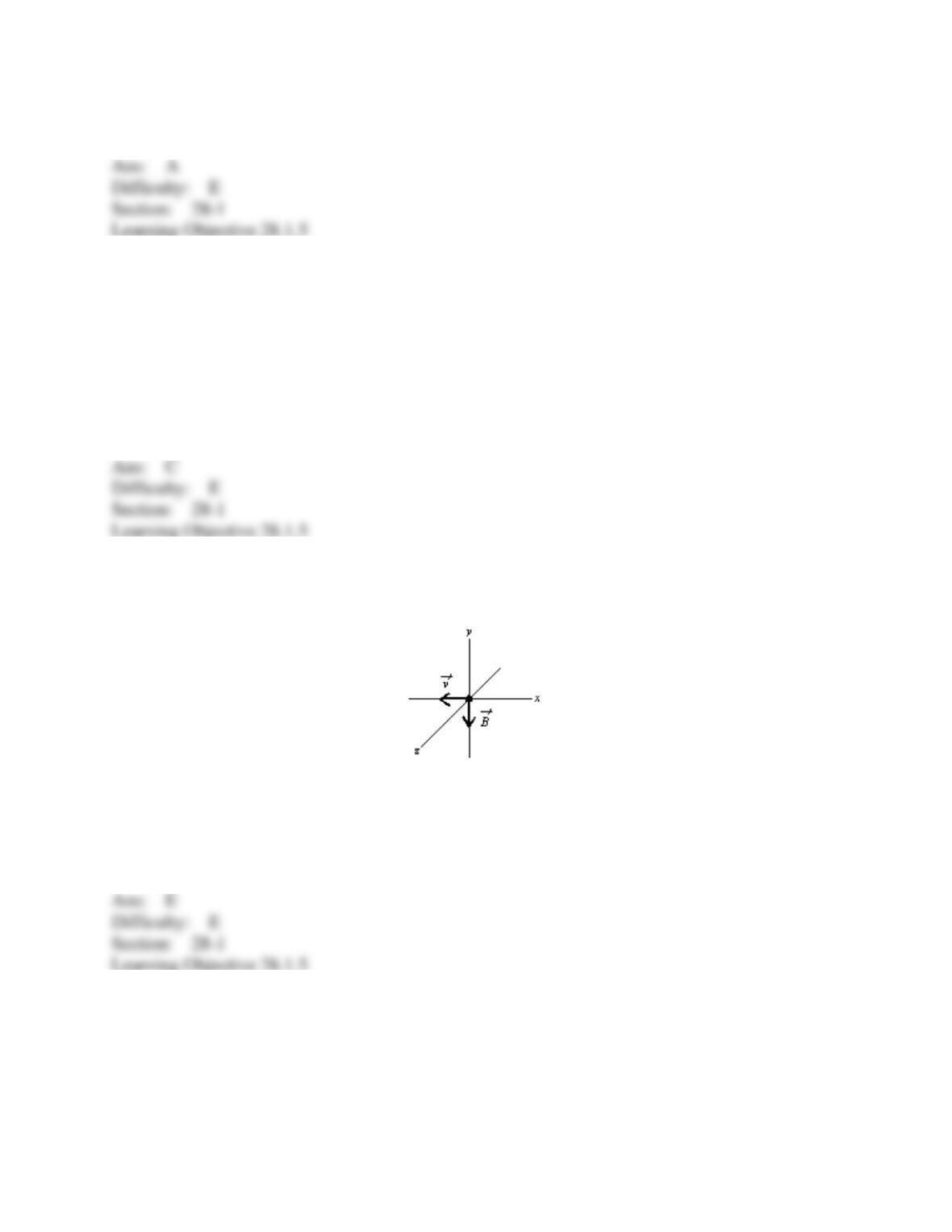
10. An electron moves in the negative x direction, through a uniform magnetic field that is in
the negative y direction. The magnetic force on the electron is:
A) in the negative x direction
B) in the positive y direction
C) in the negative y direction
D) in the positive z direction
E) in the negative z direction
11. An electron (charge = –1.6 10–19 C) is moving at 3.0 105 m/s in the positive x direction.
A magnetic field of 0.80 T is in the positive z direction. The magnetic force on the electron is:
A) 0 N
B) 4.5 10–14 N in the positive z direction
C) 4.5 10–14 N in the negative z direction
D) 4.5 10–14 N in the positive y direction
E) 4.5 10–14 N in the negative y direction
12. At one instant an electron (charge = –1.6 10–19 C) is moving in the xy plane, the
components of its velocity being vx = 5.0 105 m/s and vy = 3.0 105 m/s. A magnetic field of
0.80 T is in the positive x direction. At that instant the magnitude of the magnetic force on the
electron is:
A) 0 N
B) 3.8 10–14 N
C) 6.0 10–14 N
D) 6.4 10–14 N
E) 1.0 10–13 N
13. At one instant an electron (charge = –1.6 10–19 C) is moving in the xy plane, the
components of its velocity being vx = 5.0 105 m/s and vy = 3.0 105 m/s. A magnetic field of
0.80 T is in the positive y direction. At that instant the magnitude of the magnetic force on the
electron is:
A) 0 N
B) 3.8 10–14 N
C) 6.4 10–14 N
D) 7.5 10–14 N
E) 1.0 10–13 N
14. In the formula 𝐹
⃗= 𝑞𝑣⃗ × 𝐵
⃗
⃗
:
A) 𝐹
⃗ must be perpendicular to 𝑣⃗ but not necessarily to 𝐵
⃗
⃗
B) 𝐹
⃗ must be perpendicular to 𝐵
⃗
⃗
but not necessarily to 𝑣⃗
C) 𝑣⃗ must be perpendicular to 𝐵
⃗
⃗
but not necessarily to 𝐹
⃗
D) all three vectors must be mutually perpendicular
E) 𝐹
⃗ must be perpendicular to both 𝑣⃗ and 𝐵
⃗
⃗
15. The magnetic force on a charged particle is in the direction of its velocity if:
A) it is moving in the direction of the field
B) it is moving opposite to the direction of the field
C) it is moving perpendicular to the field
D) it is moving in some other direction
E) never
16. A static magnetic field CANNOT:
A) exert a force on a charge
B) accelerate a charge
C) change the momentum of a charge
D) change the kinetic energy of a charge
E) exist
17. At any point the magnetic field lines are in the direction of:
A) the magnetic force on a moving positive charge
B) the magnetic force on a moving negative charge
C) the velocity of a moving positive charge
D) the velocity of a moving negative charge
E) none of the above
18. J. J. Thomson’s experiment, involving the motion of an electron beam in mutually
perpendicular 𝐸
⃗
⃗
and 𝐵
⃗
⃗
fields, gave the value of:
A) the mass of an electron
B) the charge of an electron
C) the Earth’s magnetic field
D) the charge/mass ratio for an electron
E) Avogadro’s number
19. A charged particle is projected into a region of uniform, parallel, 𝐸
⃗
⃗
and 𝐵
⃗
⃗
fields. The
force on the particle is:
A) zero
B) at some angle < 90° with the field lines
C) along the field lines
D) perpendicular to the field lines
E) unknown (need to know the sign of the charge)
20. An electron enters a region of uniform perpendicular 𝐸
⃗
⃗
and 𝐵
⃗
⃗
fields. It is observed that
the velocity 𝑣⃗ of the electron is unaffected. A possible explanation is:
A) 𝑣⃗ is parallel to 𝐸
⃗
⃗
and has magnitude E/B
B) 𝑣⃗ is parallel to 𝐵
⃗
⃗
C) 𝑣⃗ is perpendicular to both 𝐸
⃗
⃗
and 𝐵
⃗
⃗
and has magnitude B/E
D) 𝑣⃗ is perpendicular to both 𝐸
⃗
⃗
and 𝐵
⃗
⃗
and has magnitude E/B
E) the given situation is impossible
21. A uniform magnetic field is in the positive z direction. A positively charged particle is
moving in the positive x direction through the field. The net force on the particle can be made
zero by applying an electric field in what direction?
A) Positive y
B) Negative y
C) Positive x
D) Negative x
E) Positive z
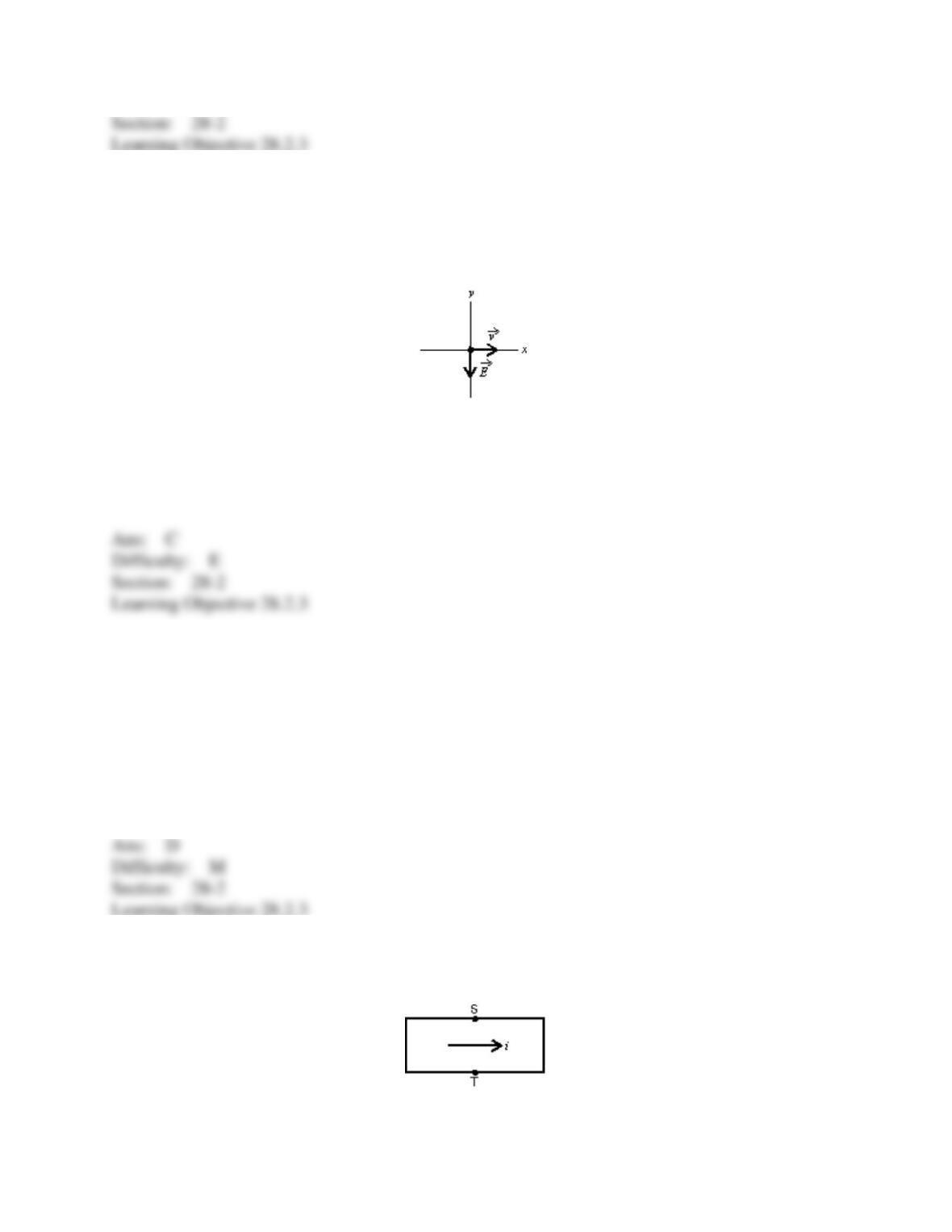
22. An electron is travelling in the positive x direction. A uniform electric field 𝐸
⃗
⃗
is in the
negative y direction. If a uniform magnetic field with the appropriate magnitude and direction
also exists in the region, the total force on the electron will be zero. The appropriate direction
for the magnetic field is:
A) the positive y direction
B) the negative y direction
C) into the page
D) out of the page
E) the negative x direction
23. An ion with a charge of +3.2 10−19 C is in region where a uniform electric field of 5
104. V/m is perpendicular to a uniform magnetic field of 0.8 T. If its acceleration is zero then its
speed must be:
A) 0 m/s
B) 1.6 10-5 m/s
C) 4.0 105 m/s
D) 6.3 105 m/s
E) any value but 0 m/s
24. The current is from left to right in the conductor shown. The magnetic field is into the page
and point S is at a higher potential than point T. The charge carriers are:
A) positive
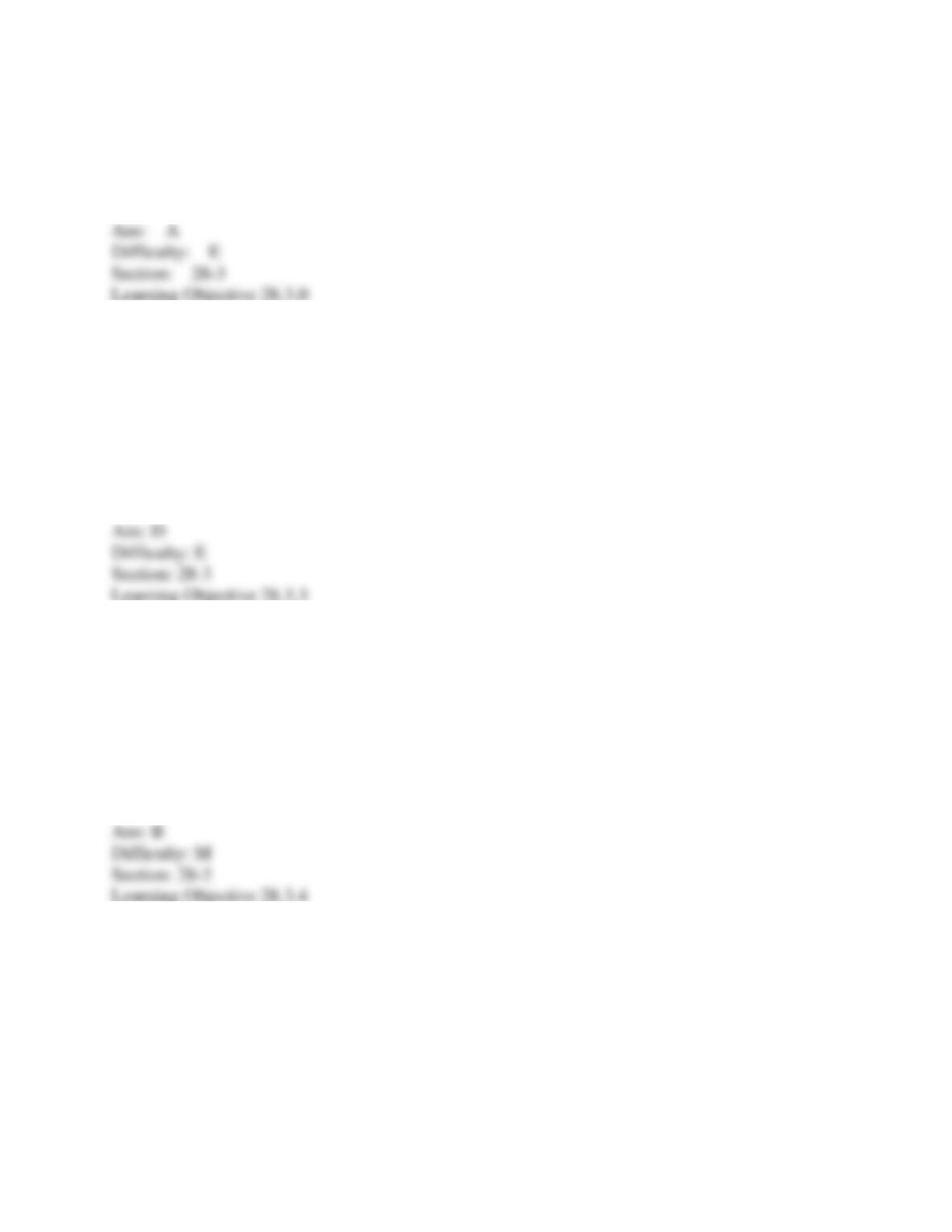
B) negative
C) neutral
D) absent
E) moving near the speed of light
25. A conducting strip of width 1.5 mm is in a magnetic field. As a result, there is a potential
difference of 4.3 mV across the width of the strip. What is the magnitude of the electric field in
the strip?
A) 0.35 V/m
B) 1.2 V/m
C) 1.9 V/m
D) 2.9 V/m
E) 6.4 V/m
26. The Hall effect can be used to calculate the charge-carrier number density in a conductor. If a
conductor carrying a current of 2.0 A is 0.5 mm thick, and the Hall effect voltage is 4.5 µV when
it is in a uniform magnetic field of 1.2 T, what is the density of charge carriers in the conductor?
A) 1.0 x 1028/m3
B) 6.7 x 1027/m3
C) 4.6 x 1027/m3
D) 1.7 x 1027/m3
E) 1.2 x 1027/m3
27. A strip 1.2 mm wide is moving at a speed of 25 cm/s through a uniform magnetic field of 5.6
T. What is the maximum Hall voltage across the strip?
A) 1.7 mV
B) 8.5 mV
C) 27 mV
D) 1.2 V
E) 17 V