C) The current in the capacitor branch leads the current in the inductor branch by 1/4 cycle.
D) The potential difference across the capacitor branch leads the potential difference across the
inductor branch by 1/4 cycle.
E) The current in the capacitor branch lags the current in the inductor branch by 1/4 cycle.
42. The impedance of an RLC series circuit is definitely increased if:
A) C decreases
B) L increases
C) L decreases
D) R increases
E) R decreases
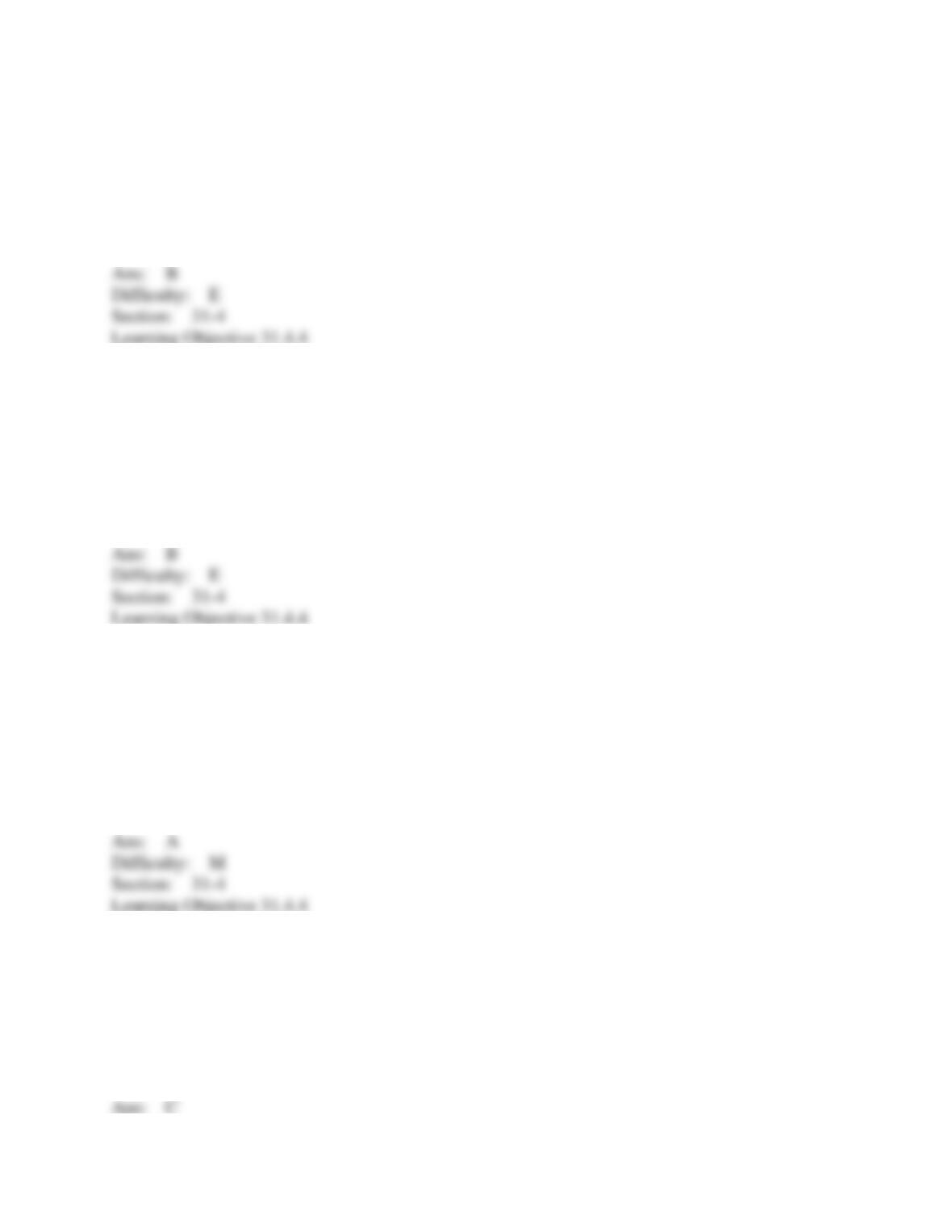
43. The impedance of the circuit shown is:
A) 21
B) 50
C) 63
D) 65
E) 98
44. When the frequency of the oscillator in a series RLC circuit is doubled:
A) the capacitive reactance is doubled
B) the capacitive reactance is halved
C) the impedance is doubled
D) the current amplitude is doubled
E) the current amplitude is halved
45. In an RLC series circuit, the source voltage is leading the current at a given frequency f. If f
is lowered slightly, then the circuit impedance will:
A) increase
B) decrease
C) remain the same
D) cannot answer without knowing the amplitude of the source voltage
E) cannot answer without knowing whether the phase angle is larger or smaller than 45
46. An RLC series circuit has R = 4 , XC = 3 , and XL = 6 . The impedance of this circuit
is:
A) 5
B) 7
C) 7.8
D) 9.8
E) 13
47. A coil has a resistance of 60 and an impedance of 100 . Its reactance is:
A) 40
B) 60
C) 80
D) 117
E) 160
48. When the amplitude of the oscillator in a series RLC circuit is doubled:
A) the impedance is doubled
B) the voltage across the capacitor is halved
C) the capacitive reactance is halved
D) the power factor is doubled
E) the current amplitude is doubled
49. An electric motor, under load, has an effective resistance of 30 and an inductive
reactance of 40 . When powered by a source with a maximum voltage of 420 V, the maximum
current is:
A) 6.0 A
B) 8.4 A
C) 10.5 A
D) 12 A
E) 14 A
50. An ac generator producing 10 V (rms) at 200 rad/s is connected in series with a 50–
resistor, a 400-mH inductor, and a 200-F capacitor. The rms current is:
A) 0.125 A
B) 0.135 A
C) 0.18 A
D) 0.20 A
E) 0.40 A
51. An ac generator producing 10 V (rms) at 200 rad/s is connected in series with a 50-
resistor, a 400-mH inductor, and a 200-F capacitor. The rms voltage across the resistor is:
A) 2.5 V
B) 3.4 V
C) 6.7 V
D) 10.0 V
E) 10.8 V
52. An ac generator producing 10 V (rms) at 200 rad/s is connected in series with a 50-
resistor, a 400-mH inductor, and a 200-F capacitor. The rms voltage across the capacitor is:
A) 2.5 V
B) 3.4 V
C) 6.7 V
D) 10.0 V
E) 10.8 V
53. An ac generator producing 10 V (rms) at 200 rad/s is connected in series with a 50–
resistor, a 400-mH inductor, and a 200-F capacitor. The rms voltage across the inductor is:
A) 2.5 V
B) 3.4 V
C) 6.7 V
D) 10.0 V
E) 10.8 V
54. An RL series circuit is connected to an ac generator with a maximum emf of 20 V. If the
maximum potential difference across the resistor is 16 V, then the maximum potential difference
across the inductor is:
A) 2 V
B) 4 V
C) 12 V
D) 26 V
E) 36 V
55. In an RLC series circuit, which is connected to a source of emf ℰmcos(
t), the current lags
the voltage by 45 if:
A) R = 1/
C –
L
B) R = 1/
L –
C
C) R =
L – 1/
C
D) R =
C – 1/
L
E)
L = 1/
C
56. An RLC series circuit has L = 100 mH and C = 1 F. It is connected to a 1000-Hz source
emf, and the voltage is found to lead the current by 75. The value of R is:
A) 12.6
B) 126
C) 175
D) 1750
E) 1810
57. An RLC series circuit is connected to an oscillator with a maximum emf of 100 V. If the
voltage amplitudes VR, VL, and VC are all equal to each other, then VR must be:
A) 33 V
B) 50 V
C) 67 V
D) 87 V
E) 100 V
58. An ac generator produces 10 V (rms) at 400 rad/s. It is connected to a series RL circuit (R =
17.3 , L = 0.025 H). The rms current is:
A) 0.50 A and leads the emf by 30
B) 0.71 A and lags the emf by 30
C) 1.4 A and lags the emf by 60
D) 0.50 A and lags the emf by 30
E) 0.58 A and leads the emf by 90
59. In a purely capacitive circuit the current:
A) leads the voltage by one-fourth of a cycle
B) leads the voltage by one-half of a cycle
C) lags the voltage by one-fourth of a cycle
D) lags the voltage by one-half of a cycle
E) is in phase with the potential difference across the plates
60. In a purely resistive circuit the current:
A) leads the voltage by 1/4 cycle
B) leads the voltage by 1/2 cycle
C) lags the voltage by 1/4 cycle
D) lags the voltage by 1/2 cycle
E) is in phase with the voltage
61. In a purely inductive circuit, the current lags the voltage by:
A) 0 (they are in phase)
B) one-fourth of a cycle
C) one-half of a cycle
D) three-fourths of a cycle
E) one cycle
62. A series RL circuit is connected to an emf source of angular frequency
. The current:
A) leads the applied emf by tan–1(
L/R)
B) lags the applied emf by tan–1(
L/R)
C) lags the applied emf by tan–1(
R/L)
D) leads the applied emf by tan–1(
R/L)
E) is zero
63. An RC series circuit is connected to an emf source having angular frequency
. The
current:
A) leads the source emf by tan–1(1/
CR)
B) lags the source emf by tan–1(1/
CR)
C) leads the source emf by tan–1(
CR)
D) lags the source emf by tan–1(
CR)
E) leads the source emf by /4
64. An RLC series circuit is driven by a sinusoidal emf with angular frequency
d. If
d is
increased without changing the amplitude of the emf, the current amplitude increases. If L is
the inductance, C is the capacitance, and R is the resistance, this means that:
A)
dL > 1/
dC
B)
dL < 1/
dC
C)
dL = 1/
dC
D)
dL > R
E)
dL < R
65. In a sinusoidally driven series RLC circuit, the inductive resistance is XL = 200 , the
capacitive reactance is XC = 100 , and the resistance is R = 50 . The current and applied emf
would be in phase if:
A) the resistance is increased to 100 , with no other changes
B) the resistance is increased to 200 , with no other changes
C) the inductance is reduced to zero, with no other changes
D) the capacitance is doubled, with no other changes
E) the capacitance is halved, with no other changes
66. An RLC series circuit, connected to a source ℰ, is at resonance. Then:
A) the voltage across R is zero
B) the voltage across R equals the applied voltage
C) the voltage across C is zero
D) the voltage across L equals the applied voltage
E) the applied voltage and current differ in phase by 90
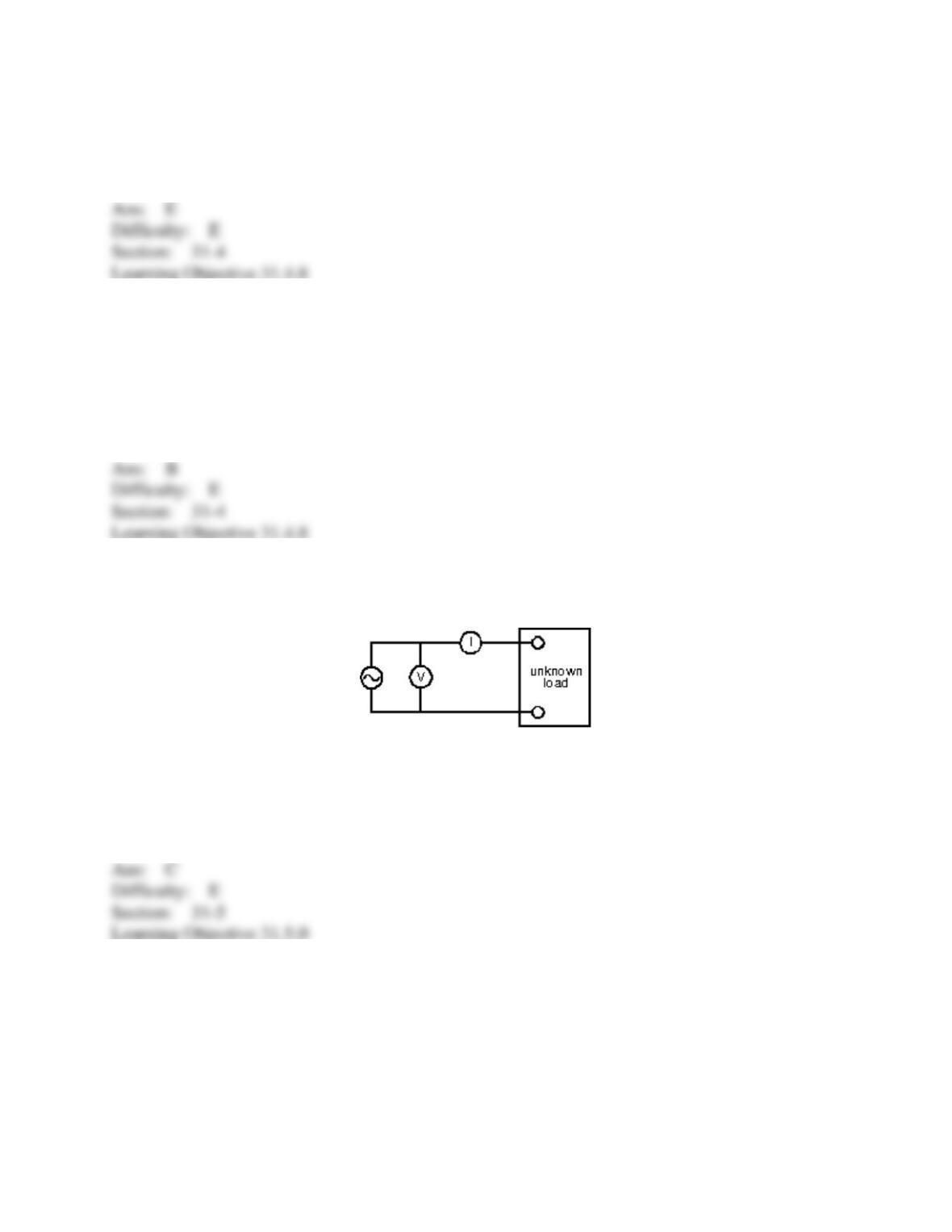
67. The ideal meters shown read rms current and voltage. The average power delivered to the
load is:
A) definitely not equal to VI
B) perhaps more than VI
C) possibly equal to VI even if the load contains an inductor and a capacitor
D) definitely less than VI
E) zero as is the average of any sine wave
68. The units of the power factor are:
A) ohm
B) watt
C) radian
D) ohm1/2
E) none of these
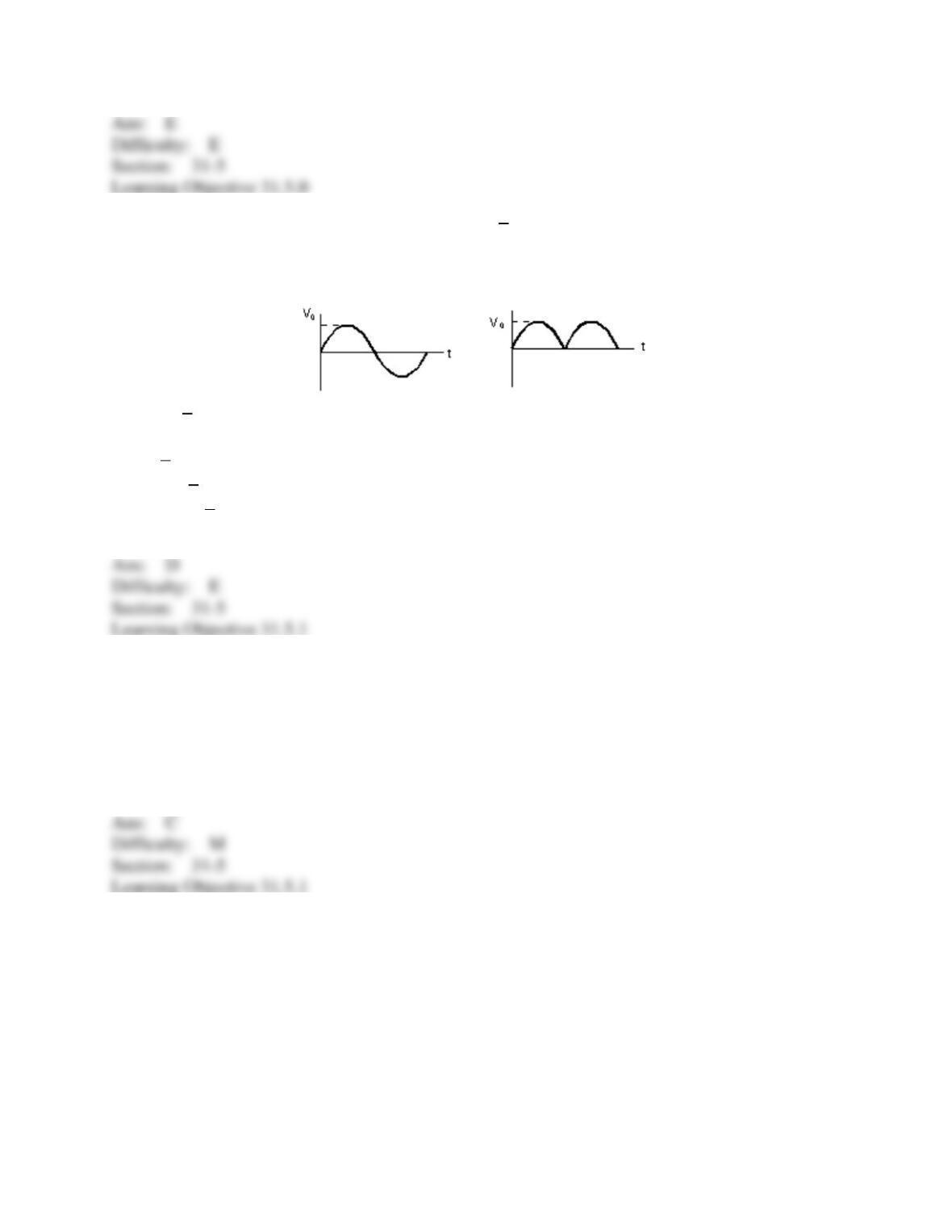
69. The rms value of a sinusoidal voltage is 𝑉0/√2, where V0 is the amplitude. What is the rms
value of its fully rectified wave? Recall that Vrect(t) = V(t).
A) 𝑉0
2/√2
B) 𝑉0
2/2
C) √2𝑉0
D) 𝑉0/√2
E) 𝑉0/(2√2)
70. A sinusoidal voltage V(t) has an rms value of 100 V. Its maximum value is:
A) 70.7 V
B) 100 V
C) 141 V
D) 200 V
E) 707 V
71. In a series RLC circuit the rms value of the generator emf is ℰ and the rms value of the
current is i. The current lags the emf by
. The average power supplied by the generator is given
by:
A) (iℰ/2)cos
B) iℰ
C) i2/Z
D) i2Z
E) i2R
72. In a sinusoidally driven series RLC circuit the current lags the applied emf. The rate at
which energy is dissipated in the resistor can be increased by:
A) decreasing the capacitance and making no other changes
B) increasing the capacitance and making no other changes
C) increasing the inductance and making no other changes
D) increasing the driving frequency and making no other changes
E) decreasing the amplitude of the driving emf and making no other changes
73. An RLC circuit has a sinusoidal source of emf. The average rate at which the source
supplies energy is 5 nW. This must also be:
A) the average rate at which energy is stored in the capacitor
B) the average rate at which energy is stored in the inductor
C) the average rate at which energy is dissipated in the resistor
D) twice the average rate at which energy is stored in the capacitor
E) three times the average rate at which energy is stored in the inductor
74. The rms value of an ac current is:
A) its peak value
B) its average value
C) that steady current that produces the same rate of heating in a resistor
D) that steady current that will charge a battery at the same rate
E) zero
75. The average power supplied to the circuit shown passes through a maximum when which
one of the following is increased continuously from a very low to a very high value?
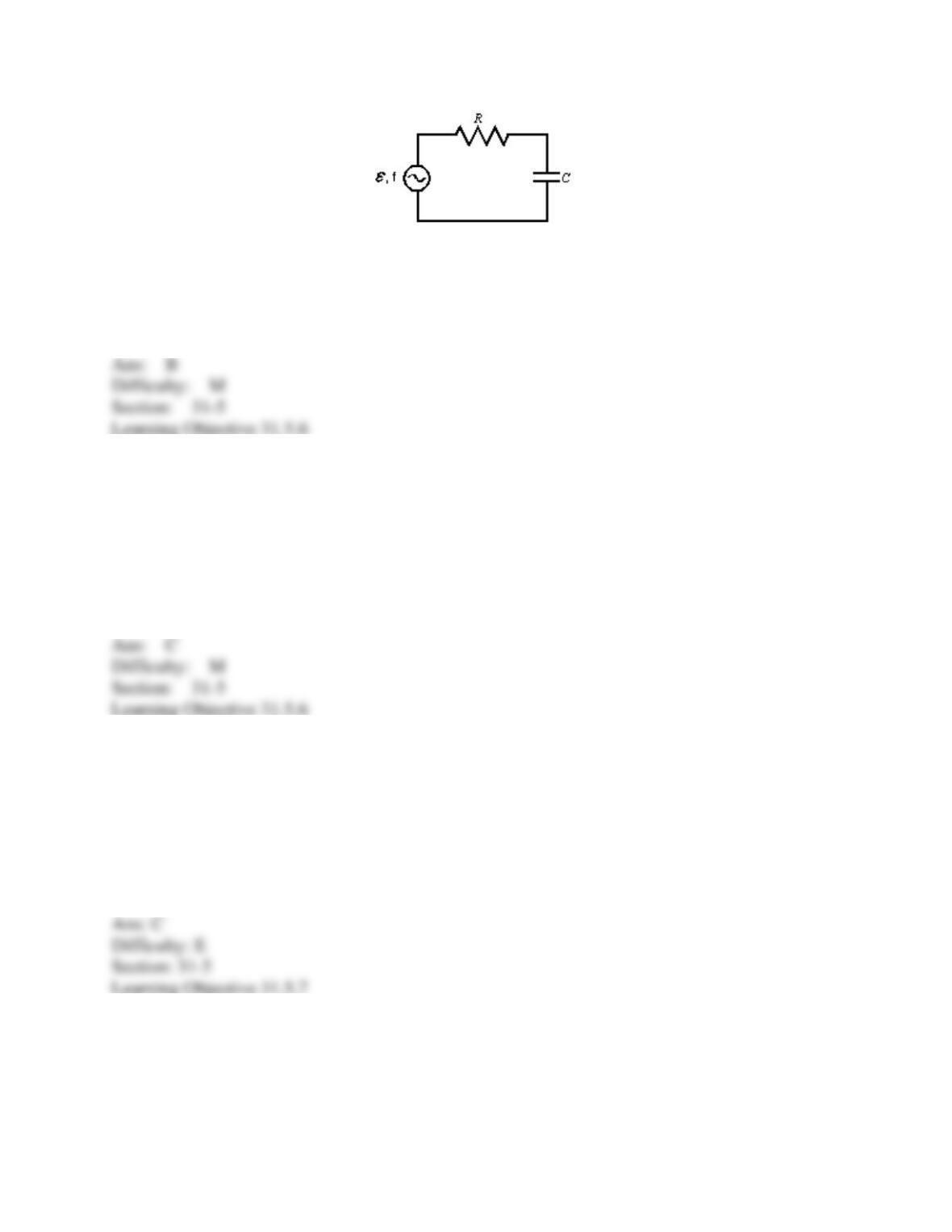
A) source emf ℰ
B) R
C) C
D) source frequency f
E) none of these
76. A series circuit consists of a 15- resistor, a 25-mH inductor, and a 35-F capacitor. If
the frequency is 100 Hz the power factor is:
A) 0
B) 0.20
C) 0.45
D) 0.65
E) 1.0
77. In order to maximize the rate at which energy is supplied to a resistive load, the power factor
of an RLC circuit should be as close as possible to:
A) 0
B) 0.5
C) 1
D) infinity
E) cannot tell without knowing R, L, C, and the driving frequency
78. The main reason that alternating current replaced direct current for general use is:
A) ac generators do not need slip rings
B) ac voltages may be conveniently transformed
C) electric clocks do not work on dc
D) a given ac current does not heat a power line as much as the same dc current
E) ac minimizes magnetic effects
79. Iron, rather than copper, is used in the core of transformers because iron:
A) can withstand a higher temperature
B) has a greater resistivity
C) has a very high permeability
D) makes a good permanent magnet
E) insulates the primary from the secondary
80. The core of a transformer is made in a laminated form to:
A) facilitate easy assembly
B) reduce i2R losses in the coils
C) increase the magnetic flux
D) save weight
E) prevent eddy currents
81. For a power transmission line, the transmission should be at low current and high voltage
because:
A) this is the least dangerous to electrical workers
B) this gives the least dose of electromagnetic radiation to the public
C) this minimizes transmission losses
D) low current and high voltage is easier to transform than high current and low voltage
E) household appliances run at low current and high voltage
82. A power transmission line carries 400A of current at a voltage of 765 kV. If the line has a
resistance of 29 µΩ/m, what is the rate at which energy is being dissipated in 800 km of line?
A) 0 W
B) 3.7 kW
C) 310 kW
D) 3.7 MW
E) 310 MW
83. A generator supplies 100 V to the primary coil of a transformer. The primary has 50 turns
and the secondary has 500 turns. The secondary voltage is:
A) 1000 V
B) 500 V
C) 250 V
D) 100 V
E) 10 V
84. A step-down transformer is used to:
A) increase the power
B) decrease the power
C) increase the voltage
D) decrease the voltage
E) change ac to dc
85. The resistance of the primary coil of a well-designed, 1:10 step-down transformer is 1 .
With the secondary circuit open, the primary is connected to a 12 V ac generator. The primary
current is:
A) essentially zero
B) about 12 A
C) about 120 A
D) depends on the actual number of turns in the primary coil
E) depends on the core material
86. The primary of an ideal transformer has 100 turns and the secondary has 600 turns. Then:
A) the power in the primary circuit is less than that in the secondary circuit
B) the currents in the two circuits are the same
C) the voltages in the two circuits are the same
D) the primary current is six times the secondary current
E) the frequency in the secondary circuit is six times that in the primary circuit
87. The primary of a 3:1 step-up transformer is connected to a source and the secondary is
connected to a resistor R. The power dissipated by R in this situation is P. If R is connected
directly to the source it will dissipate a power of:
A) P/9
B) P/3
C) P
D) 3P
E) 9P
88. In an ideal 1:8 step-down transformer, the primary power is 10 kW and the secondary
current is 25 A. The primary voltage is:
A) 25,600 V
B) 3200 V
C) 400 V
D) 50 V
E) 6.25 V
89. A source with an impedance of 100 is connected to the primary coil of a transformer and
a resistance R is connected to the secondary coil. If the transformer has 500 turns in its primary
coil and 100 turns in its secondary coil the greatest power will be dissipated in the resistor if R =
A) 0
B) 0.25
C) 4.0
D) 20
E) 100