D) the radiation pressure stays the same and the radiation force decreases
E) the radiation pressure decreases and the radiation force decreases
42. Light with an intensity of 1 kW/m2 falls normally on a surface with an area of 1 cm2 and is
completely absorbed. The force of the radiation on the surface is:
A) 3.3 10–11 N
B) 1.7 10–10 N
C) 3.3 10–10 N
D) 6.7 10–10 N
E) 1.0 10–4 N
43. Light with an intensity of 1 kW/m2 falls normally on a surface with an area of 1 cm2 and is
completely reflected. The force of the radiation on the surface is:
A) 3.3 10–11 N
B) 1.7 10–10 N
C) 3.3 10–10 N
D) 6.7 10–10 N
E) 1.0 10–4 N
44. Light with an intensity of 1 kW/m2 falls normally on a surface and is completely absorbed.
The radiation pressure is:
A) 1 kPa
B) 3 1011 Pa
C) 1.7 10–6 Pa
D) 3.3 10–6 Pa
E) 6.7 10–6 Pa
45. Light with an intensity of 1 kW/m2 falls normally on a surface and is completely reflected.
The radiation pressure is:
A) 1 kPa
B) 3 1011 Pa
C) 1.7 10–6 Pa
D) 3.3 10–6 Pa
E) 6.7 10–6 Pa
46. Polarization experiments provide evidence that light is:
A) a longitudinal wave
B) a stream of particles
C) a transverse wave
D) some type of wave
E) nearly monochromatic
47. A vertical automobile radio antenna is sensitive to electric fields that are polarized:
A) horizontally
B) in circles around the antenna
C) vertically
D) normal to the antenna in the forward direction
E) none of the above
48. For linearly polarized light the plane of polarization is:
A) perpendicular to both the direction of polarization and the direction of propagation
B) perpendicular to the direction of polarization and parallel to the direction of propagation
C) parallel to the direction of polarization and perpendicular to the direction of propagation
D) parallel to both the direction of polarization and the direction of propagation
E) none of the above
49. Light from any ordinary source (such as a flame) is usually:
A) unpolarized
B) plane polarized
C) circularly polarized
D) elliptically polarized
E) monochromatic
50. The electric field in unpolarized light:
A) has no direction at any time
B) rotates rapidly
C) is always parallel to the direction of propagation
D) can be in any direction perpendicular to the direction of propagation
E) remains along the same line but reverses direction randomly and often
51. A clear sheet of polarizing material is placed on top of a second, similar sheet so that their
polarizing axes make an angle of 30 with each other. The ratio of the intensity of emerging light
to incident unpolarized light is:
A) 1:4
B) 1:3
C) 1:2
D) 3:4
E) 3:8
52. An unpolarized beam of light has intensity I0. It is incident on two ideal polarizing sheets.
The angle between the axes of polarization of these sheets is
. Find
if the emerging light has
intensity I0/4:
A) sin–1(1/2)
B) sin-1(1/√5)
C) cos–1(1/2)
D) cos–1(1/√2)
E) tan–1(1/4)
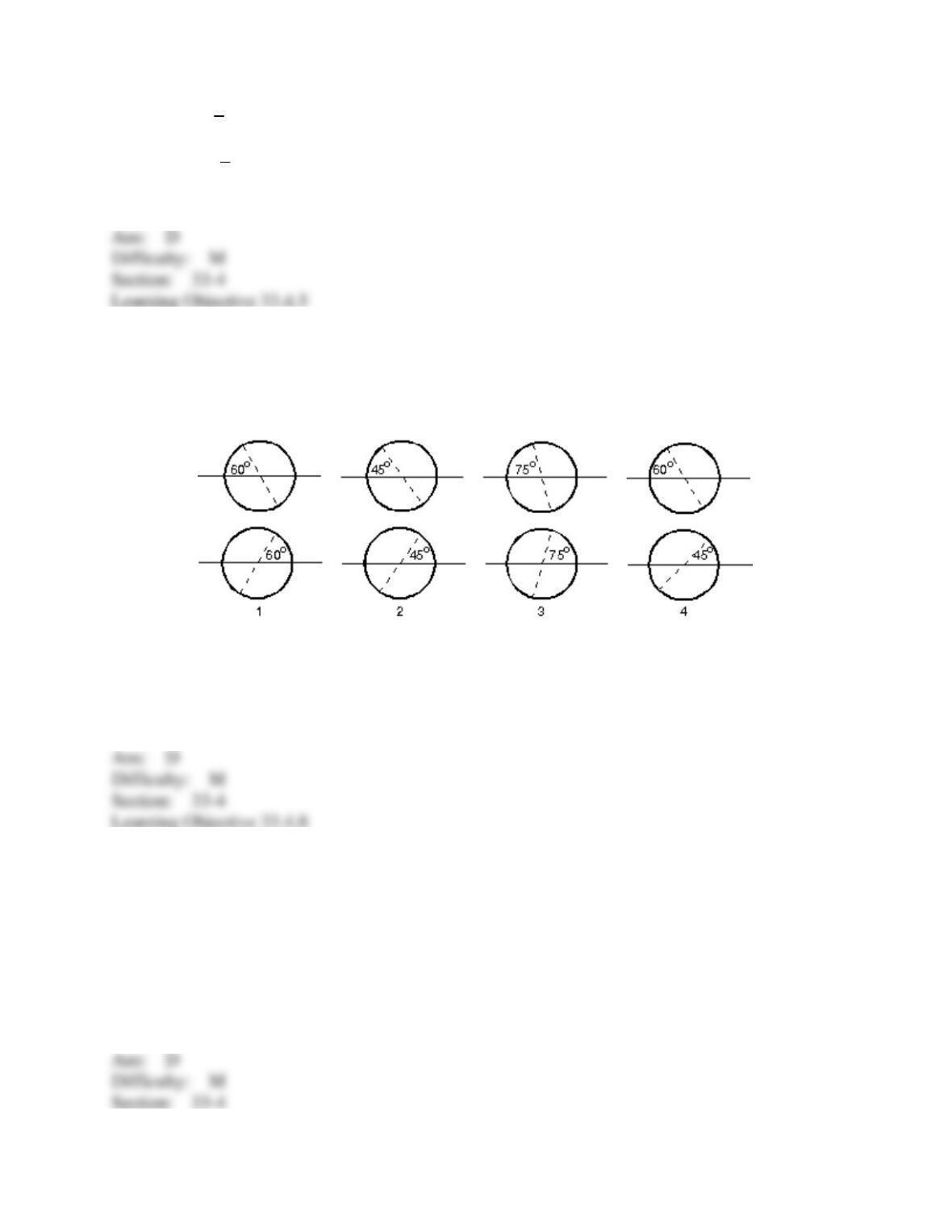
53. The diagrams show four pairs of polarizing sheets, with the polarizing directions indicated
by dashed lines. The two sheets of each pair are placed one behind the other and the front sheet
is illuminated by unpolarized light. The incident intensity is the same for all pairs of sheets.
Rank the pairs according to the intensity of transmitted light, least to greatest.
A) 1, 2, 3, 4
B) 4, 2, 1, 3
C) 2, 4, 3, 1
D) 2, 4, 1, 3
E) 3, 1, 4, 2
54. In a stack of three polarizing sheets the first and third are crossed while the middle one has
its axis at 45 to the axes of the other two. The fraction of the intensity of an incident unpolarized
beam of light that is transmitted by the stack is:
A) 1/2
B) 1/3
C) 1/4
D) 1/8
E) 0
55. Three polarizing sheets are placed in a stack with the polarizing directions of the first and
third perpendicular to each other. What angle should the polarizing direction of the middle sheet
make with the polarizing direction of the first sheet to obtain maximum transmitted intensity
when unpolarized light is incident on the stack?
A) 0°
B) 30
C) 45
D) 60
E) 90
56. Three polarizing sheets are placed in a stack with the polarizing directions of the first and
third perpendicular to each other. Which of the following angles should the polarizing direction
of the middle sheet make with the polarizing direction of the first sheet to obtain zero transmitted
intensity when unpolarized light is incident on the stack?
A) 0°
B) 30
C) 45
D) 60
E) all angles allow light to pass through
57. The relation
incident =
reflected, which applies as a ray of light strikes an interface between
two media, is known as:
A) Faraday’s law
B) Snell’s law
C) Ampere’s law
D) Cole’s law
E) none of these
58. The relation n1sin
1 = n2 sin
2 which applies as a ray of light strikes an interface between
two media, is known as:
A) Gauss’ law
B) Snell’s law
C) Faraday’s law
D) Cole’s law
E) law of sines
59. The index of refraction of a substance is:
A) the speed of light in the substance
B) the angle of refraction
C) the angle of incidence
D) the speed of light in vacuum divided by the speed of light in the substance
E) measured in radians
60. The units of index of refraction are:
A) m/s
B) s/m
C) radian
D) m/s2
E) none of these
61. When light travels from medium X to medium Y as shown:
A) both the speed and the frequency decrease
B) both the speed and the frequency increase
C) both the speed and the wavelength decrease
D) both the speed and the wavelength increase
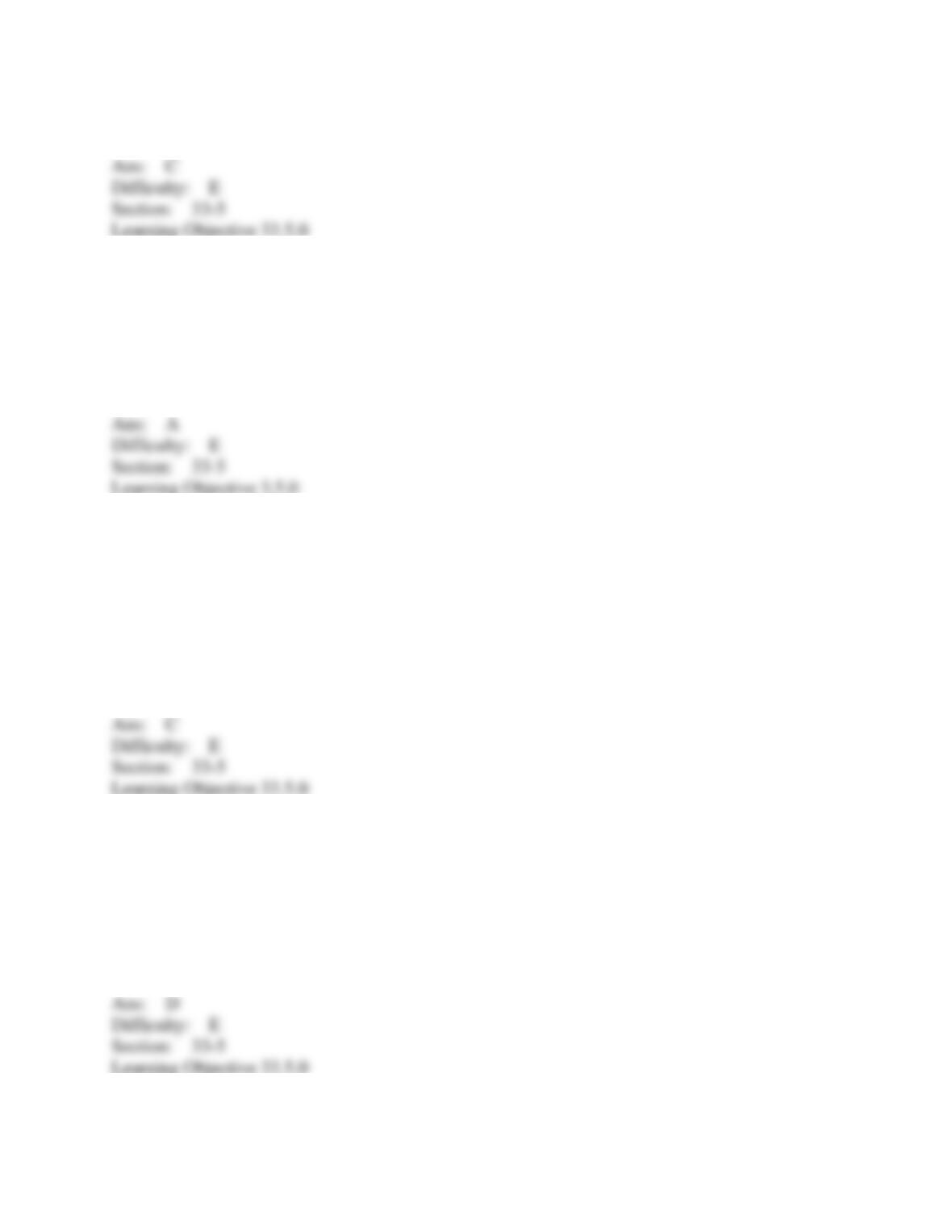
E) both the wavelength and the frequency are unchanged
62. As light goes from one medium to another, it is bent away from the normal. Then:
A) the speed of the light has increased
B) dispersion must occur
C) the second medium has a higher index of refraction
D) no change in speed has occurred
E) refraction has not occurred because refraction means a bending toward the normal
63. A pole stands in a river, half in and half out of the water. Another pole of the same length
stands vertically on the shore at a place where the ground is level. The shadow cast by the pole in
the river on the river bottom is:
A) slightly longer than the shadow of the pole on land
B) much longer than the shadow of the pole on land
C) shorter than the shadow of the pole on land
D) shorter than the shadow of the pole on land if the sun is high and longer if the sun is low
E) the same length as the shadow of the pole on land
64. A ray of light passes obliquely through a plate of glass having parallel faces. The emerging
ray:
A) is totally internally reflected
B) is bent more toward the normal than the incident ray
C) is bent further away from the normal than the incident ray
D) is parallel to the incident ray but displaced sideways
E) lies on the same straight line as the incident ray
65. As used in the laws of reflection and refraction, the “normal” direction is:
A) any convenient direction
B) tangent to the interface
C) along the incident ray
D) perpendicular to the electric field vector of the light
E) perpendicular to the interface
66. When an electromagnetic wave meets a reflecting surface, the direction taken by the
reflected wave is determined by:
A) the material of the reflecting surface
B) the angle of incidence
C) the index of the medium
D) the intensity of the wave
E) the wavelength
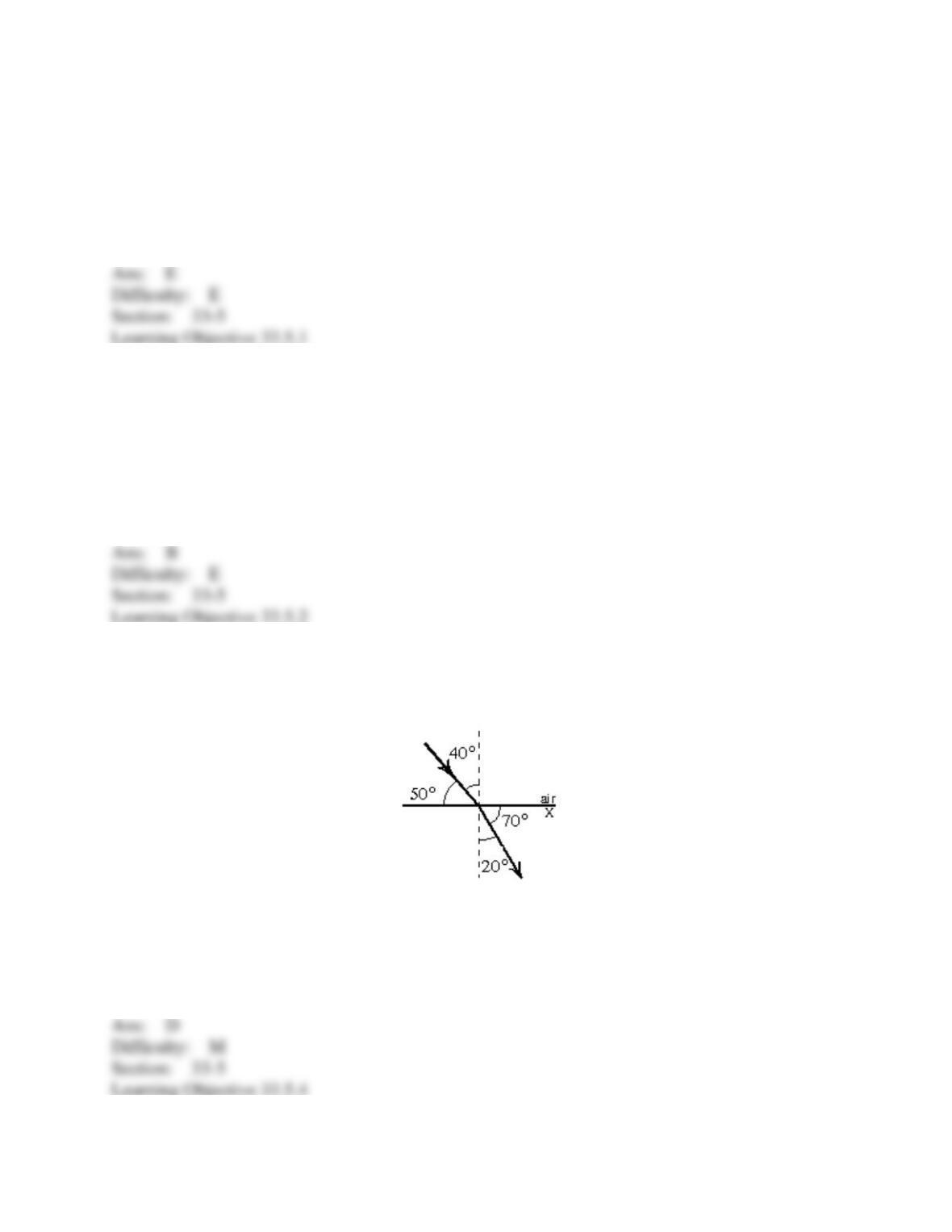
67. The diagram shows the passage of a ray of light from air into a substance X. The index of
refraction of X is:
A) 0.53
B) 0.82
C) 1.2
D) 1.9
E) 3.0
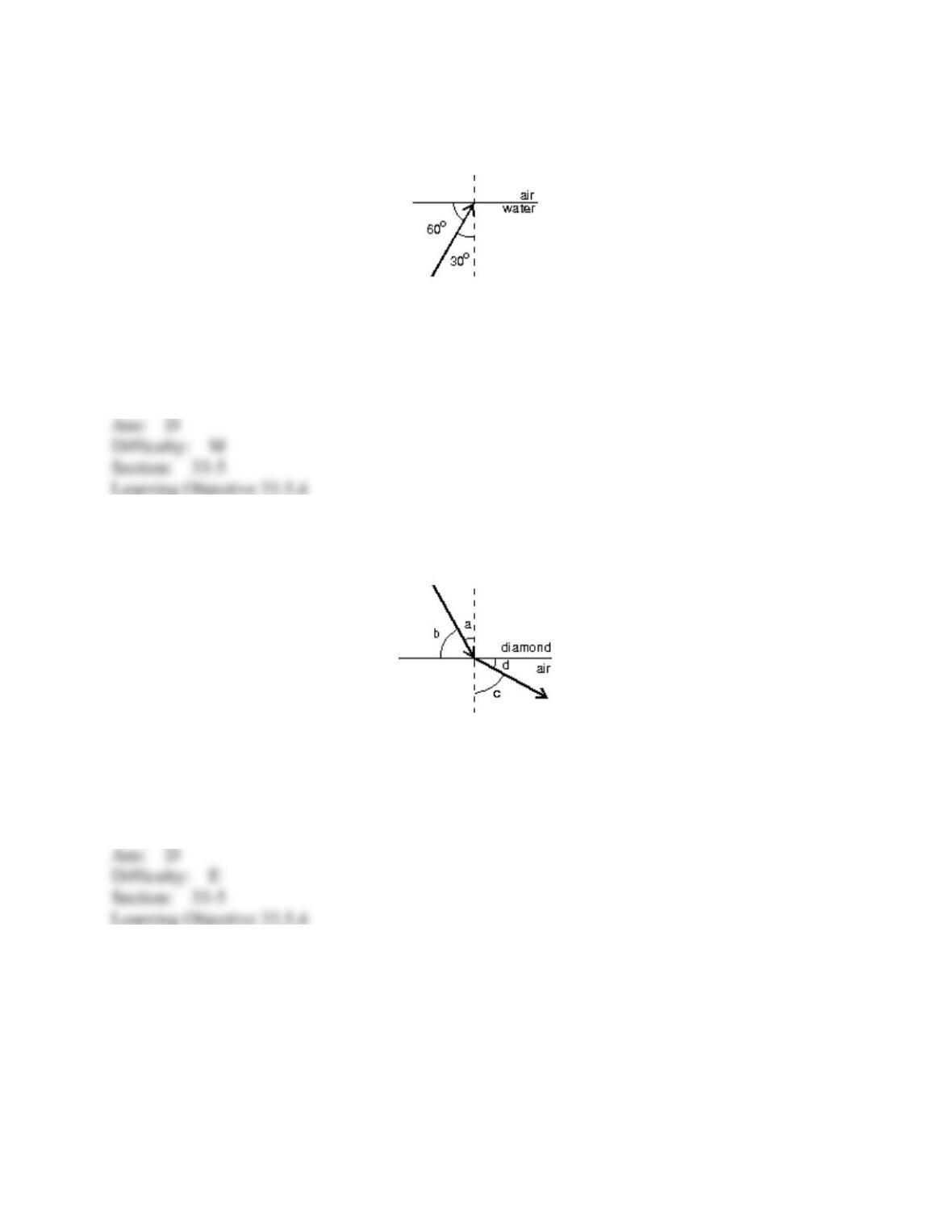
68. If nwater = 1.33, what is the angle of refraction for the ray shown?
A) 19
B) 22
C) 40
D) 42
E) 48
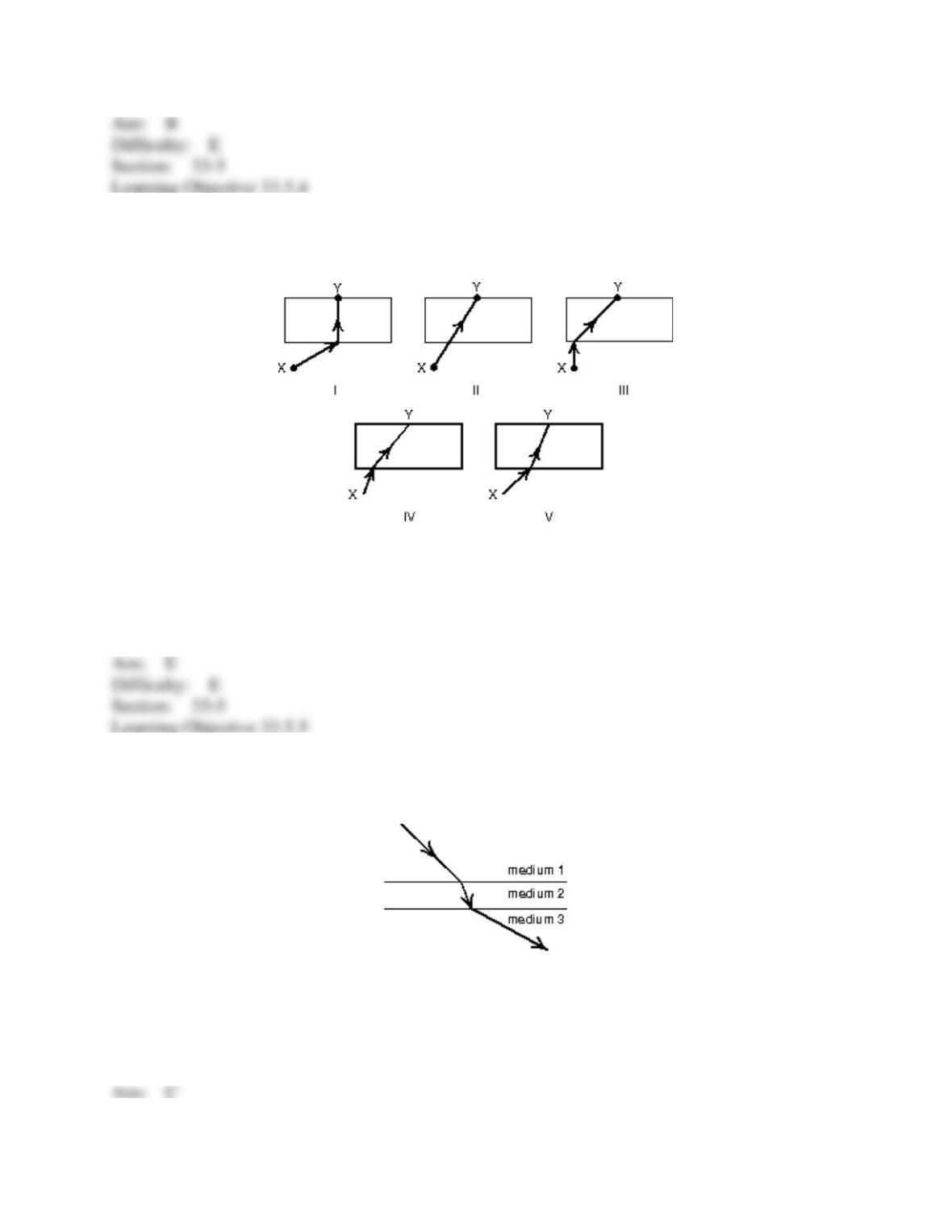
69. The index of refraction for diamond is 2.5. Which of the following is correct for the
situation shown?
A) (sin a)/(sin b) = 2.5
B) (sin b)/(sin d) = 2.5
C) (cos a)/(cos c) = 2.5
D) (sin a)/(sin c) = 1/(2.5)
E) a/c = 2.5
70. When light passes from air to glass, it bends:
A) toward the normal without changing speed
B) toward the normal and slows down
C) toward the normal and speeds up
D) away from the normal and slows down
E) away from the normal and speeds up
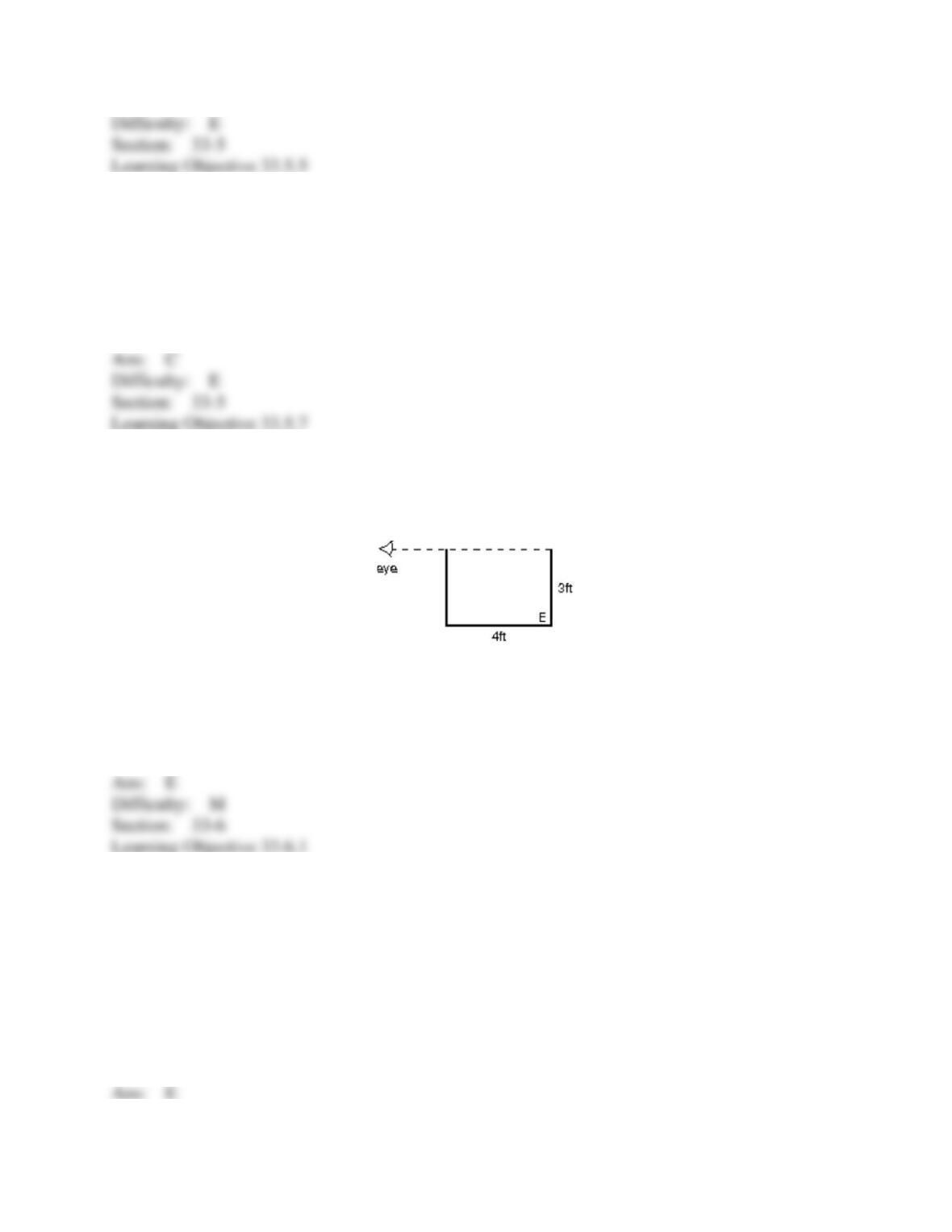
71. Which diagram below illustrates the path of a light ray as it travels from a given point X in
air to another given point Y in glass?
A) I
B) II
C) III
D) IV
E) V
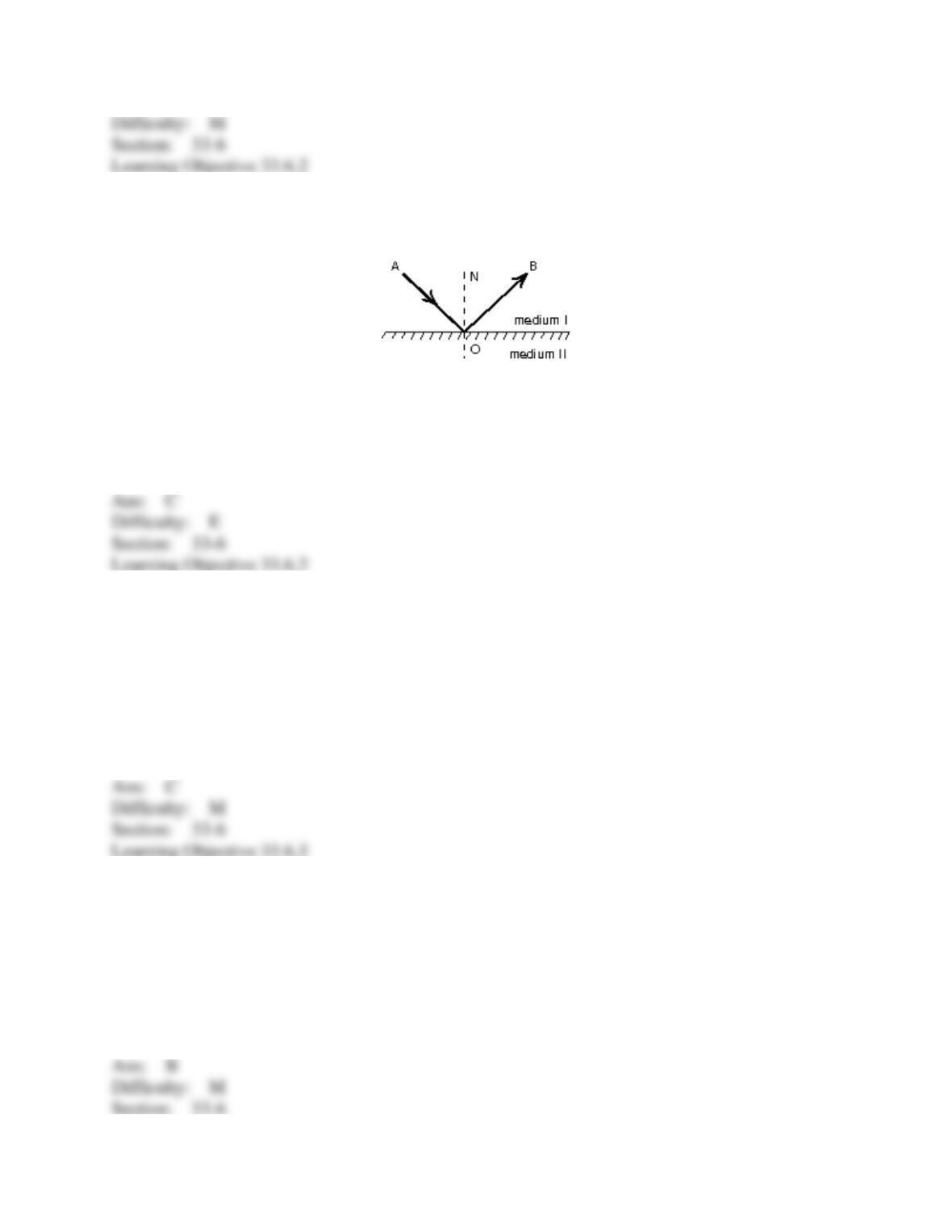
72. A ray of light passes through three media as shown. The speeds of light in these media
obey:
A) v1 > v2 > v3
B) v3 > v2 > v1
C) v3 > v1 > v2
D) v2 > v1 > v3
E) v1 > v3 > v2
73. The separation of white light into colors by a prism is associated with:
A) total internal reflection
B) partial reflection from each surface
C) variation of index of refraction with wavelength
D) a decrease in the speed of light in the glass
E) selective absorption of various colors
74. The rectangular metal tank shown is filled with an unknown liquid. The observer, whose
eye is level with the top of the tank, can just see corner E. The index of refraction of this liquid
is:
A) 1.75
B) 1.67
C) 1.50
D) 1.33
E) 1.25
75. The critical angle for total internal reflection at a diamond-air interface is 25. Suppose
light is incident at an angle of
with the normal. Total internal reflection will occur if the
incident medium is:
A) air and
= 25
B) air and
> 25
C) air and
< 25
D) diamond and
< 25
E) diamond and
> 25
76. The diagram shows total internal reflection. Which of the following statements is NOT
true?
A) angle AON is the angle of incidence
B) angle AON = angle BON
C) angle AON must be the critical angle
D) the speed of light in medium II is greater than that in medium I
E) if angle AON were increased, there would still be total internal reflection
77. The index of refraction of benzene is 1.80. The critical angle for total internal reflection, at
a benzene-air interface, is about:
A) 56
B) 47
C) 34
D) 22
E) 18
78. The index of refraction of a certain glass is 1.50. The sine of the critical angle for total
internal reflection at a glass-air interface is:
A) 0.50
B) 0.67
C) 0.75
D) 1.00
E) 1.50
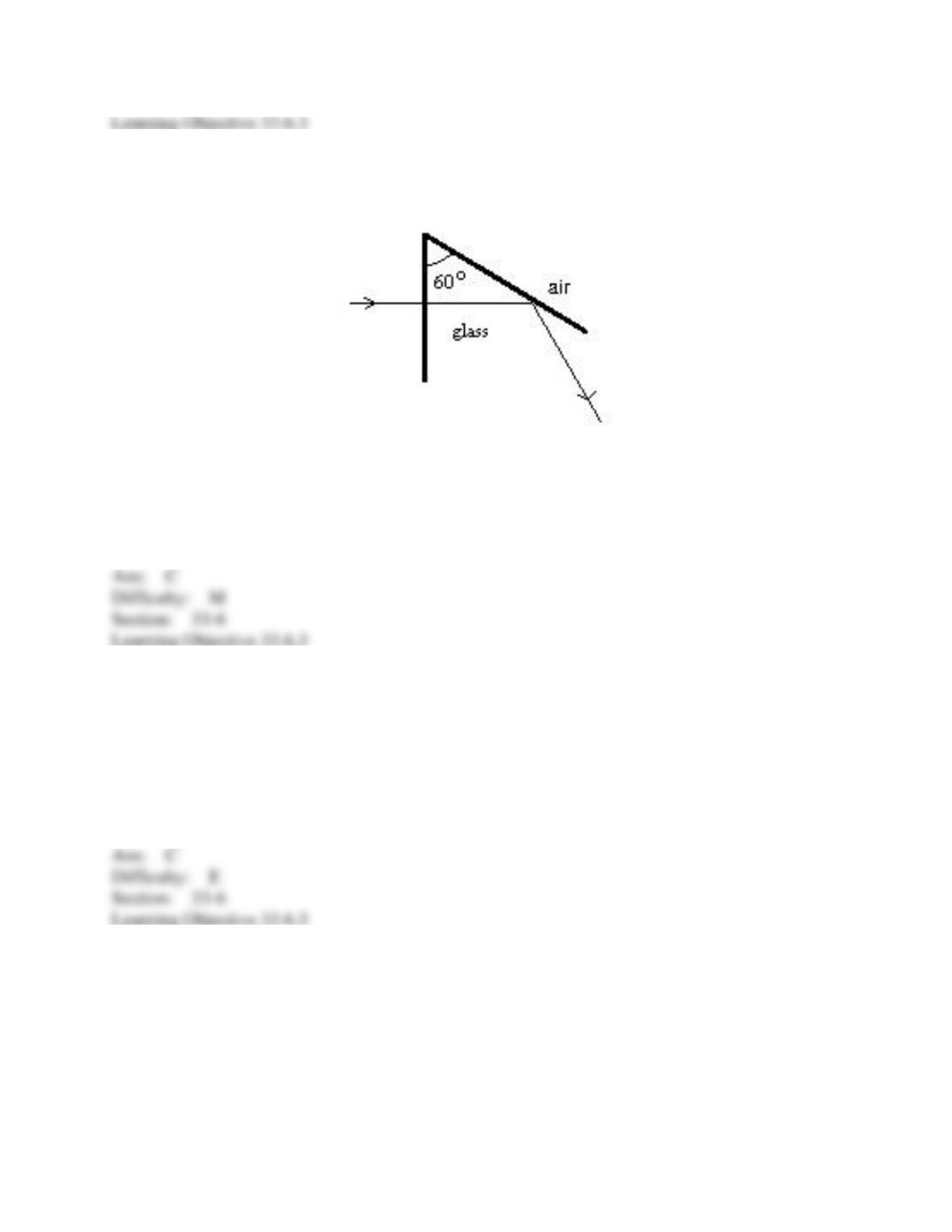
79. The illustration shows total internal reflection taking place in a piece of glass. The index of
refraction of this glass:
A) is at least 2.0
B) is at most 2.0
C) is at least 1.15
D) is at most 1.15
E) cannot be calculated from the given data
80. If nwater = 1.33 and nglass = 1.50, then total internal reflection at an interface between this
glass and water:
A) occurs whenever the light goes from glass to water
B) occurs whenever the light goes from water to glass
C) may occur when the light goes from glass to water
D) may occur when the light goes from water to glass
E) can never occur at this interface
81. A ray of light in water (index n1) is incident on its surface (with air) at the critical angle.
Some oil (index n2) is now floated on the water. The angle between the ray in the oil and the
normal is:
A) sin–1(1.00)
B) sin–1(1/n1)
C) sin–1(1/n2)
D) sin–1(n1/n2)
E) sin–1(n2/n1)
82. For a beam of light in air (n = 1) reflecting off glass (n = 1.5), what is Brewster’s angle?
A) 34°
B) 42°
C) 45°
D) 48°
E) 56°
83. Why do polarizing sunglasses work to reduce glare?
A) They don’t; this is just a marketing ploy
B) They reduce the amount of light entering your eyes
C) Light reflected from horizontal surfaces tends to be horizontally polarized, so the sunglasses’
vertical polarization cuts the glare
D) Light reflected from horizontal surfaces tends to be vertically polarized, so the sunglasses’
horizontal polarization cuts the glare
E) Light reflected from horizontal surfaces tends to be horizontally polarized, so the sunglasses’
horizontal polarization cuts the glare