Learning Objective 32.3.8
40. Which of the following equations, along with a symmetry argument, can be used to
calculate the magnetic field between the plates of a charging parallel plate capacitor with circular
plates?
A) ∮𝐸
⃗
∙ 𝑑𝐴
= 𝑞/𝜀0
B) ∮𝐵
⃗
∙ 𝑑𝐴
= 0
C) ∮𝐸
⃗
∙ 𝑑𝑠 = − 𝑑Φ𝐵
𝑑𝑡
D) ∮𝐵
⃗
∙ 𝑑𝑠 = 𝜇0𝑖 + 𝜇0𝜀0
𝑑Φ𝐸
𝑑𝑡
E) none of these
41. Maxwell’s equations, along with an appropriate symmetry argument, can be used to
calculate:
A) the electric force on a given charge
B) the magnetic force on a given moving charge
C) the flux of a given electric field
D) the flux of a given magnetic field
E) none of these
42. The magnetic field of Earth is roughly the same as that of a magnetic dipole with a dipole
moment of about:
A) 1017 J/T
B) 1019 J/T
C) 1021 J/T
D) 1023 J/T
E) 1025 J/T
43. Of the following places one would expect that the horizontal component of the Earth’s
magnetic field to be largest in:
A) Maine
B) Florida
C) Maryland
D) New York
E) Iowa
44. A positively charged ion, due to a cosmic ray, is headed through Earth’s atmosphere toward
the center of Earth. Due to Earth’s magnetic field, the ion will be deflected:
A) south
B) north
C) west
D) east
E) not at all since it is a charge and not a pole
45. The polarity of an unmarked magnet can be determined using:
A) a charged glass rod
B) a compass
C) an electroscope
D) another unmarked magnet
E) iron filings
46. A bar magnet is placed vertically with its S pole up and its N pole down. The 𝐵
⃗
field at its
center is:
A) zero
B) down
C) up
D) horizontal
E) slightly below the horizontal
47. A bar magnet is broken in half. Each half is broken in half again, etc. The observation is
that each piece has both a north and south pole. This is usually explained by:
A) Ampere’s theory that all magnetic phenomena result from electric currents
B) our inability to divide the magnet into small enough pieces
C) Coulomb’s law
D) Lenz’ law
E) conservation of charge
48. A small bar magnet is suspended horizontally by a string. When placed in a uniform
horizontal magnetic field, it will:
A) translate in the direction of 𝐵
⃗
B) translate in the opposite direction of 𝐵
⃗
C) rotate so as to be at right angles to 𝐵
⃗
D) rotate so as to be vertical
E) none of the above
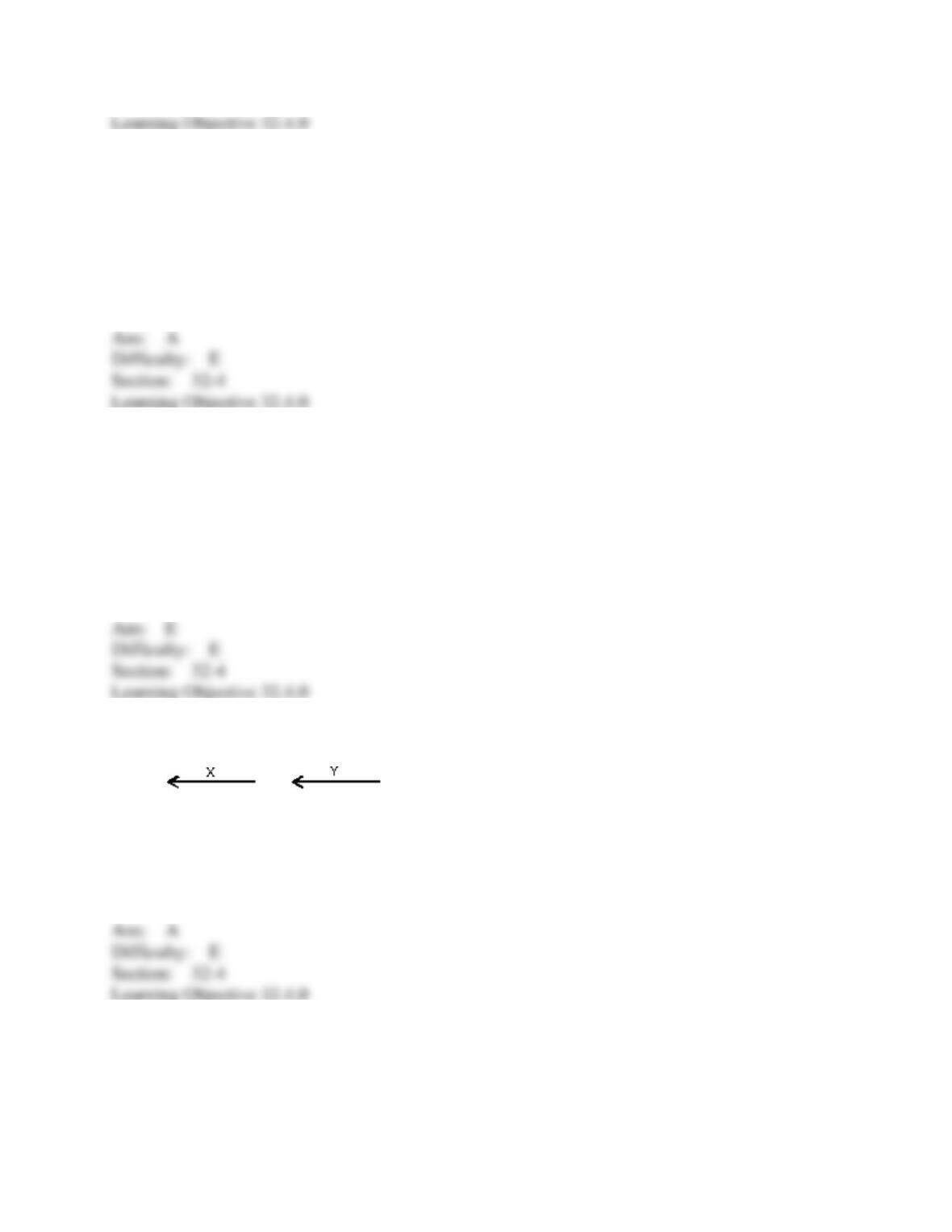
49. Magnetic dipole X is fixed and dipole Y is free to move. Dipole Y will initially:
A) move toward X but not rotate
B) move away from X but not rotate
C) move toward X and rotate
D) move away from X and rotate
E) rotate but not translate
50. Magnetic dipole X is fixed. Dipole Y is placed in the position indicated and is free to move.
The first thing dipole Y will do is:
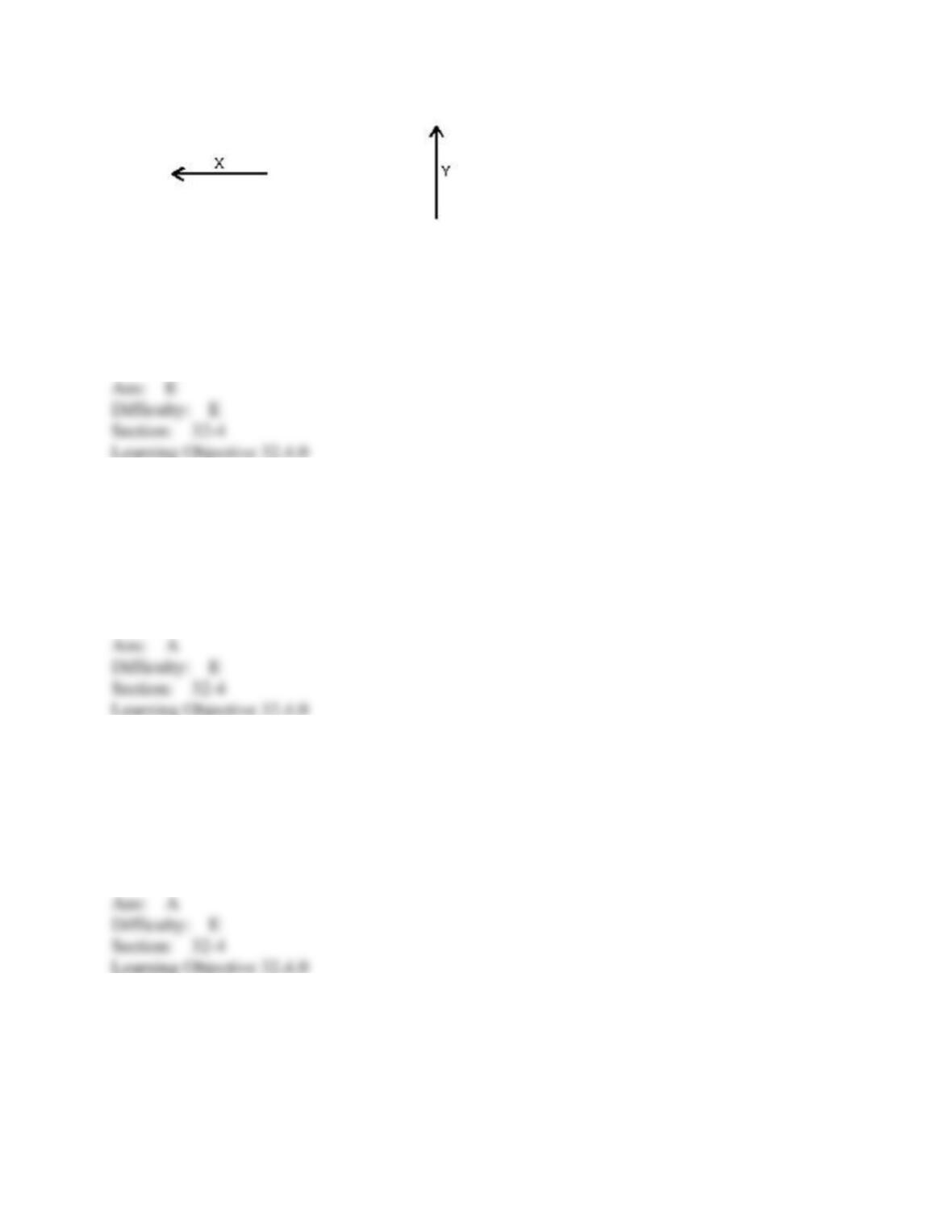
A) move toward X but not rotate
B) move away from X but not rotate
C) move toward X and rotate
D) move away from X and rotate
E) rotate but not move toward or away from X
51. The potential energy of a magnetic dipole in an external magnetic field is least when:
A) the dipole moment is parallel to the field
B) the dipole moment is antiparallel to the field
C) the dipole moment is perpendicular to the field
D) none of the above (the same energy is associated with all orientations)
E) none of the above (no energy is associated with the dipole-field interaction)
52. The magnetic field lines due to an ordinary bar magnet:
A) form closed curves
B) cross one another near the poles
C) are more numerous near the N pole than near the S pole
D) leave the S pole, loop around the outside of the magnet, and enter the N pole
E) none of the above
53. Which of the following statements about the Earth’s magnetic field is correct?
A) The Earth’s magnetic field is approximately that of a dipole, and the north magnetic pole is in
the northern hemisphere.
B) The Earth’s magnetic field is approximately that of a dipole, and the north magnetic pole is in
the southern hemisphere.
C) The Earth’s magnetic field is approximately that of a monopole, and the north magnetic pole
is in the northern hemisphere.
D) The Earth’s magnetic field is approximately that of a monopole, and the north magnetic pole
is in the southern hemisphere.
E) The Earth’s magnetic field is approximately that of a quadrupole, and the north magnetic pole
is in the eastern hemisphere.
54. Which of the following statements is correct?
A) The declination of the Earth’s magnetic field is the angle between a horizontal plane and the
direction of the field.
B) The declination of the Earth’s magnetic field is the angle between a vertical plane and the
direction of the field.
C) The inclination of the Earth’s magnetic field is the angle between a horizontal plane and the
direction of the field.
D) The inclination of the Earth’s magnetic field is the angle between the horizontal component
of the field direction and the direction to geographic north.
E) Inclination and declination mean the same thing.
55. An electron traveling with speed v around a circle of radius r is equivalent to a current of:
A) evr/2
B) ev/r
C) ev/2r
D) 2er/v
E) 2ev/r
56. The molecular theory of magnetism can explain each of the following EXCEPT:
A) a N pole attracts a S pole
B) stroking an iron bar with a magnet will magnetize the bar
C) when a bar magnet is broken in two, each piece is a bar magnet
D) heating tends to destroy magnetization
E) hammering tends to destroy magnetization
57. The magnetic properties of materials stem chiefly from:
A) particles with north poles
B) particles with south poles
C) motions of protons within nuclei
D) proton spin angular momentum
E) electron magnetic dipole moments
58. The spin magnetic dipole moment of an electron:
A) is in the same direction as the spin angular momentum
B) is zero
C) has a magnitude that depends on the orbital angular momentum
D) has a magnitude that depends on the applied magnetic field
E) none of the above
59. Which of the following statements is correct?
A) The spin angular momentum of the electron can be directly observed, but the spin magnetic
dipole moment cannot be.
B) The spin angular momentum of the electron cannot be directly observed, but the spin
magnetic dipole moment can be.
C) Both the spin angular momentum and the spin magnetic dipole moment of the electron can be
directly observed.
D) Neither the spin angular momentum nor the spin magnetic dipole moment of the electron can
be directly observed.
E) Although both the spin angular momentum and the spin magnetic dipole moment can be
defined theoretically, neither has any physical meaning at all.
60. What are the possible allowed values of the spin magnetic quantum number ms of the
electron?
A) +1/2 only
B) ±1/2
C) any half-odd integer
D) any integer
E) It depends on the external magnetic field.
61. If an electron has zero orbital angular momentum, the magnitude of its magnetic dipole
moment equals:
A) zero
B) half the Bohr magneton
C) a Bohr magneton
D) twice a Bohr magneton
E) none of these
62. The magnetic dipole moment of an atomic electron is typically:
A) much less than a Bohr magneton
B) a few Bohr magnetons
C) much greater than a Bohr magneton
D) much greater or much less than a Bohr magneton, depending on the atom
E) not related to the value of the Bohr magneton
63. The magnitude of the Bohr magneton is about:
A) 10–15 J/T
B) 10–19 J/T
C) 10–23 J/T
D) 10–27 J/T
E) 10–31 J/T
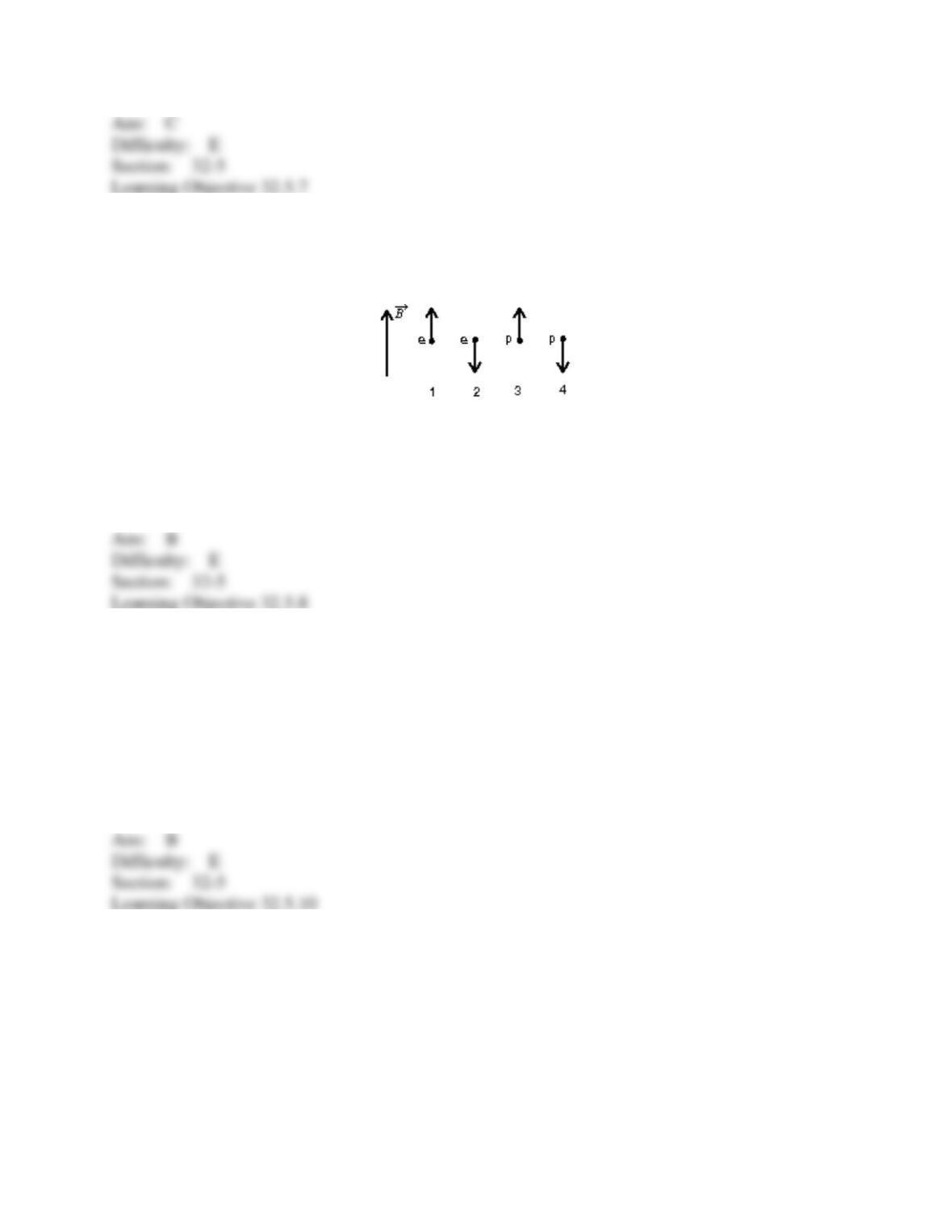
64. The diagram shows the spin angular momentum vectors of two electrons and two protons
in the same external magnetic field. The field points upward in the diagram. Rank the
situations according to the potential energy, least to greatest.
A) 1 and 3 tie, then 2 and 4 tie
B) 2 and 3 tie, then 1 and 4 tie
C) 1 and 2 tie, then 3 and 4 tie
D) 3 and 4 tie, then 1 and 2 tie
E) all tie
65. If 𝐿
⃗
is the orbital angular momentum of an electron, the magnetic dipole moment
associated with its orbital motion:
A) is in the direction of 𝐿
⃗
and has magnitude proportional to L
B) is opposite to the direction of 𝐿
⃗
and has magnitude proportional to L
C) is in the direction of 𝐿
⃗
and has magnitude proportional to L2
D) is opposite to the direction of 𝐿
⃗
and has magnitude proportional to L2
E) does not depend on 𝐿
⃗
66. If an electron has an orbital angular momentum with magnitude L the magnitude of the
orbital contribution to its magnetic dipole moment is given by:
A) eL/m
B) eL/2m
C) 2eL/m
D) mL/e
E) mL/2
67. The intrinsic magnetic dipole moments of protons and neutrons are much less than that of
an electron because:
A) their masses are greater
B) their angular momenta are much less
C) their angular momenta are much greater
D) their charges are much less
E) their radii are much less
68. What are the possible allowed values of the orbital magnetic quantum number mℓ of the
electron?
A) 0 only
B) 0, ±1 only
C) any half-odd integer
D) 0, ±1, ±2, …, up to the maximum value for that orbit
E) It depends on the external magnetic field.
69. An electron in a hydrogen atom moves in a circle of radius 1.1 x 10⁻¹⁰ m at a speed of about
1.6 x 10⁶ m/s. What is the magnetic dipole moment of this electron due to its orbital motion?
A) 9.3 x 10⁻²⁴ J/T
B) 1.4 x 10⁻²³ J/T
C) 1.9 x 10⁻²³ J/T
D) 2.8 x 10⁻²³ J/T
E) 3.5 x 10⁻²³ J/T
70. Lenz’ law can explain:
A) paramagnetism only
B) diamagnetism only
C) ferromagnetism only
D) only two of the three types of magnetism
E) all three of the types of magnetism
71. A magnetic field 𝐵
⃗
0 is applied to a diamagnetic substance. In the interior the magnetic
field produced by the magnetic dipoles of the substance is:
A) greater than 𝐵
⃗
0 and in the opposite direction
B) less than 𝐵
⃗
0 and in the opposite direction
C) greater than 𝐵
⃗
0 and in the same direction
D) less than 𝐵
⃗
0 and in the same direction
E) the same as 𝐵
⃗
0
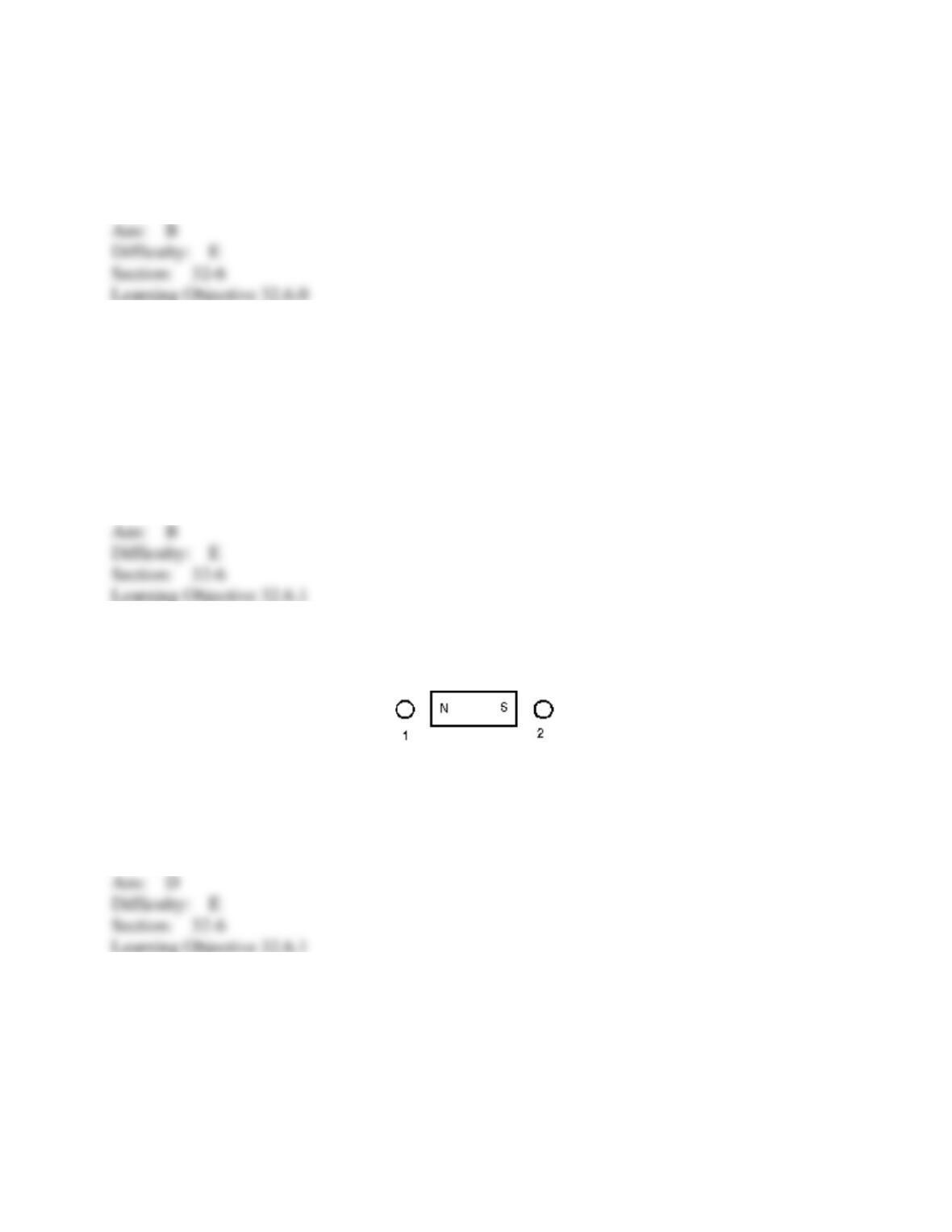
72. The diagram shows two small diamagnetic spheres, one near each end of a bar magnet.
Which of the following statements is true?
A) The force on 1 is toward the magnet and the force on 2 is away from the magnet
B) The force on 1 is away from the magnet and the force on 2 is away from the magnet
C) The forces on 1 and 2 are both toward the magnet
D) The forces on 1 and 2 are both away from the magnet
E) The magnet does not exert a force on either sphere
73. The units of magnetization are:
A) ampere
B) amperemeter
C) amperemeter2
D) ampere/meter
E) ampere/meter2
74. A paramagnetic substance, in an external magnetic field, is thermally isolated. The field is
then removed. As a result:
A) the magnetic energy of the magnetic dipoles decreases
B) the temperature of the substance increases
C) the magnetization decreases, but only slightly
D) the magnetization reverses direction
E) none of the above
75. Paramagnetism is closely associated with:
A) the tendency of electron dipole moments to align with an applied magnetic field
B) the tendency of electron dipole moments to align opposite to an applied magnetic field
C) the exchange force between electrons
D) the force exerted by electron dipole moments on each other
E) the torque exerted by electron dipole moments on each other
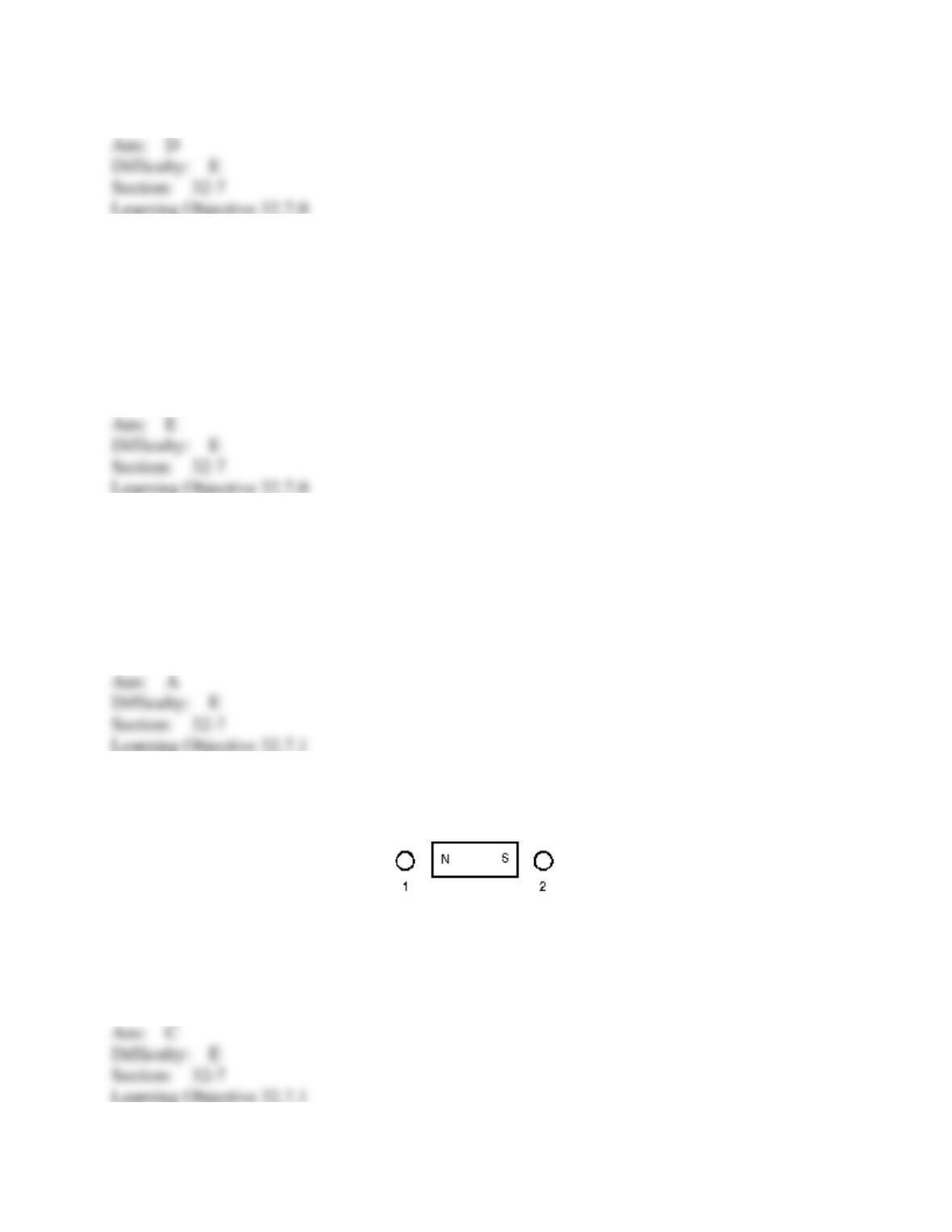
76. The diagram shows two small paramagnetic spheres, one near each end of a bar magnet.
Which of the following statements is true?
A) The force on 1 is toward the magnet and the force on 2 is away from the magnet
B) The force on 1 is away from the magnet and the force on 2 is away from the magnet
C) The forces on 1 and 2 are both toward the magnet
D) The forces on 1 and 2 are both away from the magnet
E) The magnet does not exert a force on either sphere
77. A magnetic field 𝐵
⃗
0 is applied to a paramagnetic substance. In the interior the magnetic
field produced by the magnetic dipoles of the substance is:
A) greater than 𝐵
⃗
0 and in the opposite direction
B) less than 𝐵
⃗
0 and in the opposite direction
C) greater than 𝐵
⃗
0 and in the same direction
D) less than 𝐵
⃗
0 and in the same direction
E) the same as 𝐵
⃗
0
78. Magnetization is:
A) the current density in an object
B) the charge density of moving charges in an object
C) the magnetic dipole moment of an object
D) the magnetic dipole moment per unit volume of an object
E) the magnetic field per unit volume produced by an object
79. A paramagnetic substance is placed in a weak magnetic field and its absolute temperature T
is increased. As a result, its magnetization:
A) increases in proportion to T
B) increases in proportion to T2
C) remains the same
D) decreases in proportion to 1/T
E) decreases in proportion to 1/T2
80. The soft iron core in the solenoid shown is removable. Then:
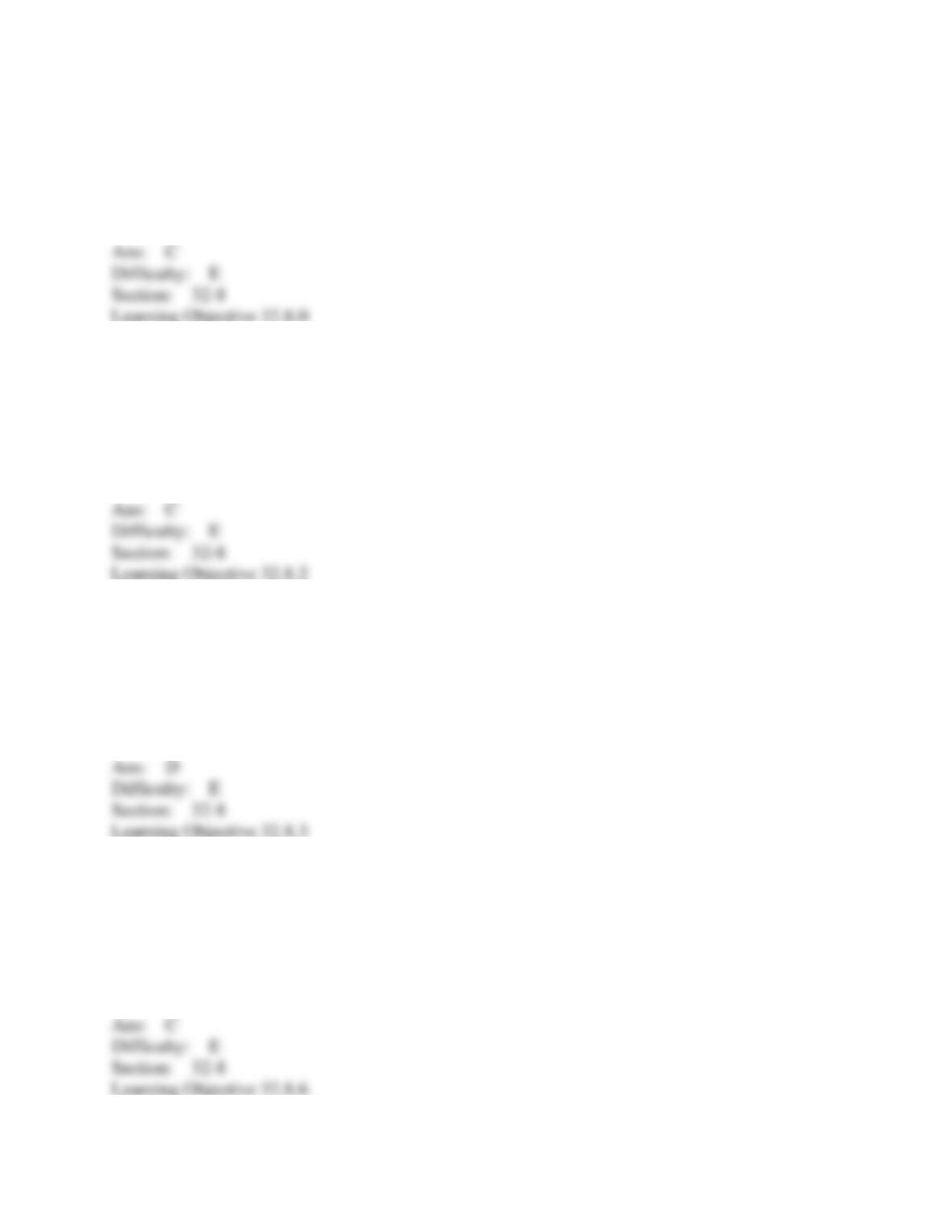
A) the current will be larger without the core
B) the current will be larger with the core
C) one must do work to remove the core
D) the circuit will do work in expelling the core
E) the stored energy is the same with or without the core
81. When a permanent magnet is strongly heated:
A) nothing happens
B) it becomes an induced magnet
C) it loses its magnetism
D) its magnetism increases
E) its polarity reverses
82. Ferromagnetism is closely associated with:
A) the tendency of electron dipole moments to align with an applied magnetic field
B) the tendency of electron dipole moments to align opposite to an applied magnetic field
C) the tendency of electron dipole moments to change magnitude in an applied magnetic field
D) the tendency of electron dipole moments to align with each other
E) the force exerted by electron dipole moments on each other
83. Magnetization vectors in neighboring ferromagnetic domains are:
A) always in opposite directions
B) always in the same direction
C) always in different directions
D) sometimes in different directions and sometimes in the same direction
E) sometimes in opposite directions and sometimes in the same direction
84. The behavior of ferromagnetic domains in an applied magnetic field gives rise to:
A) hysteresis
B) ferromagnetism
C) the Curie law
D) a lowering of the Curie temperature
E) Gauss’ law for magnetism
85. Because ferromagnets exhibit hysteresis, the magnetization:
A) can never be in the same direction as an applied field
B) may not vanish when an applied field is reduced to zero
C) can never vanish
D) is proportional to any applied magnetic field
E) is always opposite to the direction of any applied magnetic field
86. An unmagnetized steel bar is placed inside a solenoid. As the current in the solenoid is
slowly increased from zero to some large value, the magnetization of the bar:
A) increases proportionally with the current
B) remains zero for a while and then increases linearly with any further increase in current
C) increases with increasing current at first but later is much less affected by it
D) is unaffected by the current
E) increases quadratically with the current
87. Of the three chief kinds of magnetic materials (diamagnetic, paramagnetic, and
ferromagnetic) which are used to make permanent magnets?
A) only diamagnetic
B) only ferromagnetic
C) only paramagnetic
D) only paramagnetic and ferromagnetic
E) all three