Chapter: Chapter 34
Learning Objectives
LO 34.1.0 Solve problems related to images and plane mirrors.
LO 34.1.1 Distinguish virtual images from real images.
LO 34.1.2 Explain the common roadway mirage.
LO 34.1.3 Sketch a ray diagram for the reflection of a point source of light by a plane mirror,
indicating the object distance and image distance.
LO 34.1.4 Using the proper algebraic sign, relate the object distance p to the image distance i.
LO 34.1.5 Give an example of the apparent hallway that you can see in a mirror maze based on
equilateral triangles.
LO 34.2.0 Solve problems related to spherical mirrors.
LO 34.2.1 Distinguish a concave spherical mirror from a convex spherical mirror.
LO 34.2.2 For concave and convex mirrors, sketch a ray diagram for the reflection of light rays
that are initially parallel to the central axis, indicating how they form the focal points, and
identifying which is real and which is virtual.
LO 34.2.3 Distinguish a real focal point from a virtual focal point, identify which corresponds to
which type of mirror, and identify the algebraic sign associated with each focal length.
LO 34.2.4 Relate a focal length of a spherical mirror to the radius.
LO 34.2.5 Identify the terms “inside the focal point” and “outside the focal point.”
LO 34.2.6 For an object (a) inside and (b) outside the focal point of a concave mirror, sketch the
reflections of at least two rays to find the image and identify the type and orientation of the
image.
LO 34.2.7 For a concave mirror, distinguish the locations and orientations of a real image and a
virtual image.
LO 34.2.8 For an object in front of a convex mirror, sketch the reflections of at least two rays to
find the image and identify the type and orientation of the image.
LO 34.2.9 Identify which type of mirror can produce both real and virtual images and which type
can produce only virtual images.
LO 34.2.10 Identify the algebraic signs of the image distance i for real images and virtual
images.
LO 34.2.11 For convex, concave, and plane mirrors, apply the relationship between the focal
length f, object distance p, and image distance i.
LO 34.2.12 Apply the relationships between lateral magnification m, image height h′, object
height h, image distance i, and object distance p.
LO 34.3.0 Solve problems related to spherical refracting surface.
LO 34.3.1 Identify that the refraction of rays by a spherical surface can produce real images and
virtual images of an object, depending on the indexes of refraction on the two sides, the surface’s
radius of curvature r, and whether the object faces a concave or convex surface.
LO 34.3.2 For a point object on the central axis of spherical refracting surface, sketch the
refraction of a ray in the six general arrangements and identify if the image is real or virtual.
LO 34.3.3 For a spherical refracting surface, identify what type of image appears on the same
side as the object and what type appears on the opposite side.
LO 34.3.4 For a spherical refracting surface, apply the relationship between the two indexes of
refraction, the object distance p, the image distance i, and the radius of curvature r.
LO 34.3.5 Identify the algebraic signs of the radius r for an object facing a concave refracting
surface and a convex refracting surface.
LO 34.4.0 Solve problems related to thin lenses.
LO 34.4.1 Distinguish converging lenses from diverging lenses.
LO 34.4.2 For converging and diverging lenses, sketch a ray diagram for rays initially parallel
to the central axis, indicating how they form focal points, and identifying which is real and which
is virtual.
LO 34.4.3 Distinguish a real focal point from a virtual focal point, identify which corresponds
to which type of lens and under which circumstances, and identify the algebraic sign associated
with each focal length.
LO 34.4.4 For an object (a) inside and (b) outside the focal point of a converging lens, sketch at
least two rays to find the image and identify the type and orientation of the image.
LO 34.4.5 For a converging lens, distinguish the locations and orientations of a real image and
a virtual image.
LO 34.4.6 For an object in front of a diverging lens, sketch at least two rays to find the image
and identify the type and orientation of the image.
LO 34.4.7 Identify which type of lens can produce both real and virtual images and which type
can produce only virtual images.
LO 34.4.8 Identify the algebraic sign of the image distance i for a real image and for a virtual
image.
LO 34.4.9 For converging and diverging lenses, apply the relationship between the focal length
f, object distance p, and image distance i.
LO 34.4.10 Apply the relationships between lateral magnification m, image height h′, object
height h, image distance i, and object distance p.
LO 34.4.11 Apply the lens maker’s equation to relate a focal length to the index of refraction of
the lens (assumed to be in air) and the radii of curvature of the two sides of the lens.
LO 34.4.12 For a multiple-lens system with the object in front of lens 1, find the image
produced by lens 1 and then use it as the object for lens 2, and so on.
LO 34.4.13 For a multiple-lens system, determine the overall magnification (of the final
image) from the magnifications produced by each lens.
LO 34.5.0 Solve problems related to optical instruments.
LO 34.5.1 Identify the near point in vision.
LO 34.5.2 With sketches, explain the function of a simple magnifying lens.
LO 34.5.3 Identify angular magnification.
LO 34.5.4 Determine the angular magnification for an object at the focal point of a simple
magnifying lens.
LO 34.5.5 With a sketch, explain a compound microscope.
LO 34.5.6 Identify that the overall magnification of a compound microscope is due to the lateral
magnification by the objective and the angular magnification by the eye piece.
LO 34.5.7 Calculate the overall magnification of a compound microscope.
LO 34.5.8 With a sketch, explain a refracting telescope.
LO 34.5.9 Calculate the angular magnification of a refracting telescope.
Multiple Choice
1. A card marked IAHIO8 is standing upright in front of a plane mirror. Which of the
following is NOT true?
A) The image is virtual
B) The image shifts its position as the observer shifts his position
C) The image appears as 8OIHAI to a person looking in the mirror
D) The image is caused mostly by specular rather than diffuse reflection
E) The image is the same size as the object
2. The angle between a horizontal ruler and a vertical plane mirror is 30. The angle between
the ruler and its image is:
A) 15
B) 30
C) 60
D) 90
E) 180
3. A 5.0-ft woman wishes to see a full length image of herself in a plane mirror. The minimum
length mirror required is:
A) 2.5 ft
B) 3.54 ft
C) 5.0 ft
D) 10 ft
E) no single answer: the farther away she stands the smaller the required mirror length
4. A man holds a rectangular card in front of and parallel to a plane mirror. In order for him to
see the entire image of the card, the least mirror area needed is:
A) that of the whole mirror, regardless of its size
B) that of the pupil of his eye
C) one-half that of the card
D) one-fourth that of the card
E) an amount which decreases with his distance from the mirror
5. A light bulb burns in front of the center of a 40-cm wide mirror that is hung vertically on a
wall. A man walks in front of the mirror along a line that is parallel to the mirror and twice as far
from it as the bulb. The greatest distance he can walk and see the image of the bulb at all times
is:
A) 20 cm
B) 40 cm
C) 60 cm
D) 80 cm
E) 120 cm
6. A plane mirror is in a vertical plane and is rotating about a vertical axis at 100 rpm. A
horizontal beam of light is incident on the mirror. The reflected beam will rotate at:
A) 0 rpm
B) 100 rpm
C) 141 rpm
D) 200 rpm
E) 10,000 rpm
7. Two plane mirrors make an angle of 120 with each other. The maximum number of images
of an object placed between them is:
A) one
B) two
C) three
D) four
E) more than four
8. A virtual image is one:
A) toward which light rays converge but do not pass through
B) from which light rays diverge but do not pass through
C) from which light rays diverge as they pass through
D) toward which light rays converge and pass through
E) with a ray normal to a mirror passing through it
9. Which of the following is true of all virtual images?
A) They can be seen but not photographed
B) They appear only briefly
C) They are smaller than the objects
D) They are larger than the objects
E) None of the above
10. The term “virtual” as applied to an image made by a mirror means that the image:
A) is on the mirror surface
B) cannot be photographed by a camera
C) is in front of the mirror
D) is the same size as the object
E) cannot be shown directly on a screen
11. When you stand in front of a plane mirror, your image is:
A) real, erect, and smaller than you
B) real, erect, and the same size as you
C) virtual, erect, and smaller than you
D) virtual, erect, and the same size as you
E) real, inverted, and the same size as you
12. An object is 2 m in front of a plane mirror. Its image is:
A) virtual, inverted, and 2 m behind the mirror
B) virtual, inverted, and 2 m in front of the mirror
C) virtual, erect, and 2 m in front of the mirror
D) real, erect, and 2 m behind the mirror
E) none of the above
13. Roadway mirages are formed when:
A) the warm air above the hood of your car bends light from the sky, making the road appear wet
B) a layer of cold air above the road bends light from the sky, making it look like there is a
puddle on the road
C) a layer of warm air above the road bends light from the sky, making it look like there is a
puddle on the road
D) a layer of cold air above the road bends light from the road so it looks wet when it is actually
dry
E) a layer of warm air above the road bends light from the road so it looks wet when it is actually
dry
14. A ball is held 50 cm in front of a plane mirror. The distance between the ball and its image
is:
A) 0 cm
B) 50 cm
C) 100 cm
D) 150 cm
E) 200 cm
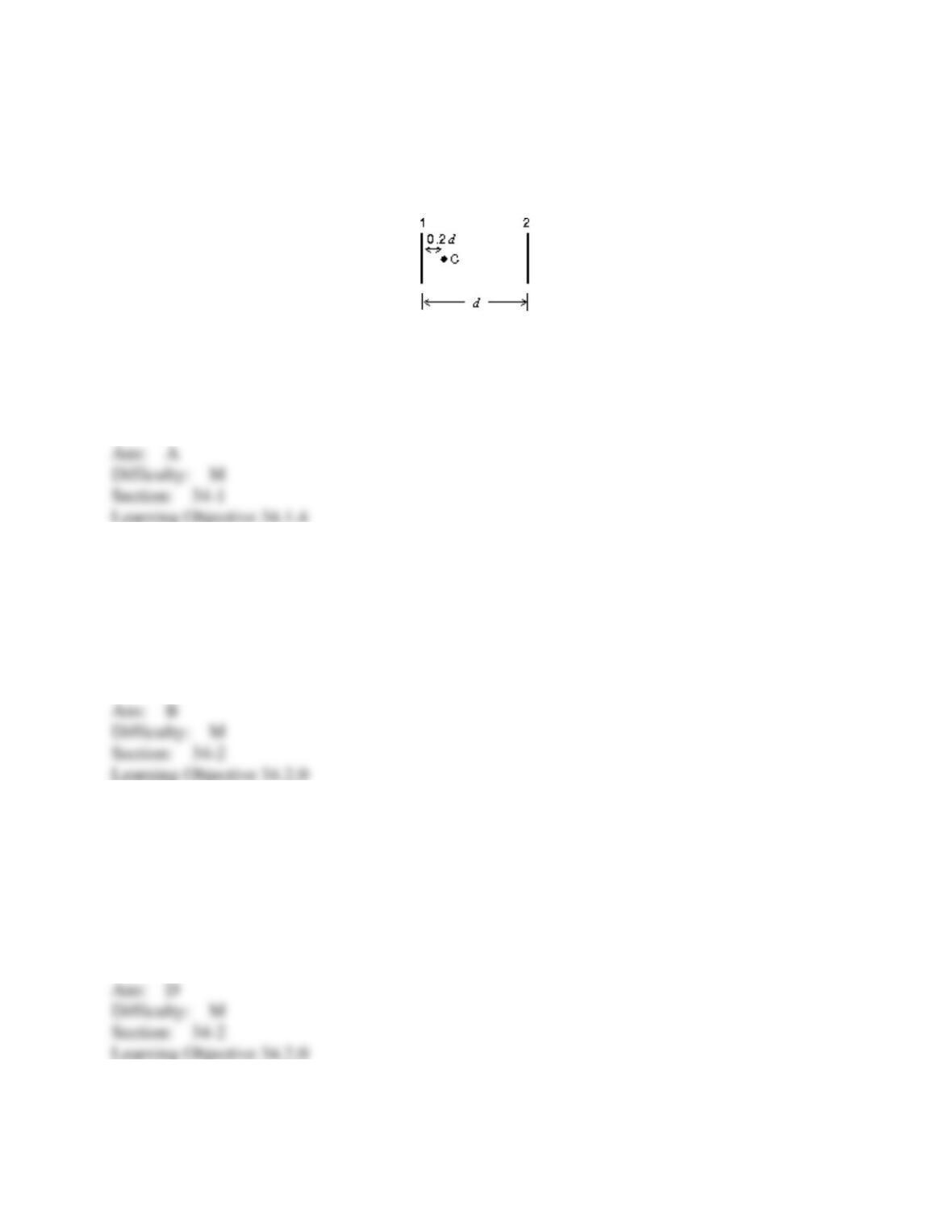
15. A candle C sits between two parallel mirrors, a distance 0.2d from mirror 1. Here d is the
distance between the mirrors. Multiple images of the candle appear in both mirrors. How far
behind mirror 1 are the nearest three images of the candle in that mirror?
A) 0.2d, 1.8d, 2.2d
B) 0.2d, 2.2d, 4.2d
C) 0.2d, 1.8d, 3.8d
D) 0.2d, 0.8d, 1.4d
E) 0.2d, 1.8d, 3.4d
16. The image produced by a convex mirror of an erect object in front of the mirror is always:
A) virtual, erect, and larger than the object
B) virtual, erect, and smaller than the object
C) real, erect, and larger than the object
D) real, erect, and smaller than the object
E) none of the above
17. An erect object is in front of a convex mirror a distance greater than the focal length. The
image is:
A) real, inverted, and smaller than the object
B) virtual, inverted, and larger than the object
C) real, inverted, and larger than the object
D) virtual, erect, and smaller than the object
E) real, erect, and larger than the object
18. A point source is to be used with a concave mirror to produce a beam of parallel light. The
source should be placed:
A) as close to the mirror as possible
B) at the center of curvature
C) midway between the center of curvature and the focal point
D) midway between the center of curvature and the mirror
E) midway between the focal point and the mirror
19. The passenger-side rear view mirror on a car says, “Objects in the mirror may be closer than
they appear”. Assuming the images are not inverted, this mirror must be:
A) concave
B) plane
C) convex
D) mounted on the wrong side of the car
E) confused, as objects cannot be closer than they appear
20. Real images formed by a spherical mirror are always:
A) on the side of the mirror opposite the object
B) on the same side of the mirror as the object but closer to the mirror than the object
C) on the same side of the mirror as the object but closer to the mirror than the focal point
D) on the same side of the mirror as the object but further from the mirror than the focal point
E) none of the above
21. The focal length of a spherical mirror is N times its radius of curvature where N is:
A) 1/4
B) 1/2
C) 1
D) 2
E) 4
22. An erect object is located between a concave mirror and its focal point. Its image is:
A) real, erect, and larger than the object
B) real, inverted, and larger than the object
C) virtual, erect, and larger than the object
D) virtual, inverted, and larger than the object
E) virtual, erect, and smaller than the object
23. As an object is moved from the center of curvature of a concave mirror toward its focal
point its image:
A) remains virtual and becomes larger
B) remains virtual and becomes smaller
C) remains real and becomes larger
D) remains real and becomes smaller
E) remains real and approaches the same size as the object
24. As an object is moved from a distant location toward the center of curvature of a concave
mirror its image:
A) remains virtual and becomes smaller
B) remains virtual and becomes larger
C) remains real and becomes smaller
D) remains real and becomes larger
E) changes from real to virtual
25. The image of an erect candle, formed using a convex mirror, is always:
A) virtual, inverted, and smaller than the candle
B) virtual, inverted, and larger than the candle
C) virtual, erect, and larger than the candle
D) virtual, erect, and smaller than the candle
E) real, erect, and smaller than the candle
26. If the image distance is negative,
A) the image is real.
B) the image is virtual.
C) the mirror is concave.
D) you have made a mistake; image distances must be positive.
E) the object distance must also be negative.
27. A man stands with his nose 8 cm from a concave shaving mirror of radius 32 cm. The
distance from the mirror to the image of his nose is:
A) 8 cm
B) 12 cm
C) 16 cm
D) 24 cm
E) 32 cm
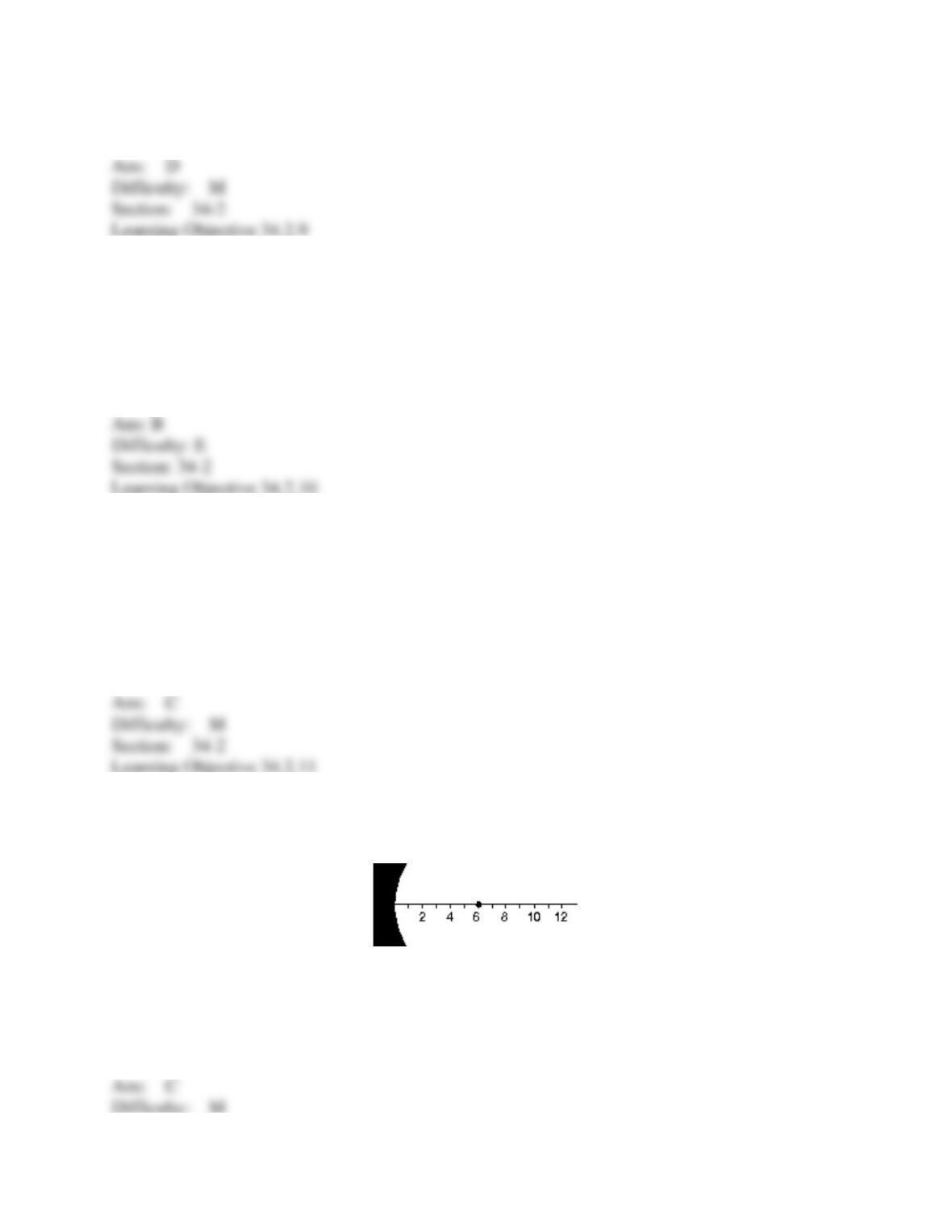
28. The figure shows a concave mirror with a small object located at the point marked 6. If the
image is also at this point, then the center of curvature of the mirror is at the point marked:
A) 3
B) 4
C) 6
D) 9
E) 12
29. A concave spherical mirror has a focal length of 12 cm. If an object is placed 6 cm in front
of it the image position is:
A) 4 cm behind the mirror
B) 4 cm in front of the mirror
C) 12 cm behind the mirror
D) 12 cm in front of the mirror
E) at infinity
30. A concave spherical mirror has a focal length of 12 cm. If an object is placed 18 cm in
front of it the image position is:
A) 7.2 cm behind the mirror
B) 7.2 cm in front of the mirror
C) 36 cm behind the mirror
D) 36 cm in front of the mirror
E) at infinity
31. A convex spherical mirror has a focal length of 12 cm. If an object is placed 6 cm in front
of it the image position is:
A) 4 cm behind the mirror
B) 4 cm in front of the mirror
C) 12 cm behind the mirror
D) 12 cm in front of the mirror
E) at infinity
32. A concave spherical mirror has a focal length of 12 cm. If an erect object is placed 6 cm in
front of it:
A) the magnification is 2 and the image is erect
B) the magnification is 2 and the image is inverted
C) the magnification is 0.67 and the image is erect
D) the magnification is 0.67 and the image is inverted
E) the magnification is 0.5 and the image is erect
33. An erect object is located on the central axis of a spherical mirror. The magnification is
–3. This means its image is:
A) real, inverted, and on the same side of the mirror
B) virtual, erect, and on the opposite side of the mirror
C) real, erect, and on the same side of the mirror
D) real, inverted, and on the opposite side of the mirror
E) virtual, inverted, and on the opposite side of the mirror
34. At what distance in front of a concave mirror must an object be placed so that the image
and object are the same size?
A) one focal length
B) half the focal length
C) twice the focal length
D) less than half the focal length
E) more than twice the focal length
35. A concave mirror forms a real image which is twice the size of the object. If the object is
20 cm from the mirror, the radius of curvature of the mirror must be about:
A) 13 cm
B) 20 cm
C) 27 cm
D) 40 cm
E) 80 cm
36. A parallel beam of monochromatic light in air is incident on a plane glass surface. In the
glass, the beam:
A) remains parallel
B) undergoes dispersion
C) becomes diverging
D) follows a parabolic path
E) becomes converging
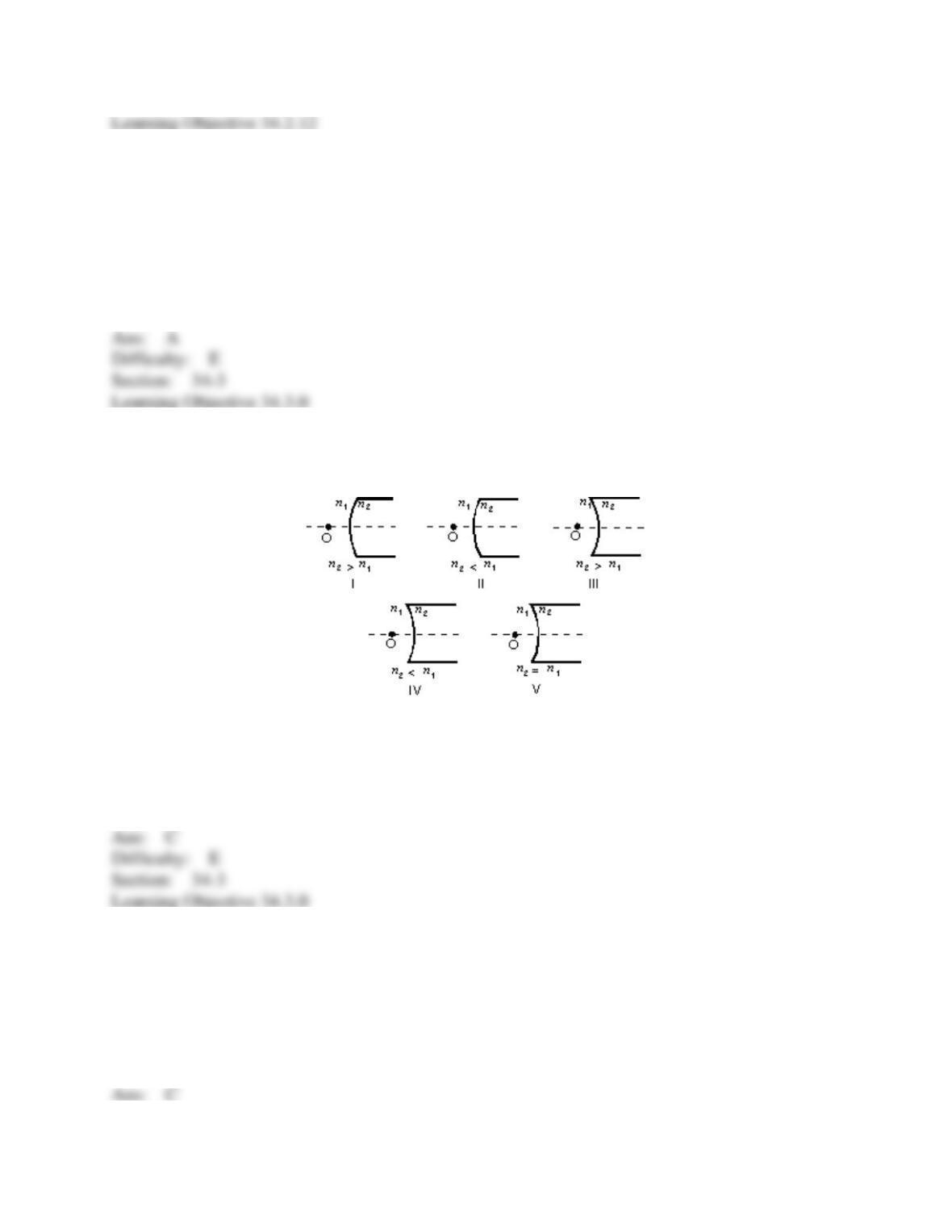
37. An object O, in air, is in front of the concave spherical refracting surface of a piece of
glass. Which of the general situations depicted below is like this situation?
A) I
B) II
C) III
D) IV
E) V
38. A concave refracting surface is one with a center of curvature:
A) to the left of the surface
B) to the right of the surface
C) on the side of the incident light
D) on the side of the refracted light
E) on the side with the higher index of refraction