A) 300 N
B) 520 N
C) 690 N
D) 1200 N
E) none of these
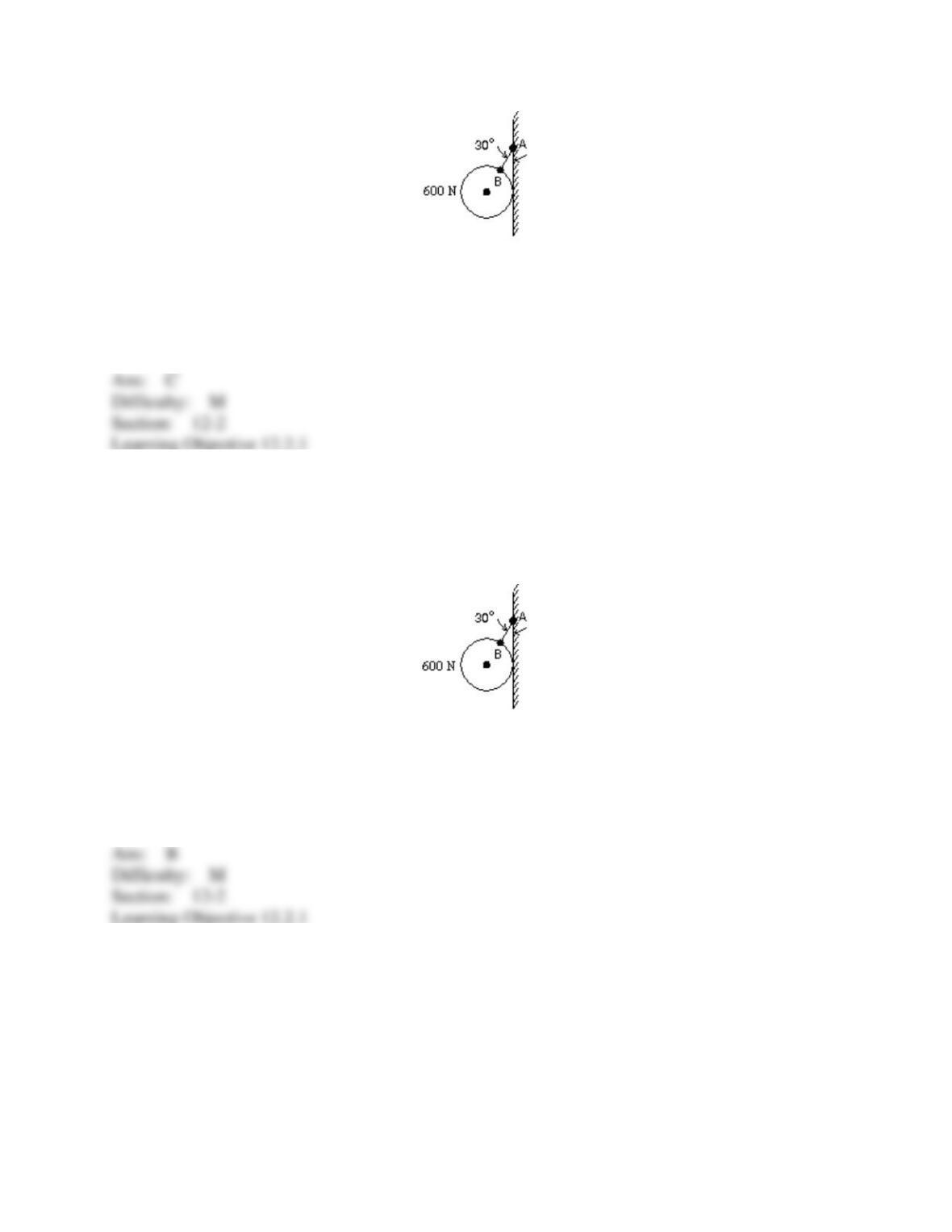
32. The 600-N ball shown is suspended on a string AB and rests against the frictionless vertical
wall. The string makes an angle of 30 with the wall. The line AB goes through the center of the
ball, and the contact point with the wall is at the same vertical height as the center of the ball.
The ball presses against the wall with a force of magnitude:
A) 300 N
B) 350 N
C) 520 N
D) 600 N
E) 690 N
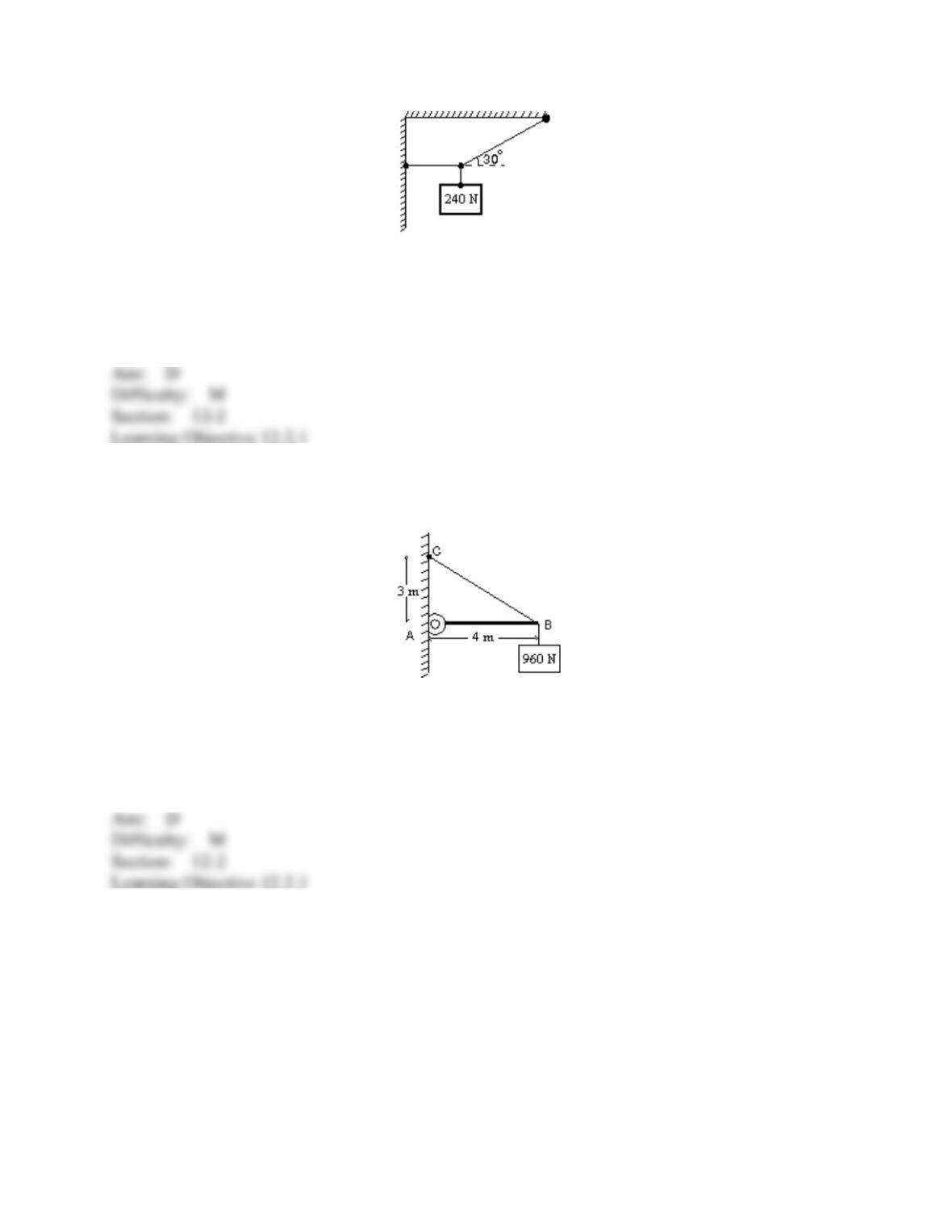
33. A 240-N weight is hung from two ropes as shown. The tension in the horizontal rope has
magnitude:
A) 0 N
B) 660 N
C) 480 N
D) 420 N
E) 140 N
34. A 960-N block is suspended as shown. The beam AB is weightless and is hinged to the
wall at A. The tension force of the cable BC has magnitude:
A) 720 N
B) 1200 N
C) 1280 N
D) 1600 N
E) none of these
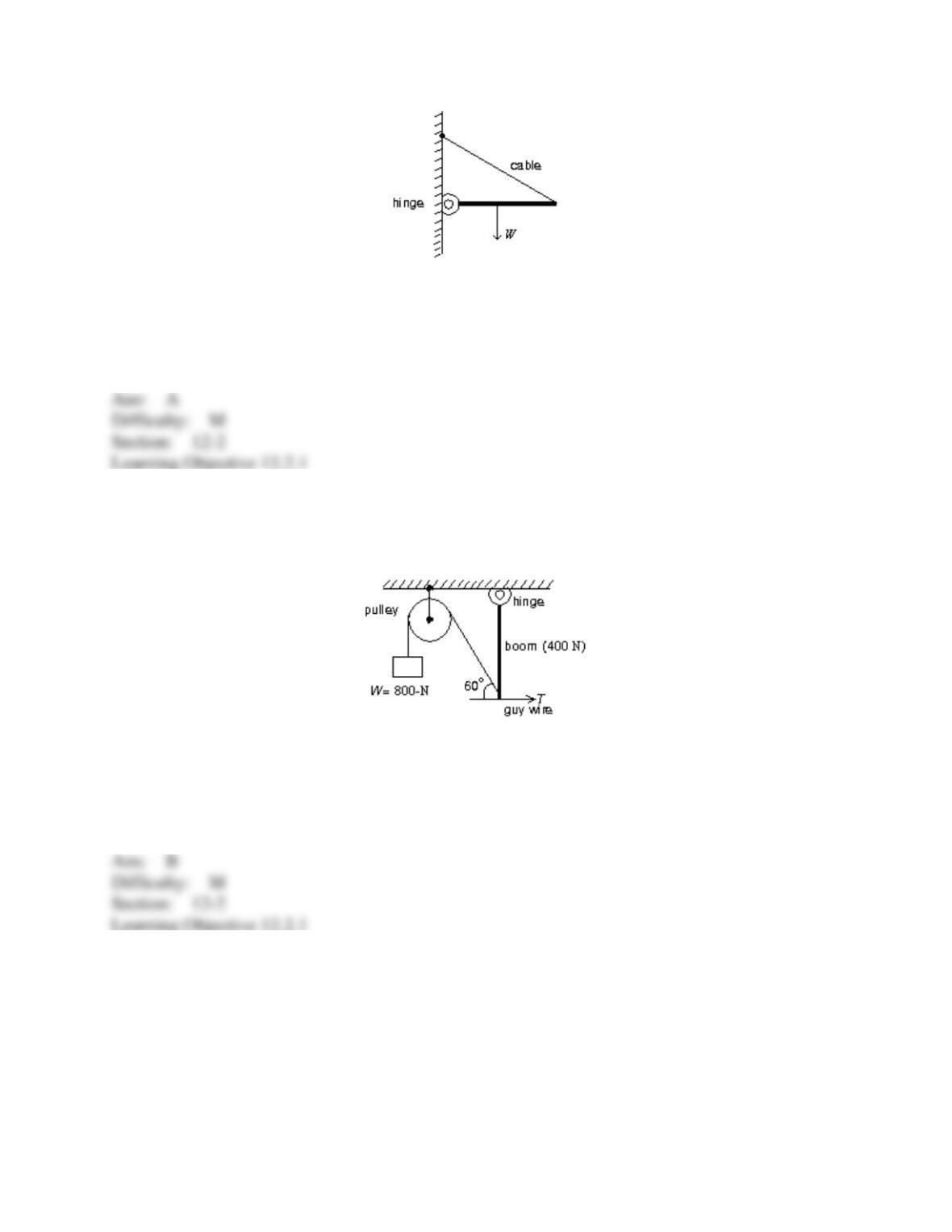
35. A horizontal beam of weight W is supported by a hinge and cable as shown. The force
exerted on the beam by the hinge has a vertical component that must be:
A) nonzero and up
B) nonzero and down
C) nonzero but not enough information given to know whether up or down
D) zero
E) equal to W
36. A 400-N uniform vertical boom is attached to the ceiling by a hinge, as shown. An 800-N
weight W and a horizontal guy wire are attached to the lower end of the boom as indicated. The
pulley is massless and frictionless. The tension force T of the horizontal guy wire has magnitude:
A) 350 N
B) 400 N
C) 690 N
D) 800 N
E) 1200 N
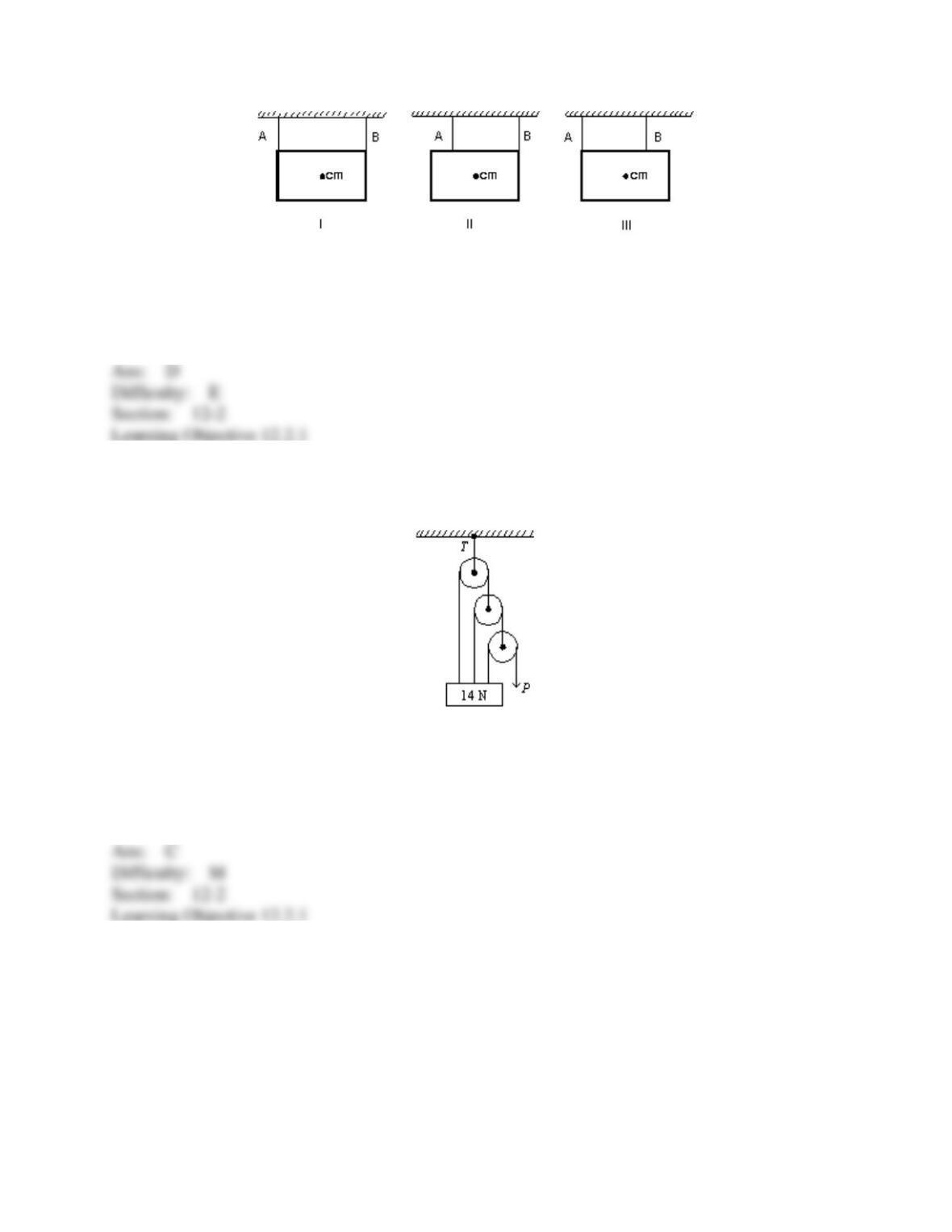
37. A picture is to be hung from the ceiling by means of two wires. Order the following
arrangements of the wires according to the tension in wire B, from least to greatest.
A) I, II, III
B) III, I, II
C) I and II tie, then III
D) II, I, III
E) all tie
38. The pull P is just sufficient to keep the 14-N block and the weightless pulleys in
equilibrium as shown. The tension T in the upper cable is:
A) 14 N
B) 28 N
C) 16 N
D) 9.3 N
E) 19 N
39. The ideal mechanical advantage (i.e. the ratio of the weight W to the pull P for equilibrium)
of the combination of pulleys shown is:
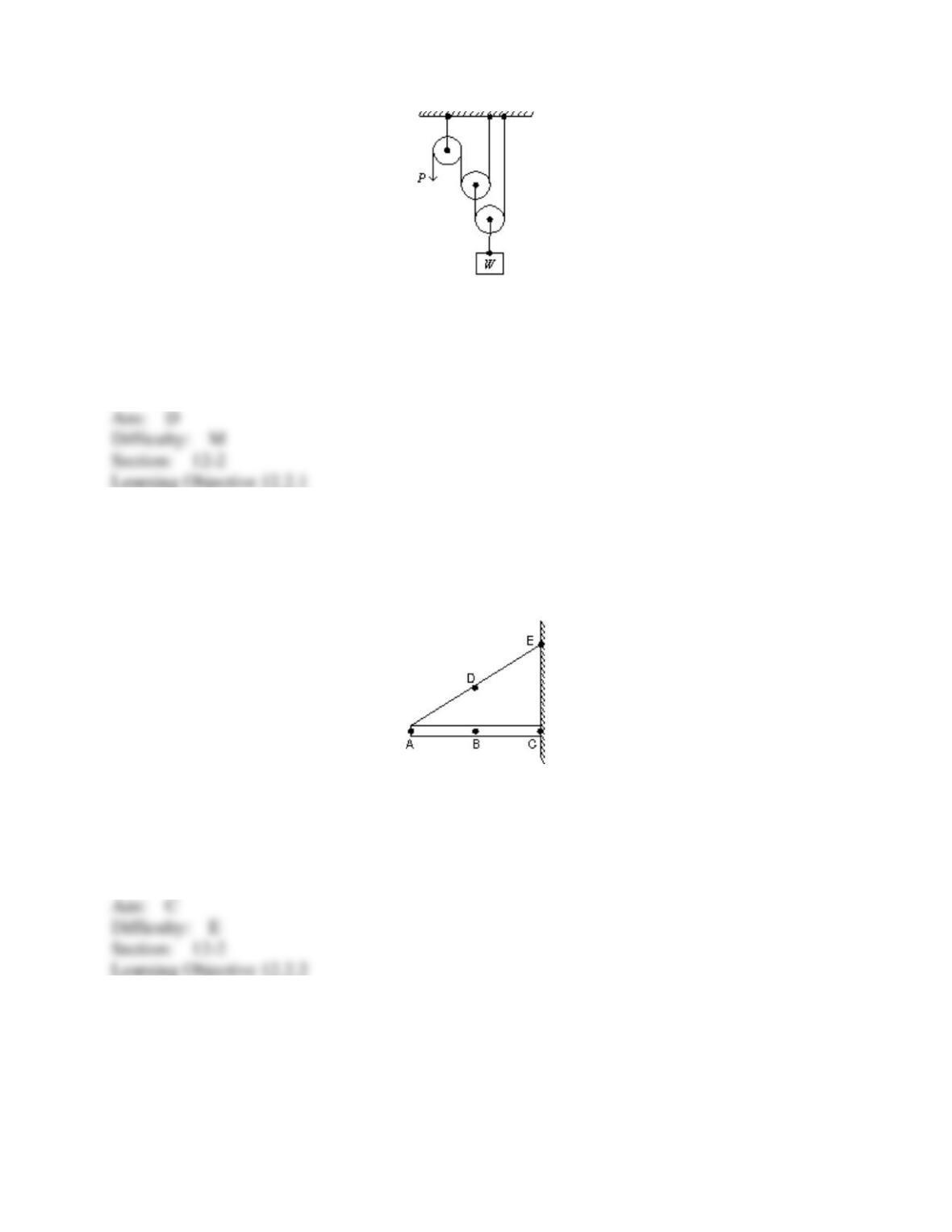
A) 1
B) 2
C) 3
D) 4
E) 5
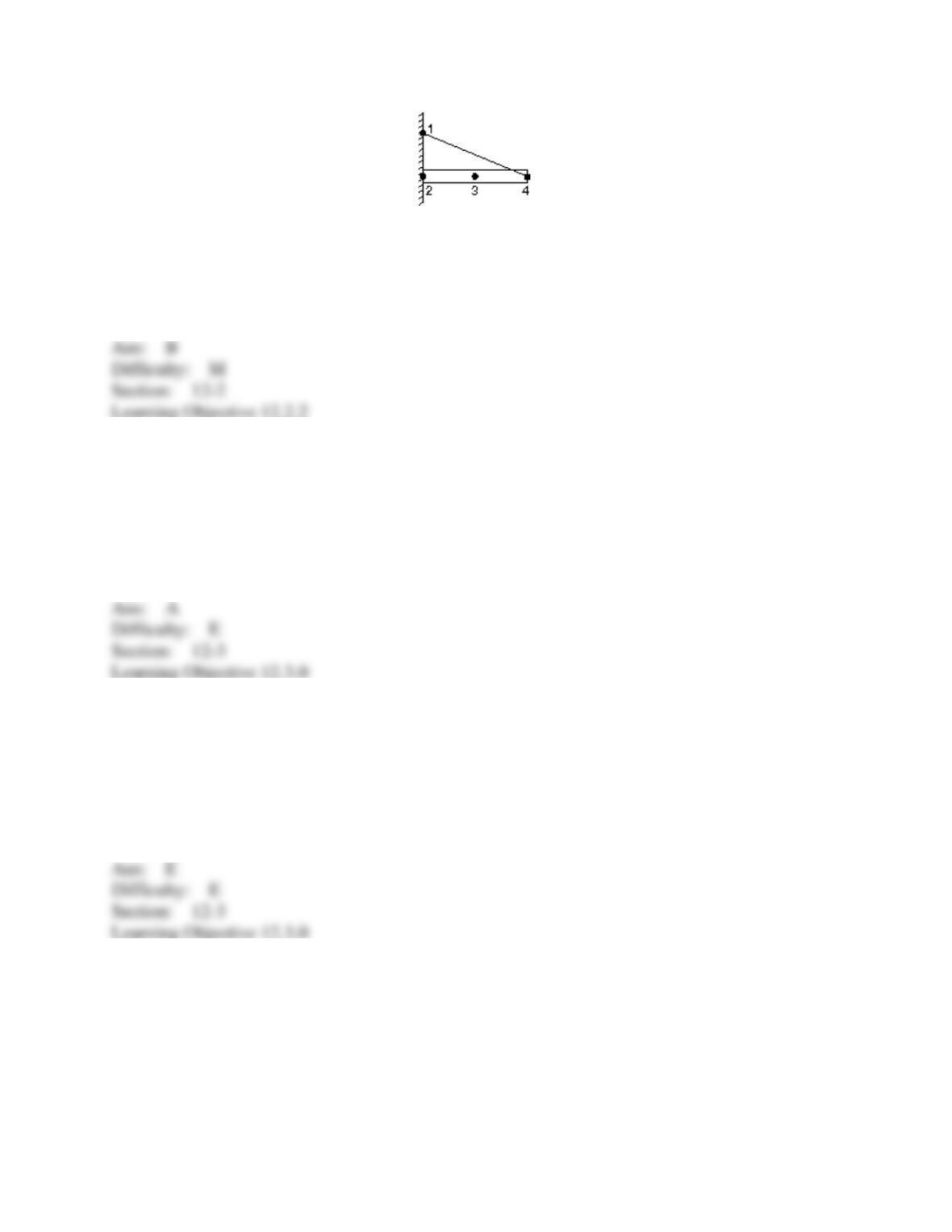
40. The diagram shows a stationary 5-kg uniform rod (AC), 1 m long, held against a wall by a
rope (AE) and friction between the rod and the wall. To use a single equation to find the force
exerted on the rod by the rope at which point should you place the reference point for computing
torque?
A) A
B) B
C) C
D) D
E) E
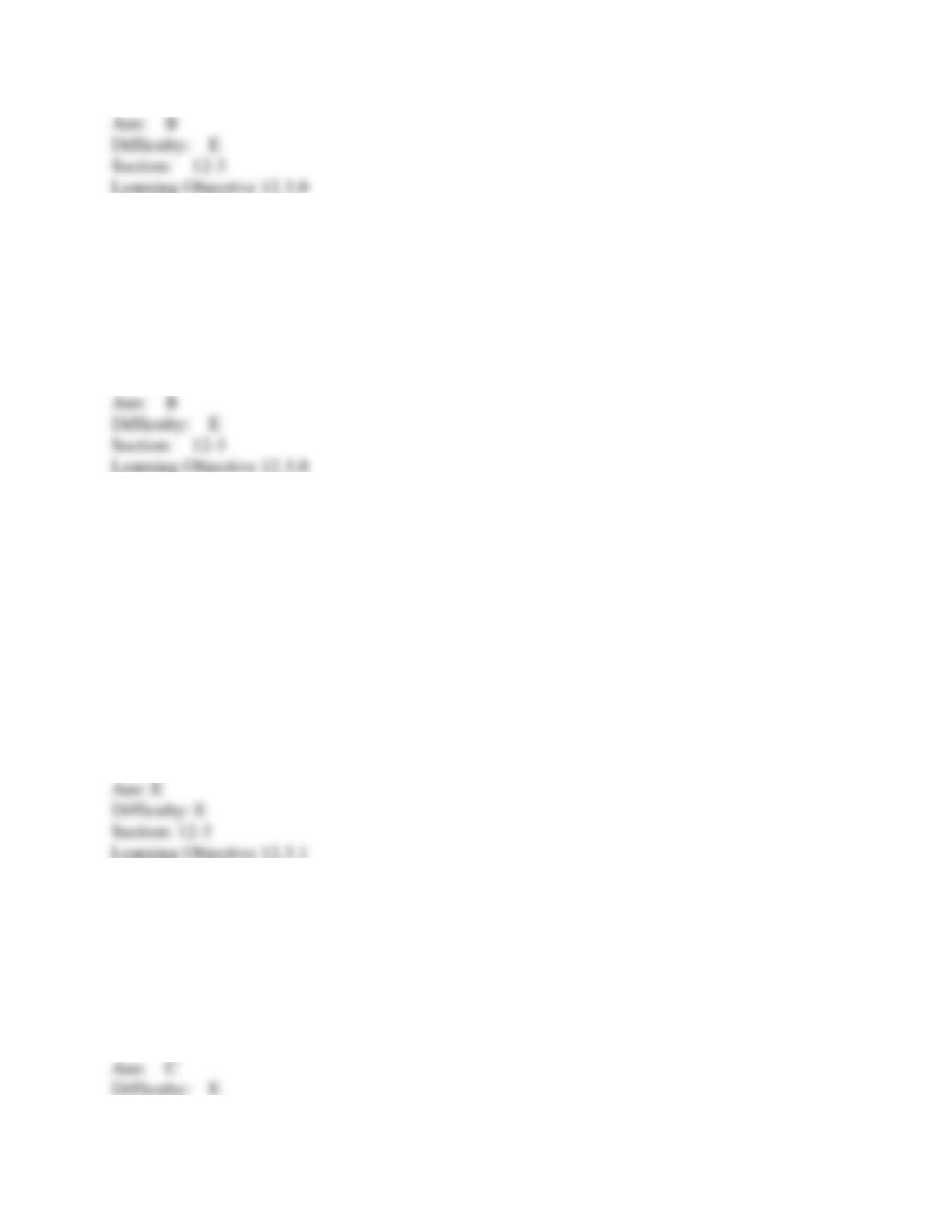
41. The uniform rod shown below is held in place by the rope and wall. Suppose you know the
weight of the rod and all dimensions. Then you can solve a single equation for the force exerted
by the rope, provided you write expressions for the torques about the point:
A) 1
B) 2
C) 3
D) 4
E) 1, 2, or 3
42. Stress can be measured in:
A) N/m2
B) Nm2
C) N/m
D) Nm
E) none of these (it is dimensionless)
43. Strain can be measured in:
A) N/m2
B) Nm2
C) N/m
D) Nm
E) none of these (it is dimensionless)
44. Young’s modulus can be correctly given in:
A) Nm
B) Nm2
C) Nm/s
D) N/m
E) joules
45. To shear a cube-shaped object, forces of equal magnitude and opposite directions might be
applied:
A) to opposite faces, perpendicular to the faces
B) to opposite faces, parallel to the faces
C) to adjacent faces, perpendicular to the faces
D) to adjacent faces, neither parallel nor perpendicular to the faces
E) to a single face, in any direction
46. If you sit on an ordinary 4-legged chair, which of the following is true?
A) As long as you know your weight and the point at which it acts on the chair, you can calculate
the forces exerted by all four chair legs on the floor.
B) As long as you know your weight and the point at which it acts on the chair, you can calculate
the forces exerted by all four chair legs on the floor, but only if your own feet are not also on the
floor.
C) This is an indeterminate situation, and the forces of the chair legs on the floor cannot be
uniquely calculated.
D) This is an indeterminate situation, and the forces of the chair legs on the floor cannot be
uniquely calculated without knowing how your weight is distributed on the chair.
E) This is an indeterminate situation, and the forces of the chair legs on the floor cannot be
uniquely calculated without knowing how the chair deforms due to your weight.
47. Young’s modulus is a proportionality constant that relates the force per unit area applied
perpendicularly at the surface of an object to:
A) the shear
B) the fractional change in volume
C) the fractional change in length
D) the pressure
E) the spring constant
48. A certain wire stretches 0.90 cm when outward forces with magnitude F are applied to each
end. The same forces are applied to a wire of the same material but with three times the diameter
and three times the length. The second wire stretches:
A) 0.10 cm
B) 0.30 cm
C) 0.90 cm
D) 2.7 cm
E) 8.1 cm
49. A force of 5000 N is applied outwardly to each end of a 5.0-m long rod with a radius of
34.0 mm and a Young’s modulus of 125 108 N/m2. The elongation of the rod is:
A) 0.022 mm
B) 0.0040 mm
C) 0.11 mm
D) 0.55 mm
E) 1.42 mm
50. A 4.0 m steel beam with a cross sectional area of 1.0 10–2 m2 and a Young’s modulus of
2.0 1011 N/m2 is wedged horizontally between two vertical walls. In order to wedge the beam,
it is compressed by 0.020 mm. If the coefficient of static friction between the beam and the walls
is 0.35, the maximum mass (including its own) it can bear without slipping is:
A) 0 kg
B) 36 kg
C) 70 kg
D) 360 kg
E) 700 kg
51. Two supports, made of the same material and initially of equal length, are 2.0 m apart. A
stiff board with a length of 4.0 m and a mass of 10 kg is placed on the supports, with one support
at the left end and the other at the midpoint. A block is placed on the board a distance of 0.50 m
from left end. As a result the board is horizontal (that is, the downward force on each support is
the same). The mass of the block is:
A) 0 kg
B) 2.3 kg
C) 6.6 kg
D) 10 kg
E) 20 kg
52. Young’s modulus can be used to calculate the strain for a stress that is:
A) just below the ultimate strength
B) just above the ultimate strength
C) well below the yield strength
D) well above the yield strength
E) none of the above
53. The ultimate strength of a sample is the stress at which the sample:
A) returns to its original shape when the stress is removed
B) remains underwater
C) breaks
D) bends 180
E) does none of these
54. A shearing force of 50 N is applied to an aluminum rod with a length of 10 m, a
cross-sectional area of 1.0 10−5 m, and shear modulus of 2.5 1010 N/m2. As a result the rod is
sheared through a distance of:
A) zero
B) 2.0 mm
C) 2.0 cm
D) 20 cm
E) 2.0 m
55. The bulk modulus is a proportionality constant that relates the pressure acting on an object
to:
A) the shear
B) the fractional change in volume
C) the fractional change in length
D) Young’s modulus
E) the spring constant
56. A cube with edges exactly 2 cm long is made of material with a bulk modulus of 3.5 109
N/m2. When it is subjected to a pressure of 3.0 105 Pa its volume is:
A) 7.31 cm3
B) 7.99931 cm3
C) 8.00069 cm3
D) 8.69 cm3
E) none of these
57. A cube with 2.0-cm sides is made of material with a bulk modulus of 4.7 105 N/m2.
When it is subjected to a pressure of 2.0 105 Pa the length in cm of its any of its any of its sides
is:
A) 0.85 cm
B) 1.15 cm
C) 1.66 cm
D) 2.0 cm
E) none of these