Chapter: Chapter 14
Learning Objectives
LO 14.1.0 Solve problems related to fluid, density, and pressure
LO 14.1.1 Distinguish fluids from solids.
LO 14.1.2 When mass is uniformly distributed, relate density to mass and volume.
LO 14.1.3 Apply the relationship between hydrostatic pressure, force, and the surface area over
which that force acts.
LO 14.2.0 Solve problems related to fluids at rest.
LO 14.2.1 Apply the relationship between the hydrostatic pressure, fluid density, and the height
above or below a reference level.
LO 14.2.2 Distinguish between total pressure (absolute pressure) and gauge pressure.
LO 14.3.0 Solve problems related to measuring pressure.
LO 14.3.1 Describe how a barometer can measure atmospheric pressure.
LO 14.3.2 Describe how an open-tube manometer can measure the gauge pressure of a gas.
LO 14.4.0 Solve problems related to Pascal’s principle.
LO 14.4.1 Identify Pascal’s principle.
LO 14.4.2 For a hydraulic lift, apply the relationship between the input area and displacement
and the output area and displacement.
LO 14.5.0 Solve problems related to Archimedes’ principle.
LO 14.5.1 Describe Archimedes’ principle.
LO 14.5.2 Apply the relationship between the buoyant force on a body and the mass of the
fluid displaced by the body.
LO 14.5.3 For a floating body, relate the buoyant force to the gravitational force.
LO 14.5.4 For a floating body, relate the gravitational force to the mass of the fluid displaced
by the body.
LO 14.5.5 Distinguish between apparent weight and actual weight.
LO 14.5.6 Calculate the apparent weight of a body that is fully or partially submerged.
LO 14.6.0 Solve problems related to the equation of continuity.
LO 14.6.1 Describe steady flow, incompressible flow, nonviscous flow, and irrotational flow.
LO 14.6.2 Explain the term streamline.
LO 14.6.3 Apply the equation of continuity to relate the cross-sectional area and flow speed at
one point in a tube to those quantities at a different point.
LO 14.6.4 Identify and calculate volume flow rate.
LO 14.6.5 Identify and calculate mass flow rate.
LO 14.7.0 Solve problems related to Bernoulli’s equation.
LO 14.7.1 Calculate the kinetic energy density in terms of a fluid’s density and flow speed.
LO 14.7.2 Identify the fluid pressure as being a type of energy density.
LO 14.7.3 Calculate the gravitational potential energy density.
LO 14.7.4 Apply Bernoulli’s equation to relate the total energy density at one point on a
streamline to the value at another point.
LO 14.7.5 Identify that Bernoulli’s equation is a statement of the conservation of energy.
Multiple Choice
1. Gases may be distinguished from other forms of matter by their:
A) lack of color
B) small atomic weights
C) inability to form free surfaces
D) ability to flow
E) ability to exert a buoyant force
2. 1 Pa is:
A) 1 N/m
B) 1 m/N
C) 1 kg/ms
D) 1 kg/ms2
E) 1 N/ms
3. All fluids are:
A) gases
B) liquids
C) gases or liquids
D) non-metallic
E) transparent
4. If p is a pressure and
is a mass density then p/
has units of:
A) m2
B) m2/s2
C) N/m2
D) kg/m2
E) m3/kg
5. The pressure exerted on the ground by a man is greatest when:
A) he stands with both feet flat on the ground
B) he stands flat on one foot
C) he stands on the toes of one foot
D) he lies down on the ground
E) all of the above yield the same pressure
6. An airtight box, having a lid of area 80.0 cm2, is partially evacuated. Atmospheric pressure
is 1.01 105 Pa. A force of 108 lb is required to pull the lid off the box. The pressure in the box
was:
A) 1.35 104 Pa
B) 2.60 104 Pa
C) 4.10 104 Pa
D) 8.75 104 Pa
E) 1.36 105 Pa
7. A bucket resting on the floor of an elevator contains an incompressible fluid of density
.
When the elevator has an upward acceleration a the pressure difference between two points in a
fluid separated by a vertical distance h, is given by:
A)
ah
B)
gh
C)
(g + a)h
D)
(g – a)h
E)
gah
8. A bucket resting on the floor of an elevator contains an incompressible fluid of density
.
When the elevator has a downward acceleration of magnitude a the pressure difference between
two points in a fluid, separated by a vertical distance h, is given by:
A)
ah
B)
gh
C)
(g + a)h
D)
(g – a)h
E)
gah
9. A bucket of water is pushed from left to right with increasing speed across a horizontal
surface. Consider the pressure at two points at the same level in the water.
A) It is the same
B) It is higher at the point on the left
C) It is higher at the point on the right
D) At first it is higher at the point on the left but as the bucket speeds up it is lower there
E) At first it is higher at the point on the right but as the bucket speeds up it is lower there
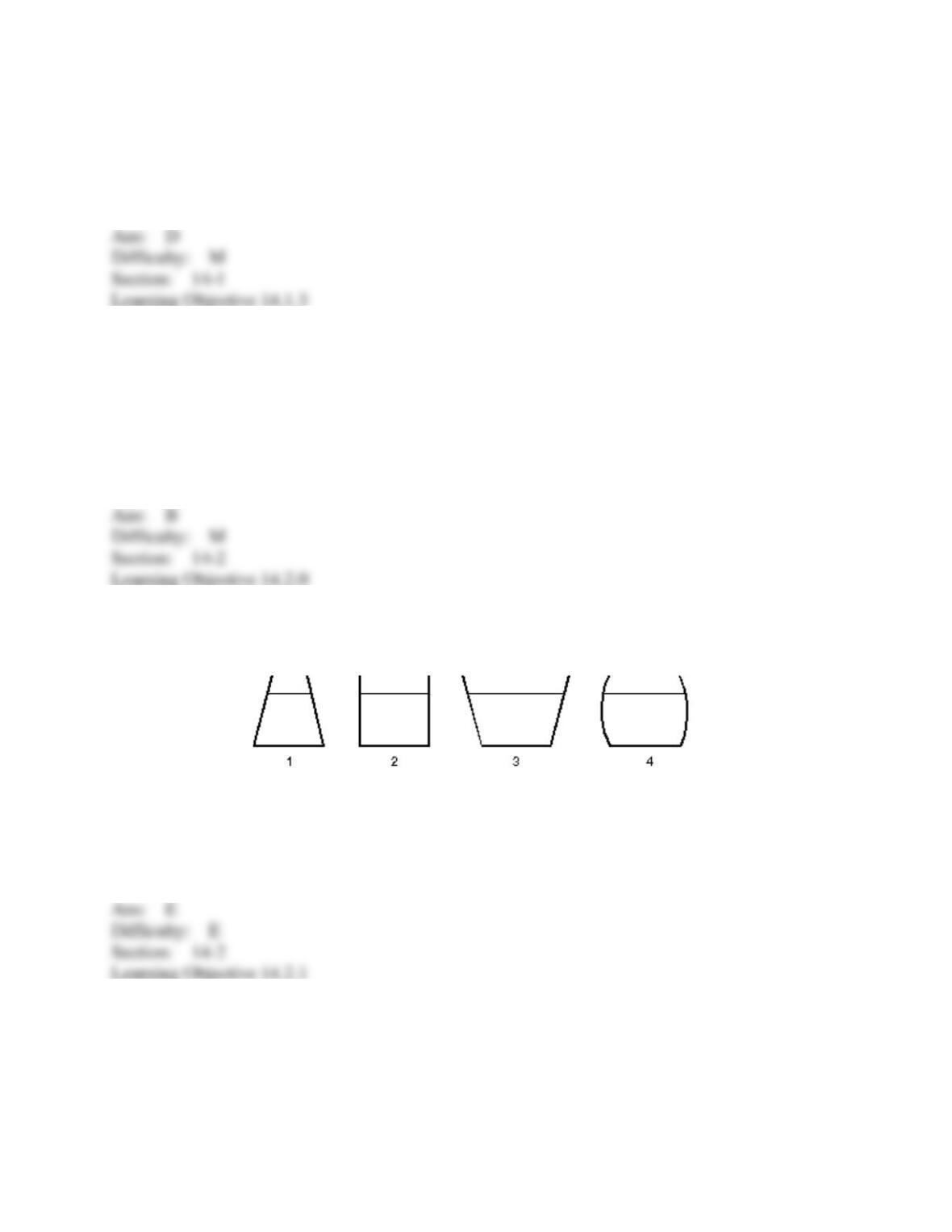
10. The vessels shown below all contain water to the same height. Rank them according to the
pressure exerted by the water on the vessel bottoms, least to greatest.
A) 1, 2, 3, 4
B) 3, 4, 2, 1
C) 1, 2, 4, 3
D) 2, 3, 4, 1
E) All pressures are the same
11. A closed hemispherical shell of radius R is filled with fluid at uniform pressure p. The net
force of the fluid on the curved portion of the shell is given by:
A) 2R2p
B) R2p
C) 4R2p
D) (4/3)R2p
E) (4/3)R3p
12. In a stationary homogeneous liquid:
A) pressure is the same at all points
B) pressure depends on the direction
C) pressure is independent of any atmospheric pressure on the upper surface of the liquid
D) pressure is the same at all points at the same level
E) none of the above
13. Which of the following five statements, concerning the upper surface pressure of a liquid,
is FALSE?
A) it is independent of the surface area
B) it is the same for all points on that surface
C) it would not increase if the liquid depth were increased
D) it would increase if the liquid density were increased
E) it would increase if the atmospheric pressure increased
14. Several cans of different sizes and shapes are all filled with the same liquid to the same
depth. Then:
A) the weight of the liquid is the same for all cans
B) the force of the liquid on the bottom of each can is the same
C) the least pressure is at the bottom of the can with the largest bottom area
D) the greatest pressure is at the bottom of the can with the largest bottom area
E) the pressure on the bottom of each can is the same
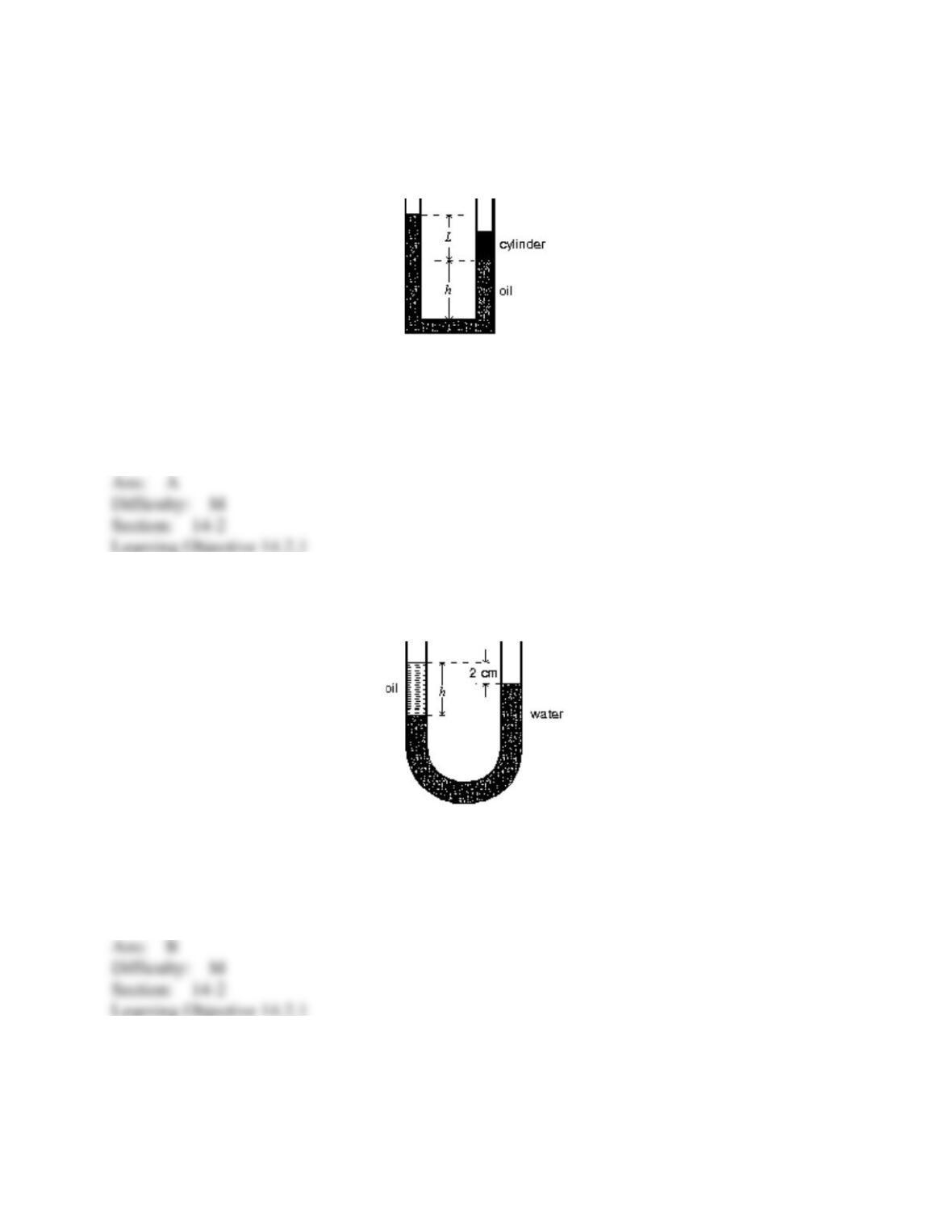
15. The diagram shows a U-tube having cross-sectional area A and partially filled with oil of
density
. A solid cylinder, which fits the tube tightly but can slide without friction, is placed in
the right arm. The system reaches equilibrium. The weight of the cylinder is:
A) AL
g
B) L3
g
C) A
(L + h)g
D) A
(L – h)g
E) none of these
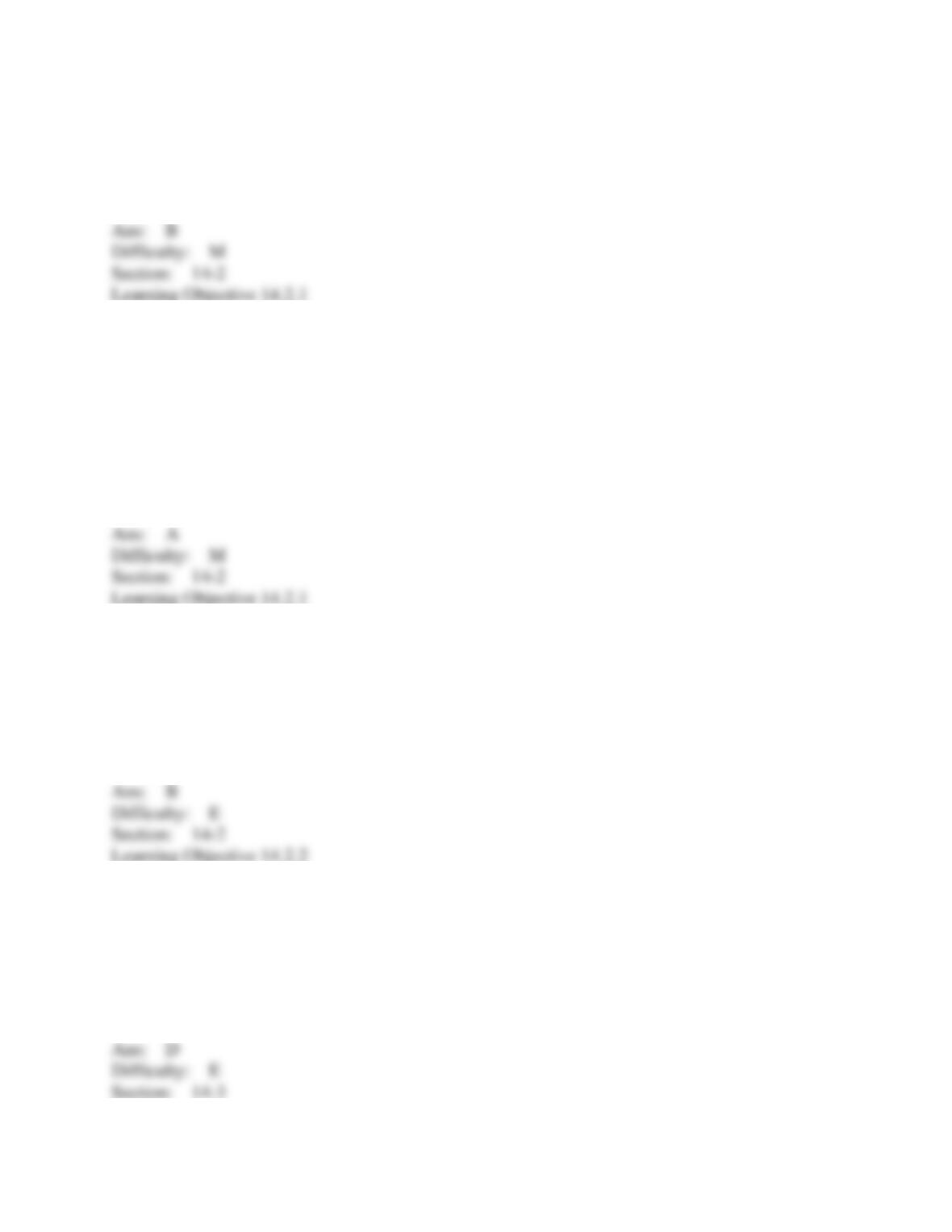
16. The density of water is 1.0 g/cm3. If h = 20 cm, the density of the oil in the left column of
the U-tube shown below is:
A) 0.20 g/cm3
B) 0.90 g/cm3
C) 1.0 g/cm3
D) 1.3 g/cm3
E) 5.0 g/cm3
17. A uniform U-tube is partially filled with water. Oil, of density 0.75 g/cm3, is poured into
the right arm until the water level in the left arm rises 3 cm. The length of the oil column is then:
A) 2.25 cm
B) 8 cm
C) 6 cm
D) 4 cm
E) need to know the cross-sectional area of the U-tube
18. A long U-tube contains mercury (density = 14 103 kg/m3). When 10 cm of water (density
= 1.0 103 kg/m 3) is poured into the left arm, the mercury in the right arm rises above its
original level by:
A) 0.36 cm
B) 0.72 cm
C) 14 cm
D) 35 cm
E) 70 cm
19. To obtain the absolute pressure from the gauge pressure:
A) subtract atmospheric pressure
B) add atmospheric pressure
C) subtract 273
D) add 273
E) convert to N/m2
20. Mercury is a convenient liquid to use in a barometer because:
A) it is a metal
B) it has a high boiling point
C) it expands little with temperature
D) it has a high density
E) it looks silvery
21. Barometers and open-tube manometers are two instruments that are used to measure
pressure. Which statement is true?
A) Both measure gauge pressure
B) Both measure absolute pressure
C) Barometers measure gauge pressure and manometers measure absolute pressure
D) Barometers measure absolute pressure and manometers measure gauge pressure
E) Both measure an average of the absolute and gauge pressures
22. To measure moderately low pressures oil with a density of 8.5 102 kg/m3 is used in place
of mercury in a barometer. A change in the oil column of 1.0 mm indicates a change in pressure
of about:
A) 1.2 10–7 Pa
B) 1.2 10–5 Pa
C) 0.85 Pa
D) 1.2 Pa
E) 8.3 Pa
23. An open-tube manometer is used to measure the gauge pressure in a tank. If the manometer
is filled with mercury, and the open end is at a height of 15 cm above the end attached to the
tank, what is the gauge pressure in the tank? The density of mercury is 14 x 103 kg/m3.
A) 2.1 x 10³ Pa
B) 2.1 x 10⁴ Pa
C) 4.0 x 10⁴ Pa
D) 1.2 x 10⁵ Pa
E) 2.1 x 10⁶ Pa
24. The principle of fluid pressure which is used in hydraulic brakes or lifts is that:
A) pressure is the same at all levels in a fluid
B) increases of pressure are transmitted equally to all parts of a fluid
C) the pressure at a point in a fluid is due to the weight of the fluid above it
D) increases of pressure can only be transmitted through fluids
E) the pressure at a given depth is proportional to the depth in the fluid
25. Which of the following statements about Pascal’s principle is true?
A) It is valid only for incompressible fluids
B) It explains why light objects float
C) It explains why the pressure is greater at the bottom of a lake than at the surface
D) It is valid only for objects that are less dense than water
E) None of the above is true
26. The hydraulic automobile jack illustrates:
A) Archimedes’ principle
B) Pascal’s principle
C) Hooke’s law
D) Newton’s third law
E) Newton’s second law
27. One piston in a hydraulic lift has an area that is twice the area of the other. When the
pressure at the smaller piston is increased by p the pressure at the larger piston:
A) increases by 2p
B) increases by p/2
C) increases by p
D) increases by 4p
E) does not change
28. A hydraulic press has one piston of diameter 2.0 cm and the other piston of diameter 8.0
cm. What force must be applied to the smaller piston to obtain a force of 1600 N at the larger
piston:
A) 100 N
B) 400 N
C) 1600 N
D) 6400 N
E) 26000 N
29. The two arms of a U-tube are not identical, one having twice the diameter of the other. A
cork in the narrow arm requires a force of 16 N to remove it. The tube is filled with water and the
wide arm is fitted with a piston. The minimum force that must be applied to the piston to push
the cork out is:
A) 4 N
B) 8 N
C) 16 N
D) 32 N
E) 64 N
30. A U-tube has dissimilar arms, one having twice the diameter of the other. It contains an
incompressible fluid and is fitted with a sliding piston in each arm, with each piston in contact
with the fluid. When the piston in the narrow arm is pushed down a distance d, the piston in the
wide arm rises a distance:
A) d
B) 2d
C) d/2
D) 4d
E) d/4
31. A U-tube has dissimilar arms, one having twice the diameter of the other. It contains an
incompressible fluid and is fitted with a sliding piston in each arm, with each piston in contact
with the fluid. When an applied force does work W in pushing the piston in the narrow arm
down, the fluid does work __________ on the piston in the wide arm.
A) W
B) 2W
C) W/2
D) 4W
E) W/4
32. “An object completely submerged in a fluid displaces its own volume of fluid.” This is:
A) Pascal’s paradox
B) Archimedes’ principle
C) Pascal’s principle
D) true, but none of the above
E) false
33. A certain object floats in fluids of density
1. 0.9
0
2.
0
3. 1.1
0
Which of the following statements is true?
A) the buoyant force of fluid 1 is greater than the buoyant forces of the other two fluids
B) the buoyant force of fluid 3 is greater than the buoyant forces of the other two fluids
C) the three fluids exert the same buoyant force
D) the object displace the same volume of all three fluids
E) none of these are true
34. Two identical blocks of ice float in water as shown. Then:
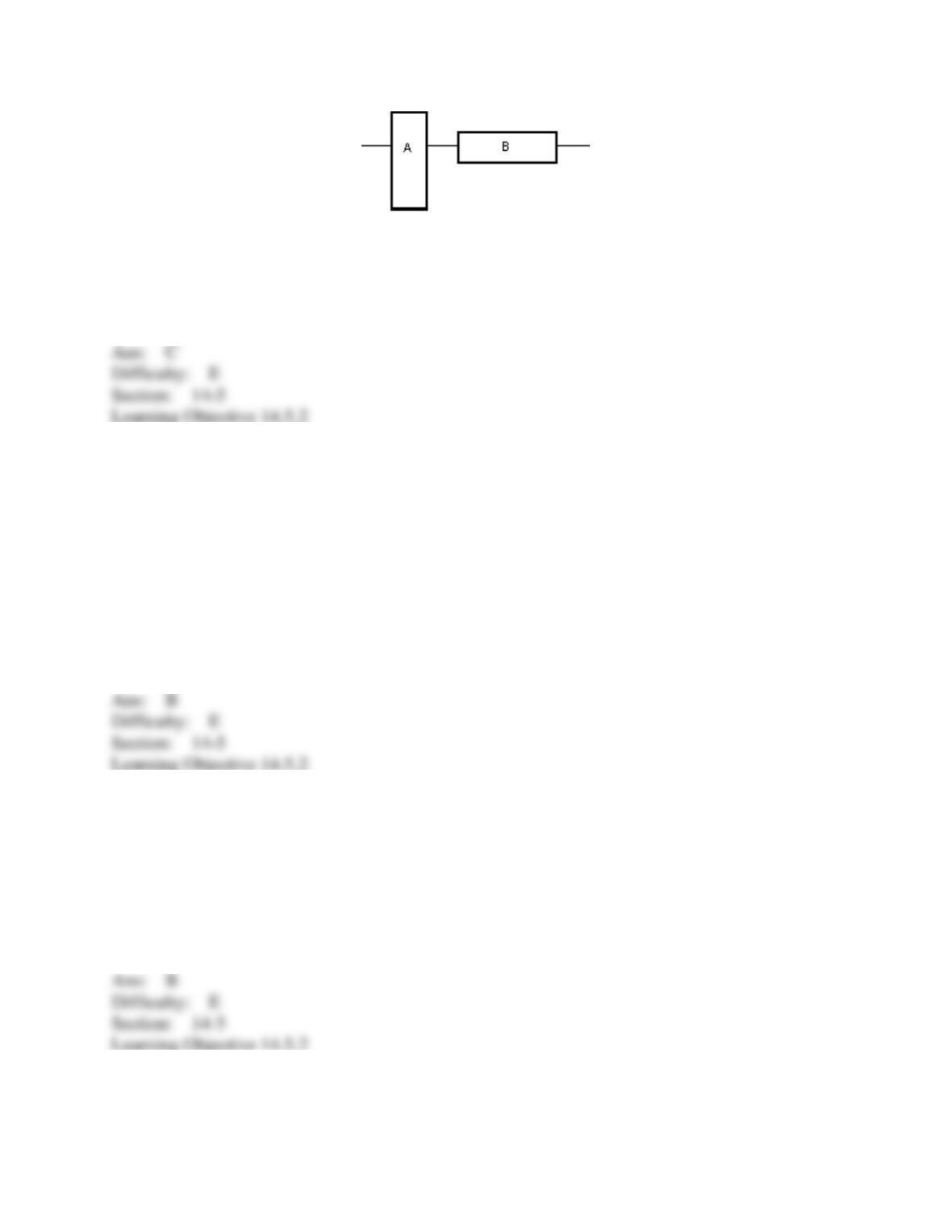
A) block A displaces a greater volume of water since the pressure acts on a smaller bottom area
B) block B displaces a greater volume of water since the pressure is less on its bottom
C) the two blocks displace equal volumes of water since they have the same weight
D) block A displaces a greater volume of water since its submerged end is lower in the water
E) block B displaces a greater volume of water since its submerged end has a greater area
35. A certain object floats in fluids of density
1. 0.9
0
2.
0
3. 1.1
0
Rank these fluids according to the volume displaced by the object, least to greatest.
A) 1, 2, 3
B) 3, 2, 1
C) 2, 3, 1
D) 3, 1, 2
E) All are the same
36. A block of ice at 0C is floating on the surface of water in a beaker. The surface of the
water just comes to the top of the beaker. When the ice melts the water level will:
A) rise and overflow will occur
B) remain the same
C) fall
D) depend on the initial ratio of water to ice
E) depend on the shape of the block of ice
37. A block of ice at 0C containing a piece of cork is floating on the surface of water in a
beaker. When the ice has melted the water level:
A) is higher
B) is lower
C) is the same
D) depends on the initial ratio of water to ice
E) depends on the shape of the ice block
38. A pirate chest rests at the bottom of an ocean. If the water is still, the net force it exerts on
the chest:
A) is upward
B) is downward
C) is zero
D) depends on the mass of the chest
E) depends on the contents of the chest
39. A small steel ball floats in a half-full container of mercury. When water is added:
A) the ball will float on the water
B) the ball will rise slightly
C) the mercury will float on the water
D) the ball will sink to the bottom of the container
E) the ball will lower slightly more into the mercury
40. A cork floats on the surface of an incompressible liquid in a container exposed to
atmospheric pressure. The container is then sealed and the air above the liquid is evacuated. The
cork:
A) sinks slightly
B) rises slightly
C) floats at the same height
D) bobs up and down about its old position
E) behaves erratically
41. A block of wood weighs 160 N and has a specific gravity of 0.60. To sink it in fresh water
requires an additional downward force of:
A) 54 N
B) 64 N
C) 96 N
D) 110 N
E) 240 N
42. An object floats on the surface of a fluid. For purposes of calculating the torque on it, the
buoyant force is taken to act at:
A) the center of the bottom surface of the object
B) the center of gravity of the object
C) the center of gravity of the fluid that the object replaced
D) the geometric center of the object
E) none of the above
43. A blast of wind tips a sailboat in the clockwise direction when viewed from the stern.
When the wind ceases the boat rotates back toward the upright position if, when it is tilted, the
center of buoyancy:
A) is above the center of gravity
B) is below the center of gravity
C) is to the right of the center of gravity
D) is to the left of the center of gravity
E) coincides with the center of gravity
44. A cork floats in water in a bucket resting on the floor of an elevator. The elevator then