46. An object with an initial velocity of 12 m/s west experiences a constant acceleration of 4
m/s2 west for 3 seconds. During this time the object travels a distance of:
A) 18 m
B) 24 m
C) 36 m
D) 54 m
E) 144 m
47. How far does a car travel in 6 s if its initial velocity is 2 m/s and its acceleration is 2 m/s2 in
the same direction as its initial velocity?
A) 12 m
B) 14 m
C) 24 m
D) 36 m
E) 48 m
48. At a stop light, a truck traveling at 15 m/s passes a car as it starts from rest. The truck travels
at constant velocity and the car accelerates at 3 m/s2. How much time does the car take to catch
up to the truck?
A) 5 s
B) 10 s
C) 15 s
D) 20 s
E) 25 s
49. An object starts from rest and has a constant acceleration of 3 m/s2. The position versus time
graph for this object has a slope:
A) that increases with time
B) that is constant
C) that decreases with time
D) of 3 m/s
E) of 3 m/s2
50. An object starts from rest at the origin and moves along the x axis with a constant
acceleration of 4 m/s2. Its average velocity as it goes from x = 2 m to x = 8 m is:
A) 1 m/s
B) 2 m/s
C) 3 m/s
D) 5 m/s
E) 6 m/s
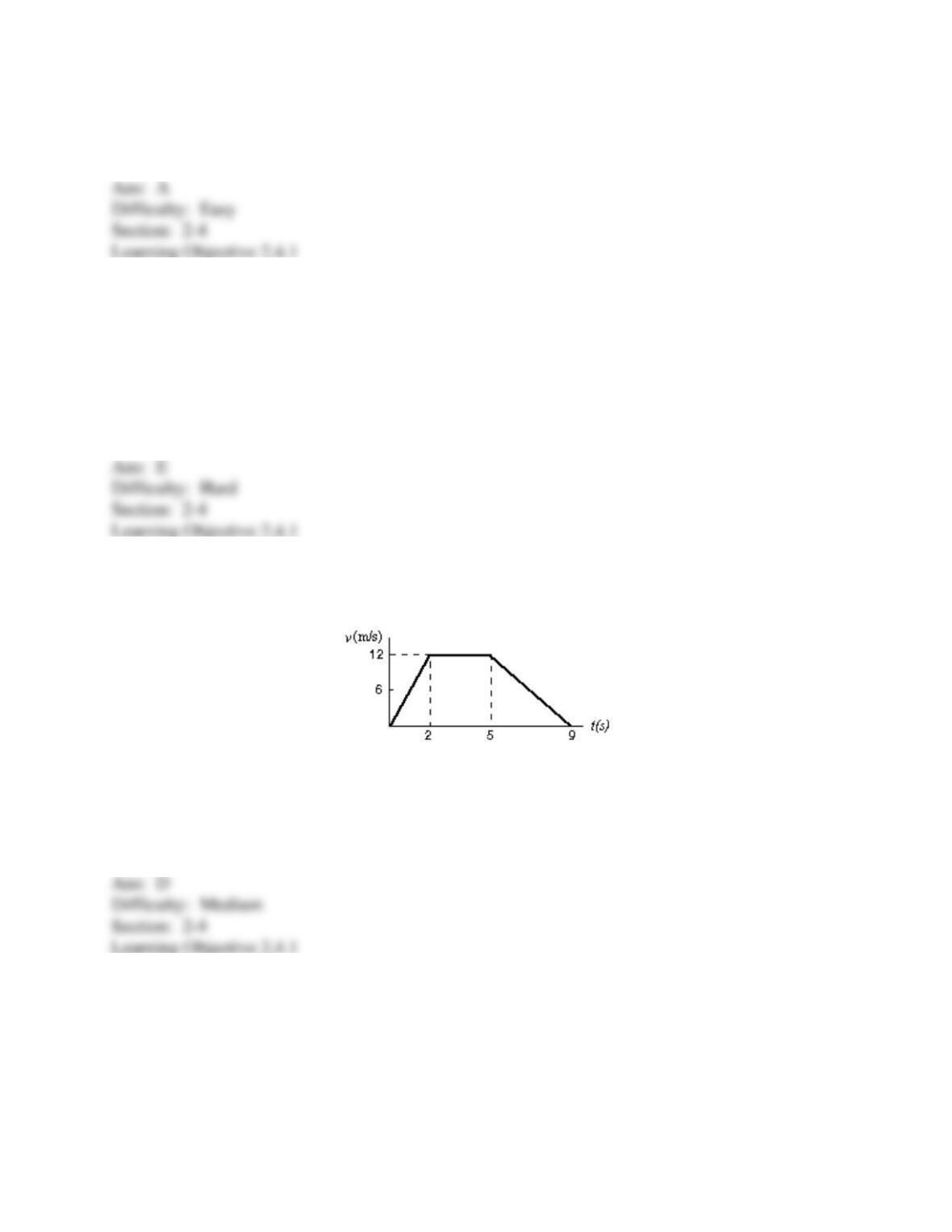
51. The graph represents the straight line motion of a car. How far does the car travel between t
= 2 seconds and t = 5 seconds?
A) 4 m
B) 12 m
C) 24 m
D) 36 m
E) 60 m
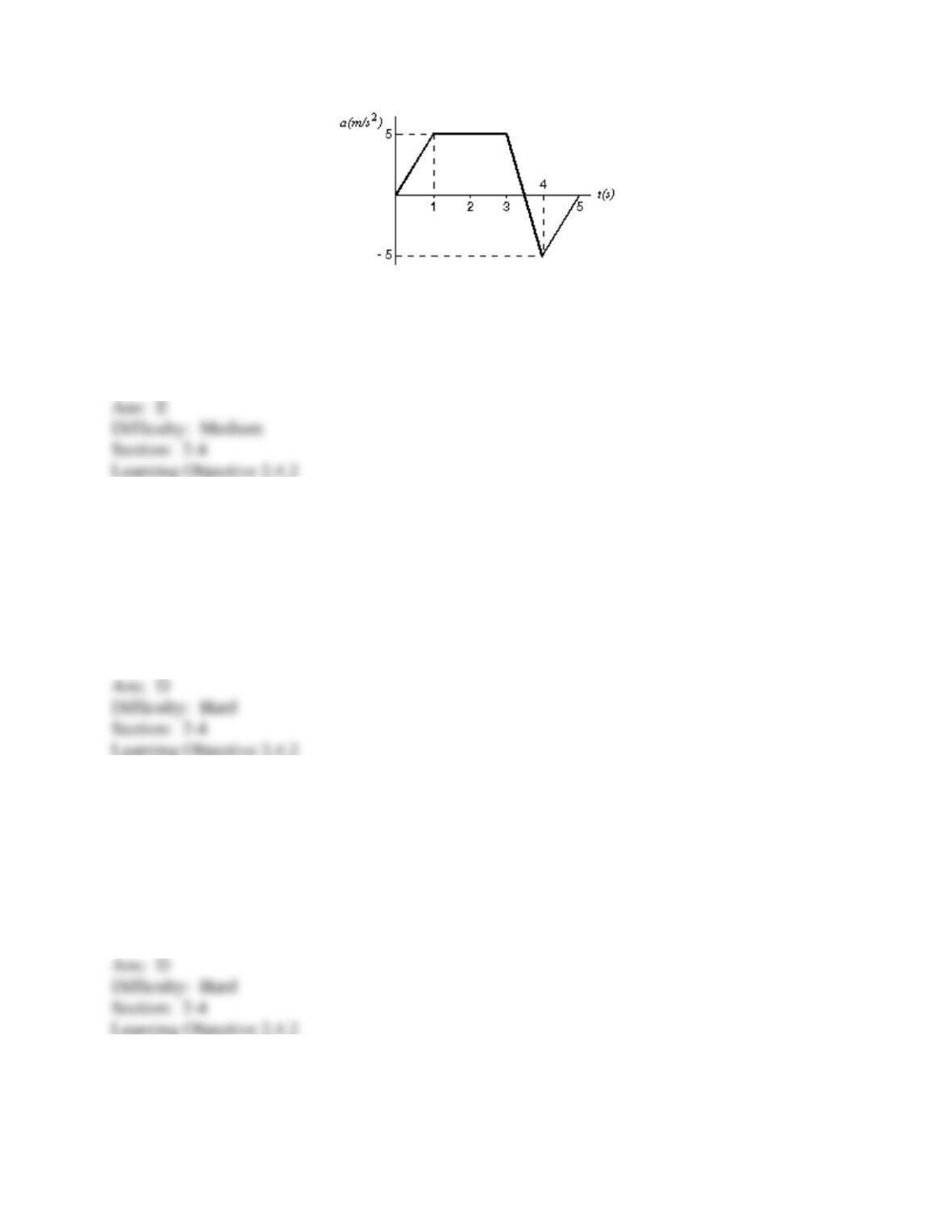
52. The acceleration of an object, starting from rest, is shown in the graph below. Other than at t
= 0, when is the velocity of the object equal to zero?
A) During the interval from 1.0 s to 3.0 s
B) At t = 3.5 s
C) At t = 4.0 s
D) At t = 5.0 s
E) At no other time less than or equal to 5 s.
53. At time t = 0 a car has a velocity of 16 m/s. It slows down with an acceleration given by a =
–0.50t, in m/s2 for t in seconds. By the time it stops it has traveled:
A) 15 m
B) 31 m
C) 62 m
D) 85 m
E) 100 m
54. At time t = 0 a car has a velocity of 16 m/s. It slows down with an acceleration given by a =
–0.50t, in m/s2 for t in seconds. It stops at t =
A) 64 s
B) 32 s
C) 16 s
D) 8.0 s
E) 4.0 s
55. At time t = 0 a car has a velocity of 16 m/s. It slows down with an acceleration given by a =
–0.50t, in m/s2 for t in seconds. At the end of 4.0 s it has traveled:
A) 0
B) 12 m
C) 14 m
D) 25 m
E) 59 m
56. The area under a velocity-time graph represents:
A) acceleration
B) change in acceleration
C) speed
D) change in velocity
E) displacement
57. The velocity of an object is given as a function of time by v = 4t – 3t2, where v is in m/s and t
is in seconds. Its average velocity over the interval from t = 0 s to t = 2 s:
A) is 0
B) is –2 m/s
C) is 2 m/s
D) is –4 m/s
E) cannot be calculated unless the initial position is given
58. Displacement can be obtained from:
A) the slope of an acceleration-time graph
B) the slope of a velocity-time graph
C) the area under an acceleration-time graph
D) the area under a velocity-time graph
E) the slope of an acceleration-time graph
59. A drag racing car starts from rest at t = 0 and moves along a straight line with velocity given
by v = bt2, where b is a constant. The expression for the distance traveled by this car from its
position at t = 0 is:
A) bt3
B) bt3/3
C) 4bt2
D) 3bt2
E) bt3/2
60. A ball is in free fall motion. Upward is taken to be the positive direction. The displacement
of the ball is:
A) positive during both ascent and descent
B) negative during both ascent and descent
C) negative during ascent and positive during descent
D) positive during ascent and negative during descent
E) none of the above
61. Which of the following is NOT true of an object in free fall in the absence of air resistance?
A) Its acceleration is constant.
B) If its initial velocity is upwards, it will reach a maximum height and then begin to fall.
C) If its initial velocity is zero, its position below its starting point can be calculated knowing
only how long ago it began falling.
D) Its velocity will always be zero at some point along its path.
E) Its velocity changes by the same amount every second.
62. An object is shot vertically upward. While it is rising:
A) its velocity and acceleration are both upward
B) its velocity is upward and its acceleration is downward
C) its velocity and acceleration are both downward
D) its velocity is downward and its acceleration is upward
E) its velocity and acceleration are both decreasing
63. A baseball is thrown vertically into the air. The acceleration of the ball at its highest point is:
A) zero
B) g, down
C) g, up
D) 2g. down
E) 2g, up
64. A feather, initially at rest, is released in a vacuum 12 m above the surface of the Earth.
Which of the following statements is correct?
A) The maximum velocity of the feather is 9.8 m/s
B) The acceleration of the feather decreases until terminal velocity is reached
C) The acceleration of the feather remains constant during the fall
D) The acceleration of the feather increases during the fall
E) The acceleration of the feather is zero
65. A ball is thrown upwards. Its acceleration is:
A) downward during both ascent and descent
B) downward during ascent and upward during descent
C) upward during ascent and downward during descent
D) upward during both ascent and descent
E) downward at all times except at the very top, when it is zero
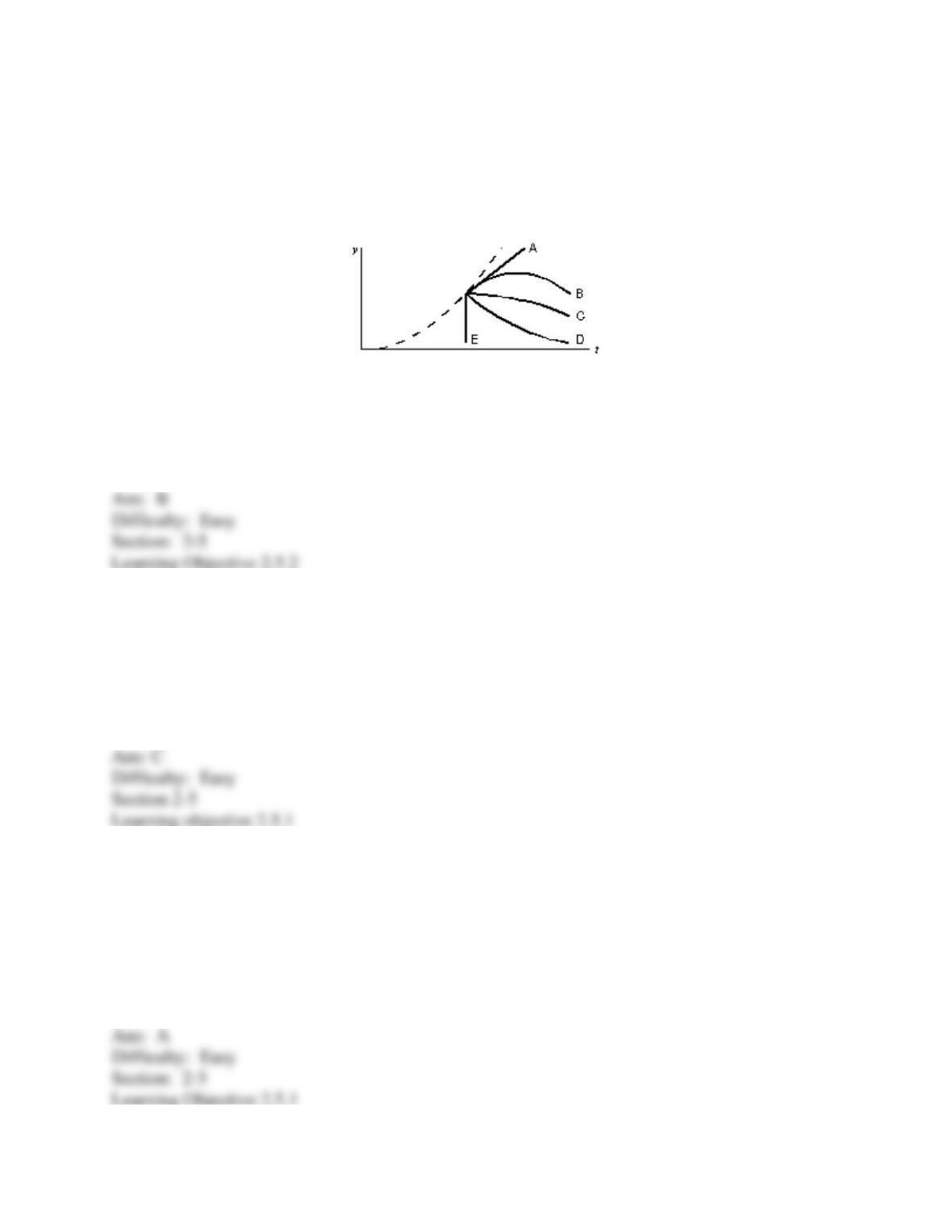
66. An elevator is moving upward with constant acceleration. The dashed curve shows the
position y of the ceiling of the elevator as a function of the time t. At the instant indicated by the
dot, a bolt breaks loose and drops from the ceiling. Which curve best represents the position of
the bolt as a function of time?
A) A
B) B
C) C
D) D
E) E
67. If you drop a rock and a feather, the rock hits the ground first. This demonstrates that:
A) The acceleration of gravity is not constant.
B) Heavier objects are accelerated faster by gravity than lighter objects are.
C) Air resistance has a larger effect on feathers than on rocks.
D) Rocks can’t fly.
E) Gravity has little effect on a feather.
68. As a rocket is accelerating vertically upward at 9.8 m/s2 near the Earth’s surface, it releases a
projectile. Immediately after release the acceleration of the projectile is:
A) 9.8 m/s2 down
B) 0 m/s2
C) 9.8 m/s2 up
D) 19.6 m/s2 up
E) none of the above
69. Which one of the following statements is correct for an object in free fall released from rest?
A) The average velocity during the first second of time is 4.9 m/s
B) During each second the object falls 9.8 m
C) The acceleration changes by 9.8 m/s every second
D) The object falls 9.8 m during the first second of time
E) The acceleration of the object is proportional to its weight
70. A freely falling body has a constant acceleration of 9.8 m/s2. This means that:
A) the body falls 9.8 m during each second
B) the body falls 9.8 m during the first second
C) the speed of the body increases by 9.8 m/s during each second
D) the acceleration of the body increases by 9.8 m/s2 during each second
E) the acceleration of the body decreases by 9.8 m/s2 during each second
71. An object is thrown straight up from ground level with a speed of 50 m/s. If g = 10 m/s2 its
distance above ground level 1.0 second later is:
A) 40 m
B) 45 m
C) 50 m
D) 55 m
E) 60 m
72. An object is thrown straight up from ground level with a speed of 50 m/s. If g = 10 m/s2 its
distance above ground level 6.0 s later is:
A) 0.00 m
B) 270 m
C) 330 m
D) 480 m
E) none of these
73. At a location where g = 9.80 m/s2, an object is thrown vertically down with an initial speed
of 1.00 m/s. After 5.00 s the object will have traveled:
A) 125 m
B) 128 m
C) 245 m
D) 250 m
E) 255 m
74. An object is thrown vertically upward at 35 m/s. Taking g = 10 m/s2, the velocity of the
object 5 seconds later is:
A) 7.0 m/s up
B) 15 m/s down
C) 15 m/s up
D) 85 m/s down
E) 85 m/s up
75. An object is released from rest. How far does it fall during the second second of its fall?
A) 4.9 m
B) 9.8 m
C) 15 m
D) 20 m
E) 25 m
76. A heavy ball falls freely, starting from rest. Between the third and fourth second of its fall it
travels a distance of:
A) 4.9 m.
B) 9.8 m.
C) 29.4 m
D) 34.3 m.
E) 39.8 m.
77. A stone is released from a balloon that is descending at a constant speed of 10 m/s.
Neglecting air resistance, after 20 s the speed of the stone is:
A) 2160 m/s
B) 1760 m/s
C) 206 m/s
D) 196 m/s
E) 186 m/s
78. An object dropped from a window of a tall building hits the ground in 12.0 s. If its
acceleration is 9.80 m/s2, the height of the window above the ground is (you may neglect air
resistance):
A) 29.4 m
B) 58.8 m
C) 118 m
D) 353 m
E) 706 m
79. Neglecting the effect of air resistance, a stone dropped off a 175-m high building lands on
the ground in:
A) 3 s
B) 4 s
C) 6 s
D) 18 s
E) 36 s
80. A stone is thrown vertically upward with an initial speed of 19.5 m/s. It will rise to a
maximum height of:
A) 4.9 m
B) 9.8 m
C) 19.4 m
D) 38.8 m
E) none of these
81. A baseball is hit straight up and is caught by the catcher 2.0 s later, at the same height at
which it left the bat. The maximum height of the ball during this interval is:
A) 4.9 m
B) 7.4 m
C) 12.4 m
D) 19.6 m
E) 38.8 m
82. An object is thrown straight down with an initial speed of 4 m/s from a window which is 8 m
above the ground. The time it takes the object to reach the ground is:
A) 0.80 s
B) 0.93 s
C) 1.3 s
D) 1.7 s
E) 2.0 s
83. A stone is released from rest from the edge of a building roof 190 m above the ground.
Neglecting air resistance, the speed of the stone, just before striking the ground, is:
A) 43 m/s
B) 61 m/s
C) 120 m/s
D) 190 m/s
E) 1400 m/s
84. An object is thrown vertically upward with a certain initial velocity in a world where the
acceleration due to gravity is 19.6 m/s2. The height to which it rises is ____ that to which the
object would rise if thrown upward with the same initial velocity on the Earth. Neglect air
resistance.
A) one fourth
B) half
C) twice
D) four times
E) cannot be calculated from the given data
85. A projectile is shot vertically upward with a given initial velocity. It reaches a maximum
height of 100 m. If on a second shot the initial velocity is doubled, then the projectile will reach a
maximum height of:
A) 70.7 m
B) 141.4 m
C) 200 m
D) 241 m
E) 400 m
86. One object is thrown vertically upward with an initial velocity of 100 m/s and another object
with an initial velocity of 10 m/s. The maximum height reached by the first object will be
_______ that of the other.
A) 10 times
B) 100 times
C) 1000 times
D) 10,000 times
E) none of these
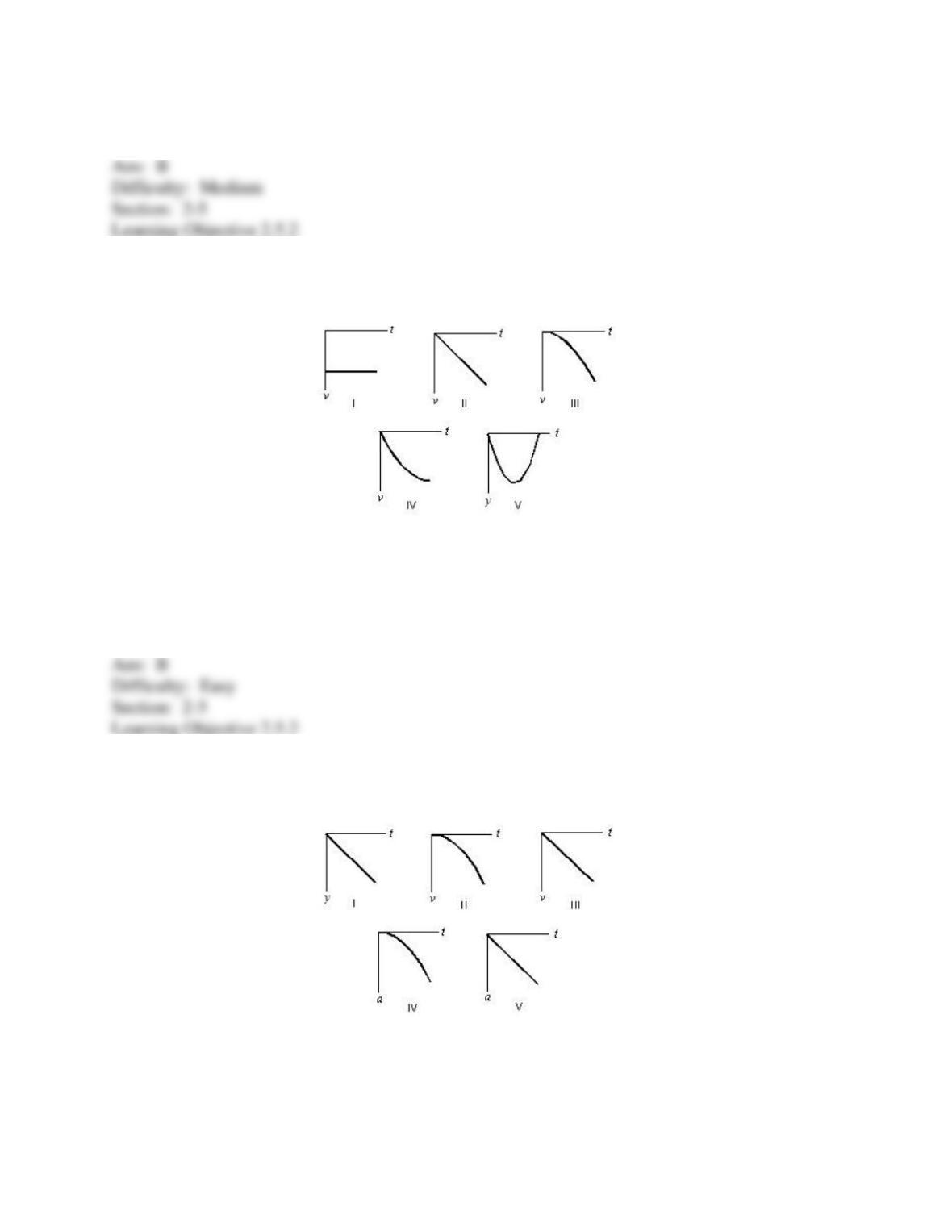
87. An object is dropped from rest. Which of the five following graphs correctly represents its
motion? The positive direction is taken to be upward. Take careful note of the axes.
A) I
B) II
C) III
D) IV
E) V
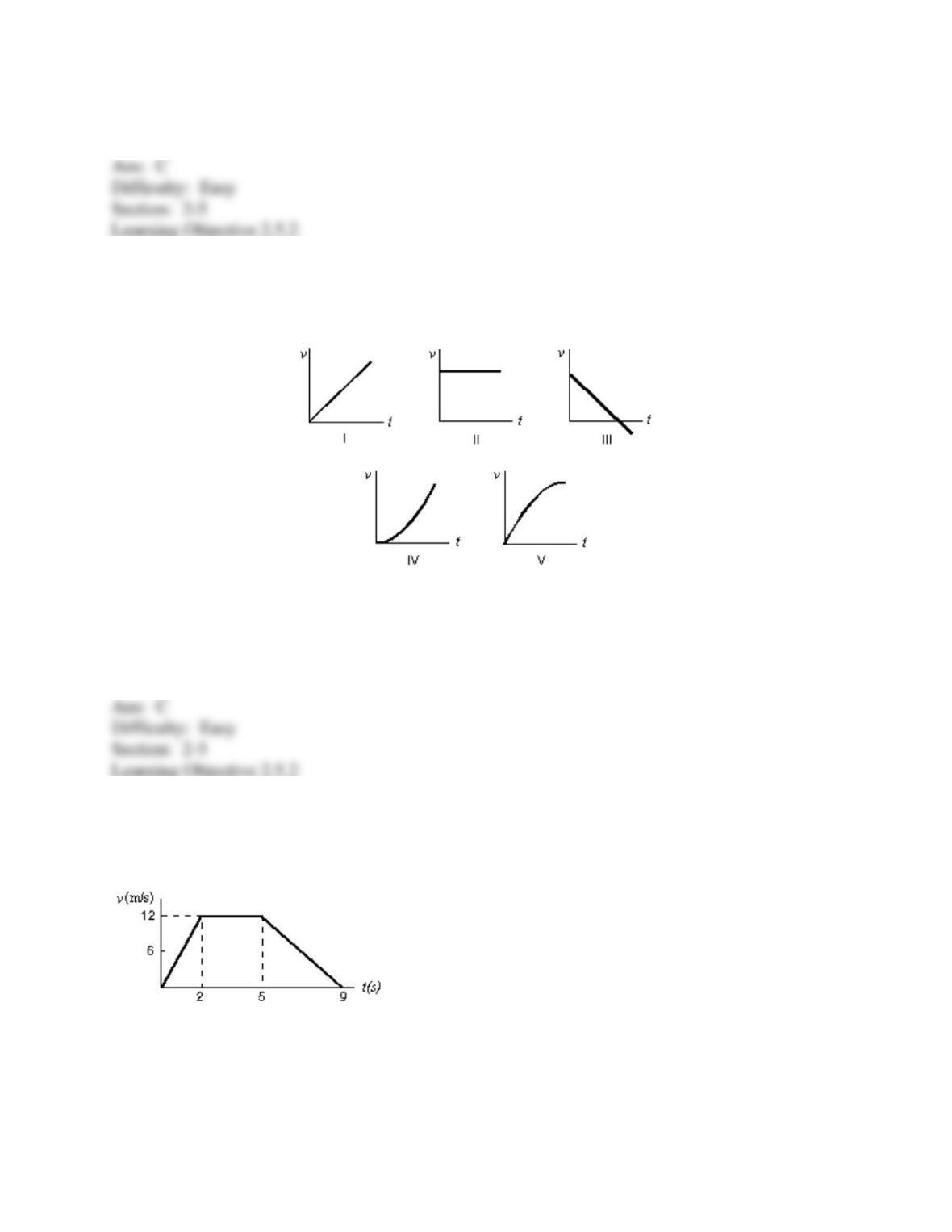
88. A stone is dropped from a cliff. The graph (carefully note the axes) that best represents its
motion while it falls is:
A) I
B) II
C) III
D) IV
E) V
89. An object is thrown vertically into the air. Which of the following five graphs represents the
velocity (v) of the object as a function of the time (t)? The positive direction is taken to be
upward.
A) I
B) II
C) III
D) IV
E) V
90. This graph shows the velocity of a particle as a function of time. During what interval is its
displacement negative?
A) 0 – 2 s
B) 2s – 5 s
C) 5 s – 9 s
D) 0 – 9 s

E) Its displacement is not negative between 0 and 9 s.