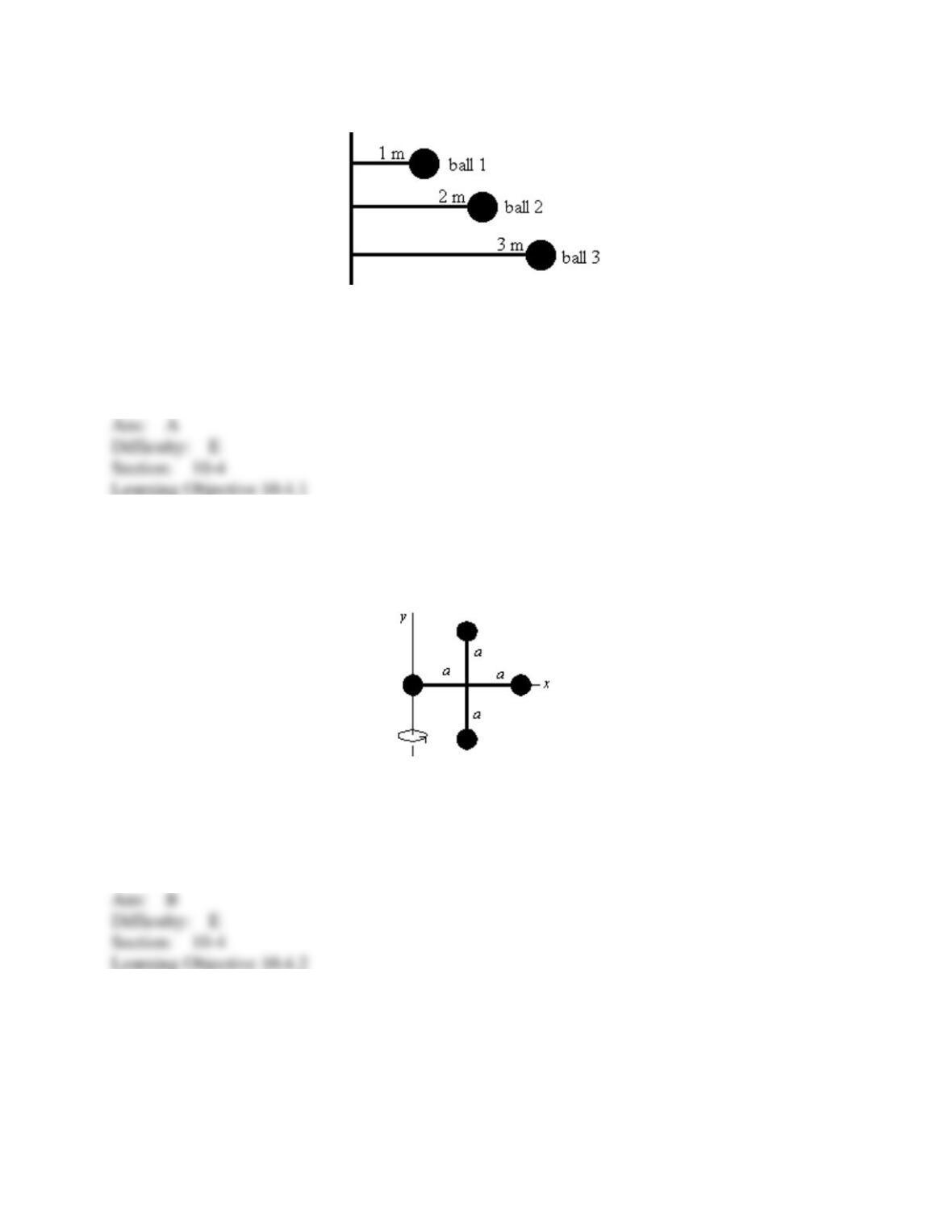
A) 1, 2, 3
B) 3, 2, 1
C) 3, then 1 and 2 tie
D) 1, 3, 2
E) All are the same
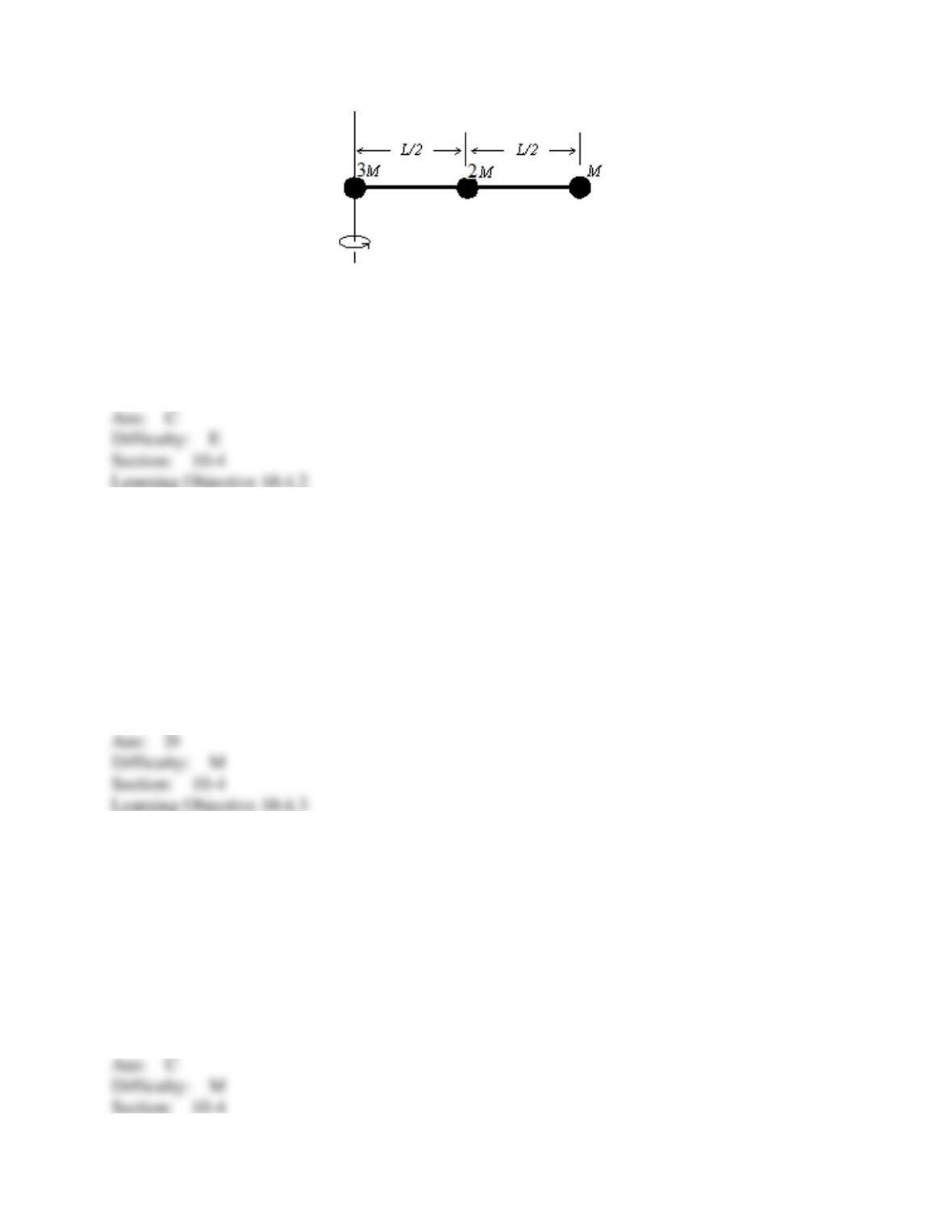
55. Four identical particles, each with mass m, are arranged in the x, y plane as shown. They
are connected by light sticks to form a rigid body. If m = 2.0 kg and a = 1.0 m, the rotational
inertia of this array about the y-axis is:
A) 4.0 kg∙m2
B) 12 kg∙m2
C) 9.6 kg∙m2
D) 4.8 kg∙m2
E) none of these
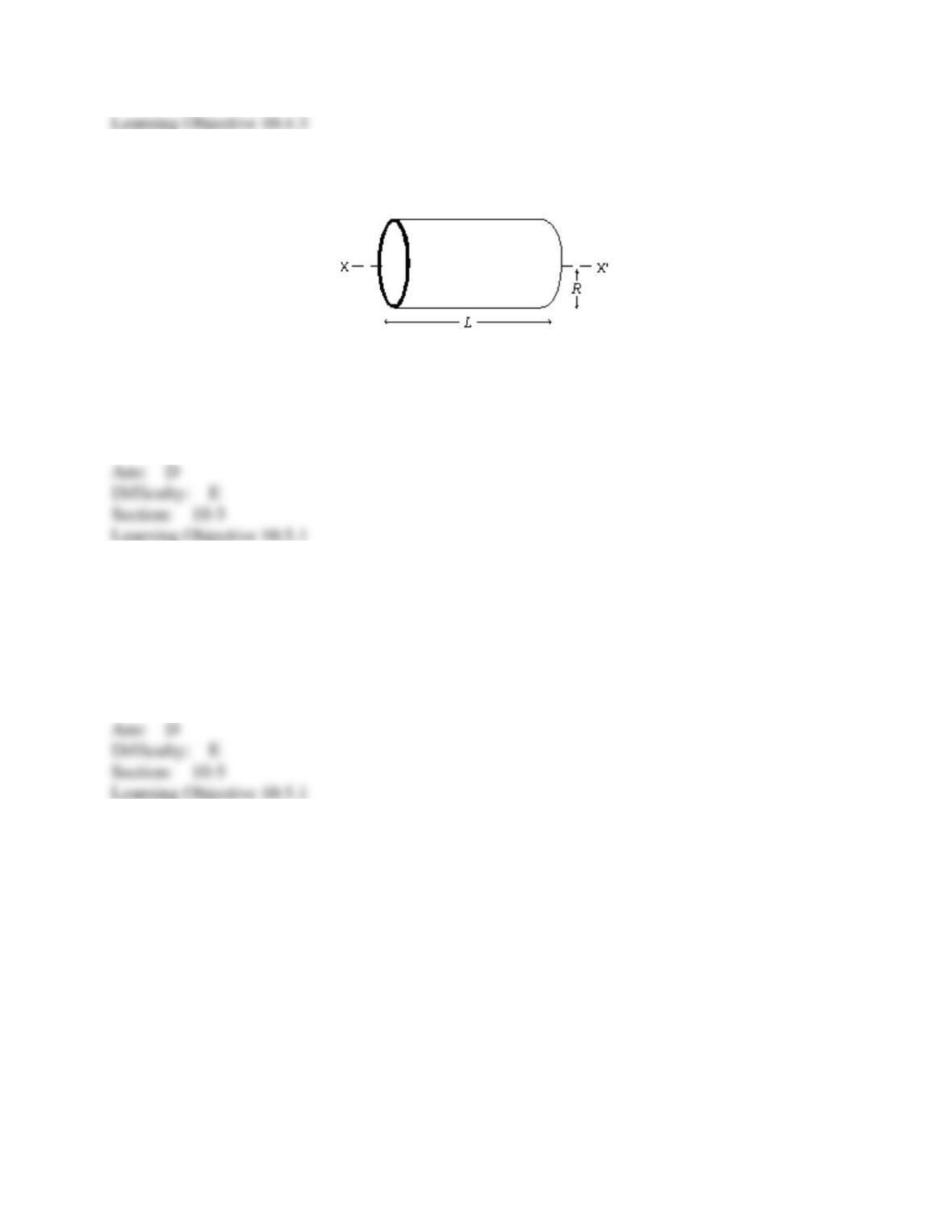
56. Three balls, with masses of 3M, 2M, and M, are fastened to a massless rod of length L as
shown. The rotational inertia about the left end of the rod is:
A) ML2/2
B) ML2
C) 3ML2/2
D) 6ML2
E) 3ML2
57. A pulley with a radius of 3.0 cm and a rotational inertia of 4.5 10–3 kg∙m2 is suspended
from the ceiling. A rope passes over it with a 2.0-kg block attached to one end and a 4.0-kg block
attached to the other. The rope does not slip on the pulley. When the velocity of the heavier
block is 2.0 m/s the total kinetic energy of the pulley and blocks is:
A) 2.0 J
B) 12 J
C) 14 J
D) 22 J
E) 28 J
58. A pulley with a radius of 3.0 cm and a rotational inertia of 4.5 10–3 kg∙m2 is suspended
from the ceiling. A rope passes over it with a 2.0-kg block attached to one end and a 4.0-kg block
attached to the other. The rope does not slip on the pulley. At any instant after the blocks start
moving the object with the greatest kinetic energy is:
A) the heavier block
B) the lighter block
C) the pulley
D) either block (the two blocks have the same kinetic energy)
E) none (all three objects have the same kinetic energy)
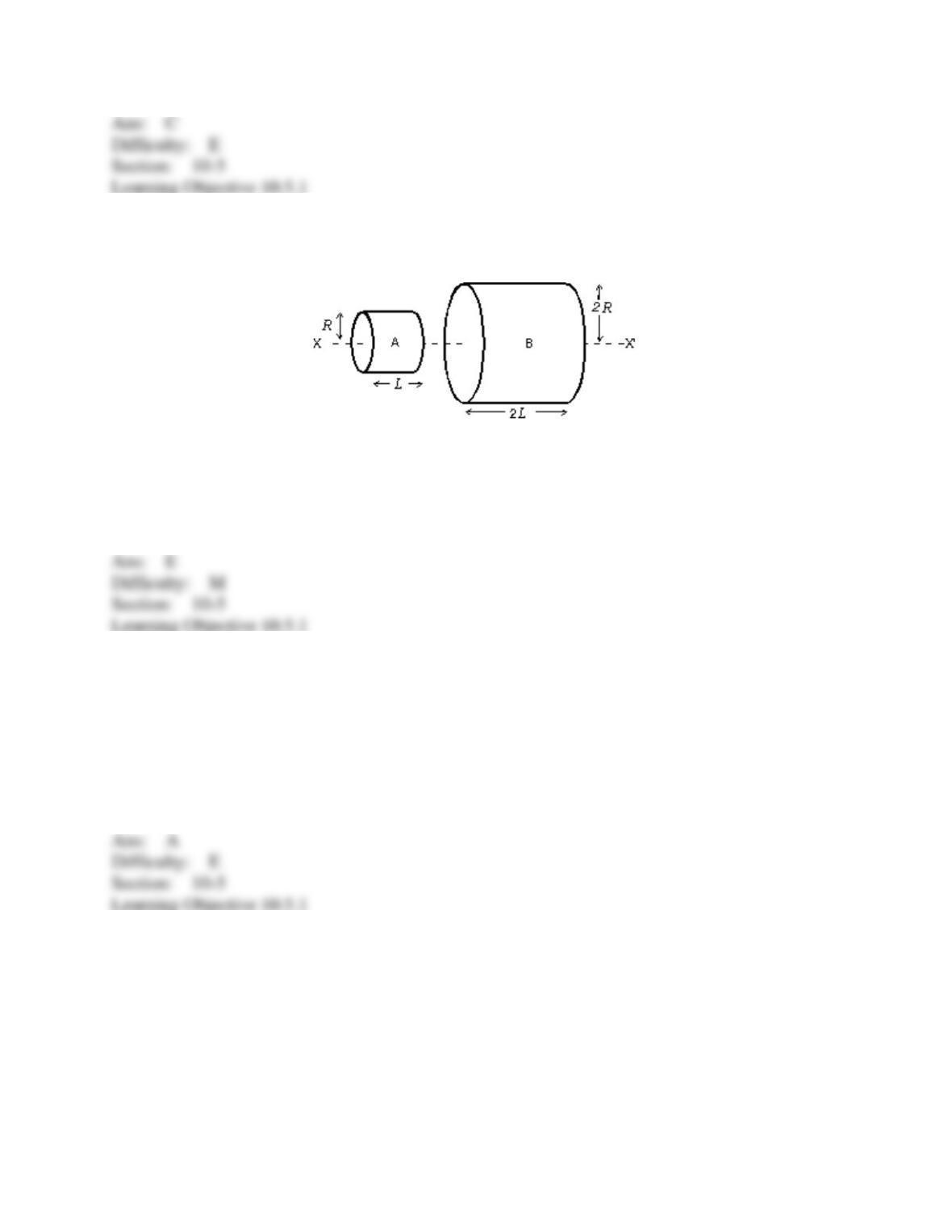
59. The rotational inertia of a thin cylindrical shell of mass M, radius R, and length L about its
central axis (X – X’) is:
A) MR2/2
B) ML2/2
C) ML2
D) MR2
E) none of these
60. The rotational inertia of a wheel about its axle does not depend upon its:
A) diameter
B) mass
C) distribution of mass
D) speed of rotation
E) material composition
61. Consider four objects, each having the same mass and the same radius:
1. a solid sphere
2. a hollow sphere
3. a flat disk in the x,y plane
4. a hoop in the x,y plane
The order of increasing rotational inertia about an axis through the center of mass and parallel to
the z axis is:
A) 1, 2, 3, 4
B) 4, 3, 2, 1
C) 1, 3, 2, 4
D) 4, 2, 3, 1
E) 3, 1, 2, 4
62. A and B are two solid cylinders made of aluminum. Their dimensions are shown. The ratio
of the rotational inertia of B to that of A about the common axis X─X’ is:
A) 2
B) 4
C) 8
D) 16
E) 32
63. Two uniform circular disks having the same mass and the same thickness are made from
different materials. The disk with the smaller rotational inertia is:
A) the one made from the more dense material
B) the one made from the less dense material
C) neither — both rotational inertias are the same
D) the disk with the larger angular velocity
E) the disk with the larger torque
64. A uniform solid cylinder made of lead has the same mass and the same length as a uniform
solid cylinder made of wood. The rotational inertia of the lead cylinder compared to the wooden
one is:
A) greater
B) less
C) same
D) unknown unless the radii are given
E) unknown unless both the masses and the radii are given
65. To increase the rotational inertia of a solid disk about its axis without changing its mass:
A) drill holes near the rim and put the material near the axis
B) drill holes near the axis and put the material near the rim
C) drill holes at points on a circle near the rim and put the material at points between the holes
D) drill holes at points on a circle near the axis and put the material at points between the holes
E) do none of the above (the rotational inertia cannot be changed without changing the mass)
66. The rotational inertia of a disk about its axis is 0.70 kgm2. When a 2.0 kg weight is added
to its rim, 0.40 m from the axis, the rotational inertia becomes:
A) 0.32 kgm2
B) 0.54 kgm2
C) 0.70 kgm2
D) 0.86 kgm2
E) 1.0 kgm2
67. A thin rod of length L has a density that increases along its length, ρ = ρ0x. What is the
rotational inertia of the rod around its less dense end?
A) ML2/12
B) ML2/6
C) ML2/3
D) ML2/2
E) ML2
68. When a thin uniform stick of mass M and length L is pivoted about its midpoint, its
rotational inertia is ML2/12. When pivoted about a parallel axis through one end, its rotational
inertia is:
A) ML2/12
B) ML2/6
C) ML2/3
D) 7ML2/12
E) 13ML2/12
69. The rotational inertia of a solid uniform sphere about a diameter is (2/5)MR2, where M is its
mass and R is its radius. If the sphere is pivoted about an axis that is tangent to its surface, its
rotational inertia is:
A) MR2
B) (2/5)MR2
C) (3/5)MR2
D) (5/2)MR2
E) (7/5)MR2
70. A solid uniform sphere of radius R and mass M has a rotational inertia about a diameter that
is given by (2/5)MR2. A light string of length 2.5 R is attached to the surface and used to suspend
the sphere from the ceiling. Its rotational inertia about the point of attachment at the ceiling is:
A) (2/5)MR2
B) 9MR2
C) 16MR2
D) 47/5MR2
E) (82/5)MR2
71. The torque exerted on an object can be written as
rF
=
. Here,
r
:
A) is the radius of the object.
B) is a vector pointing from the axis of rotation to the point where the force is applied.
C) is always perpendicular to
F
.
D) is a vector pointing from the point where the force is applied to the axis of rotation.
E) points along the axis of rotation.
72. A force with a given magnitude is to be applied to a wheel. The torque can be maximized
by:
A) applying the force near the axle, radially outward from the axle
B) applying the force near the rim, radially outward from the axle
C) applying the force near the axle, parallel to a tangent to the wheel
D) applying the force at the rim, tangent to the rim
E) applying the force at the rim, at 45 to the tangent
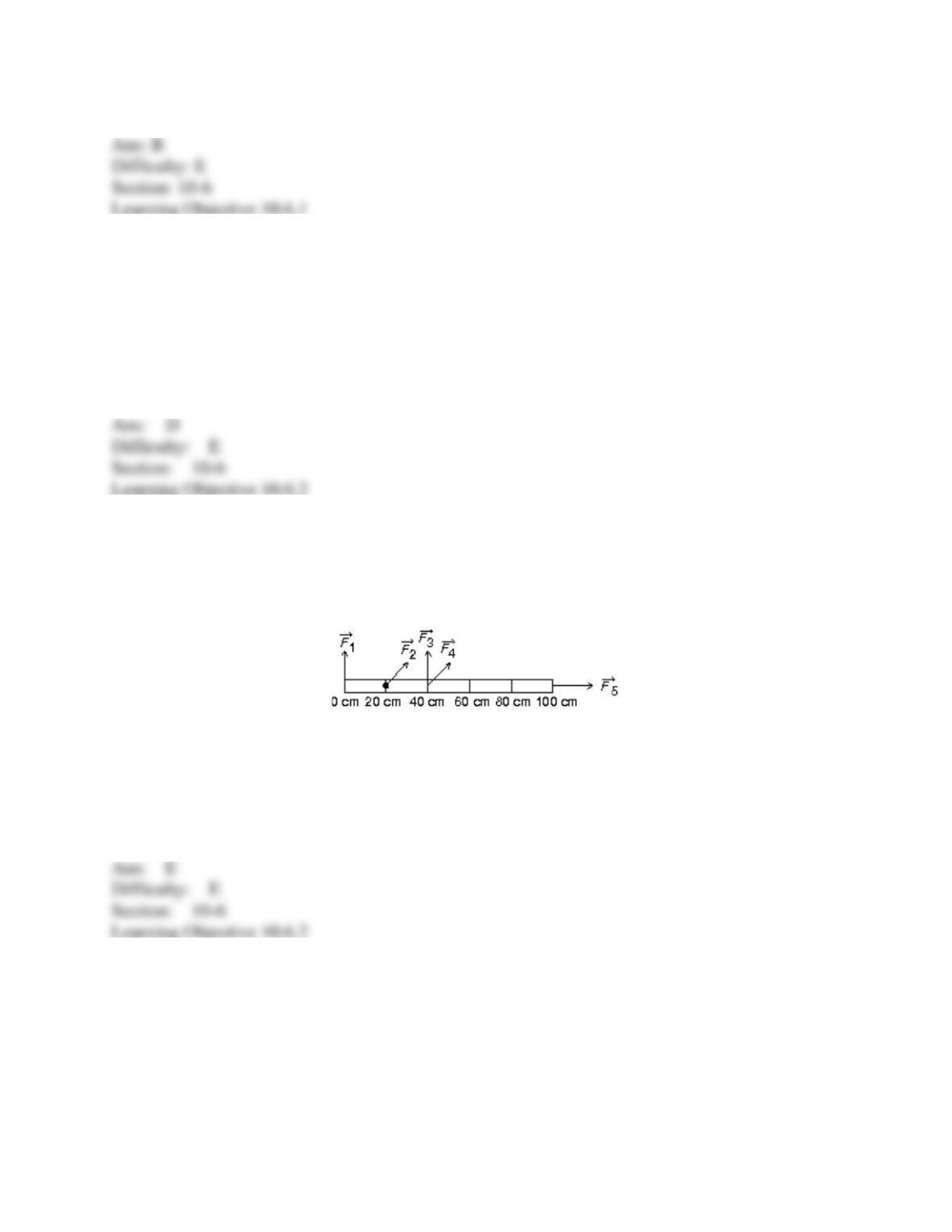
73. The meter stick shown below rotates about an axis through the point marked •, 20 cm from
one end. Five forces act on the stick: one at each end, one at the pivot point, and two 40 cm from
one end, as shown. The magnitudes of the forces are all the same. Rank the forces according to
the magnitudes of the torques they produce about the pivot point, least to greatest.
A) 𝐹1
⃗
⃗
⃗
, 𝐹2
⃗
⃗
⃗
, 𝐹3
⃗
⃗
⃗
, 𝐹
4
⃗
⃗
⃗
, 𝐹5
⃗
⃗
⃗
B) 𝐹1
⃗
⃗
⃗
and 𝐹2
⃗
⃗
⃗
tie, then 𝐹3
⃗
⃗
⃗
, 𝐹
4
⃗
⃗
⃗
, 𝐹5
⃗
⃗
⃗
C) 𝐹2
⃗
⃗
⃗
and 𝐹5
⃗
⃗
⃗
tie, then 𝐹4
⃗
⃗
⃗
, 𝐹1
⃗
⃗
⃗
, 𝐹3
⃗
⃗
⃗
D) 𝐹2
⃗
⃗
⃗
, 𝐹5
⃗
⃗
⃗
, 𝐹1
⃗
⃗
⃗
, and 𝐹3
⃗
⃗
⃗
tie, then 𝐹
4
⃗
⃗
⃗
E) 𝐹2
⃗
⃗
⃗
and 𝐹5
⃗
⃗
⃗
tie, then 𝐹
4
⃗
⃗
⃗
, then 𝐹1
⃗
⃗
⃗
and 𝐹3
⃗
⃗
⃗
tie
74. A disk is free to rotate on a fixed axis. A force of given magnitude F, in the plane of the
disk, is to be applied. Of the following alternatives the greatest angular acceleration is obtained if
the force is:
A) applied tangentially halfway between the axis and the rim
B) applied tangentially at the rim
C) applied radially halfway between the axis and the rim
D) applied radially at the rim
E) applied at the rim but neither radially nor tangentially
75. A force is applied to a billiard ball. In order to calculate the torque created by the force, you
also need to know:
A) the mass of the ball
B) the rotational inertia of the ball
C) the kinetic energy of the ball
D) the angular speed of the ball
E) the location and orientation of the axis of rotation of the ball
76. The figure shows forces acting on a meter stick, which is constrained to rotate around the
axis indicated by the dot • Which force(s) create a positive torque around that axis?
A) 𝐹1
⃗
⃗
⃗
only
B) 𝐹3
⃗
⃗
⃗
and 𝐹4
⃗
⃗
⃗
C) 𝐹5
⃗
⃗
⃗
only
D) 𝐹2
⃗
⃗
⃗
, 𝐹3
⃗
⃗
⃗
, 𝐹
4
⃗
⃗
⃗
and 𝐹5
⃗
⃗
⃗
E) 𝐹3
⃗
⃗
⃗
only
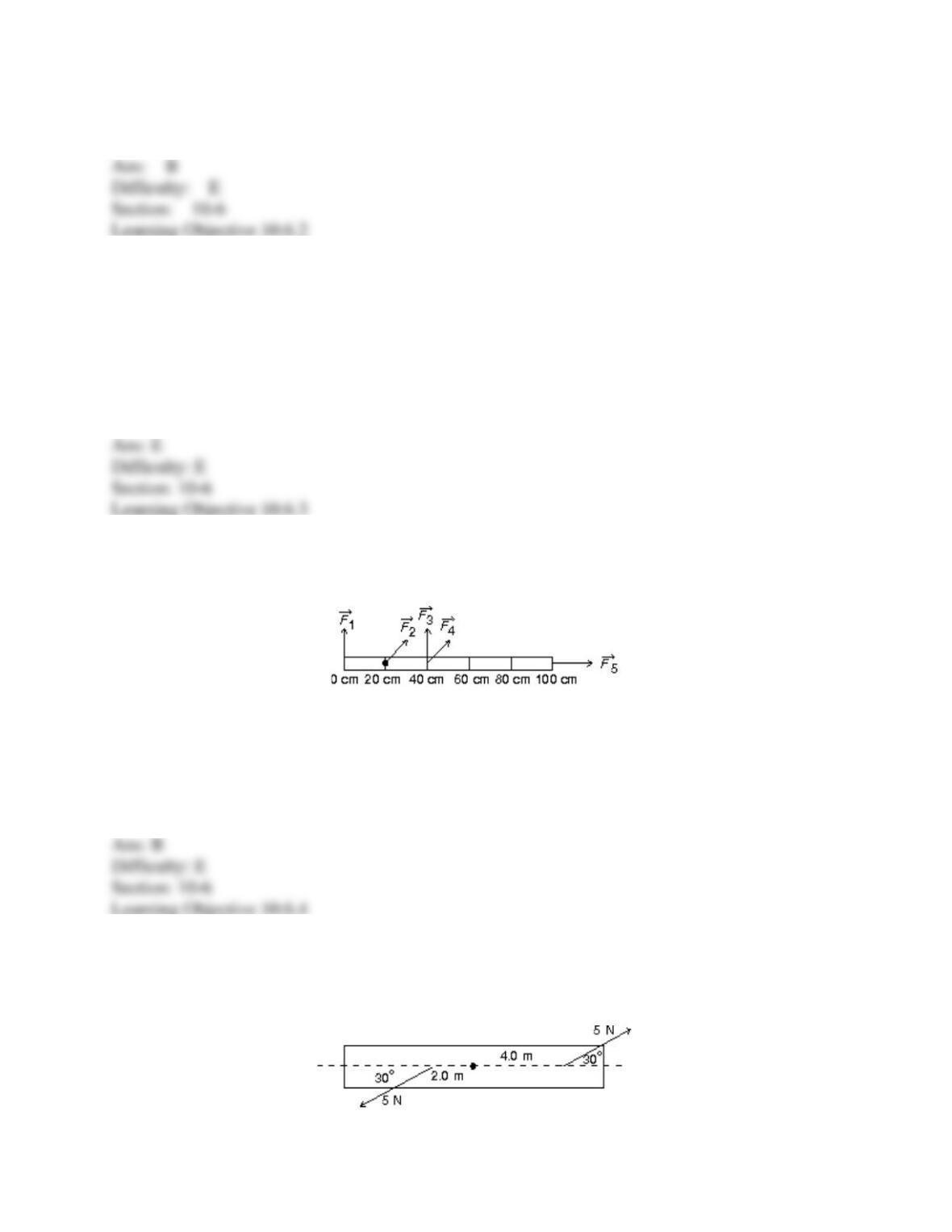
77. A rod is pivoted about its center. A 5-N force is applied 4 m from the pivot and another
5-N force is applied 2 m from the pivot, as shown. The magnitude of the total torque about the
pivot is:
A) 0 Nm
B) 5.0 Nm
C) 8.7 Nm
D) 15 Nm
E) 26 Nm
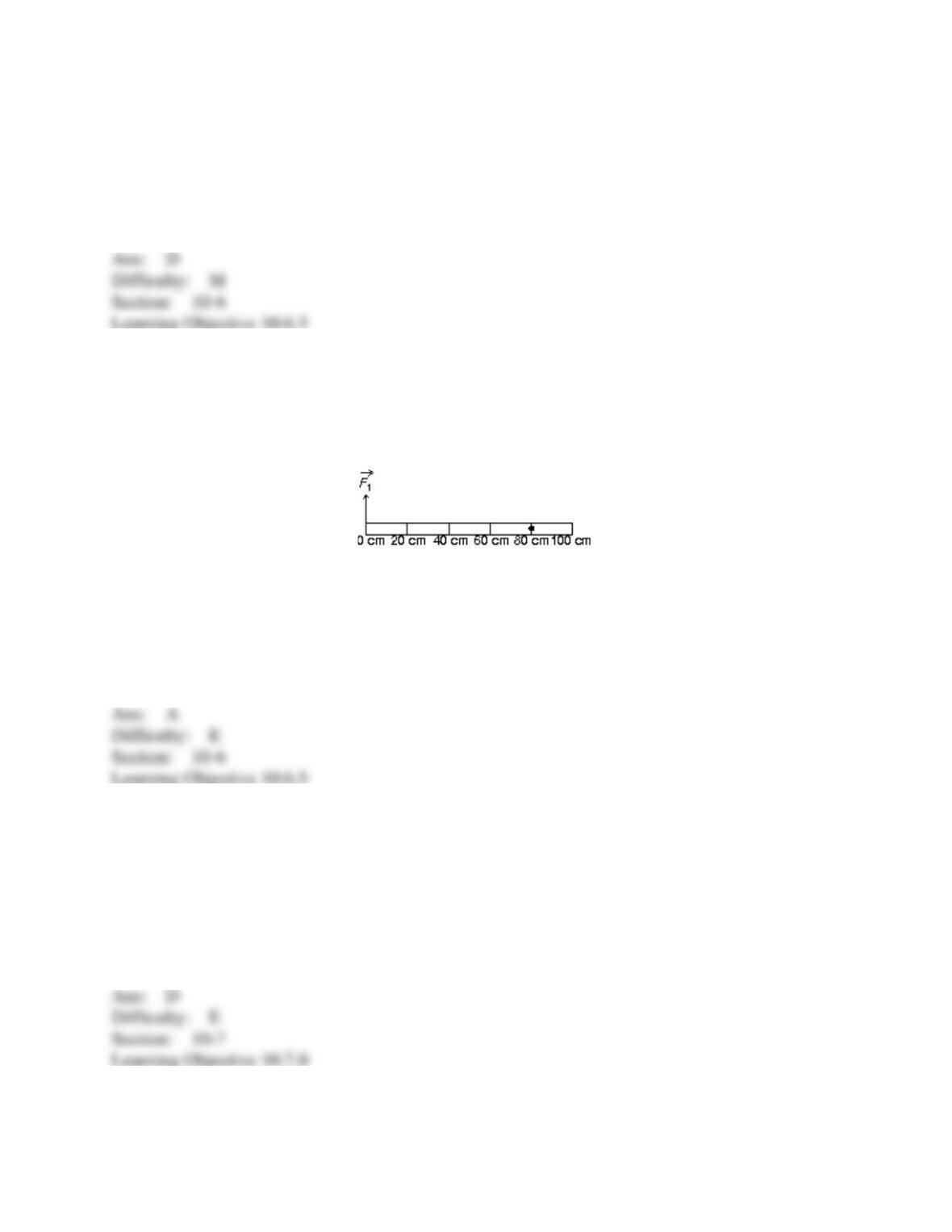
78. A meter stick on a horizontal frictionless table top is pivoted at the 80-cm mark. A
horizontal force 𝐹1
⃗
⃗
⃗
is applied perpendicularly to the end of the stick at 0 cm, as shown. A
second horizontal force 𝐹2
⃗
⃗
⃗
(not shown) is applied at the 100-cm end of the stick. If the stick
does not rotate:
A) |𝐹
2| > |𝐹
1| for all orientations of 𝐹2
⃗
⃗
⃗
B) |𝐹
2| < |𝐹
1| for all orientations of𝐹2
⃗
⃗
⃗
C) |𝐹
2| = |𝐹
1| for all orientations of 𝐹2
⃗
⃗
⃗
D) |𝐹
2| > |𝐹
1| for some orientations of 𝐹2
⃗
⃗
⃗
and |𝐹
2| < |𝐹
1| for others
E) |𝐹
2| > |𝐹
1| for some orientations of 𝐹2
⃗
⃗
⃗
and |𝐹
2| = |𝐹
1| for others
79. = I
for an object rotating about a fixed axis, where is the net torque acting on it, I is its
rotational inertia, and
is its angular acceleration. This expression:
A) is the definition of torque
B) is the definition of rotational inertia
C) is the definition of angular acceleration
D) follows directly from Newton’s second law
E) depends on a principle of physics that is unrelated to Newton’s second law
80. A uniform disk, a thin hoop, and a uniform solid sphere, all with the same mass and same
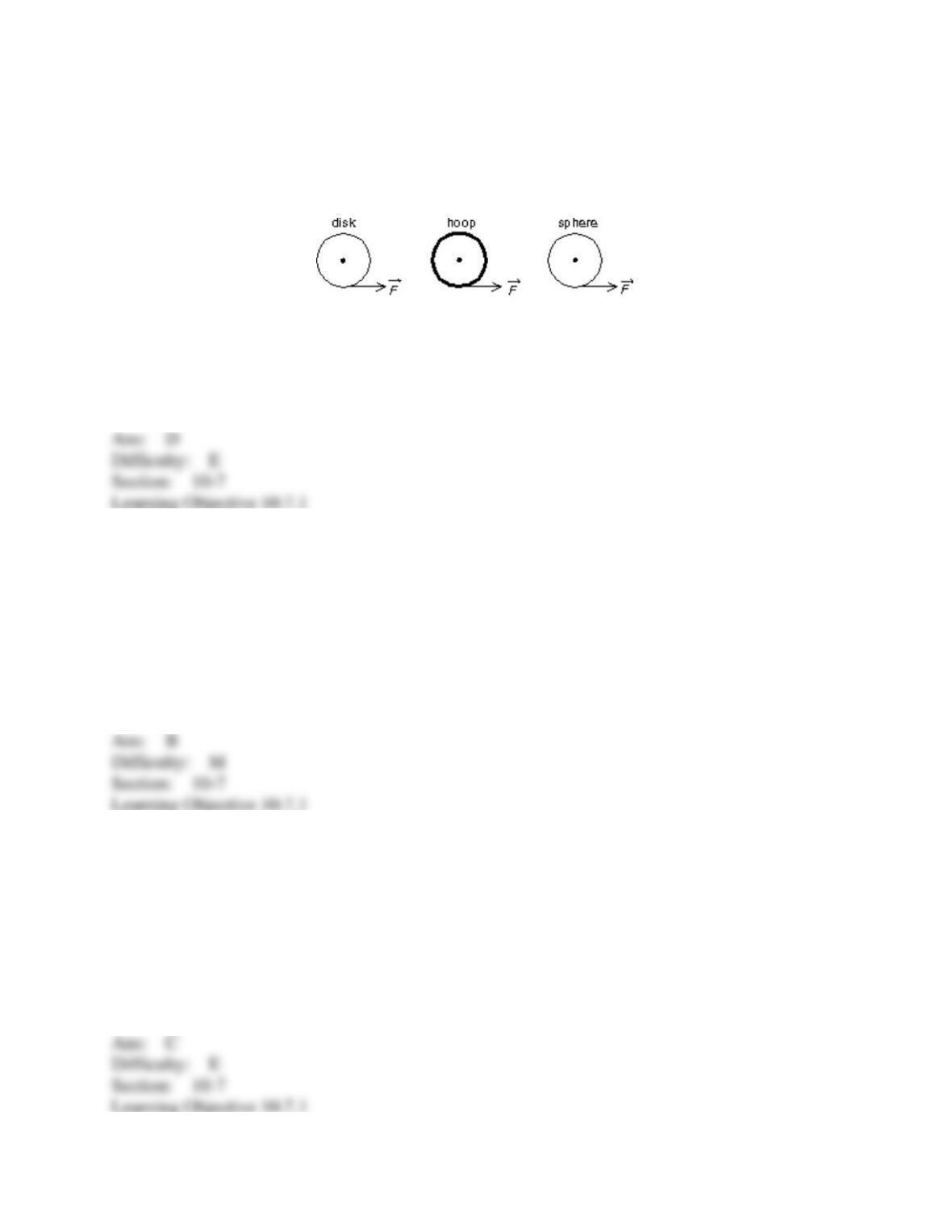
outer radius, are each free to rotate about a fixed axis through its center. Assume the hoop is
connected to the rotation axis by light spokes. With the objects starting from rest, identical forces
are simultaneously applied to the rims, as shown. Rank the objects according to their angular
velocities after a given time t, least to greatest.
A) disk, hoop, sphere
B) disk, sphere, hoop
C) hoop, sphere, disk
D) hoop, disk, sphere
E) sphere, disk, hoop
81. A cylinder is 0.10 m in radius and 0.20 m in length. Its rotational inertia, about the cylinder
axis on which it is mounted, is 0.020 kg m2. A string is wound around the cylinder and pulled
with a force of 1.0 N. The angular acceleration of the cylinder is:
A) 2.5 rad/s2
B) 5.0 rad/s2
C) 10 rad/s2
D) 15 rad/s2
E) 20 rad/s2
82. A disk with a rotational inertia of 2.0 kgm2 and a radius of 0.40 m rotates on a frictionless
fixed axis perpendicular to the disk faces and through its center. A force of 5.0 N is applied
tangentially to the rim. The angular acceleration of the disk is:
A) 0.40 rad/s2
B) 0.60 rad/s2
C) 1.0 rad/s2
D) 2.5 rad/s2
E) 10 rad/s2
83. A disk with a rotational inertia of 5.0 kgm2 and a radius of 0.25 m rotates on a frictionless
fixed axis perpendicular to the disk and through its center. A force of 8.0 N is applied along the
rotation axis. The angular acceleration of the disk is:
A) 0 rad/s2
B) 0.40 rad/s2
C) 0.60 rad/s2
D) 1.0 rad/s2
E) 2.5 rad/s2
84. A disk with a rotational inertia of 5.0 kg m2 and a radius of 0.25 m rotates on a frictionless
fixed axis perpendicular to the disk and through its center. A force of 8.0 N is applied
tangentially to the rim. If the disk starts at rest, then after it has turned through half a revolution
its angular velocity is:
A) 0.57 rad/s
B) 0.64 rad/s
C) 0.80 rad/s
D) 1.6 rad/s
E) 3.2 rad/s
85. A thin circular hoop of mass 1.0 kg and radius 2.0 m is rotating about an axis through its
center and perpendicular to its plane. It is slowing down at the rate of 7.0 rad/s2. The net torque
acting on it is:
A) 7.0 N∙m
B) 14 N∙m
C) 28 N∙m
D) 44 N∙m
E) none of these
86. A certain wheel has a rotational inertia of 12 kg∙m2. As it turns through 5.0 rev its angular
velocity increases from 5.0 rad/s to 6.0 rad/s. If the net torque is constant its value is:
A) 0.015 N∙m
B) 0.18 N∙m
C) 0.57 N∙m
D) 2.1 N∙m
E) 13 N∙m
87. An 8.0-cm radius disk with a rotational inertia of 0.12 kg∙m2 is free to rotate on a horizontal
axis. A string is fastened to the surface of the disk and a 10-kg mass hangs from the other end.
The mass is raised by using a crank to apply a 9.0-Nm torque to the disk. The acceleration of the
mass is:
A) 0.50 m/s2
B) 3.9 m/s2
C) 6.0 m/s2
D) 12 m/s2
E) 20 m/s2
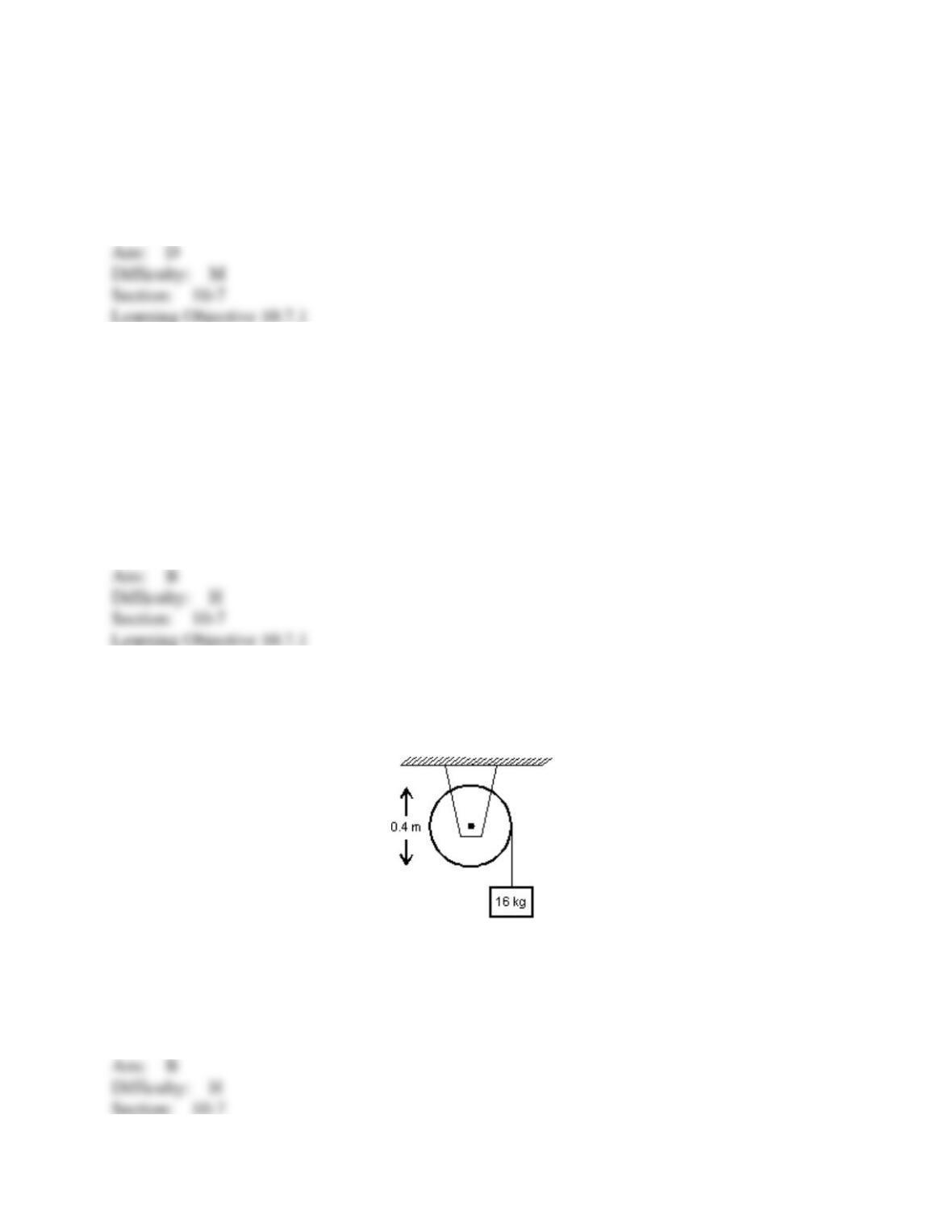
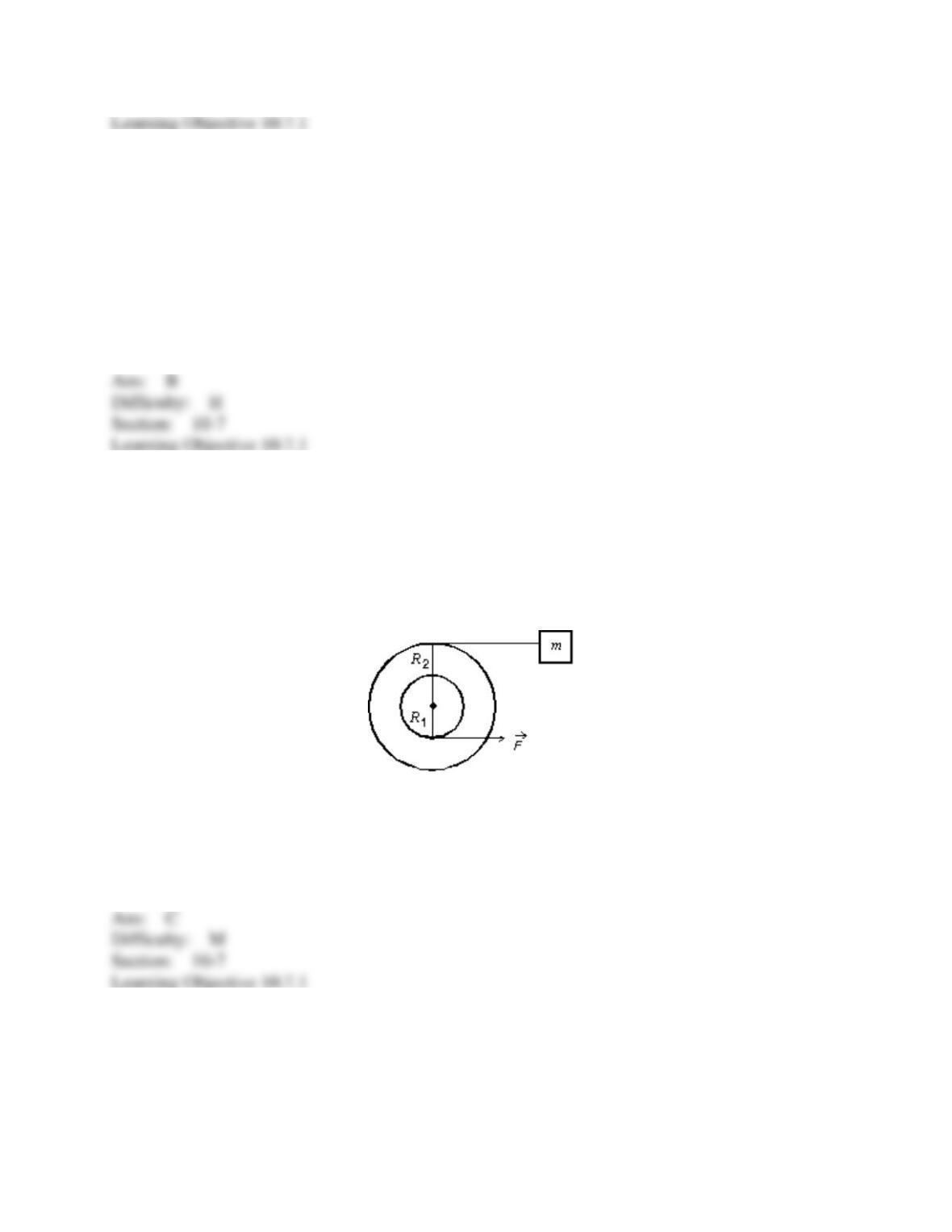
88. A 16 kg block is attached to a cord that is wrapped around the rim of a flywheel of
diameter 0.40 m and hangs vertically, as shown. The rotational inertia of the flywheel is 0.50
kg∙m2. When the block is released and the cord unwinds, the acceleration of the block is:
A) 0.15 g
B) 0.56 g
C) 0.84 g
D) 1.0 g
E) 1.3 g
89. A 0.70-kg disk with a rotational inertia given by MR2/2 is free to rotate on a fixed
horizontal axis suspended from the ceiling. A string is wrapped around the disk and a 2.0-kg
mass hangs from the free end. If the string does not slip then as the mass falls and the cylinder
rotates the suspension holding the cylinder pulls up on the mass with a force of:
A) 6.9 N
B) 9.8 N
C) 16 N
D) 26 N
E) 29 N
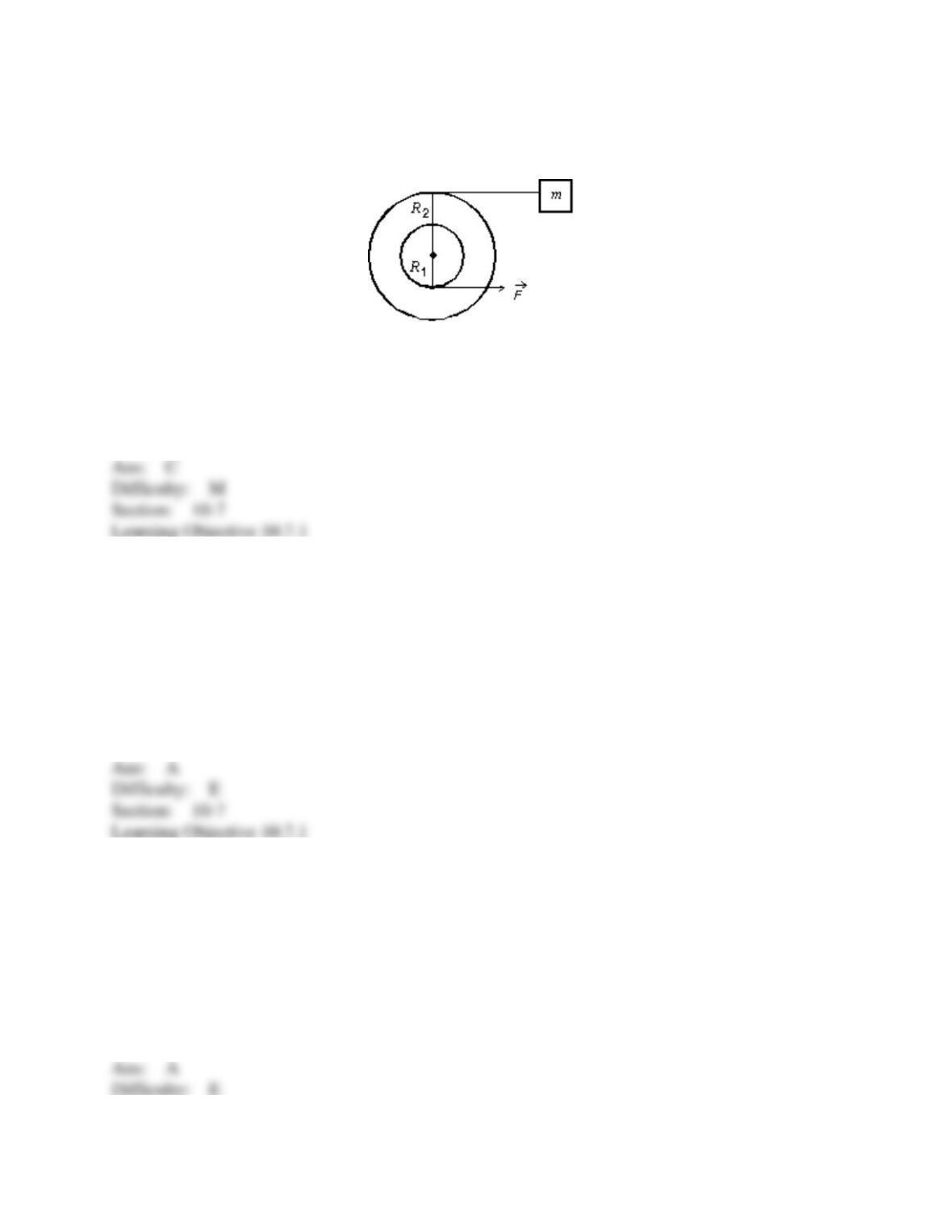
90. A small disk of radius R1 is mounted coaxially with a larger disk of radius R2. The disks are
securely fastened to each other and the combination is free to rotate on a fixed axle that is
perpendicular to a horizontal frictionless table top, as shown in the overhead view below. The
rotational inertia of the combination is I. A string is wrapped around the larger disk and attached
to a block of mass m, on the table. Another string is wrapped around the smaller disk and is
pulled with a force 𝐹
as shown. The acceleration of the block is:
A) R1F/mR2
B) R1R2F/(I – mR22)
C) R1R2F/(I + mR22)
D) R1R2F/(I – mR1R2)
E) R1R2F/(I + mR1R2)
91. A small disk of radius R1 is fastened coaxially to a larger disk of radius R2. The
combination is free to rotate on a fixed axle, which is perpendicular to a horizontal frictionless
table top, as shown in the overhead view below. The rotational inertia of the combination is I. A
string is wrapped around the larger disk and attached to a block of mass m, on the table. Another
string is wrapped around the smaller disk and is pulled with a force 𝐹
as shown. The tension in
the string pulling the block is:
A) R1F/R2
B) mR1R2F/(I – mR22)
C) mR1R2F/(I + mR22)
D) mR1R2F/(I – mR1R2)
E) mR1R2F/(I + mR1R2)
92. A block is attached to each end of a rope that passes over a pulley suspended from the
ceiling. The blocks do not have the same mass. If the rope does not slip on the pulley, then at any
instant after the blocks start moving, the rope:
A) pulls on both blocks, but exerts a greater force on the heavier block
B) pulls on both blocks, but exerts a greater force on the lighter block
C) pulls on both blocks and exerts the same magnitude force on both blocks
D) does not pull on either block
E) pulls only on the lighter block
93. A disk with a rotational inertia of 5.0 kg∙m2 and a radius of 0.25 m rotates on a fixed axis
perpendicular to the disk and through its center. A force of 2.0 N is applied tangentially to the
rim. As the disk turns through half a revolution the work done by the force is:
A) 1.6 J
B) 2.5 J
C) 6.3 J
D) 10 J
E) 40 J
94. A circular saw is powered by a motor. When the saw is used to cut wood, the wood exerts
a torque of 0.80 N∙m on the saw blade. If the blade rotates with a constant angular velocity of
20 rad/s the work done on the blade by the motor in 1.0 min is:
A) 0 J
B) 480 J
C) 960 J
D) 1500 J
E) 1800 J
95. A disk has a rotational inertia of 6.0 kg∙m2 and a constant angular acceleration of 2.0 rad/s2.
If it starts from rest the work done during the first 5.0 s by the net torque acting on it is:
A) 0 J
B) 30 J
C) 60 J
D) 300 J
E) 600 J
96. A disk starts from rest and rotates around a fixed axis, subject to a constant net torque. The
work done by the torque during the second 5 s is ______ as the work done during the first 5 s.
A) the same
B) half as much
C) twice as much
D) three times as much
E) four times as much
97. A disk starts from rest and rotates about a fixed axis, subject to a constant net torque. The
work done by the torque during the second revolution is ______ as the work done during the first
revolution.
A) the same
B) twice as much
C) half as much
D) four times as much
E) one fourth as much
98. A torque of 170 N∙m does 4700 J of work on a rotating flywheel. If the flywheel’s initial
kinetic energy is 1500 J, what is its final kinetic energy?
A) 1500 J
B) 3200 J
C) 4700 J
D) 6200 J
E) cannot be calculated without knowing the rotational inertia of the flywheel
99. A constant torque of 260 N∙m acts on a flywheel. If the flywheel makes 25 complete
revolutions, how much work has been done by the torque on the flywheel?
A) 1.7 J
B) 41 J
C) 600 J
D) 6.5 x 10³ J
E) 4.1 x 10⁴ J
100. A constant torque of 260 N∙m acts on a flywheel. If the flywheel makes 25 complete
revolutions in 2 minutes, what is the power exerted by the torque?
A) 54 W
B) 200 W
C) 340 W
D) 3.3 x 10³ W
E) 2.0 x 10⁴ W
101. A torque of 470 N∙m acts on a flywheel. At the instant that the flywheel’s angular speed is
56 rad/s, at what rate is work being done by the torque?
A) 8.4 W
B) 26 W
C) 112 W
D) 4200 W
E) 2.6 x 10⁴ W