Chapter: Chapter 16
Learning Objectives
LO 16.1.0 Solve problems related to transverse waves.
LO 16.1.1 Identify the three main types of waves.
LO 16.1.2 Distinguish between transverse waves and longitudinal waves.
LO 16.1.3 Given a displacement function for a traverse wave, determine amplitude ym, angular
wave number k, angular frequency ω, phase constant φ, and direction of travel, and calculate the
phase kx + ωτ + φ and the displacement at any given time and position.
LO 16.1.4 Given a displacement function for a traverse wave, calculate the time between two
given displacements.
LO 16.1.5 Sketch a graph of a transverse wave as a function of position, identifying amplitude
ym, wavelength λ, where the slope is greatest, where it is zero, and where the string elements
have positive velocity, negative velocity, and zero velocity.
LO 16.1.6 Given a graph of displacement versus time for a transverse wave, determine
amplitude ym and period T.
LO 16.1.7 Describe the effect on a transverse wave of changing phase constant φ.
LO 16.1.8 Apply the relation between the wave speed v, the distance traveled by the wave, and
the time required for that travel.
LO 16.1.9 Apply the relationships between wave speed v, angular frequency ω, angular wave
number k, wavelength λ, period T, and frequency f.
LO 16.1.10 Describe the motion of a string element as a transverse wave moves through its
location, and identify when its transverse speed is zero and when it is maximum.
LO 16.1.11 Calculate the transverse velocity u(t) of a string element as a transverse wave
moves through its location.
LO 16.1.12 Calculate the transverse acceleration a(t) of a string element as a transverse wave
moves through its location.
LO 16.1.13 Given a graph of displacement, transverse velocity, or transverse acceleration,
determine the phase constant.
LO 16.2.0 Solve problems related to wave speed on a stretched string.
LO 16.2.1 Calculate the linear density μ of a uniform string in terms of the total mass and total
length.
LO 16.2.2 Apply the relationship between wave speed v, tension τ, and linear density μ.
LO 16.3.0 Solve problems related to energy and power of a wave traveling along a string.
LO 16.3.1 Calculate the average rate at which energy is transported by a transverse wave.
LO 16.4.0 Solve problems related to the wave equation.
LO 16.4.1 For the equation giving a string-element displacement as a function of position x and
time t, apply the relationship between the second derivative with respect to x and the second
derivative with respect to t.
LO 16.5.0 Solve problems related to interference of waves.
LO 16.5.1 Apply the principle of superposition to show that two overlapping waves add
algebraically to give a resultant (or net) wave.
LO 16.5.2 For two transverse waves with the same amplitude and wavelength and that travel
together, find the displacement equation for the resultant wave and calculate the amplitude in
terms of the individual wave amplitude and the phase difference.
LO 16.5.3 Describe how the phase difference between two transverse waves (with the same
amplitude and wavelength) can result in fully constructive interference, fully destructive
interference, and intermediate interference.
LO 16.5.4 With the phase difference between two interfering waves expressed in terms of
wavelengths, quickly determine the type of interference the waves have.
LO 16.6.0 Solve problems related to phasors.
LO 16.6.1 Using sketches, explain how a phasor can represent the oscillations of a string element
as a wave travels through its location.
LO 16.6.2 Sketch a phasor diagram for two overlapping waves traveling together on a string,
indicating their amplitudes and phase difference on the sketch.
LO 16.6.3 By using phasors, find the resultant wave of two transverse waves traveling together
along a string, calculating the amplitude and phase and writing out the displacement equation.
LO 16.7.0 Solve problems related to standing waves and resonance.
LO 16.7.1 For two overlapping waves (same amplitude and wavelength) that are traveling in
opposite directions, sketch snapshots of the resultant wave, indicating nodes and antinodes.
LO 16.7.2 For two overlapping waves (same amplitude and wavelength) that are traveling in
opposite directions, find the displacement equation for the resultant wave and calculate the
amplitude in terms of the individual wave amplitude.
LO 16.7.3 Describe the SHM of a string element at an antinode of a standing wave.
LO 16.7.4 For a string element at an antinode of a standing wave, write equations for the
displacement, transverse velocity, and transverse acceleration as functions of time.
LO 16.7.5 Distinguish between “hard” and “soft” reflections of string waves at a boundary.
LO 16.7.6 Describe resonance on a string tied taut between two supports, and sketch the first
several standing-wave patterns, indicating nodes and antinodes.
LO 16.7.7 In terms of string length, determine the wavelengths required for the first several
harmonics on a string under tension.
LO 16.7.8 For any given harmonic, apply the relationship between frequency, wave speed, and
string length.
Multiple Choice
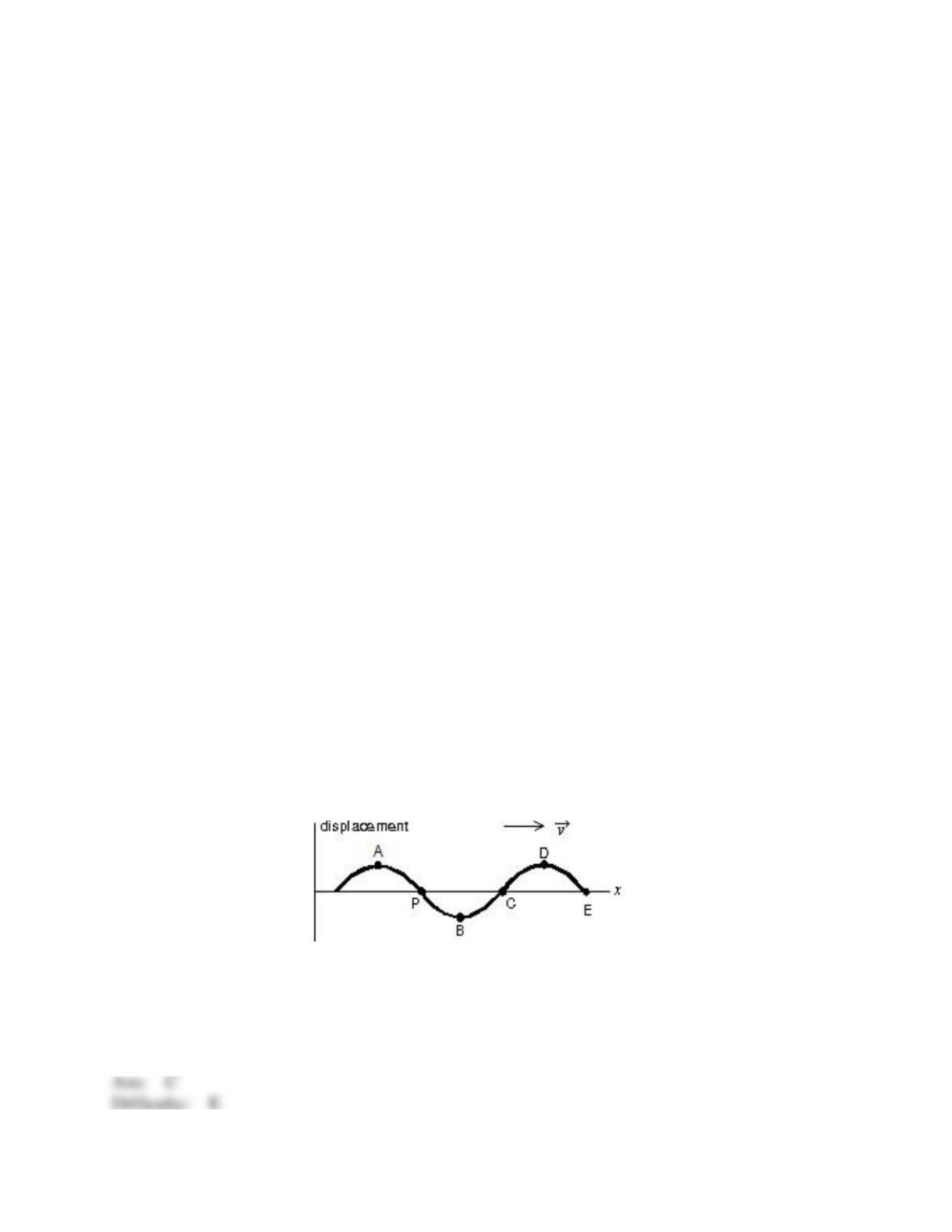
1. A traveling sinusoidal wave is shown below. At which point is the motion 180 out of phase
with the motion at point P?
A) A
B) B
C) C
D) D
E) E
2. What are the three main types of waves?
A) transverse, longitudinal, linear
B) plane, spherical, transverse
C) mechanical, electromagnetic, matter
D) transverse, linear, water
E) plane, longitudinal, mechanical
3. What is the difference between transverse and longitudinal waves?
A) Mechanical waves are transverse waves while electromagnetic waves are longitudinal.
B) Plane waves are transverse waves while spherical waves are longitudinal.
C) Only longitudinal waves transmit matter.
D) Only transverse waves transmit energy.
E) In transverse waves the displacement is perpendicular to the direction of propagation of the
wave, while in longitudinal waves the displacement is parallel to the direction of propagation.
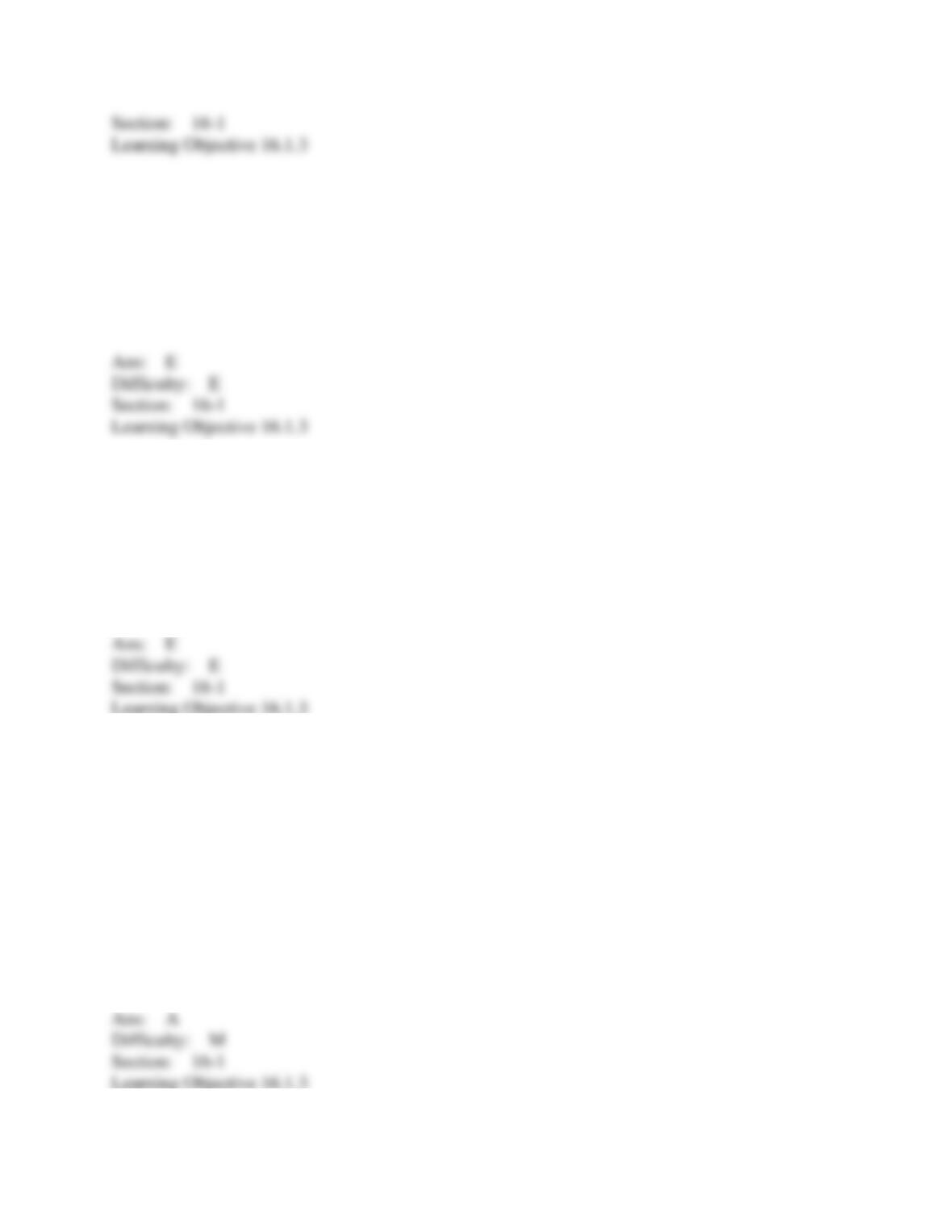
4. Three traveling sinusoidal waves are on identical strings, with the same tension. The
mathematical forms of the waves are y1(x,t) = ymsin(3x – 6t), y2(x,t) = ymsin(4x – 8t), and y3(x,t) =
ymsin(6x – 12t), where x is in meters and t is in seconds. Match each mathematical form to the
appropriate graph below.
A) y1: i, y2: ii, y3: iii
B) y1: iii, y2: ii, y3: i
C) y1:i, y2: iii, y3: ii
D) y1: ii, y2: i, y3: iii
E) y1: iii, y2: i, y3: ii
5. A wave is described by y(x,t) = 0.1 sin(3x + 10t), where x is in meters, y is in centimeters
and t is in seconds. The angular wave number is:
A) 0.10 rad/m
B) 3 rad/m
C) 10 rad/m
D) 10 rad/m
E) 3.0 rad/m
6. A wave is described by y(x,t) = 0.1 sin(3x – 10t), where x is in meters, y is in centimeters and
t is in seconds. The angular frequency is:
A) 0.10 rad/s
B) 3.0 rad/s
C) 10 rad/s
D) 20 rad/s
E) 10 rad/s
7. The displacement of a string carrying a traveling sinusoidal wave is given by
y(x,t) = ymsin(kx –
t –
).
At time t = 0 the point at x = 0 has a displacement of 0 and is moving in the positive y direction.
The phase constant
is:
A) 0
B) 90
C) 135
D) 180
E) 270
8. The displacement of a string carrying a traveling sinusoidal wave is given by
y(x,t) = ymsin(kx –
t –
).
At time t = 0 the point at x = 0 has a velocity of 0 and a positive displacement. The phase
constant
is:
A) 45
B) 90
C) 135
D) 180
E) 270
9. The displacement of a string carrying a traveling sinusoidal wave is given by
y(x,t) = ymsin(kx –
t –
).
At time t = 0 the point at x = 0 has velocity v0 and displacement y0. The phase constant
is given
by tan
=:
A) v0/
y0
B)
y0/v0
C)
v0/y0
D) y0/
v0
E)
v0y0
10. A wave is described by y(x,t) = 0.1 sin(3x – 10t), where x is in meters, y is in centimeters and
t is in seconds. At time t = 0, the point at x = 0 has a vertical displacement y = 0.0 cm. When is
its displacement equal to 0.1 cm?
A) 0.16 s
B) 0.47 s
C) 2.5 s
D) 7.5 s
E) 10 s
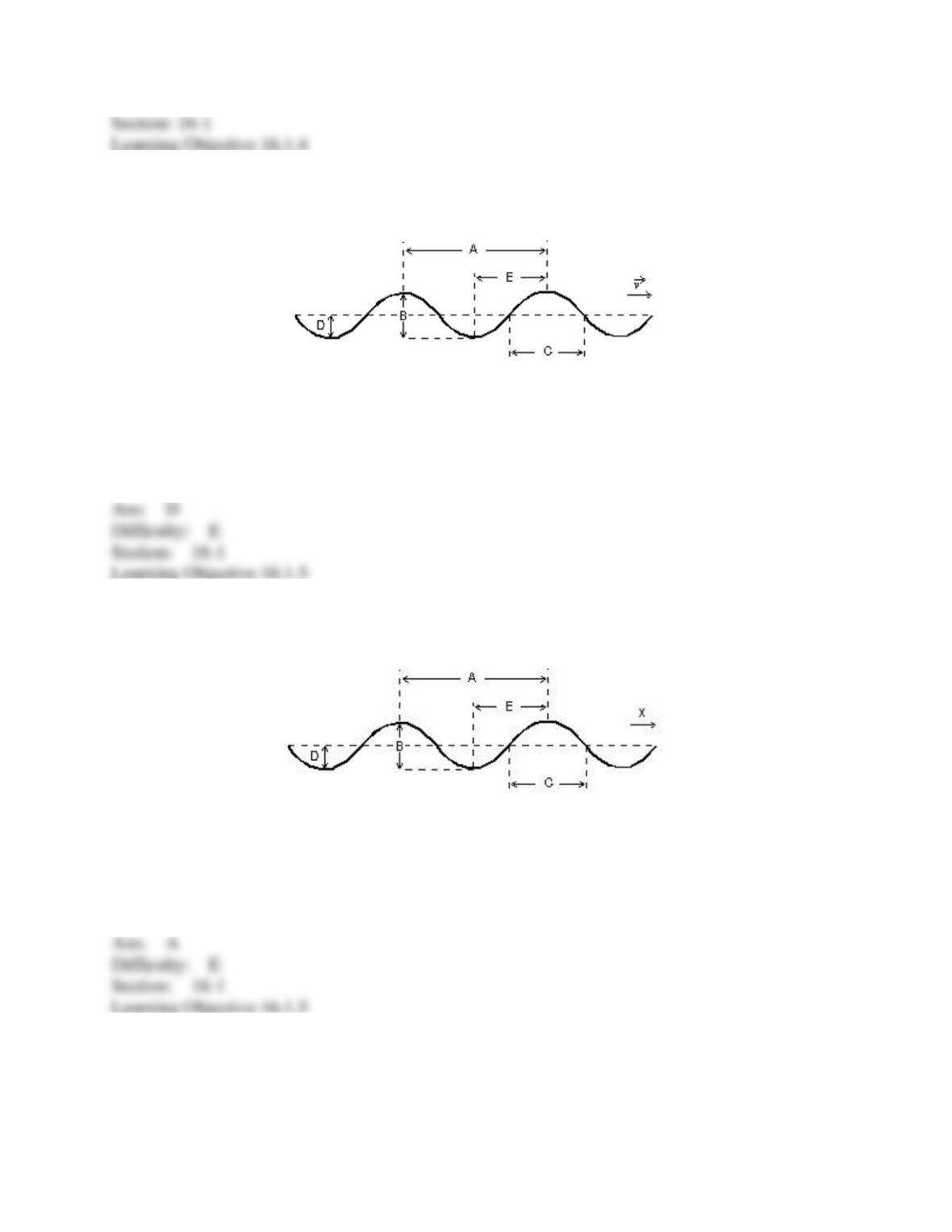
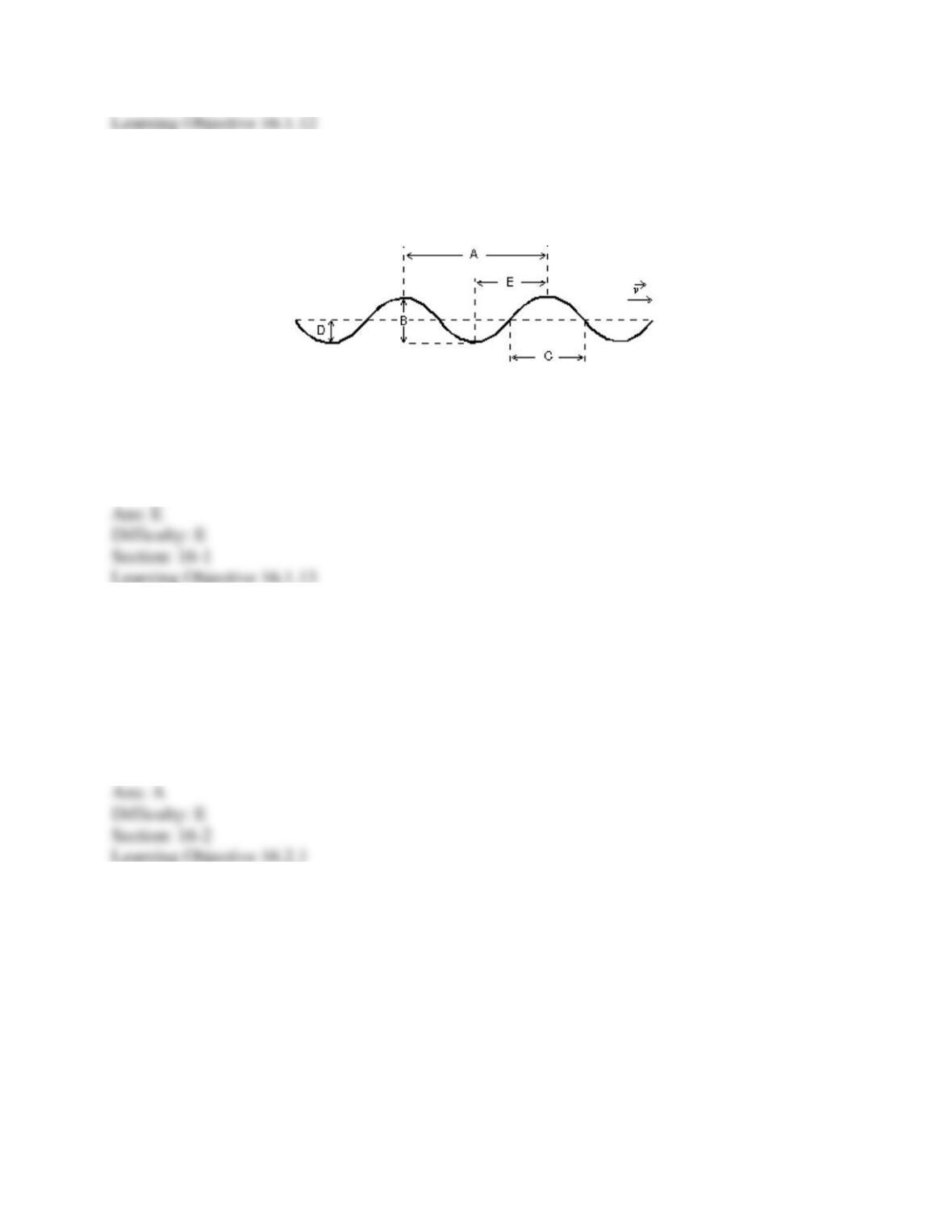
11. A sinusoidal wave is traveling toward the right as shown. Which letter correctly labels the
amplitude of the wave?
A) A
B) B
C) C
D) D
E) E
12. A sinusoidal wave is traveling toward the right as shown. Which letter correctly labels the
wavelength of the wave?
A) A
B) B
C) C
D) D
E) E
13. In the diagram below, the interval PQ represents:
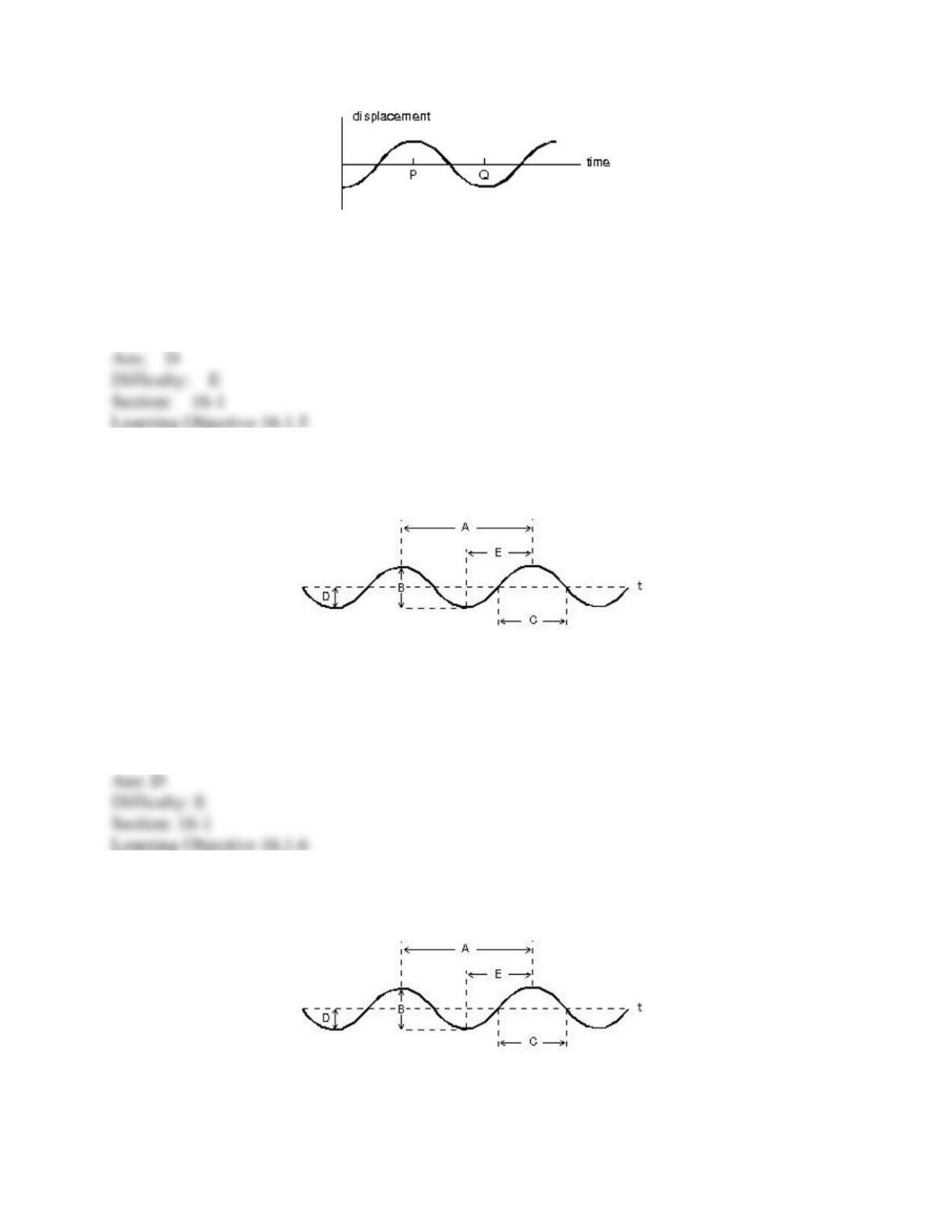
A) wavelength/2
B) wavelength
C) 2 amplitude
D) period/2
E) period
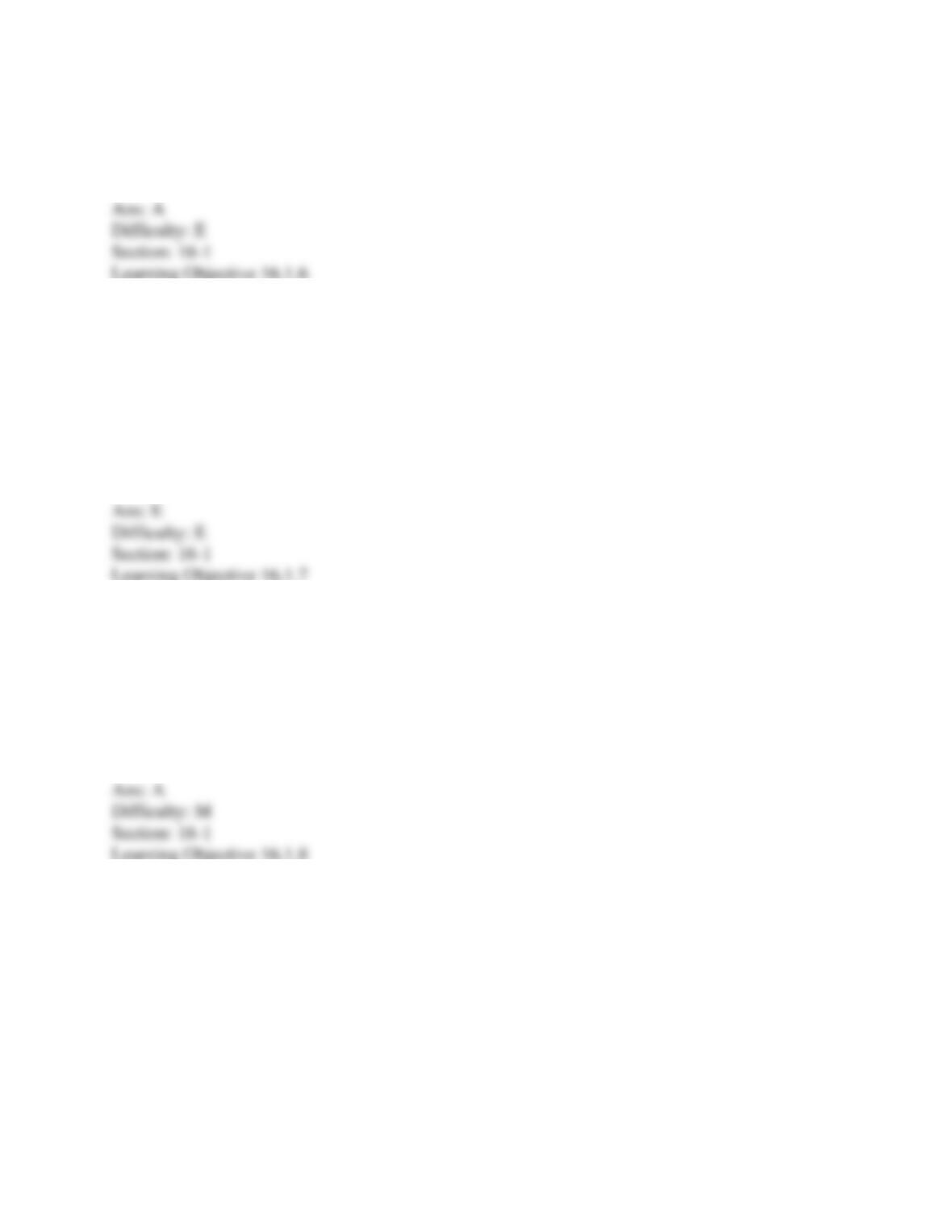
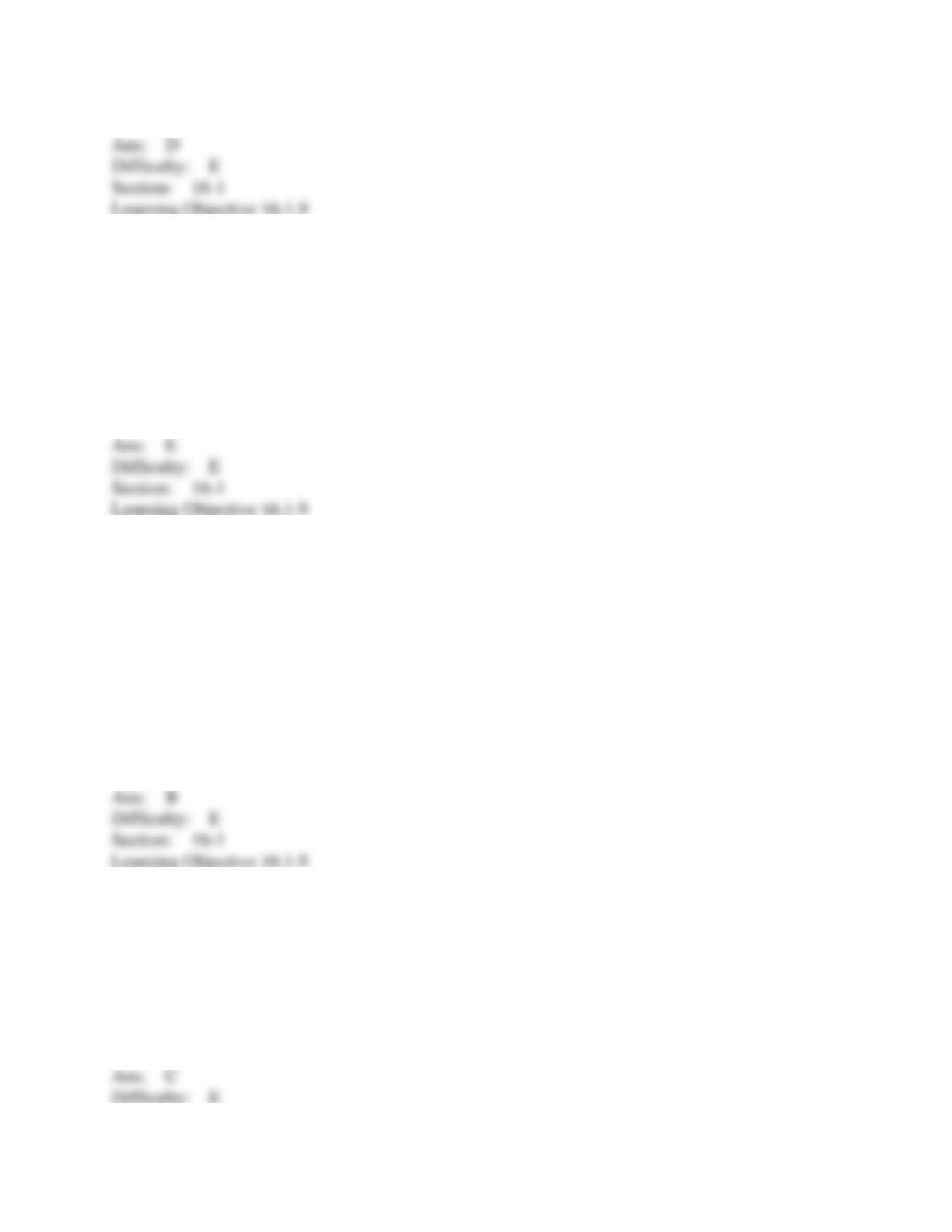
14. This plot shows the displacement of a string as a function of time, as a sinusoidal wave
travels along it. Which letter corresponds to the amplitude of the wave?
A) A
B) B
C) C
D) D
E) E
15. This plot shows the displacement of a string as a function of time, as a sinusoidal wave
travels along it. Which letter corresponds to the period of the wave?
A) A
B) B
C) C
D) D
E) E
16. Two waves are traveling on two different strings. The displacement of one is given by y1(x,t)
= ymsin(kx +
t) and of the other by y2(x,t) = ymsin(kx +
t + φ). What is the difference between
these two waves?
A) The displacement of wave y1 is always greater than the displacement of wave y2.
B) Wave y1 has a smaller amplitude than wave y2.
C) Wave y1 has a higher frequency than wave y2.
D) Wave y1 has a shorter wavelength than wave y2.
E) The two waves are identical except for their displacement at time t = 0.
17. A wave is described by y(x,t) = 0.1 sin(3x – 10t), where x is in meters, y is in centimeters and
t is in seconds. How long does it take the wave to travel 2.0 m?
A) 0.6 s
B) 1.0 s
C) 3.0 s
D) 6.7 s
E) 10 s
18. The displacement of a string is given by
y(x,t) = ymsin(kx +
t).
The wavelength of the wave is:
A) 2k/
B) k/
C)
k
D) 2/k
E) k/2
19. For a transverse wave on a string the string displacement is described by y(x,t) = f(x–at)
where f is a given function and a is a positive constant. Which of the following does NOT
necessarily follow from this statement?
A) The shape of the string at time t = 0 is given by f(x).
B) The shape of the waveform does not change as it moves along the string.
C) The waveform moves in the positive x direction.
D) The speed of the waveform is a.
E) The speed of the waveform is x/t.
20. The displacement of a string is given by
y(x,t) = ymsin(kx +
t).
The speed of the wave is:
A) 2k/
B)
/k
C)
k
D) 2/k
E) k/2
21. Water waves in the sea are observed to have a wavelength of 300 m and a frequency of
0.07 Hz. The speed of these waves is:
A) 0.00023 m/s
B) 2.1 m/s
C) 21 m/s
D) 4300 m/s
E) none of these
22. Sinusoidal water waves are generated in a large ripple tank. The waves travel at 20 cm/s
and their adjacent crests are 5.0 cm apart. The time required for each new whole cycle to be
generated is:
A) 100 s
B) 4.0 s
C) 2.0 s
D) 0.5 s
E) 0.25 s
23. For a given medium, the frequency of a wave is:
A) independent of wavelength
B) proportional to wavelength
C) inversely proportional to wavelength
D) proportional to the amplitude
E) inversely proportional to the amplitude
24. Let f be the frequency, v the speed, and T the period of a sinusoidal traveling wave. The
correct relationship is:
A) f = 1/T
B) f = v + T
C) f = vT
D) f = v/T
E) f = T/v
25. Let f be the frequency, v the speed, and T the period of a sinusoidal traveling wave. The
angular frequency is given by:
A) 1/T
B) 2/T
C) vT
D) f/T
E) T/f
26. A source of frequency f sends waves of wavelength traveling with speed v in some
medium. If the frequency is changed from f to 2f, then the new wavelength and new speed are
(respectively):
A) 2, v
B) /2, v
C) , 2v
D) , v/2
E) /2, 2v
27. A long string is constructed by joining the ends of two shorter strings. The tension in the
strings is the same but string I has 4 times the linear mass density of string II. When a sinusoidal
wave passes from string I to string II:
A) the frequency decreases by a factor of 4
B) the frequency decreases by a factor of 2
C) the wavelength decreases by a factor of 4
D) the wavelength decreases by a factor of 2
E) the wavelength increases by a factor of 2
28. A sinusoidal transverse wave is traveling on a string. Any point on the string:
A) moves in the same direction as the wave
B) moves in simple harmonic motion with a different frequency than that of the wave
C) moves in simple harmonic motion with the same angular frequency as the wave
D) moves in uniform circular motion with a different angular speed than the wave
E) moves in uniform circular motion with the same angular speed as the wave
29. Any point on a string carrying a sinusoidal wave is moving with its maximum speed when:
A) the magnitude of its acceleration is a maximum
B) the magnitude of its displacement is a maximum
C) the magnitude of its displacement is a minimum
D) the magnitude of its displacement is half the amplitude
E) the magnitude of its displacement is one fourth the amplitude
30. Here are equations for three waves traveling on separate strings. Rank them according to
the maximum transverse speed, least to greatest.
wave 1: y(x,t) = (2.0 mm) sin [(4.0 m–1)x – (3.0 s–1)t]
wave 2: y(x,t) = (1.0 mm) sin [(8.0 m–1)x – (4.0 s–1)t]
wave 3: y(x,t) = (1.0 mm) sin [(4.0 m–1)x – (8.0 s–1)t]
A) 1, 2, 3
B) 1, 3, 2
C) 2, 1, 3
D) 2, 3, 1
E) 3, 1, 2
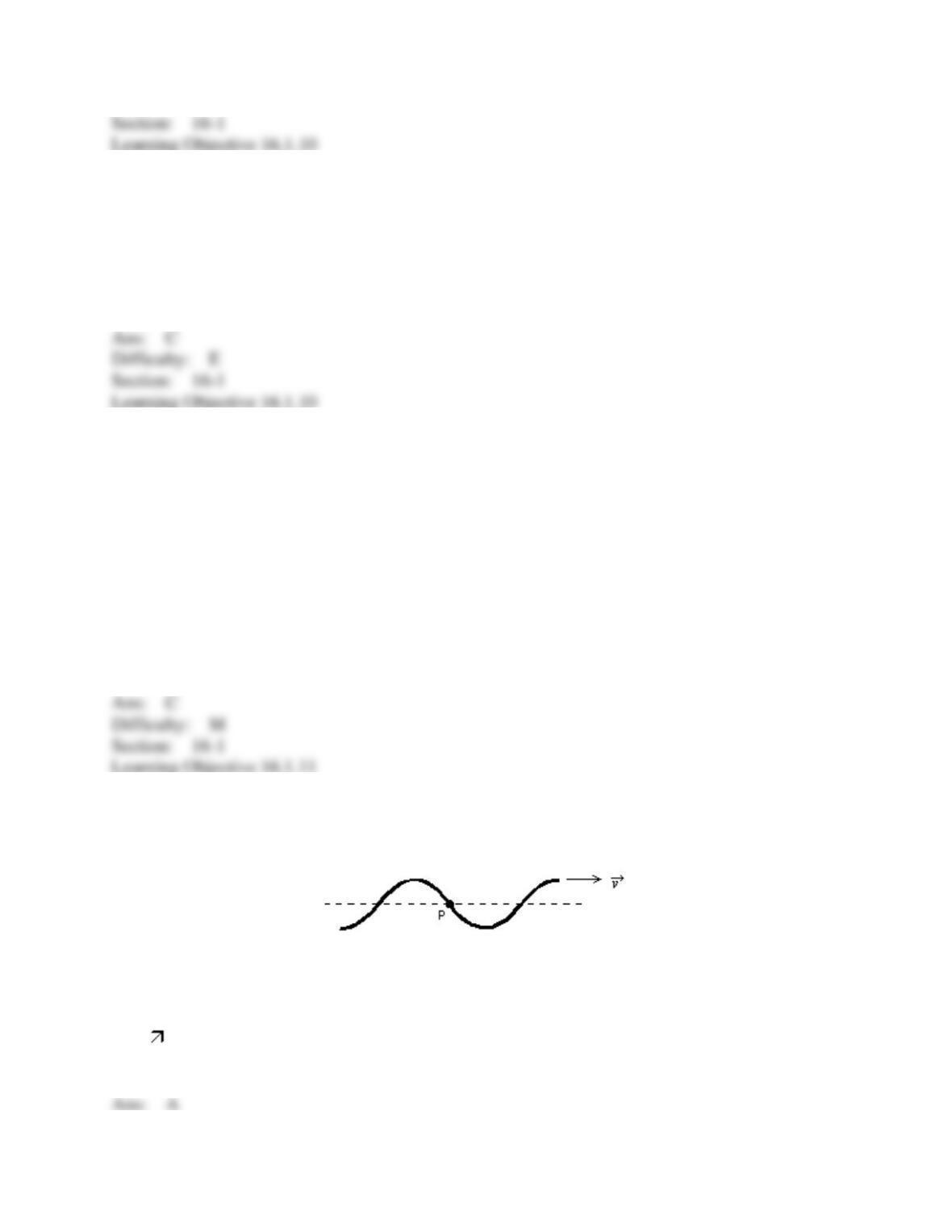
31. The transverse wave shown is traveling from left to right in a medium. The direction of the
instantaneous velocity of the medium at point P is:
A)
B)
C) →
D)
E) no direction since v = 0
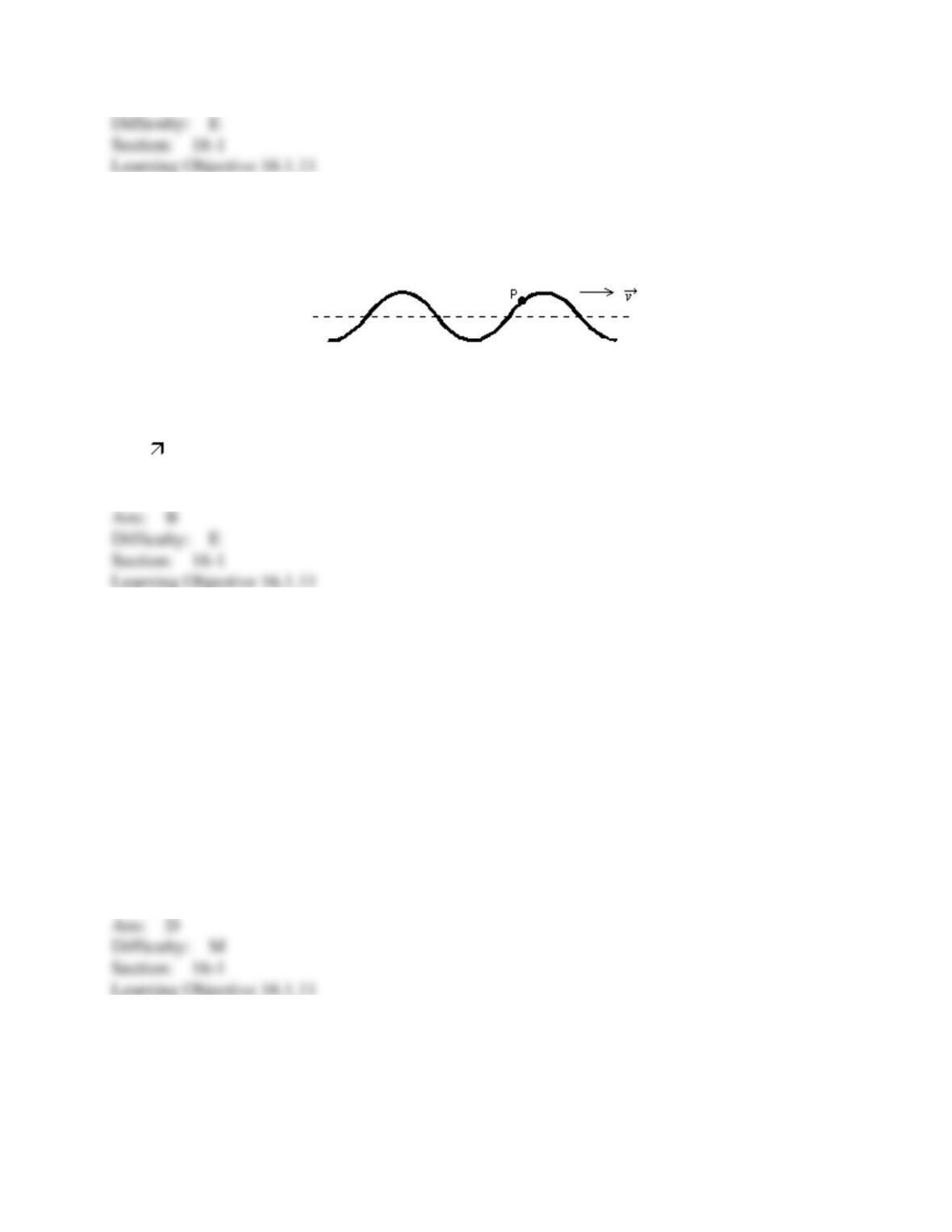
32. A wave traveling to the right on a stretched string is shown below. The direction of the
instantaneous velocity of the point P on the string is:
A)
B)
C) →
D)
E) no direction since v = 0
33. The mathematical forms for the three sinusoidal traveling waves are given by
wave 1: y(x,t) = (2 cm) sin (3x – 6t)
wave 2: y(x,t) = (3 cm) sin (4x – 12t)
wave 3: y(x,t) = (4 cm) sin (5x – 11t)
where x is in meters and t is in seconds. Of these waves:
A) wave 1 has the greatest wave speed and the greatest maximum transverse string speed
B) wave 2 has the greatest wave speed and wave 1 has the greatest maximum transverse string
speed
C) wave 3 has the greatest wave speed and the greatest maximum transverse string speed
D) wave 2 has the greatest wave speed and wave 3 has the greatest maximum transverse string
speed
E) wave 3 has the greatest wave speed and wave 2 has the greatest maximum transverse string
speed
34. Suppose the maximum speed of a string carrying a sinusoidal wave is vs. When the
displacement of a point on the string is half its maximum, the speed of the point is:
A) vs/2
B) 2vs
C) vs/4
D) 3vs/4
E) √3 vs/2
35. A string carries a sinusoidal wave with an amplitude of 2.0 cm and a frequency of 100 Hz.
The maximum speed of any point on the string is:
A) 2.0 m/s
B) 4.0 m/s
C) 6.3 m/s
D) 13 m/s
E) unknown (not enough information is given)
36. A transverse traveling sinusoidal wave on a string has a frequency of 100 Hz, a wavelength
of 0.040 m and an amplitude of 2.0 mm. The maximum velocity of any point on the string is:
A) 0.20 m/s
B) 1.3 m/s
C) 4.0 m/s
D) 15 m/s
E) 25 m/s
37. A transverse traveling sinusoidal wave on a string has a frequency of 100 Hz, a wavelength
of 0.040 m and an amplitude of 2.0 mm. The maximum acceleration of any point on the string is:
A) 0 m/s2
B) 200 m/s2
C) 390 m/s2
D) 790 m/s2
E) 1600 m/s2
38. In the figure, a wave is traveling from left to right. If the point marked “D” represents the
origin at time t = 0, and the displacement of the wave is given by y(x,t) = ymsin(kx –
t –
), what
is the phase constant
A) 0
B) π/6
C) π/4
D) π/2
E) 3π/2
39. A transverse wave travels on a string of length 1.3 m and diameter 1.1 mm, whose mass is 10
g and which is under a tension of 16 N. What is the linear mass density of the string?
A) 7.7 x 10⁻³ kg/m
B) 0.13 kg/m
C) 7.7 kg/m
D) 46 kg/m
E) 130 kg/m
40. Sinusoidal waves travel on five identical strings. Four of the strings have the same tension,
but the fifth has a different tension. Use the mathematical forms of the waves, gives below, to
identify the string with the different tension. In the expressions given below x and y are in
centimeters and t is in seconds.
A) y(x,t) = (2 cm) sin (2x – 4t)
B) y(x,t) = (2 cm) sin (4x – 10t)
C) y(x,t) = (2 cm) sin (6x – 12t)
D) y(x,t) = (2 cm) sin (8x – 16t)
E) y(x,t) = (2 cm) sin (10x – 20t)