41. The speed of a sinusoidal wave on a string depends on:
A) the frequency of the wave
B) the wavelength of the wave
C) the length of the string
D) the tension in the string
E) the amplitude of the wave
42. The time required for a small pulse to travel from A to B on a stretched cord shown is NOT
altered by changing:
A) the linear mass density of the cord
B) the length between A and B
C) the shape of the pulse
D) the tension in the cord
E) none of the above (changes in all alter the time)
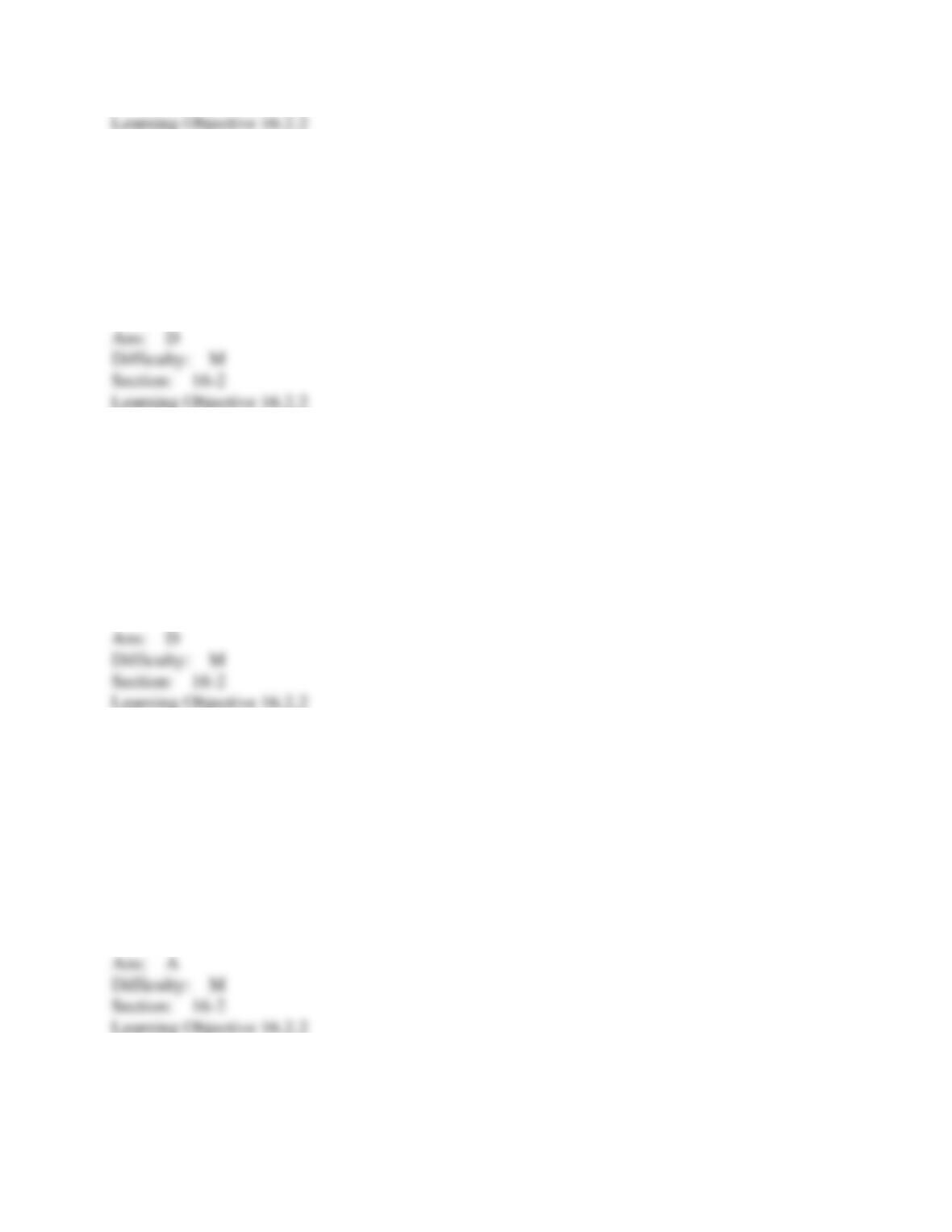
43. The diagram shows three identical strings that have been put under tension by suspending
masses of 5 kg each. For which is the wave speed the greatest?
A) 1
B) 2
C) 3
D) 1 and 3 tie
E) 2 and 3 tie
44. The tension in a string with a linear density of 0.0010 kg/m is 0.40 N. A 100 Hz sinusoidal
wave on this string has a wavelength of:
A) 0.20 cm
B) 2.0 cm
C) 5.0 cm
D) 20 cm
E) 400 cm
45. When a 100-Hz oscillator is used to generate a sinusoidal wave on a certain string the
wavelength is 10 cm. When the tension in the string is doubled the generator produces a wave
with a frequency and wavelength of:
A) 200 Hz and 20 cm
B) 141 Hz and 10 cm
C) 100 Hz and 20 cm
D) 100 Hz and 14 cm
E) 50 Hz and 14 cm
46. Three separate strings are made of the same material. String 1 has length L and tension ,
string 2 has length 2L and tension 2 and string 3 has length 3L and tension 3. A pulse is started
at one end of each string. If the pulses start at the same time, the order in which they reach the
other end is:
A) 1, 2, 3
B) 3, 2, 1
C) 2, 3, 1
D) 3, 1, 2
E) they all take the same time
47. A long string is constructed by joining the ends of two shorter strings. The tension in the
strings is the same but string I has 4 times the linear mass density of string II. When a sinusoidal
wave passes from string I to string II:
A) the frequency decreases by a factor of 4
B) the frequency decreases by a factor of 2
C) the wave speed decreases by a factor of 4
D) the wave speed decreases by a factor of 2
E) the wave speed increases by a factor of 2
48. A stretched string, clamped at its ends, vibrates at a particular frequency. To double that
frequency, one can change the string tension by a factor of:
A) 2
B) 4
C) √2
D) 1/2
E) 1/√2
49. Two identical but separate strings, with the same tension, carry sinusoidal waves with the
same amplitude. Wave A has a frequency that is twice that of wave B and transmits energy at a
rate that is __________ that of wave B.
A) half
B) twice
C) one-fourth
D) four times
E) eight times
50. Two identical but separate strings, with the same tension, carry sinusoidal waves with the
same frequency. Wave A has an amplitude that is twice that of wave B and transmits energy at a
rate that is __________ that of wave B.
A) half
B) twice
C) one-fourth
D) four times
E) eight times
51. A sinusoidal wave is generated by moving the end of a string up and down periodically.
The generator must supply the greatest power when the end of the string:
A) has its greatest acceleration
B) has its greatest displacement
C) has half its greatest displacement
D) has one fourth its greatest displacement
E) has its least displacement
52. A sinusoidal wave is generated by moving the end of a string up and down periodically.
The generator does not supply any power when the end of the string
A) has its least acceleration
B) has its greatest displacement
C) has half its greatest displacement
D) has one fourth its greatest displacement
E) has its least displacement
53. The displacement of an element of a string is given by y(x,t) = 4.3sin(1.2x – t – π), with
x in meters and t in seconds. Given that 𝜕2𝑦
𝜕𝑥2=1
𝑣2
𝜕2𝑦
𝜕𝑡2, what is v?
A) 0.065 m/s
B) 0.25 m/s
C) 2.0 m/s
D) 3.9 m/s
E) 15 m/s
54. The sum of two sinusoidal traveling waves is a sinusoidal traveling wave only if:
A) their amplitudes are the same and they travel in the same direction
B) their amplitudes are the same and they travel in opposite directions
C) their frequencies are the same and they travel in the same direction
D) their frequencies are the same and they travel in opposite directions
E) their frequencies are the same and their amplitudes are the same
55. Two traveling sinusoidal waves interfere to produce a wave with the mathematical form
y(x,t) = ym sin(kx +
t + ).
If the value of
is appropriately chosen, the two waves might be:
A) y1(x,t) = (ym/3) sin (kx +
t) and y2(x,t) = (ym/3) sin (kx +
t +
)
B) y1(x,t) = 0.7ym sin (kx –
t) and y2(x,t) = 0.7ym sin (kx –
t +
)
C) y1(x,t) = 0.7ym sin (kx –
t) and y2(x,t) = 0.7ym sin (kx +
t +
)
D) y1(x,t) = 0.7ym sin [(kx/2) – (
t/2)] and y2(x,t) = 0.7ym sin [(kx/2) – (
t/2) +
]
E) y1(x,t) = 0.7ym sin (kx +
t) and y2(x,t) = 0.7ym sin (kx +
t +
)
56. Two sinusoidal waves have the same angular frequency, the same amplitude ym, and travel
in the same direction in the same medium. If they differ in phase by 50, the amplitude of the
resultant wave is given by
A) 0.64 ym
B) 1.3 ym
C) 0.91 ym
D) 1.8 ym
E) 0.35 ym
57. Fully constructive interference between two sinusoidal waves of the same frequency occurs
only if they:
A) travel in the same direction and are 270 out of phase
B) travel in the same direction and are 45 out of phase
C) travel in the same direction and are in phase
D) travel in the same direction and are 180 out of phase
E) travel in the same direction and are 90 out of phase
58. Fully destructive interference between two sinusoidal waves of the same frequency and
amplitude occurs only if they:
A) travel in the same direction and are 270 out of phase
B) travel in the same direction and are 45 out of phase
C) travel in the same direction and are in phase
D) travel in the same direction and are 180 out of phase
E) travel in the same direction and are 90 out of phase
59. Two sinusoidal waves travel in the same direction and have the same frequency. Their
amplitudes are y1m and y2m. The smallest possible amplitude of the resultant wave is:
A) y1m + y2m and occurs when they are 180 out of phase
B) y1m – y2m and occurs when they are 180 out of phase
C) y1m + y2m and occurs when they are in phase
D) y1m – y2m and occurs when they are in phase
E) y1m – y2m and occurs when they are 90 out of phase
60. Two separated sources emit sinusoidal traveling waves that have the same wavelength
and are in phase at their respective sources. One travels a distance ℓ1 to get to the observation
point while the other travels a distance ℓ2. The amplitude is a minimum at the observation point
if ℓ1 − ℓ2 is:
A) an odd multiple of /2
B) an odd multiple of /4
C) a multiple of
D) an odd multiple of /2
E) a multiple of
61. Two separated sources emit sinusoidal traveling waves that have the same wavelength
and are in phase at their respective sources. One travels a distance ℓ1 to get to the observation
point while the other travels a distance ℓ2 The amplitude is a maximum at the observation point if
ℓ1 − ℓ2 is:
A) an odd multiple of /2
B) an odd multiple of /4
C) a multiple of
D) an odd multiple of /2
E) a multiple of
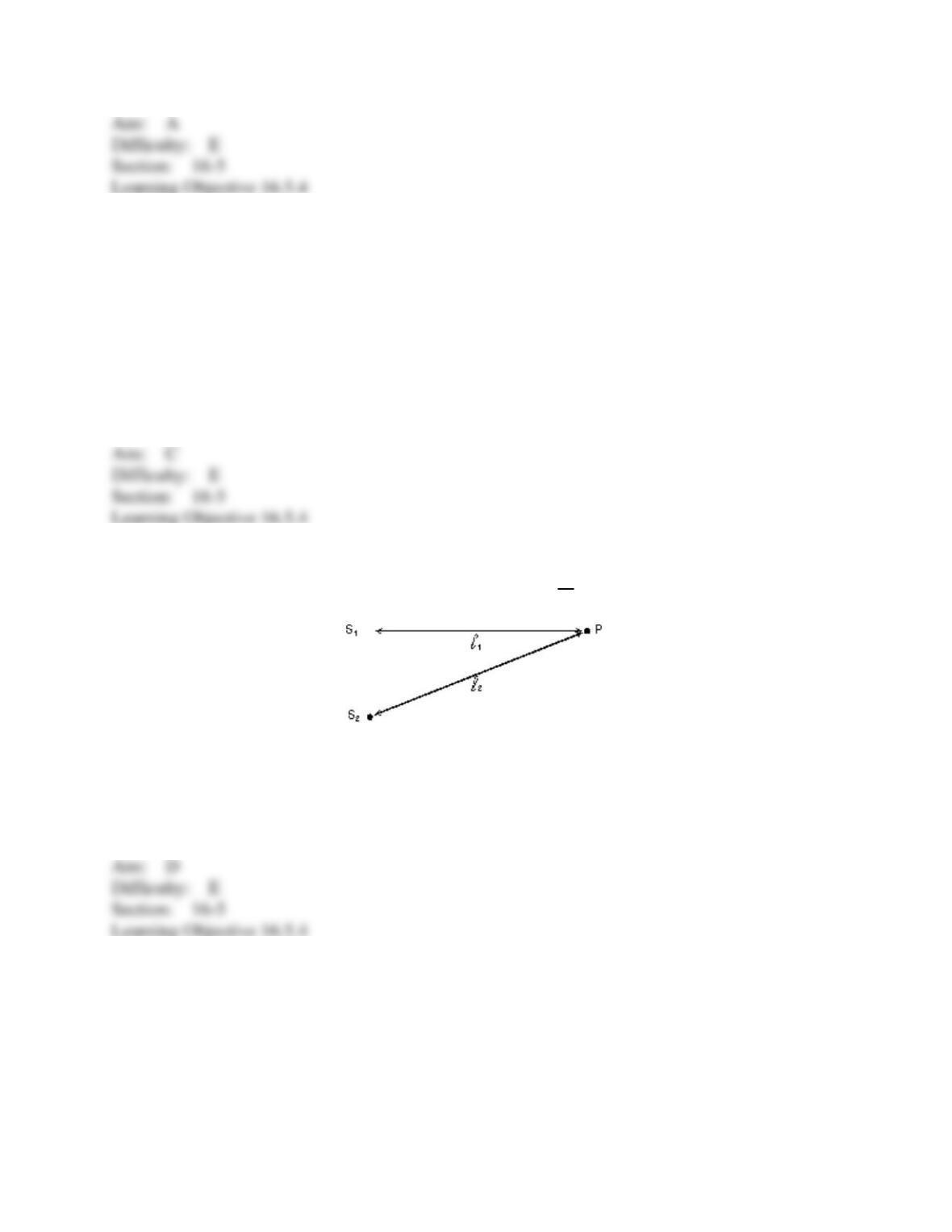
62. Two sources, S1 and S2, each emit waves of wavelength in the same medium. The phase
difference between the two waves, at the point P shown, is 2𝜋
𝜆(ℓ2− ℓ1)+ 𝜀. The quantity is:
A) the distance S1S2
B) the angle S1PS2
C) /2
D) the phase difference between the two sources
E) zero for transverse waves, for longitudinal waves
63. Two sinusoidal waves travel along the same string. They have the same wavelength and
frequency. Their amplitudes are ym1 = 2.5 mm and ym2 = 4.5 mm, and their phases are π/4 rad and
π/2 rad, respectively. What are the amplitude and phase of the resultant wave?
A) cannot solve without knowing the wavelength
B) 5.1 mm, 0.51 rad
C) 5.1 mm, 0.79 rad
D) 6.5 mm, 1.3 rad
E) 7.0 mm, 1.3 rad
64. The sinusoidal wave
y(x,t) = ymsin(kx –
t)
is incident on the fixed end of a string at x = L. The reflected wave is given by:
A) ymsin(kx +
t)
B) –ymsin(kx +
t)
C) ymsin(kx +
t – kL)
D) ymsin(kx +
t – 2kL)
E) –ymsin(kx +
t + 2kL)
65. A standing wave:
A) can be constructed from two similar waves traveling in opposite directions
B) must be transverse
C) must be longitudinal
D) has motionless points that are closer than half a wavelength
E) has a wave velocity that differs by a factor of two from what it would be for a traveling
wave
66. When a certain string is clamped at both ends, the lowest four resonant frequencies are 50,
100, 150, and 200 Hz. When the string is also clamped at its midpoint, the lowest four resonant
frequencies are:
A) 50, 100, 150, and 200 Hz
B) 50, 150, 250, and 300 Hz
C) 100, 200, 300, and 400 Hz
D) 25, 50 75, and 100 Hz
E) 75, 150, 225, and 300 Hz
67. When a certain string is clamped at both ends, the lowest four resonant frequencies are
measured to be 100, 150, 200, and 250 Hz. One of the resonant frequencies (below 200 Hz) is
missing. What is it?
A) 25 Hz
B) 50 Hz
C) 75 Hz
D) 125 Hz
E) 225 Hz
68. When a string is vibrating in a standing wave pattern the power transmitted across an
antinode, compared to the power transmitted across a node, is:
A) more
B) less
C) the same (zero)
D) the same (non-zero)
E) sometimes more, sometimes less, and sometimes the same
69. Which of the following represents a standing wave?
A) y = (6.0 mm)sin[(3.0 m–1)x + (2.0 s–1)t] – (6.0 mm)cos[(3.0 m–1)x + 2.0]
B) y = (6.0 mm)cos[(3.0 m–1)x – (2.0 s–1)t] + (6.0 mm)cos[(2.0 s–1)t + (3.0 m–1)x]
C) y = (6.0 mm)cos[(3.0 m–1)x – (2.0 s–1)t] – (6.0 mm)sin[(2.0 s–1)t – 3.0]
D) y = (6.0 mm)sin[(3.0 m–1)x – (2.0 s–1)t] – (6.0 mm)cos[(2.0 s–1)t + (3.0 m–1)x]
E) y = (6.0 mm)sin[(3.0 m–1)x] + (6.0 mm)cos[(2.0 s–1)t]
70. Which of the following represents the motion of a string element at an antinode of a standing
wave?
A) y = (6.0 mm)sin[(3.0 m–1)x + (2.0 s–1)t]
B) y = (6.0 mm)cos[(3.0 m–1)x – (2.0 s–1)t]
C) y = (6.0 mm)cos[(3.0 m–1)x + (2.0 s–1)t]
D) y = (6.0 mm)sin[(3.0 m–1)x
E) y = (6.0 mm)cos[(2.0 s–1)t
71. A wave on a stretched string is reflected from a fixed end P of the string. The phase
difference, at P, between the incident and reflected waves is:
A) 0 rad
B) rad
C) /2 rad
D) depends on the velocity of the wave
E) depends on the frequency of the wave
72. A wave on a string is reflected from a fixed end. The reflected wave:
A) is in phase with the original wave at the end
B) is 180 out of phase with the original wave at the end
C) has a larger amplitude than the original wave
D) has a larger speed than the original wave
E) cannot be transverse
73. Two traveling waves, y1 = A sin[k(x – vt)] and y2 = A sin[k(x + vt)], are superposed on the
same string. The distance between the adjacent nodes is:
A) vt/
B) vt/2
C) /2k
D) /k
E) 2/k
Learning Objective 16.7.6
74. If is the wavelength of the each of the component sinusoidal traveling waves that form a
standing wave, the distance between adjacent nodes in the standing wave is:
A) /4
B) /2
C) 3/4
D)
E) 2
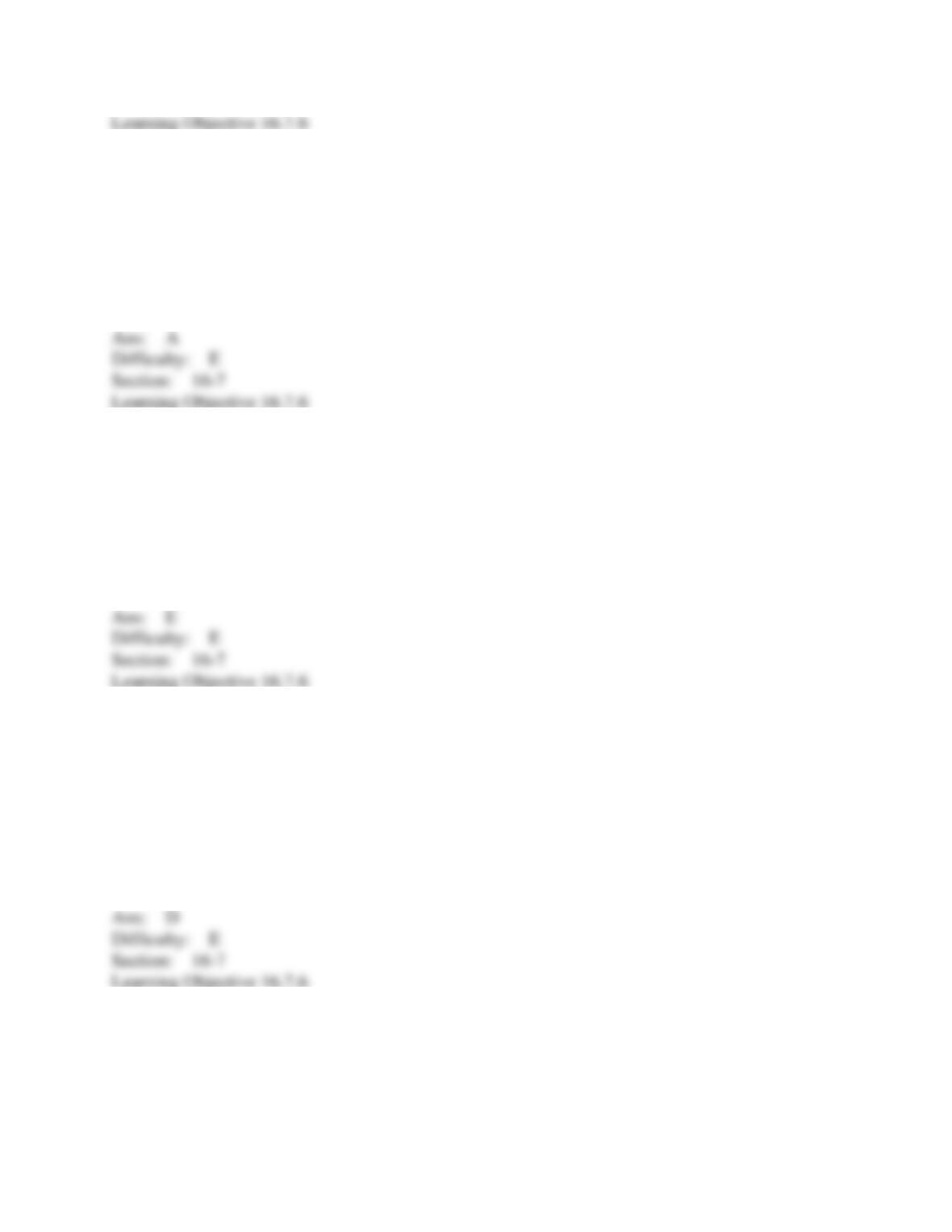
75. A standing wave pattern is established in a string as shown. The wavelength of one of the
component traveling waves is:
A) 0.25 m
B) 0.5 m
C) 1 m
D) 2 m
E) 4 m
76. Standing waves are produced by the interference of two traveling sinusoidal waves, each of
frequency 100 Hz. The distance from the 2nd node to the 5th node is 60 cm. The wavelength of
each of the two original waves is:
A) 50 cm
B) 40 cm
C) 30 cm
D) 20 cm
E) 15 cm
77. A string of length 100 cm is held fixed at both ends and vibrates in a standing wave pattern.
The wavelengths of the constituent traveling waves CANNOT be:
A) 400 cm
B) 200 cm
C) 100 cm
D) 67 cm
E) 50 cm
78. A string of length L is clamped at each end and vibrates in a standing wave pattern. The
wavelengths of the constituent traveling waves CANNOT be:
A) L
B) 2L
C) L/2
D) 2L/3
E) 4L
79. Two sinusoidal waves, each of wavelength 5 m and amplitude 10 cm, travel in opposite
directions on a 20-m stretched string which is clamped at each end. Excluding the nodes at the
ends of the string, how many nodes appear in the resulting standing wave?
A) 3
B) 4
C) 5
D) 7
E) 8
80. A 40-cm long string, with one end clamped and the other free to move transversely, is
vibrating in its fundamental standing wave mode. The wavelength of the constituent traveling
waves is:
A) 10 cm
B) 20 cm
C) 40 cm
D) 80 cm
E) 160 cm
81. A 30-cm long string, with one end clamped and the other free to move transversely, is
vibrating in its second harmonic. The wavelength of the constituent traveling waves is:
A) 10 cm
B) 30 cm
C) 40 cm
D) 60 cm
E) 120 cm
82. A string, clamped at its ends, vibrates in three segments. The string is 100 cm long. The
wavelength is:
A) 33 cm
B) 67 cm
C) 150 cm
D) 300 cm
E) need to know the frequency
83. A 40-cm long string, with one end clamped and the other free to move transversely, is
vibrating in its fundamental standing wave mode. If the wave speed is 320 cm/s the frequency is:
A) 32 Hz
B) 16 Hz
C) 8 Hz
D) 4 Hz
E) 2 Hz