C) (7/4) min
D) (7/2) min
E) (14/3) min
34. The half-life of a radioactive isotope is 140 days. In how many days does the decay rate of
a sample of this isotope decrease to one fourth its initial decay rate?
A) 35 days
B) 70 days
C) 105 days
D) 210 days
E) 280 days
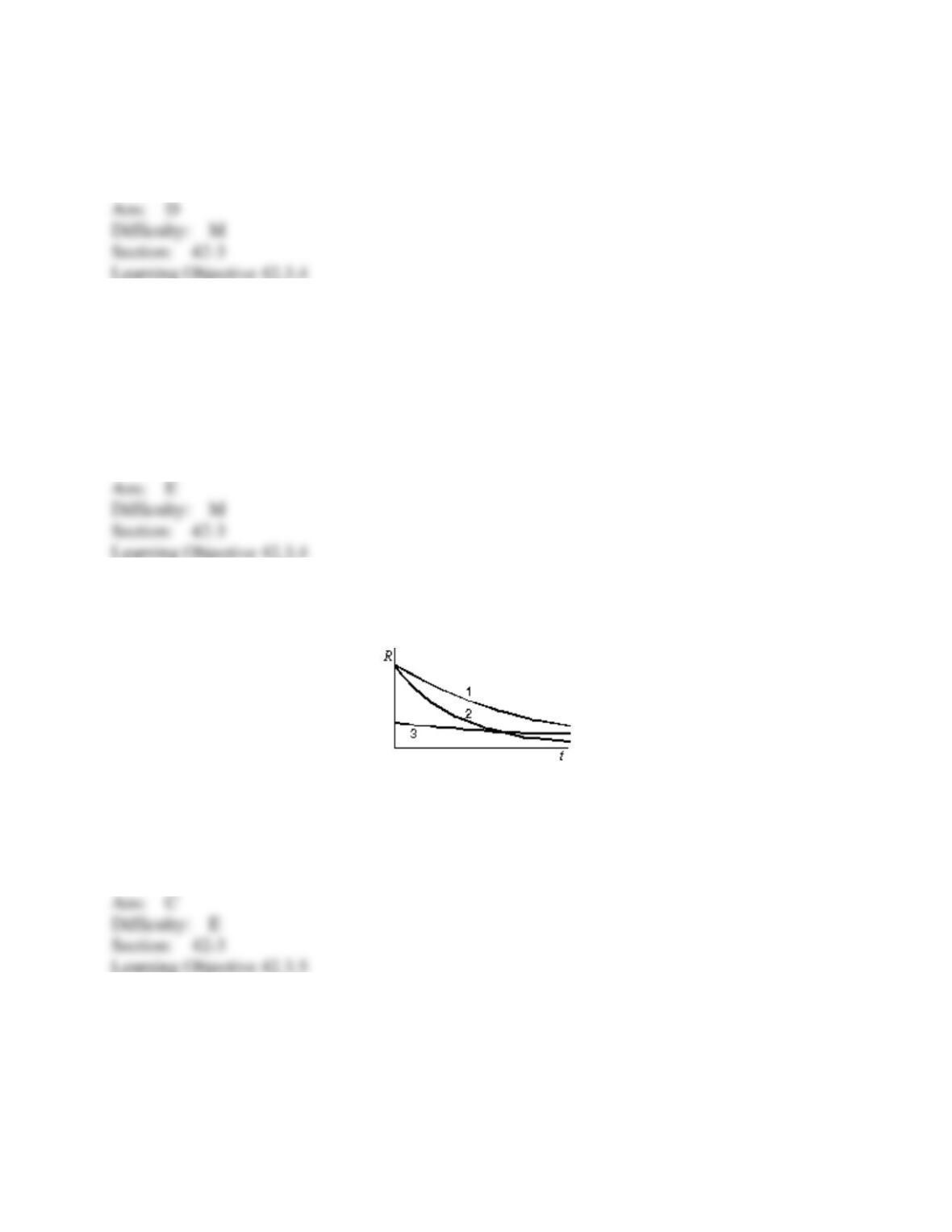
35. The graph shows the decay rate R as a function of the time t for three radioactive samples.
Rank the samples according to their half-lives, shortest to longest.
A) 1, 2 ,3
B) 1, 3, 2
C) 2, 1, 3
D) 2, 3, 1
E) 3, 1, 2
36. The relationship between the activity R, the disintegration constant λ, and the remaining
number N of radioactive nuclei is:
A) N = λR
B) R = λN
C) R = λ/N
D) R = N/ λ
E) R = λ ln N
37. One curie is equivalent to:
A) one Becquerel
B) one decay per second
C) 3.0 x 10⁸ decays per second
D) 3.7 x 10¹⁰ decays per second
E) 106 Becquerel
38. The half-life of a radioactive substance is:
A) half the time it takes for the entire substance to decay
B) usually about 50 years
C) the time for radium to change into lead
D) calculated from E = mc2
E) the time for half the substance to decay
39. The relation between the disintegration constant and the half-life T of a radioactive
substance is:
A) = 2T
B) = 1/T
C) = 2/T
D) T = ln 2
E) T = ln(1/2)
40. In an alpha decay the disintegration energy appears as:
A) photon energies
B) the kinetic energies of the alpha and the daughter nucleus
C) the excitation energy of the daughter nucleus
D) the excitation energy of the alpha particle
E) heat
41. Magnesium has atomic number 12, hydrogen has atomic number 1, and helium has atomic
number 2. In the nuclear reaction 24Mg + 2H → ( ) + 4He the missing quantity is:
A) 23Na (Z = 11)
B) 22Ne (Z = 10)
C) 21Na (Z = 11)
D) 21Ne (Z = 10)
E) 22Na (Z = 11)
42. Aluminum has atomic number 13, helium has atomic number 2, and silicon has atomic
number 14. In the nuclear reaction 27Al + 4He → 30Si + ( ) the missing particle is:
A) an
particle
B) a positron
C) an electron
D) a proton
E) a neutron
43. Bombardment of 28Si (Z = 14) with alpha particles may produce:
A) a proton and 31P (Z = 15)
B) hydrogen and 32S (Z = 16)
C) a deuteron and 27Al (Z = 13)
D) helium and 31P (Z = 15)
E) 35Cl (Z = 17)
44. An alpha particle is:
A) a helium atom with two electrons removed
B) an aggregate of two or more electrons
C) a hydrogen atom
D) the ultimate unit of positive charge
E) sometimes negatively charged
45. Rank the following collections of particles according to the total binding energy of all the
particles in each collection, least to greatest.
collection 1: 244Pu (Z = 94) nucleus alone
collection 2: 240U (Z = 92) nucleus,
particle
collection 3: 240U (Z = 92) nucleus, two separated protons, two separated neutrons
A) 1,2,3
B) 3,2,1
C) 2,1,3
D) 1,3,2
E) 2,3,1
46. A nucleus with mass number A and atomic number Z emits an alpha particle. The mass
number and atomic number, respectively, of the daughter nucleus are:
A) A, Z –2
B) A – 2, Z – 2
C) A – 2, Z
D) A – 4, Z
E) A – 4, Z – 2
47. Radioactive polonium, 214Po (Z = 84), decays by alpha emission to:
A) 214Po (Z = 84)
B) 210Pb (Z = 82)
C) 214At (Z = 85)
D) 218Po (Z = 84)
E) 210Bi (Z = 83)
48. A radium atom, 226Ra (Z = 86), emits an alpha particle. The number of protons in the
resulting atom is:
A) 84
B) 85
C) 86
D) 88
E) some other number
49. Some alpha emitters have longer half-lives than others because:
A) their alpha particles have greater mass
B) their alpha particles have less mass
C) their barriers to decay are higher and wider
D) their barriers to decay are lower and narrower
E) their decays include the emission of a photon
50. A beta particle is:
A) a helium nucleus
B) an electron or a positron
C) a radioactive element
D) any negative particle
E) a hydrogen atom
51. Beta particles from various radioactive sources all have:
A) the same mass
B) the same speed
C) the same charge
D) the same deflection
E) the same energy in a magnetic field
52. In addition to the daughter nucleus and an electron or positron, the products of a beta decay
include:
A) a neutron
B) a neutrino
C) a proton
D) an alpha particle
E) no other particle
53. The energies of electrons emitted in
– decays have a continuous spectrum because:
A) the original neutron has a continuous spectrum
B) the neutrino can carry off energy
C) the emitted electron is free
D) energy is not conserved
E) the daughter nucleus may have any energy
54. A radioactive atom X emits a
– particle. The resulting atom:
A) must be very reactive chemically
B) has an atomic number that is one more than that of X
C) has a mass number that is one less than that of X
D) has an atomic number that is one less than that of X
E) is the same chemical element as X
55. A nucleus with mass number A and atomic number Z undergoes
– decay. The mass
number and atomic number, respectively, of the daughter nucleus are:
A) A, Z – 1
B) A – 1, Z
C) A + 1, Z – 1
D) A, Z + 1
E) A, Z – 1
56. A nucleus with mass number A and atomic number Z undergoes
+ decay. The mass
number and atomic number, respectively, of the daughter nucleus are:
A) A – 1, Z – 1
B) A – 1, Z + 1
C) A + 1, Z – 1
D) A, Z + 1
E) A, Z – 1
57. If 204Tl (Z = 81) emits a
– particle from its nucleus:
A) stable Tl is formed
B) 202Hg (Z = 80) is formed
C) 204Pb (Z = 82) is formed
D) radioactive Tl is formed
E) 197Au (Z = 79) is formed
58. An atom of 235U (Z = 92) disintegrates to 207Pb (Z = 82) with a half-life of about a billion
years by emitting seven alpha particles and ______
– particles:
A) 3
B) 4
C) 5
D) 6
E) 7
59. The 66Cu (Z = 29) produced in a nuclear bombardment is unstable, changing to 66Zn (Z =
30) by the emission of:
A) a proton
B) a gamma ray photon
C) a positron
D) an electron
E) an alpha particle
60. A certain nucleus, after absorbing a neutron, emits a
– and then splits into two alpha
particles. The (A, Z) of the original nucleus must have been:
A) 6, 2
B) 6, 3
C) 7, 2
D) 7, 3
E) 8, 4
61. 40K decays to 40Ar with a half-life of 1.25 x 10⁹ yr. Assume that rocks contain no 40Ar when
they form, and that the only way 40Ar can be present is through the decay of 40K. If the ratio of
40K to 40Ar in a particular rock is found to be 1:3, what is the age of the rock?
A) 1.25 x 10⁹ yr
B) 2.50 x 10⁹ yr
C) 3.75 x 10⁹ yr
D) 5.00 x 10⁹ yr
E) cannot be determined without knowing how much 40K was in the rock to begin with
62. A fly caught in amber is thought to be 3 million years old. Why would it not be useful to
confirm its age using radiocarbon dating?
A) The fly contains no carbon.
B) The fly is too small to contain a measurable amount of carbon.
C) The fly is too old to contain a measureable amount of carbon-14.
D) The carbon-14 doesn’t begin to decay until the fly is removed from the amber.
E) Radiocarbon dating is too inaccurate to be useful.
63. The becquerel is the correct unit to use in reporting the measurement of:
A) the rate of decay of a radioactive source
B) the ability of a beam of gamma ray photons to produce ions in a target
C) the energy delivered by radiation to a target
D) the biological effect of radiation
E) none of the above
64. The gray is the correct unit to use in reporting the measurement of:
A) the rate of decay of a radioactive source
B) the ability of a beam of gamma ray photons to produce ions in a target
C) the energy delivered by radiation to a target
D) the biological effect of radiation
E) none of the above
65. The sievert is the correct unit to use in reporting the measurement of:
A) the rate of decay of a radioactive source
B) the ability of a beam of gamma ray photons to produce ions in a target
C) the energy delivered by radiation to a target
D) the biological effect of radiation
E) none of the above
66. A typical mammogram X-ray results in a radiation dose equivalent of 70 mrem. What
absorbed dose does this correspond to?
A) 70 mGy
B) 70 Sv
C) 7.0 Gy
D) 0.70 Sv
E) 0.70 Gy
67. The model of the nucleus in which each nucleon has its own well-defined quantum numbers
is called the:
A) collective model
B) quantum model
C) liquid drop model
D) independent model
E) atomic model
68. Magic nucleon numbers are associated with:
A) nuclei that decay via alpha decay
B) nuclei that decay via beta decay
C) nuclei that have equal numbers of protons and neutrons
D) nuclei that are relatively stable
E) nuclei that fission readily