Chapter: Chapter 12
Learning Objectives
LO 12.1.0 Solve problems related to equilibrium.
LO 12.1.1 Distinguish between equilibrium and static equilibrium.
LO 12.1.2 Specify the four conditions for static equilibrium.
LO 12.1.3 Explain center of gravity and how it relates to center of mass.
LO 12.1.4 For a given distribution of particles, calculate the coordinates of the center of gravity
and the center of mass.
LO 12.2.0 Solve problems related to some examples of static equilibrium.
LO 12.2.1 Apply the force and torque conditions for static equilibrium.
LO 12.2.2 Identify that a wise choice about the placement of the origin (about which to calculate
torques) can simplify the calculations by eliminating one or more unknown forces from the
torque equation.
LO 12.3.0 Solve problems related to elasticity.
LO 12.3.1 Explain what an indeterminate situation is.
LO 12.3.2 For tension and compression, apply the equation that relates stress to strain and
Young’s modulus.
LO 12.3.3 Distinguish between yield strength and ultimate strength.
LO 12.3.4 For shearing, apply the equation that relates stress to strain and the shear modulus.
LO 12.3.5 For hydraulic stress, apply the equation that relates fluid pressure to strain and the
bulk modulus.
Multiple Choice
1. A net torque applied to a rigid object always tends to produce:
A) linear acceleration
B) rotational equilibrium
C) angular acceleration
D) rotational inertia
E) none of these
2. Which of the following is NOT in equilibrium?
A) a rock resting on the ground
B) a rock sliding at constant velocity across a frictionless surface
C) a rock rotating in place on a frictionless surface
D) a rock rotating at a constant rate as it slides at constant velocity across a frictionless surface
E) a rock falling off a cliff
3. Which of the following is in static equilibrium?
A) a rock resting on the ground
B) a rock sliding at constant velocity across a frictionless surface
C) a rock rotating in place on a frictionless surface
D) a rock rotating at a constant rate as it slides at constant velocity across a frictionless surface
E) a rock falling off a cliff
4. The conditions that the sum of forces and the sum of the torques both vanish:
A) hold for every solid body in equilibrium
B) hold only for elastic solid bodies in equilibrium
C) hold for every solid body
D) are always sufficient to calculate the forces on a solid object in equilibrium
E) are sufficient to calculate the forces on a solid object in equilibrium only if the object is
elastic
5. For an object in equilibrium the sum of the torques acting on it vanishes only if each torque
is calculated about:
A) the center of mass
B) the center of gravity
C) the geometrical center
D) the point of application of the force
E) the same point
6. For a body to be equilibrium under the combined action of several forces:
A) all the forces must be applied at the same point
B) all of the forces are composed of pairs of equal and opposite forces
C) the sum of the components of all the forces in any direction must equal zero
D) any two of these forces must be balanced by a third force
E) the lines of action of all the forces must pass through the center of gravity of the body
7. For a body to be equilibrium under the combined action of several forces:
A) all the forces must be applied at the same point
B) all of the forces are composed of pairs of equal and opposite forces
C) any two of these forces must be balanced by a third force
D) the sum of the torques about any point must equal zero
E) the lines of action of all the forces must pass through the center of gravity of the body
8. To determine if a rigid body is in equilibrium the vector sum of the gravitational forces
acting on the particles of the body can be replaced by a single force acting at:
A) the center of mass
B) the geometrical center
C) the center of gravity
D) a point on the boundary
E) none of the above
9. The center of gravity coincides with the center of mass:
A) always
B) never
C) if the center of mass is at the geometrical center of the body
D) if the acceleration due to gravity is uniform over the body
E) if the body has a uniform distribution of mass
10. The location of which of the following points within an object might depend on the
orientation of the object?
A) Its center of mass
B) Its center of gravity
C) Its geometrical center
D) Its center of momentum
E) None of the above
11. A cylinder placed so it can roll on a horizontal table top, with its center of gravity above its
geometrical center, is:
A) in stable equilibrium
B) in unstable equilibrium
C) in neutral equilibrium
D) not in equilibrium
E) none of the above
12. A cylinder placed so it can roll on a horizontal table top, with its center of gravity below its
geometrical center, is:
A) in stable equilibrium
B) in unstable equilibrium
C) in neutral equilibrium
D) not in equilibrium
E) none of the above
13. A cube balanced with one edge in contact with a table top and with its center of gravity
directly above the edge is in ________ equilibrium with respect to rotation about the edge and in
________ equilibrium with respect to rotation about a horizontal axis that is perpendicular to the
edge.
A) stable, stable
B) stable, unstable
C) unstable, stable
D) unstable, unstable
E) unstable, neutral
14. A 5.1-kg mass is located at the origin, and a 2.3-kg mass is located at x = 4.9 cm. Assuming g
is constant, what is the location of the center of mass xcom, and the location of the center of
gravity xcog, of the two masses?
A) xcom = 1.5 cm, xcog = 3.4 cm
B) xcom = 3.4 cm, xcog = 1.5 cm
C) xcom = 1.5 cm, xcog = 1.5 cm
D) xcom = 3.4 cm, xcog = 3.4 cm
E) xcom = 1.5 cm, xcog = 0 cm
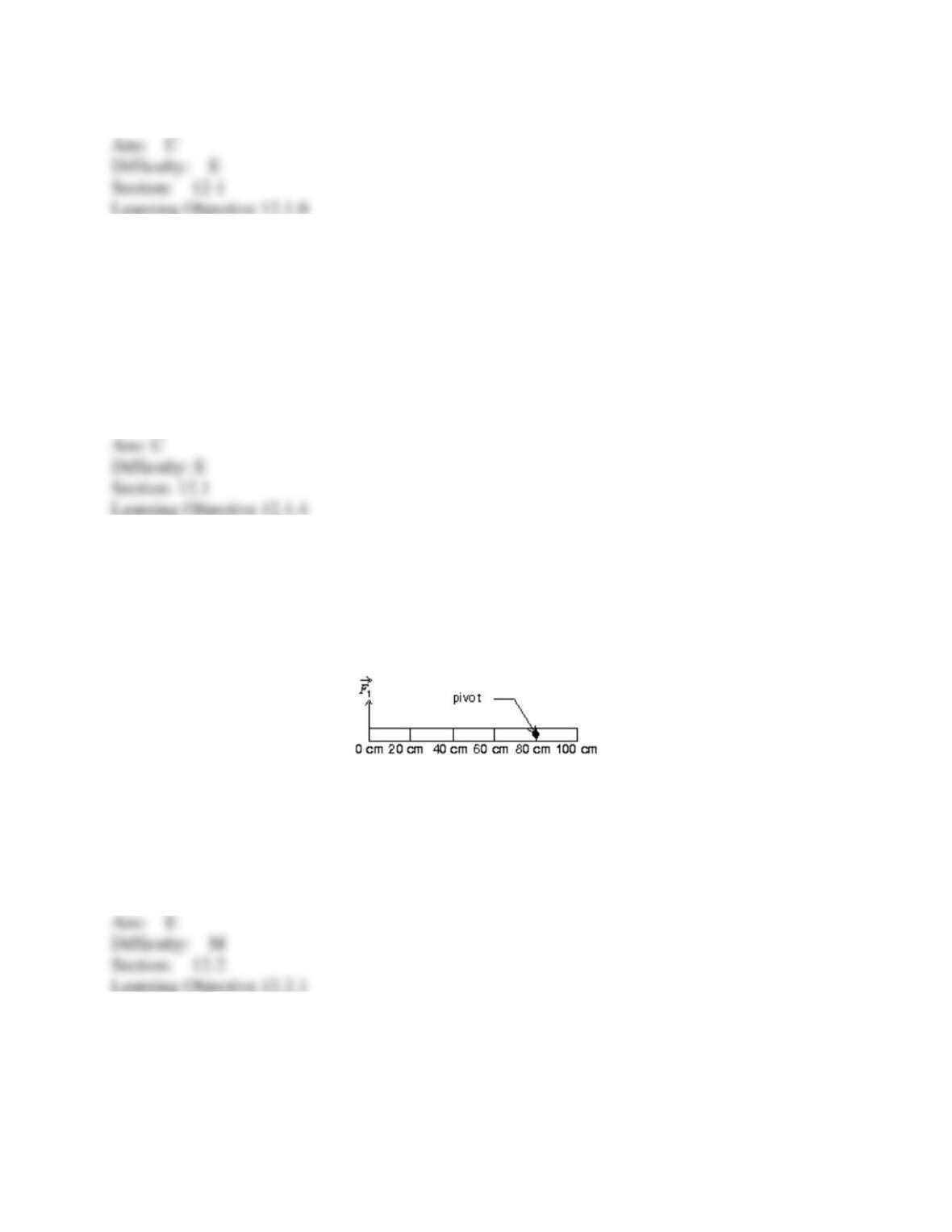
15. A massless meter stick on a horizontal frictionless table top is pivoted at the 80-cm mark. A
force 𝐹1
⃗
⃗
⃗
is applied perpendicularly to the end of the stick at 0 cm, as shown. A second force 𝐹2
⃗
⃗
⃗
(not shown) is applied perpendicularly to the stick at the 100-cm end of the stick. The forces are
in the plane of the table top. If the stick does not move, the force exerted by the pivot on the
stick:
A) must be zero
B) must be in the same direction as 𝐹1
⃗
⃗
⃗
and have magnitude |𝐹2
⃗
⃗
⃗
| − |𝐹1
⃗
⃗
⃗
|
C) must be directed opposite to 𝐹1
⃗
⃗
⃗
and have magnitude |𝐹2
⃗
⃗
⃗
| − |𝐹1
⃗
⃗
⃗
|
D) must be in the same direction as 𝐹1
⃗
⃗
⃗
and have magnitude |𝐹2
⃗
⃗
⃗
| + |𝐹1
⃗
⃗
⃗
|
E) must be directed opposite to 𝐹1
⃗
⃗
⃗
and have magnitude |𝐹2
⃗
⃗
⃗
| + |𝐹1
⃗
⃗
⃗
|
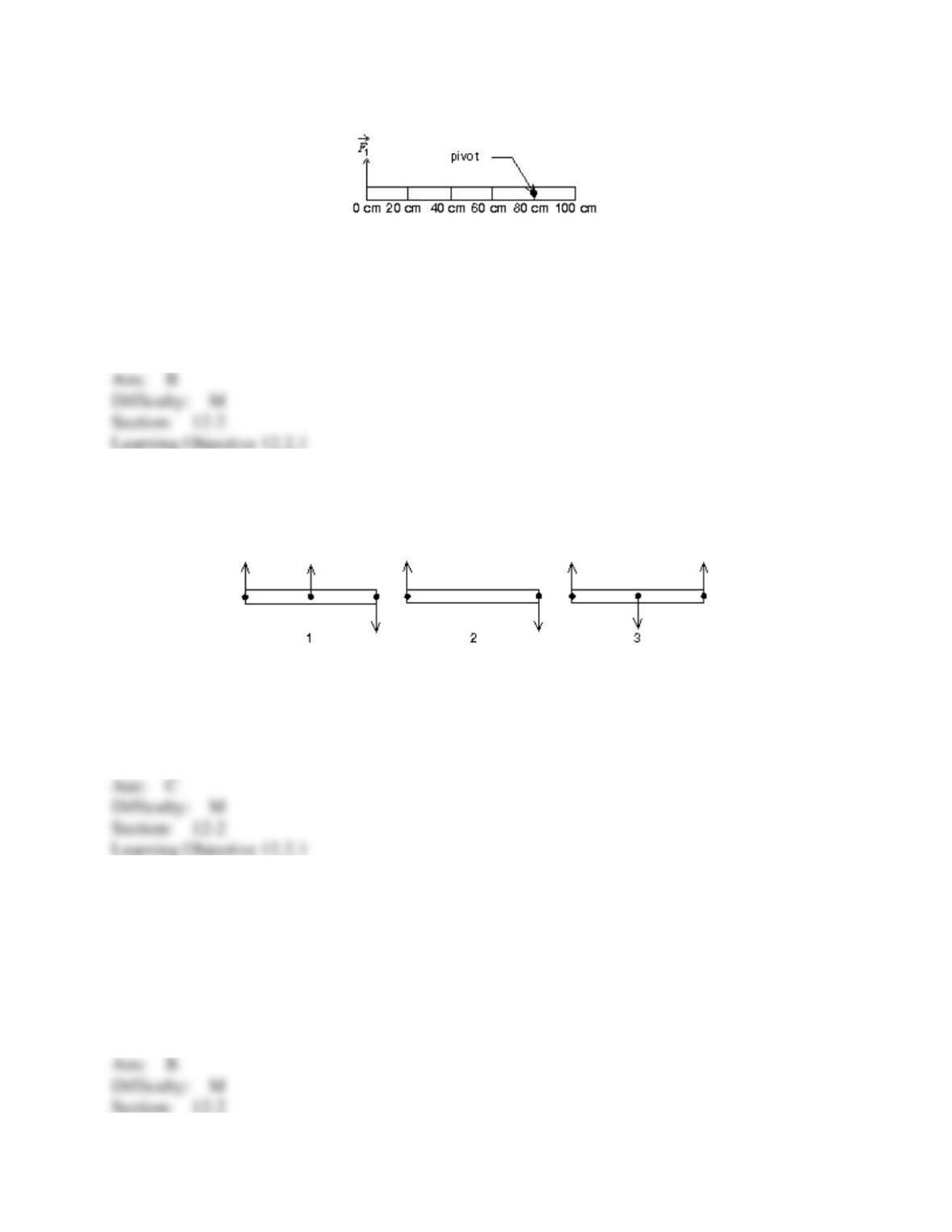
16. A massless meter stick on a horizontal frictionless table top is pivoted at the 80-cm mark. A
force 𝐹1
⃗
⃗
⃗
is applied perpendicularly to the end of the stick at 0 cm, as shown. A second force 𝐹2
⃗
⃗
⃗
(not shown) is applied perpendicularly at the 60-cm mark. The forces are in the plane of the table
top. If the stick does not move, the force exerted by the pivot on the stick:
A) must be zero
B) must be in the same direction as 𝐹1
⃗
⃗
⃗
and have magnitude |𝐹2
⃗
⃗
⃗
| − |𝐹1
⃗
⃗
⃗
|
C) must be directed opposite to 𝐹1
⃗
⃗
⃗
and have magnitude |𝐹2
⃗
⃗
⃗
| − |𝐹1
⃗
⃗
⃗
|
D) must be in the same direction as 𝐹1
⃗
⃗
⃗
and have magnitude |𝐹2
⃗
⃗
⃗
| + |𝐹1
⃗
⃗
⃗
|
E) must be directed opposite to 𝐹1
⃗
⃗
⃗
and have magnitude |𝐹2
⃗
⃗
⃗
| + |𝐹1
⃗
⃗
⃗
|
17. Three identical uniform rods are each acted on by two or more forces, all perpendicular to
the rods. Which of the rods could be in static equilibrium if an additional force is applied at the
center of mass of the rod?
A) Only 1
B) Only 2
C) Only 3
D) Only 1 and 2
E) All three
18. A 160-N child sits on a light swing and is pulled back and held with a horizontal force of
100 N. The magnitude of the tension force of each of the two supporting ropes is:
A) 60 N
B) 94 N
C) 120 N
D) 190 N
E) 260 N
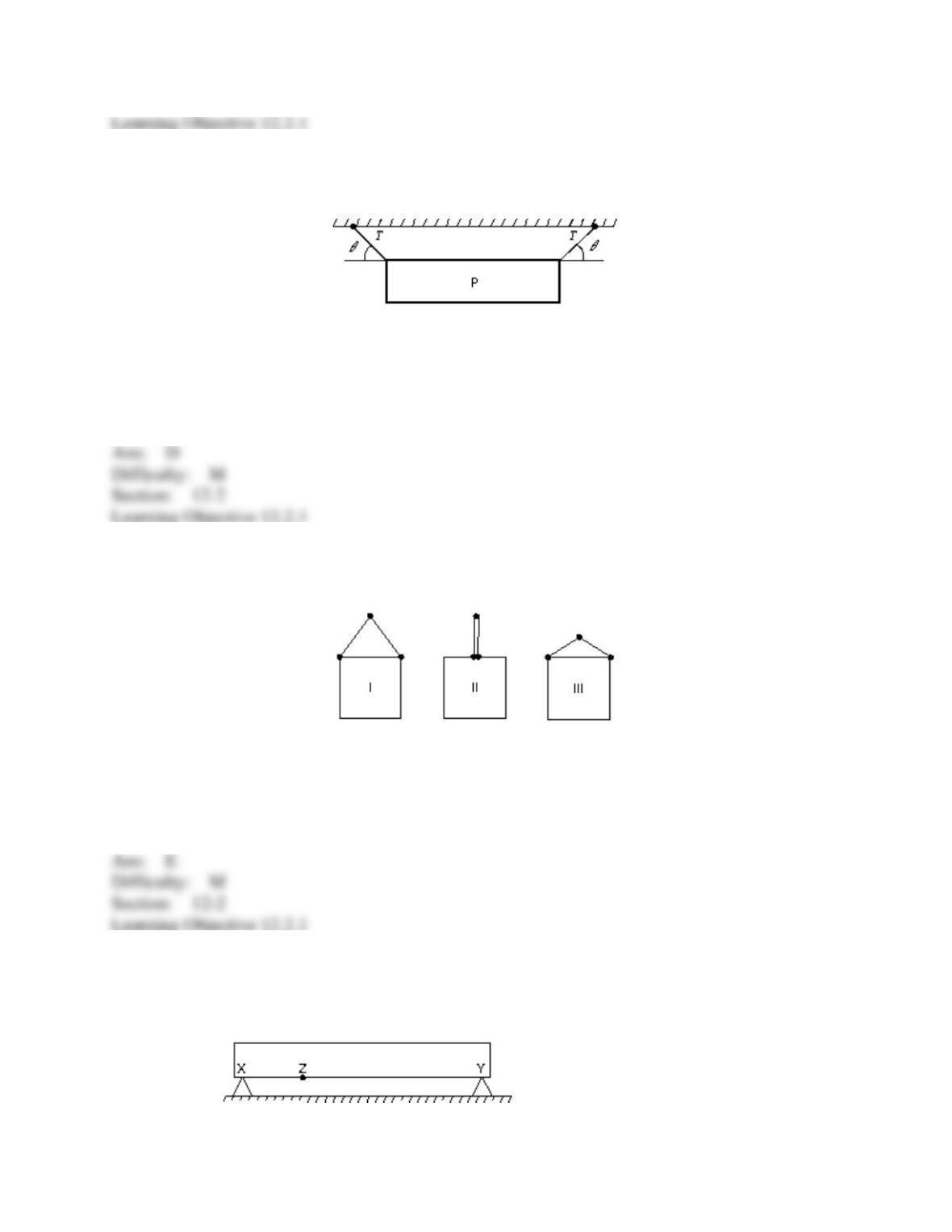
19. A picture P of weight W is hung by two strings as shown. The magnitude of the tension
force of each string is T. The total upward pull of the strings on the picture is:
A) 2W cos
B) T sin
C) T cos
D) 2T sin
E) 2T cos
20. A picture can be hung on a wall in three different ways, as shown. The tension in the string
is:
A) least in I
B) greatest in I
C) greatest in II
D) least in III
E) greatest in III
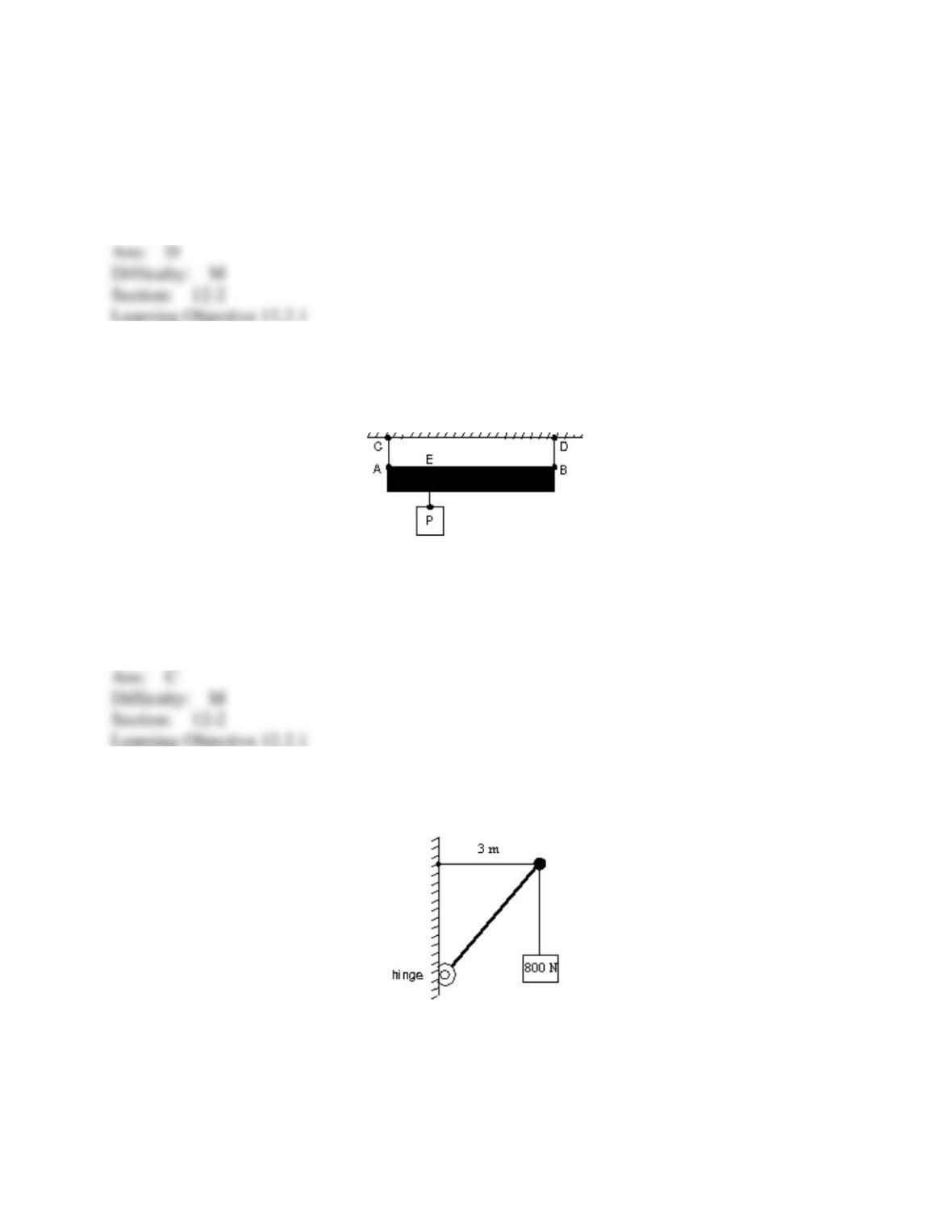
21. A uniform plank XY is supported by two equal 120-N forces at X and Y, as shown. The
support at X is then moved to Z (half-way to the plank center). The supporting forces at Y and Z
are then:
A) FY = 240 N, FZ = 120 N
B) FY = 200 N, FZ = 40 N
C) FY = 40 N, FZ = 200 N
D) FY = 80 N, FZ = 160 N
E) FY = 160 N, FZ = 80 N
22. A uniform rod AB is 1.2 m long and weighs 16 N. It is suspended by strings AC and BD as
shown. A block P weighing 96 N is attached at E, 0.30 m from A. The magnitude of the tension
force in the string BD is:
A) 8.0 N
B) 24 N
C) 32 N
D) 48 N
E) 80 N
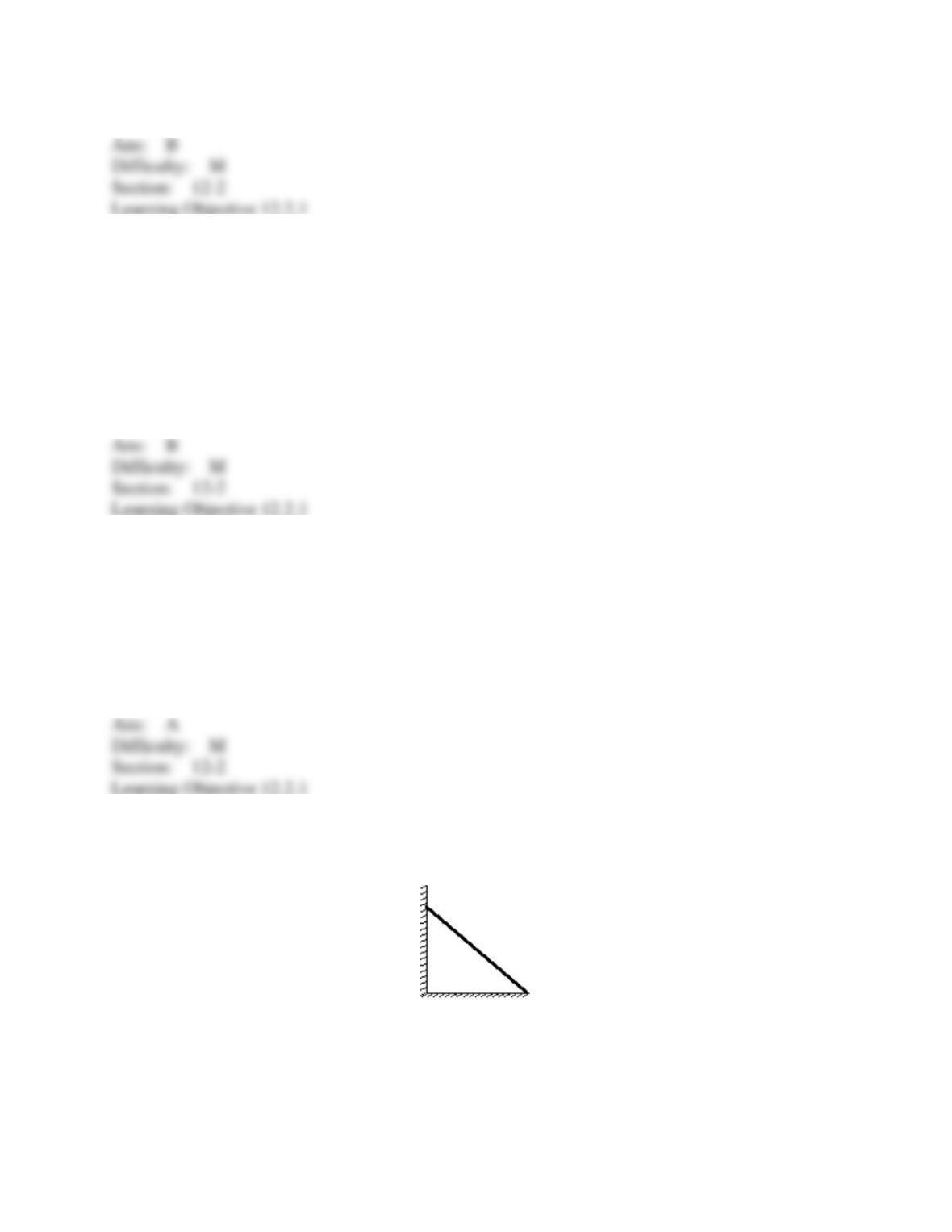
23. A 5.0 m weightless strut, hinged to a wall, is used to support an 800-N block as shown. The
horizontal and vertical components of the force of the hinge on the strut are:
A) FH = 800 N, FY = 800 N
B) FH = 600 N, FY = 800 N
C) FH = 800 N, FY = 600 N
D) FH = 1200 N, FY = 800 N
E) FH = 0 N, FY = 800 N
24. A uniform plank is 6.0 m long and weighs 80 N. It is balanced on a sawhorse at its center.
An additional 160 N weight is now placed on the left end of the plank. To keep the plank
balanced, it must be moved what distance to the right?
A) 6.0 m
B) 2.0 m
C) 1.5 m
D) 1.0 m
E) 0.50 m
25. A uniform 240-g meter stick can be balanced by a 240-g weight placed at the 100-cm mark
if the fulcrum is placed at the point marked:
A) 75 cm
B) 60 cm
C) 50 cm
D) 40 cm
E) 80 cm
26. A ladder leans against a wall. If the ladder is not to slip, which one of the following must
be true?
A) The coefficient of friction between the ladder and the wall must not be zero
B) The coefficient of friction between the ladder and the floor must not be zero
C) Both A and B
D) Either A or B
E) Neither A nor B
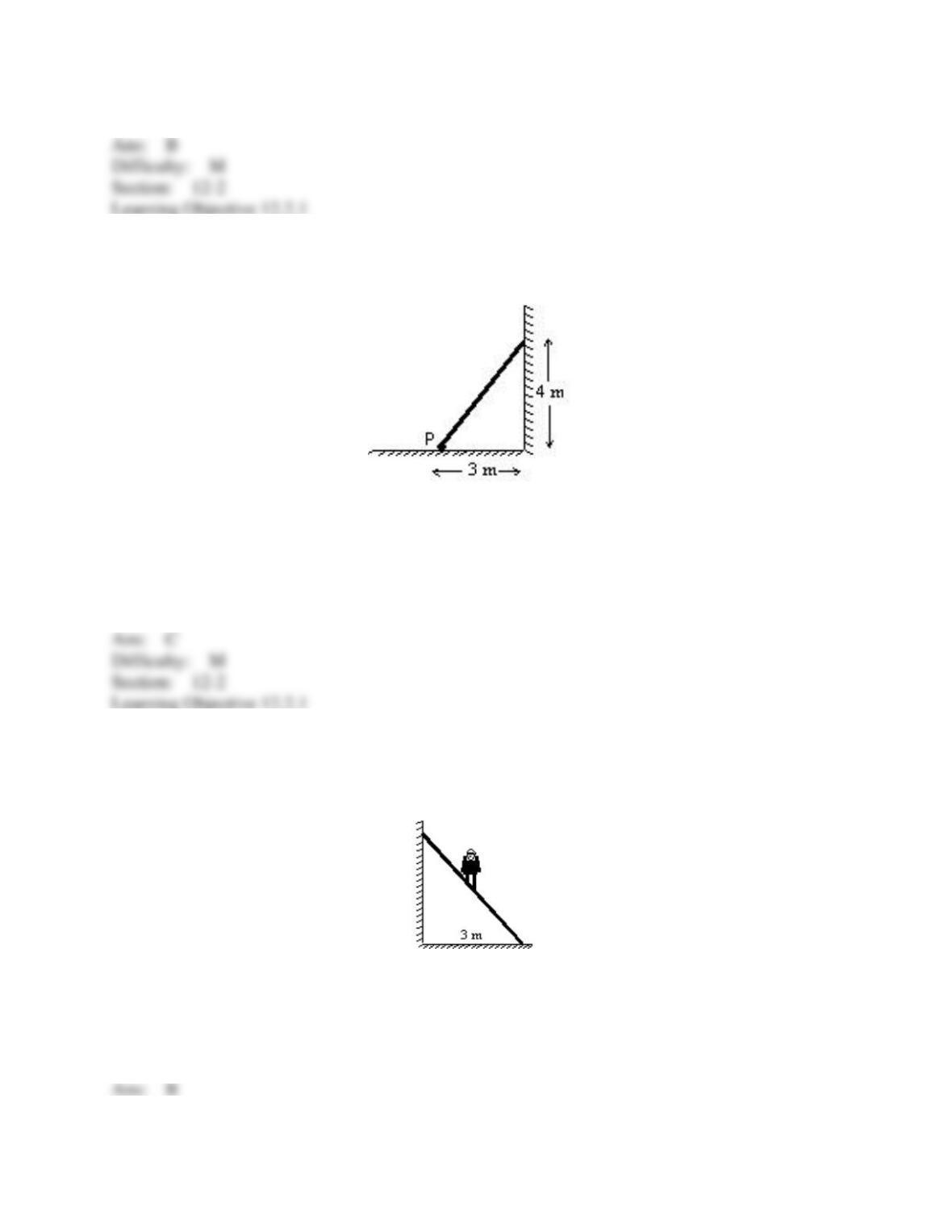
27. An 80-N uniform plank leans against a frictionless wall as shown. The torque (about point
P) applied to the plank by the wall is:
A) 40 Nm
B) 60 Nm
C) 120 Nm
D) 160 Nm
E) 240 Nm
28. An 800-N man stands halfway up a 5.0 m ladder of negligible weight. The base of the
ladder is 3.0 m from the wall as shown. Assuming that the wall-ladder contact is frictionless, the
wall pushes against the ladder with a force of:
A) 150 N
B) 300 N
C) 400 N
D) 600 N
E) 800 N
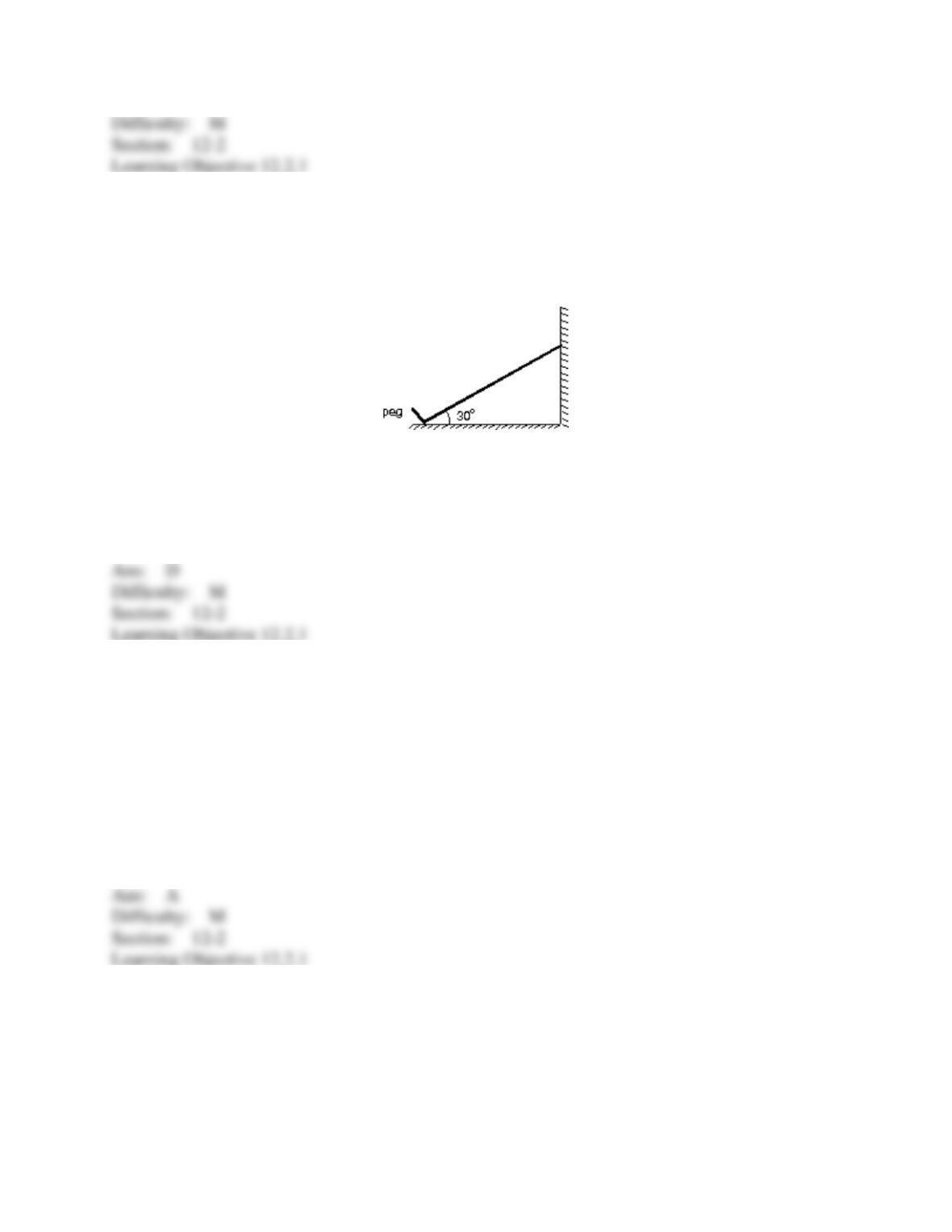
29. A uniform ladder is 10 m long and weighs 400 N. It rests with its upper end against a
frictionless vertical wall. Its lower end rests on the ground and is prevented from slipping by a
peg driven into the ground. The ladder makes a 30 angle with the horizontal. The force exerted
on the wall by the ladder is:
A) 47 N
B) 74 N
C) 120 N
D) 350 N
E) 460 N
30. A window washer attempts to lean a ladder against a frictionless wall. He finds that the
ladder slips on the ground when it is placed at an angle of less than 75 to the ground but remains
in place when the angle is greater than 75. The coefficient of static friction between the ladder
and the ground:
A) is 0.13
B) is 0.27
C) is 1.3
D) depends on the mass of the ladder
E) depends on the length of the ladder
31. The 600-N ball shown is suspended on a string AB and rests against the frictionless vertical
wall. The string makes an angle of 30 with the wall. The line AB goes through the center of the
ball, and the contact point with the wall is at the same vertical height as the center of the ball.
The magnitude of the tension in the string is: