47. A 10-kg block of ice is at rest on a frictionless horizontal surface. A 1.0-N force is applied
in an easterly direction for 1.0 s. During this time interval, the block:
A) acquires a speed of 1 m/s
B) moves 10 cm
C) acquires a momentum of 1.0 kg m/s
D) acquires a kinetic energy of 0.1 J
E) none of the above
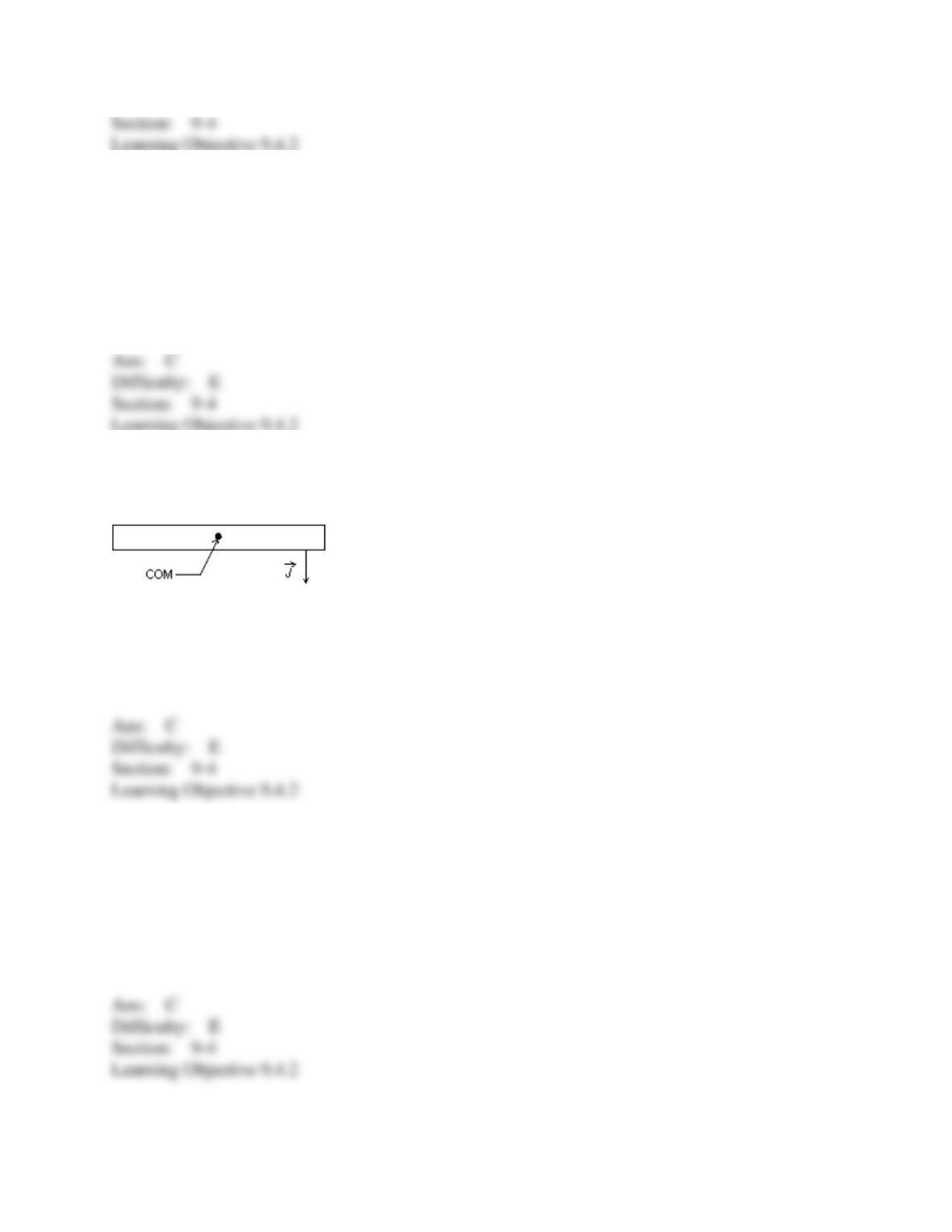
48. A uniform narrow bar, resting on frictionless ice, is given a transverse horizontal impulse 𝐽
⃗
at one end as shown. The center of mass of the bar COM will then:
A) remain at rest
B) move in a circle
C) move in a straight line
D) move in a parabola
E) move along some other curve
49. What magnitude impulse will give a 2.0-kg object a momentum change of magnitude +50
kg∙m/s?
A) + 25 N∙s
B) – 25 N∙s
C) + 50 N∙s
D) – 50 N∙s
E) + 100 N∙s
50. A golf ball of mass m is hit by a golf club so that the ball leaves the tee with speed v. The
club is in contact with the ball for time T. The average force on the club on the ball during the
time T is:
A) mvT
B) mv/T
C) (1/2)mv2T
D) mv2/(2T)
E) mT2/(2v)
51. A 640-N acrobat falls 5.0 m from rest into a net. The net tosses him back up with the same
speed he had just before he hit the net. The average upward force exerted on him by the net
during this collision is:
A) 32 N
B) 64 N
C) 320 N
D) 640 N
E) impossible to determine from given data
52. Sphere X, of mass 2 kg, is moving to the right at 10 m/s. Sphere Y, of mass 4 kg, is moving
to the left at 10 m/s. The two spheres collide head-on. The magnitude of the impulse of X on Y
is:
A) twice the magnitude of the impulse of Y on X
B) half the magnitude of the impulse of Y on X
C) one-fourth the magnitude of the impulse of Y on X
D) four times the magnitude of the impulse of Y on X
E) the same as the magnitude of the impulse of Y on X
53. Two bodies of unequal mass, placed at rest on a frictionless surface, are acted on by equal
horizontal forces for equal times. Just after these forces are removed, the body of greater mass
will have:
A) greater speed than the other body
B) greater acceleration than the other body
C) smaller momentum than the other body
D) greater momentum than the other body
E) the same momentum as the other body
54. A student’s life was saved in an automobile accident because an airbag expanded in front of
his head. If the car had not been equipped with an airbag, the windshield would have stopped the
motion of his head in a much shorter time. Compared to the windshield, the airbag:
A) causes a much smaller change in momentum
B) exerts a much smaller impulse
C) causes a much smaller change in kinetic energy
D) exerts a much smaller force
E) does much more work
55. A 25-kg box of books is dropped on the floor from a height of 1.1 m and comes to rest. What
impulse did the floor exert on the box?
A) cannot be answered without knowing how long it took the box to stop
B) 22 kg∙m/s
C) 120 kg∙m/s
D) 270 kg∙m/s
E) 540 kg∙m/s
56. The force on a particle is given by F(t) = 0.71 t + 1.2 t2, in N. If the force acts from t = 0 to t
= 2.0 s, the total impulse is:
A) 1.2 kg∙m/s
B) 1.9 kg∙m/s
C) 4.6 kg∙m/s
D) 4.8 kg∙m/s
E) 6.2 kg∙m/s
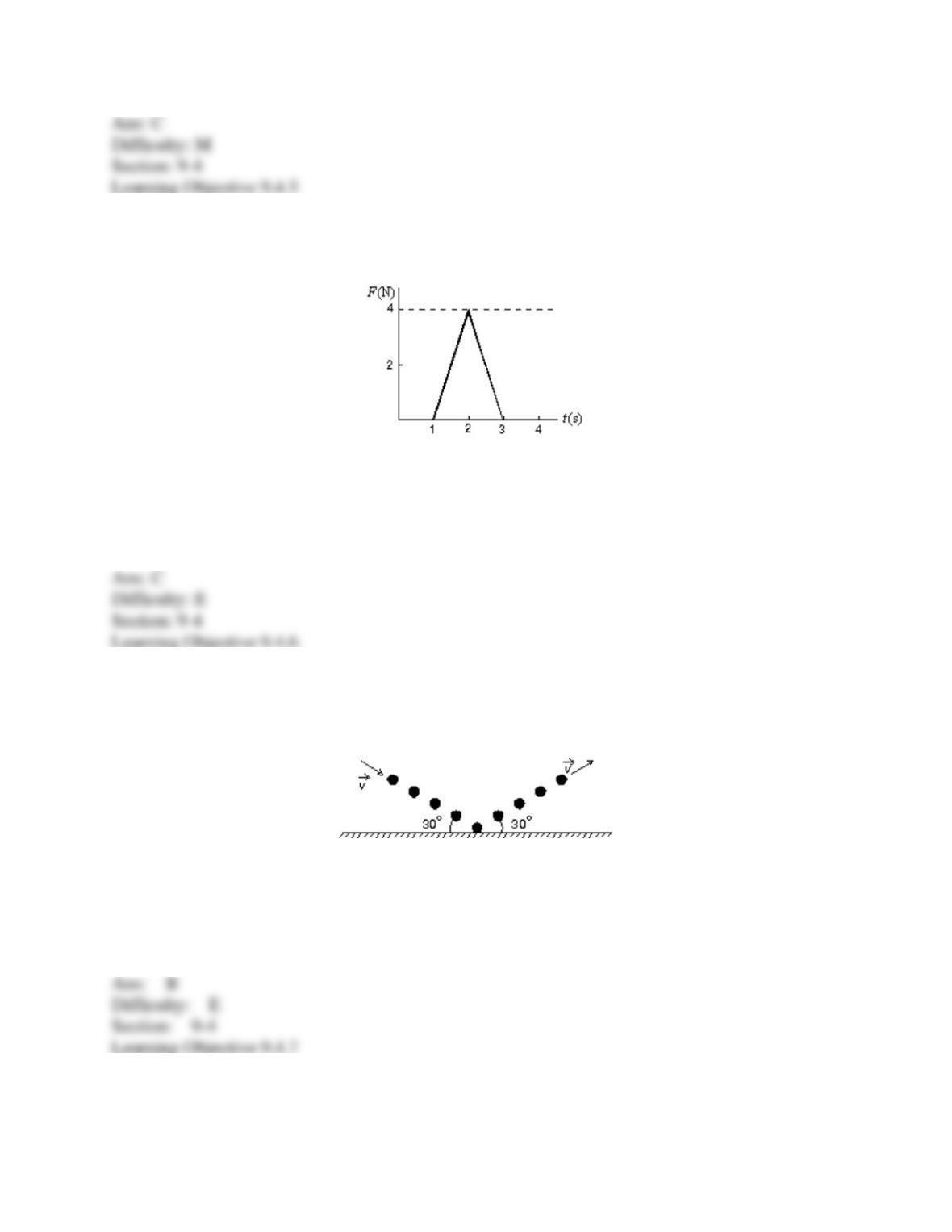
57. The plot shows the force acting on an object as a function of time. Over the time the force is
applied, the total impulse is:
A) 0 N∙s
B) 2 N∙s
C) 4 N∙s
D) 8 N∙s
E) cannot be determined without knowing the mass of the object
58. A stream of gas consists of n molecules. Each molecule has mass m and speed v. The
stream is reflected elastically from a rigid surface as shown. The magnitude of the change in the
total momentum of the stream is:
A) 2mnv
B) 2mnv sin 30
C) mnv sin 30
D) mnv cos 30
E) mnv
59. A 75-kg man is riding in a 30-kg cart at 2.0 m/s. He jumps off in such a way as to land on
the ground with no horizontal velocity. The resulting change in speed of the cart is:
A) 0 m/s
B) 2.0 m/s
C) 3.0 m/s
D) 5.0 m/s
E) 7.0 m/s
60. A shell is launched from a cannon and explodes mid-air. Which of the following is correct
after the explosion?
A) Since the explosion exerts external forces on the shell, neither its horizontal momentum nor
its vertical momentum is conserved.
B) Since the explosion exerts only internal forces on the shell, both its horizontal and vertical
momenta are conserved.
C) Since the explosion exerts only internal forces on the shell, but gravity is an external force,
neither its horizontal momentum nor its vertical momentum is conserved.
D) Since the explosion exerts only internal forces on the shell, but gravity is an external force, its
horizontal momentum is conserved but its vertical momentum is not conserved.
E) Since the explosion exerts only internal forces on the shell, but gravity is an external force, its
vertical momentum is conserved but its horizontal momentum is not conserved.
61. An inelastic collision is one in which:
A) momentum is not conserved but kinetic energy is conserved
B) total mass is not conserved but momentum is conserved
C) neither kinetic energy nor momentum is conserved
D) momentum is conserved but kinetic energy is not conserved
E) the total impulse is equal to the change in kinetic energy
62. A 4.0-N puck is traveling at 3.0 m/s. It strikes an 8.0-N puck, which is stationary. The two
pucks stick together. Their common final speed is:
A) 1.0 m/s
B) 1.5 m/s
C) 2.0 m/s
D) 2.3 m/s
E) 3.0 m/s
63. An elastic collision is one in which:
A) momentum is not conserved but kinetic energy is conserved
B) total mass is not conserved but momentum is conserved
C) kinetic energy and momentum are both conserved
D) momentum is conserved but kinetic energy is not conserved
E) the total impulse is equal to the change in kinetic energy
64. Whenever an object strikes a stationary object of equal mass:
A) the two objects cannot stick together
B) the collision must be elastic
C) the first object must stop
D) momentum is not necessarily conserved
E) none of the above
65. In a one-dimensional collision,
A) a moving object strikes a stationary object, after which the objects move in arbitrary
directions.
B) the objects must be moving along the same line before the collision, but may be moving in
arbitrary directions after the collision.
C) one of the objects must remain at rest after the collision.
D) one of the objects must be at rest before the collision.
E) all motion, both before and after the collision, must be along the same line.
66. A 64-kg woman stands on frictionless level ice with a 0.10-kg stone at her feet. She kicks
the stone with her foot so that she acquires a velocity of 0.0017 m/s in the forward direction. The
velocity acquired by the stone is:
A) 1.1 m/s forward
B) 1.1 m/s backward
C) 0.0017 m/s forward
D) 0.0017 m/s backward
E) none of these
67. A man is marooned at rest on level frictionless ice. In desperation, he hurls his shoe to the
right at 15 m/s. If the man weighs 720 N and the shoe weighs 4.0 N, the man moves to the left at
approximately:
A) 0 m/s
B) 2.1 10–2 m/s
C) 8.3 10–2 m/s
D) 15 m/s
E) 1.1 m/s
68. Two spacemen are floating together with zero speed in a gravity-free region of space. The
mass of spaceman A is 120 kg and that of spaceman B is 90 kg. Spaceman A pushes B away
from him with B attaining a final speed of 0.5 m/s. The final recoil speed of A is:
A) 0 m/s
B) 0.38 m/s
C) 0.43 m/s
D) 0.50 m/s
E) 1.0 m/s
69. A rifle of mass M is initially at rest but free to recoil. It fires a bullet of mass m and
velocity v (relative to the ground). After firing, the velocity of the rifle (relative to the ground) is:
A) –mv
B) –Mv/m
C) –mv/M
D) –v
E) mv/M
70. Bullets from two revolvers are fired with the same velocity. The bullet from gun #1 is twice
as heavy as the bullet from gun #2. Gun #1 weighs three times as much as gun #2. The ratio of
the momentum imparted to gun #1 to that imparted to gun #2 is:
A) 2:3
B) 3:2
C) 2:1
D) 3:1
E) 6:1
71. Cart A, with a mass of 0.2 kg, travels on a horizontal air track at 3 m/s and hits cart B,
which has a mass of 0.4 kg and is initially at rest. After the collision the center of mass of the
two cart system has a speed in m/s of:
A) 0 m/s
B) 1.0 m/s
C) 2.3 m/s
D) 2.5 m/s
E) 5.0 m/s
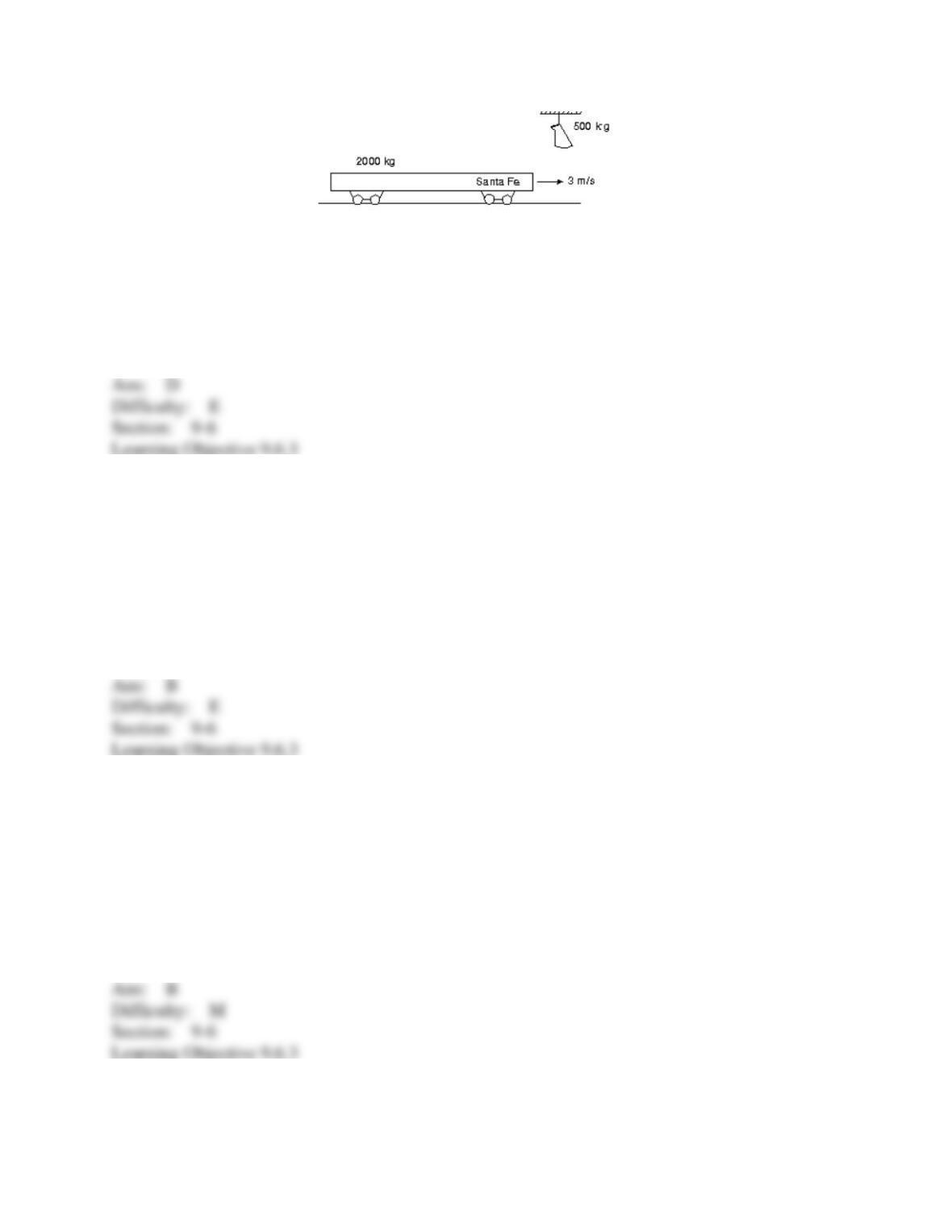
72. A 500-kg sack of coal is dropped on a 2000-kg railroad flatcar which was initially moving
at 3 m/s as shown. After the sack rests on the flatcar, the speed of the flatcar is:
A) 0.6 m/s
B) 1.2 m/s
C) 1.8 m/s
D) 2.4 m/s
E) 3.6 m/s
73. A 3.00-g bullet traveling horizontally at 400 m/s hits a 3.00-kg wooden block, which is
initially at rest on a smooth horizontal table. The bullet buries itself in the block without passing
through. The speed of the block after the collision is:
A) 1.33 m/s
B) 0.40 m/s
C) 12.0 m/s
D) 12.6 m/s
E) 40.0 m/s
74. A 3-g bullet is fired horizontally into a 10-kg block of wood suspended by a rope from the
ceiling. The block swings in an arc, rising 3 mm above its lowest position. The velocity of the
bullet was:
A) unknown since the heat generated in the collision was not given
B) 8.0 102 m/s
C) 24.0 m/s
D) 8.0 m/s
E) 2.4 104 m/s
75. A 3.0-kg cart and a 2.0-kg cart approach each other on a horizontal air track. They collide
and stick together. After the collision their total kinetic energy is 40 J. The speed of their center
of mass is:
A) 0 m/s
B) 2.8 m/s
C) 4.0 m/s
D) 5.2 m/s
E) 8.0 m/s
76. Blocks A and B are moving toward each other. A has a mass of 2.0 kg and a velocity of 50
m/s, while B has a mass of 4.0 kg and a velocity of –25 m/s. They suffer a completely inelastic
collision. The kinetic energy lost during the collision is:
A) 0 J
B) 1250 J
C) 3750 J
D) 5000 J
E) 5600 J
77. For a completely inelastic two-body collision the kinetic energy retained by the objects is
the same as:
A) the total kinetic energy before the collision
B) the difference in the kinetic energies of the objects before the collision
C) 1/2Mv2com, where M is the total mass and vcom is the velocity of the center of mass
D) the kinetic energy of the more massive body before the collision
E) the kinetic energy of the less massive body before the collision
78. A 2-kg cart, traveling on a horizontal air track with a speed of 3 m/s, collides with a
stationary 4-kg cart. The carts stick together. The impulse exerted by one cart on the other
has a magnitude of:
A) 0 N∙s
B) 4 N∙s
C) 6 N∙s
D) 9 N∙s
E) 12 N∙s
79. Two identical carts travel at 1 m/s on a common surface. They collide head-on and are
reported to rebound, each with a speed of 2 m/s. Then:
A) momentum was not conserved, therefore the report must be false
B) if some other form of energy were changed to kinetic during the collision, the report could
be true
C) if the collision were elastic, the report could be true
D) if the surface were inclined, the report could be true
E) kinetic energy increased, therefore the report must be false
80. A block moves at 5 m/s in the positive x direction and hits an identical block, initially at
rest. A small amount of gunpowder had been placed on one of the blocks. The explosion does
not harm the blocks but it doubles their total kinetic energy. After the explosion the blocks move
along the x axis and the incident block has a speed of:
A) 1.8 m/s
B) 3.2 m/s
C) 5.0 m/s
D) 6.8 m/s
E) 7.1 m/s
81. A projectile in flight explodes into several fragments. The total momentum of the
fragments immediately after this explosion:
A) is the same as the momentum of the projectile immediately before the explosion
B) has been changed into kinetic energy of the fragments
C) is less than the momentum of the projectile immediately before the explosion
D) is more than the momentum of the projectile immediately before the explosion
E) has been changed into radiant energy
82. The law of conservation of momentum applies to a system of colliding objects only if:
A) there is no change in kinetic energy of the system
B) the coefficient of restitution is one
C) the coefficient of restitution is zero
D) the net external impulse is zero
E) the collisions are all elastic
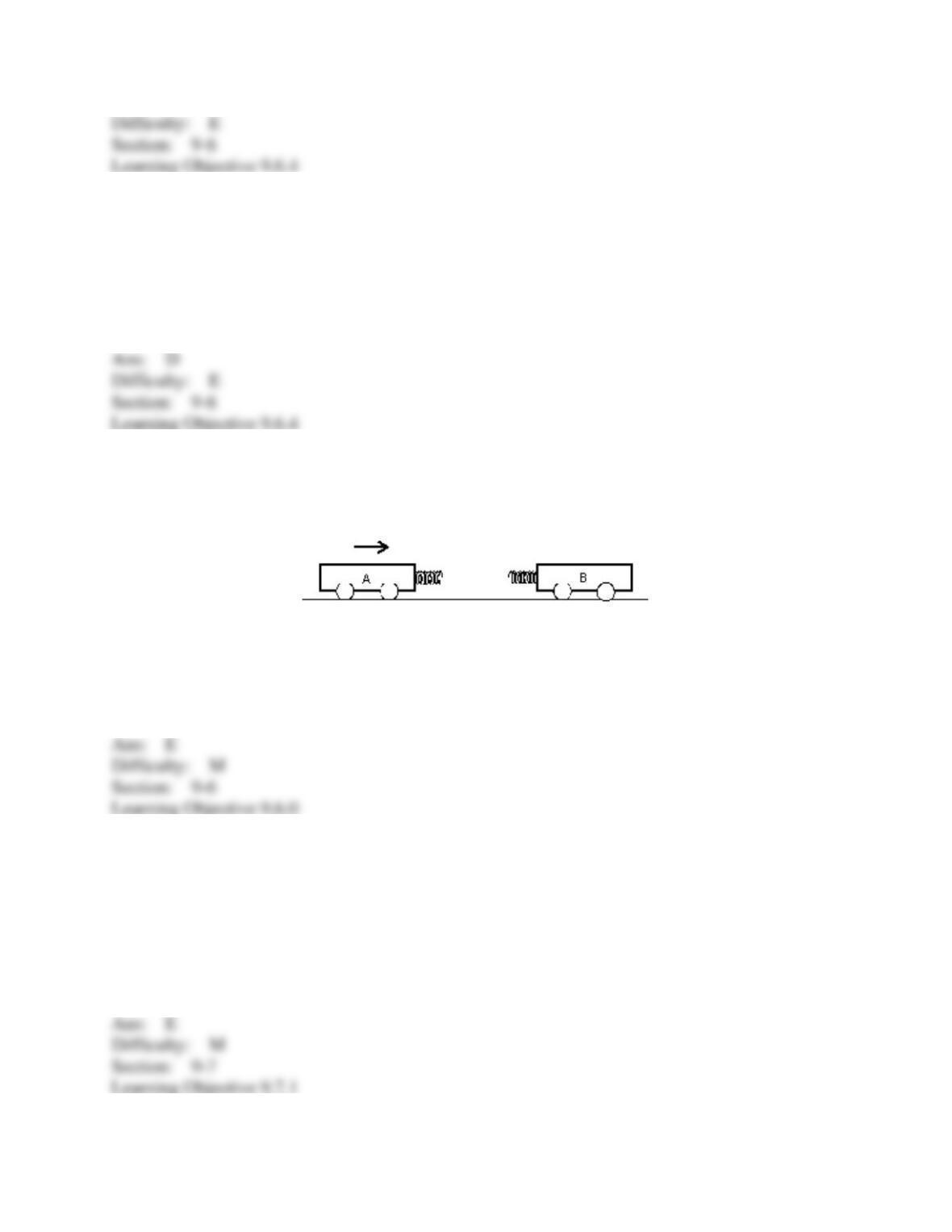
83. Two carts (A and B), having spring bumpers, collide as shown. Cart A has a mass of 2 kg
and is initially moving to the right. Cart B has a mass of 3 kg and is initially stationary. When the
separation between the carts is a minimum:
A) cart B is still at rest
B) cart A has come to rest
C) the carts have the same momentum
D) the carts have the same kinetic energy
E) the kinetic energy of the system is at a minimum
84. Object A strikes the stationary object B head-on in an elastic collision. The mass of A is
fixed, you may choose the mass of B appropriately. Then:
A) for B to have the greatest recoil speed, choose mB = mA
B) for B to have the greatest recoil momentum, choose mB << mA
C) for B to have the greatest recoil kinetic energy, choose mB >> mA
D) for B to have the least recoil speed, choose mB = mA
E) for B to have the greatest recoil kinetic energy, choose mB = mA
85. Block A, with a mass of 2.0 kg, moves along the x axis with a velocity of 5.0 m/s in the
positive x direction. It suffers an elastic collision with block B, initially at rest, and the blocks
leave the collision along the x axis. If B is much more massive than A, the velocity of A after the
collision is:
A) 0 m/s
B) +5.0 m/s
C) –5.0 m/s
D) +10 m/s
E) –10 m/s
86. A very massive object traveling at 10 m/s strikes a light object, initially at rest, and the light
object moves off in the direction of travel of the heavy object. If the collision is elastic, the speed
of the lighter object is
A) 5.0 m/s
B) 10 m/s
C) 15 m/s
D) 20 m/s
E) Can’t tell from the information given.
87. Sphere A has mass m and is moving with velocity v. It makes a head-on elastic collision
with a stationary sphere B of mass 2m. After the collision their speeds (vA, vB) are:
A) 0, v/2
B) –v/3, 2v/3
C) –v, v
D) –2v/3, v/3
E) none of these
88. Blocks A and B are moving toward each other along the x axis. A has a mass of 2.0 kg and
a velocity of 50 m/s, while B has a mass of 4.0 kg and a velocity of –25 m/s. They suffer an
elastic collision and move off along the x axis. The kinetic energy transferred from A to B during
the collision is:
A) 0 J
B) 2500 J
C) 5000 J
D) 7500 J
E) 10000 J
89. When a particle suffers a head-on elastic collision with another particle, initially at rest, the
greatest fraction of kinetic energy is transferred if:
A) the incident particle is initially traveling very fast
B) the incident particle is traveling very slowly
C) the incident particle is much more massive than the target particle
D) the incident particle is much less massive than the target particle
E) the incident and target particle have the same mass
90. Two objects, X and Y, are held at rest on a horizontal frictionless surface and a spring is
compressed between them. The mass of X is 2/5 times the mass of Y. Immediately after the
spring is released, X has a kinetic energy of 50 J and Y has a kinetic energy of:
A) 20 J
B) 8 J
C) 310 J
D) 125 J
E) 50 J
91. If a projectile hits a stationary target, and the projectile stops while the target moves at the
same speed as the incoming speed of the projectile,
A) the mass of the projectile is much less than the mass of the target.
B) the mass of the projectile is equal to the mass of the target.
C) the mass of the projectile is much greater than the mass of the target.
D) nothing can be said about the masses of the projectile and target without further information.
E) this is an unphysical situation and will not actually happen.
92. If a projectile hits a stationary target, and the projectile rebounds and travels back the way it
came,
A) the mass of the projectile is much less than the mass of the target.
B) the mass of the projectile is equal to the mass of the target.
C) the mass of the projectile is much greater than the mass of the target.
D) nothing can be said about the masses of the projectile and target without further information.
E) this is an unphysical situation and will not actually happen.
93. If a projectile hits a stationary target, and the projectile continues to travel in the same
direction,
A) the mass of the projectile is less than the mass of the target.
B) the mass of the projectile is equal to the mass of the target.
C) the mass of the projectile is greater than the mass of the target.
D) nothing can be said about the masses of the projectile and target without further information.
E) this is an unphysical situation and will not actually happen.
94. A hockey puck of mass m traveling along the x axis at 4.5 m/s hits another identical hockey
puck at rest. If after the collision the second puck travels at a speed of 3.5 m/s at an angle of 30°
above the x axis, what is the final velocity of the first puck?
A) 1.0 m/s, 30° below the x axis
B) 2.3 m/s, 50° below the x axis
C) 2.8 m/s, 60° below the x axis
D) 3.0 m/s, 45° below the x axis
E) not enough information
95. A hockey puck of mass m traveling along the x axis at 4.5 m/s hits another identical hockey
puck at rest. If after the collision the second puck travels at a speed of 3.5 m/s at an angle of 30°
above the x axis, is this an elastic collision?
A) Yes, since momentum is conserved.
B) No, since momentum is not conserved.
C) Yes, since kinetic energy is conserved.
D) No, since kinetic energy is not conserved.
E) Not enough information.
96. The thrust of a rocket is
A) a gravitational force acting on the rocket
B) the force of the exiting fuel gases on the rocket
C) any force that is external to the rocket-fuel system
D) a force that arises from the reduction in mass of the rocket-fuel system
E) none of the above
97. At one instant of time a rocket is traveling in outer space at 2500 m/s and is exhausting fuel
at a rate of 100 kg/s. If the speed of the fuel as it leaves the rocket is 1500 m/s, relative to the
rocket, the thrust is:
A) 0 N
B) 1.0 105 N
C) 1.5 105 N
D) 2.9 105 N
E) 2.5 105 N
98. A rocket exhausts fuel with a velocity of 1500 m/s, relative to the rocket. It starts from rest
in outer space with fuel comprising 80 per cent of the total mass. When all the fuel has been
exhausted its speed is:
A) 3600 m/s
B) 2400 m/s
C) 1200 m/s
D) 880 m/s
E) 400 m/s
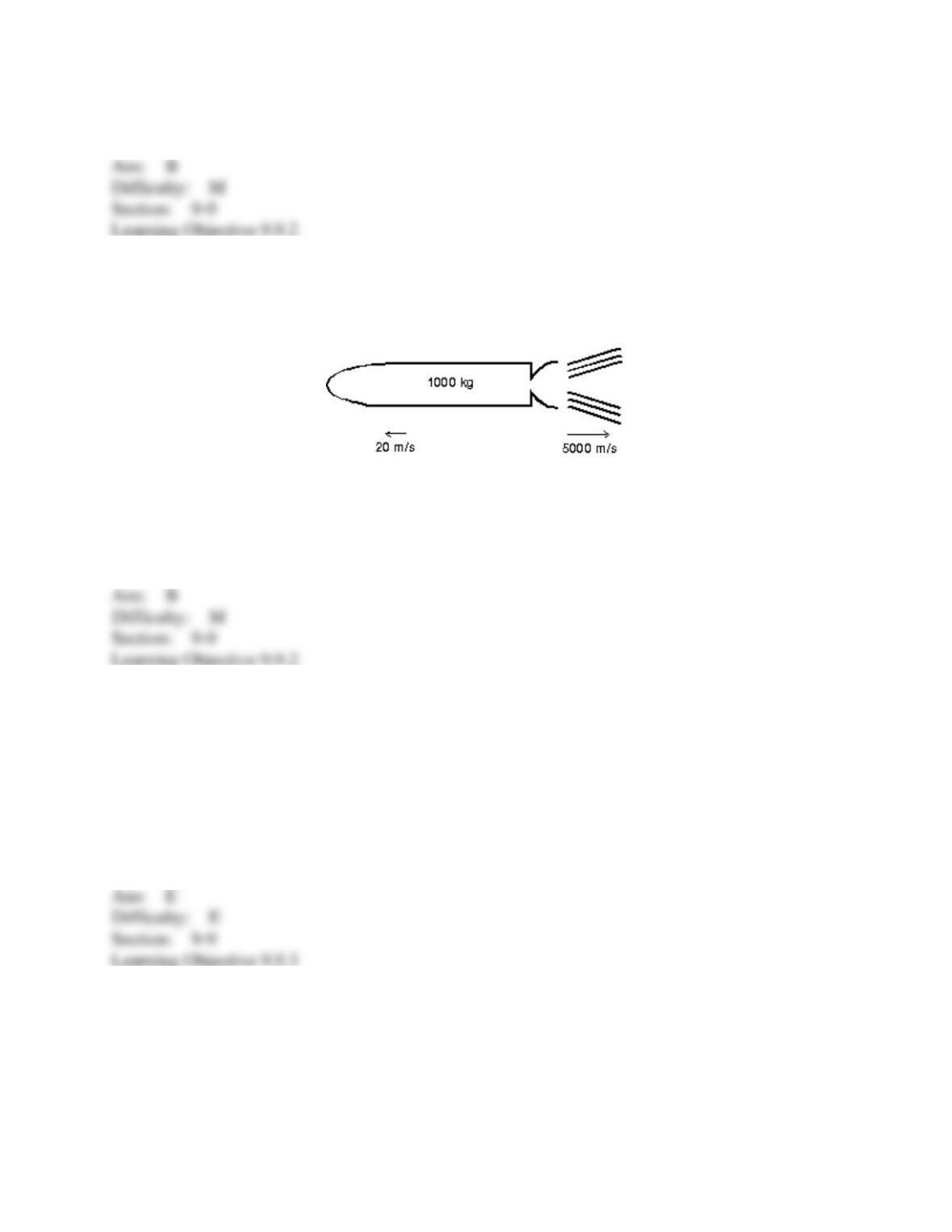
99. A 1000-kg space probe is motionless in space. To start moving, its main engine is fired for
5 s during which time it ejects exhaust gases at 5000 m/s. At the end of this process it is moving
at 20 m/s. The approximate mass of the ejected gas is:
A) 0.8 kg
B) 4 kg
C) 5 kg
D) 20 kg
E) 25 kg
100. A cart loaded with sand slides forward along a horizontal frictionless track. As the cart
moves, sand trickles out at a constant rate through a hole in the back of the cart. The acceleration
of the cart is:
A) constant and in the forward direction
B) constant and in the backward direction
C) variable and in the forward direction
D) variable and in the backward direction
E) zero