Chapter: Chapter 22
Learning Objectives
LO 22.1.0 Solve problems related to the electric field.
LO 22.1.1 Identify that at every point in the space surrounding a charged particle, the particle
sets up an electric field 𝐸
⃗
, which is a vector quantity and thus has both magnitude and direction.
LO 22.1.2 Explain how an electric field 𝐸
⃗
can be used to explain how a charged particle can
exert an electric force 𝐹
on a second charged particle even though there is no contact between
the particles.
LO 22.1.3 Explain how a small positive test charge is used (in principle) to measure the electric
field at any given point.
LO 22.1.4 Explain electric field lines, including where they originate and terminate and what
their spacing represents.
LO 22.2.0 Solve problems related to the electric field due to a charged particle.
LO 22.2.1 In a sketch, draw a charged particle, indicate its sign, pick a nearby point, and then
draw the electric field vector 𝐸
⃗
at that point, with its tail anchored on the point.
LO 22.2.2 For a given point in the electric field of a charged particle, identify the direction of the
field vector 𝐸
⃗
when the particle is positively charged and when it is negatively charged.
LO 22.2.3 For a given point in the electric field of a charged particle, apply the relationship
between the field magnitude E, the charge magnitude q, and the distance r between the point and
the particle.
LO 22.2.4 Identify that the equation given here for the magnitude of an electric field applies only
to a particle, not an extended object.
LO 22.2.5 If more than one electric field is set up at a point, draw each electric field vector and
then find the net electric field by adding the individual electric fields as vectors (not as scalars).
LO 22.3.0 Solve problems related to the electric field due to an electric dipole.
LO 22.3.1 Draw an electric dipole, identifying the charges (sizes and signs), dipole axis, and
direction of the electric dipole moment.
LO 22.3.2 Identify the direction of the electric field at any given point along the dipole axis.
LO 22.3.3 Outline how the equation for the electric field due to an electric dipole is derived from
the equations for the electric field due to the individual charged particles.
LO 22.3.4 For a single charged particle and an electric dipole, compare the rate at which the
electric field magnitude decreases with increase in distance.
LO 22.3.5 Apply the relationship between the magnitude p of dipole moment, the charge
separation d, and the magnitude q of either of the charges.
LO 22.3.6 For any distant point along a dipole axis, apply the relationship between the electric
field magnitude E, the distance z from the center of the dipole, and either the dipole moment
magnitude p or the product of charge magnitude q and charge separation d.
LO 22.4.0 Solve problems related to the electric field due to a line of charge.
LO 22.4.1 For a uniform distribution of charge, find the linear charge density λ for charge along
a line, the surface charge density σ for charge on a surface, and the volume charge density ρ for
charge in a volume.
LO 22.4.2 For charge that is distributed uniformly along a line, find the net electric field at a
given point near the line by splitting the distribution up into charge elements dq and then
summing (by integration) the electric field vectors 𝐸
⃗
set up at the point by each element.

LO 22.4.3 Explain how symmetry can be used to simplify the calculation of the electric field at
a point near a line of uniformly distributed charge.
LO 22.5.0 Solve problems related to the electric field due to a charged disk.
LO 22.5.1 Sketch a disk with uniform charge and indicate the direction of the electric field at a
point on the central axis if the charge is positive and if it is negative.
LO 22.5.2 Explain how the equation for the electric field on the central axis of a uniformly
charged ring can be used to find the equation for the electric field on the central axis of a
uniformly charged disk.
LO 22.5.3 For a point on the central axis of a uniformly charged disk, apply the relationship
between the surface charge density σ, the disk radius R, and the distance z to that point.
LO 22.6.0 Solve problems related to a point charge in an electric field.
LO 22.6.1 For a charged particle placed in an external electric field (a field due to other charged
objects), apply the relationship between the electric field 𝐸
⃗
at that point, the particle’s charge q,
and the electrostatic force 𝐹
that acts on the particle, and identify the relative directions of the
force and the field when the particle is positively charged and negatively charged.
LO 22.6.2 Explain Millikan’s procedure of measuring the elementary charge.
LO 22.6.3 Explain the general mechanism of ink-jet printing.
LO 22.7.0 Solve problems related to a dipole in an electric field.
LO 22.7.1 On a sketch of an electric dipole in an external electric field, indicate the direction of
the field, the direction of the dipole moment, the direction of the electrostatic forces on the two
ends of the dipole, and the direction in which those forces tend to rotate the dipole, and identify
the value of the net force on the dipole.
LO 22.7.2 Calculate the torque on an electric dipole in an external electric field by evaluating a
cross product of the dipole moment vector and the electric field vector, in magnitude-angle
notation and unit-vector notation.
LO 22.7.3 For an electric dipole in an external electric field, relate the potential energy of the
dipole to the work done by a torque as the dipole rotates in the electric field
LO 22.7.4 For an electric dipole in an external electric field, calculate the potential energy by
taking a dot product of the dipole moment vector and the electric field vector, in
magnitude-angle notation and unit-vector notation.
LO 22.7.5 For an electric dipole in an external electric field, identify the angles for the minimum
and maximum potential energies and the angles for the minimum and maximum torque
magnitudes.
Multiple Choice
1. The units of the electric field are:
A) NC2
B) C/N
C) N
D) N/C
E) C/m2
2. The units of the electric field are:
A) J/(Cm)
B) J/C
C) JC
D) J/m
E) none of these
3. An electric field is most directly related to:
A) the momentum of a test charge
B) the kinetic energy of a test charge
C) the potential energy of a test charge
D) the force acting on a test charge
E) the charge carried by a test charge
4. As used in the definition of electric field, a “test charge”:
A) has zero charge
B) must be a proton
C) has charge of magnitude 1.6 10–19 C
D) must be an electron
E) none of the above
5. Experimenter A uses a test charge q0 and experimenter B uses a test charge 2q0 to measure
an electric field produced by stationary charges. A finds a field that is:
A) the same as the field found by B
B) greater than the field found by B
C) less than the field found by B
D) either greater or less than the field found by B, depending on the masses of the test charges
E) either greater or less than the field found by B, depending on the accelerations of the test
charges
6. Electric field lines:
A) are trajectories of a test charge
B) are vectors in the direction of the electric field
C) form closed loops
D) cross each other in the region between two point charges
E) are none of the above
7. Two thin spherical shells, one with radius R and the other with radius 2R, surround an
isolated charge point particle. The ratio of the number of field lines through the larger sphere to
the number through the smaller is:
A) 1
B) 2
C) 4
D) 1/2
E) 1/4
8. A certain physics textbook shows a region of space in which two electric field lines cross
each other. We conclude that:
A) at least two point charges are present
B) an electrical conductor is present
C) an insulator is present
D) the field points in two directions at the same place
E) the author made a mistake
9. Choose the correct statement concerning electric field lines:
A) field lines may cross
B) field lines are close together where the field is large
C) field lines point away from negatively charged particle
D) a point charge particle released from rest moves along a field line
E) none of these are correct
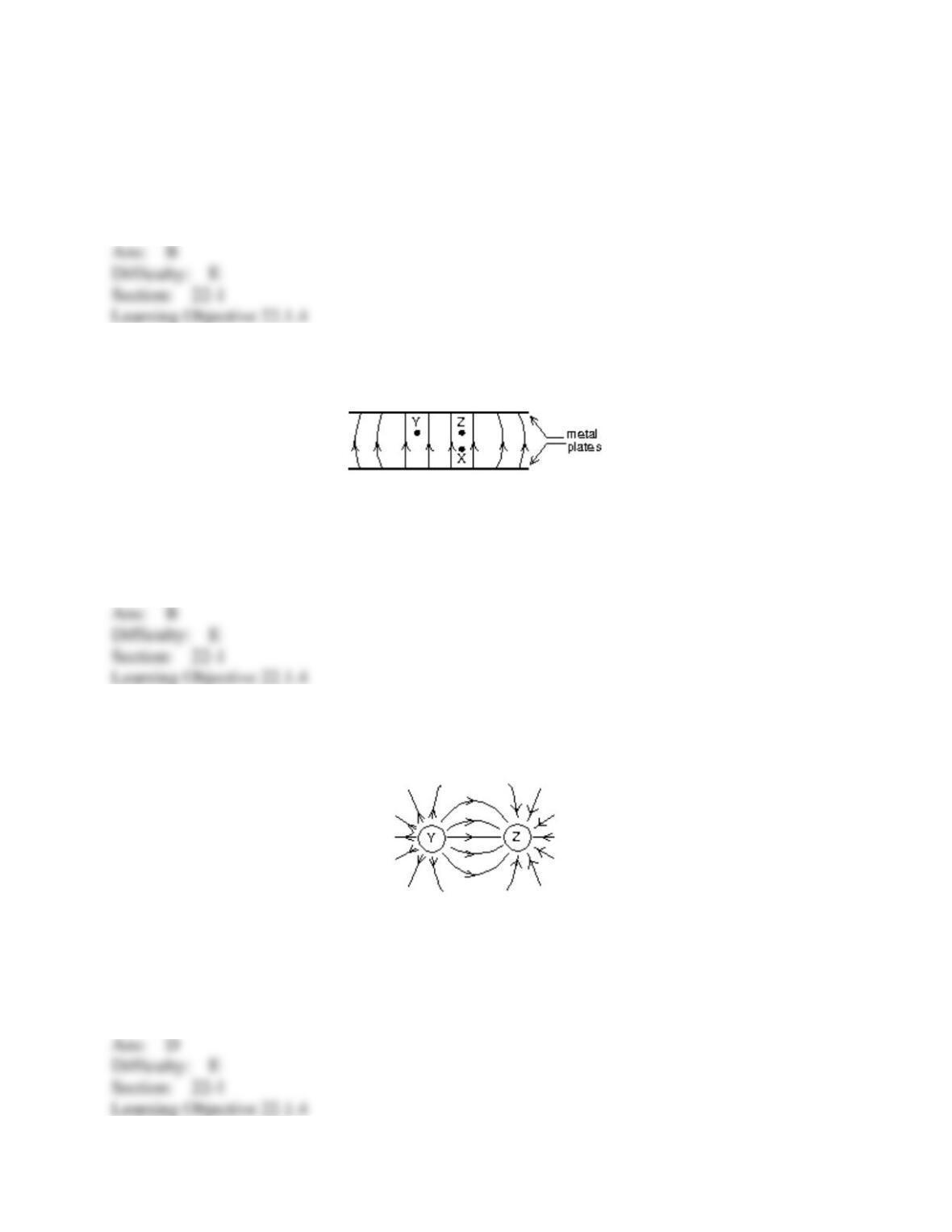
10. The diagram shows the electric field lines due to two charged parallel metal plates. We
conclude that:
A) the upper plate is positive and the lower plate is negative
B) a proton at X would experience the same force if it were placed at Y
C) a proton at X experiences a greater force than if it were placed at Z
D) a proton at X experiences less force than if it were placed at Z
E) an electron at X could have its weight balanced by the electrical force
11. The diagram shows the electric field lines in a region of space containing two small
charged spheres (Y and Z). Then:
A) Y is negative and Z is positive
B) the magnitude of the electric filed is the same everywhere
C) the electric field is strongest midway between Y and Z
D) Y is positive and Z is negative
E) Y and Z must have the same sign
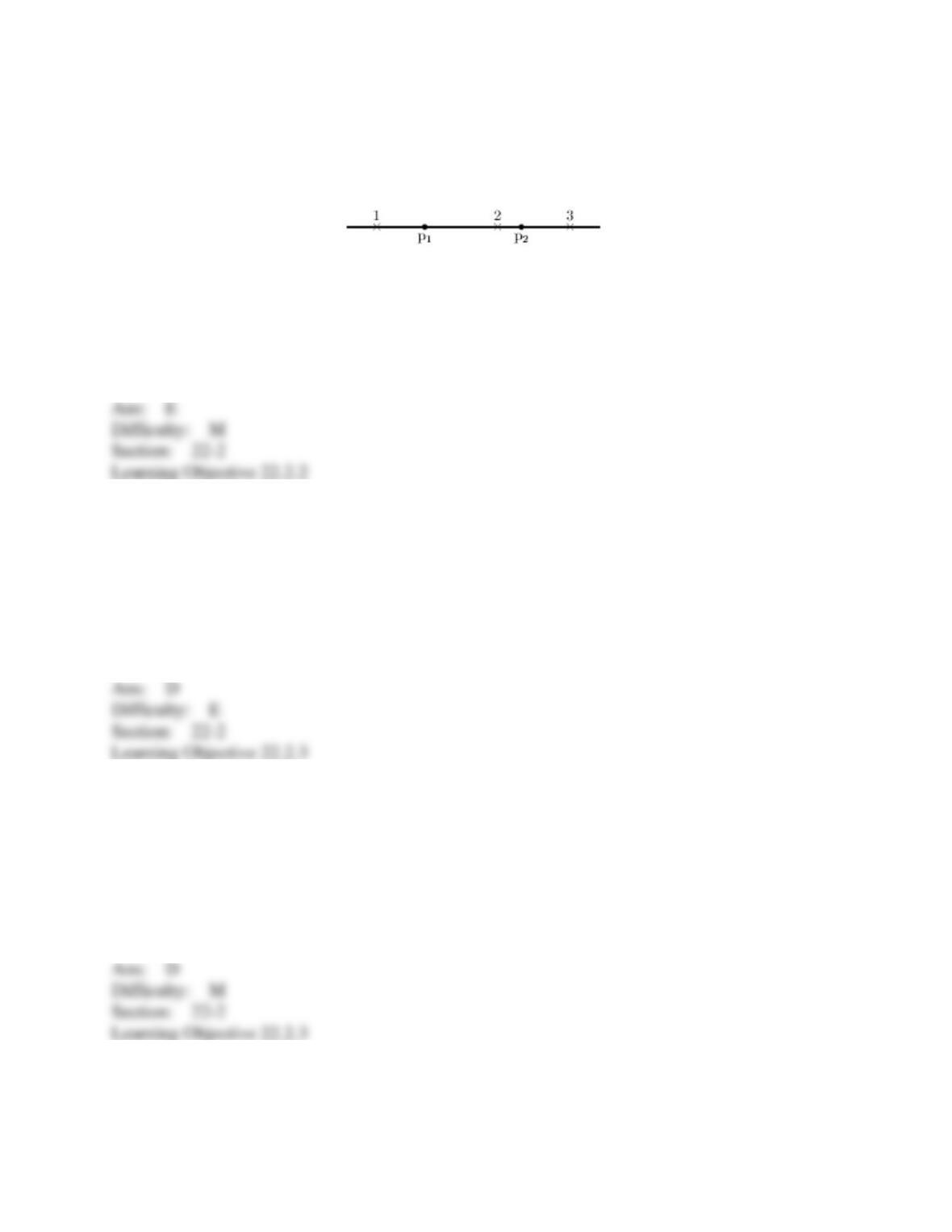
12. Two protons (p1 and p2) are on the x axis, as shown below. The directions of the electric
field at points 1, 2, and 3 respectively, are:
A) →, , →
B) , →,
C) , →, →
D) , ,
E) , , →
13. Let k denote 1/40. The magnitude of the electric field at a distance r from an isolated
point charge q is:
A) kq/r
B) kr/q
C) kq/r3
D) kq/r2
E) kq2/r2
14. The electric field at a distance of 10 cm from an isolated point particle with a charge of 2
10–9 C is:
A) 1.8 N/C
B) 18 N/C
C) 180 N/C
D) 1800 N/C
E) none of these
15. An isolated point charged point particle produces an electric field with magnitude E at a
point 2 m away from the charge. A point at which the field magnitude is E/4 is:
A) 0.5 m away from the charge
B) 1 m away from the charge
C) 2 m away from the charge
D) 4 m away from the charge
E) 8 m away from the charge
16. An isolated charged point particle produces an electric field with magnitude E at a point 2
m away. At a point 1 m from the particle the magnitude of the field is:
A) E
B) 2E
C) 4E
D) E/2
E) E/4
17. The equation E = kq/r2 applies to:
A) only pointlike particles
B) any symmetric objects
C) all objects
D) any spherical object
E) it applies to all objects as long as they are not moving
18. Two point particles, with charges of q1 and q2, are placed a distance r apart. The electric
field is zero at a point P between the particles on the line segment connecting them. We conclude
that:
A) q1 and q2 must have the same magnitude and sign
B) P must be midway between the particles
C) q1 and q2 must have the same sign but may have different magnitudes
D) q1 and q2 must have equal magnitudes and opposite signs
E) q1 and q2 must have opposite signs and may have different magnitudes
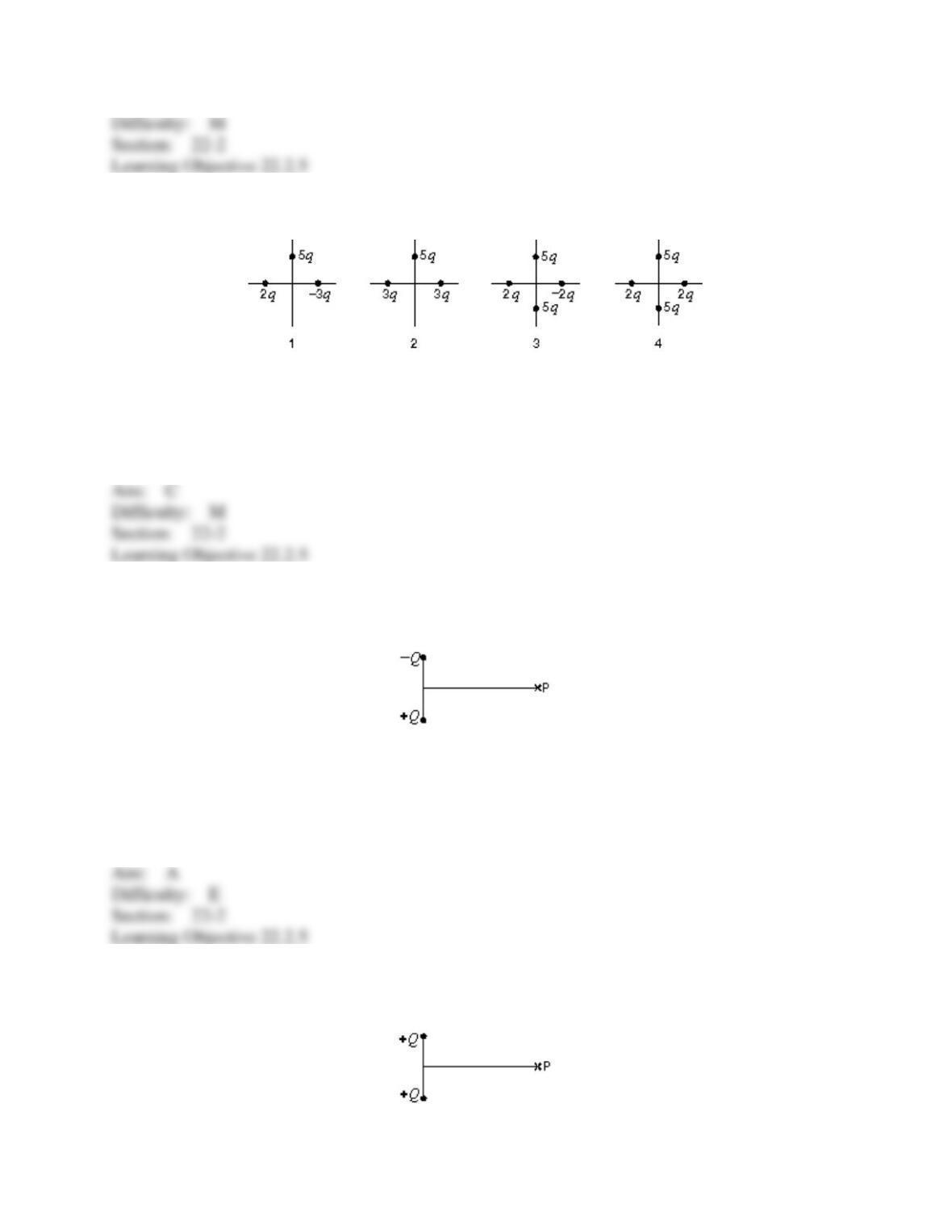
19. The diagrams below depict four different charge distributions. The charged particles are
all the same distance from the origin. The electric field at the origin:
A) is least for situation 1
B) is greatest for situation 3
C) is zero for situation 4
D) is downward for situation 1
E) is downward for situation 3
20. The diagram shows a particle with positive charge Q and a particle with negative charge
−Q. The electric field at point P on the perpendicular bisector of the line joining them is:
A)
B)
C) →
D)
E) zero
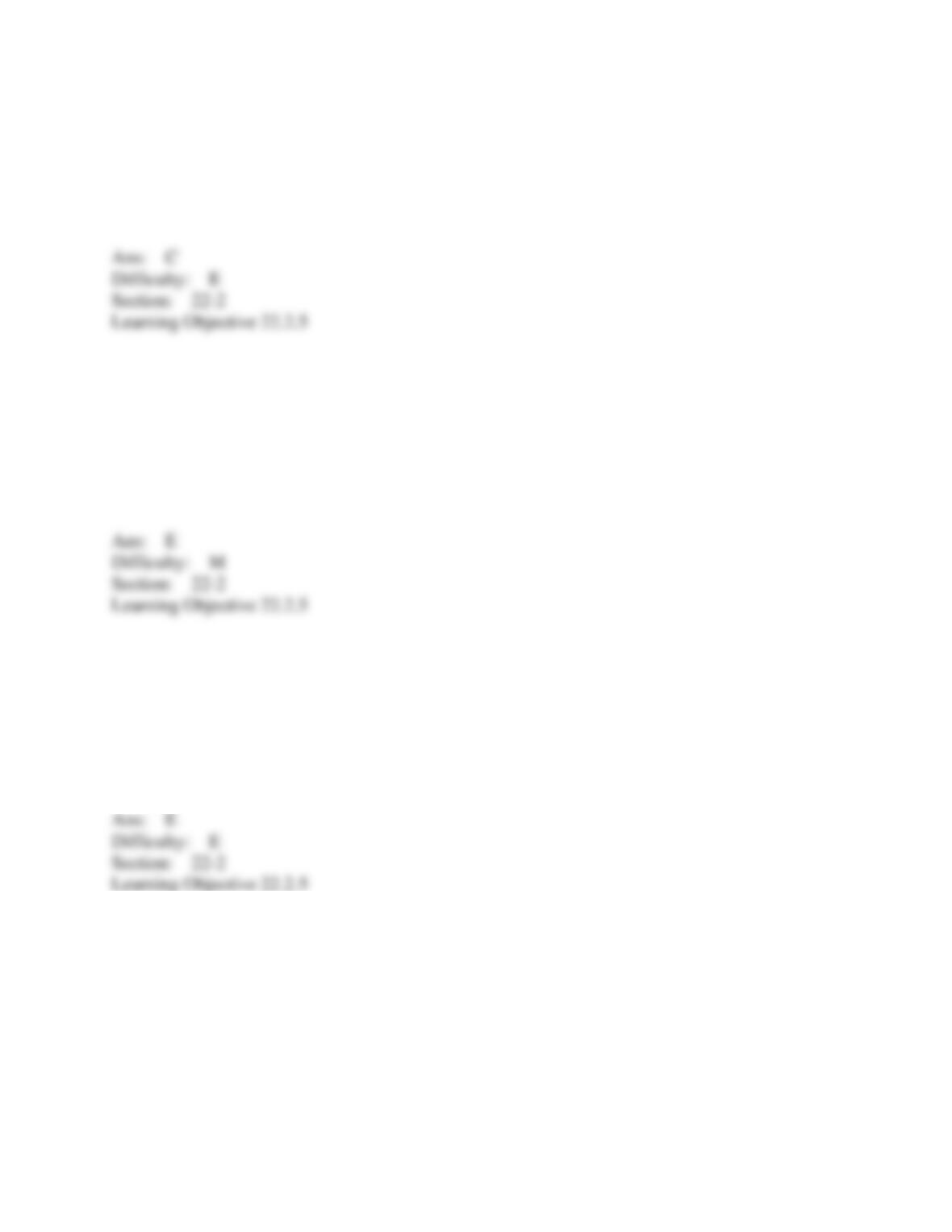
21. The diagram shows two identical particles, each with positive charge Q. The electric field
at point P on the perpendicular bisector of the line joining them is:
A)
B)
C) →
D)
E) zero
22. Two point particles, one with charge +8 10–9 C and the other with charge–2 10–9 C, are
separated by 4 m. The electric field midway between them is:
A) 9 109 N/C
B) 13,500 N/C
C) 135,000 N/C
D) 36 10–9 N/C
E) 22.5 N/C
23. Two charged point particles are located at two vertices of an equilateral triangle and the
electric field is zero at the third vertex. We conclude:
A) the two particles have charges with opposite signs and the same magnitude
B) the two particles have charges with opposite signs and different magnitudes
C) the two particles have identical charges
D) the two particles have charges with the same sign but different magnitudes
E) at least one other charged particle is present
24. Two point particles, with the same charge, are located at two vertices of an equilateral
triangle. A third charged particle is placed so the electric field at the third vertex is zero. The
third particle must:
A) be on the perpendicular bisector of the line joining the first two charges
B) be on the line joining the first two charges
C) be identical to the first two charges
D) have the same magnitude as the first two charges but may have a different sign
E) be at the center of the triangle
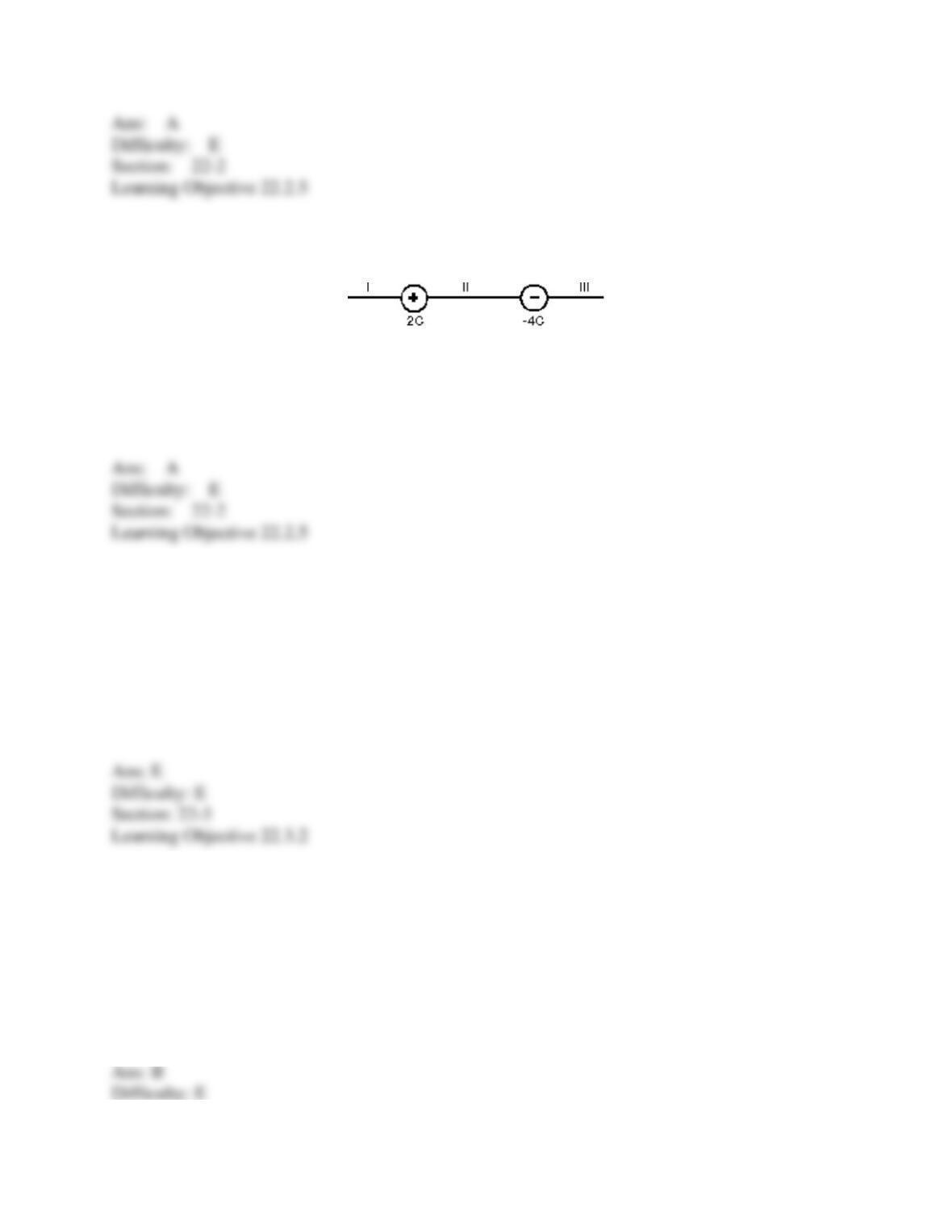
25. Two point charges are arranged as shown. In which region could a third charge +1 C be
placed so that the net electrostatic force on it is zero?
A) I only
B) I and II only
C) III only
D) I and III only
E) II only
26. An electric dipole consists of a particle with a charge of +6 10–6 C at the origin and a
particle with a charge of –6 10–6 C on the x axis at x = 3 10–3 m. The direction of the electric
field due to the dipole at points on the x axis is:
A) in the positive x direction
B) in the negative x direction
C) in the positive y direction
D) in the negative y direction
E) in the positive x direction between the charges and in the negative x direction elsewhere
27. Comparing the field of a single point charge with the field of an electric dipole,
A) the field of the point charge decreases more rapidly with distance
B) the field of the point charge decreases less rapidly with distance
C) the field of the point charge decreases more rapidly with distance but only along the dipole
axis
D) the field of the point charge decreases less rapidly with distance but only perpendicular to the
dipole axis
E) the fields decrease equally rapidly with distance
28. An electric dipole consists of a particle with a charge of +6 10–6 C at the origin and a
particle with a charge of –6 10–6 C on the x axis at x = 3 10–3 m. Its dipole moment is:
A) 1.8 10–8 Cm, in the positive x direction
B) 1.8 10–8 Cm, in the negative x direction
C) 0 Cm, because the net charge is 0
D) 1.8 10–8 Cm, in the positive y direction
E) 1.8 10–8 Cm, in the negative y direction
29. An electric dipole consists of two charges, ±2.5 µC, separated by 1.0 x 10⁻⁴ m and centered
on the origin. If the dipole is oriented along the x axis, what is the electric field at x = 15 cm?
A) 0 N/C
B) 100 N/C
C) 200 N/C
D) 670 N/C
E) 1300 N/C
30. A total charge of 6.3 10–8 C is distributed uniformly throughout a 2.7-cm radius sphere.
The volume charge density is:
A) 3.7 10–7 C/m3
B) 6.9 10–6 C/m3
C) 6.9 10–6 C/m2
D) 2.5 10–4 C/m3
E) 7.6 10–4 C/m3
31. Charge is placed on the surface of a 2.7-cm radius isolated conducting sphere. The
surface charge density is uniform and has the value 6.9 10–6 C/m2. The total charge on the
sphere is:
A) 5.7 10–10 C
B) 1.6 10–8 C
C) 3.2 10–8 C
D) 6.3 10–8 C
E) 7.5 10–4 C
32. A spherical shell has an inner radius of 3.7 cm and an outer radius of 4.5 cm. If charge is
distributed uniformly throughout the shell with a volume density of 6.1 10–4 C/m3 the total
charge is:
A) 1.0 10–7 C
B) 1.3 10–7 C
C) 2.0 10–7 C
D) 1.7 10–6 C
E) 5.0 10–6 C
33. A cylinder has a radius of 2.1 cm and a length of 8.8 cm. Total charge 6.1 10–7 C is
distributed uniformly throughout. The volume charge density is:
A) 7.4 10–11 C/m3
B) 5.3 10–5 C/m3
C) 5.3 10–5 C/m2
D) 8.5 10–4 C/m3
E) 5.0 10–3 C/m3
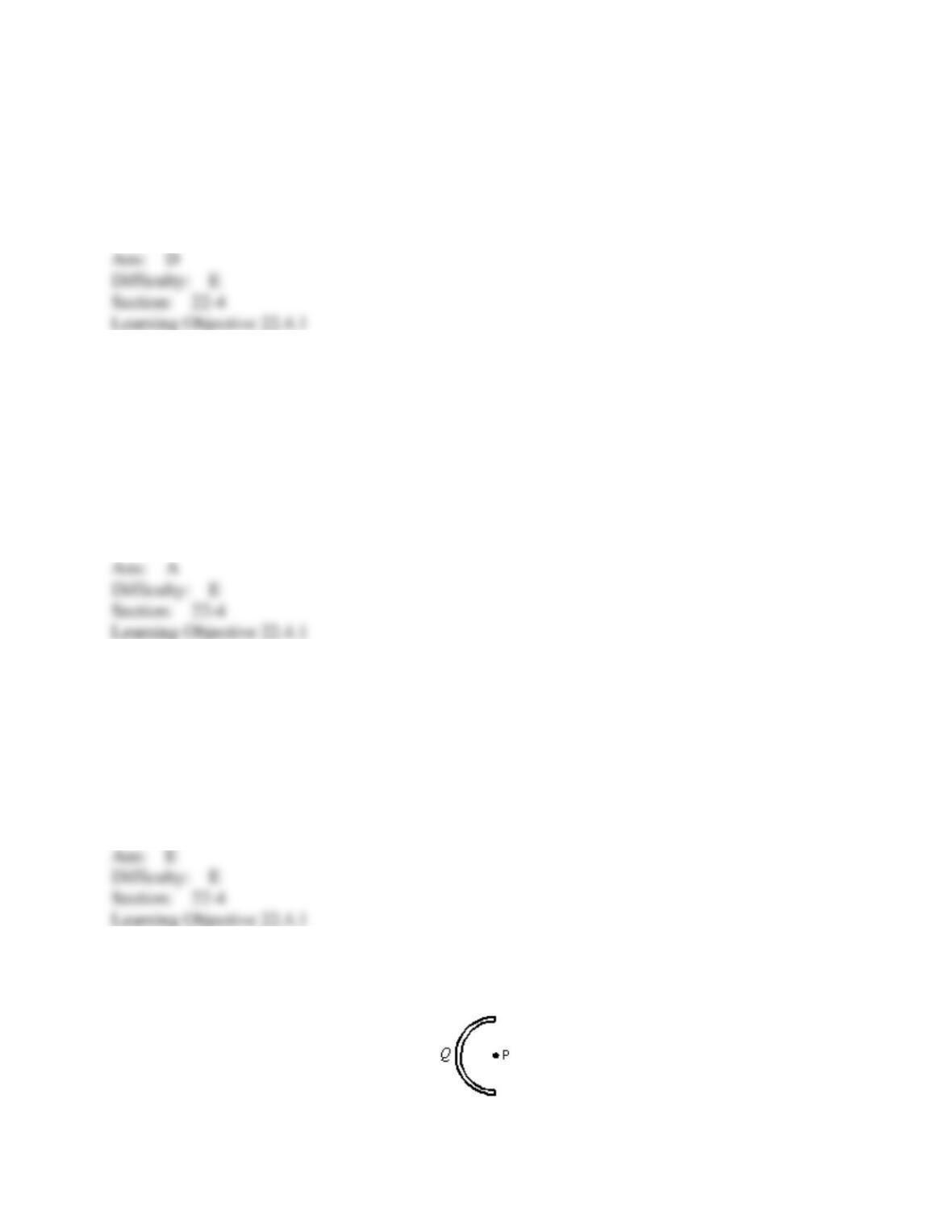
34. Positive charge Q is uniformly distributed on a semicircular rod. What is the direction of
the electric field at point P, the center of the semicircle?
A)
B)
C)
D) →
E)
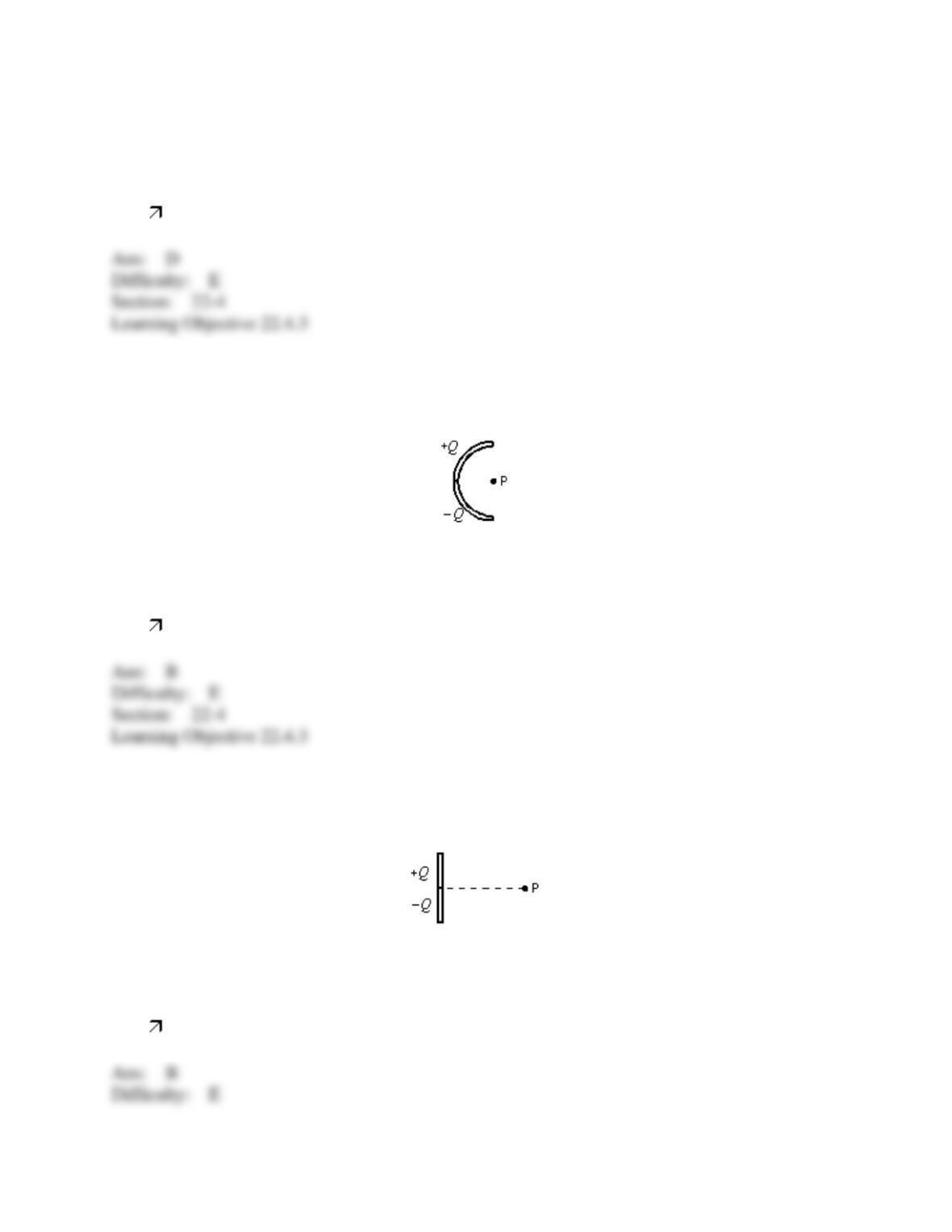
35. Positive charge +Q is uniformly distributed on the upper half of a semicircular rod and
negative charge –Q is uniformly distributed on the lower half. What is the direction of the
electric field at point P, the center of the semicircle?
A)
B)
C)
D) →
E)
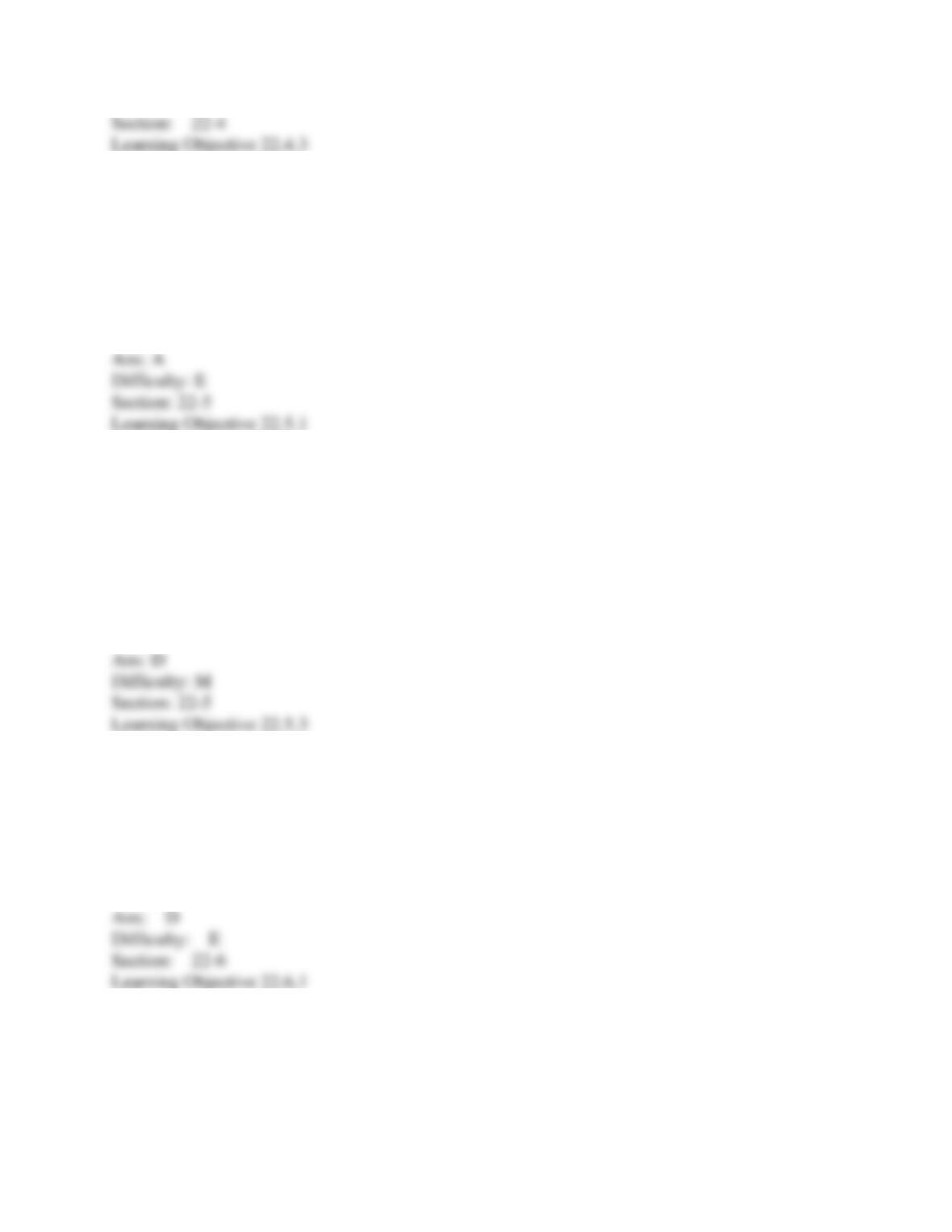
36. Positive charge +Q is uniformly distributed on the upper half of a rod and a negative charge
–Q is uniformly distributed on the lower half. What is the direction of the electric field at point
P, on the perpendicular bisector of the rod?
A)
B)
C)
D) →
E)
37. A disk with a uniform positive surface charge density lies in the x-y plane, centered on the
origin. Along the positive z axis, the direction of the electric field is:
A) in the +z direction
B) in the –z direction
C) in the +x direction
D) in the +y direction
E) there is no field along the positive z axis
38. A disk with a uniform positive surface charge density lies in the x-y plane, centered on the
origin. The disk contains 2.5 x 10⁻⁶ C/m2 of charge, and is 7.5 cm in radius. What is the electric
field at z = 15 cm?
A) 30 N/C
B) 300 N/C
C) 3000 N/C
D) 3.0 x 10⁴ N/C
E) 3.0 x 10⁷ N/C
39. The electric field due to a uniform distribution of charge on a spherical shell is zero:
A) everywhere
B) nowhere
C) only at the center of the shell
D) only inside the shell
E) only outside the shell
40. A charged particle is placed in an electric field that varies with location. No force is
exerted on this charge:
A) at locations where the electric field is zero
B) at locations where the electric field strength is 1/(1.6 10–19) N/C
C) if the particle is moving along a field line
D) if the particle is moving perpendicular to a field line
E) if the field is caused by an equal amount of positive and negative charge
41. The magnitude of the force of a 400-N/C electric field on a 0.02-C point charge is:
A) 8 N
B) 5 10–5 N
C) 8 10–3 N
D) 0.08 N
E) 2 103 N
42. A 200-N/C electric field is in the positive x direction. The force on an electron in this field
is:
A) 200 N in the positive x direction
B) 200 N in the negative x direction
C) 3.2 10–17 N, in the positive x direction
D) 3.2 10–17 N, in the negative x direction
E) 0 N
43. An electron traveling north enters a region where the electric field is uniform and points
north. The electron:
A) speeds up
B) slows down
C) veers east
D) veers west
E) continues with the same speed in the same direction
44. An electron traveling north enters a region where the electric field is uniform and points
west. The electron:
A) speeds up
B) slows down
C) veers east
D) veers west
E) continues with the same speed in the same direction
45. A charged oil drop with a mass of 2 10–4 kg is held suspended by a downward electric
field of 300 N/C. The charge on the drop is:
A) +1.5 106 C
B) –1.5 106 C
C) +6.5 10–6 C
D) –6.5 10–6 C
E) 0 C
46. The purpose of Milliken’s oil drop experiment was to determine:
A) the mass of an electron
B) the charge of an electron
C) the ratio of charge to mass for an electron
D) the sign of the charge on an electron
E) viscosity
47. The force exerted by a uniform electric field on a dipole is:
A) parallel to the dipole moment
B) perpendicular to the dipole moment
C) parallel to the electric field
D) perpendicular to the electric field
E) none of the above
48. An electric field exerts a torque on a dipole only if:
A) the field is parallel to the dipole moment
B) the field is not parallel to the dipole moment
C) the field is perpendicular to the dipole moment
D) the field is not perpendicular to the dipole moment
E) the field is uniform
49. The torque exerted by an electric field on a dipole is:
A) parallel to the field and perpendicular to the dipole moment
B) parallel to both the field and dipole moment
C) perpendicular to both the field and dipole moment
D) parallel to the dipole moment and perpendicular to the field
E) not related to the directions of the field and dipole moment
50. A uniform electric field of 300 N/C makes an angle of 25 with the dipole moment of an
electric dipole. If the torque exerted by the field has a magnitude of 2.5 10–7 Nm, the dipole
moment must be:
A) 8.3 10–10 Cm
B) 9.2 10–10 Cm
C) 2.0 10–9 Cm
D) 8.3 10–5 Cm
E) 1.8 10–4 Cm
51. When the dipole moment of a dipole in a uniform electric field rotates to become more
nearly aligned with the field:
A) the field does positive work and the potential energy increases
B) the field does positive work and the potential energy decreases
C) the field does negative work and the potential energy increases
D) the field does negative work and the potential energy decreases
E) the field does no work
52. The dipole moment of a dipole in a 300-N/C electric field is initially perpendicular to the
field, but it rotates so it is in the same direction as the field. If the moment has a magnitude of 2
10–9 Cm the work done by the field is:
A) –12 10–7 J
B) –6 10–7 J
C) 0 J
D) 6 10–7 J
E) 12 10–7 J
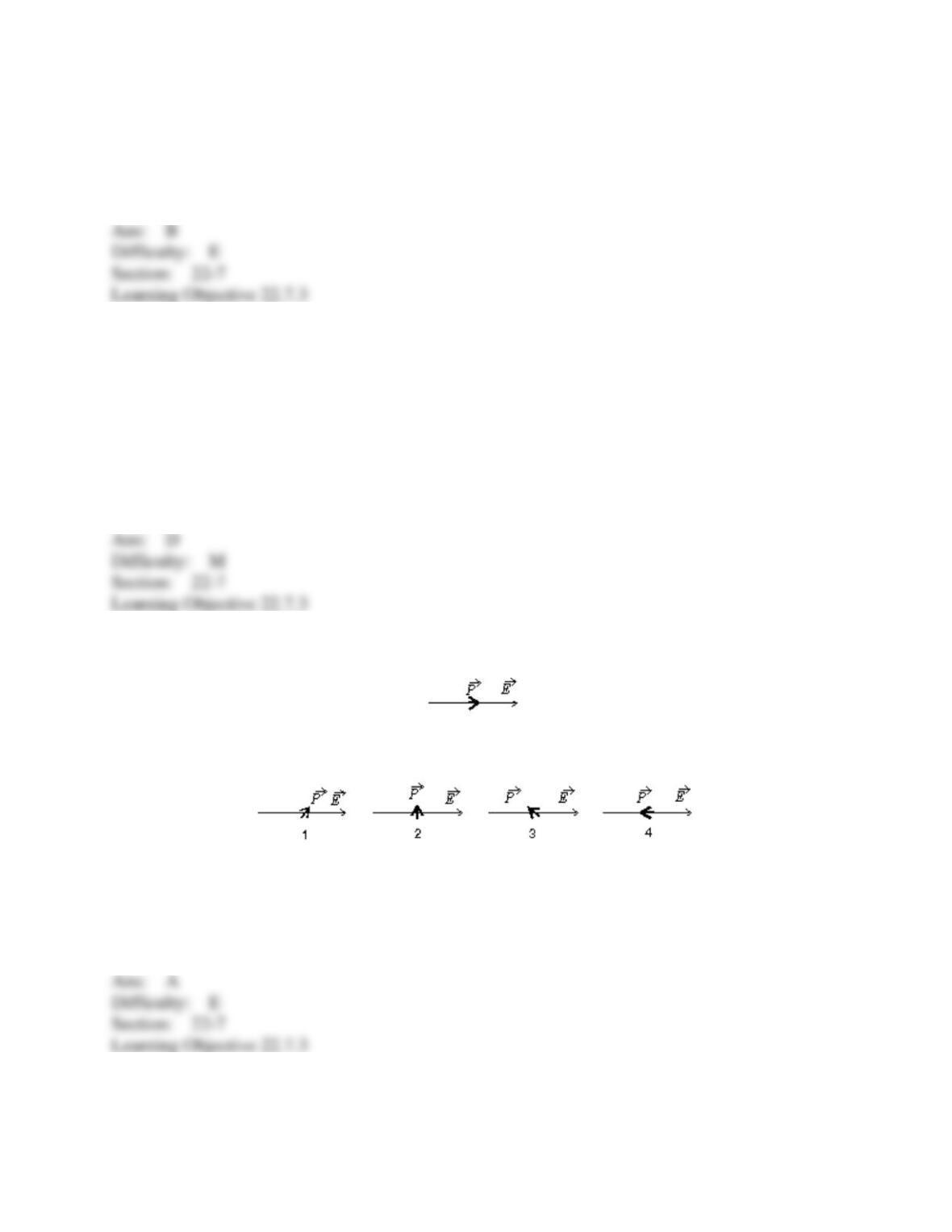
53. An electric dipole is oriented parallel to a uniform electric field, as shown.
It is rotated to one of the five orientations shown below. Rank the final orientations according
to the change in the potential energy of the dipole-field system, most negative to most positive.
A) 1, 2, 3, 4
B) 4, 3, 2, 1
C) 1, 2, 4, 3
D) 3, then 2 and 4 tie, then 1
E) 1, then 2 and 4 tie, then 3
54. An electric dipole of dipole moment 4.5 x 10⁻⁹ C·m is in a 250 N/C electric field. If the
electric field points east, and the dipole moment vector points 37° west of south, what is the
potential energy?
A) –6.8 x 10⁻⁸ J
B) –9.0 x 10⁻⁷ J
C) 0 J
D) 6.8 x 10⁻⁸ J
E) 9.0 x 10⁻⁷ J
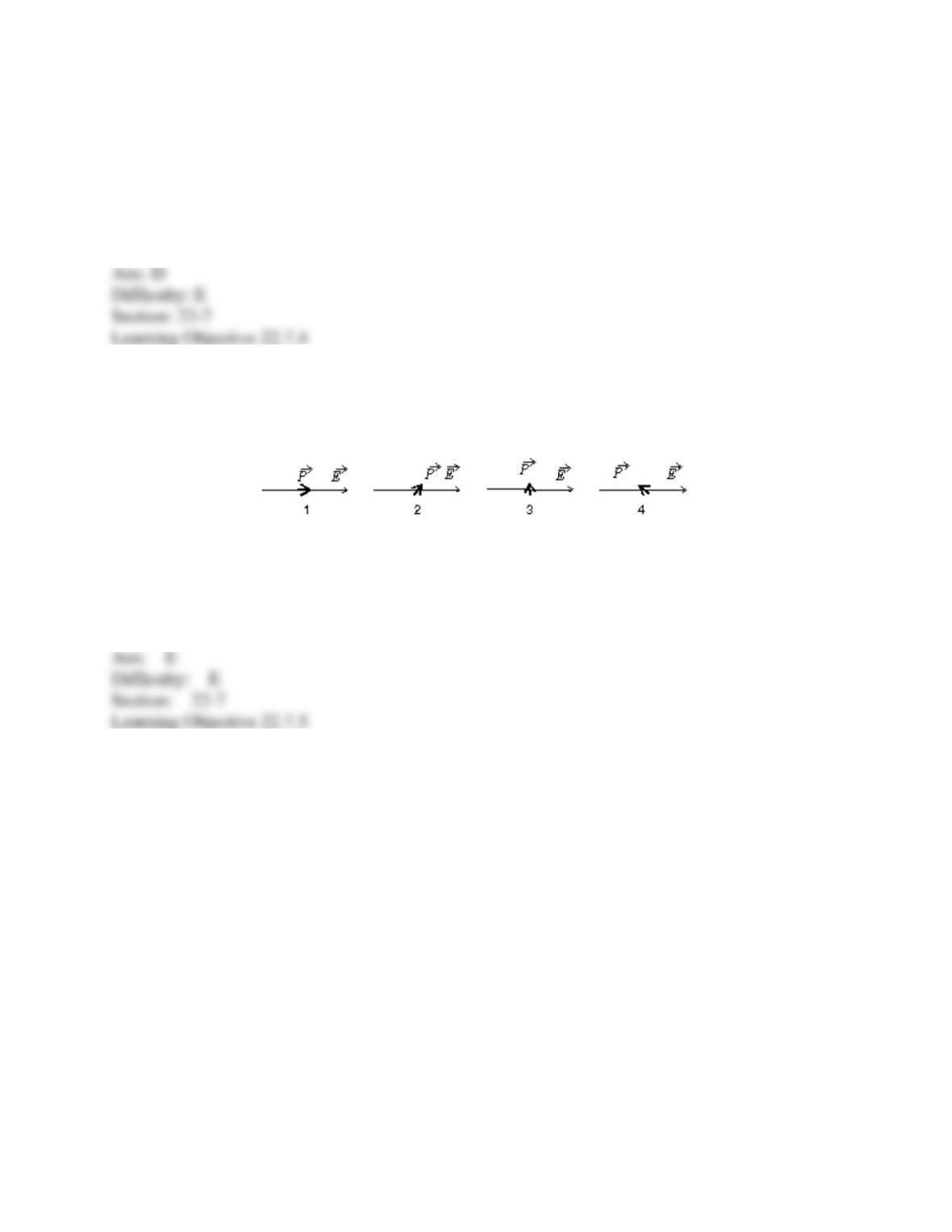
55. The diagrams show four possible orientations of an electric dipole in a uniform electric
field 𝐸
⃗
Rank them according to the magnitude of the torque exerted on the dipole by the field,
least to greatest.
A) 1, 2, 3, 4
B) 4, 3, 2, 1
C) 1, 2, 4, 3
D) 3, then 2 and 4 tie, then 1
E) 1, then 2 and 4 tie, then 3