39. A concave refracting surface of a medium with index of refraction n produces a real image
no matter where an object is placed outside:
A) always
B) only if the index of refraction of the surrounding medium is less than n
C) only if the index of refraction of the surrounding medium is greater than n
D) never
E) none of the above
40. A convex spherical surface with radius r separates a medium with index of refraction 2
from air. As an object in air is moved toward the surface from far away along the central axis, its
image:
A) changes from virtual to real when it is a distance r/2 from the surface
B) changes from virtual to real when it is a distance r from the surface
C) changes from real to virtual when it is a distance r/2 from the surface
D) changes from real to virtual when it is a distance r from the surface
E) remains real
41. A concave spherical surface with radius r separates a medium with index of refraction 2
from air. As an object in air is moved toward the surface from far away along the central axis, its
image:
A) changes from virtual to real when it is a distance r/2 from the surface
B) changes from virtual to real when it is a distance 2r from the surface
C) changes from real to virtual when it is a distance r/2 from the surface
D) changes from real to virtual when it is a distance 2r from the surface
E) remains virtual
42. A convex refracting surface has a radius of 12 cm. Light is incident in air (n = 1) and
refracted into a medium with an index of refraction of 2. Light incident parallel to the central
axis is focused at a point:
A) 3 cm from the surface
B) 6 cm from the surface
C) 12 cm from the surface
D) 18 cm from the surface
E) 24 cm from the surface
43. A convex refracting surface has a radius of 12 cm. Light is incident in air (n = 1) and
refracted into a medium with an index of refraction of 2. To obtain light with rays parallel to the
central axis after refraction a point source should be placed on the axis:
A) 3 cm from the surface
B) 6 cm from the surface
C) 12 cm from the surface
D) 18 cm from the surface
E) 24 cm from the surface
44. A convex spherical refracting surface separates a medium with index of refraction 2 from
air. The image of an object outside the surface is real:
A) always
B) never
C) only if it is close to the surface
D) only if its distance from the surface is large compared to the radius of curvature
E) only if the radius of curvature is small
45. An object faces a spherical refracting surface. If r is negative,
A) the surface is convex.
B) the surface is concave.
C) the image must be real.
D) the object distance must be negative.
E) this cannot happen; r must be positive.
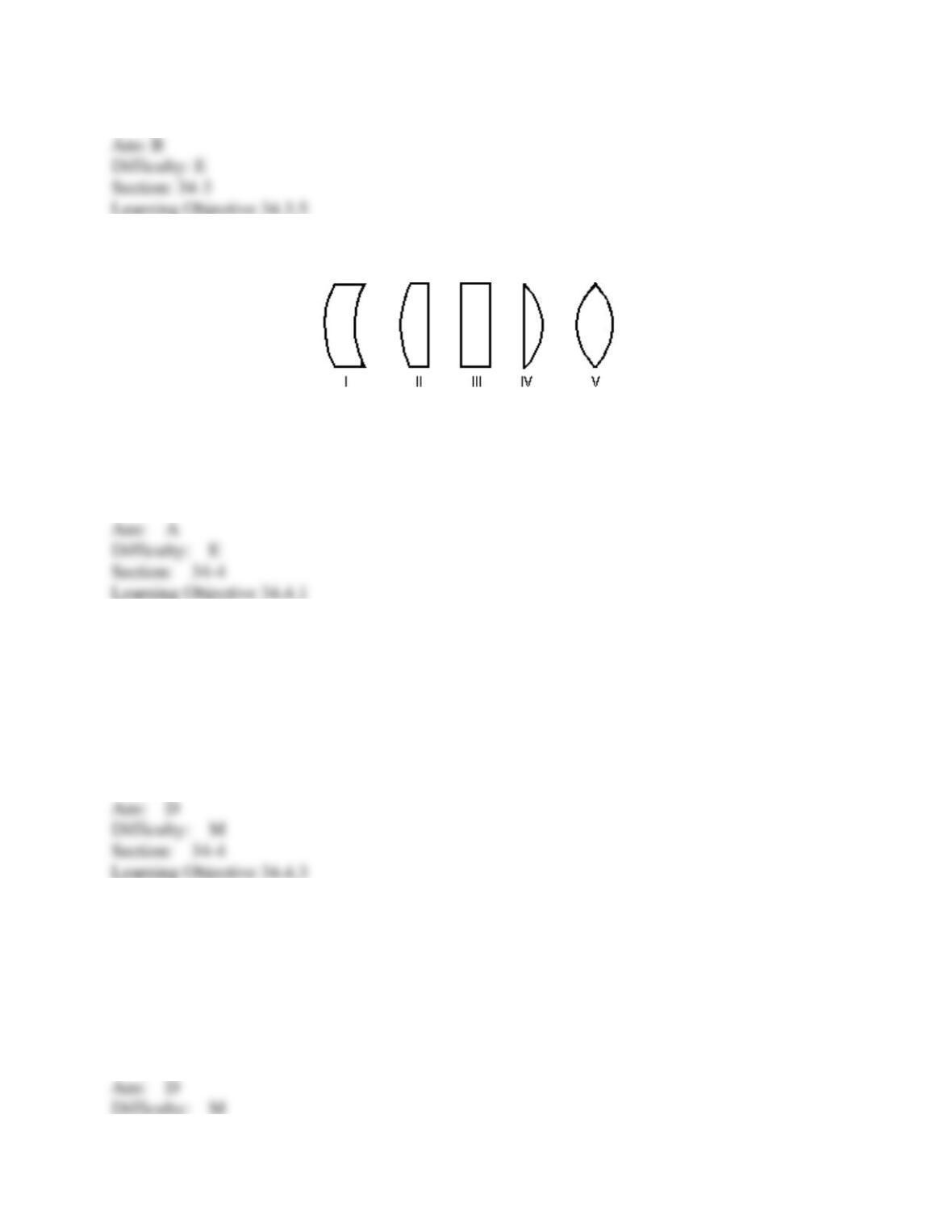
46. Which of the following five glass lenses is a diverging lens?
A) I
B) II
C) III
D) IV
E) V
47. Where must an object be placed in front of a converging lens in order to obtain a virtual
image?
A) At the focal point
B) At twice the distance to the focal point
C) Anywhere beyond the focal point
D) Between the focal point and the lens
E) Between the focal point and twice the distance to the focal point
48. An erect object placed outside the focal point of a converging lens will produce an image
that is:
A) erect and virtual
B) inverted and virtual
C) erect and real
D) inverted and real
E) impossible to locate
49. An object is in front of a converging lens, at a distance less than the focal length from the
lens. Its image is:
A) virtual and larger than the object
B) real and smaller than the object
C) virtual and smaller than the object
D) real and larger than the object
E) virtual and the same size as the object
50. Which type(s) of lenses can produce both real and virtual images?
A) only diverging lenses
B) only converging lenses
C) only plane lenses
D) both converging and diverging lenses
E) neither converging nor diverging lenses
51. If the image distance is negative,
A) the image is real.
B) the image is virtual.
C) the lens is converging.
D) the object distance must also be negative.
E) this is not possible; the image distance must be positive.
52. A hollow lens is made of thin glass as shown. It can be filled with air, water (n = 1.3) or
CS2 (carbon disulfide, n = 1.6). A beam of parallel light entering the lens will diverge if the lens
is filled with:
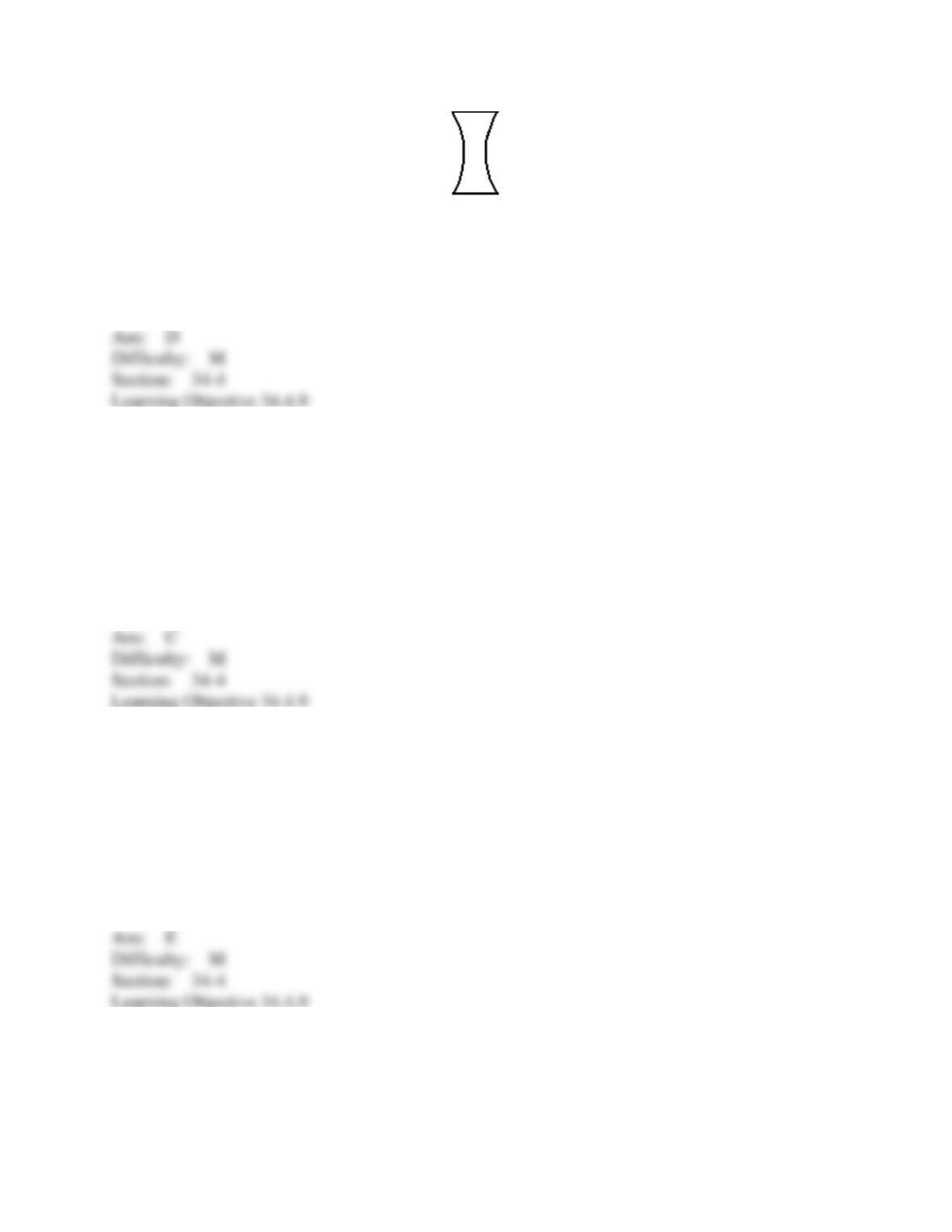
A) air and immersed in air
B) air and immersed in water
C) water and immersed in CS2
D) CS2 and immersed in water
E) CS2 and immersed in CS2
53. The bellows of an adjustable camera can be extended so that the largest film to lens
distance is one and one-half times the focal length. If the focal length is 12 cm, the nearest object
which can be sharply focused on the film must be what distance from the lens?
A) 12 cm
B) 24 cm
C) 36 cm
D) 48 cm
E) 72 cm
54. When a single-lens camera is focused on a distant object, the lens-to-film distance is found
to be 40.0 mm. To focus on an object 0.540 m in front of the lens, the film-to-lens distance
should be:
A) 36.8 mm
B) 37.3 mm
C) 40.0 mm
D) 42.7 mm
E) 43.2 mm
55. In a cinema, a picture 2.5 cm wide on the film is projected to an image 3.0 m wide on a
screen which is 18 m away. The focal length of the lens is about:
A) 7.5 cm
B) 10 cm
C) 12.5 cm
D) 15 cm
E) 20 cm
56. A 3-cm high object is in front of a thin lens. The object distance is 4 cm and the image
distance is –8 cm. The image height is:
A) 0.5 cm
B) 1 cm
C) 1.5 cm
D) 6 cm
E) 24 cm
57. An erect object is placed on the central axis of a thin lens, further from the lens than the
magnitude of its focal length. The magnification is +0.4. This means:
A) the image is real and erect and the lens is a converging lens
B) the image is real and inverted and the lens is a converging lens
C) the image is virtual and erect, and the lens is a diverging lens
D) the image is virtual and erect, and the lens is a converging lens
E) the image is virtual and inverted and the lens is a diverging lens
58. An object is 30 cm in front of a converging lens of focal length 10 cm. The image is:
A) real and larger than the object
B) real and the same size than the object
C) real and smaller than the object
D) virtual and the same size than the object
E) virtual and smaller than the object
59. Let p denote the object-lens distance and i the image-lens distance. The image produced by
a lens of focal length f has a height that can be obtained from the object height by multiplying it
by:
A) p/i
B) i/p
C) f/p
D) f/i
E) i/f
60. A camera with a lens of focal length 6.0 cm takes a picture of a 1.4-m man standing 11 m
away. The height of the image is about:
A) 0.39 cm
B) 0.77 cm
C) 1.5 cm
D) 3.0 cm
E) 6.0 cm
61. The object-lens distance for a certain converging lens is 400 mm. The image is three times
the size of the object. To make the image five times the size of the object, the object-lens
distance must be changed to:
A) 360 mm
B) 540 mm
C) 600 mm
D) 720 mm
E) 960 mm
62. An erect object is 2f in front of a convex lens of focal length f. The image is:
A) real, inverted, magnified
B) real, erect, same size
C) real, inverted, same size
D) virtual, inverted, reduced
E) real, inverted, reduced
63. A plano-convex glass (n = 1.5) lens has a curved side whose radius is 50 cm. If the image
size is to be the same as the object size, the object should be placed at a distance from the lens of:
A) 50 cm
B) 100 cm
C) 200 cm
D) 340 cm
E) 400 cm
64. A converging lens is symmetric; its curved sides have radii of 50 cm. If the focal length is to
be 80 cm, what should the index of refraction be?
A) 0
B) 0.3
C) 0.6
D) 1.3
E) 1.6
65. An object is 20 cm to the left of a lens of focal length +10 cm. A second lens, of focal
length +12.5 cm, is 30 cm to the right of the first lens. The distance between the original object
and the final image is:
A) 0 cm
B) 28 cm
C) 50 cm
D) 100 cm
E) infinite
66. A converging lens of focal length 20 cm is placed in contact with a diverging lens of focal
length 30 cm. The focal length of this combination is:
A) +60 cm
B) +25 cm
C) +12 cm
D) +10 cm
E) –10 cm
67. Two thin lenses (focal lengths f1 and f2) are in contact. Their equivalent focal length is:
A) f1 + f2
B) f1f2/(f1 + f2)
C) 1/f1 + 1/f2
D) f1 – f2
E) f1(f1 – f2)/f2
68. A converging lens of focal length 20 cm is placed in contact with, and to the left of, a
diverging lens of focal length 30 cm. If an object is placed 40 cm to the left of the converging
lens, the total magnification is:
A) –3.0
B) –1.5
C) –1.0
D) 2.0
E) 3.0
69. An ordinary magnifying glass in front of an erect object produces an image that is:
A) real and erect
B) real and inverted
C) virtual and inverted
D) virtual and erect
E) none of these
70. Which instrument uses a single converging lens with the object placed just inside the focal
point?
A) Camera
B) Compound microscope
C) Magnifying glass
D) Overhead projector
E) Telescope
71. Which of the following is NOT correct for a simple magnifying glass?
A) the image is virtual
B) the image is erect
C) the image is larger than the object
D) the object is inside the focal point
E) the lens is diverging
72. In a two lens microscope, the intermediate image is:
A) virtual, erect and magnified
B) real, erect and magnified
C) real, inverted and magnified
D) virtual, inverted and reduced
E) virtual, inverted and magnified
73. The two lenses shown are illuminated by a beam of parallel light from the left. Lens B is
then moved slowly toward lens A. The beam emerging from lens B is:
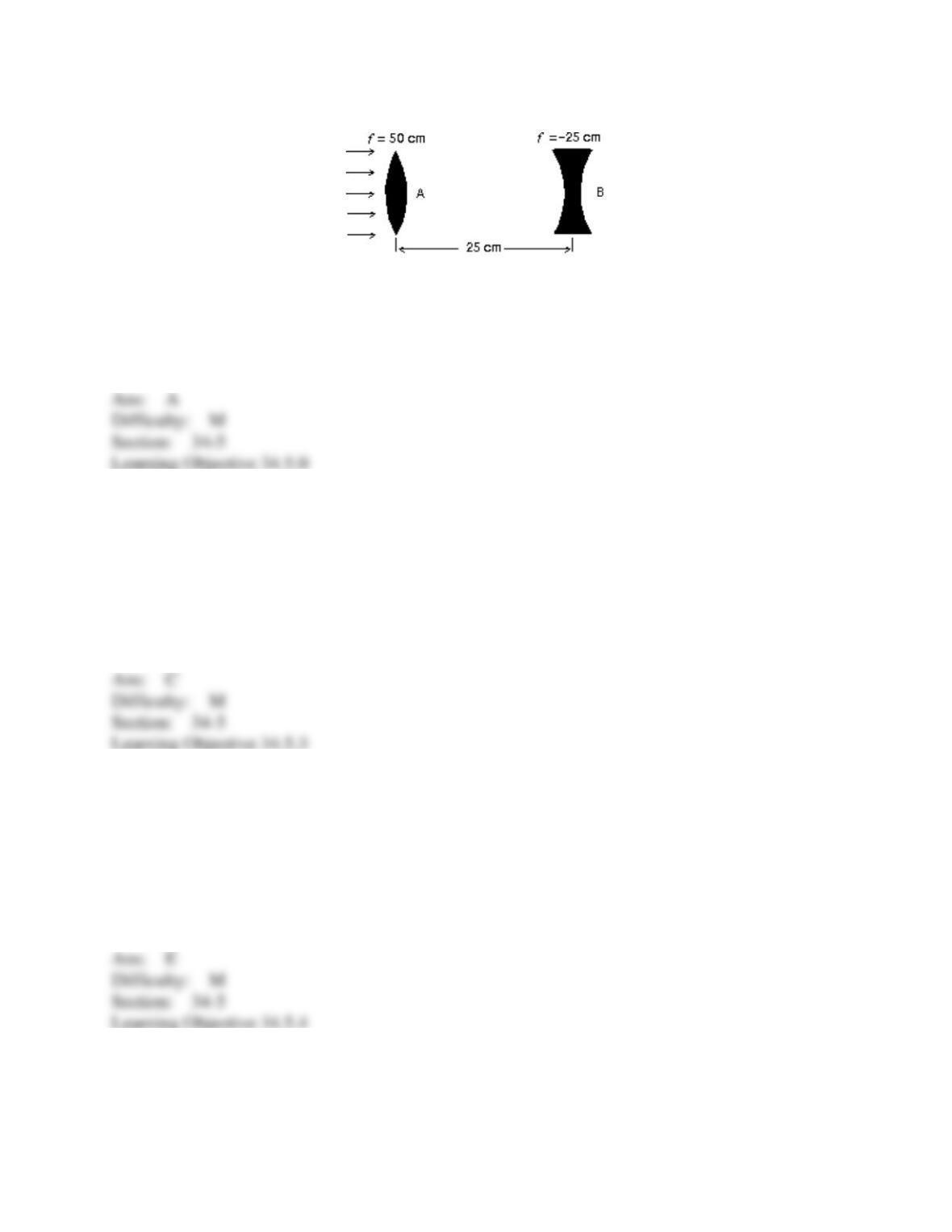
A) initially parallel and then diverging
B) always diverging
C) initially converging and finally parallel
D) always parallel
E) initially converging and finally diverging
74. The Sun subtends 0.5 as seen from the Earth. Its image, using a 1.0-m focal length lens, is
about:
A) 10 cm
B) 2 cm
C) 1 cm
D) 5 mm
E) 1 mm
75. A magnifying glass has a focal length of 15 cm. If the near point of the eye is 25 cm from
the eye the angular magnification of the glass is about:
A) 0.067
B) 0.33
C) 0.5
D) 0.67
E) 1.7
76. Let fo and fe be the focal lengths of the objective and eyepiece of a compound microscope.
In ordinary use, the object:
A) is less than fo from the objective lens
B) is more that fo from the objective
C) produces an intermediate image which is slightly more than fe from the eyepiece
D) produces an intermediate image which is 2fe away from the eyepiece
E) produces an intermediate image which is less than fo from the objective
77. Consider the following four statements concerning a compound microscope:
I.
Each lens produces an image that is virtual and inverted.
II.
The objective lens has a very short focal length.
III.
The eyepiece is used as a simple magnifying glass.
IV.
The objective lens is convex and the eyepiece is concave.
Which two of the four statements are correct?
A) I, II
B) I, III
C) I, IV
D) II, III
E) II, IV
78. In a compound microscope, the objective has a focal length of 1.0 cm, the eyepiece has a
focal length of 2.0 cm, and the tube length is 25 cm. What is the magnitude of the overall
magnification of the microscope?
A) 25
B) 50
C) 100
D) 250
C) 310
79. The objective lens of the Yerkes telescope (the largest functioning refracting telescope in the
world) has a focal length of 19.4 m. If its eyepiece has a focal length of 2.5 cm, what is the
magnitude of its magnification?
A) 7.8
B) 13

C) 130
D) 780
E) cannot be calculated without knowing the length of the telescope