Learning Objective 19.5.2
57. If the temperature T of an ideal gas is increased at constant pressure the mean free path:
A) decreases in proportion to 1/T
B) decreases in proportion to 1/T2
C) increases in proportion to T
D) decreases in proportion to T2
E) does not change
58. A certain ideal gas has a temperature 300 K and a pressure 5.0 104 Pa. The molecules
have a mean free path of 4.0 10−7m. If the temperature is raised to 350 K and the pressure is
reduced to 1.0 104 Pa the mean free path is then:
A) 6.9 10−8 m
B) 9.3 10−8 m
C) 3.4 10−7 m
D) 1.7 10−6 m
E) 2.3 10−6 m
59. Which of the following changes when the pressure of an ideal gas is changed isothermally?
A) Mean free path
B) Root-mean-square molecular speed
C) Internal energy
D) Most probable kinetic energy
E) Average speed
60. The Maxwellian speed distribution provides a direct explanation of:
A) thermal expansion
B) the ideal gas law
C) heat
D) evaporation
E) boiling
61. According to the Maxwellian speed distribution, as the temperature increases the number of
molecules with speeds within a small interval near the most probable speed:
A) increases
B) decreases
C) increases at high temperatures and decreases at low
D) decreases at high temperatures and increases at low
E) stays the same
62. For a gas at thermal equilibrium the average speed v, the most probable speed vp, and the
root-mean-square speed vrms are in the order:
A) vp < vrms < v
B) vrms < vp < v
C) v < vrms < vp
D) vp < v < vrms
E) v < vp < vrms
63. The average speed of air molecules at room temperature is about:
A) 0 m/s
B) 2 m/s (walking speed)
C) 30 m/s (fast car)
D) 500 m/s (supersonic airplane)
E) 3 108 m/s (speed of light)
64. According to the Maxwellian speed distribution, as the temperature increases the most
probable speed:
A) increases
B) decreases
C) increases at high temperatures and decreases at low
D) decreases at high temperatures and increases at low
E) stays the same
65. According to the Maxwellian speed distribution, as the temperature increases the average
speed:
A) increases
B) decreases
C) increases at high temperatures and decreases at low
D) decreases at high temperatures and increases at low
E) stays the same
66. Two ideal monatomic gases are in thermal equilibrium with each other. Gas A is composed
of molecules with mass m while gas B is composed of molecules with mass 4m. The ratio of the
average molecular speeds vA/vB is:
A) 1/4
B) 1/2
C) 1
D) 2
E) 4
67. Ideal monatomic gas A is composed of molecules with mass m while ideal monatomic gas
B is composed of molecules with mass 4m. The average molecular speeds are the same if the
ratio of the temperatures TA/TB is:
A) 1/4
B) 1/2
C) 1
D) 2
E) 4
68. As the pressure in an ideal gas is increased isothermally the average molecular speed:
A) increases
B) decreases
C) increases at high temperature, decreases at low
D) decreases at high temperature, increases at low
E) stays the same
69. As the volume of an ideal gas is increased at constant pressure the average molecular
speed:
A) increases
B) decreases
C) increases at high temperature, decreases at low
D) decreases at high temperature, increases at low
E) stays the same
70. The heat capacity at constant volume of an ideal gas depends on:
A) the temperature
B) the pressure
C) the volume
D) the number of molecules
E) none of the above
71. The internal energy of an ideal gas depends on:
A) the temperature only
B) the pressure only
C) the volume only
D) the temperature and pressure only
E) temperature, pressure, and volume
72. Two monatomic ideal gases are in thermal equilibrium with each other. Gas A is composed
of molecules with mass m while gas B is composed of molecules with mass 4m. The ratio of the
average molecular kinetic energy KA/KB is:
A) 1/4
B) 1/2
C) 1
D) 2
E) 4
73. Ideal monatomic gas A is composed of molecules with mass m while ideal monatomic gas
B is composed of molecules with mass 4m. The average molecular energies are the same if the
ratio of the temperatures TA/TB is:
A) 1/4
B) 1/2
C) 1
D) 2
E) 4
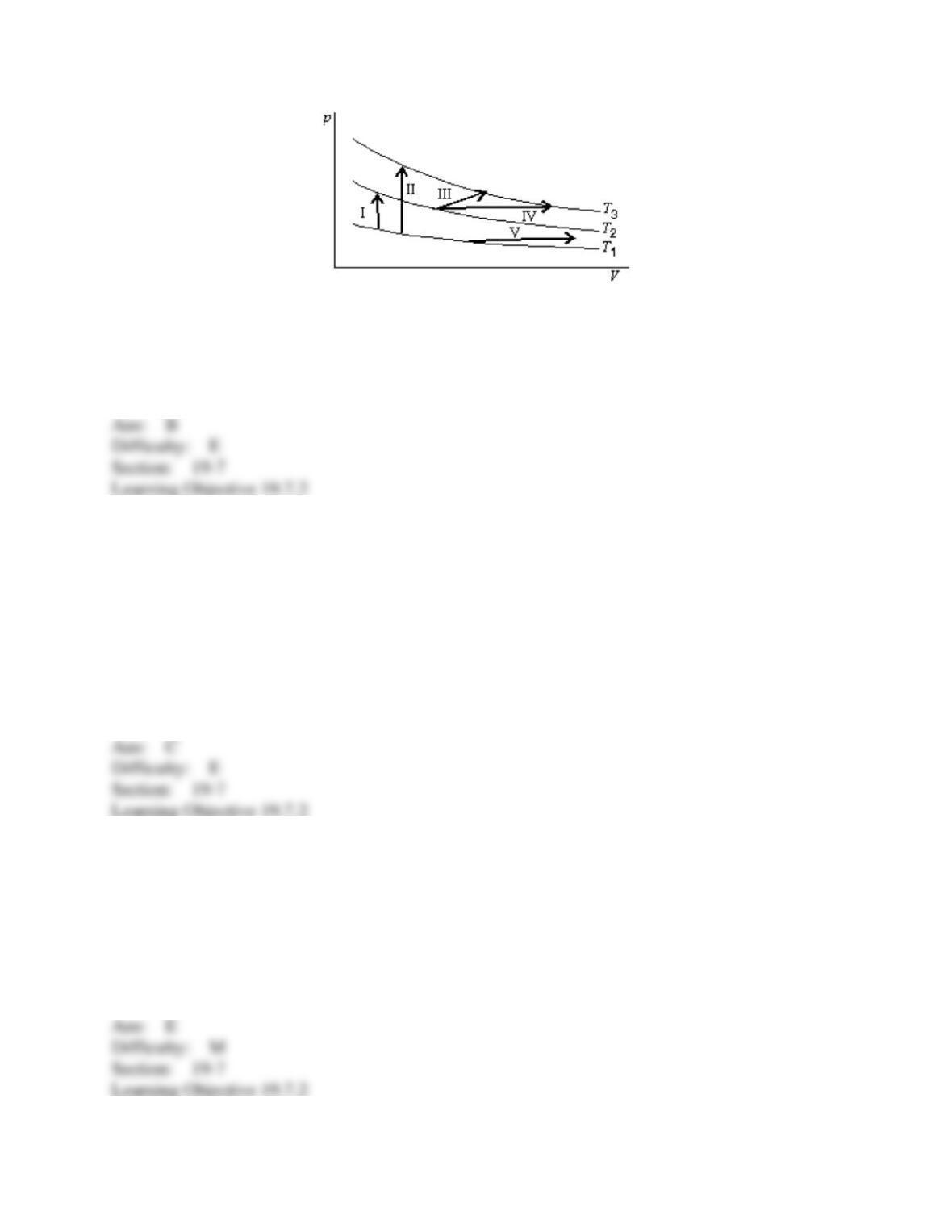
74. The diagram shows three isotherms for an ideal gas, with T3-T2 the same as T2-T1. It also
shows five thermodynamic processes carried out on the gas. Rank the processes in order of the
change in the internal energy of the gas, least to greatest.
A) I, II, III, IV, V
B) V; then I, III and IV tied; then II
C) V; I; then III, and IV tied; then II
D) II; then I, III and IV tied; then V
E) II; I; then III, IV, and V tied
75. Two ideal gases, each consisting of N monatomic molecules, are in thermal equilibrium
with each other and equilibrium is maintained as the temperature is increased. A molecule of the
first gas has mass m and a molecule of the second has mass 4m. The ratio of the internal energies
E4m/Em is:
A) 1/4
B) 1/2
C) 1
D) 2
E) 4
76. Both the pressure and volume of an ideal gas of diatomic molecules are doubled. The ratio
of the new internal energy to the old both measured relative to the internal energy at 0 K is:
A) 1/4
B) 1/2
C) 1
D) 2
E) 4
77. The pressure of an ideal gas of diatomic molecules is doubled by halving the volume. The
ratio of the new internal energy to the old, both measured relative to the internal energy at 0 K,
is:
A) 1/4
B) 1/2
C) 1
D) 2
E) 4
78. An ideal monatomic gas has a molar specific heat Cv at constant volume of:
A) R
B) 3R/2
C) 5R/2
D) 7R/2
E) 9R/2
79. The specific heat Cv at constant volume of a monatomic gas at low pressure is proportional
to Tn where the exponent n is:
A) –1
B) 0
C) 1/2
D) 1
E) 2
80. The ratio of the specific heat of an ideal gas at constant volume to its specific heat at
constant pressure is:
A) R
B) 1/R
C) dependent on the temperature
D) dependent on the pressure
E) different for monatomic, diatomic, and polyatomic gases
81. The specific heat at constant volume of an ideal gas depends on:
A) the temperature
B) the pressure
C) the volume
D) the number of molecules
E) none of the above
82. Consider the ratios of the heat capacities = Cp/Cv for the three types of ideal gases:
monatomic, diatomic, and polyatomic.
A) is the greatest for monatomic gases
B) is the greatest for polyatomic gases
C) is the same only for diatomic and polyatomic gases
D) is the same only for monatomic and diatomic gases
E) is the same for all three
83. An ideal gas has molar specific heat Cp at constant pressure. When the temperature of n
moles is increased by T the increase in the internal energy is:
A) nCpT
B) n(Cp + R)T
C) n(Cp – R)T
D) n(2Cp + R)T
E) n(2Cp – R)T
84. The heat capacity at constant volume and the heat capacity at constant pressure have
different values because:
A) heat increases the internal energy at constant volume but not at constant pressure
B) heat increases the internal energy at constant pressure but not at constant volume
C) the system does work at constant volume but not at constant pressure
D) the system does work at constant pressure but not at constant volume
E) the system does more work at constant volume than at constant pressure
85. The difference between the molar specific heat at constant pressure and the molar specific
heat at constant volume for an ideal gas is:
A) the Boltzmann constant k
B) the universal gas constant R
C) the Avogadro number NA
D) kT
E) RT
86. The ratio of the specific heat of a gas at constant volume to its specific heat at constant
pressure is:
A) 1
B) less than 1
C) more than 1
D) has units of pressure/volume
E) has units of volume/pressure
87. Energy transferred into an ideal gas as heat:
A) goes entirely into the internal energy of the gas
B) goes entirely into doing work to expand the gas
C) goes entirely into the internal energy of the gas only if the pressure is constant
D) goes entirely into the internal energy of the gas only if the temperature is constant
E) goes entirely into the internal energy of the gas only if the volume is constant
88. For a given change in temperature, the change in the internal energy of an ideal gas:
A) also depends on the change in pressure
B) also depends on the change in volume
C) depends on whether the process is adiabatic or not
D) depends on whether the process occurs at constant pressure or not
E) can be calculated assuming the volume is constant
89. Assume that helium behaves as an ideal monatomic gas. If 2 moles of helium undergo a
temperature increase of 100 K at constant pressure, how much energy has been transferred to the
helium as heat?
A) 1700 J
B) 2500 J
C) 4200 J
D) 5000 J
E) 6700 J
90. Assume that helium behaves as an ideal monatomic gas. If 2 moles of helium undergo a
temperature increase of 100 K at constant pressure, how much work is done by the gas?
A) 0 J
B) 1700 J
C) 2500 J
D) 4200 J
E) 5000 J
91. Assume that helium behaves as an ideal monatomic gas. If 2 moles of helium undergo a
temperature increase of 100 K at constant volume, how much work is done by the gas?
A) 0 J
B) 1700 J
C) 2500 J
D) 4200 J
E) 5000 J
92. The number of degrees of freedom of a rigid diatomic molecule is:
A) 2
B) 3
C) 4
D) 5
E) 6
93. The number of degrees of freedom of a triatomic molecule is:
A) 1
B) 3
C) 6
D) 8
E) 9
94. The “Principle of equipartition of energy” states that the internal energy of a gas is shared
equally:
A) among the molecules
B) between kinetic and potential energy
C) among the relevant degrees of freedom
D) between translational and vibrational kinetic energy
E) between temperature and pressure
95. The specific heat of a polyatomic gas is greater than the specific heat of a monatomic gas
because:
A) the polyatomic gas does more positive work when energy is absorbed as heat
B) the monatomic gas does more positive work when energy is absorbed as heat
C) the energy absorbed by the polyatomic gas is split among more degrees of freedom
D) the pressure is greater in the diatomic gas
E) a monatomic gas cannot hold as much heat
96. An ideal gas of N diatomic molecules has temperature T. If the number of molecules is
doubled without changing the temperature, the internal energy increases by:
A) 0
B) 1
2NkT
C) 3
2 NkT
D) 5
2NkT
E) 3 NkT
97. A monatomic gas can have internal energy consisting of:
A) translational motion only
B) rotational motion only
C) oscillatory motion only
D) both translational and rotational motion
E) translational, rotational, and oscillatory motion, depending on temperature
98. A diatomic gas can have internal energy consisting of:
A) translational motion only
B) rotational motion only
C) oscillatory motion only
D) both translational and rotational motion
E) translational, rotational, and oscillatory motion, depending on temperature
99. An ideal diatomic gas has a molar specific heat at constant pressure, Cp, of:
A) R
B) 3R/2
C) 5R/2
D) 7R/2
E) 9R/2
100. An ideal gas of N monatomic molecules is in thermal equilibrium with an ideal gas of the
same number of diatomic molecules and equilibrium is maintained as temperature is increased.
The ratio of the changes in the internal energies ΔEdia / ΔEmon is:
A) 1/2
B) 3/5
C) 1
D) 5/3
E) 2
101. Three gases, one consisting of monatomic molecules, the second consisting of diatomic
molecules, and the third consisting of polyatomic molecules, are in thermal equilibrium with
each other and remain in thermal equilibrium as the temperature is raised. All have the same
number of molecules. The gases with the least and greatest internal energy are respectively:
A) polyatomic, monatomic
B) monatomic, polyatomic
C) diatomic, monatomic
D) polyatomic, diatomic
E) all have equal internal energy
102. When work W is done on an ideal gas of N diatomic molecules in thermal isolation the
temperature increases by:
A) W/2Nk
B) W/3Nk
C) 2W/3Nk
D) 2W/5Nk
E) W/Nk
103. When work W is done on an ideal gas of diatomic molecules in thermal isolation the
increase in the total rotational energy of the molecules is:
A) 0
B) W/3
C) 2W/3
D) 2W/5
E) W
104. When work W is done on an ideal gas of diatomic molecules in thermal isolation the
increase in the total translational kinetic energy of the molecules is:
A) 0
B) 2W/3
C) 2W/5
D) 3W/5
E) W
105. The temperature of n moles of an ideal monatomic gas is increased by T at constant
pressure. The energy Q absorbed as heat, change Eint in internal energy, and work W done by
the environment are given by:
A) Q = (5/2)nRT, Eint = 0, W = –nRT
B) Q = (3/2)nRT, Eint = (5/2)nRT, W = –(3/2)nRT
C) Q = (5/2)nRT, Eint = (5/2)nRT, W = 0
D) Q = (3/2)nRT, Eint = 0, W = –nRT
E) Q = (5/2)nRT, Eint = (3/2)nRT, W = –nRT
106. The temperature of n moles of an ideal monatomic gas is increased by T at constant
volume. The energy Q absorbed as heat, change Eint in internal energy, and work W done by the
environment are given by:
A) Q = (5/2)nRT, Eint = 0, W = 0
B) Q = (3/2)nRT, Eint = (3/2)nRT, W = 0
C) Q = (3/2)nRT, Eint = (1/2)nRT, W = –nRT
D) Q = (5/2)nRT, Eint = (3/2)nRT, W = –nRT
E) Q = (3/2)nRT, Eint = 0, W = –(3/2)nRT
107. TV is constant for an ideal gas undergoing an adiabatic process, where is the ratio of
heat capacities Cp/Cv. This is a direct consequence of:
A) the zeroth law of thermodynamics alone
B) the zeroth law and the ideal gas equation of state
C) the first law of thermodynamics alone
D) the ideal gas equation of state alone
E) the first law and the equation of state
108. During a slow adiabatic expansion of a gas:
A) the pressure remains constant
B) energy is added as heat
C) work is done on the gas
D) no energy enters or leaves as heat
E) the temperature is constant
109. An adiabatic process for an ideal gas is represented on a p-V diagram by:
A) a horizontal line
B) a vertical line
C) a hyperbola
D) a circle
E) none of these
110. In an adiabatic expansion,
A) the temperature of the gas does not change.
B) the gas does work on the environment, and the internal energy of the gas decreases.
C) the environment does work on the gas, and the internal energy of the gas increases.
D) the volume of the gas does not change.
E) the pressure of the gas does not change.
111. In an adiabatic contraction,
A) the temperature of the gas does not change.
B) the gas does work on the environment, and the internal energy of the gas decreases.
C) the environment does work on the gas, and the internal energy of the gas increases.
D) the volume of the gas does not change.
E) the pressure of the gas does not change.
112. During a reversible adiabatic expansion of an ideal gas, which of the following is NOT
true?
A) 𝑝𝑉𝛾 = constant
B) pV = nRT
C) 𝑇𝑉𝛾−1 = constant
D) W = – pdV
E) pV = constant
113. Monatomic, diatomic, and polyatomic ideal gases each undergo slow adiabatic expansions
from the same initial volume and the same initial pressure to the same final volume. The
magnitude of the work done by the environment on the gas:
A) is greatest for the polyatomic gas
B) is greatest for the diatomic gas
C) is greatest for the monatomic gas
D) is the same only for the diatomic and polyatomic gases
E) is the same for all three gases
114. If a gas expands freely into a vacuum,
A) the expansion is adiabatic, so the gas does work on its environment and its internal energy
decreases.
B) the expansion is isothermal.
C) the expansion is occurs at constant pressure.
D) the expansion is adiabatic but no work is done, so the internal energy of the gas and its
temperature both decrease.
E) the expansion is adiabatic but no work is done, so the internal energy of the gas and its
temperature do not change.