Chapter: Chapter 17
Learning Objectives
LO 17.1.0 Solve problems related to speed of sound.
LO 17.1.1 Distinguish between a longitudinal wave and a transverse wave.
LO 17.1.2 Explain wavefronts and rays.
LO 17.1.3 Apply the relationship between the speed of sound through a material, the material’s
bulk modulus, and the material’s density.
LO 17.1.4 Apply the relationship between the speed of sound, the distance travelled by a sound
wave, and the time required to travel that distance.
LO 17.2.0 Solve problems related to traveling sound waves.
LO 17.2.1 For any particular time and position, calculate the displacement s(x,t) of an element of
air as a sound wave travels through its location.
LO 17.2.2 Given a displacement function s(x,t) for a sound wave, calculate the time between two
given displacements.
LO 17.2.3 Apply the relationships between wave speed v, angular frequency ω, angular
wavenumber k, wavelength λ, period T, and frequency f.
LO 17.2.4 Sketch a graph of the displacement s(x) of the element as a function of position, and
identify the amplitude sm and wavelength λ.
LO 17.2.5 For any particular time and position, calculate the pressure variation Δρ (variation
from atmospheric pressure) of an element of air as a sound wave travels through its location.
LO 17.2.6 Sketch a graph of the pressure variation Δρ(x) of an element as a function of position,
and identify the amplitude Δρm and wavelength λ.
LO 17.2.7 Apply the relationship between pressure-variation amplitude Δρm and displacement
amplitude sm.
LO 17.2.8 Given a graph of position s versus time for a sound wave, determine the amplitude sm
and the period T.
LO 17.2.9 Given a graph of pressure variation Δρ versus time for a sound wave, determine the
amplitude Δρm and the period T.
LO 17.3.0 Solve problems related to interference.
LO 17.3.1 If two waves with the same wavelength begin in phase but reach a common point by
traveling along different paths, calculate their phase difference φ at that point by relating the
path-length difference ΔL to the wavelength λ.
LO 17.3.2 Given the phase difference between two sound waves with the same amplitude,
wavelength, and travel direction, determine the type of interference between the waves (fully
destructive interference, fully constructive interference, or indeterminate interference).
LO 17.3.3 Convert a phase difference between radians, degrees, and number of wavelengths.
LO 17.4.0 Solve problems related to intensity and sound level.
LO 17.4.1 Calculate the sound intensity I at a surface as the ratio of the power P to the surface
area A.
LO 17.4.2 Apply the relationship between the sound intensity I and the displacement amplitude
sm of the sound wave.
LO 17.4.3 Identify an isotropic point source of sound.
LO 17.4.4 For an isotropic point source, apply the relationship involving the emitting power
Ps, the distance r to a detector, and the sound intensity I at the detector.
LO 17.4.5 Apply the relationship between the sound level β, the sound intensity I, and the

standard reference intensity I0.
LO 17.4.6 Evaluate a logarithm function (log) and an antilogarithm function (log-1).
LO 17.4.7 Relate the change in sound level to the change in sound intensity.
LO 17.5.0 Solve problems related to sources of musical sound.
LO 17.5.1 Using standing wave patterns for string waves, sketch the standing wave patterns for
the first several acoustical harmonics of a pipe with only one open end and with two open ends.
LO 17.5.2 For a standing wave of sound, relate the distance between nodes and the
wavelength.
LO 17.5.3 Identify which type of pipe has even harmonics.
LO 17.5.4 For any given harmonic and for a pipe with only one open end or with two open
ends, apply the relationships between the pipe length L, the speed of sound v, the wavelength λ,
the harmonic frequency f, and the harmonic number n.
LO 17.6.0 Solve problems related to beats.
LO 17.6.1 Explain how beats are produced.
LO 17.6.2 Add the displacement equations for two sound waves of the same amplitude and
slightly different angular frequencies to find the displacement equation of the resultant wave and
identify the time-varying amplitude.
LO 17.6.3 Apply the relationship between the beat frequency and the frequencies of two sound
waves of the same amplitude and slightly different angular frequencies.
LO 17.7.0 Solve problems related to the Doppler effect.
LO 17.7.1 Identify that the Doppler effect is the shift in frequency due to the relative motion
between a sound source and a detector intercepting that sound.
LO 17.7.2 Identify that in calculating the Doppler shift in sound, the speeds in the calculations
are measured relative to the air, which may be moving.
LO 17.7.3 Calculate the shift in sound frequency for (a) a source moving either directly toward
or away from a stationary detector, (b) a detector moving either directly toward or away from a
stationary source, and (c) both source and detector moving.
LO 17.7.4 Identify that for relative motion between a sound source and a sound detector, motion
toward tends to shift the frequency up and motion away tends to shift it down.
LO 17.8.0 Solve problems related to supersonic speeds, shock waves.
LO 17.8.1 Sketch the bunching of wavefronts for a sound source traveling at the speed of sound
or faster.
LO 17.8.2 Calculate the Mach number for a sound source exceeding the speed of sound.
LO 17.8.3 For a sound source exceeding the speed of sound, apply the relationship between the
Mach cone angle, the speed of sound, and the speed of the source.
Multiple Choice
1. The speed of a sound wave is determined by:
A) its amplitude
B) its intensity
C) its pitch
D) number of overtones present
E) the transmitting medium

2. The difference between transverse and longitudinal waves:
A) depends on the frequency of the wave
B) depends on the wavelength of the wave
C) depends on the direction of propagation of the wave
D) depends on the direction of oscillation of the medium relative to the direction of propagation
of the wave
E) there is no difference, they are just two ways of describing the same phenomenon
3. What is a wavefront?
A) A set of points on a wave that are all traveling in the same direction.
B) The front of the wave is the highest point on the wave.
C) The front of the wave faces the direction the wave is traveling.
D) A set of points on a wave that all have the same wavelength.
E) A set of points on a wave that all have the same displacement.
4. The bulk modulus of water is 2.2 x 10⁹ Pa, and its density is 1.0 x 10³ kg/m3. What is the
speed of sound in water?
A) 1.5 x 10³ m/s
B) 2.2 x 10³ m/s
C) 3.5 x 10³ m/s
D) 4.5 x 10³ m/s
E) 2.2 x 10⁶ m/s
5. Take the speed of sound to be 340 m/s. A thunder clap is heard about 3 s after the lightning
is seen. The source of both light and sound is:
A) moving overhead faster than the speed of sound
B) emitting a much higher frequency than is heard

C) emitting a much lower frequency than is heard
D) about 1000 m away
E) much more than 1000 m away
6. A sound wave has a wavelength of 3.0 m. The distance from a compression center to the
adjacent rarefaction center is:
A) 0.75 m
B) 1.5 m
C) 3.0 m
D) need to know wave speed
E) need to know frequency
7. Which of the following properties of a sound wave determine its “pitch”?
A) amplitude
B) distance form source to detector
C) frequency
D) phase
E) speed
8. The longitudinal displacement of a mass element in a medium as a sound wave passes through
it is given by s = sm cos (kx – ωt). Consider a sound wave of frequency 440 Hz and wavelength
0.75m. If sm = 12 µm, what is the displacement of an element of air located at x = 1.2 m at time t
= 0.11 s?
A) 3.7 µm
B) 4.9 µm
C) 6.0 µm
D) 8.2 µm
E) 12 µm

9. The longitudinal displacement of a mass element in a medium as a sound wave passes
through it is given by s = sm cos (kx – ωt). Consider a sound wave of frequency 440 Hz and
wavelength 0.75m. If sm = 12 µm, how long does it take an element of air to move from a
displacement of 12 µm to a displacement of 0 µm?
A) 0.57 ms
B) 1.1 ms
C) 2.3 ms
D) 3.4 ms
E) 4.6 ms
10. A fire whistle emits a tone of 170 Hz. Take the speed of sound in air to be 340 m/s. The
wavelength of this sound is about:
A) 0.5 m
B) 1.0 m
C) 2.0 m
D) 3.0 m
E) 340 m
11. During a time interval of exactly one period of vibration of a tuning fork, the emitted sound
travels a distance:
A) equal to the length of the tuning fork
B) equal to twice the length of the tuning fork
C) of about 330 m
D) which decreases with time
E) of one wavelength in air
12. At points in a sound wave where the gas is maximally compressed, the pressure
A) is a maximum
B) is a minimum
C) is equal to the ambient value
D) is greater than the ambient value but less than the maximum
E) is less than the ambient value but greater than the minimum
13. The speed of sound in air is 340 m/s, and the density of air is 1.2 kg/m3. If the displacement
amplitude of a 440-Hz sound wave is 10 µm, what is its pressure-variation amplitude?
A) 1.8 Pa
B) 3.3 Pa
C) 11 Pa
D) 15 Pa
E) 28 Pa
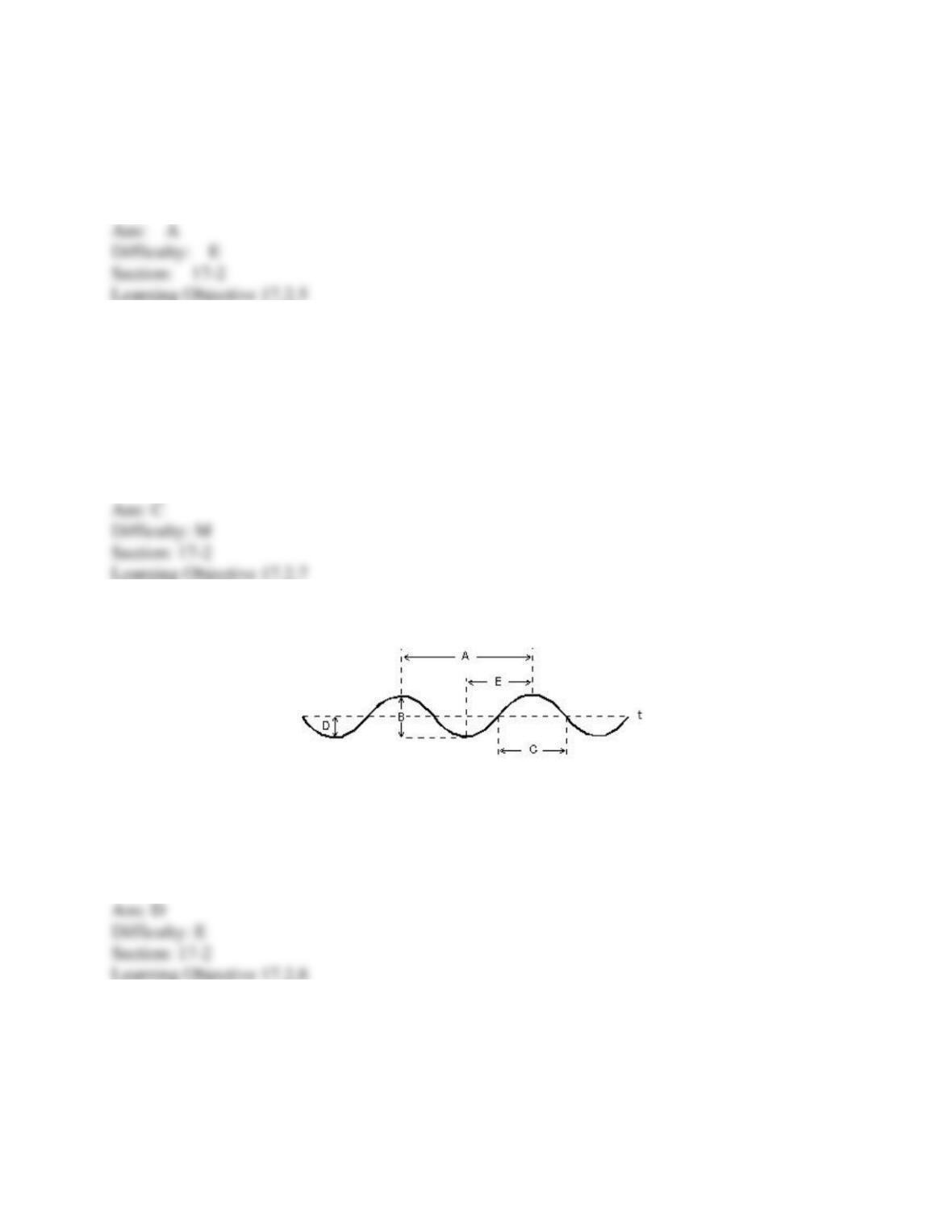
14. This graph shows the position of an element of air as a function of time as a sound wave
passes through it. Which letter corresponds to the amplitude of the wave?
A) A
B) B
C) C
D) D
E) E
15. This graph shows the position of an element of air as a function of time as a sound wave
passes through it. Which letter corresponds to the period of the wave?
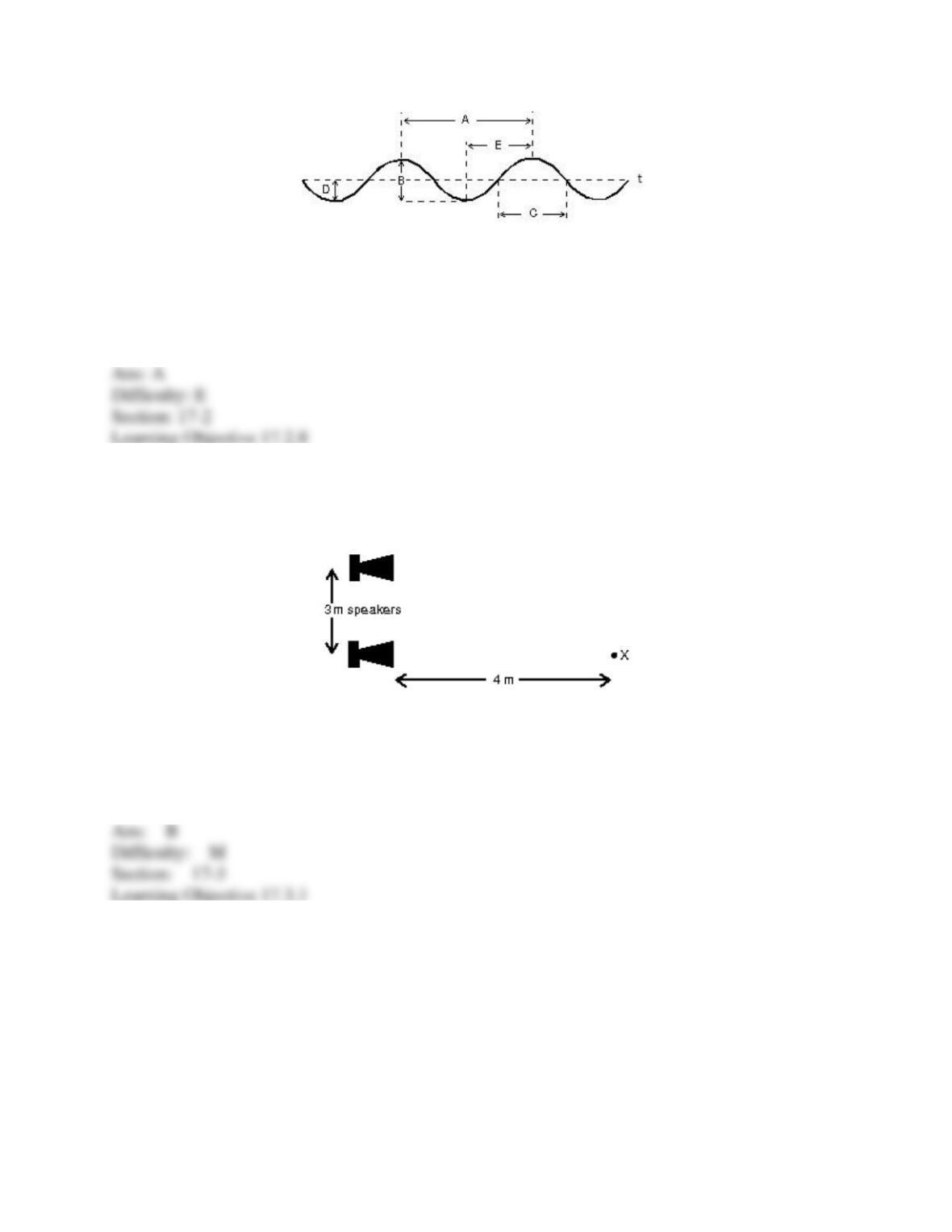
A) A
B) B
C) C
D) D
E) E
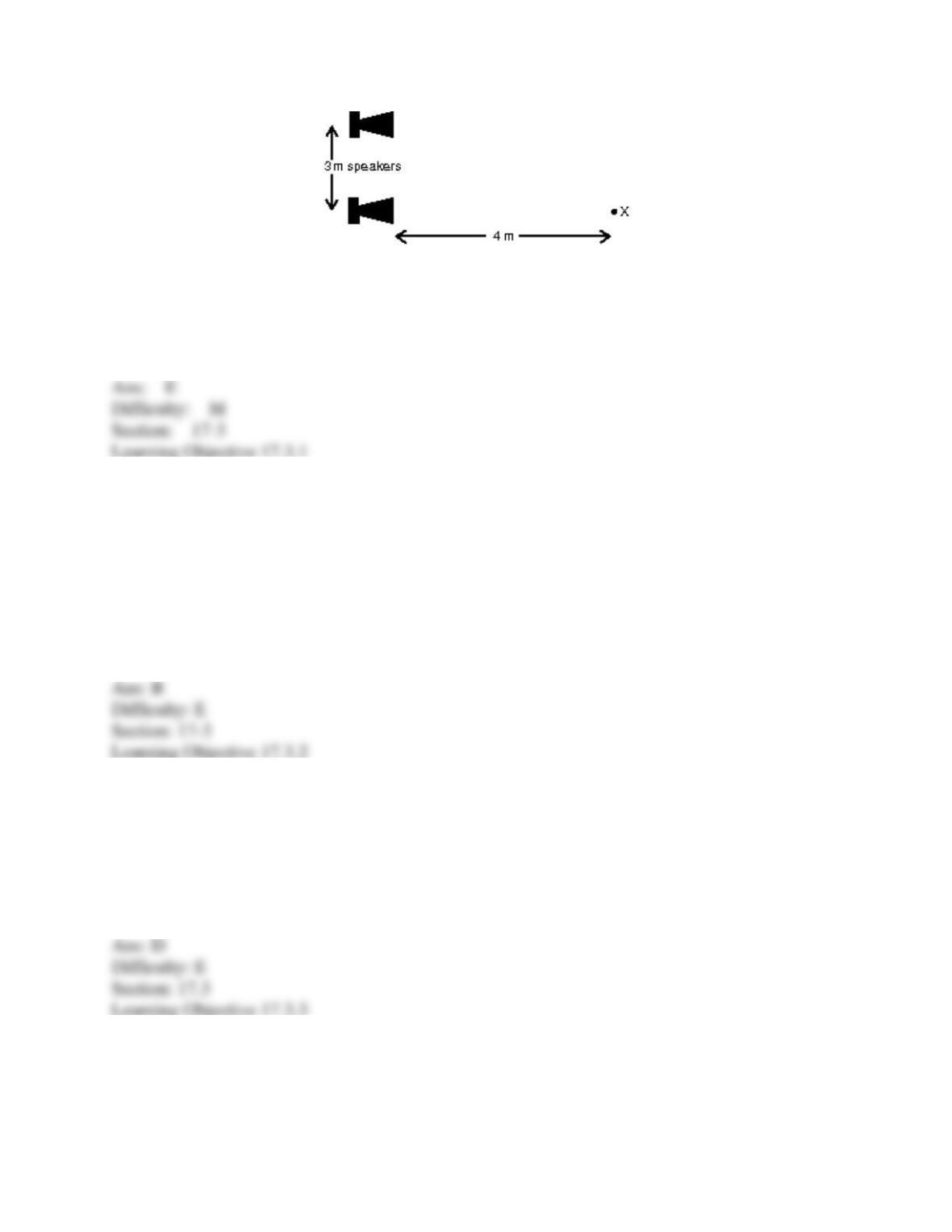
16. Two small identical speakers are connected (in phase) to the same source. The speakers are
3 m apart and at ear level. An observer stands at X, 4 m in front of one speaker as shown. If the
amplitudes are not changed, the sound he hears will be least intense if the wavelength is:
A) 1 m
B) 2 m
C) 3 m
D) 4 m
E) 5 m
17. Two small identical speakers are connected (in phase) to the same source. The speakers are
3 m apart and at ear level. An observer stands at X, 4 m in front of one speaker as shown. The
sound she hears will be most intense if the wavelength is:
A) 5 m
B) 4 m
C) 3 m
D) 2 m
E) 1 m
18. Two sound waves are traveling through the same medium. They have the same amplitude,
wavelength, and direction of travel. If the phase difference between them is 7π, the type of
interference they exhibit is:
A) fully constructive
B) fully destructive
C) indeterminate
D) partially constructive
E) partially destructive
19. Two waves are out of phase by half a wavelength. What is this in radians?
A) π/6
B) π/4
C) π/2
D) π
E) 3π/2
20. Two waves are out of phase by half a wavelength. What is this in degrees?
A) 45°
B) 90°

C) 135°
D) 180°
E) 360°
21. The standard reference sound level is about:
A) the threshold of human hearing at 1000 Hz
B) the threshold of pain for human hearing at 1000 Hz
C) the level of sound produced when the 1 kg standard mass is dropped 1 m onto a concrete
floor
D) the level of normal conversation
E) the level of sound emitted by a standard 60 Hz tuning fork
22. A microphone of surface area 2.0 cm2 absorbs 1.1 mW of sound. What is the intensity of
sound hitting the microphone?
A) 2.2 x 10⁻⁵ W/m2
B) 0.55 W/m2
C) 2.2 W/m2
D) 2.8 W/m2
E) 5.5 W/m2
23. The speed of sound in air is 340 m/s, and the density of air is 1.2 kg/m3. If the displacement
amplitude of a 440-Hz sound wave is 10 µm, what is the intensity of the wave?
A) 0.16 W/m2
B) 0.32 W/m2
C) 12 W/m2
D) 16 W/m2
E) 32 W/m2

24. Consider two imaginary spherical surfaces of different radius, both centered on a point
sound source emitting spherical waves. The power transmitted across the larger sphere is
________ the power transmitted across the smaller and the intensity at a point on the larger
sphere is ________ the intensity at a point on the smaller.
A) greater than, the same as
B) greater than, greater than
C) greater than, less than
D) the same as, less than
E) the same as, the same as
25. The sound intensity 5.0 m from point source is 0.50 W/m2. The power output of the source
is:
A) 12.5 W
B) 39 W
C) 79 W
D) 160 W
E) 260 W
26. The sound level at a point P is 14 db below the sound level at a point 1.0 m from a point
source. Assuming the intensity from a point source drops off like the inverse square of the
distance, the distance from the source to point P is:
A) 4.0 cm
B) 20 m
C) 2.0 m
D) 5.0 m
E) 25 m
27. The intensity of a certain sound wave is 6
W/cm2. If its intensity is raised by 10 decibels,
the new intensity is:

A) 60
W/cm2
B) 6.6
W/cm2
C) 6.06
W/cm2
D) 600
W/cm2
E) 12
W/cm2
28. If I0 = 10–12 W/m2, and I = 4.5 x 10⁻⁸ W/m2, what is log (I/I0)?
A) 4.5 x 10⁴
B) 18
C) 11
D) 4.7
E) 3.7
29. The intensity of sound wave A is 100 times that of sound wave B. Relative to wave B the
sound level of wave A is:
A) –2 db
B) +2 db
C) +10 db
D) +20 db
E) +100 db
30. If the sound level is increased by 10 db the intensity increases by a factor of:
A) 2
B) 5
C) 10
D) 20
E) 100

31. You are listening to an “A” note played on a violin string. Let the subscript “s” refer to the
violin string and “a” refer to the air. Then:
A) fs = fa but s a
B) fs = fa and s = a
C) s = a but fs fa
D) s a and fs fa
E) linear density of string = volume density of air
32. Two pipes are each open at one end and closed at the other. Pipe A has length L and pipe B
has length 2L. Which harmonic of pipe B matches in frequency the fundamental of pipe A?
A) The fundamental
B) The second
C) The third
D) The fourth
E) There are none
33. An organ pipe with one end open and the other closed is operating at one of its resonant
frequencies. The open and closed ends are respectively:
A) pressure node, pressure node
B) pressure node, displacement node
C) displacement antinode, pressure node
D) displacement node, displacement node
E) pressure antinode, pressure antinode
34. The “A” on a trumpet and a clarinet have the same pitch, but the two are clearly
distinguishable. Which property is most important in enabling one to distinguish between these
two instruments?
A) intensity
B) fundamental frequency