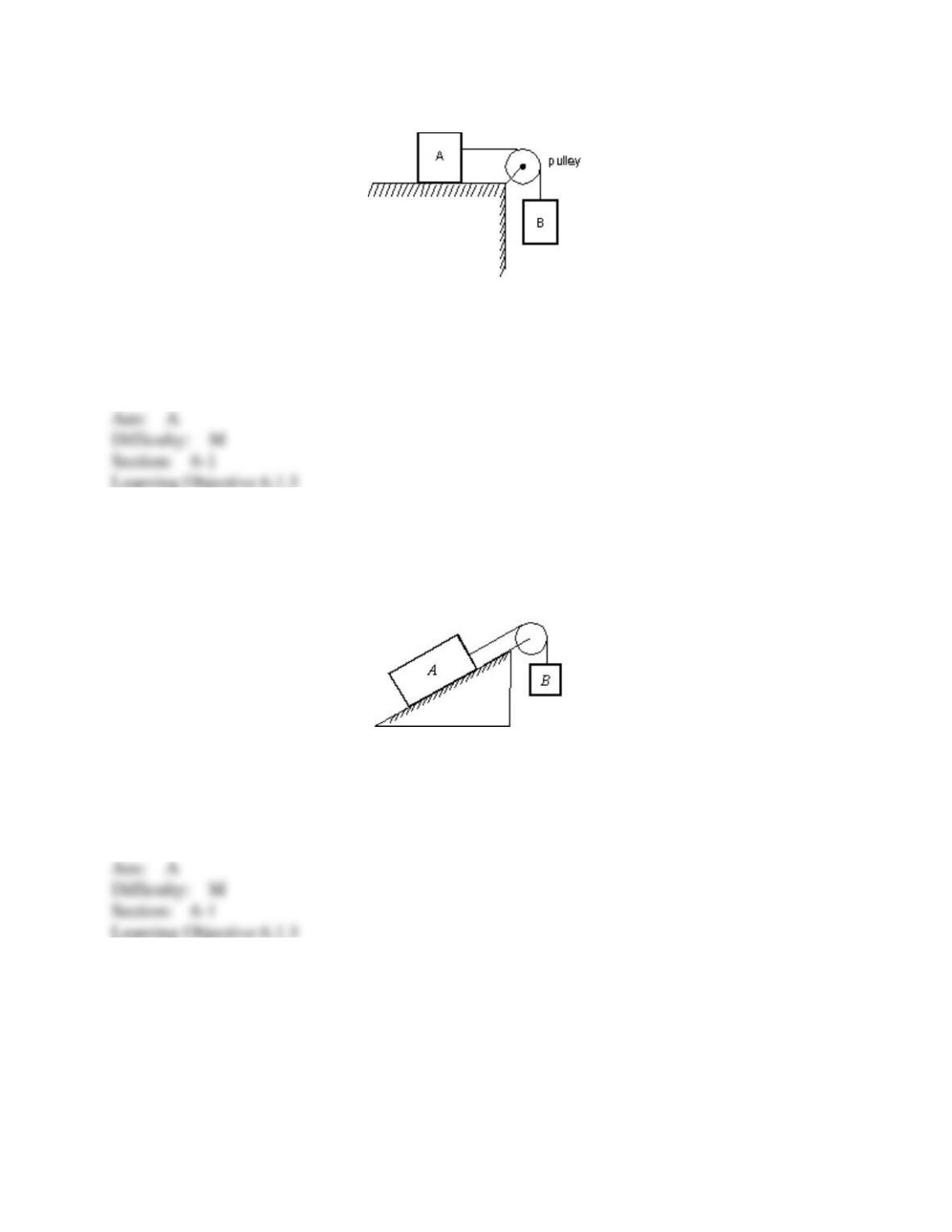
A) 20 kg
B) 30 kg
C) 40 kg
D) 50 kg
E) 70 kg
39. Block A, with a mass of 10 kg, rests on a 35 incline. The coefficient of static friction is
0.40. An attached string is parallel to the incline and passes over a massless, frictionless pulley at
the top. The largest mass mB, of block B, attached to the dangling end, for which A begins to
slide down the incline, is:
A) 2.5 kg
B) 3.5 kg
C) 5.9 kg
D) 9.0 kg
E) 10.5 kg
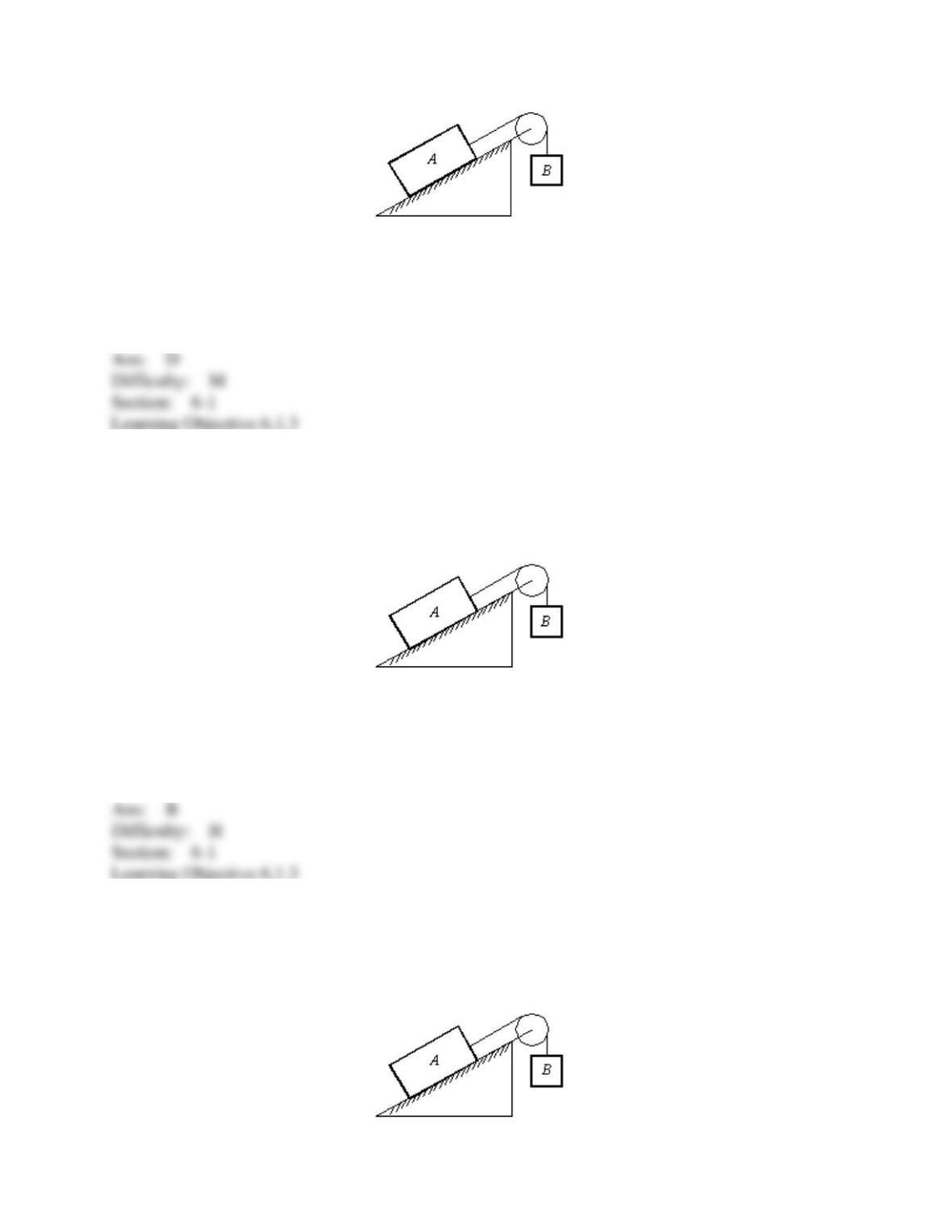
40. Block A, with a mass of 10 kg, rests on a 35 incline. The coefficient of static friction is
0.40. An attached string is parallel to the incline and passes over a massless, frictionless pulley at
the top. The largest mass mB, attached to the dangling end, for which A remains at rest is:
A) 2.5 kg
B) 3.5 kg
C) 5.9 kg
D) 9.0 kg
E) 10.5 kg
41. Block A, with a mass of 10 kg, rests on a 30 incline. The coefficient of kinetic friction is
0.20. The attached string is parallel to the incline and passes over a massless, frictionless pulley
at the top. Block B, with a mass of 8.0 kg, is attached to the dangling end of the string. The
acceleration of B is:
A) 0.69 m/s2, up
B) 0.69 m/s2, down
C) 2.6 m/s2, up
D) 2.6 m/s2, down
E) 0 m/s2
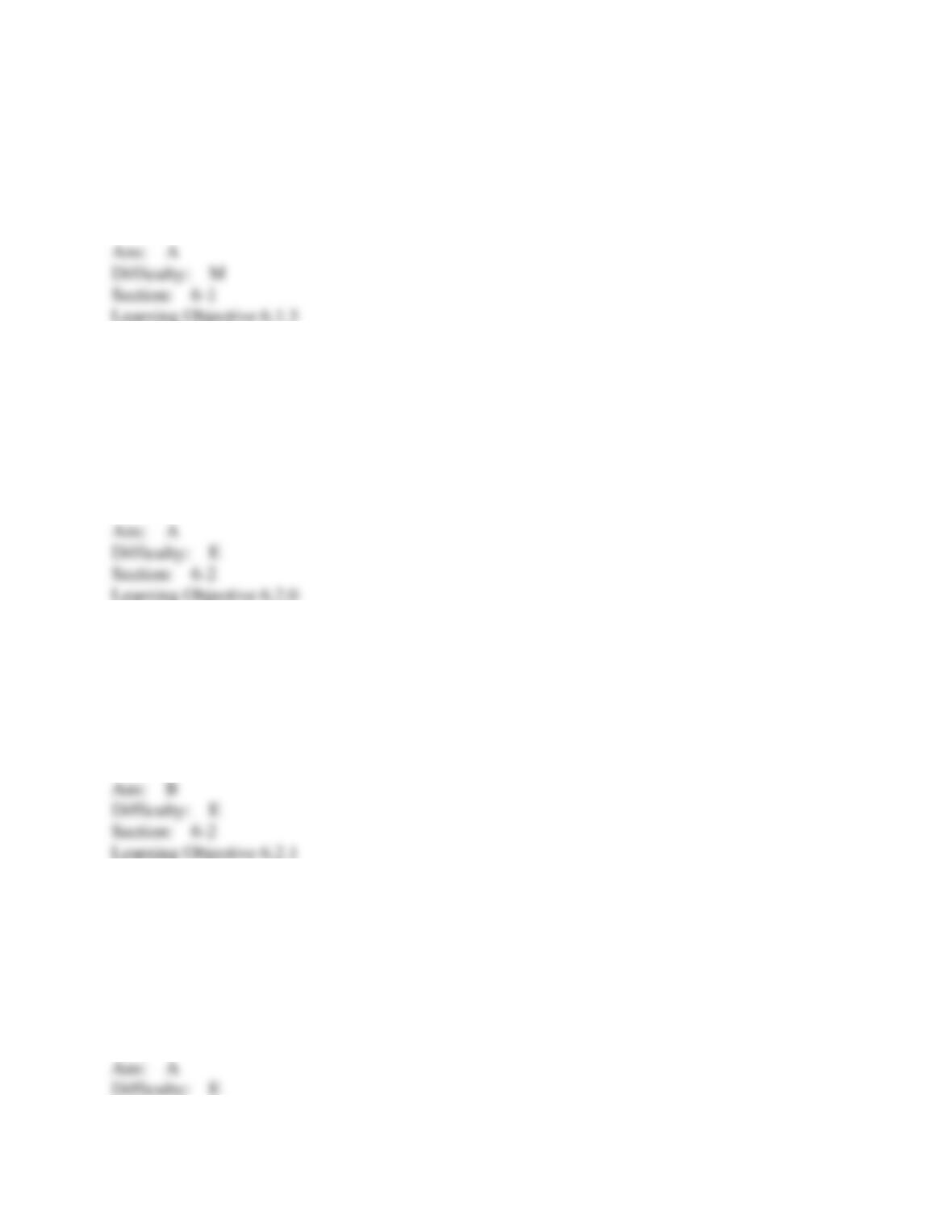
42. Block A, with a mass of 10 kg, rests on a 30 incline. The coefficient of kinetic friction is
0.20. The attached string is parallel to the incline and passes over a massless, frictionless pulley
at the top. Block B, with a mass of 3.0 kg, is attached to the dangling end of the string. The
acceleration of B is:
A) 0.20 m/s2, up
B) 0.20 m/s2, down
C) 2.8 m/s2, up
D) 2.8 m/s2, down
E) 0 m/s2
43. A 1000-kg airplane moves in straight flight at constant speed. The force of air friction is
1800 N. The net force on the plane is:
A) 0 N
B) 11600 N
C) 1800 N
D) 9800 N
E) none of these
44. Why do raindrops fall with constant speed during the later stages of their descent?
A) The gravitational force is the same for all drops
B) Air resistance just balances the force of gravity
C) The drops all fall from the same height
D) The force of gravity is negligible for objects as small as raindrops
E) Gravity cannot increase the speed of a falling object to more than 9.8 m/s
45. A ball of mass m is thrown downward from the edge of a cliff with an initial speed that is
three times the terminal speed. Initially the drag force on it is
A) upward and greater than mg
B) upward and less than mg
C) downward and greater than mg
D) downward and less than mg
E) downward and equal to mg
46. A ball is thrown upward into the air with a speed that is greater than terminal speed. On the
way up it slows down and, after its speed equals the terminal speed but before it gets to the top of
its trajectory:
A) its speed is constant
B) it continues to slow down
C) it speeds up
D) its motion becomes jerky
E) none of the above
47. A ball is thrown upward into the air with a speed that is greater than terminal speed. It
lands at the place where it was thrown. During its flight the force of air resistance is the greatest:
A) just after it is thrown
B) halfway up
C) at the top of its trajectory
D) halfway down
E) just before it lands
48. A cube has a drag coefficient of 0.8. What would be the terminal velocity of a sugar cube 1
cm on a side in air (ρ = 1.2 kg/m3)? Take the density of sugar to be 1.6 x 10³ kg/m3.
A) 1.4 m/s
B) 5 m/s
C) 18 m/s
D) 60 m/s
E) 320 m/s
49. A baseball has a terminal speed of 42 m/s in air (ρ = 1.2 kg/m3). What would be its terminal
speed in water (ρ = 1.0 x 10³ kg/m3)?
A) 0.05 m/s
B) 1.5 m/s
C) 18 m/s
D) 42 m/s
E) 1200 m/s
50. In uniform circular motion,
A) the acceleration always points away from the center of the circle.
B) the velocity always points towards the center of the circle.
C) the acceleration and the velocity are always parallel.
D) the acceleration and the velocity are always perpendicular.
E) there is no fixed relationship between the direction of the acceleration and the direction of the
velocity.
51. In uniform circular motion,
A) the acceleration is always constant in magnitude and direction.
B) the velocity is always constant in magnitude and direction.
C) both the acceleration and the velocity are continually changing direction.
D) the velocity is always changing direction but the acceleration is always in the same direction.
E) the net force is always constant in magnitude and direction.
52. Uniform circular motion is the direct consequence of:
A) Newton’s third law
B) a force that is always tangent to the path
C) an acceleration tangent to the path
D) a force of constant magnitude that is always directed away from the same fixed point
E) a force of constant magnitude that is always directed toward the same fixed point
53. An object moving in a circle at constant speed:
A) must have only one force acting on it
B) is not accelerating
C) is held to its path by centrifugal force
D) has an acceleration of constant magnitude
E) has an acceleration that is tangent to the circle
54. If a satellite moves above the Earth’s atmosphere in a circular orbit with constant speed,
then:
A) its acceleration and velocity are in the same direction
B) the net force on it is zero
C) its velocity is constant
D) it will fall back to Earth when its fuel is used up
E) its acceleration is toward the Earth
55. A coin is placed on a horizontal phonograph turntable. Let N be the normal force exerted
by the turntable on the coin, f be the frictional force exerted by the turntable on the coin, and fs,
max be the maximum force of the static friction. The speed of the turntable is increased in small
steps. If the coin does not slide, then
A) N increases, f increases, and fs, max stays the same
B) N increases, f increases, and fs, max increases
C) f increases and both N and fs, max stay the same
D) N, f, and fs, max all stay the same
E) N, f, and fs, max all increase
56. The driver of a 1000-kg car tries to turn through a circle of radius 100 m on an unbanked
curve at a speed of 10 m/s. The actual frictional force between the tires and a slippery road has
a magnitude of 900 N. The car:
A) slides into the inside of the curve
B) makes the turn
C) slows down due to the frictional force
D) will make the turn only if it goes faster
E) slides off to the outside of the curve
57. A car rounds a 75-m radius curve at a constant speed of 18 m/s. A ball is suspended by a
string from the ceiling the car and moves with the car. The angle between the string and the
vertical is:
A) 0°
B) 1.4°
C) 24°
D) 90°
E) cannot be found without knowing the mass of the ball
58. An object of mass m and another object of mass 2m are each forced to move along a circle
of radius 1.0 m at a constant speed of 1.0 m/s. The magnitudes of their accelerations are:
A) equal
B) in the ratio of √2 : 1
C) in the ratio of 2 : 1
D) in the ratio of 4 : 1
E) zero
59. The magnitude of the force required to cause an 0.04-kg object to move at 0.6 m/s in a
circle of radius 1.0 m is:
A) 2.4 10–2 N
B) 1.4 10–2 N
C) 1.4 10–2 N
D) 2.42 10–2 N
E) 3.13 N
60. A 0.2-kg stone is attached to a string and swung in a circle of radius 0.6 m on a horizontal
and frictionless surface. If the stone makes 150 revolutions per minute, the tension force of the
string on the stone is:
A) 0.03 N
B) 0.2 N
C) 0.75 N
D) 1.96 N
E) 30 N
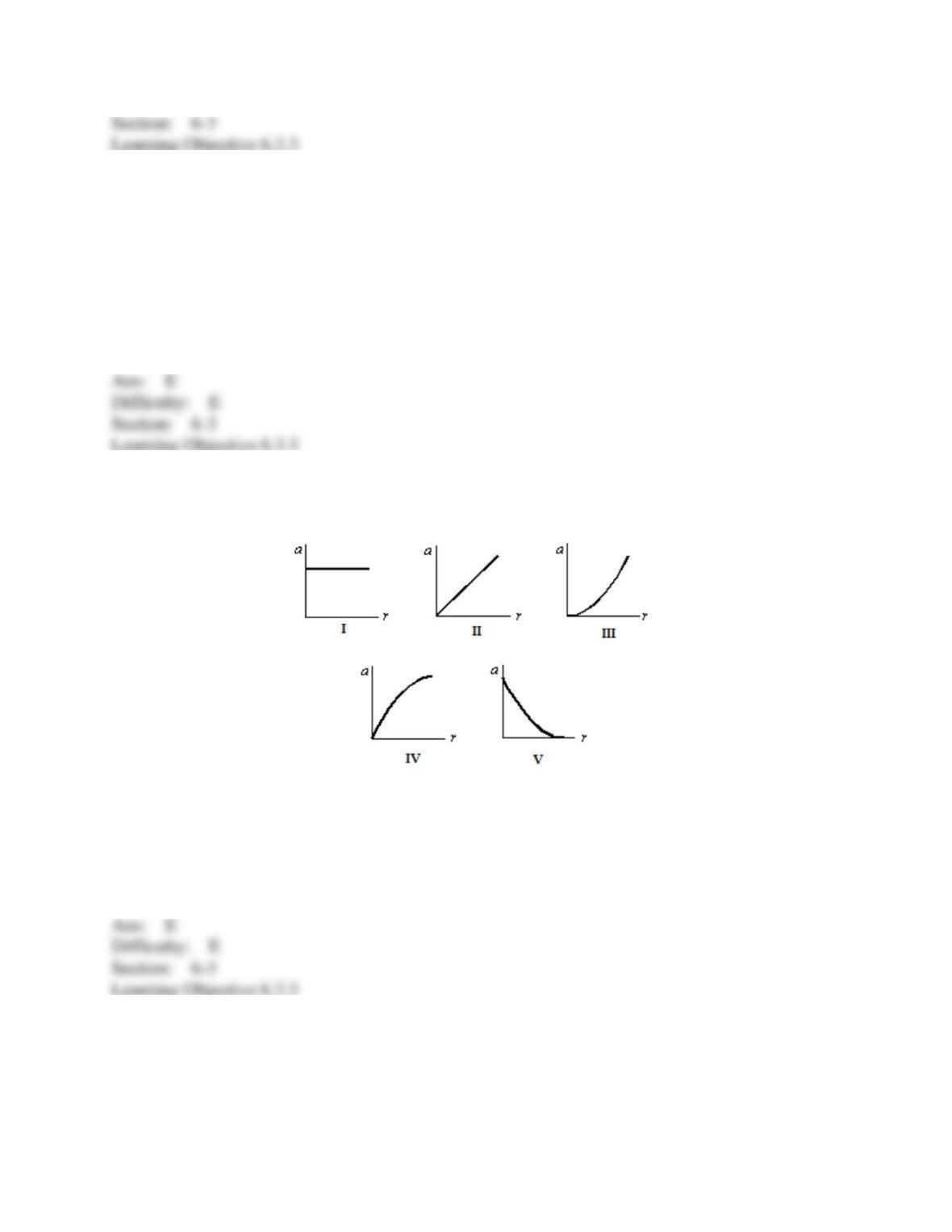
61. Which of the following five graphs is correct for a particle moving in a circle of radius r at
a constant speed of 10 m/s?
A) I
B) II
C) III
D) IV
E) V
62. An object moves around a circle. If the radius is doubled keeping the speed the same then
the magnitude of the centripetal force must be:
A) twice as great
B) half as great
C) four times as great
D) one-fourth as great
E) the same
63. An object moves in a circle. If the mass is tripled, the speed halved and the radius
unchanged then the magnitude of the centripetal force must be multiplied by a factor of:
A) 3/2
B) 3/4
C) 9/4
D) 6
E) 12
64. An 800-N passenger in a car presses against the car door with a 200 N force when the car
makes a left turn at 13 m/s. The (faulty) door will pop open under a force of 800 N. Of the
following, the least speed for which the man is thrown out of the car is:
A) 14 m/s
B) 19 m/s
C) 20 m/s
D) 26 m/s
E) 52 m/s
65. If a certain car, going with speed v1, rounds a level curve with a radius R1, it is just on the
verge of skidding. If its speed is now doubled, the radius of the tightest curve on the same road
that it can round without skidding is:
A) 2R1
B) 4R1
C) R1/2
D) R1/4
E) R1
66. An automobile moves on a level horizontal road in a circle of radius 30 m. The coefficient
of friction between tires and road is 0.50. The maximum speed with which this car can round this
curve is:
A) 3.0 m/s
B) 4.9 m/s
C) 9.8 m/s
D) 12 m/s
E) 147 m/s
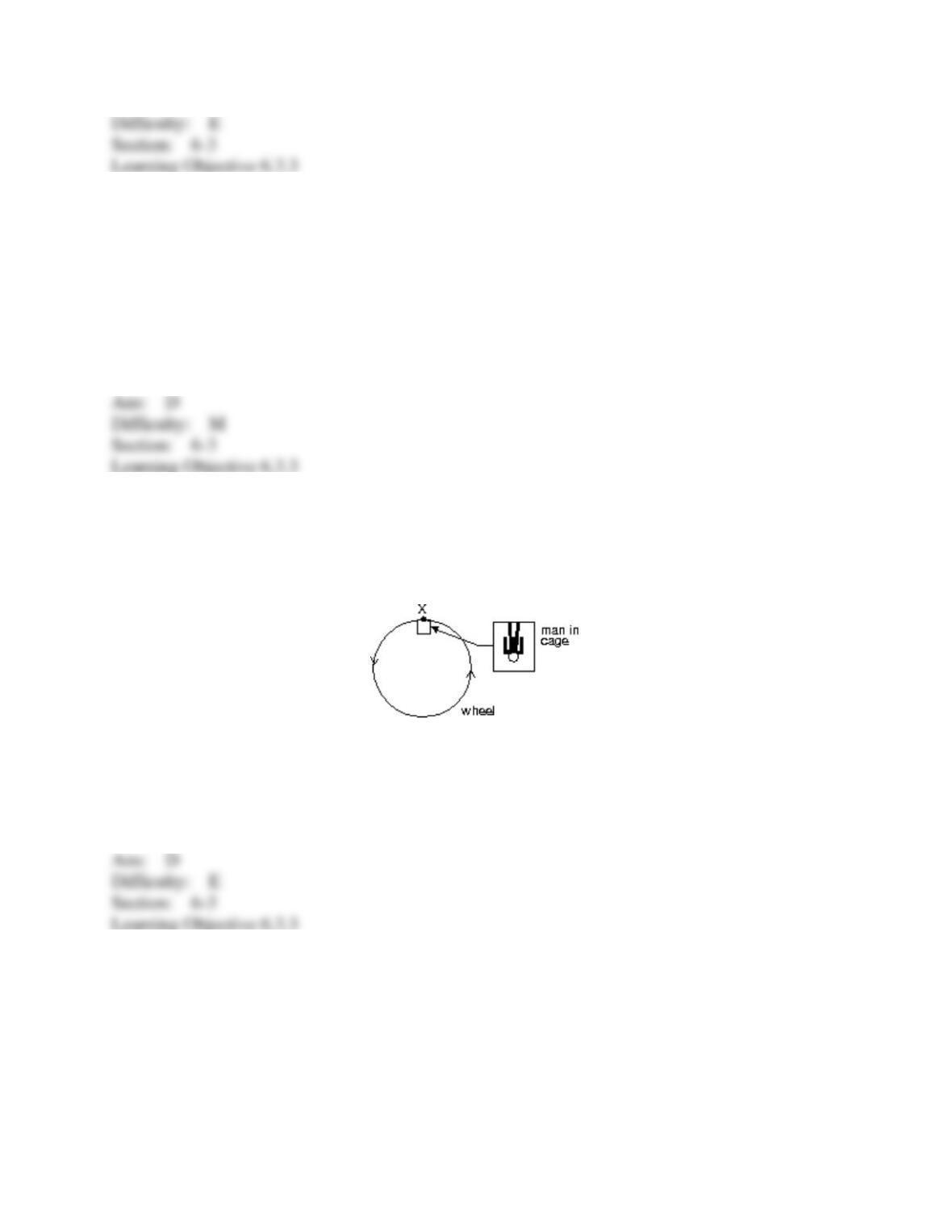
67. A giant wheel, having a diameter of 40 m, is fitted with a cage and platform on which a
man of mass m stands. The wheel is rotated in a vertical plane at such a speed that the force
exerted by the man on the platform is equal to his weight when the cage is at X, as shown. The
net force on the man at point X is:
A) 0
B) mg, down
C) mg, up
D) 2 mg, down
E) 2 mg, up
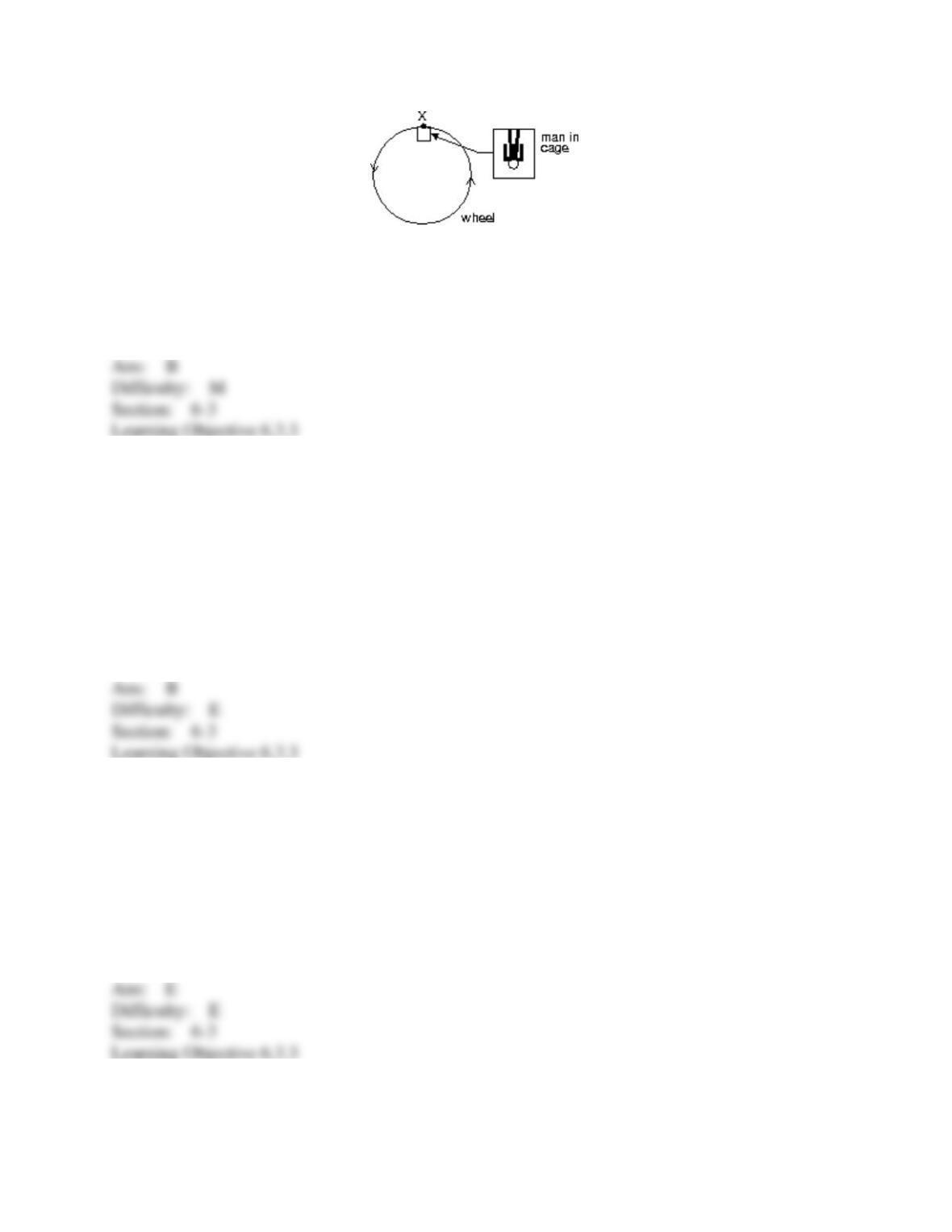
68. A giant wheel, 40 m in diameter, is fitted with a cage and platform on which a man can
stand. The wheel rotates at such a speed that when the cage is at X (as shown) the force exerted
by the man on the platform is equal to his weight. The speed of the man is:
A) 14 m/s
B) 20 m/s
C) 28 m/s
D) 80 m/s
E) 120 m/s
69. A person riding a Ferris wheel is strapped into her seat by a seat belt. The wheel is spun so
that the centripetal acceleration is g. Select the correct combination of forces that act on her
when she is at the top. Here, Fg = force of gravity, down; Fb = seat belt force, down; and Fs =
seat force, up.
A) Fg = 0, Fb = mg, Fs = 0
B) Fg = mg, Fb = 0, Fs = 0
C) Fg = 0, Fb = 0, Fs = mg
D) Fg = mg, Fb = mg, Fs = 0
E) Fg = mg, Fb = 0, Fs = mg
70. One end of a 1.0-m long string is fixed; the other end is attached to a 2.0-kg stone. The
stone swings in a vertical circle, passing the bottom point at 4.0 m/s. The tension force of the
string at this point is about:
A) 0 N
B) 12 N
C) 20 N
D) 32 N
E) 52 N
71. One end of a 1.0-m string is fixed; the other end is attached to a 2.0-kg stone. The stone
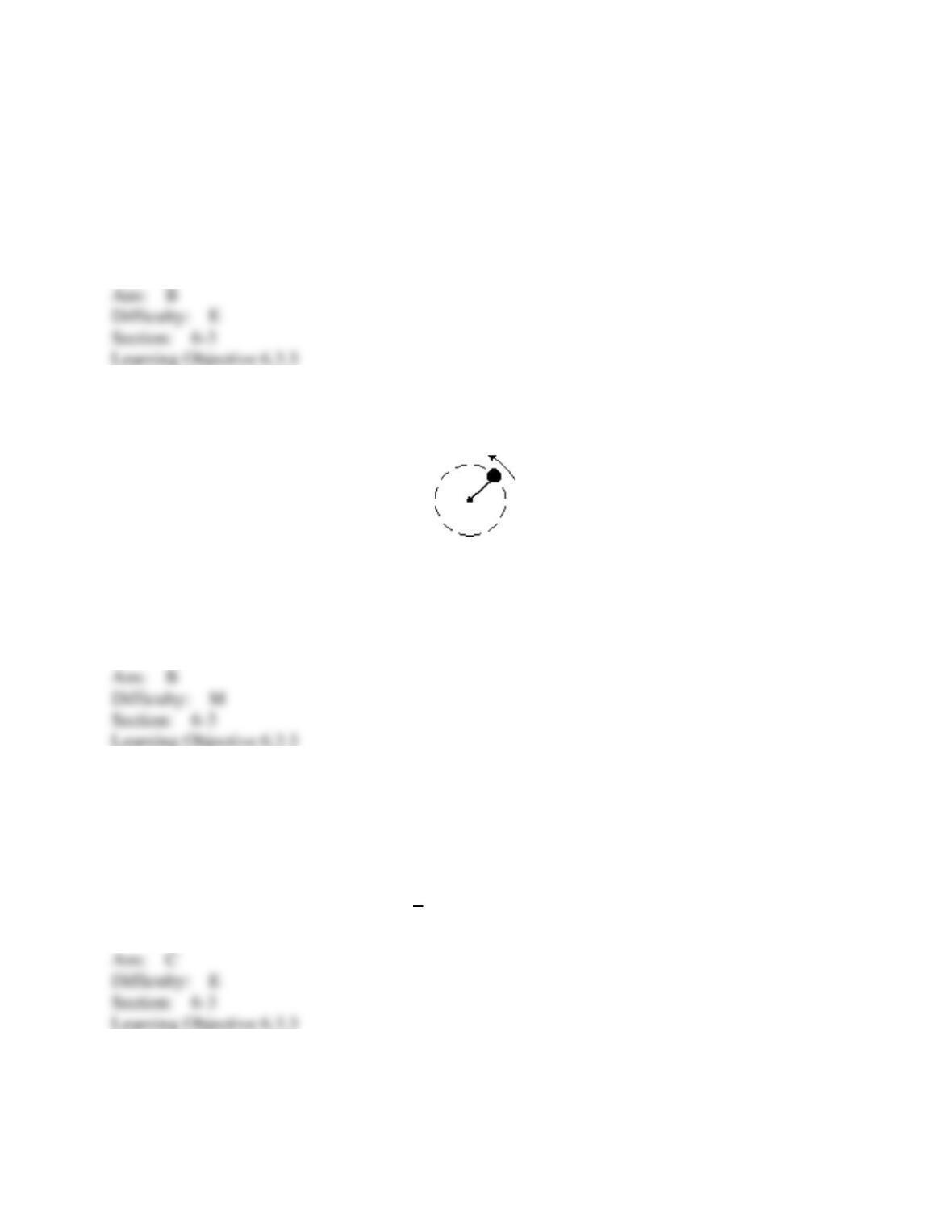
swings in a vertical circle, passing the top point at 4.0 m/s. The tension force of the string at this
point is about:
A) 0 N
B) 12 N
C) 20 N
D) 32 N
E) 52 N
72. The iron ball shown is being swung in a vertical circle at the end of a 0.7-m string. How
slowly can the ball go through its top position without having the string go slack?
A) 1.3 m/s
B) 2.6 m/s
C) 3.9 m/s
D) 6.9 m/s
E) 9.8 m/s
73. Circular freeway entrance and exit ramps are commonly banked to handle a car moving at
13 m/s. To design a similar ramp for 26 m/s one should:
A) increase the radius by a factor of 2
B) decrease the radius by a factor of 2
C) increase the radius by a factor of 4
D) decrease the radius by a factor of 4
E) increase the radius by a factor of √2
74. At what angle should the roadway on a curve with a 50m radius be banked to allow cars to
negotiate the curve at 12 m/s even if the roadway is icy (and the frictional force is zero)?
A) 0°
B) 16°
C) 17°
D) 35°
E) 73°