Chapter: Chapter 11
Learning Objectives
LO 11.1.0 Solve problems related to rolling as translation and rotation combined.
LO 11.1.1 Identify that smooth rolling can be considered as a combination of pure translation
and pure rotation.
LO 11.1.2 Apply the relationship between the center-of-mass speed and the angular speed of a
body in smooth rolling.
LO 11.2.0 Solve problems related to forces and kinetic energy of rolling
LO 11.2.1 Calculate the kinetic energy of a body in smooth rolling as the sum of the translational
kinetic energy of the center of mass and the rotational kinetic energy around the center of mass.
LO 11.2.2 Apply the relationship between the work done on a smoothly rolling object and the
change in its kinetic energy.
LO 11.2.3 For smooth rolling (and thus no sliding), conserve mechanical energy to relate initial
energy values to the values at a later point.
LO 11.2.4 Draw a free-body diagram of an accelerating body that is smoothly rolling on a
horizontal surface or up or down a ramp.
LO 11.2.5 Apply the relationship between the center-of-mass acceleration and the angular
acceleration.
LO 11.2.6 For smooth rolling of an object up or down a ramp, apply the relationship between the
object’s acceleration, its rotational inertia, and the angle of the ramp.
LO 11.3.0 Solve problems related to the yo-yo.
LO 11.3.1 Draw a free-body diagram of a yo-yo moving up or down its string.
LO 11.3.2 Calculate the acceleration of a yo-yo moving up or down its string.
LO 11.4.0 Solve problems related to torque revisited.
LO 11.4.1 Identify that torque is a vector quantity.
LO 11.4.2 Identify that the point about which a torque is calculated must always be specified.
LO 11.4.3 Calculate the torque due to a force on a particle by taking the cross product of the
particle’s position vector and the force vector, in either unit-vector notation or magnitude-angle
notation.
LO 11.4.4 Use the right-hand rule for cross products to find the direction of a torque vector.
LO 11.5.0 Solve problems related to angular momentum.
LO 11.5.1 Identify that angular momentum is a vector quantity.
LO 11.5.2 Identify that the fixed point about which an angular momentum is calculated must
always be specified.
LO 11.5.3 Use the right-hand rule for cross products to find the direction of an angular
momentum vector.
LO 11.6.0 Solve problems related to Newton’s second law in angular form.
LO 11.6.1 Apply Newton’s second law in angular form to relate the torque acting on a particle
to the resulting rate of change of the particle’s angular momentum, all relative to a specified axis.
LO 11.7.0 Solve problems related to angular momentum of a rigid body.
LO 11.7.1 For a system of particles, apply Newton’s second law in angular form to relate the
net torque acting on the system to the rate of the resulting change in the system’s angular
momentum.
LO 11.7.2 Apply the relationship between the angular momentum of a rigid body rotating
around a fixed axis and the body’s rotational inertia and angular speed around that axis.
LO 11.7.3 If two rigid bodies rotate about the same axis, calculate their total angular
momentum.
LO 11.8.0 Solve problems related to conservation of angular momentum.
LO 11.8.1 When no external net torque acts on a system along a specified axis, apply the
conservation of angular momentum to relate the initial angular momentum value along that axis
to the value at a later instant.
LO 11.9.0 Solve problems related to precession of a gyroscope.
LO 11.9.1 Identify that the gravitational force acting on a spinning gyroscope causes the spin
angular momentum vector (and thus the gyroscope) to rotate about the vertical axis in a motion
called precession.
LO 11.9.2 Calculate the precession rate.
LO 11.9.3 Identify that a gyroscope’s precession rate is independent of the gyroscope’s mass.
Multiple Choice
1. When a wheel rolls without slipping,
A) its motion is purely translational.
B) its motion is purely rotational.
C) whether its motion is purely rotational or purely translational depends on whether it is rolling
up or downhill.
D) its motion is a combination of rotational and translational motion.
E) every point on its rim has the same linear velocity.
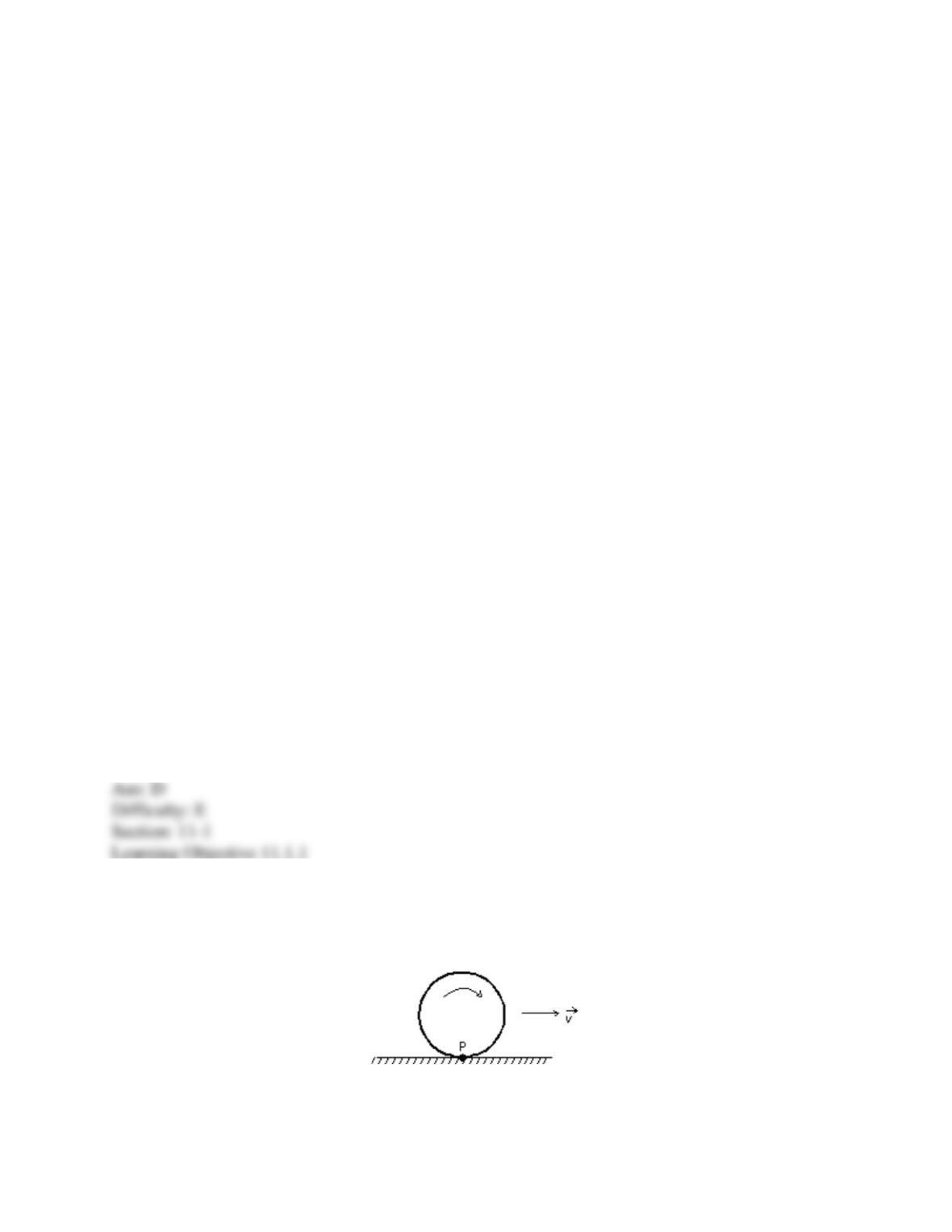
2. A wheel rolls without slipping along a horizontal road as shown. The velocity of the center
of the wheel is represented by 𝒗
⃗
⃗
. Point P is painted on the rim of the wheel. The direction of the
instantaneous velocity of point P is:
A) →
B)
C)
D)
E) zero
3. A wheel of radius 0.5 m rolls without sliding on a horizontal surface as shown. Starting from
rest, the wheel moves with constant angular acceleration 6 rad/s2. The distance in traveled by the
center of the wheel from t = 0 to t = 3 s is:
A) 0 m
B) 27 m
C) 13.5 m
D) 18 m
E) none of these
4. Two wheels roll side-by-side without sliding, at the same speed. The radius of wheel 2 is
twice the radius of wheel 1. The angular velocity of wheel 2 is:
A) twice the angular velocity of wheel 1
B) the same as the angular velocity of wheel 1
C) half the angular velocity of wheel 1
D) more than twice the angular velocity of wheel 1
E) less than half the angular velocity of wheel 1
5. A thin-walled hollow tube rolls without sliding along the floor. The ratio of its translational
kinetic energy to its rotational kinetic energy (about an axis through its center of mass) is:
A) 1
B) 2
C) 3
D) 1/2
E) 1/3
6. A forward force acting on the axle accelerates a rolling wheel on a horizontal surface. If the
wheel does not slide the frictional force of the surface on the wheel is:
A) zero
B) in the forward direction and does zero work on the wheel
C) in the forward direction and does positive work on the wheel
D) in the backward direction and does zero work on the wheel
E) in the backward direction and does positive work on the wheel
7. When the speed of a rear-drive car is increasing on a horizontal road the direction of the
frictional force on the tires is:
A) forward for all tires
B) backward for all tires
C) forward for the front tires and backward for the rear tires
D) backward for the front tires and forward for the rear tires
E) zero
8. A solid sphere and a solid cylinder of equal mass and radius are simultaneously released
from rest on the same inclined plane sliding down the incline. Then:
A) the sphere reaches the bottom first because it has the greater inertia
B) the cylinder reaches the bottom first because it picks up more rotational energy
C) the sphere reaches the bottom first because it picks up more rotational energy
D) they reach the bottom together
E) none of the above is true
9. A hoop rolls with constant velocity and without sliding along level ground. Its rotational
kinetic energy is:
A) half its translational kinetic energy
B) the same as its translational kinetic energy
C) twice its translational kinetic energy
D) four times its translational kinetic energy
E) one-third its translational kinetic energy
10. When we apply the energy conversation principle to a cylinder rolling down an incline
without sliding, we exclude the work done by friction because:
A) there is no friction present
B) the angular velocity of the center of mass about the point of contact is zero
C) the coefficient of kinetic friction is zero
D) the linear velocity of the point of contact (relative to the inclined surface) is zero
E) the coefficient of static and kinetic friction are equal
11. Two uniform cylinders have different masses and different rotational inertias. They
simultaneously start from rest at the top of an inclined plane and roll without sliding down the
plane. The cylinder that gets to the bottom first is:
A) the one with the larger mass
B) the one with the smaller mass
C) the one with the larger rotational inertia
D) the one with the smaller rotational inertia
E) neither (they arrive together)
12. A 5.0-kg ball rolls without sliding from rest down an inclined plane. A 4.0-kg block,
mounted on roller bearings totaling 100 g, rolls from rest down the same plane. At the bottom,
the block has:
A) greater speed than the ball
B) less speed than the ball
C) the same speed as the ball
D) greater or less speed than the ball, depending on the angle of inclination
E) greater or less speed than the ball, depending on the radius of the ball
13. A hoop (I = MR2) of mass 2.0 kg and radius 0.50 m is rolling at a center-of-mass speed of 15
m/s. An external force does 750 J of work on the hoop. What is the new speed of the center of
mass of the hoop?
A) 19 m/s
B) 22 m/s
C) 24 m/s
D) 27 m/s
E) 68 m/s
14. A hoop, a uniform disk, and a uniform sphere, all with the same mass and outer radius, start
with the same speed and roll without sliding up identical inclines. Rank the objects according to
how high they go, least to greatest.
A) hoop, disk, sphere
B) disk, hoop, sphere
C) sphere, hoop, disk
D) sphere, disk, hoop
E) hoop, sphere, disk
15. Two identical disks, with rotational inertia I (= 1/2 MR2), roll without slipping across a
horizontal floor and then up inclines. Disk A rolls up its incline without sliding. On the other
hand, disk B rolls up a frictionless incline. Otherwise the inclines are identical. Disk A reaches a
height 12 cm above the floor before rolling down again. Disk B reaches a height above the floor
of:
A) 24 cm
B) 18 cm
C) 12 cm
D) 8 cm
E) 6 cm
16. A cylinder of radius R = 6.0 cm is on a rough horizontal surface. The coefficient of kinetic
friction between the cylinder and the surface is 0.30 and the rotational inertia for rotation about
the axis is given by MR2/2, where M is its mass. Initially it is not rotating but its center of mass
has a speed of 7.0 m/s. After 2.0 s the speed of its center of mass and its angular velocity about
its center of mass, respectively, are:
A) 1.1 m/s, 0
B) 1.1 m/s, 19 rad/s
C) 1.1 m/s, 98 rad/s
D) 4.7 m/s, 78 rad/s
E) 5.9 m/s, 98 rad/s
17. A solid wheel with mass M, radius R, and rotational inertia MR2/2, rolls without sliding on
a horizontal surface. A horizontal force F is applied to the axle and the center of mass has an
acceleration a. The magnitudes of the applied force F and the frictional force f of the surface,
respectively, are:
A) F = Ma, f = 0
B) F = Ma, f = Ma/2
C) F = 2Ma, f = Ma
D) F = 2Ma, f = Ma/2
E) F = 3Ma/2, f = Ma/2
18. The coefficient of static friction between a certain cylinder and a horizontal floor is 0.40. If
the rotational inertia of the cylinder about its symmetry axis is given by I = (1/2)MR2, then the
maximum acceleration the cylinder can have without sliding is:
A) 0.1 g
B) 0.2 g
C) 0.4 g
D) 0.8 g
E) 1.0 g
19. A solid sphere starts from rest and rolls down a slope that is 5.1 m long. If its speed at the
bottom of the slope is 4.3 m/s, what is the angle of the slope?
A) 10°
B) 15°
C) 20°
D) 30°
E) cannot be calculated without knowing the mass and radius of the sphere
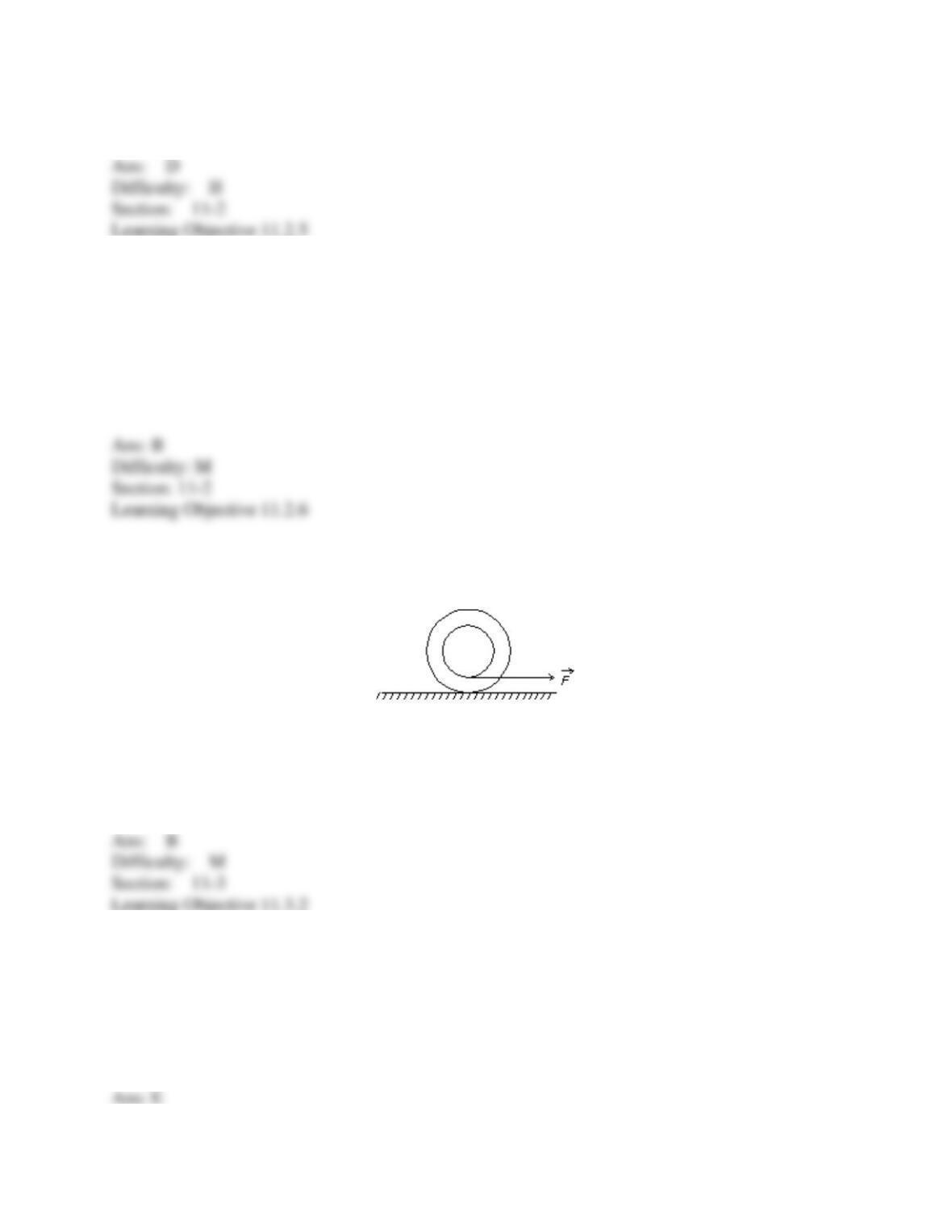
20. A yo-yo, arranged as shown, rests on a frictionless surface. When a force 𝐹
is applied to
the string as shown, the yo-yo:
A) moves to the left and rotates counterclockwise
B) moves to the right and rotates counterclockwise
C) moves to the left and rotates clockwise
D) moves to the right and rotates clockwise
E) moves to the right and does not rotate
21. Which of the following is a vector quantity?
A) angular speed
B) rotational inertia
C) rotational kinetic energy
D) mass
E) torque
22. A particle moves along the x axis. In order to calculate the torque on the particle, you need to
know:
A) the velocity of the particle
B) the rotational inertia of the particle
C) the point about which the torque is to be calculated
D) the kinetic energy of the particle
E) the mass of the particle
23. A particle is located on the x axis at x = 2.0 m from the origin. A force of 25 N, directed 30°
above the x axis in the x–y plane, acts on the particle. What is the torque about the origin on the
particle?
A) 50 N∙m, in the positive z direction
B) 25 N∙m, in the positive z direction
C) 50 N∙m, in the negative z direction
D) 25 N∙m, in the negative z direction
E) There is no torque about the origin.
24. A force
F
= 4.2 N 𝑖̂ + 3.7 N 𝑗̂ + 1.2 N 𝑘
̂ acts on a particle located at x = 3.3 m. What is
the torque on the particle around the origin?
A) 14 N∙m 𝑖̂
B) –4.0 N∙m 𝑗̂ + 12 N∙m 𝑘
̂
C) 12 N∙m 𝑘
̂
D) 14 N∙m 𝑖̂ – 4.0 N∙m 𝑗̂ + 12 N∙m 𝑘
̂
E) cannot be calculated without knowing the mass of the particle
25. A single force acts on a particle situated on the positive x axis. The torque about the origin
is in the negative z direction. The force might be:
A) in the positive y direction
B) in the negative y direction
C) in the positive x direction
D) in the negative x direction
E) in the positive z direction
26. The fundamental dimensions of angular momentum are:
A) mass·length·time–1
B) mass·length–2·time–2
C) mass2·time–1
D) mass·length2·time–2
E) none of these
27. Possible units of angular momentum are:
A) kgm/s
B) kgm2/s2
C) kgm/s2
D) kgm2/s
E) none of these
28. The unit kgm2/s can be used for:
A) angular momentum
B) rotational kinetic energy
C) rotational inertia
D) torque
E) power
29. The newtonsecond is a unit of:
A) work
B) angular momentum
C) power
D) linear momentum
E) none of these
30. A 2.0-kg block travels around a 0.50-m radius circle with an angular velocity of 12 rad/s.
The magnitude of its angular momentum about the center of the circle is:
A) 6.0 kg∙m2/s
B) 12 kg∙m2/s
C) 48 kg∙m2/s
D) 72 kg∙m2/s
E) 576 kg∙m2/s
31. Which of the following is NOT a vector?
A) linear momentum
B) angular momentum
C) rotational inertia
D) torque
E) angular velocity
32. A particle moves along the x axis. In order to calculate the angular momentum of the particle,
you need to know:
A) the size of the particle
B) the rotational inertia of the particle
C) the point about which the angular momentum is to be calculated
D) the kinetic energy of the particle
E) the acceleration of the particle
33. The angular momentum vector of Earth, due to its daily rotation, is directed:
A) tangent to the equator toward the east
B) tangent to the equator toward the west
C) north
D) south
E) toward the sun
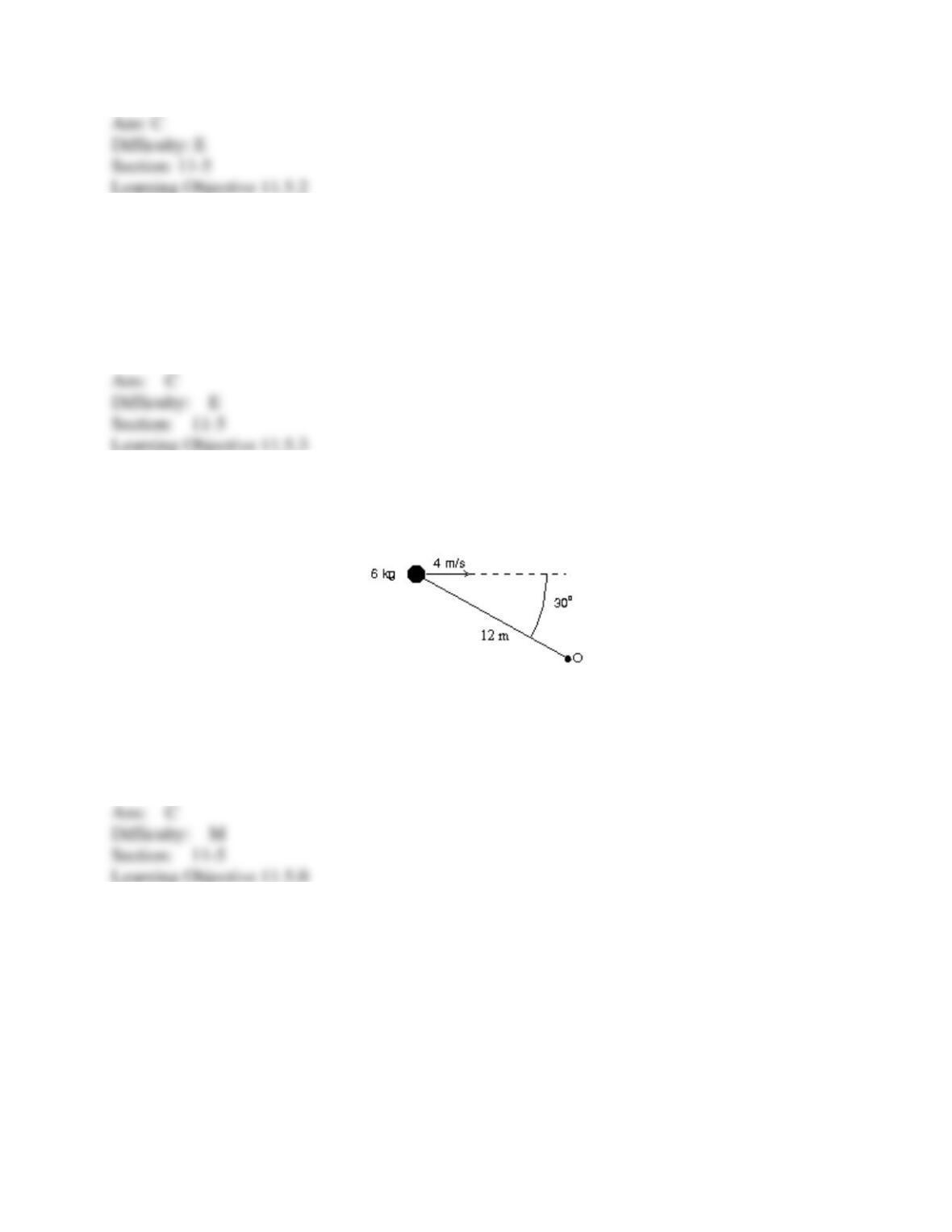
34. A 6.0-kg particle moves to the right at 4.0 m/s as shown. The magnitude of its angular
momentum about the point O is:
A) 0 kg∙m2/s
B) 288 kg∙m2/s
C) 144 kg∙m2/s
D) 24 kg∙m2/s
E) 249 kg∙m2/s
35. A 2.0-kg block starts from rest on the positive x axis 3.0 m from the origin and thereafter
has an acceleration given by 𝑎 = 4.0𝑖̂ − 3.0𝑗̂ in m/s2. At the end of 2.0 s its angular momentum
about the origin is:
A) 0 kg∙m2/s
B) (–36 kg∙m2/s)𝑘
̂
C) (+48 kg∙m2/s) 𝑘
̂
D) (–96 kg∙m2/s) 𝑘
̂
E) (+96 kg∙m2/s) 𝑘
̂